August 2025

Matthew 18:19-20

Praying Together with the Son

Again, amen, I say to you, if two of you agree on earth about anything for which they are to pray, it shall be granted to them by my heavenly Father. For where two or three are gathered together in my name, there am I in the midst of them.

Reflection:

This is a bold and awe-inspiring promise from our Lord. This passage reveals Jesus’ desire that we pray with others, uniting our prayer as one and offering it to the Father. Jesus says that when we do this in union with His prayer, our prayer will be answered.

The first thing to note is that this passage could easily be misunderstood. For example, is Jesus telling us that if two or more people get together and pray that it rains, then it will happen? Certainly not. The key to understanding this passage is found in the last line: “…there am I in the midst of them.” This means that the goal of gathering together with two or more people in prayer is to unite our unified prayer to the prayer of Jesus. The Father always hears and answers the prayer of the Son. No matter what the Son asks the Father, it is granted. Thus, this passage tells us that the goal of gathering together in prayer with others, that is, with the Church, is to unite ourselves with the one and eternal prayer of God the Son. This is first and foremost fulfilled within the Sacred Liturgy. 

When we come together in the Liturgy, our prayer is always heard. Why? Because the Liturgy is first an action of God the Son in which He invites us, the Church, to share. And the prayer that is offered is the one and eternal prayer by which God the Son asks the Father to bring salvation to all those who accept the saving action of His sacrifice on the Cross. When we join in this prayer, it is granted.

What type of prayer is not answered? First, God does not grant that which fails to serve His mission. Second, if we pray for God’s will but fail to do our part, then our prayer cannot be answered. For example, if you pray that you overcome a particular sin but then fail to respond to the grace God gives, then this is not the fault of God. Third, praying for vengeance on those who have hurt us is ineffective. And fourth, praying for the conversion of one who refuses to repent will also be unable to be fulfilled, unless they ultimately repent. These are but a few examples.

What type of prayer is effective? As already mentioned, the prayer of the Liturgy as the one Sacrifice of Christ is always heard when we participate in it. But there are other ways that our united prayer will be fulfilled with certainty. For example, if you gather with others and together pray for the grace of deeper conversion, you can be certain that the grace will be offered. It is then up to you to open your heart to that grace so that it is effective. Or if you pray that God offers His mercy to someone caught in sin, you can be certain that that grace will be offered, even if the person refuses to accept it. And the list could go on. Simply put, if we gather with others and seek to unite our prayer to the one and perfect prayer of God the Son as it is offered to the Father in Heaven, then that prayer of the Son in which we share will be answered. Perhaps the best way to pray together in this way is to pray the “Our Father” prayer with another. This prayer is always heard and answered by the Father since it is the prayer given to us by the Son.

Reflect, today, upon God the Son praying to the Father. What is His perfect prayer? What does He ask the Father? Look for ways in which you can join with others to unite your own prayer to this prayer of the Son of God. Do this first and foremost in the Sacred Liturgy, but look for other ways in which you can practice this form of prayer. Praying together with others in union with the one prayer of Jesus will always be answered by the Father in Heaven. 

Source: https://catholic-daily-reflections.com/2025/08/12/praying-together-with-the-son-4/

Matthew 18:19-20 Read More »

Saint Jane Frances de Chantal, Religious

1572–1641; Patron Saint of forgotten people, parents separated from their children, and widows; Invoked against in-law problems; Canonized by Pope Clement XIII in 1767

Saint Jane Frances de Chantal, born Jeanne-Françoise Frémiot in Dijon, France, was born into an influential and noble family. Her father held the position of President of the Parliament of Burgundy. Tragically, Jane lost her mother at the tender age of eighteen months, an event that profoundly impacted her early life. Despite this hardship, her deeply religious father ensured that Jane and her siblings received an excellent education and were raised as devout Catholics. Jane was recognized for her intelligence and piety from an early age, and her beauty, faith, strong moral character, and personal virtues were widely acknowledged. Her brother pursued a religious life, becoming first a priest, and later the Archbishop of Bourges.

When Jane was twenty, she married Baron Christophe de Rabutin, also known as Baron de Chantal. His baronial title, signifying high noble rank, was either bestowed upon him by the king or inherited, bringing with it a set of rights and responsibilities. Christophe and Jane resided in the feudal Castle of Bourbilly, which served as the administrative, military, and governing center of the town. As a baron, Christophe was tasked with managing lands, governing, collecting taxes, and providing military support to the king when needed. The castle not only served as their family residence but was also home to numerous servants and administrative staff. Prior to his marriage to Jane, the baron lived a disorderly life, leading to disorder among the castle staff. As the new baroness, Jane’s refined and orderly life led her to quickly restore order, to the delight of all the staff. She even brought back the practice of daily Mass at the castle. The baron and baroness had seven children together, but the first three did not survive infancy. One boy and three girls did survive.

In fulfilling his baronial duties, Christophe was frequently summoned by the king for administrative and military tasks, often requiring him to be away from home. During his absence, Jane maintained a custom of dressing very modestly, a habit viewed by some as unsuitable for nobility. When confronted, Jane would typically reply, “The eyes of the one whom I aim to please are very far away.” Her modesty and purity of heart prevailed.

Eight years into their marriage, when Jane was twenty-eight, her husband was accidentally shot in the leg by his friend while hunting. Nine days later, due to the inadequate medical care of the time, he succumbed to his wound, leaving Jane a widow. She and her four children spent the next year living with her father in Dijon. As her marriage had constituted her life, Jane needed to discern God’s will for her future while caring for her children. After consistently praying for a holy spiritual director, Jane had a vision of a saintly priest whom she did not recognize. She understood this figure to be God’s chosen spiritual director for her; she simply had to await their meeting. On another occasion, while praying, she visualized herself traveling through a forest in a futile search for a church. Reflecting upon this image, she understood that she had an arduous journey ahead, one that would purify her soul from self-love and lead her to serve Christ selflessly.

After a year with her father, Jane and her children moved into an old castle with her widowed father-in-law, helping manage his household. Despite her father-in-law’s coarse character, she treated him with kindness and respect.

In 1604, Jane’s father invited her to Dijon to attend a Lenten mission to be preached by the renowned Bishop of Geneva, Francis de Sales. Upon arriving at the mission, she immediately recognized the holy bishop, not from a previous meeting, but as the priest from her vision whom God revealed would be her spiritual director. After the mission, Bishop de Sales agreed to serve in that role. As her spiritual director, Bishop de Sales’ primary duty was to assist Jane in ordering her soul. He helped her address scruples, focused her prayer life, and reminded her of her responsibilities to her children, father, and father-in-law.

Over the next six years, Jane maintained regular correspondence with Bishop de Sales through letters and, when possible, in person. This fostered a deep mutual respect and a holy bond of spiritual friendship. Jane split her time caring for her father in Dijon and her father-in-law in Monthelon. After her husband’s death, Jane had made a private vow of celibacy, and her desire to join a religious order grew stronger. Bishop de Sales dissuaded her from this while her children were still young. However, as they grew older, she revisited the idea. Bishop de Sales informed her of his inspiration to establish a congregation for women, especially for those not accepted into other religious houses due to poor health or age, which would focus on humility and meekness, in imitation of the virtues exemplified by the Blessed Virgin Mary at the time of the Visitation. Instead of being a cloistered convent of nuns who followed a strict discipline of asceticism, the women would live a simpler life of prayer and then tend to the sick, poor, and others in need. In addressing her obligations to her children, the bishop helped her realize that she could serve them more spiritually as a consecrated religious than in the world. After all, they were now of an age where they could take care of themselves. In 1610, one of her daughters died, and another got married. Her fourteen-year-old son was entrusted to the care of her father and her brother, the bishop. Jane then moved to Annecy, France, with her two daughters, one married and the other soon-to-be. On June 6, 1610, the Solemnity of Trinity Sunday, Jane formally entered religious life, co-founding the Order of the Visitation of Holy Mary with the future saint, Bishop Francis de Sales.

In 1609, Bishop de Sales wrote a book called Introduction to the Devout Life, which was made up of letters of spiritual guidance especially for married women seeking to grow in holiness. This book proved invaluable to Mother Jane de Chantal and her sisters as they sought to live out their new vocation. In 1616, the bishop wrote another book called Treatise on the Love of God that was more directed to his spiritual daughters who were seeking practical wisdom on how to immerse themselves daily in the will of God and His divine love.

In addition to establishing her new convent in Annecy, Mother de Chantal made frequent visits to Dijon to care for her aging father and to visit her son and other relatives. She also began founding convents. By the time that her co-founder, Bishop de Sales, died in 1622, they had founded thirteen convents. Saint Vincent de Paul served as her spiritual director after this, and by the time that Mother Jane de Chantal died in 1641, she had founded eighty-six convents.

Saint Jane de Chantal began her life within the world of the nobility, embraced her marriage with deep devotion, raised children with motherly love, became a widow, discerned a new calling to religious life, and became a spiritual mother to many new daughters.

As we honor this wife, mother, baroness, founder, religious, and saint, ponder the fact that Christ led her down a path she could never have discerned early in life. She responded to promptings of grace over and over, and God did incredible things through her. Know that God’s plans for your life might not be what you expect. Every cross and every twist and turn in life has the potential to be a new beginning to a new and glorious life. Allow this saint to inspire you wherever you find yourself on life’s journey.

Source: https://mycatholic.life/saints/saints-of-the-liturgical-year/august-12—saint-jane-frances-de-chantal-religious/

Saint Jane Frances de Chantal, Religious Read More »

Matthew 18:12-14

Carrying You Home

“What is your opinion? If a man has a hundred sheep and one of them goes astray, will he not leave the ninety-nine in the hills and go in search of the stray? And if he finds it, amen, I say to you, he rejoices more over it than over the ninety-nine that did not stray. In just the same way, it is not the will of your heavenly Father that one of these little ones be lost.”

Reflection:

It is so easy to go astray. There are many wandering souls who are lost, confused, and in need of the Shepherd. Perhaps there are many reasons for this straying, including the lure of fleshly indulgence, the lure of money, temptations toward pride, anger, and selfishness, confusion, and much more. Today’s Gospel passage is not so much about the fact that people do stray; rather, it’s about God’s desire to win them back.

When a person strays from God, they are left empty. That is the reality of our human condition. The only way to be satisfied in life is to give yourself to God out of love. God and God alone fulfills us. God and God alone can bestow joy and happiness upon us. So when a person is straying and is left empty inside, they have to make a choice. Will they repent of their sins and turn back to God? Or will they continue to seek satisfaction elsewhere?

One of the greatest obstacles to repenting of one’s sins and turning back to God is our pride. It is hard to admit to sin. It is hard to admit we went astray. It is hard to take ownership of what we have done and turn to God for His mercy and compassion.

Today’s Gospel is especially for the sinner who has strayed. It presents us with an image of God that is exceptionally inviting. It’s the image of a God Who goes forth searching for the stray sheep. But the most important image in today’s Gospel is that of the rejoicing of the Shepherd. We must come to realize that when God seeks us out and gets through to us, we should have no shame anymore. God does not condemn the person who has sorrow. Instead, He rejoices and carries that soul back home. Whenever we start to stray in life and give into a life of sin, we must understand this image of God and know that it applies to us.

The truth is that sin is humiliating. And facing humiliation is difficult. But it’s also purifying. And if you are willing to embrace the humiliation experienced by confessing your sin, an endless amount of freedom awaits. Freedom comes especially in the form of God rejoicing and carrying you home.

Reflect, today, upon the holy image of the Good Shepherd diligently searching for you. See His loving desire to get through to you, to reunite with you, to forgive you, and to lovingly carry you home. Allow fear of judgment to disperse. Humble yourself and acknowledge your sin. Admit that you are incapable of overcoming it by yourself. If you do, the heart of the Good Shepherd will rejoice as He lifts you up and carries you to freedom.

Source: https://catholic-daily-reflections.com/2025/08/11/carrying-you-home-2/

Matthew 18:12-14 Read More »

Saint Clare, Virgin

c. 1193–1253; Patron Saint of the Poor Clares, embroiderers, goldworkers, laundry workers, needleworkers, telephones, and television; Invoked against eye diseases and for good weather; Canonized by Pope Alexander IV in 1255

Clare Offreduccio, born to a high-ranking noble family in the quaint Italian town of Assisi, was the eldest of three daughters. Raised in a grand palace in Assisi and a castle on the nearby slope of Mount Subasio, the girls were nurtured in their faith by their devout Catholic parents, especially their mother. From an early age, they led a life of prayer.

When Clare was twelve, her parents, adhering to the customs of the time, intended to arrange a marriage for her with a wealthy nobleman. However, Clare expressed her desire to wait until she turned eighteen, to which her parents agreed.

As a teenager, Clare grew to admire a twenty-four-year-old man named Francis, who had recently undergone an intense conversion. In his youth, Francis had been the life of the party in Assisi, aspiring to become a great knight—a dream he chased twice. His life took a turn when he was captured in war and subsequently imprisoned for a year. Upon being ransomed by his father, Francis returned to Assisi as a changed man. His ordeal ignited a spiritual transformation that would eventually influence not only his life but also that of Clare, the town of Assisi, and the entire Church for centuries to come. After renouncing his family inheritance and receiving papal approval, Francis and a small group of followers adopted a radical lifestyle, marked by poverty, prayer, penance, and itinerant preaching.

Around 1211 or 1212, when Clare was nearing her eighteenth birthday, she attended a Lenten mission at the church of San Giorgio in Assisi, preached by Brother Francis. The mission resonated deeply with Clare, and she felt God calling her to join Francis and his brothers by forming a women’s branch of their new order. Aware that her family would not approve of her decision, Clare spoke to Brother Francis in secret. With the local bishop’s approval, Francis agreed to welcome her on Palm Sunday evening at the small chapel of the Portiuncula where his order was staying.

That night, Clare arrived at the chapel, dressed as a bride ready to wed her spouse. She was accompanied by her aunt and a friend. Clare surrendered her noble attire for a coarse habit, allowed Brother Francis to cut her long hair, and covered her head with a veil. Francis then arranged for her to stay at a nearby Benedictine convent.

Upon discovering Clare’s decision, her family tried to convince her to return home, making promises of wealth and all the privileges of nobility. Clare refused. When they attempted to force her to return, she resisted, clung to the altar, and showed them her cut hair, a symbol of her dedication to God. Realizing they no longer held authority over her, her family reluctantly backed down. This marked not only a pivotal moment in Clare’s life but also the birth of the religious order of the Poor Clares.

For her safety and peace of mind, Clare was moved to another monastery a few days later, and then to another. To her surprise, her sister Caterina joined her a few weeks later. Their family attempted to intervene again, trying to force Caterina to leave, but Clare’s prayers triumphed. As one story goes, due to Clare’s prayers, Caterina’s body became so heavy that the men could not lift her. Eventually, her family gave up. Caterina was accepted into the newly formed order and was given the religious name Agnes.

In time, even their other sister and mother joined Clare and Agnes at the small house that Brother Francis had built for them next to the church of San Damiano. Under the rule for their new life given by Brother Francis, they became known as the Poor Ladies of San Damiano. Only after Clare’s death did they become known as the Poor Clares.

The Poor Ladies of San Damiano led a life of extreme poverty, manual labor, and almost complete silence under the rule of Brother Francis, which they strictly followed for the first few years. Unlike the friars, the Poor Ladies remained cloistered, instead of traveling and preaching. At that time, their severe austerity was new to religious women, as most convents were wealthy and owned large amounts of land tended by others for their needs. This newly formed order, like the Franciscan friars, was groundbreaking in its vocation, particularly its strict rule of poverty.

Despite her reluctance to assume any form of authority or title, Clare was made the abbess of the community in the following years. She was humble and shy, and found giving orders challenging. She often took up the most menial and unwanted chores.

God’s protection shielded the new order. When Muslim invaders surrounded the convent, preparing to attack Assisi, Clare, upon hearing of their presence, went to the chapel and took the monstrance with the Blessed Sacrament to confront them. Overwhelmed, the invaders retreated and never returned.

Mother Clare spent most of her life battling bishops, cardinals, and even popes who wished her order to align more with mainstream Benedictine nuns. Unyielding, she chose to depend on divine providence, trusting completely in her divine Spouse. These struggles intensified after the death of her spiritual father and brother, Saint Francis, in 1226. After many years of battling, Mother Clare wrote a rule for her sisters and received approval of that rule from Pope Innocent IV, mere days before her death in 1256 at the age of fifty-nine. This marked the first time in history that a woman wrote a rule for religious life that was formally approved. Despite her hidden life, Saint Clare’s holiness was widely known, so much so that the pope came to Assisi to celebrate her funeral. She was canonized just two years later.

As we honor Saint Clare and her sisters, we are especially invited to ponder their complete trust in God. It took great faith to abandon her noble life to embrace radical poverty, but she did so, remaining faithful to her calling. Through her, God has brought forth an abundance of good fruit that will only be fully understood in Heaven. Ponder Clare’s poverty, her hidden life of silence and continuous prayer, and her fidelity to God’s call. As you do, let her radicalness inspire you to step out of your own comfort zone and embrace a more trusting life of selfless service to God’s will.

Source: https://mycatholic.life/saints/saints-of-the-liturgical-year/august-11—saint-clare-virgin/

Saint Clare, Virgin Read More »

Matthew 17:25-27

Miracles of Hope

From whom do the kings of the earth take tolls or census tax? From their subjects or from foreigners?” When he said, “From foreigners,” Jesus said to him, “Then the subjects are exempt. But that we may not offend them, go to the sea, drop in a hook, and take the first fish that comes up. Open its mouth and you will find a coin worth twice the temple tax. Give that to them for me and for you.”

Reflection:

Prior to this minor miracle, Jesus had just told His disciples for the second time about His coming passion. Again, this was difficult for them to hear. Recall that after the first prediction of Jesus’ coming passion and death, Jesus took Peter, James and John up the mountain and was Transfigured before them. The Transfiguration was meant, in part, to dispel the fear of the disciples and to give them hope for that which was to come. And now, after Jesus’ second prediction of His passion, another miracle was performed for Peter, personally, to help encourage him and give him hope.

Imagine if you were Peter. Imagine following through with Jesus’ instructions by going to the sea, dropping in a hook, pulling out a fish and then opening its mouth. Peter must have been filled with hope and excitement as he pulled this fish in, wondering if Jesus’ words would come true. And as soon as Peter saw the coin, just as Jesus said, he must have been in awe. Slowly, the fear and anxiety he was experiencing at this second prediction of Jesus’ passion and death would have begun to subside as Peter witnessed yet another incredible sign from his Lord.

God performs miracles in our lives every day. The problem is that we often fail to discern them. Any time His glorious power works within us to strengthen us or fills us with courage, hope, charity and every other virtue, this is a miracle of transforming grace. God always knows what we need in life. He knows our struggles and doubts. At times, He is silent so as to draw us deeper through intentional prayer and acts of faith. And at times, we suddenly find that we receive a new clarity in life that is the result of His grace at work.

Jesus knew that Peter needed this extra grace of this personal miracle so that he could move beyond his fears and struggles and place all of his trust in Jesus. Jesus was trustworthy. This is the conclusion Peter would have arrived at. He was trustworthy. Therefore, everything He said should be believed. What a wonderful conclusion for us all to arrive at.

Reflect, today, upon the ways that God has assured you of His divine presence and action in your life. Though the assuring miracles God has performed in your life may not be physical in their manifestation, God’s workings can be just as convincing if we clearly perceive them. What does God want to assure you of in your life? What struggle or doubt do you struggle with? If you struggle, turn your mind to the ways that God has been present and active in your life. Ponder His intervention and the ways He has cared for you and led you. Be grateful and allow the memory of what God has done to be your strength today and the source of hope when you need it the most.

Source: https://catholic-daily-reflections.com/2025/08/10/miracles-of-hope-4/

Matthew 17:25-27 Read More »

Nineteenth Sunday in Ordinary Time

First Reading Wisdom 18:6-9

The night of the passover was known beforehand to our fathers,
 that, with sure knowledge of the oaths in which they put their faith,
 they might have courage.
 Your people awaited the salvation of the just
 and the destruction of their foes.
 For when you punished our adversaries,
 in this you glorified us whom you had summoned.
 For in secret the holy children of the good were offering sacrifice
 and putting into effect with one accord the divine institution.

Responsorial Psalm Psalms 33:1, 12, 18-19, 20-22

R. (12b) Blessed the people the Lord has chosen to be his own.
Exult, you just, in the LORD;
 praise from the upright is fitting.
Blessed the nation whose God is the LORD,
 the people he has chosen for his own inheritance.
R. Blessed the people the Lord has chosen to be his own.
See, the eyes of the LORD are upon those who fear him,
 upon those who hope for his kindness,
To deliver them from death
 and preserve them in spite of famine.
R. Blessed the people the Lord has chosen to be his own.
Our soul waits for the LORD,
 who is our help and our shield.
May your kindness, O LORD, be upon us
 who have put our hope in you.
R. Blessed the people the Lord has chosen to be his own.

Second Reading Hebrews 11:1-2, 8-19

Brothers and sisters:
Faith is the realization of what is hoped for
and evidence of things not seen.
Because of it the ancients were well attested.

By faith Abraham obeyed when he was called to go out to a place
that he was to receive as an inheritance;
he went out, not knowing where he was to go.
By faith he sojourned in the promised land as in a foreign country,
dwelling in tents with Isaac and Jacob, heirs of the same promise;
for he was looking forward to the city with foundations,
whose architect and maker is God.
By faith he received power to generate,
even though he was past the normal age
—and Sarah herself was sterile—
for he thought that the one who had made the promise was
trustworthy.
So it was that there came forth from one man,
himself as good as dead,
descendants as numerous as the stars in the sky
and as countless as the sands on the seashore.

All these died in faith.
They did not receive what had been promised
but saw it and greeted it from afar
and acknowledged themselves to be strangers and aliens on earth,
for those who speak thus show that they are seeking a homeland.
If they had been thinking of the land from which they had come,
they would have had opportunity to return.
But now they desire a better homeland, a heavenly one.
Therefore, God is not ashamed to be called their God,
for he has prepared a city for them.

By faith Abraham, when put to the test, offered up Isaac,
and he who had received the promises was ready to offer his only son,
of whom it was said,
“Through Isaac descendants shall bear your name.”
He reasoned that God was able to raise even from the dead,
and he received Isaac back as a symbol.

Alleluia Matthew 24;42a, 44

R. Alleluia, alleluia.
Stay awake and be ready!
For you do not know on what day your Lord will come.
R. Alleluia, alleluia.

Gospel Luke 12:32-48

Jesus said to his disciples:
“Do not be afraid any longer, little flock,
for your Father is pleased to give you the kingdom.
Sell your belongings and give alms.
Provide money bags for yourselves that do not wear out,
an inexhaustible treasure in heaven
that no thief can reach nor moth destroy.
For where your treasure is, there also will your heart be.

“Gird your loins and light your lamps
and be like servants who await their master’s return from a wedding,
ready to open immediately when he comes and knocks.
Blessed are those servants
whom the master finds vigilant on his arrival.  
Amen, I say to you, he will gird himself,
have them recline at table, and proceed to wait on them.
And should he come in the second or third watch
and find them prepared in this way,
blessed are those servants.
Be sure of this:
if the master of the house had known the hour
when the thief was coming,
he would not have let his house be broken into.
You also must be prepared, for at an hour you do not expect,
the Son of Man will come.”

Then Peter said,
“Lord, is this parable meant for us or for everyone?”
And the Lord replied,
“Who, then, is the faithful and prudent steward
whom the master will put in charge of his servants
to distribute the food allowance at the proper time?
Blessed is that servant whom his master on arrival finds doing so.
Truly, I say to you, the master will put the servant
in charge of all his property.
But if that servant says to himself,
‘My master is delayed in coming,’
and begins to beat the menservants and the maidservants,
to eat and drink and get drunk,
then that servant’s master will come
on an unexpected day and at an unknown hour
and will punish the servant severely
and assign him a place with the unfaithful.
That servant who knew his master’s will
but did not make preparations nor act in accord with his will
shall be beaten severely;
and the servant who was ignorant of his master’s will
but acted in a way deserving of a severe beating
shall be beaten only lightly.
Much will be required of the person entrusted with much,
and still more will be demanded of the person entrusted with more.”

Source: https://bible.usccb.org/bible/readings/081025.cfm

Nineteenth Sunday in Ordinary Time Read More »

Saint Lawrence, Deacon and Martyr

c. 225–c. 258; Patron Saint of archivists, armories, book lovers, brewers, butchers, cooks, comedians, deacons, glaziers, laundry workers, librarians, firefighters, poor people, restaurateurs, schoolchildren, seminarians, tanners, vine growers, winemakers, and Rome; Invoked against fire and lumbago (lower back pain); Pre-Congregation canonization

Though not much is known for certain about Saint Lawrence, he has been highly revered as a martyr and deacon from at least the fourth century. Most of the legends come from the detailed writings of Saint Ambrose, who served as Bishop of Milan from 374 to 397, more than a century after Saint Lawrence’s death. His writings are likely more of an imagined telling of the story than a literal account. Another early source of Saint Lawrence’s life and martyrdom comes in the form of a Latin poem written by the Christian poet Prudentius, who lived c. 348–c. 405. Finally, the later Passio Sancti Laurentii gives other details about Saint Lawrence, which comes from an anonymous Spanish author who most likely did not write until the fifth or sixth century. From these three sources, as well as from the writings of others, such as Saint Augustine of Hippo and Pope Saint Gregory the Great, great reverence and devotion to Saint Lawrence have flourished throughout the centuries. He is even one of the few early martyrs named in Eucharistic Prayer I (the Roman Canon). It is for these reasons that today’s celebration holds the rank of Feast within our Church.

According to these legends, Lawrence was born in Spain, perhaps at Osca in Aragon, near the foot of the Pyrenees mountains. Both of his parents are believed to have been martyrs. As a youth, he is said to have been brilliant, studying humanities and theology in Zaragoza where he met the future Pope Saint Sixtus II. After Lawrence completed his studies, he and the future pope traveled to Rome. In Rome, Lawrence was ordained one of the city’s seven deacons—most likely as the head of the seven deacons, the Archdeacon of Rome. As archdeacon, Lawrence was put in charge of the Church’s material possessions and was responsible for distributing alms to the poor. By the time Pope Sixtus II was elected pope in 257, he and Deacon Lawrence are believed to have had a strong friendship.

In 253, Valerian became the Roman Emperor. At first, he tolerated Christians. However, in 257 he issued an edict that began a fierce persecution of the Church. Saint Cyril, then the bishop of Carthage, North Africa, who also died a martyr under Valerian, described the persecution this way: “The Emperor Valerian has consigned to the Senate a decree by which he has determined that all Bishops, Priests and Deacons will be immediately put to death. I communicate to you that Sixtus suffered martyrdom on 6 August together with four Deacons while they were in a cemetery. The Roman authorities have established a norm according to which all Christians who have been denounced must be executed and their goods confiscated by the Imperial treasury.” The Liber Pontificalis identifies two other deacons who were martyred with Pope Sixtus, for a total of six deacons on August 6, 258: Januarius, Vincentius, Magnus, Stephanus, Felicissimus, and Agapitus.

According to Saint Ambrose’s account, Deacon Lawrence was martyred four days after his close friend and spiritual father, Pope Sixtus II, and the other deacons who were put to death. Ambrose records this exchange between the two prior to the pope’s execution, “Saint Lawrence wept when he saw his Bishop, Sixtus, led out to his martyrdom. He wept not because he was being led out to die but because he would survive Sixtus. He cried out to him in a loud voice: ‘Where are you going Father, without your son? Where do you hasten to, holy Bishop, without your Deacon? You cannot offer sacrifice without a minister…’” Ambrose records Pope Sixtus as responding, “I will not leave you, I will not abandon you my son. More difficult trials are kept for you. A shorter race is set for us who are older. For you who are young a more glorious triumph over tyranny is reserved. Soon, you will see, cry no more, after three days you will follow me…”

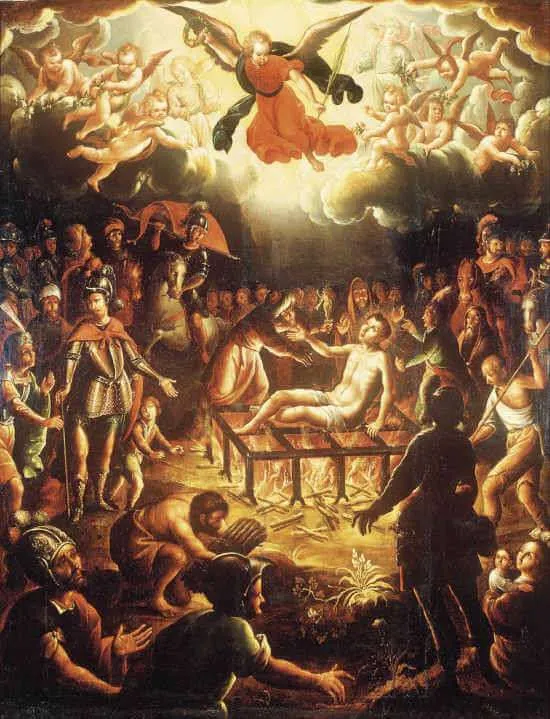
After Pope Sixtus and the other deacons were martyred, Deacon Lawrence was arrested. Because he was in charge of the riches of the Church, the prefect of Rome demanded that Deacon Lawrence hand over to him all the treasures of the Church. Lawrence requested three days to gather them, during which time he distributed all he could to the poor. After three days, Deacon Lawrence appeared again before the prefect and pointed to the poor, the crippled, the blind, and the suffering of Rome, saying, “These are the treasures of the Church.” This infuriated the prefect who had anticipated receiving gold and silver. He ordered that Deacon Lawrence be burned on a gridiron. Saint Ambrose records Deacon Lawrence’s last act of heroic virtue and defiance of diabolical oppression this way: “However, after three days he was placed upon the gridiron by the tyrant whom he mocked, and was burnt. He said: ‘The flesh is roasted, turn it and eat.’ So by the courage of his mind he overcame the power of fire.”

What is known for certain is that Saint Lawrence of Rome gave his life for Christ. After that heroic act of selflessness, God raised Saint Lawrence back to life—not physically, but spiritually, making him an icon of Christ to inspire others. Because Saint Lawrence is believed to have been burned on a gridiron, he has become known as the patron saint of cooks and tanners. Because he cared for and hid important documents of the Church before dying, he is the patron saint of archivists and librarians. And because of the humor Lawrence displayed while dying, as recorded by Saint Ambrose, he is the patron saint of comedians. From the third century onward, Saint Lawrence has been highly venerated in Rome and is considered a patron of Rome, after Saints Peter and Paul. After Constantine the Great legalized Christianity in the fourth century, tradition holds that he built a basilica over the tomb of Saint Lawrence that became one of the seven main churches in Rome, the Basilica di San Lorenzo fuori le Mura.

As we honor this legend of heroic virtue within the Roman Church, ponder not only his courage but also the way that God has used him to inspire many throughout the centuries. Though acts of courage may be difficult at the time they are performed, the good fruit of such heroism lives on. Seek the intercession of Saint Lawrence today, asking him to pray for you so that you will have the courage to do all that God asks of you, even using humor when helpful, so that you will find joy in everything, even persecution and suffering.

Source: https://mycatholic.life/saints/saints-of-the-liturgical-year/august-10—saint-lawrence-deacon-and-martyr/

Saint Lawrence, Deacon and Martyr Read More »

Luke 12:35-37

Vigilance, Attentiveness, Action

Jesus said to his disciples: “Gird your loins and light your lamps and be like servants who await their master’s return from a wedding, ready to open immediately when he comes and knocks. Blessed are those servants whom the master finds vigilant on his arrival. Amen, I say to you, he will gird himself, have the servants recline at table, and proceed to wait on them.”

Reflection:

Vigilance, hard work, determination, attentiveness, fidelity—these are some of the qualities that Jesus is speaking about. To “gird your loins” means that you are immediately prepared for some challenging task. You are ready for the hard work ahead and are committed to it. To “light your lamps” implies that you are not in the dark but that your mind is enlightened in such a way that you are able to see that which is the will of God.

As we go through life, it is easy to become complacent in the things of faith. It is easy to become lazy, disinterested, distracted, and unfocused. This parable goes on to speak of a thief who tries to break into a house in the middle of the night. This is Jesus’ way of saying that the evil one, with his lies and attacks, is constant, vicious, forceful, and unpredictable. For that reason, we must never grow tired of being vigilant in the spiritual life and must always be attentive to the light of God’s voice.

How attentive are you to the mission of Christ on a daily basis? This is an essential question to answer honestly. Most people will find that they become distracted from the mission God has given to them. We experience countless things every day that compete for our attention. Many of those competing voices might not appear to be sinful. For example, perhaps a certain hobby has become the dominant focus of your free time. Or perhaps responsibilities at work have spilled over into your family time. Or perhaps some painful or even enjoyable experience has had your full attention for some time. Though it is obvious that sinful distractions in life are evil, it might not always be as obvious that there are many other neutral distractions that are a real problem. The problems they can produce are a lack of attentiveness to the will of God and a lack of readiness to engage the will of God the moment He calls.

Imagine, for example, that a very important person calls you to ask for a favor. Most likely you would drop all you were doing and respond immediately. But, sadly, when the King of the Universe attempts to speak to us and inspire us to some mission, we can be too distracted to even listen, let alone respond with immediacy and zeal. This is a problem. If, however, a person is continually attentive to the voice of God and responds to His interior promptings as soon as they are received, then Jesus says that this person is truly blessed and that He will “have the servants recline at table, and proceed to wait on them.” In other words, the result of being vigilant in our attentiveness to the inspirations of God is that God Himself will reward us with His service. He will invite us to the table of spiritual rest, peace, joy, and fulfillment. He will serve us His mercy, which will be more than we could ever imagine.

Reflect, today, upon the call from God to always be attentive to His voice the instant He speaks. Reflect upon how aware you are of His constant presence in your life and His ongoing communication. Know that if you can form a habit of always listening, then you will never miss out on the grace-filled mission given to you by our Lord. Always listen to Him, seek out His still and gentle voice, and be ready to respond to Him every time He calls.

Source: https://catholic-daily-reflections.com/2025/08/09/vigilance-attentiveness-action/

Luke 12:35-37 Read More »

Saint Teresa Benedicta of the Cross (Edith Stein)

1891–1942; Patron Saint of Europe; Canonized by Pope John Paul II in 1998

Edith Stein was the youngest of eleven children, eight of whom survived infancy. She was born in Breslau, Germany, the daughter of devout Jewish parents. After World War II, Breslau became part of Poland and is now named Wrocław. Edith’s father died when she was only two, so her mother raised her children as a widow but ensured that Edith received an excellent education. Although her mother was an observant Jew, Edith decided she was agnostic around the age of fourteen, breaking her mother’s heart. Edith’s decision was part of her deeper quest for truth. Edith attended the local university when she was nineteen and studied philosophy, psychology, history, and German. At the age of twenty-two, she traveled about 300 miles east to study philosophy at the University of Göttingen in Germany under the renowned professor and founder of Phenomenology, Edmund Husserl. Phenomenology is an intellectual method that seeks to offer a systematic, clear, and unbiased description of the world as it is experienced, rather than explaining it from a theoretical or abstract perspective, as is common in other philosophical approaches.

In 1914, World War I broke out, and Edith volunteered with the Red Cross, where she cared for soldiers suffering from infectious diseases. This compassionate work gave her much to reflect on during that year, and her reflections and experiences made their way into her doctoral thesis, which centered on an understanding of empathy from a phenomenological perspective. She was granted her doctorate from the University of Göttingen in 1916, at the age of twenty-five, and followed her mentor, Professor Edmund Husserl, to the University of Freiburg, where she became his teaching assistant for the next two years.

At that time in Germany, a doctoral degree was not enough to become a university professor. It was also necessary to write a habilitation, a second, post-doctorate original thesis that often includes other requirements, such as teaching courses, advising students, or giving public lectures. In 1918, Edith attempted to complete her habilitation at the University of Göttingen, but the work was rejected because women were not then permitted to go become university professors.

In 1921, during a summer vacation, Edith was visiting a friend named Hedwig Conrad-Martius in Bergzabern, Germany. Hedwig was also a phenomenologist and one of the early women pioneers in German philosophy. She had recently converted to Catholicism and had many Catholic books in her home. During her stay, Edith picked up the autobiography of Saint Teresa of Ávila and read it. After reading it, she is said to have exclaimed, “This is the truth!” Her quest for truth had led her from Judaism to agnosticism to empathetic care for the suffering soldiers, to philosophical inquiry, and finally to one of the most brilliant spiritual writers in the history of the Church. Though Saint Teresa of Ávila was not an academic like Edith, Edith knew the truth when she saw it. The truths contained in Saint Teresa’s autobiography changed Edith’s life. She left her teaching position with Professor Husserl, learned the Catholic faith, and was baptized on January 1, 1922, in the church of Saint Martin in Bergzabern, Germany. From 1923–1931, Edith taught history, philosophy, and German to girls at the Dominican convent of Saint Magdalene in Speyer, Germany. During this time, she intensified her study of Catholicism, translating portions of Saint Thomas Aquinas and other Catholic theologians and philosophers into German. In 1932, Edith became a lecturer at the Catholic Institute for Scientific Pedagogy in Münster, but this was short-lived because the Nazi government passed anti-Semitic legislation that forced her to resign. However, “We know that all things work for good for those who love God, who are called according to his purpose” (Romans 8:28), and that is exactly what happened with Edith. Out of work and oppressed by the government, in October 1933, Edith was accepted into the Discalced Carmelite Monastery of Our Lady of Peace, Lindenthal, Cologne, Germany. She took the religious name Sister Teresa Benedicta of the Cross, after Saint Teresa of Ávila and Saint John of the Cross.

As a Carmelite nun, Sister Teresa Benedicta continued her philosophical studies and writings. In Cologne, she wrote “Finite and Eternal Being,” an attempt to synthesize and harmonize the philosophies of Saint Thomas Aquinas and the phenomenology of Edmund Husserl. After Hitler came to power in 1933, life as a Jew, even a Jewish convert to Catholicism, became increasingly dangerous in Germany. In 1938, the Carmelite superiors secretly transferred Sister Teresa Benedicta and her sister Rosa (who had become an extern of the Carmelites after their mother’s death), to their monastery in Echt, Netherlands. While in Echt, Sister Teresa wrote one of her most famous books, “The Science of the Cross,” an explanation of the mystery of the Cross using the teachings of Saint John of the Cross with references to the teachings of Saint Teresa of Ávila.

In 1940, the Nazis invaded the Netherlands, and in 1942, the Dutch bishops’ conference issued a statement that was read at all Masses, condemning the Nazis and their oppression of the Jews. In retaliation, the Nazis arrested all Catholic converts from Judaism, including Sister Teresa Benedicta and her sister Rosa. On August 9, 1942, Sister Teresa and Rosa were led into the gas chambers in Auschwitz where their mortal bodies perished, but their souls triumphed over death and were welcomed into Heaven. Saint Teresa Benedicta of the Cross is considered a martyr because she died as a result of the moral clarity issued by the bishops against Nazi oppression and because she chose to remain faithful to her religious vocation, despite the evident risk.

As we honor this saint and her fascinating journey, ponder her pursuit of the truth. She walked away from her Jewish roots at an early age and studied philosophy as a way of seeking the truth. She experienced human compassion during World War I while caring for soldiers, which fueled her phenomenological reflections of human empathy. She rigorously studied philosophy as a way of making sense of life, earning her doctorate. She remained humble and open to the truth while reading the life experience of Saint Teresa of Ávila, which led to her conversion. She pursued ongoing study of the truth as a Catholic theologian and philosopher. She made the radical choice to enter Carmel and become a nun. She experienced the suffering of the Cross firsthand during the Nazi oppression of World War II. Through it all, she used her keen intellect to develop a profound theology of the Cross, using the writings of Saint John of the Cross and Saint Teresa of Ávila. Finally, she lived the ultimate suffering through her martyrdom with fellow Jewish converts to the faith in Auschwitz. Above all, her story is a witness to the pursuit of the deepest truths found in the suffering and death of Christ. Allow this witness of her intellectual and lived experience of Christ’s Cross to inspire you to turn more fully to the sacrificial life to which you are called.

Source: https://mycatholic.life/saints/saints-of-the-liturgical-year/august-9—saint-teresa-benedicta-of-the-cross-edith-stein-virgin-and-martyr/

Saint Teresa Benedicta of the Cross (Edith Stein) Read More »

Matthew 17:19-20

Doing the Unimaginable

Then the disciples approached Jesus in private and said, “Why could we not drive it out?” He said to them, “Because of your little faith. Amen, I say to you, if you have faith the size of a mustard seed, you will say to this mountain, ‘Move from here to there,’ and it will move. Nothing will be impossible for you.”

Reflection:

A man came up to Jesus, fell on his knees before Him and begged Jesus to cure his son who was possessed by a demon. The man explained that Jesus’ disciples had tried to cast the demon out, but they could not do so. Jesus’ initial response to the man was, “O faithless and perverse generation, how long will I be with you? How long will I endure you?” But then Jesus had the boy brought to Him, and He cast the demon out.

The line quoted above reveals the conversation that immediately followed between Jesus and His disciples who failed to cast out the demon. It was because of their lack of faith that they were not able to do so. It should be noted that Jesus reacts firmly with a rebuke to this lack of faith as a way of emphasizing the importance of having a more pure faith.

Is it true that if you were to have “faith the size of a mustard seed” that you would be able to move a mountain? Yes, most certainly. But this statement must be carefully understood. First of all, we can only have “faith” in that which is in the mind and will of God. Faith is a response to that which God speaks to us. We listen, understand and believe. This is faith. Faith is not just believing in something so strongly that we try to will it to happen. Thus, if God truly wanted a mountain to be uprooted and moved, and He spoke this to you asking you to do it, then if you listened to His Voice and responded with complete trust, then it would happen. But, of course, the glory of God is not fulfilled by moving a literal mountain, so it is very unlikely that this would ever be done through the gift of faith.

But Jesus speaks this to His disciples and to us to assure us that we must listen, understand and believe all that He says. In the case of the curing of the boy with the demon, it is clear that it was the will of God that the disciples cast the demon out. But they failed to believe and, therefore, were unable to bring forth God’s will through their faith.

As for moving mountains, this happens on a figurative and spiritual level all the time. Any time God works in our lives in a supernatural way, or any time God uses us to work in another’s life in a supernatural way, much more than a “mountain” is moved. From an eternal perspective, what is more glorious and what gives God greater glory? To literally move a mountain? Or to be changed by grace and to be interiorly transformed by God so as to give Him eternal glory? And what is more impressive? To be able to defy the laws of physics in a way that comes and goes in an instant, or to be used to change someone’s soul for eternity? Without question, being used by God to bring transformation to another’s soul for eternity is of infinitely greater magnitude.

Reflect, today, upon the importance of listening to the Voice of God and responding with complete obedience and love. This is faith. What “mountain” does God want to move in your life? What transformation does He want to perform? Listen to Him and believe with every fiber of your being. As you do, God will not only do unimaginable things in your life, but through you, He will do unimaginable things in the lives of others.

Source: https://catholic-daily-reflections.com/2025/08/08/doing-the-unimaginable-3/

Matthew 17:19-20 Read More »