August 2025

Saint Dominic, Priest

1170–1221; Patron Saint of astronomers, scientists, and those falsely accused; Canonized by Pope Gregory IX in 1234

Dominic was born in Caleruega, in the Kingdom of Castile, present-day Spain, to noble parents. He was likely named after Saint Dominic of Silos, a local saint from the previous century. An early biographer relates that his mother, struggling to conceive a child, made a pilgrimage to the monastery where Saint Dominic of Silos had been abbot. Around that time, she dreamt of a dog emerging from her womb that ran around carrying a torch, setting the world on fire. The name “Dominic” can be translated as “The Lord’s Dog.”

Today’s saint came from a holy family. Dominic’s mother was later beatified, as was one brother who followed Dominic into the Order of Preachers. His other brother was a diocesan priest who lived in poverty and was devoted to the care of the poor and suffering. From the age of seven to fourteen, Dominic was educated under the guidance of his mother’s uncle, a priest. From fourteen to twenty-four, he attended the University of Palencia where he excelled in his studies. During his ten years at Palencia, Dominic was also deeply devoted to the poor. On one occasion, he sold all he had, including books he had copied by hand, to alleviate the suffering of those affected by a plague. Twice, he attempted to sell himself into slavery to assist those held captive by their Muslim captors.

When Dominic was twenty-four years old, the Bishop Diego de Acebo of Osma ordained him as an Augustinian canon of the cathedral, hoping that Father Dominic would help reform the other canons. For the next nine years, Father Dominic lived a life of deep prayer, was named sub-prior and then prior, and gave great witness to others through his holy life.

In 1203, the King of Castile sent Bishop Diego on a diplomatic mission. The bishop asked Father Dominic to accompany him on the journey. During their travels, they became aware of two grave needs within the Church. First, they discovered many people in northern Europe who had yet to hear the Gospel’s saving message. Second, they encountered a heretical group in southern France called the Cathars, who were leading many astray. After completing their diplomatic mission, Bishop Diego and Father Dominic detoured to Rome to consult with the pope. After their consultation, the pope sent them back to southern France to assist with the conversion of the Cathars. The Cathars followed a form of the Albigensian Heresy, which taught that there were two gods: one good, associated with the New Testament and the spiritual world, and one evil, associated with the Old Testament and the material world. They believed that the goal of life was to escape the evil of the material world and live a purely spiritual life, achieved by a rigorously ascetic lifestyle.

Previously, the pope had sent Cistercian monks to convert the Cathars. However, the Cathars lived an extremely ascetic life while the Cistercians did not, leading the Cathars to reject the Cistercian intervention. Encountering this firsthand, Father Dominic understood that the best way to combat the heresy was to form an order that lived in extreme asceticism yet remained true to the faith of the Church.

Back in southern France, Father Dominic and Bishop Diego worked tirelessly to rescue souls from the Albigensian heresy. They did so by engaging in public debates and private dialogues with the Cathars, hoping to convince them of their errors through reason and persuasion. Father Dominic and Bishop Diego lived in poverty as itinerant preachers, possessing only the Gospel. After Bishop Diego died, Father Dominic founded a convent in Prouille in 1206 dedicated to Saint Mary Magdalene. The purpose of the order was twofold. First, Father Dominic believed that it was through prayer, above all else, that souls would be saved. Second, the convent provided a safe haven for women and nuns who were converted away from the Albigensian heresy. The convent also provided for the education of girls, giving parents an alternative to the heretical convents for their daughters’ education.

Over the next several years, God performed a number of miracles through Father Dominic. Some of those miracles resulted in conversion and new followers. As time went on, Father Dominic began to write a rule of life for himself and his companions. In 1215, with the permission of the Bishop of Toulouse, Father Dominic founded a new order of men, dedicated to evangelization through prayer, study, and poverty. Like the newly formed Franciscans, they sought to institute a new form of religious life. They did not live as monks, canons, or diocesan priests. Instead, they lived a combination of the three. They lived communally; prayed together; embraced poverty, obedience, and chastity; studied the faith; and then set out on missions of preaching and evangelizing, later returning to their community house where they remained grounded and were renewed in their mission. The following year, Pope Honorius III gave formal consent to the order. Thus, the Order of Preachers, also known as the Dominicans, was established.

The Order of Preachers quickly became a huge success due to the humility, patience, and dedication of Father Dominic and his friars. Miracles also made a difference. One legend states that Father Dominic was invited to a public debate with a leading Albigensian monk. After the debate, the judges could not determine who was victorious so they suggested a test. They were both to place their book of teachings in the fire. The book that did not burn would be declared the winner. The Albigensian went first, and his writings were immediately consumed. When Father Dominic threw his book in the fire, it immediately jumped back into his hand. He did it a second time and a third with the same result. News spread quickly and hearts continued to convert.

In 1217, the pope, impressed with the order’s beginnings, gave Father Dominic the Church of Santa Sabina in Rome as the order’s second home. The pope also elevated Father Dominic to the “Master of the Sacred Palace,” a position designating Father Dominic as the pope’s chief theological adviser. Despite his success, Father Dominic remained a humble and prayerful penitent throughout his life. He slept on the floor, wore a hairshirt, and often walked barefoot when he entered a new town.

In the years following until Dominic’s death in 1221, other houses were founded in Paris, Madrid, and Bologna. After his death, the order continued to expand. By the mid-1200s, hundreds of Dominican houses had sprung up across Europe and even in other parts of the world.

As we honor Saint Dominic and the Order of Preachers, ponder his patience and dedication. In working with the Albigensian heretics, he was neither condemning nor harsh. Instead, he immersed himself in prayer and study, and then made himself available to each person he encountered, listening, discussing, reasoning, and helping to open the eyes of many. His prayerful and humble spirit, coupled with his wise words, saved many souls. Know that God calls you to a similar vocation. Each of us must long for the salvation of souls above everything else in life. Once we are filled with that longing, we must then dedicate all we are and all we have to that mission. Nothing else in life is more important because nothing gives God more glory than rescuing one soul from sin and hell as Saint Dominic did so well.

Source: https://mycatholic.life/saints/saints-of-the-liturgical-year/8-august-saint-dominic-priest/

Saint Dominic, Priest Read More »

Matthew 16:26

Purifying Worldly Desires

What profit would there be for one to gain the whole world and forfeit his life? Or what can one give in exchange for his life?

Reflection:

Would you like to “gain the whole world?” Many people daydream about becoming exceptionally rich and being able to purchase everything they ever wanted. Others dream of doing heroic acts that thrust them into the public spotlight and lead to public admiration. Still, others dream of having great power in this world and being a person of great importance. Though none of these are bad in and of themselves, the inordinate desire for them will damage your relationship with God. And when one of these desires becomes the dominant and all-consuming desire within, the result is that you forfeit your eternal soul.

When we speak of the “world,” we can understand different things. First, this is a reference to all the material things of this world—for example, the best of food and drink, self-indulgence, fleshly pleasures, material wealth, and all that is temporary and passing in this life. Second, the “world” can refer to pride and desire for attention and praise. This is when we become consumed with concern about what others think and say about us. Third, the “world” can refer to the desire for power so as to insert our own will. At a very high level, this is often the cause of wars among countries. One leader has a desire for domination and control. This desire for power and control can also affect each person within any part of that person’s life, including family, friends, work, social circles, etc.

The common thread among all three of these examples of worldly desires is the deception that obtaining more of them will satisfy you. Though they may satisfy you in a temporal and passing way, these desires will also have the effect of destroying your soul. This is because we have to choose. Either we seek to satiate the spiritual yearning of our souls, or we will seek to satiate ourselves with the passing promises of the world. We cannot have both.

It should be noted that obtaining wealth, being publicly praised, or being put in a position of power is not evil in and of itself. In fact, any one of these offers potential for good. The problem arises when a person seeks one of these worldly desires for selfish reasons and under the delusion that it will provide fulfillment. Truth be told, any one of those situations imposes a true cross on the person who is seeking to serve God alone. The responsibility that comes with wealth, prestige, or power is real. Therefore, when one or more of these are obtained, they must be handled with detachment and humility.

For example, if one becomes quite wealthy, the precept to live spiritually detached from material things still remains. Thus, in this case, material wealth poses a certain burden in the form of temptation. While this temptation certainly can be overcome and wealth can be used for good, the danger is real and must be regularly acknowledged. Or, if you are praised by many for something you did, or if you are given much responsibility and authority over others, humility and detachment must also increase so that God and God alone remains the single object of your desire.

Reflect, today, upon your desires. What do you want in life? Do you want to “gain the whole world?” Do you desire to gain even some of the worldly ambitions? If so, be careful. Reflect honestly upon your interior desires and work to purify them so that you desire God’s will alone. Once that happens, it will not matter to you if you are rich or poor, publicly praised or criticized, entrusted with earthly power or not. All that will matter is that you use all for the glory of God, in accord with His perfect and fulfilling will.

Source: https://catholic-daily-reflections.com/2025/08/07/purifying-worldly-desires-3/

Matthew 16:26 Read More »

Saint Sixtus II, Pope and Martyr, and Companions, Martyrs

Unknown–c. 258; Patron Saint of Bellegra, Italy; Pre-Congregation canonization

In the first and second centuries, Emperors Nero, Domitian, and Trajan persecuted Christians, exiling some and killing others. Famous martyrs of that time include Saints Peter, Paul, Domitilla, and Ignatius of Antioch. The Apostle John went into exile. Emperor Domitian was especially violent toward the Christians because he saw himself as a god and expected his subjects to treat him as such. In 250, Emperor Decius issued an edict requiring all citizens to offer sacrifice to the Roman gods for the well-being of the Roman Emperor. Those who did received an official certificate. Those who did not could be arrested and killed. This empire-wide persecution not only targeted the leaders within the Church but also the laity. Among the most well-known saints martyred under Decius were Pope Fabian, Bishop Alexander of Jerusalem, and two laywomen, Apollonia and Agatha.

The persecutions under Emperor Decius ended with his death in 251, and the next two emperors were more tolerant of Christians. However, the way that Decius handled Christians had a devastating impact upon the Church. Because Decius required all citizens to sacrifice to the Roman gods and obtain a certificate of compliance, many Christians did so out of fear. Once the persecutions subsided, the Church had to address the question of what to do with those who had apostatized to save their lives. Many of these “lapsi” as they were called, which is Latin for “lapsed,” wanted to be reconciled with Christ and be readmitted to the Sacraments. Some Church leaders were strict, believing that they should not and could not be readmitted after such a cowardly public act of apostasy. Others held that they could only be readmitted after severe public penance. And others believed that they should be readmitted into full communion with the Church immediately, without the requirement of public penance if their sorrow was sincere. Pope Cornelius and Bishop Cyprian of Carthage were among those who advocated for the reconciliation of the lapsi, taking a more middle-of-the-road approach, which was confirmed and universally adopted at the Council of Carthage in 251.

In 253, Valerian became emperor and was tolerant at first. However, around 257, things changed. He issued an edict that outlawed Christian worship and directed that bishops, priests, and deacons be arrested. Christian nobility lost their titles and property, and Christian senators could be put to death if they did not publicly renounce their faith. It was in that same year that today’s saint, Sixtus, was elected pope.

Little is known about Pope Saint Sixtus II’s childhood and early years, other than that he was most likely born in Greece and may have been well versed in Greek philosophy. Regarding the lapsi controversy, he was in full union with the merciful approach adopted by the Church. He was well aware of the fear so many Christians were encountering due to the threat to their lives. He was also courageous, not giving into those fears himself.

A related issue that the Church faced during the time that Pope Sixtus served was the question of whether or not those who were baptized by heretic bishops and priests needed to go through a rebaptism when they embraced the orthodox faith. Once the question of readmittance of the lapsi to the faith was resolved, those bishops and priests who refused to accept the decision of the Council of Carthage were deemed heretics. The new question was whether the baptisms of those heretical bishops and priests were valid.

Pope Sixtus came down on the side that ultimately was adopted by the Church, namely, that despite the heretical position of the bishop or priest, as long as he had the intent of the Church, used water, and spoke the words given to us by Christ for the baptism, that baptism was valid and there was no need for a rebaptism. Pope Sixtus worked hard to unite the bishops of the Church, especially the North African bishops, on this issue and succeeded in that endeavor.

Pope Sixtus’ papacy was short-lived. About a year after being chosen as pope, he was among the first of the Christians to suffer martyrdom under the edict of Emperor Valerian II. With him, six deacons were also killed: Januarius, Vincentius, Magnus, Stephanus, Felicissimus, and Agapitus. Four days later, Deacon Lawrence also suffered death. Pope Sixtus was buried in the Crypt of the Popes, within the Catacombs of Callixtus located on the Appian Way in Rome. A century later Pope Damasus I honored his tomb with an epitaph, and sometime before the end of the seventh century, his name was inserted into the Roman Canon of the Mass by which he is honored as a martyr.

Though we do not know much about Pope Saint Sixtus II, we know that he is a saint and among the early martyrs of our Church who also fought to unite the Church, treat sinners with mercy, and hold firm to the teachings handed down to us from the Apostles. As we honor this courageous saint, pray that you will be able to give witness to Christ by your fidelity to Him, to mercy, and to authentic unity in all that he calls you to do.

Source: https://mycatholic.life/saints/saints-of-the-liturgical-year/august-7—saint-sixtus-ii-pope-and-companions-martyrs/

Saint Sixtus II, Pope and Martyr, and Companions, Martyrs Read More »

Matthew 16:22-23

Facing Fear with Hope

Then Peter took Jesus aside and began to rebuke him, “God forbid, Lord!  No such thing shall ever happen to you.” He turned and said to Peter, “Get behind me, Satan!  You are an obstacle to me. You are thinking not as God does, but as human beings do.”

Reflection:

What a shocking statement this must have been that was spoken by Jesus to Peter. “Get behind me, Satan!” Jesus said. In the paragraph before this, Peter professed that Jesus was “the Christ, the Son of the living God.” Jesus in turn told Peter that he was Petros and on this petra He would build His Church. Petros is the Greek word for a movable rock and petra was an immovable solid rock foundation. Thus, Peter was told that he would be the stone, set upon a solid foundation, by which Jesus would build His Church. Jesus even went on to promise Peter that he would receive the keys to the Kingdom and that whatever he bound on earth would be bound in Heaven. And then, one paragraph later, Jesus rebukes Peter for thinking “not as God” but as a human being.

Jesus rebuked Peter because Peter could not accept Jesus’ teaching about His coming passion and death. Jesus told Peter and the other disciples that He would soon suffer greatly, be rejected by the chief priest, the scribes and the elders, be killed and then rise on the third day. So Peter went from a profound proclamation of faith, to fear and a rejection of the divine plan of salvation. And for that reason, Jesus went from entrusting much authority to Peter to rebuking him for his weakness and fear.

Fear is often a paralyzing passion. Saint Thomas Aquinas explains that the passion of fear comes from a perceived future evil. Sorrow is the normal reaction to a present suffering such as the death of a loved one. But when the perceived suffering, or apparent evil, is something that has not yet come, then we often react with fear. When that fear is caused by something exterior and out of our control, it tempts us to feel shock, a sense of being overwhelmed and anxiety. In the case of Peter, the thought of Jesus suffering greatly, and being killed, was more than he was able to accept. So Peter says, “God forbid, Lord! No such thing shall ever happen to you.”

Jesus’ rebuke of Peter was an act of true love. It was a way of shaking him free from the paralysis of fear. Jesus wanted Peter to think clearly and to face this future suffering with courage, acceptance, hope and faith. Courage provides strength. Acceptance cures anxiety. Hope produces joy. And faith is the remedy for all fear. These and other similar virtues were necessary if Peter and the other disciples were going to be able to endure the suffering and passion of Jesus. They needed to know that this perceived evil was going to be transformed by the Father in Heaven and used for the greatest good the world had ever known. They needed to know that Jesus “must go to Jerusalem and suffer greatly…” It was the Father’s will. And because it was the Father’s will, the greatest good would come from the greatest evil because of God’s almighty power.

Reflect, today, upon that which causes you the most fear and anxiety in your life. When you look to the future, what is it that paralyzes you or at least tempts you to fear and worry? The truth is that any evil or suffering that you foresee has the potential to bring forth the greatest good in your life. Your natural human mind cannot discern this. We must strive to think as God, not as humans, as Jesus says. Try to look at anything that causes you anxiety through the eyes of God alone. Trust that, in faith, all can be used by God for good. Do not doubt but believe and God will begin to bestow upon you the many virtues you need to move forward with peace, courage and confidence.

Source: https://catholic-daily-reflections.com/2025/08/06/facing-fear-with-hope-3/

Matthew 16:22-23 Read More »

Transfiguration of the Lord

c. 32

All three of the Synoptic Gospels record the event of the Lord’s Transfiguration (Matthew 17:1–8Mark 9:2–8Luke 9:28–36). Just prior to the Transfiguration, all three Gospels also record Jesus’ trip with His disciples to Caesarea Philippi, located about thirty miles north of the Sea of Galilee. Caesarea Philippi was a primarily pagan Greek town occupied by the Romans. The Greek god Pan was worshiped there in a cave thought to be bottomless and often referred to as the gate to the netherworld because of its association with the pagan god. It was there that Jesus asked His disciples who they thought He was. Peter declared, “You are the Messiah, the Son of the living God.” Jesus then blessed Peter and announced His intent to build His Church upon Peter, declaring that “the gates of the netherworld shall not prevail against it…” (Matthew 16:16–18).

After this significant exchange, Jesus began revealing to His disciples His impending fate—His journey to Jerusalem to suffer and die. Peter resisted this revelation, to which Jesus responded sternly, correcting Peter’s human thinking with divine wisdom (Matthew 16:22–23).

This is the context of the Feast of the Transfiguration we celebrate today. First, Jesus proclaimed the triumph of His Church over evil. Second, He informed them that this victory would be achieved through His own suffering and death. Although the first message is encouraging, the second one is challenging to accept. According to the Gospels, Jesus allowed His disciples about a week to grapple with these teachings, a period that must have been tough for them.

Understanding their struggle, Jesus took His three closest companions, Peter, James, and John, up a high mountain. There He was transfigured before them, radiating pure white light, conversing with Moses and Elijah, and being affirmed in His identity by the Father.

This event was likely meant to reinforce His disciples’ faith after a week of pondering Jesus’ foretold suffering and death, along with His exhortation that they must follow Him. The Transfiguration affirmed Jesus’ divinity and His relationship with the revered figures of Moses and Elijah. Furthermore, the Father in Heaven confirmed Jesus as His divine Son with whom He was well pleased.

After the Resurrection and Ascension of Jesus, these three Apostles shared their experience of the Transfiguration, fortifying others in the faith. This story is still shared today to strengthen us as we bear our own crosses.

The Feast of the Transfiguration is strategically placed forty days before the Feast of the Triumph of the Cross. Thus, the Transfiguration should be seen as a preparation for both the Cross of Christ and our participation in that triumph. According to the Gospel, we are called to take up our crosses and follow Jesus for the glory of the Father, the fulfillment of His will, and the good of the Church, which will always prevail against the gates of hell.

As you celebrate the Transfiguration today, look at this event as a foretaste of the reward awaiting you, and a source of encouragement to endure all sufferings for the final victory of Christ. The Christian life, as stated by Jesus Himself, is about suffering and dying out of love and with unwavering hope. By uniting our trials with Christ’s Cross, we share in His glorious victory for all eternity.

Source: https://mycatholic.life/saints/saints-of-the-liturgical-year/august-6—transfiguration-of-the-lord/

Transfiguration of the Lord Read More »

Mark 9:5-7

The Glory of the Transfiguration

Then Peter said to Jesus in reply, “Rabbi, it is good that we are here! Let us make three tents: one for you, one for Moses, and one for Elijah.” He hardly knew what to say, they were so terrified. Then a cloud came, casting a shadow over them; from the cloud came a voice, “This is my beloved Son. Listen to him.”

Reflection:

Just prior to the Transfiguration, Jesus began to reveal to His disciples that He would suffer greatly, be rejected by the elders, be killed and then rise on the third day. This caused much fear for the disciples as they grappled with this unsettling revelation from our Lord. And even though Jesus remained firm with them and even rebuked Peter for his fear, Jesus also gave three of His disciples a very precious gift.

After much traveling, preaching, miracle working and private conversations about His passion with the Twelve, Jesus invited Peter, James and John to go with Him up a high mountain to pray. These disciples most likely had no idea what they would soon encounter. As they made the difficult and arduous journey, their minds must have been pondering not only the mighty deeds done by Jesus in the previous months but also His words about the suffering to come. As they struggled with this, much to their amazement, Jesus “was transfigured before them, and his clothes became dazzling white.” Suddenly Moses and Elijah appeared before them, representing the Law and the prophets. These two Old Testament figures appeared as a way of saying to these disciples that everything that Jesus was telling them was to take place to fulfill all that had been foretold about Him from of old. Perhaps Jesus thought that if His disciples would not fully listen to Him, then seeing Moses and Elijah would help. But Jesus went even further. The Voice of the Father Himself thundered and said, “This is my beloved Son. Listen to him.” Thus, if these disciples would not ultimately listen to Jesus alone, or if even Moses and Elijah failed to convince them, then the last hope was the Father Himself. And Jesus delivered such a grace.

The Transfiguration was a true mercy. These disciples had never seen anything like it before. But it was most likely this act of mercy that ultimately helped them to accept the hard truth that Jesus was trying to teach them about His coming suffering and death. If the Father in Heaven Personally gave witness to Jesus, then everything that Jesus had said was trustworthy.

As we read through the Gospels and the many teachings God has given us through the Church, think about whether there are some teachings with which you struggle? Or in your own life, on a personal level, are there some things you know God wants of you but you find it difficult to accept? When confusion sets in, that means we are not listening, are not fully hearing what God is saying to us or are not understanding. And though we will not see the Transfigured Lord with our eyes and hear the Voice of the Father with our ears as these three disciples did, we must choose to believe all that God has said as if it were the Transfigured Lord, with Moses and Elijah, and the Father Himself speaking clearly and directly to us. “This is my beloved Son. Listen to him.” Those words were not only spoken for the good of the disciples, they are also spoken to us.

Reflect, today, upon this powerful experience given to these disciples by our Lord. Try to place yourself in the scene so as to witness Jesus transfigured in the most glorious way, with Moses and Elijah and with the thundering Voice of the Father. Allow the Father to speak also to you, telling you that all He has spoken through the Scriptures, the Church and within your own conscience is true. Allow this revelation to convince you on the deepest level to acknowledge not only the divinity of Jesus but also to “Listen to Him” in every way.

Source: https://catholic-daily-reflections.com/2025/08/05/the-glory-of-the-transfiguration-4/

Mark 9:5-7 Read More »

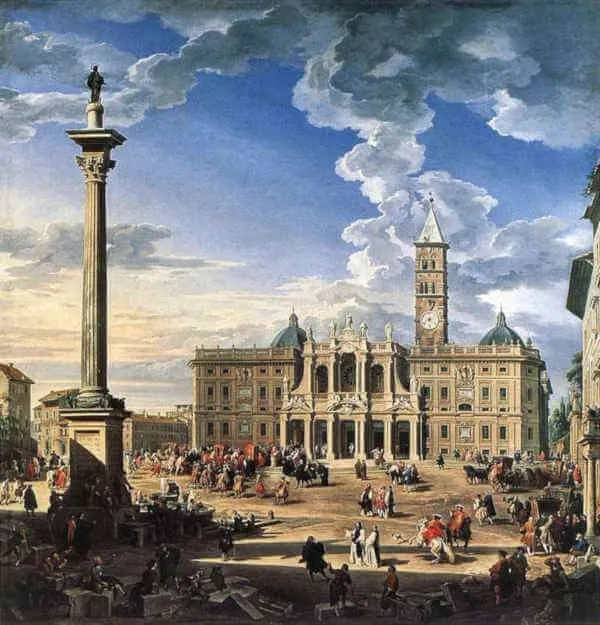
Dedication of the Basilica of Saint Mary Major

Our Lady of the Snows; c. 352

The fourth century was a significant time in the history of the Church, and the fifth century was a significant time in the history of Marian devotion. In 313, Roman Emperor Constantine the Great issued the Edict of Milan, making Christianity legal and ending state-led persecutions of Christians. Over the next forty years, many people throughout the Roman Empire, including many in Rome itself, converted. The Catholic Church also became more structured, and the Bishop of Rome was becoming increasingly understood as the leader of the universal Church.

As the Church in Rome was continuing to find its way, legend has it that the Mother of God decided to do her part to help. In the year 352, a wealthy Roman aristocrat named John and his wife, who were childless and faithful Christians, wanted to use their money to help expand the Church. After praying for direction, John had a dream on the night of August 4, 352, in which our Blessed Mother appeared to him and informed him that she wanted a church built in Rome on the Esquiline Hill. She said that, despite it being the middle of summer, snow would fall on the spot the following day. When John arose on August 5, he went to see Pope Liberius to tell him about his dream-vision. To John’s surprise, Pope Liberius had a similar dream the night before, so they decided to see if snow had fallen on the Esquiline Hill. Sure enough, upon their arrival, they found fresh snow in the form of a foundation for a church. The Pope used the snow to outline the foundation and ordered the church to be built. John and his wife used their money to pay for the project, and the church was called Basilica Liberiana, after Pope Liberius.

In the century that followed, a controversy arose over the appropriate title of Jesus’ mother. Should she be called the “Christ-bearer” or the “God-bearer?” In other words, was she only the Mother of Christ, or the Mother of God? Nestorius, who was the Archbishop of Constantinople from 428 to 431, argued that Mary was only the mother of Christ’s human side, suggesting that there were two persons in Christ, a divine person and a human person. Archbishop Cyril of Alexandria, on the other hand, argued that Christ was only one Person and that His humanity and divinity were united as one in His personhood. The natural consequence of his argument was that if Mary was the mother of the Person, and the Person was God, then Mary was and is the Mother of God.

To resolve the controversy, Eastern Roman Emperor Theodosius II called for a church council to be held in Ephesus in 431. Nestorius and Cyril both attended, although Nestorius arrived late, and Cyril’s position won the day. Nestorius was deposed and exiled. Pope Celestine I approved the council’s decision but died shortly afterward. Pope Sixtus III was elected to succeed him in 432 and did much to implement the teachings of the Council of Ephesus. Among them was to rebuild and enlarge the Basilica Liberiana, and to give it a new name in honor of the Mother of God. The core of the current structure of the Basilica of Santa Maria Maggiore (Saint Mary Major) on the Esquiline Hill in Rome was built and dedicated by Pope Sixtus sometime before his death in 440.

Today, Santa Maria Maggiore is one of the four main basilicas in Rome, along with Saint Peter’s Basilica on Vatican Hill, Saint John Lateran Basilica (the official cathedral of the Diocese of Rome), and Saint Paul Outside the Walls. Each basilica has a unique significance and history. Santa Maria Maggiore contains within its walls a triumphal arch and stunning nave mosaics, which date back to the fifth century. The mosaics depict various biblical scenes, including events from the Old Testament and the infancy of Christ. They are among the oldest and most important Christian mosaics in Rome. Also within the basilica, under the main altar, is the church’s most sacred relic, the wood of the manger in which the baby Jesus was laid. Another important relic is the Salus Populi Romani, an icon of the Blessed Virgin Mary. According to legend, this ancient icon is the first icon to be painted of Mary and was painted by Saint Luke, the Gospel writer. For centuries, as a reminder of the legend of the miraculous summer snowfall, white rose petals have been dropped on the faithful from the dome of the Basilica every August 5.

Though the relics, history, and legends attached to this ancient church are inspirational, perhaps the most enduring inspiration we can take from this church is that it has been a place of divine worship for more than 1,600 years. Since that time, almost every pope has offered Mass there, countless millions have prayed there, numerous saints have made a pilgrimage to that holy church, and our Blessed Mother has certainly received and answered many prayers within those walls.

As we celebrate the Dedication of the Basilica of Saint Mary Major, reflect upon your own devotion to the Mother of God. Especially call to mind the countless saints who prayed within the walls of Saint Mary Major, and seek to imitate their faith and their devotion to the Mother of God.

Source: https://mycatholic.life/saints/saints-of-the-liturgical-year/august-5—dedication-of-the-basilica-of-saint-mary-major/

Dedication of the Basilica of Saint Mary Major Read More »

Matthew 14:27-29

Come With Your Fears

“Take courage, it is I; do not be afraid.” Peter said to him in reply, “Lord, if it is you, command me to come to you on the water.” He said, “Come.”

Reflection:

Peter and the other disciples were frightened. They were in a boat on the Sea of Galilee, the wind was strong, and the waves were crashing. This scene took place “during the fourth watch of the night,” which meant the time was early in the morning, between 3:00 and 6:00 a.m., when it was still dark. Jesus had been alone on a mountain praying during that night and now came walking on the water toward the disciples. When they saw our Lord, they cried out, “It is a ghost!” But then Jesus spoke the words quoted above to them, calming them and calling them to courage and trust.

Imagine yourself being with the disciples as Jesus approached. How would you react? Would you, too, be filled with fear? Perhaps it is best to answer that question from two perspectives. One is from the perspective of our fallen human nature. The other comes from the perspective of Truth. First, from the perspective of our fallen human nature, there are many things in this life that tempt us to fear. Therefore, this Gospel passage should be seen as a prophetic action of our Lord by which He tells you that He wants to come to you and meet you in your fears. What is it that gives you the most fear in your life right now? Oftentimes fear has to do with the future and the unknown. What if this or that were to happen? Fear ultimately results from a lack of faith in God and His protective care.

The second perspective from which we might see this passage is that of the full Truth. The truth is that the disciples not only had no need to fear, they actually had every reason to rejoice and be at peace. While on that boat, in the middle of the sea, in the middle of the night, during strong winds, it was God Himself, the Great I AM, Who was coming to protect them, care for them, and lead them safely to shore. Jesus’ “it is I” could actually be translated more literally “I AM” in reference to Jesus’ divinity.

The last word in the passage quoted above is what Jesus speaks to all of us when we fall into fear and worry. Jesus says, “Come.” This word is a command and is a word spoken to you. It’s a good word to prayerfully meditate upon and hear spoken to you during every struggle and fear you endure.

Reflect, today, upon this Gospel passage and try to insert yourself into it. See the waves, wind, and darkness as symbols of whatever it is that troubles you the most. As you do, close your eyes and see Jesus, the Great I AM, coming to you. Gaze at Him and hear Him tell you to trust Him. Hear Him say to you, “Come.” Peter initially trusted and began to walk on water when he came to Jesus, but he quickly allowed his fear to set in and took his eyes off Jesus. As soon as he did, he began to sink. Turn your eyes to Jesus, keep them firmly fixed on Him, ignore the temptations in life that lead you to fear, and trust in God. He commands you to do so out of love.

Source: https://catholic-daily-reflections.com/2025/08/04/come-with-your-fears-2/

Matthew 14:27-29 Read More »

Saint John Vianney (the Curé of Ars), Priest

1786–1859; Patron Saint of parish priests, all priests, and confessors; Canonized by Pope Pius XI in 1925

 John Mary Baptiste Vianney was the fourth of six children born to devout Catholic parents in Dardilly, a rural village located near Lyon in the eastern part of France. John was born just three years before the start of the French Revolution, during which the Catholic Church came under ferocious attack. Public worship was suppressed, churches were closed or repurposed, and many priests either swore allegiance to the new state under duress, went into hiding, or were killed. During the Reign of Terror, from 1793-1794, thousands of clergy in France were executed by the guillotine. It was a chaotic time in France and an even more chaotic time to be a priest.

During this time, the Vianney family often hid priests and attended their clandestine Masses at nearby farms. The witness of the priests who risked their lives to offer the Sacraments was a powerful source of inspiration for young John, and later motivated him to become a priest. Given the chaos of the time, John spent most of his childhood helping on the family farm and tending to the flocks, rather than attending school. He received a simple education from his mother but was functionally illiterate through his teenage years. He secretly received catechetical instruction from two nuns to prepare him for his First Holy Communion, which he received at the age of thirteen in a neighbor’s house.

In 1799, Napoleon seized power in France and, in 1801, he and Pope Pius VII signed an agreement called the Concordat. This agreement did not fully restore the Catholic Church to its former rights but did recognize Catholicism as the faith of the majority of French citizens and permitted public worship, albeit worship that was regulated by the state. In 1806, the parish priest of John’s neighboring village of Écully, Father Balley, opened a school for prospective seminarians. At the age of twenty, John began his formal education there. Although he struggled, especially with Latin, his faith was manifest and his humility profound.

In 1809, John’s education was interrupted when he was drafted into Napoleon’s army to help fight the Spanish during the War of the Fifth Coalition. Prior to this, seminary students were exempt from the draft, but Napoleon, facing heavy losses, abolished the exemption. After joining his regiment, John fell ill, was hospitalized, and was left behind. He was then appointed to another regiment and this time, was so immersed in prayer at a nearby church that he missed their departure. He was sent after the troops but couldn’t find them and was instead misdirected to the village of Noes where a number of deserters were hiding. He was convinced to stay with them, change his name, hide, and teach in the school. He did this for more than a year. Eventually, he was granted amnesty and was able to return to Écully to continue his education under Father Balley.

Though John continued to struggle with his studies, Father Balley supported him, seeing in John a true vocation, a deep love for the Blessed Mother, and a profound prayer life. After John completed his studies in Écully, Father Balley convinced the Vicar General of the diocese to permit John into the diocesan seminary. John struggled but persevered. When he was up for ordination, the diocesan authorities questioned his suitability. When the bishop asked about John’s piety, he was told that John prayed the rosary like an angel. That was all the bishop needed to know. John was ordained a priest on August 12, 1815, and was sent to serve as an assistant priest in Écully, under the supervision of Father Balley, where he served for two years until Father Balley’s death.

In 1817, Father Vianney was sent to be a chaplain at the church of Saint Sixtus, in Ars, a farming community of just over 200 people. He would remain there for the next forty-one years. As Father Vianney walked to Ars, one story relates that he came upon a young boy tending sheep. He asked the boy how far away Ars was and the boy pointed him in the right direction, accompanying him on the way. When he saw the steeple in the distance, Father Vianney knelt in prayer for a long time, rose, and continued on. When he and the boy arrived, Father Vianney said to the boy, “You have shown me the way to Ars, I will show you the way to Heaven!”

Ars was known as a community that enjoyed its dancing, drunkenness, and swearing. Although the church was in disrepair, morals were lacking, and church attendance was scarce, Father Vianney went straight to work. The townspeople did not know they were receiving a chaplain, so no one attended Father’s first Masses. But as word spread, people became curious. When some stopped by the church, they saw Father Vianney kneeling in prayer before the Blessed Sacrament. Then others saw the same. And others. Eventually, people started to attend Mass. They were touched by Father Vianney’s simple homilies that presented the basic Gospel message. Sin must be avoided; those who remain in sin will go to hell. Those who turn to God will be saved and welcomed into Heaven. He often conveyed these messages by preaching on the love of God, prayer, the sacraments (especially Confession and the Eucharist), and the duty to live a life of charity and virtue.

Within the first three years of Father Vianney’s priestly ministry, Ars was being transformed. Father Vianney not only spent hours in prayer every day, endured severe penances and fasting (mainly eating boiled potatoes), and restored the church building, but he also made many home visits to his parishioners and even to the surrounding villages. This impressed many and drew them to the church. In 1823, things were going so well that the bishop raised Saint Sixtus Church to the level of a parish, appointing Father Vianney as pastor. In 1827, Father Vianney said from the pulpit, “Ars, my brothers and sisters, is no longer Ars!” Ars had been converted, people were flocking to confession and Mass, praying, overcoming sin, and turning to the love of God. But Ars was not the only place being affected; Father Vianney’s reputation had traveled far and wide. As a result, thousands of people were traveling to Ars every year to attend his Masses and confess their sins. On many days, Father Vianney spent up to sixteen hours in the confessional. By the 1850s, tens of thousands, or according to some estimates, hundreds of thousands of people were coming to Ars. A new and larger church had to be built, and a new railroad was even constructed to help people get to this small village.

Father Vianney’s method of being a priest was simple. He allowed God to consume him, live in him, and minister to the people through him. It was God who did the absolving, preaching, and loving. Father Vianney was just the human instrument. It is said that the devil appeared to Father Vianney many times, harassing him and trying to intimidate him. One time the devil spoke the truth when he said, “If there were only three like you in France, I would not be able to set foot there.”

As we honor this holy priest of God, reflect upon the importance of the priesthood. Saint John Vianney once said, “If I were to meet a priest and an angel, I would greet the priest first and then the angel…. If there were no priest, the Passion and death of Jesus would serve no purpose. What use is a treasure chest full of gold if there is no one who can unlock it? The priest has the key to the treasures of Heaven.” Though few priests live up to the dignity and responsibility they are given, every priest carries within him the sacred power of dispensing the mercy of God, absolving sins, and making the Passion of Christ present in the Eucharist. Call to mind your own priest today and pray for him, that he will become a holy and humble instrument of Christ.

Source: https://mycatholic.life/saints/saints-of-the-liturgical-year/august-4—saint-jean-vianney-the-cur-of-ars-priest/

Saint John Vianney (the Curé of Ars), Priest Read More »

Matthew 14:19-20

Giving What You Receive

Taking the five loaves and the two fish, and looking up to heaven, he said the blessing, broke the loaves, and gave them to the disciples, who in turn gave them to the crowds. They all ate and were satisfied, and they picked up the fragments left over—twelve wicker baskets full.

Reflection:

An important aspect of this miracle that is easy to miss is that Jesus multiplied the loaves and fishes through His disciples’ instrumentality. He did this by inviting them to assist in the distribution of the loaves and in the gathering of the fragments left over. This reveals that God often uses us as mediators of His superabundant graces given to others. Though God could pour forth His mercy directly, most often He does so through others.

As you ponder this miracle, try to see yourself as one of the disciples who was invited to distribute the bread to the people. If you were there and were hungry and then were given bread, you would be tempted to eat the bread yourself before giving any away. But Jesus gave the bread to His hungry disciples with the instruction to first give it to others.

Sometimes, when God calls us to give His mercy to others, we become selfish. It’s easy to think that we must first take care of ourselves and our own needs. We erroneously believe that we can only offer mercy to others after our needs are met. Imagine, for example, if upon receiving the bread from Jesus the disciples would have decided that they should eat of it first. Then, if there was anything extra, they could give it to others. Had they done this, the superabundance of the multiplication of the loaves would not have happened. In the end, the disciples themselves received a superabundance of food—precisely because they first gave away what they had received.

Spiritually speaking, the same is true with us. When we receive spiritual nourishment from our Lord, our first thought must be to give it away. We must first see all that we receive from God as an opportunity to bestow those blessings upon others. This is the nature of grace. For example, if we are given a sense of peace or joy within our hearts, we must realize that this peace or joy we receive is a gift that must be immediately offered to others. If we are given a spiritual insight into the Scriptures, this is given to us first and foremost to share with others. Every gift we receive from God must be understood as a gift given to us so that we can immediately share it with others. The good news is that when we seek to give away that which we have received, more is given to us and, in the end, we will be far richer.

Reflect, today, upon the action of the disciples receiving this food from our Lord and immediately giving it away. See yourself in this miracle, and see the bread as a symbol of every grace you receive from God. What have you received that God wants you to distribute to others? Are there graces you have received that you selfishly try to hold onto? The nature of grace is that it is given to give it to others. Seek to do this with every spiritual gift you receive, and you will find that the graces multiply to the point that you receive more than you could ever imagine.

Source: https://catholic-daily-reflections.com/2025/08/03/giving-what-you-receive-3/

Matthew 14:19-20 Read More »