August 2025

Twenty-second Sunday in Ordinary Time

First Reading Sirach 3:17-18, 20, 28-29

My child, conduct your affairs with humility,
 and you will be loved more than a giver of gifts.
 Humble yourself the more, the greater you are,
 and you will find favor with God.
 What is too sublime for you, seek not,
 into things beyond your strength search not.
 The mind of a sage appreciates proverbs,
 and an attentive ear is the joy of the wise.
 Water quenches a flaming fire,
 and alms atone for sins.

Responsorial Psalm Psalms 68:4-5, 6-7, 10-11

R. (cf. 11b)  God, in your goodness, you have made a home for the poor.
The just rejoice and exult before God;
they are glad and rejoice.
Sing to God, chant praise to his name;
whose name is the LORD.
R. God, in your goodness, you have made a home for the poor.
The father of orphans and the defender of widows
is God in his holy dwelling.
God gives a home to the forsaken;
he leads forth prisoners to prosperity.
R. God, in your goodness, you have made a home for the poor.
A bountiful rain you showered down, O God, upon your inheritance;
you restored the land when it languished;
your flock settled in it;
in your goodness, O God, you provided it for the needy.
R. God, in your goodness, you have made a home for the poor.

Second Reading Hebrews 12:18-19, 22-24a

Brothers and sisters:
You have not approached that which could be touched
and a blazing fire and gloomy darkness
and storm and a trumpet blast
and a voice speaking words such that those who heard
begged that no message be further addressed to them.
No, you have approached Mount Zion
and the city of the living God, the heavenly Jerusalem,
and countless angels in festal gathering,
and the assembly of the firstborn enrolled in heaven,
and God the judge of all,
and the spirits of the just made perfect,
and Jesus, the mediator of a new covenant,
and the sprinkled blood that speaks more eloquently than that of Abel.

Alleluia Matthew 11:29ab

R. Alleluia, alleluia.
Take my yoke upon you, says the Lord,
and learn from me, for I am meek and humble of heart.
R. Alleluia, alleluia.

Gospel Luke 14:1, 7-14

On a sabbath Jesus went to dine
at the home of one of the leading Pharisees,
and the people there were observing him carefully.

He told a parable to those who had been invited,
noticing how they were choosing the places of honor at the table.
“When you are invited by someone to a wedding banquet,
do not recline at table in the place of honor.
A more distinguished guest than you may have been invited by him,
and the host who invited both of you may approach you and say,
‘Give your place to this man,’
and then you would proceed with embarrassment
to take the lowest place.
Rather, when you are invited,
go and take the lowest place
so that when the host comes to you he may say,
‘My friend, move up to a higher position.’
Then you will enjoy the esteem of your companions at the table.
For every one who exalts himself will be humbled,
but the one who humbles himself will be exalted.”
Then he said to the host who invited him,
“When you hold a lunch or a dinner,
do not invite your friends or your brothers
or your relatives or your wealthy neighbors,
in case they may invite you back and you have repayment.
Rather, when you hold a banquet,
invite the poor, the crippled, the lame, the blind;
blessed indeed will you be because of their inability to repay you.
For you will be repaid at the resurrection of the righteous.”

Source: https://bible.usccb.org/bible/readings/083125.cfm

Twenty-second Sunday in Ordinary Time Read More »

Saint Cyprian of Carthage

Profile

Cyprian was born to wealthy pagan parents. He taught rhetoric and literature. He was an adult convert in 246, and taught the faith by Saint Caecilius of Carthage. He was ordained in 247 and became Bishop of Carthage in 249. During the persecution of Decius, beginning in 250, Cyprian lived in hiding, covertly ministering to his flock; his enemies condemned him for being a coward and not standing up for his faith. As a writer, he was second only in importance to Tertullian as a Latin Father of the Church. He was a friend of Saint Pontius. He was involved in the great argument over whether apostates should be readmitted to the Church; Cyprian believed they should, but under stringent conditions. He supported Pope Saint Cornelius against the anti-pope Novatian. During the persecutions of Valerian, he was exiled to Curubis in 257, brought back Carthage, and then martyred in 258. His name is in the Communicantes in the Canon of the Mass.

Born

  • 190 in Carthage, North Africa

Died

  • beheaded 14 September 258 in Carthage, North Africa

Canonized

  • Pre-Congregation

Patronage

  • Algeria (proclaimed on 6 July 1914 by Pope Pius X)
  • North Africa (proclaimed on 6 July 1914 by Pope Pius X, on 10 January 1958 by Pope Pius XII, and on 27 July 1962 by Pope John XXIII editor’s note – no, I don’t know why it was done so many times)
  • Lyon, France
  • in Italy
    – Albano Sant’Alessandro
    – Cerro Maggiore
    – Moissac

Source: https://catholicsaints.info/saint-cyprian-of-carthage/

Saint Cyprian of Carthage Read More »

Luke 14:12-14

Motivations of Love

When you hold a lunch or a dinner, do not invite your friends or your brothers or your relatives or your wealthy neighbors, in case they may invite you back and you have repayment. Rather, when you hold a banquet, invite the poor, the crippled, the lame, the blind; blessed indeed will you be because of their inability to repay you. For you will be repaid at the resurrection of the righteous.

Reflection:

This Gospel passage goes to the heart of our motivations in life. Because of our fallen human nature, we can easily do what we do for selfish reasons. We want payment for our labors and acknowledgement for our acts of kindness. We want to get ahead in life and try to elevate ourselves over others. But Jesus makes it clear that our motivation for everything we do must only be the glory of God and the love of others.

The poor, crippled, lame and blind in this passage refer to those who are in need of our love. This certainly will include friends and family. When we encounter those in need, we must offer our love, not because we get something out of it, but because it is the right thing to do. The payment we receive in this case comes directly and exclusively from God. It’s not a payment of societal recognition or praise. It’s not a payment of material things. It’s not a payment that helps us get ahead in life. It’s a payment of grace that makes us holy. This is the only motivation we should have in life—a motivation for holiness by glorifying God through our love of Him and others.

Think about your motivations in life. Why do you do what you do every day? Clearly we all have certain responsibilities that must be met, such as earning a living, caring for the home and family, strengthening our relationships, etc. But why do you do these things? What is the source of your motivation? Is your motivation based on pure love?

When our love is pure, we are motivated to act in one way or another because we see that it is our holy duty toward God or an act that will benefit another. For example, a loving and holy parent will work hard to earn a living not because they want to get rich so as to indulge in the things of this world, but because they love and care for their family and want to provide for their material needs. Or a friend will seek to be there and listen to another friend not because it is advantageous for them, but because they love their friend and want to provide a listening ear when they need it. True love always looks at the good of the other, looking for the ways they are spiritually poor, crippled, lame and blind so that they can help them in accord with God’s will. True love always seeks to fill a void with what is needed at that moment.

The good news for us is that when our motivations are pure and selfless, looking only to glorify God and care for others, God will lavish upon us eternal rewards that begin now. We will grow rich in virtue and rich in the fruits of the Holy Spirit. We will obtain joy, peace, strength, courage, love, goodness and so much more. These good things are the true riches in life and can only be bestowed by God upon a soul whose motivations in life are pure, selfless, sacrificial and merciful.

Reflect, today, upon what motivates you each and every day. Do you think more about yourself when acting or more about God and others? Hopefully you will discover within your motivation a burning desire to serve others and glorify God in everything you do. But where you do see selfishness, know that this motivation can never fulfill you. Humble yourself by turning your attention to the love of God and the needs of others, and make serving them your exclusive mission. Doing so will result in God lavishing upon you more than you could ever imagine.

Source: https://catholic-daily-reflections.com/2025/08/30/motivations-of-love/

Luke 14:12-14 Read More »

Saint Fiacre

Profile

Fiacre was the brother of Saint Syra of Troyes. He was raised in an Irish monastery, which in the 7th century were great repositories of learning, including the use of healing herbs, a skill studied by Fiacre. His knowledge and holiness caused followers to flock to him, which destroyed the holy isolation he sought.

Fleeing to France, Fiacre established a hermitage in a cave near a spring, and was given land for his hermitage by Saint Faro of Meaux, who was bishop at the time. Fiacre asked for land for a garden for food and healing herbs. The bishop said Fiacre could have as much land as he could entrench in one day. The next morning Fiacre walked around the perimeter of the land he wanted, dragged his spade behind him. Wherever the spade touched, trees were toppled, bushes uprooted, and the soil was entrenched. A local woman heard of this, and claimed sorcery was involved, but the bishop decided it was a miracle. This garden, miraculously obtained, became a place of pilgrimage for centuries for those seeking healing.

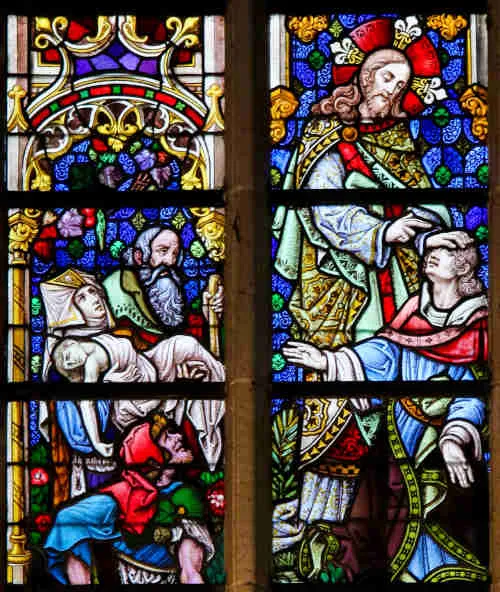
Fiacre had the gift of healing by laying on his hands; blindness, polypus, and fevers are mentioned by the old records as being cured by his touch; he was especially effective against a type of tumor or fistula later known as “le fic de S. Fiacre”.

Fiacre’s connection to cab drivers is because the Hotel de Saint Fiacre in Paris, France rented carriages. People who had no idea who Fiacre was referred to the cabs as Fiacre cabs, and eventually just as fiacres. Those who drove them assumed Fiacre as their patron.

Died

  • 18 August 670 of natural causes
  • his relics have been distributed to several churches and cathedrals across Europe

Canonized

  • Pre-Congregation

Patronage

  • against barrenness
  • against blindness
  • against colic
  • against fever
  • against fistula
  • against hemorrhoids or piles
  • against headache
  • against sterility
  • against syphilis
  • against venereal disease
  • sick people
  • box makers
  • brass workers
  • cab drivers
  • coppersmiths
  • florists
  • gardeners
  • hat makers, cap makers
  • harvests
  • hosiers
  • lead workers
  • needle makers
  • pewterers, pewtersmiths
  • potters
  • taxi drivers
  • tile makers
  • trellis makers
  • Saint-Fiacre, Seine-et-Marne, France

Representation

  • man carrying a spade and a basket of vegetables beside him, surrounded by pilgrims and blessing the sick
  • Benedictine monk with a shovel
  • Benedictine monk with a heavy staff interceding for sick people
  • Benedictine monk with pilgrims
  • Benedictine monk with a basket of vegetables
  • shovel
  • spade

Source: https://catholicsaints.info/saint-fiacre/

Saint Fiacre Read More »

Matthew 25:20-21

Gifts of the Holy Spirit in Superabundance

The one who had received five talents came forward bringing the additional five. He said, ‘Master, you gave me five talents. See, I have made five more.’ His master said to him, ‘Well done, my good and faithful servant. Since you were faithful in small matters, I will give you great responsibilities.

Reflection:

Oftentimes, when we are presented with a story of success versus tragedy, our attention goes to the tragedy first. The parable we are given today, the Parable of the Talents, presents us with three persons. Two of the people display stories of great success. One, however, offers a story that is more tragic. The tragic story ends by the master telling the servant who buried his money that he is a “wicked, lazy servant!” But both of the success stories end with the master saying, “Well done, my good and faithful servant. Since you were faithful in small matters, I will give you great responsibilities.” Let’s focus upon these success stories.

Both of the servants who were successful doubled the master’s money. Even from a secular point of view, that is very impressive. If you were investing money with a financial advisor and shortly after investing you were told that your money had doubled, you’d be quite pleased. Such a rate of return is rare. This is the first message we should take from this parable. Doubling the gifts and graces God gives us is very doable. The reason for this is not primarily because of us; rather, it’s because of God. By their very nature, God’s gifts to us are meant to grow. By its very nature, grace flows in superabundance; and, when we cooperate with God’s grace, then it grows in an exponential way.

When you consider your own life, what gifts has God given to you that He wants you to use for His glory? Are there gifts buried away that remain stagnant or, even worse, are used for purposes that are contrary to the divine plan for your life? Some of the more obvious gifts you were given within your very nature are your intellect and will. Additionally, you may be extra-talented in one way or another. These are all gifts given on a natural level. In addition to these, God often bestows supernatural gifts in abundance when we begin to use what we have for His glory and for the salvation of others. For example, if you work to share the truths of our faith with others, God will begin to deepen your supernatural gifts of Counsel, Wisdom, Knowledge and Understanding so that you will be able to speak about God and His will. All seven of the Gifts of the Holy Spirit are among the clearest examples of supernatural gifts given by God as follows: Wisdom, Understanding, Counsel, Fortitude, Knowledge, Piety, Fear of the Lord. The prayer that concludes this reflection comes from a traditional novena to the Holy Spirit and not only asks for these gifts but also gives a short description of them for a better understanding. 

Reflect, today, upon the fact that what God has given to you, both on a natural and supernatural level, must be devoted to the service of God and others. Do you do this? Do you try to use every talent, every gift, every part of who you are for God’s glory and the eternal good of others? If you don’t, then those gifts dwindle away. If you do, you will see those gifts of God’s grace grow in manifold ways. Strive to understand the gifts you have received and firmly resolve to use them for God’s glory and the salvation of souls. If you do, you will also hear our Lord say to you one day, “Well done, my good and faithful servant.”

Source: https://catholic-daily-reflections.com/2025/08/29/gifts-of-the-holy-spirit-in-superabundance-4/

Matthew 25:20-21 Read More »

The Passion of Saint John the Baptist, Martyr

John, the son of Zechariah and Elizabeth, was born approximately six months before the Savior of the World. He was likely born in the small, rural Jewish town of Ein Karem, located in the hill country about five miles west of Jerusalem. The surrounding land would have been utilized for agriculture and herding, centered around a town hub and water well. Uniquely, John was blessed with the presence of both the Son of God and the Mother of God at his birth. Many Catholic theologians, including the Angelic Doctor of the Church, Saint Thomas Aquinas, believe that while John was conceived in Original Sin, he was sanctified in the womb immediately after the Blessed Virgin Mary greeted his mother Elizabeth, several months prior to John’s birth. “When Elizabeth heard Mary’s greeting, the infant leaped in her womb…” (Luke 1:41). This leap in the womb has been interpreted as John’s sanctification by grace before he was born. Jesus would later say of John, “Amen, I say to you, among those born of women there has been none greater than John the Baptist” (Matthew 11:11).

Not much is known about John’s childhood other than what is stated in the Bible, “The child grew and became strong in spirit, and he was in the desert until the day of his manifestation to Israel” (Luke 1:80). Though he would have been raised devoutly in the Jewish faith by his parents in their hometown, John eventually entered the desert, about twenty miles east of his hometown, to live as a hermit, praying, practicing penance, and preparing for his mission.

John’s first mission was to serve as the precursor of the Lord. As the last of the Old Testament prophets and the first of the New Testament prophets, he bridges the gap to Christ. John’s mission was to precede Jesus “in the spirit and power of Elijah to turn the hearts of fathers toward children and the disobedient to the understanding of the righteous, to prepare a people fit for the Lord” (Luke 1:17). Sometime between the years 27–29, John received inspiration from God in the Judean desert and started to gather disciples whom he taught, called to repentance, and baptized with water. John’s preaching was fierce, branding some a “brood of vipers” and demanding evidence of their conversion. He called tax collectors, soldiers, religious leaders, the average townspeople, and even Herod to repent. Many responded.

John’s life reached its earthly climax when he saw Jesus, the Son of God, approaching him in the desert while he was baptizing. John immediately exclaimed, “Behold, the Lamb of God, who takes away the sin of the world. He is the one of whom I said, ‘A man is coming after me who ranks ahead of me because he existed before me.’ I did not know him, but the reason why I came baptizing with water was that he might be made known to Israel…Now I have seen and testified that he is the Son of God” (John 1:29–3134). John reluctantly baptized Jesus, after which the Holy Spirit descended upon Jesus in a visible form and the Voice of the Father thundered, “This is my beloved Son, with whom I am well pleased” (Matthew 3:17). With that, John’s life began to recede into the background, “He must increase; I must decrease” (John 3:30).

Today, the Church commemorates one of the oldest feasts within the Church, the Memorial of the Beheading of Saint John the Baptist. Just as John preceded Jesus in birth, preaching, and baptizing, so too did he precede Jesus in death, dying as a prefiguration of the one who would give His life sacrificially on the Cross.

John’s death resulted from his bold proclamation of the truth. His call to repentance extended to everyone, including Herod Antipas, the tetrarch, ruler of Galilee and Perea. Although it appears that the area where John was preaching (the Jordan Valley) was not directly governed by Herod, Herod nonetheless was well aware of John’s preaching and his condemnation of him. As a result, Herod was able to have John arrested and imprisoned.

John was most likely imprisoned in a fortress constructed by Herod Antipas’ father, Herod the Great, named Machaerus, northwest of the Dead Sea, in modern-day Jordan. Alternatively, he might have been imprisoned in the Herodium, another palace under Herod’s control just south of Jerusalem.

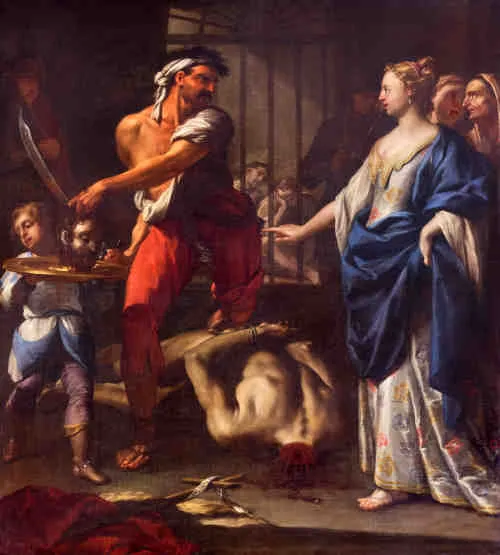
Two of the Gospels narrate the story of John’s death: Matthew 14:1–12 and Mark 6:14–29. John’s criticism of Herod was specific. He condemned Herod’s unlawful marriage to his brother’s wife, Herodias. Though Herod seemed to fear John and his disciples because of John’s popularity and the power of his words, he decided to appease Herodias’ hatred of John for condemning her and Herod. On Herod’s birthday, Herodias’ daughter, traditionally named Salome, performed a dance for Herod and his guests that so pleased him that he promised her anything she asked of him, up to half of his kingdom. Her mother saw her opportunity for revenge and convinced her daughter to ask for the head of John the Baptist on a platter. In his weakness, Herod complied.

After John’s death, the Bible tells us that “His disciples came and took away the corpse and buried him; and they went and told Jesus” (Matthew 14:12). The news caused Jesus to withdraw alone in a boat to a deserted place to pray. Jesus not only grieved with human sorrow over the death of his cousin, but he also came face-to-face with the reality of His own fate. Thus, His time of prayer was a period in which He perfectly renewed His fidelity to the Mission on which He was sent, to give His life for the salvation of souls. Traditionally, it is believed that John’s body was buried in the town of Sebaste, about fifty miles north of Jerusalem. Various traditions have evolved over the centuries about what happened to his head. Some say Herodias buried it in a dung heap to hide it from his followers and it was later discovered, buried in the Mount of Olives, and today is preserved in the Church of San Silvestro in Capite, Rome, Italy. This tradition, among many others, is impossible to confirm.

As we honor this man so highly honored by our Lord, we also honor our Lord Himself. John’s life was given to the mission to which he was called. He never wavered and willingly accepted even death, rather than shy away from God’s will. He introduced the Lamb of God to the world and led the way for Jesus by his preaching, baptism of repentance, and death, which prefigured Jesus’ own death. As you ponder Saint John’s life, reflect especially upon the wholehearted commitment he made to selflessly give himself to the mission he received. Where you see hesitancy in your own life, take inspiration from Saint John the Baptist, praying that you will exemplify his courage and resolve to fulfill the will of God.

Source: https://mycatholic.life/saints/saints-of-the-liturgical-year/august-29the-beheading-of-st-john-the-baptist/

The Passion of Saint John the Baptist, Martyr Read More »

Mark 6:17-19

Fidelity in Suffering

Herod was the one who had John the Baptist arrested and bound in prison on account of Herodias, the wife of his brother Philip, whom he had married. John had said to Herod, “It is not lawful for you to have your brother’s wife.” Herodias harbored a grudge against him and wanted to kill him but was unable to do so.

Reflection:

The suffering and death of Saint John the Baptist greatly parallels the suffering and death of Jesus. They were cousins. John was one of the first to acknowledge the divine presence of our Lord when he leaped for joy in the womb of his mother during the Visitation of Mary to Elizabeth. John lived a holy and simple life, embracing His mission to prepare the way for the Lord. He was the last and greatest of the Old Testament prophets. Of him, Jesus said that there was no one born of woman who was greater than John. For these reasons, we should not be the least bit surprised that John’s suffering and death parallelled and prefigured the death of the Savior of the World.

Herod was fearful of John, believing him to be a holy man of God. He imprisoned him with a certain regret, knowing that he was innocent. Similarly, before Pilate condemned Jesus to death, he found Him not guilty of any crime. Pilate knew Jesus was innocent but allowed fear to direct his choice to condemn our Lord.

John was ultimately killed because of the hatred and plotting of Herodias, the unlawful wife of Herod. It was Herodias’ anger that became a weapon, forcing Herod to put John to death. Similarly, it was the jealousy and anger of the religious leaders at that time that instigated and drove the death of Jesus. Pilate, like Herod, was at first unwilling to condemn our Lord. But the relentless hatred of the scribes and Pharisees compelled Pilate to condemn Jesus, just as it was Herodias’ hatred that compelled Herod to kill John.

After John’s death, some of his disciples came to carry his body away for burial. This was permitted by Herod, perhaps because of his feelings of guilt. So also with our Lord, Pilate permitted some disciples and the holy women to carry Jesus’ dead body to the tomb for burial.

In the end, the good fruit of Jesus’ death infinitely overshadowed the crime that was committed against Him. So also with John. We can be certain that, as a martyr, the blood he shed as a witness to Christ bore spiritual fruit that surpassed all he had done in his public ministry.

Each of us is called to imitate our Lord and, therefore, should also take inspiration from Saint John the Baptist. They both were innocent but suffered greatly. They both spoke the truth, despite the hatred of some. They both gave their lives, in accord with the Father’s plan. Jesus was John’s Savior; John was but a precursor and servant of our Lord.

Reflect, today, upon the invitation God has given to you to imitate the life of John the Baptist by uniting yourself to his Lord. The first form of imitation will take place when you commit yourself to the proclamation of the truth in accord with your mission. What mission has God given to you? How is He calling you to proclaim the Gospel with courage, strength, determination and fidelity to the end? Reflect, also, upon the injustice inflicted first upon John and then upon our Lord. As you do, try to look at any injustice you have received in life in the light of John’s and Jesus’ lives. They did not run away from injustice. They embraced it as a sacrifice and offered it to the Father in Heaven. Jesus’ Sacrifice brought forth the Salvation of the World; John’s was but a sharing in that glorious offering. Make your offering with them, and do not hesitate to do so with deep love and trust in the Father’s plan.

Source: https://catholic-daily-reflections.com/2025/08/28/fidelity-in-suffering-5/

Mark 6:17-19 Read More »

Saint Augustine of Hippo, Bishop and Doctor of the Church

354–430; Patron Saint of brewers, printers, and theologians; Invoked against sore eyes and vermin; Pre-Congregation canonization; Declared a Doctor of the Church by Pope Boniface VIII in 1298; Referred to as “Doctor of Grace” by popular acclaim

Yesterday, the Church honored Saint Monica, the mother of today’s saint, Saint Augustine. Despite her challenging life, Monica fulfilled her most crucial duty as a mother and wife. She prayed for her family and demonstrated such compelling virtues that her husband, mother-in-law, and all three of her children were converted to Christ. Among them was Saint Augustine of Hippo, one of the Church’s most revered saints.

Aurelius Augustinus Hipponensis, known as Augustine, was born in Tagaste, present-day Souk Ahras, Algeria, North Africa. He was the oldest of three children, including a younger brother and sister. His father, Patricius (Patrick) was not wealthy but had civic responsibilities in his city, which was part of the Roman Empire. His father was a pagan, known for his violent temper and immoral lifestyle. Augustine’s mother, known today as Saint Monica, struggled with alcohol at an early age but overcame that vice. She was raised a Christian and wholeheartedly embraced her Catholic faith. Despite suffering due to her husband’s temper and adulterous behavior, Monica was a model of charity, and her prayers eventually converted her whole family.

Augustine’s father would not permit his children to receive baptism, despite their mother’s pleas. Nevertheless, Monica ensured their catechetical formation from an early age, as well as an education in the classics. Monica’s faith instilled within Augustine an awareness of Christ his Savior, but that awareness never fully penetrated his young mind. Instead, he became a troublemaker. For instance, he and his friends once stole some pears, not because they were hungry or because the pears tasted good, but merely for the thrill of it. He later recounted in his Confessions, “I loved my own undoing. I loved my error—not that for which I erred but the error itself…seeking nothing from the shameful deed but shame itself. It was a love of sin.”

Because Augustine excelled in his studies in his hometown, his proud father decided to send him to the thriving nearby city of Carthage to continue his education, once he could find someone to pay for it. This took several months, and Augustine’s idleness during that time only led him into greater mischief. His father died that year, but a wealthy citizen of Tagaste offered to sponsor Augustine’s education. By the time he arrived in Carthage, he was ripe for a life of sin. Many of the other students lived immorally, the theaters stirred up his passions, and he became intoxicated by his literary successes. Shortly after his arrival, he moved in with a young woman and fathered a child out of wedlock. When he was nineteen, he read a book that would begin to change his life: Cicero’s Hortensius. Although that book is now lost to history, it extolled the virtue of wisdom. Reading it awakened a hunger for truth within Augustine, which he began to pursue earnestly. Unfortunately, at this time he started doubting his Christian faith, primarily due to his struggles with the Old Testament, which he perceived as violent and confusing. He then encountered the religious philosophy of Manichaeism, which claimed to have discovered secret knowledge and supported his view that the Bible had contradictions. Manichaeism looked at reality as a struggle between light and dark, good and evil. It regarded the created world as part of the dark side, aiming to trap us in darkness. This new religion influenced him, and he looked into it more. Although he never formally joined, he pursued their teachings in the hope of discovering the wisdom they promised. Several years later, he would abandon them altogether, especially after meeting their leader, Faustis, who proved a disappointment and less than wise.

When Augustine completed his studies in Carthage around the age of nineteen, he returned home to Tagaste with his girlfriend and son and began teaching grammar at a local school. When he told his mother he was considering becoming a Manichaean, she threw him out of her house but later reconciled with him due to divine inspiration she received. He was so successful as a teacher that he was invited back to Carthage a few years later to teach Rhetoric. After several successful years, he received an invitation to Rome, which was a great honor. When he informed his mother, she told him that she was going with him, to which he reluctantly agreed. However, Augustine tricked his mother and left for Rome without her. In Rome, he became disgusted with the students who cheated him out of tuition fees, and after a few years, accepted a position in Milan. It was in Milan, when Augustine was thirty years old, that his mother finally caught up with him and witnessed his conversion.

Still searching for the truth, Augustine met the future saint, Bishop Ambrose of Milan. Ambrose was a great thinker and preacher. He also paid attention to Augustine, listening to him, offering him friendship, and answering his many questions. Ambrose introduced him to the proper reading of the Bible, especially helping him with his difficulties with the Old Testament. When Ambrose came into conflict with the Empress Justina who was trying to take his Cathedral and make it Arian, Ambrose stood his ground in an act of great courage and defiance. She backed off and Augustine was greatly impressed.

One day while sitting in a garden, Augustine heard a child’s voice say to him, “Take and read.” Although he didn’t know where the voice came from, he picked up the Bible next to him and randomly opened to Romans 13:13-14 which read, “…let us conduct ourselves properly as in the day, not in orgies and drunkenness, not in promiscuity and licentiousness, not in rivalry and jealousy. But put on the Lord Jesus Christ, and make no provision for the desires of the flesh.” This passage affected him so deeply that he began his conversion in haste.

Augustine spent time with good Catholic friends and had lengthy conversations, which helped him immensely. His mother’s presence was also a great support. Although she was uneducated, her wisdom and insight into the truth were undeniable, and she always held her own with her well-educated son. All of this, coupled with Monica’s tearful prayers, led the thirty-two-year-old Augustine toward his final conversion and baptism the following year by Bishop Ambrose during the Easter Vigil in 387, along with his son. Once baptized, Augustine decided to return to his hometown with his mother, son, and friends. On the way, his mother fell ill just outside of Rome and died. Augustine later recounted her passing in the Confessions, which is one of the most beautiful depictions of a mother and son’s love ever written.

Upon returning to Tagaste, Augustine formed a religious community with his friends. His reputation within the Christian community grew quickly, and their hometown genius who had become a Catholic became a source of hope for many. By acclamation of the people, he became a priest in 391 and was consecrated as bishop of the nearby town of Hippo in 396. During his forty-three years as a Christian, Augustine became one of the greatest, if not the greatest, theologians in the history of the Church. His pastoral work with the people, his regular sermons, and his attentiveness to the people’s needs changed their lives. 

Augustine’s voluminous writings remain among the most read and quoted texts today. His works include apologetics, sermons, letters, scripture commentaries, a monastic rule, and philosophical and theological treatises. His greatest work, Confessions, is autobiographical, deeply personal, and humble. It traces his internal conversion and intersperses it with profound theological insights. In his other great work, City of God, he defends the faith and refutes the idea that the sack of Rome in 410 was caused by a rejection of pagan gods. Instead, he compares the city of man with the city of God, pointing society to the ideals to which it is called. He also wrote a famous work on the Trinity, among numerous other works. In total, over five million words written by Augustine have survived until today, numbering over 1,000 documents. In his last year of life, he witnessed the destruction of Hippo as the barbarians invaded, murdered, destroyed churches and buildings, and overthrew the town as they had done in Rome years earlier. They could not, however, destroy the lasting impact Saint Augustine would have. His influence extends far beyond the Church; he has profoundly impacted the entirety of Western thought. 

As we honor this pillar of wisdom, consider especially Augustine’s personal journey towards Christ. In many ways, Saint Augustine lived two lives. At first, he was a weak, confused, and sinful man. After that, he became a sinner who was redeemed and transformed by grace. His struggle led him to the truth and when that happened, God used him in extraordinary ways. His life can be summed up in one of his most famous quotes, “Our hearts were made for You, O Lord, and they are restless until they rest in you.” Ponder your own story of conversion, and especially any ways that you are restless. Follow this saint’s example and seek the Truth with all your heart, knowing that God will reveal Himself to you when you are ready, so that you can rest in Him.

Source: https://mycatholic.life/saints/saints-of-the-liturgical-year/august-28st-augustine-of-hippo/
Saint Augustine of Hippo, Bishop and Doctor of the Church Read More »

Matthew 24:42-44

Gentle Promptings of Grace

“Stay awake! For you do not know on which day your Lord will come. Be sure of this: if the master of the house had known the hour of night when the thief was coming, he would have stayed awake and not let his house be broken into. So too, you also must be prepared, for at an hour you do not expect, the Son of Man will come.”

Reflection:

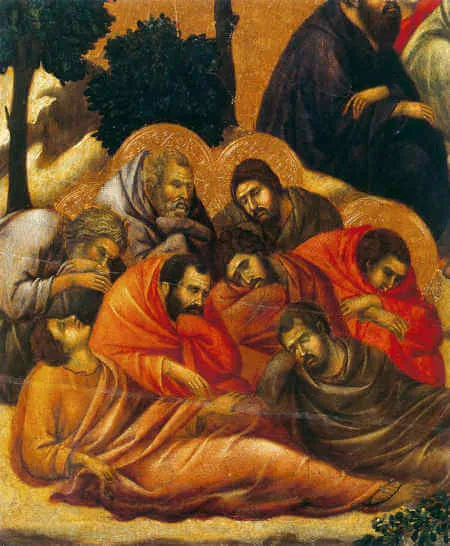
Our Lord contrasts the call to stay awake with those who are asleep. Clearly, by stating “Stay awake!” so emphatically, Jesus is also telling us that it is easy to fall asleep, spiritually speaking. So are you more often awake and attentive to His presence? Or are you most often asleep and therefore unaware of His presence?

First of all, this exhortation must be understood as a reference to our passing from this life. And though most who are younger do not expect to pass suddenly and unprepared, we know that this does happen. It could happen to any one of us at any time, unexpectedly and without warning. Therefore, we must see this passionate exhortation from Jesus to be a clear warning to always be ready to meet Him in our particular judgment upon our passing from this life.

With that said, this passage is also an invitation to become increasingly aware of the countless ways in which Jesus speaks to us each and every day. The goal of the Christian life must be to be continually at prayer. This does not mean that we are necessarily “saying” prayers all day every day. Rather, it means that we form a spiritual habit of becoming continually attentive to the promptings of grace given to us throughout our lives. God wants to lead us always. He wants to inspire us with His grace every day all day. He wants us to have one eye on the things that occupy our day and the other eye upon Him, allowing Him to gently lead us through everything.

Sometimes we can fall into the trap of thinking that God is only concerned about the big decisions of life. But the truth is that God is most clearly found in the details of life, even the smallest ones: a short exchange of words with a family member, a smile at a co-worker, a kind gesture to a stranger, and a random prayer offered for an anonymous person in need of that prayer. All of these are but a few examples of the many ways that God wants to commune with us every day throughout the day. And this can only happen if we are continually awake and attentive to His gentle promptings of grace.

How is this accomplished? How do we become attentive to God as He speaks to us and guides us every moment of every day? It is done by forming a spiritual habit of ongoing prayer. We begin by setting aside time for prayer every day, time in which all we do is pray. We set aside all distractions and begin by offering prayers, meditating upon scripture, attending the Mass, speaking from our hearts, etc. But from there, this special time of prayer, set aside exclusively for God, must begin to have an effect upon us throughout the day. And when we get distracted by the things of the world, we stop again, focus exclusively on God, and invite Him to be with us yet again. And then this is done again, and again, and again. Prayer must become a consuming habit by which God becomes present to everything we do. When this happens, we become spiritually “awake” to Him always.

Reflect, today, upon this clear and concise exhortation from our Lord. “Stay awake!” Let those words resonate within you. Hear them as a call to form this holy habit of prayer throughout the day. If you do so, God will slowly take over your life and lead you each and every day into His holy will. And through you, God will be able to extend His love and mercy to many who are in your life and beyond.

Source: https://catholic-daily-reflections.com/2025/08/27/gentle-promptings-of-grace-3/

Matthew 24:42-44 Read More »

Saint Monica

c. 332–387; Patron Saint of homemakers, married women, mothers, abuse victims, alcoholics, and widows; Invoked against difficult marriages and difficult children; Pre-Congregation canonization

Saint Monica, whom we honor today, was the mother of one of the greatest saints in the history of the Church: Saint Augustine. Monica was most likely born in Thagaste, present-day Souk Ahras, Algeria, North Africa, and was a member of the Berber tribe, a diverse group of peoples indigenous to North Africa prior to the arrival of the Arabs. Thagaste was then part of the Roman Empire, which had legalized Christianity just twenty years before Monica was born. She was raised in a Christian home and became quite devout. Because Christianity was still new to the Roman Empire, Christians were likely a minority at that time. Monica married a man named Patricius (Patrick), who was a pagan and said to have had a violent temper and an immoral lifestyle. Patricius’ mother lived with the couple and is said to have had the same violent temperament as her son. Monica and Patricius had three children: sons Augustine and Navigius and a daughter whose name is unknown.

Monica’s marriage and home life were difficult, but she was a woman of deep faith and prayer. Earlier in her life she had struggled with alcohol but overcame those difficulties. Once married, her husband opposed her Christian faith and prayer life, but he also saw in her something that led to his respect for her. She wanted to baptize her children when they were born, but Patricius refused permission. His refusal broke her heart and led to her unwavering prayers for her family. When Augustine became ill as a child, Patricius initially agreed to permit his baptism, but when the boy recovered, Patricius once again forbade it.

Monica’s only recourse was prayer. She prayed fervently for her family’s conversion, and her prayers began to take hold. Patricius admired Monica’s virtues and was deeply affected by her love for him. That, coupled with her prayers, led to Patricius’ conversion and baptism around the year 370. He died one year later. Patricius’ mother also converted.

Augustine, her oldest child, was around sixteen when his father died. He had received a good education as a youth at a school about twenty miles south of their hometown. When Augustine was seventeen, he was sent to Carthage, in modern-day Tunisia, to study rhetoric. Though part of the Roman Empire at that time, Carthage had its roots in Greek culture and had some of the best schools where many prominent figures in society were educated. In Carthage, Augustine was searching for truth. After reading Cicero’s dialogue Hortensius, his thirst for truth grew stronger. Around this time, Augustine met a woman with whom he lived and had a child, despite his mother’s strong warnings against fornication.

In Carthage, Augustine was introduced to the teachings of Mani, a man who claimed to be the final prophet in a line of prophets such as Buddha, Zoroaster, and Jesus. Mani taught that there was a fundamental conflict between two opposite, co-eternal principles: light and darkness. Light was good; darkness was evil. He taught that the material world was a union of light and darkness, good and evil, and that the goal of human life was to release the light trapped within the darkness of the material world. Augustine embraced this religion, becoming a Manichaean. But there was one problem Augustine would face: his mother’s prayers and faith were powerful.

When Augustine returned from school in Carthage, he began to teach in his hometown. It was then that he announced he had become a Manichaean. As a result, Monica threw him out of her house as an act of the deepest love. God then spoke to her in a vision that gave her hope for her son, and she reconciled with him.

Augustine decided to open a school of Rhetoric, and he could think of no better place to do so than Rome. Around the age of thirty-one, he informed his mother that he was going to Rome. Because of her motherly concern for her son and because she had seen her two other children convert and be baptized, she informed Augustine she was going with him. However, before she knew it, Augustine sneaked away and traveled to Rome without her. She would not give up, so she followed. By the time she arrived in Rome, Augustine had already left and taken a prestigious teaching position in Milan. She followed him there.

Over the next four years in Milan, Monica never gave up, praying for her son through tears. Since Augustine was impressed with intellectuals, he was drawn to the Catholic Bishop of Milan and future Saint Ambrose. Bishop Ambrose was an answer to a mother’s prayers. Around the year 387, at the age of thirty-three, Augustine converted to Christianity and was baptized by Bishop Ambrose.

Once converted, Augustine and his mother decided to return home to Thagaste, but Monica would never complete the trip. She fell ill and died in Ostia, a city just outside of Rome. Augustine went on to become one of the most influential theologians in the history of the Church. In his book, Confessions, Saint Augustine shares the beautiful story of his mother. He highlights all that we know about her. He shares her early struggle with alcohol. When Augustine went astray at Carthage, he recalls how she wept for him more than most mothers would weep over the death of their child. Augustine recounts how fervently his mother prayed while they were in Milan and sought the counsel of Bishop Ambrose. Augustine’s most tender description of his mother describes his relationship with her after his conversion, their conversations, and her death. She had a profound impact upon him, and he, in turn, has had a profound impact upon the entire Church.

Saint Monica endured a difficult life, but she persevered, overcame her difficulties, and devoted herself to a life of prayer and virtuous living. Her prayers and virtues first won over her husband and mother-in-law, then all three of her children. Though Saint Augustine is the most well known, this mother, daughter-in-law, and wife made a difference in the lives of her entire family. Saint Monica is seen by many as a model of hope for those whose family members have gone astray. As we honor her today, ponder the power of her prayers. As you do, be reminded that your prayers for your family are also powerful. If you have someone in your family who has gone astray, allow Saint Monica to inspire you and devote yourself to praying for them, so that each member of your family will share, one day, the glories of Heaven with you.

Source: https://mycatholic.life/saints/saints-of-the-liturgical-year/st-monica-mother-of-st-augustine—august-27/

Saint Monica Read More »