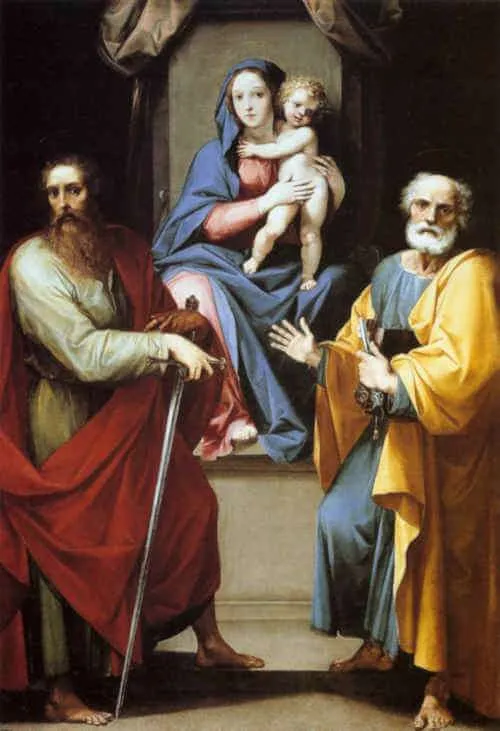
Author name: Sani

Saints Peter and Paul, Apostles

Saint Peter: c. 1–c. 64; Patron Saint of Rome, bakers, brickmakers, masons, bridge-builders, butchers, clockmakers, cobblers, fishermen, harvesters, watchmakers, locksmiths, netmakers, the papacy, and the Universal Church; Invoked against feet problems, fevers, and frenzy

Saint Paul: c. 3–c. 64; Patron Saint of Rome, evangelists, theologians, musicians, public relations personnel, writers, publishers, and reporters; rope-, saddle-, and tentmakers; Gentiles; Cursillo movement; and Catholic Action; Invoked against snakes and hailstorms Pre-Congregation canonizations

According to ancient Roman mythology, in the seventh century BC, King Numitor was forcefully removed from his throne by his brother, Amulius. Amulius then forced Numitor’s daughter, Rhea Silvia, to become a Vestal Virgin so that she would not have children who could later attempt to reclaim the throne. However, one myth relates that Mars, the god of war, impregnated Rhea Silvia, and she bore twin sons Romulus and Remus. Amulius threw them into the river, but they were rescued by a she-wolf. When they grew up, they killed Amulius and restored their grandfather to his throne. They then decided to found a city but disagreed on its location, so Romulus killed Remus and founded a city, calling it Rome, after his own name. After his death, or ascension, he was said to have been deified as the god Quirinus. To this day, one of the seven hills of Rome is named after him, the Quirinal Hill. This ancient myth helped make up the religious beliefs of the people of Rome at the time when today’s saints, Saints Peter and Paul, entered Rome and preached the Gospel, laying down their lives as martyrs.

Myths that explained a city’s founding were important. These myths were often central aspects to the cultural and historical festivities in ancient times. This was especially true in Rome. Therefore, as the early Church began to take root in Rome, rather than dismissing this cultural practice, the early Church Christianized the story of Romulus and Remus by introducing a new festival for the new founders of Rome, Peter and Paul, on June 29.

Simon was born in Bethsaida, near the Sea of Galilee. He was a fisherman by trade, along with his brother Andrew. Matthew’s Gospel records that Simon and Andrew were the first whom Jesus invited to follow Him. After Jesus was baptized by John the Baptist and completed His forty days of prayer and fasting in the desert, He went to the Sea of Galilee, saw Simon and Andrew fishing and called to them saying, “Come after me, and I will make you fishers of men” (Matthew 4:19). At that, these two brothers dropped everything and became Jesus’ first disciples. John’s Gospel relates a slightly different timeline, stating that Andrew first followed Jesus and brought Simon to Jesus the next day. When Jesus met Simon, He said, “‘You are Simon the son of John; you will be called Cephas (which is translated Peter)” (John 1:42). Matthew’s Gospel relates that Jesus changed Simon’s name to Peter when He said to him, “I say to you, you are Peter, and upon this rock I will build my church, and the gates of the netherworld shall not prevail against it. I will give you the keys to the kingdom of heaven. Whatever you bind on earth shall be bound in heaven; and whatever you loose on earth shall be loosed in heaven” (Matthew 16:18–19).

With his new name and unique spiritual authority in which he held the “keys to the kingdom of heaven,” Peter emerged as the central leader of the Church after Pentecost. He spent about a decade in Jerusalem, preaching powerfully, performing miracles, and converting many. He eventually traveled to Rome where he established the Church there, becoming its first bishop. Around the year 64, he was martyred during the persecutions of Emperor Nero. Tradition states that Peter requested to be crucified upside down because he did not consider himself to be worthy of dying the same way Jesus died. His tomb is located under the main altar of Saint Peter’s Basilica.

Saul was born as a Roman citizen in Tarsus, modern-day Turkey. As a young man, he went to Jerusalem to study at the renowned school of the rabbi Gamaliel. After Jesus’ ascension into Heaven, Saul became one of the fiercest persecutors of the early Church, being partly responsible for the death of the proto-martyr Saint Stephen (Acts 7:58). However, within a few years, as Saul was traveling to Damascus to persecute other Christians, he was knocked to the ground and struck blind. He heard Jesus say to him, “Saul, Saul, why are you persecuting me?” (Acts 9:4). Jesus then directed him to a disciple of the Lord in Damascus named Ananias who baptized Saul. Saul spent about three years in Arabia where he went through an intense time of prayer and study, eventually returning to Damascus and then to Jerusalem where Barnabus introduced him to the other disciples, testifying to the veracity of his conversion.

In Jerusalem, Saul began to use his Roman name, Paul, and then spent approximately the next ten years as a missionary throughout the Mediterranean. Back in Jerusalem, he was imprisoned for a couple of years and then was sent to Rome for trial since he was a Roman citizen. In Rome, he met up with Saint Peter. According to tradition, Paul was beheaded just outside the city of Rome. When his head fell to the ground, it bounced three times, each time giving rise to a spring of water. The place is marked today by the Abbey of the Three Fountains.

Saints Peter and Paul are considered the foundational pillars of the Church. Peter represents the stability of the Church and the office of the Vicar of Christ. Paul represents the mission of evangelization that was entrusted to the Church by Jesus Himself. He was also the Church’s first theologian, which is seen in his numerous letters that expound on the Gospels. Though unlikely, one tradition states that they were both martyred on June 29, in Rome, making them twin martyrs. Their twin martyrdom reminds us that the Church must be both stable and mission-oriented. It must remain grounded in the ancient Truth, yet grow and flower with an ongoing understanding of the mysteries of faith.

As we honor these two pillars of the Church, recall the fact that, though they are great saints, they were also ordinary men called to extraordinary vocations. They responded and God used them in ways they could have never imagined. Ponder your own calling in light of theirs and resolve to lay your life down for the Church, joining yourself to these two men so that God can continue their holy mission through you.

Source: https://mycatholic.life/saints/saints-of-the-liturgical-year/june-29—saints-peter-and-paul-apostles–solemnity/

Saints Peter and Paul, Apostles Read More »
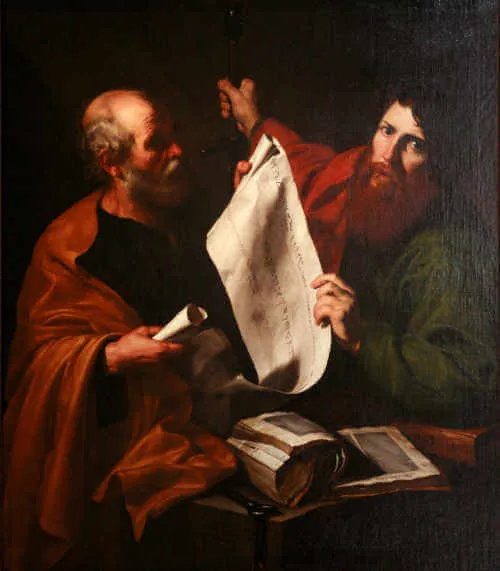
Matthew 16:17-19

Pillars of the Church

And so I say to you, you are Peter, and upon this rock I will build my Church, and the gates of the netherworld shall not prevail against it. I will give you the keys to the Kingdom of heaven. Whatever you bind on earth shall be bound in heaven; and whatever you loose on earth shall be loosed in heaven.

Reflection:

Saints Peter and Paul are often referred to as two of the great “Pillars of the Church.” They each played an incredibly essential role in the establishment of the early Church. And though each of their roles was essential and foundational, their roles were as different as they were different as persons.

Peter was a family man, a local fisherman, uneducated and quite ordinary. From what we know about him prior to being called by Jesus, there was nothing that made him uniquely qualified to become one of the pillars of the new Church to be established by the Son of God. Jesus simply called him, and he responded. Jesus got into Peter’s boat, ordered him to lower the nets, and produced a huge catch of fish. When Peter saw this miracle, he fell down at Jesus’ feet and acknowledged that he was “a sinful man” who was unworthy of being in Jesus’ presence (See Luke 5:8). But Jesus informed Peter that he would from now on be catching men. Peter immediately left everything behind and followed Jesus.

Paul describes himself as “a Jew, born at Tarsus in Cili′cia, but brought up in this city at the feet of Gama′li-el, educated according to the strict manner of the law of our fathers, being zealous for God as you all are this day” (Acts 22:3). Paul was well educated in the strictest interpretation of the Jewish law, understood philosophy and was quite zealous as a young man. Recall, also, that prior to becoming a convert to Christianity, he “persecuted the church of God violently and tried to destroy it” (Galatians 1:13). In many ways, Paul would have been seen as the most unlikely person to be chosen to be a pillar of the Church, because he so vigorously opposed it at first. He even supported the killing of Saint Stephen, the first Christian martyr.

Though each of these men would have been considered by many as very unlikely founders of the Christian Church, this is exactly what they became. Paul, after his conversion, traveled far and wide to preach the Gospel, founding several new Churches throughout Asia Minor and Europe. Eventually he was arrested in Jerusalem, brought to Rome for trial and was beheaded. Over half of the New Testament books are attributed to Paul and half of the Acts of the Apostles detail Paul’s missionary journeys. Paul is especially known for his missionary activity to the Gentiles, those who were not Jews.

Peter’s role was truly a unique one. His name was changed from “Simon” to “Peter” by Jesus. Recall Jesus saying, “And I tell you, you are Peter (Petros), and on this rock (petra) I will build my church…(Matthew 16:18). “Peter” in Greek is Petros. However, the Greek word petra means a rock as a solid formation that is fixed, immovable, and enduring. Therefore, Jesus chose to make Peter a solid foundation of immovable rock on which the Church was to be built.

You, too, have been called by our Lord to a unique mission within the Church that has not been entrusted to another. In your own way, God wants to use you to reach certain people with the Gospel as He did with Saint Paul. And like Saint Peter, God wants to continue to establish His Church upon you and your faith.

Reflect, today, upon these two holy and unique pillars of our Church. As you do, ponder how God may want to use you to continue their mission in this world. Though Saints Peter and Paul are among the greatest and most consequential Christians within our world, their mission must continue, and you are among the instruments that God wants to use. Commit yourself to this mission so that the preaching of the Gospel and the rock foundation of our Church will remain strong within our day and age just as it was of old.

Source: https://catholic-daily-reflections.com/2025/06/28/pillars-of-the-church-4/

Matthew 16:17-19 Read More »

Immaculate Heart of Mary

Saturday following the second Sunday after Pentecost

The Immaculate Heart of Mary was created around 15 BC as a result of the Immaculate Conception, which is a dogma of our faith. As The Immaculate Conception, the Blessed Virgin Mary was preserved from all sin from the first moment of her conception by a singularly unique grace, preemptively bestowed upon her by the merits of her Son’s life, death, and resurrection. From the moment of her Immaculate Conception, Mary remained free from all sin as a result of her own free choice to cooperate with grace. As a result, she was conceived as a suitable instrument for the Incarnation of God, and she remained a suitable instrument throughout her life.

After Jesus’ birth, the Mother of God continued to perfectly cooperate with grace, accompany her Son, stand at the foot of His Cross, jointly offer Him to the Father, experience His Resurrection and His Ascension into Heaven, participate in the full outpouring of the Holy Spirit at Pentecost, and help give birth to the nascent Church through her motherly care. At the completion of her life, she was taken body and soul into Heaven to be with her Son and to be crowned as the Queen of Heaven and Earth, from which she mediates the love and mercy of God, and will do so for all eternity. The immaculate nature and this full view of our Blessed Mother’s life is the “big picture.” Today, we celebrate one specific aspect of that big picture—her Immaculate Heart.

Honoring the Immaculate Heart of Mary leads us to ponder that which she pondered—her own heart filled with perfect love. We first receive a glimpse of her heart in the Gospel of Luke. After the angels appeared to the shepherds in Bethlehem and announced the birth of Christ, they went in haste to where Jesus was born and found Mary, Joseph, and the Child lying in a manger. They told Mary and Joseph about their experience of the angel, “And Mary kept all these things, reflecting on them in her heart” (Luke 2:19). Twelve years later, Mary and Joseph traveled to Jerusalem from Nazareth for the annual feast of Passover. After completing the customary prayers and sacrifice, they began their journey home, thinking Jesus was in the caravan with relatives. When they discovered He was not, they returned to Jerusalem to find twelve-year-old Jesus talking with the teachers in the temple and asking them questions, and “all who heard him were astounded at his understanding and his answers” (Luke 2:47). After inquiring of Jesus why He remained, He told them He had to be in His Father’s house. Though Mary and Joseph did not fully understand the mystery they were witnessing, “his mother kept all these things in her heart” (Luke 2:51).

Every other encounter between Jesus and His mother in Scripture also reveals a sense of mystery and awe that evoked love and pondering. Most notably, as Jesus hung on the Cross, His mother stood before Him, gazing with love. From the Cross, Jesus entrusted Mary to John, and through John, to the whole Church.

Because the Mother of God was and is the Immaculate Conception, free from all sin throughout her life, then every part of who she was and is remained immaculate, including her heart. Mary’s heart, as with every human heart, is a symbol of every relational virtue that enables one to love. The Mother of God’s human love for her Son was perfect. And that is something worth pondering! Prior to the Mother of God and her Son, the perfection of human love did not exist. From the time of Adam and Eve, human love was mixed with selfishness and sin. From the moment of the Incarnation, the perfect exchange of human love was established between the Mother of God and her divine Son. Today we celebrate that perfect love and are invited to ponder it and share in it.

As a result of Jesus entrusting His mother to John and the whole people of God and her subsequent Assumption into Heaven and coronation as Queen, we also ponder the perfection of human love for us, her children, that flows from Heaven. By God’s will, that perfection of love is bestowed upon the Church and all Her members through the Immaculate Heart of Mary. We must not only ponder this glorious reality, we must also do all we can to be receptive sons and daughters of the love of our heavenly mother who loves us with a perfect love and bestows upon us the pure and perfect love of her Son’s divine grace that was instilled in her Immaculate Heart.

Devotion to the Blessed Virgin Mary began in apostolic times and continued through great saints, such as Ephrem the Syrian, Cyril of Alexandria, John Damascene, Gregory of Nazianzus, Ambrose of Milan, Augustine of Hippo, and Jerome. Though they did not make specific reference to the Immaculate Heart, they spoke of the Blessed Mother’s many virtues. These saints especially helped to lay the foundation for proclaiming Mary as the Mother of God (Theotokos) at the Council of Ephesus in 431.

From the twelfth to the fifteenth centuries, a number of saints contributed to the deeping of our understanding of the Blessed Virgin Mary. Among them are Saints Anselm of Canterbury, Bernard of Clairvaux, Mechtilde, Gertrude the Great, Bridget of Sweden, and Bernardino of Siena.

From the sixteenth century to the twentieth centuries, many other saints continued to develop our understanding of the Blessed Virgin Mary. In 1648, Saint John Eudes, a French priest and founder of the Congregation of Jesus and Mary, instituted a local feast in honor of the Holy Heart of Mary, fostering a realization of the love that the Blessed Mother had for her Son and for all people. This was the first liturgical feast approved by a local ordinary specifically honoring the “Holy Heart of Mary.” After him, Saints Louis de Montfort and Alphonsus Liguori wrote extensively on the Blessed Virgin Mary.

In 1854, Pope Pius IX proclaimed the Dogma of the Immaculate Conception, which paved the way for the specific title of the Immaculate Heart, and in the early twentieth century, Saint Maximilian Kolbe wrote extensively on the Immaculata.

In 1916, an angel appeared to three children in Fátima, Portugal, speaking of the “infinite merits of the Most Sacred Heart of Jesus and of the Immaculate Heart of Mary.” The following year, the  Blessed Virgin Mary, under the title of “Our Lady of the Rosary,” appeared six times to the children. During the second apparition, Our Lady said that Jesus “wishes to establish in the world devotion to my Immaculate Heart.” In 1925 and 1929, Our Lady appeared again to Lúcia to ask that her Immaculate Heart be honored on the first Saturday of each month.

In 1944, Pope Pius XII instituted the universal feast of the Immaculate Heart of Mary to be celebrated annually on August 22, and in 1969, Pope Paul VI moved the celebration to the Saturday after the Solemnity of the Sacred Heart.

As we honor the holy, most pure, and Immaculate Heart of Mary, try to ponder that which the Blessed Virgin Mary pondered during her life. Ponder the love she had for her Son. Ponder the mysteries contained within her heart. As you do, especially ponder the love that her heart has for you. Only in Heaven will we fully understand the holiness of Our Lady’s Immaculate Heart. For now, we must foster devotion to all that is contained within it and seek to open ourselves to the ongoing outpouring of God’s grace that dwells in an immaculate way in that holy sanctuary of love.

Source: https://mycatholic.life/saints/saints-of-the-liturgical-year/immaculate-heart-of-mary–memorial/

Immaculate Heart of Mary Read More »

Matthew 8:14-15

Touched by Grace

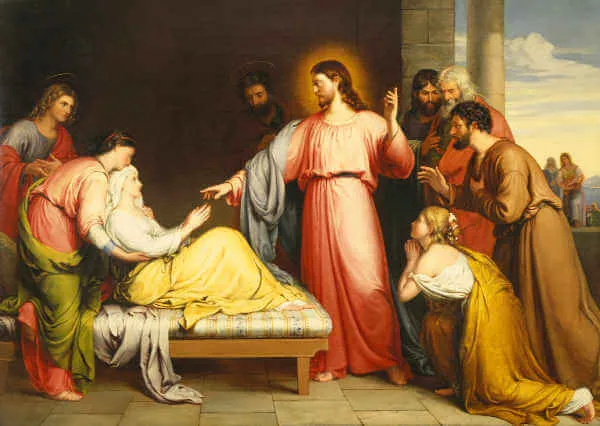
Jesus entered the house of Peter, and saw his mother-in-law lying in bed with a fever. He touched her hand, the fever left her, and she rose and waited on him.

Reflection:

How do we properly respond to the action of God in our lives? In the passage above, we are given the witness of Peter’s mother-in-law to answer that question. It should be noted that Jesus was on a continual mission of healing. In fact, before arriving at the house of Peter, Jesus had just healed a centurion’s servant. When the centurion came to Jesus stating that he was not even worthy to have Him enter his house, Jesus saw the centurion’s faith and healed his servant from a distance. After arriving at the house of Peter, we are told that many people brought to Jesus those who were possessed by demons, and Jesus healed them all. But between the healing of the servant and the healings of the many, another healing occurred. The response to this healing sets for us a wonderful example.

Peter’s mother-in-law was ill and in bed with a fever. It’s unclear just how ill she was, but the fact remains that she was ill to the point of being in bed. Notice, first, that Jesus was not even asked to heal her. Rather, He “saw” her ill and in bed, approached her of His own choosing, “touched her hand,” and she was healed.

Within the same sentence describing Jesus’ healing, we are told that “she rose and waited on him.” First of all, “she rose.” This should be seen as a symbolic depiction of what we must do when we are touched by grace. The grace of God, when it is given to us, must have the effect of causing us to rise. We rise from sin when we confess that sin and receive forgiveness, especially in the Sacrament of Reconciliation. We rise up every time God enters our lives to give us direction, clarity and hope. To rise is to be strengthened to dispel the burden that sin and confusion causes. We rise in strength, renewed and determined to go about the will of God.

After this woman rose, she “waited” on Jesus. This is the reason we rise up when touched by grace. We are not given God’s grace so that we can go back to our sin, or pursue our own ventures, or do our own will. We rise so that we can serve our Lord and His holy will. In a sense, Jesus’ actions in our lives impose upon us a holy burden. But it is a burden that is light. It’s an obligation to serve and give ourselves to our Lord to attend to Him, His holy will, and to all that He calls us to do.

Reflect, today, upon this threefold action of the Gospel. See Jesus approaching you and touching you in your prayer. Know that He comes to you not only because you pray to Him but out of His own initiative when He sees you will respond. Then consider your response. Rise from that which keeps you down. Let God’s grace free you from the burdens you carry. And as He grants you this grace, determine to wait on Him and to serve His will alone. The service of our Lord is what we are made for, and doing so will enable us to continually receive His grace through His touch of love.

Source: https://catholic-daily-reflections.com/2025/06/27/touched-by-grace-3/

Matthew 8:14-15 Read More »

Sacred Heart of Jesus

Friday following the second Sunday after Pentecost

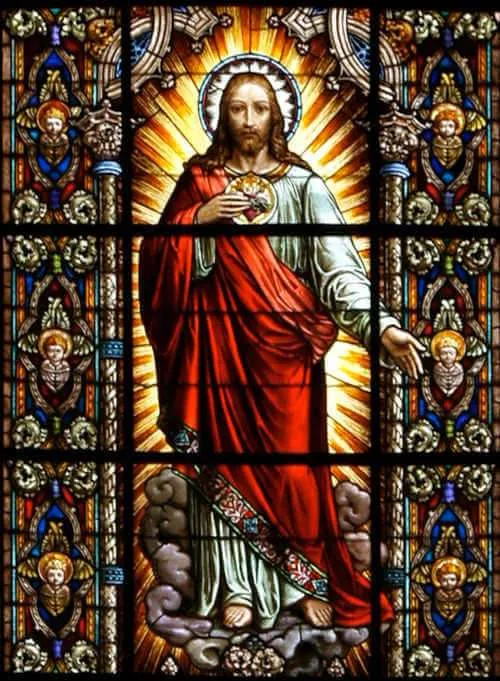
It could be said that devotion to the Sacred Heart of Jesus was first written about in John’s Gospel when John records that during the Last Supper he leaned back and rested his head on Jesus’ heart. In the thirteenth century, on December 27, the Feast of Saint John the Apostle, the German religious sister and mystic Saint Gertrude the Great had a vision of Saint John with Jesus during which she discussed that moment at the Last Supper. In that vision, Saint John said to Saint Gertrude, “Come, Spouse of my Master, together let us lay our heads on the most tender bosom of the Lord, in which all the treasures of Heaven and earth are enclosed.” As she rested her head on Jesus’ Heart, her soul was deeply stirred with devotion, and she said to Saint John, “…did these harmonious beatings, which rejoice my soul, also rejoice yours when you reposed during the Last Supper on the bosom of the Saviour?” Saint John responded, “Yes, I heard them, and my soul was penetrated with their sweetness even to its very center.” Saint Gertrude inquired, “How come, then, in your Gospel you have spoken so little of the loving secrets of the Heart of Jesus Christ?” Saint John responded, “My ministry, in those early times of the Church, was confined to speaking of the Eternal Word…but to these latter times was reserved the grace of hearing the eloquent voice of the Heart of Jesus. At this voice the time-worn world will renew its youth, be roused from its lethargy, and again be inflamed with the warmth of Divine love” (Revelations of Saint Gertrude the Great).

About 400 years later, on December 27, 1673, the Feast of Saint John the Apostle, a French cloistered Visitation Nun named Sister Margaret Mary Alacoque received the first of four visions that took place over the next eighteen months in which Jesus revealed His Sacred Heart and His desire that a feast be instituted in its honor. Though she had other visions and mystical experiences throughout her life, these visions were directly related to the Sacred Heart.

My Divine Heart is so passionately in love with men that it can no longer contain within itself the flames of its ardent charity. It must pour them out by thy means, and manifest itself to them to enrich them with its precious treasures, which contain all the graces of which they have need to be saved from perdition. I have chosen thee as an abyss of unworthiness and ignorance to accomplish so great a design, so that all may be done by Me (from the first vision).

He was brilliant with glory; His five wounds shone like five suns. Flames darted forth from all parts of His sacred humanity, but especially from His adorable breast, which resembled a furnace, and which, opening, displayed to me His loving and amiable Heart, the living source of these flames (from the second vision).

Behold, this Heart which has so loved men that it has spared nothing, even to exhausting and consuming itself, in order to testify its love. In return, I receive from the greater part only ingratitude, by their irreverence and sacrilege, and by the coldness and contempt they have for Me in this sacrament of love. And what is most painful to Me, is that they are hearts consecrated to Me. It is for this reason I ask thee that the first Friday after the octave of the Blessed Sacrament be appropriated to a special feast, to honor My Heart by communicating on that day, and making reparation for the indignity that it has received. And I promise that My Heart shall dilate to pour out abundantly the influences of its love on all that will render it this honor or procure its being rendered (from the third vision).

In her visions, Jesus also made twelve promises to those who would honor the Sacred Heart:

I will give them all the graces necessary for their state of life. I will establish peace in their families. I will console them in all their troubles. They shall find in My Heart an assured refuge during life and especially at the hour of their death. I will pour abundant blessings on all their undertakings. Sinners shall find in My Heart the source of an infinite ocean of mercy. Tepid souls shall become fervent. Fervent souls shall speedily rise to great perfection. I will bless the homes where an image of My Heart shall be exposed and honored. I will give to priests the power of touching the most hardened hearts. Those who propagate this devotion shall have their names written in My Heart, never to be effaced. The all-powerful love of My Heart will grant to all those who shall receive Communion on the First Friday of nine consecutive months the grace of final repentance; they shall not die under my displeasure, nor without receiving their Sacraments; My heart shall be their assured refuge at that last hour.

When Sister Margaret Mary told her superior about her visions, her superior doubted their authenticity and had her meet with a spiritual director who also doubted them. Eventually, Jesuit Father and future saint Claude de la Colombiere became her confessor and spiritual director. He recognized the authenticity of the visions and devoted much energy to the spreading of this devotion.

Just five years before Saint Margaret Mary’s final vision, in another part of France, the future saint Father John Eudes, founder of the Society of Jesus and Mary, composed a Mass in honor of the Sacred Heart. Father Eudes had spent the previous forty-five years of his priesthood spreading an intimate devotion to the love of God and personal conversion. Twenty-two years earlier, he had written a Mass in honor of the Holy Heart of Mary, and in 1670, with the permission of the local bishop, he began celebrating his newly written Mass and Office of the Sacred Heart and continued to promote this devotion until his death ten years later. Though Father John Eudes and Sister Margaret Mary did not know each other, God knew them both and used them both to promote devotion to the burning love in His Sacred Heart.

Toward the end of Sister Margaret Mary’s life, her community began to celebrate the Feast of the Sacred Heart. In 1756, seventy-five years after Margaret Mary’s death, Pope Clement XIII approved devotion to the Sacred Heart of Jesus, paving the way for various ecclesiastical provinces throughout Europe to celebrate the feast. It wasn’t until 1856 that Pope Pius IX placed the Feast of the Sacred Heart on the universal Roman Calendar, to be celebrated on the Friday after Corpus Christi.

The central message of the devotion to the Sacred Heart of Jesus is the infinite and compassionate love exploding from the Heart of Jesus for all mankind. It emphasizes our Lord’s sacred Sacrifice for our salvation and invites us to respond to His love. The Sacred Heart also calls us to make reparation for sins, especially human indifference and ingratitude toward Him. The nature of our Lord’s love is that it cannot be contained within His Heart and necessarily bursts forth. When His love is received, He is consoled. When it is ignored, the love in His Heart expands and waits to gush forth in superabundance upon anyone who is willing to receive it.

As we honor the Sacred Heart of Jesus, ponder the fact that Jesus’ love must pour forth from His Heart. He needs willing recipients to receive that love. Console His heart by being one of those recipients and by loving Him in return. Doing so will win countless graces for you and for the whole world.

Source: https://mycatholic.life/saints/saints-of-the-liturgical-year/sacred-heart-of-jesus–solemnity/

Sacred Heart of Jesus Read More »

John 19:33-34

The Font of Mercy

But when they came to Jesus and saw that he was already dead, they did not break his legs, but one soldier thrust his lance into his side, and immediately blood and water flowed out.

Reflection:

John’s Gospel is filled with deep spiritual imagery and symbolism. It is clear that this imagery and symbolism was divinely inspired so as to give us spiritual food for reflection and meditation. One such image is given to us today as we celebrate the Solemnity of the Sacred Heart of Jesus.

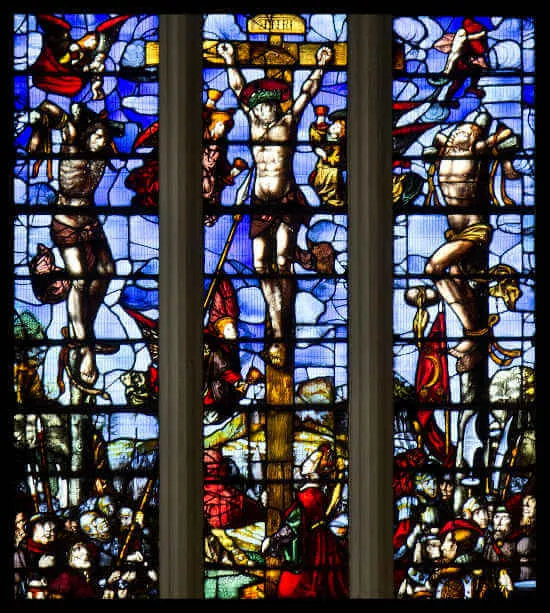
As Jesus and the two criminals on either side of Him hung upon their crosses, the soldiers came to hasten their deaths by breaking their legs to cause them to more quickly suffocate. But when they came to Jesus, He had already died. So one of the soldiers, traditionally known as Longinus, thrust his spear into Jesus’ side, and blood and water flowed forth. Some traditions identify Longinus with the centurion who cried out after Jesus’ death, “Truly, this was the Son of God!” (See Matthew 27:54.) Other traditions state that he converted at that moment, making him the first convert to Christianity. And still other traditions state that Longinus could not see well, and the blood and water from Jesus’ side poured upon his eyes, healing him. Regardless of whether these traditions are true, we know that Jesus’ side was pierced and blood and water flowed forth.

The symbolism of this act was more than a mere human symbol. It was an instrument of the profound spiritual reality that was taking place at that moment. As Jesus’ Sacred Heart was pierced, the blood and water that poured forth was the new sacramental life of the Church. The Blood was the Most Holy Eucharist and the Water was the gift of Baptism. And when Jesus had previously “breathed His last” and “handed over His Spirit,” the Sacrament of Confirmation was bestowed.

When we celebrate those Sacraments today, it is easy to see them as mere symbols of what we partake in. But in our Christian Tradition, the Sacraments are so much more. The symbol is also the reality. It is the instrument of what it symbolizes. Therefore, every time we witness a Baptism or partake in the Holy Eucharist, we are mystically present with Longinus, receiving the grace and mercy of our redemption, pouring forth from Jesus’ wounded side, so as to heal us and make us whole.

The human heart is, physically speaking, a bodily organ responsible for pumping blood throughout. But from a spiritual perspective, given that we are both body and soul, the human heart is also the source of our life. Without it, we physically and spiritually die. So it is with the Sacred Heart of Jesus. It was not only a physical heart that was physically pierced by the lance long ago. It is now also the source of our ongoing spiritual life, and, without Jesus’ Sacred Heart of Mercy, we will die in our sins.

Reflect, today, upon the Most Sacred Heart of Jesus. See His Heart as the ongoing source of your new life in grace. Understand that His Heart is more than a symbol of His grace and mercy, it is the spiritual source and the font of that mercy. Prayerfully place yourself before His Cross, this day, and allow the blood and water, flowing from His wounded side, to cover you so that you, too, may believe.

Source: https://catholic-daily-reflections.com/2025/06/26/the-font-of-mercy-4/

John 19:33-34 Read More »

Saint Josemaría Escrivá, Priest

1902–1975; The earth is our altar, and work is our sacrifice

When today’s saint was a young priest, he was a rather well-known speaker in Madrid, Spain. Besides being an excellent homilist, he also preached retreats, gave parish missions, and taught classes. A young woman heard that Father Josemaria was scheduled to give some lectures nearby and, in light of his reputation, was eager to hear him. But first she went to one of his Masses. After that, the woman had no interest in hearing him lecture; instead she wanted to discover God’s will for her life. Saint Josemaria’s example of intense devotion and prayerfulness in saying Mass made her rethink her entire vocation. A good priest disappears into his vocation, submerges himself in Christ, and communicates a divine, not a personal, message. He makes people think of God, not him. At Mass the priest is not himself, yet is fully himself. He performs a sacrament because he is a sacrament. The Sacrament of Holy Orders is hidden behind the aspects of a man, the Holy Eucharist under the aspects of bread and wine.

It is the theology of the Church that every sacrament validly performed is efficacious, that it transmits sanctifying grace to the soul. But the fruitfulness of a sacrament for its recipient, either psychologically or spiritually, fluctuates. It can hinge on any number of factors, from the beauty of a Church, the quality of a homily, the sacredness of the music, or the intellectual preparation and ardor of the one receiving the sacrament. A holy, charitable, and educated priest infuses every sacrament he celebrates with a theological meaning that yields spiritual fruit that goes beyond efficaciousness. Saint Josemaria’s writings, preaching, lectures, and talks were so rich, so chock-full of practical purpose and high meaning, that a great international family gathered around him, harvesting from his sustained example and insights an abundant banquet for their spiritual table.

Josemaria Escriva was born in a small town in rural Spain. He attended diocesan seminaries in the nearby city of Zaragoza and was ordained a priest in 1925. In 1928 he experienced a vision which spurred him to found Opus Dei, an institution that quickly spread to all the major Christian countries. Opus Dei consists primarily of married lay men and women, while some members are unmarried and consecrated celibates. A few members are priests.  After two thousand years of Catholic spirituality, it might be asked what new insight warranted the foundation of a new Church institution? It is a sign of the Church’s theological and spiritual fecundity that Saint Josemaria did offer a new, innovative approach to living as a disciple of Christ nineteen hundred years after Christ returned to the Father.

In a homily from 1967, Josemaria states his spirituality in clear terms: “…God is calling you to serve Him ‘in and from’ the ordinary, material, and secular activities of human life. He waits for us every day in the laboratory, in the operating room, in the army barracks, in the university, in the factory, in the workshop, in the fields, in the home and in the immense panorama of work. Understand this well: there is something holy, something divine hidden in the most ordinary situations, and it is up to each one of you to discover it.”

In other words, there is no need for a serious lay Catholic to abandon his work and routine, his family life, or his everyday relationships to fulfill God’s will. God is found in and through ordinary life. Cardinal Albino Luciani, later Pope John Paul I, perceptively noted that Saint Josemaria was not teaching a ‘spirituality for lay people,’ as Francis de Sales taught, but a ‘lay spirituality.’ It is not a question of praying the rosary while sweeping the floor, or contemplating scripture while driving. It is about “materializing” holiness by converting ordinary, well-done work into a sacrifice and prayer to God. Ordinary work, then, is not just the context, but the raw material, for lay holiness. All jobs are important. Daily life is not a distraction from God’s will for us. Daily life is God’s will for us. When we get to work we get to God.

Source: https://mycatholic.life/saints/saints-of-the-liturgical-year/june-26—josemara-escriv-priest—optional-memorial/

Saint Josemaría Escrivá, Priest Read More »

Matthew 7:28-29

An Authoritative New Law

When Jesus finished these words, the crowds were astonished at his teaching, for he taught them as one having authority, and not as their scribes.

Reflection:

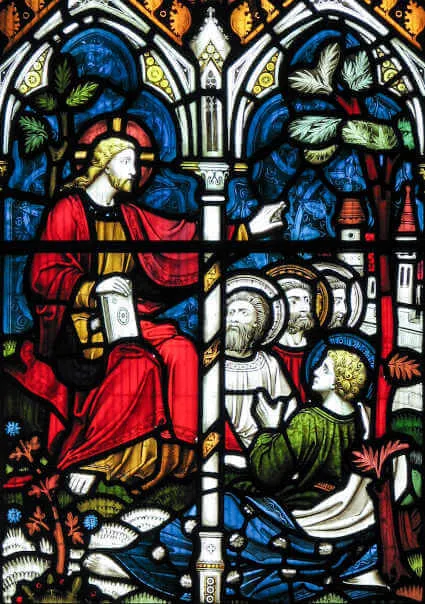
These lines conclude the Sermon on the Mount found in Matthew’s Gospel chapters 5–7. In that lengthy sermon, Jesus touches on many topics and presents us with a summary of all we need to know in our lives of faith. In these concluding lines of His sermon, the words “astonished” and “authority” should stand out. Why were the crowds astonished at Jesus’ teaching? Because His teaching was new and relied upon a new authority that the people hadn’t experienced before.

The authority with which the scribes taught was based upon their knowledge of the traditions handed down to them from earlier teachers. The scribes studied long and hard and then presented what they had learned. This was the form of religious teaching that the people were used to receiving.

Jesus, however, arrived on the scene and astonished the crowds, because He spoke with a new authority that they had not seen before. Jesus’ authority came forth from His very Person. It was not based upon what He had studied and learned from those who preceded Him. Instead, when He spoke, it was He Himself Who was not only the mouthpiece of the New Law of grace, He was also the Author of the Law and its source.

Try to ponder the idea of authority. For example, a child knows that a parent has authority over them. They may not like it at times, but they understand that they do not set the rules of the house but must abide by the rules set by their parents. Or consider the authority of civil leaders. Law enforcement officers, for example, have an authority entrusted to them by their office. They are not only well versed in the rule of law, they can also enforce it and everyone knows it.

Similarly, Jesus did not just know about the new and glorious truths He taught. He did not simply learn them from the Father in Heaven and then pass them on verbally. Instead, when He taught, He did so as the One Who knew the New Law of grace, the One from Whom it originated, and the one and only Person sent to enact and enforce this New Law.

Reflect, today, upon the New Law of grace and mercy taught by our Lord, especially as it is contained in the lengthy Sermon on the Mount. Reading those words is much more than something we study and learn. The words themselves are alive; they are the Word of God. Reading them makes present to us the same authority that the crowds experienced in Jesus’ time. Everything Jesus taught was and is new, deep, profound, transforming and alive. And when He teaches it, He also establishes His divine authority to enforce it upon the world. This is good news, because His New Law is not an imposition; it is the one and only source of freedom and new life. Reflect upon this New Law of our Lord and pray that you will more fully come under its authority.

Source: https://catholic-daily-reflections.com/2025/06/25/an-authoritative-new-law-2/

Matthew 7:28-29 Read More »

Saint Cyril of Alexandria, Bishop and Doctor

c. 376–444; Patron Saint of Alexandria, Egypt; Invoked against Christological heresies; Pre-Congregation canonization; Declared a Doctor of the Church by Pope Leo XIII in 1883

After Jesus’ life, death, and resurrection, it is believed that Saint Mark, the Evangelist and Gospel writer, preached in Alexandria, Egypt, thus establishing the Christian faith in that city. Alexandria, founded in 331 BC by Alexander the Great, was situated on the northern edge of Africa, along the coast of the Mediterranean Sea. This strategic location rapidly turned it into an important trade center for Egypt, as well as a renowned hub for science, the arts, and learning. In 30 BC, Alexandria became a province of the Roman Empire, a status it would maintain for the next 700 years.

Christianity was legalized in the Roman Empire by Constantine the Great in 313. After that, major centers of Christian learning, such as Rome, Jerusalem, Antioch, Constantinople, and Alexandria became the stage for intense debates and developments in theology. Notably, these debates often revolved around Christ’s divine and human natures, His relationship with the Father and the Holy Spirit, and the appropriate title for the Blessed Virgin Mary. The outcomes of these debates provided the Church with a clear and foundational understanding of faith, which continues to deepen and evolve even today.

The fourth century saw the emergence of the Arian heresy, which taught that the Son was subordinate to the Father and not co-eternal. Saint Athanasius, then Bishop of Alexandria, tirelessly fought this heresy, enduring years of exile as a result. After the defeat of Arianism, other heresies surfaced. Fifty years after Athanasius’ death, Bishop Cyril of Alexandria would battle Nestorianism. 

Cyril was born in the town of Theodosius, about eighty-five miles east of Alexandria. Given its proximity to Alexandria, Theodosius shared in the rich Greco-Roman culture and learning. Its close location to the Nile Delta also meant that farming and fishing were common activities. As a youth, Cyril’s uncle, Theophilus, the Patriarch of Alexandria, ensured that Cyril received an excellent education in theology, philosophy, rhetoric, and science. However, his uncle was a controversial figure in the Church. Less of an intellectual and more of a politician, Theophilus was power-hungry, harsh, often antagonizing Jews and pagans, and was known for stirring up controversy and violence. He was even responsible for deposing Saint John Chrysostom as Patriarch of Constantinople.

Around the year 412, Cyril succeeded his uncle as Patriarch, quickly discovering the challenge of following in his controversial footsteps. After a group of violent monks murdered a prominent pagan philosopher, astronomer, and mathematician, Cyril was blamed, despite his lack of involvement. Being the nephew of Patriarch Theophilus had its drawbacks, and Cyril proceeded in his ministry with caution. He eventually moved out of the shadow of his uncle, establishing himself to be an intelligent and faithful servant of God and His Church. He began to write Scripture commentaries with theological precision, especially when it came to the nature of Christ, addressing the various heresies of the time. Within a decade of being a bishop, Cyril had established the reputation of being a trustworthy and articulate teacher of the faith.

In 428, the emperor appointed Nestorius as Patriarch of Constantinople. Shortly afterward, Patriarch Nestorius assigned a priest from Antioch to preach throughout Constantinople. The priest began challenging the widely accepted notion that Mary was rightly called the Mother of God (Theotokos), suggesting instead she should only be referred to as the Mother of Christ (Christotokos). This proclamation stirred controversy among the faithful in Constantinople, and news quickly spread across the empire, eventually reaching Patriarch Cyril, over 1,000 miles away in Alexandria.

Cyril vehemently disagreed with this new heresy, which later became known as Nestorianism. He began to preach and teach against it among his own people, clarifying that Mary was rightfully termed the Mother of God. He explained that this title was not solely about the Blessed Mother, but also about the essence of Christ. If Mary wasn’t the Mother of God, then Christ’s essence was divided. Nestorianism proposed that Jesus was a divine person somehow united with a distinct human person, and Mary was only the mother of His humanity. Cyril corrected this misinterpretation, emphasizing that there was only one Person in Christ, both human and divine. This made Mary not only the mother of her human Son but also the mother of His personhood, thereby justifying her title as the Mother of God. After teaching his people, Cyril wrote private letters to Nestorius to correct him. Nestorius rejected the correction. Consequently, Cyril broadened his correspondence, involving other bishops, members of the emperor’s court, and the pope in Rome. This pleased the faithful in Constantinople but enraged Nestorius. The pope investigated and authorized Cyril to deal with Nestorius with the pope’s authority.

In 431, the Roman emperor felt the need to intervene and called a Church Council in Ephesus to settle the dispute. Ephesian Christians were known for their devotion to the Mother of God, partly due to the deeply held tradition that Mary had settled in Ephesus later in life with Saint John. Thus, the council’s location signaled the emperor’s opposition to Nestorius. Once many of the bishops from across the empire had gathered, but before Nestorius and his supporters arrived, Cyril opened the council. He took the lead and eloquently articulated his position, which was consistent with the teachings of earlier Church Fathers. The bishops present at the council accepted his explanation and voted to condemn Nestorius. On arrival, Nestorius and his supporters were outraged that the council had proceeded without them. In retaliation, they held their own meeting, voted in opposition, and attempted to depose Cyril. When the emperor heard of this, his representative attempted to resolve the dispute by jailing both Nestorius and Cyril to force an agreement. Eventually, however, the emperor sided with Cyril, due to his popular support among the people. When Nestorius refused to accept this position, he was exiled to the Egyptian desert.

Upon returning to Alexandria, Cyril continued to write and teach. Later generations conferred upon him the titles “Guardian of Exactitude” and “Seal of the Fathers,” for he successfully synthesized the teachings of the Church Fathers who preceded him, applying those teachings to the present disputes. As we honor him today, ponder the significance of precision in your faith. Without precision that is consistent with all that has been taught before us, we risk failing to fully understand Christ. Reflect on your commitment to a deep and clear understanding of God and our faith, and reaffirm your fidelity to the truth.

Source: https://mycatholic.life/saints/saints-of-the-liturgical-year/june-27—saint-cyril-of-alexandria-bishop-and-doctor/

Saint Cyril of Alexandria, Bishop and Doctor Read More »

Matthew 7:16-17

Good Fruit—Bad Fruit

Do people pick grapes from thornbushes, or figs from thistles? Just so, every good tree bears good fruit, and a rotten tree bears bad fruit.

Reflection:

“So by their fruits you will know them.” This is how our Gospel passage for today concludes. It offers us an exceptionally practical way by which you can discern the working of God in your own life and in the life of others.

When you look at your own life, what good fruit, born for the upbuilding of the Kingdom of God, do you see? Some people may find little to no fruit born, either for good or bad. Such complacency is, in and of itself, bad fruit. Other people may see an abundance of fruit, thus producing many consequences in this world. They influence the lives of many, and their public actions make a true difference. Sometimes for good…and other times for evil.

When discerning the actions of God in our world, we must first be very objective. The evil one is always very deceptive and regularly presents his bad fruit as good. For example, the legalization of abortion is often presented by many within our world as a “right to choose” or a “health service.” But the intentional death of any unborn child is clearly “bad fruit” from a “rotten tree.” There are even many so-called “humanitarian groups” or very wealthy “philanthropists” who present their work as “good fruit,” when it is anything but good. And on the contrary, there are many who work hard to bring forth a greater respect for life from the moment of conception to natural death, or strive to uphold the sacredness of marriage as God designed it, or work to promote the freedom to worship in accord with the will of God, but are labeled by the secular world as prejudiced, bigoted, fearmongers and even hateful. But their work, done very sacrificially, truly does bear good fruit for the Kingdom of God.

How about your own life? When you examine your actions and the fruit born of those actions, from where does that fruit originate? Does it come from a false sense of compassion, a misguided “charity,” and a fear of being criticized for standing for the truth? Or does it come from a deep love of God, an awareness of the truth God has revealed to us, and through a courageous proclamation of the pure Gospel?

Good fruit, born from the heart of the Father in Heaven, will always mirror the truths of our faith. A false sense of compassion, false accusations, persecutions and the like will flow from the rotten trees in our world. We must work diligently to be those good trees that bear the good fruit coming from God. This requires a radical commitment to do what is right in the face of the evil all around us.

Reflect, today, upon these images Jesus presents. Do you see clearly both the good and bad fruit around you? Is your life helping to foster the lies of the evil one or the truth and love of God? Look at the fruit your life bears, as well as the fruit within our world, in an objective way, comparing it to the clear and unambiguous teachings of Jesus. Seek out that good fruit with all your heart and do all you can to bring it forth, no matter the cost, and you will not only save your soul, you will also help feed others with the good fruit of Heaven.

Source: https://catholic-daily-reflections.com/2025/06/24/good-fruit-bad-fruit-4/

Matthew 7:16-17 Read More »