Author name: Sani

Third Sunday of Advent

First Reading Isaiah 35:1-6a, 10

The desert and the parched land will exult;
the steppe will rejoice and bloom.
They will bloom with abundant flowers,
and rejoice with joyful song.
The glory of Lebanon will be given to them,
the splendor of Carmel and Sharon;
they will see the glory of the LORD,
the splendor of our God.
Strengthen the hands that are feeble,
make firm the knees that are weak,
say to those whose hearts are frightened:
Be strong, fear not!
Here is your God,
he comes with vindication;
with divine recompense
he comes to save you.
Then will the eyes of the blind be opened,
the ears of the deaf be cleared;
then will the lame leap like a stag,
then the tongue of the mute will sing.

Those whom the LORD has ransomed will return
and enter Zion singing,
crowned with everlasting joy;
they will meet with joy and gladness,
sorrow and mourning will flee.

Responsorial Psalm Psalms 146:6-7, 8-9, 9-10.

R. (cf. Is 35:4)  Lord, come and save us.
or:
R. Alleluia.
The LORD God keeps faith forever,
secures justice for the oppressed,
gives food to the hungry.
The LORD sets captives free.
R. Lord, come and save us.
or:
R. Alleluia.
The LORD gives sight to the blind;
the LORD raises up those who were bowed down.
The LORD loves the just;
the LORD protects strangers.
R. Lord, come and save us.
or:
R. Alleluia.
The fatherless and the widow he sustains,
but the way of the wicked he thwarts.
The LORD shall reign forever;
your God, O Zion, through all generations.
R. Lord, come and save us.
or:
R. Alleluia.

Second Reading James 5:7-10

Be patient, brothers and sisters,
until the coming of the Lord.
See how the farmer waits for the precious fruit of the earth,
being patient with it
until it receives the early and the late rains.
You too must be patient.
Make your hearts firm,
because the coming of the Lord is at hand.
Do not complain, brothers and sisters, about one another,
that you may not be judged.
Behold, the Judge is standing before the gates.
Take as an example of hardship and patience, brothers and sisters,
the prophets who spoke in the name of the Lord.

Alleluia Isaiah 61:1 (cited in Lk 4:18)

R. Alleluia, alleluia.
The Spirit of the Lord is upon me,
because he has anointed me
to bring glad tidings to the poor.
R. Alleluia, alleluia.

Gospel Matthew 11:2-11

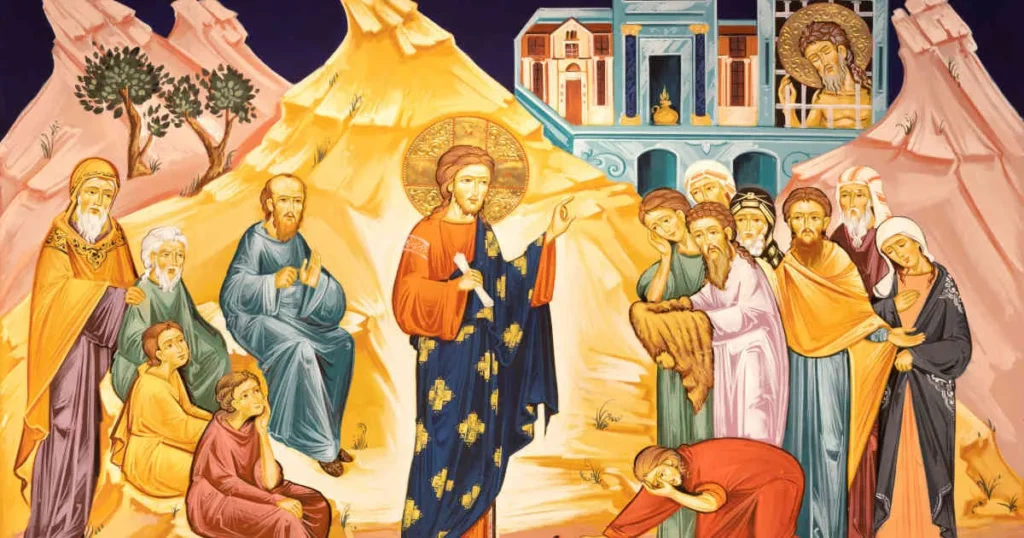
When John the Baptist heard in prison of the works of the Christ,
he sent his disciples to Jesus with this question,
“Are you the one who is to come,
or should we look for another?”
Jesus said to them in reply,
“Go and tell John what you hear and see:
the blind regain their sight,
the lame walk,
lepers are cleansed,
the deaf hear,
the dead are raised,
and the poor have the good news proclaimed to them.
And blessed is the one who takes no offense at me.”

As they were going off,
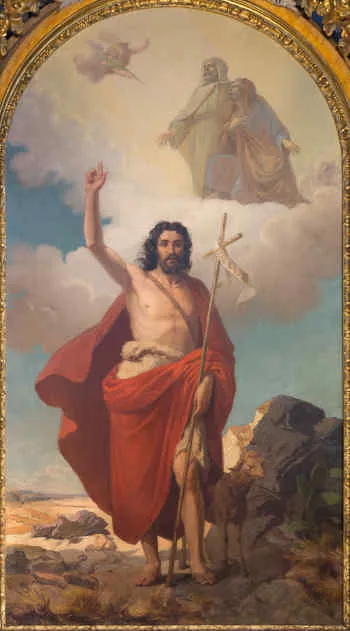
Jesus began to speak to the crowds about John,
“What did you go out to the desert to see?
A reed swayed by the wind?
Then what did you go out to see?
Someone dressed in fine clothing?
Those who wear fine clothing are in royal palaces.
Then why did you go out?  To see a prophet?
Yes, I tell you, and more than a prophet.
This is the one about whom it is written:
Behold, I am sending my messenger ahead of you;
he will prepare your way before you.

Amen, I say to you,
among those born of women
there has been none greater than John the Baptist;
yet the least in the kingdom of heaven is greater than he.”

Source: https://bible.usccb.org/bible/readings/121425.cfm

Third Sunday of Advent Read More »

Matthew 11:4-6

Rejoicing in the Cross

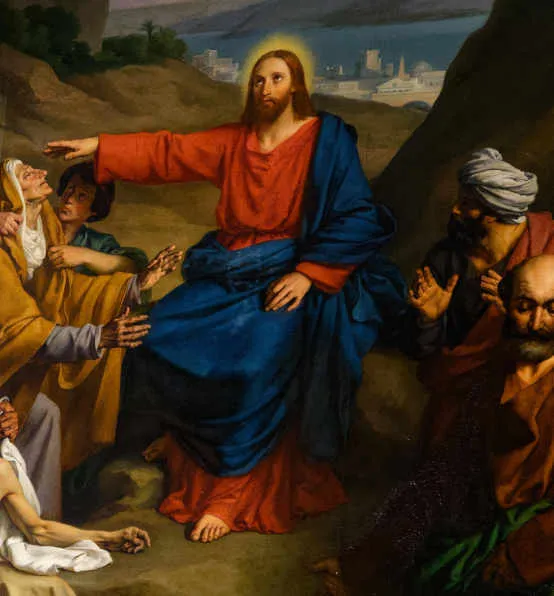
“Go and tell John what you hear and see: the blind regain their sight, the lame walk, lepers are cleansed, the deaf hear, the dead are raised, and the poor have the good news proclaimed to them. And blessed is the one who takes no offense at me.”

Reflection:

Suppose a priest came to your church to put on a parish mission, and during that mission he miraculously healed the blind, crippled, terminally ill, and deaf. What if he even raised the dead to life? How would you respond? Most likely with amazement! You’d contact everyone close to you and tell them about those miracles, encouraging them to attend the next session.

Though Jesus’ ministry was filled with miracles, they were far from the most important part of His mission. His miracles healed bodies that would eventually die, but His preaching healed souls that would live forever because His preaching ultimately pointed to His greatest work—to suffer and die for the salvation of souls.

If you were alive as Jesus walked the earth, performed miracles, preached the Good News, suffered death, and rose again, which of His actions would have had the greatest effect on you? When we consider our Lord’s mission, we must consider it all as one unified whole, not missing the most important aspects. From a faith perspective, Jesus’ suffering, death, and Resurrection are clearly His greatest acts. By freely embracing suffering and death, He transformed the worst into the best: the consequence of sin—which is death—into the instrument of eternal life. When Jesus said, “And blessed is the one who takes no offense at me,” He was identifying those as blessed who discovered the great value of His Cross.

If we were to ask Jesus’ first followers whether they would prefer to see Jesus perform miracles or suffer and die, most likely they would prefer the miracles. Such a question might have even left them confused. Why would anyone want to see a great prophet suffer and die? Yet, today, from a theological perspective, it is clear that Jesus’ suffering, death, and Resurrection are the greatest acts in human history.

Imagine being our Blessed Mother who witnessed it all, stood by her Son as He endured His Cross, and rejoiced with Him when He rose. Unquestionably, if we asked our Blessed Mother whether she preferred to see a few miracles from her Son or to witness His perfect sacrifice that brought salvation to the world, her holy and sorrowful heart would choose the latter.

Reflect today on these questions within the context of your own life. When you pray, do you primarily ask for favors, blessings, or miracles? Or do you primarily pray for the Cross? Do you see greater value in having God remove some suffering from your life or in transforming your suffering by the power of His Cross? Ask for the grace to die with our Lord, to become a living sacrifice of love, and to have the strength to lay down your life for others. By choosing that which has eternal value, you choose the better part and will rejoice in that better part forever.

Source: https://catholic-daily-reflections.com/2025/12/13/rejoicing-in-the-cross/

Matthew 11:4-6 Read More »

Saint Lucy of Syracuse, Virgin and Martyr

c. 283–c. 304; Patron Saint of blind people, martyrs, peasants, penitent prostitutes, poor people, sick children, authors, cutlers, farmers, glassmakers, glaziers, gondoliers, laborers, lawyers, maidservants, notaries, eye doctors, porters, printers, saddlers, sailors, salesmen, seamstresses, tailors, upholsterers, weavers, and writers; Invoked against dysentery, epidemics, hemorrhages, throat infections, fire, poverty, and spiritual blindness; Pre-Congregation canonization

It takes great faith to exclaim that torture and death are glorious when they result from your love of Christ, yet this type of faith has been present in countless martyrs throughout the history of the Church. The earliest centuries of the Church especially produced holy martyrs who endured the attempted extinction of Christianity by the Roman emperors who clung to their pagan gods. Such was the case with today’s saint, Saint Lucy of Syracuse, who died during the Great Persecution of Roman Emperor Diocletian. Though historical details are hard to confirm, as early as the fifth century, beautiful legends about Saint Lucy had been handed down. It is those legends that follow.

Lucy was born in Syracuse, Sicily, around the year 283 to Christian parents. When she was five, her father died, leaving her mother, Eutychia, to raise her alone. Eutychia suffered from hemorrhages and feared for Lucy’s future, so she arranged a promise of marriage for her daughter to a nobleman from a pagan family.

A half century earlier, the holy virgin Saint Agatha had been martyred forty miles north of Syracuse in the city of Cantania. Saint Agatha was revered as the glory of Cantania. Her tomb became a popular place of pilgrimage and site of many miracles. Hopeful of a cure of her mother’s hemorrhages, Lucy convinced her mother to make a pilgrimage to Saint Agatha’s tomb. Eutychia agreed. While at the tomb, the two fervently prayed for a long time. As they did, Lucy had a dream-like vision in which Saint Agatha appeared to her, informing her that her mother would be cured because of Lucy’s faith, and that Lucy would become the glory of Syracuse, just as Agatha was the glory of Cantania. When Lucy awoke from her vision, she cried out, “O, mother, mother, you are healed!”

From that moment on, Lucy continued to sense Saint Agatha speaking to her about her calling to be a Bride of Christ and to die as a martyr. She informed her mother of her desire to remain a virgin and begged her to offer their wealth to the poor. Her mother hesitated, suggesting it would be better for Lucy to do so once Eutychia had died, but Lucy urged her to do so right away because it would be a source of much greater merit. Lucy’s faith won the day. She continued to postpone her marriage and spent the next few years joyfully distributing her money and jewels to the poor.

In the year 303, Roman Emperor Diocletian issued an edict outlawing Christianity in the Roman Empire. Christian Churches and sacred texts, such as Scripture and liturgical books, were to be destroyed. Christians were forbidden to gather for worship. Civil servants and nobility were stripped of their ranks and belongings. Christians who were discovered were forced to offer sacrifice to the Roman gods and the emperor; those who refused were tortured and even killed.

Though this was clearly a grave evil to befall those who professed their faith in Christ, it also resulted in a strengthening of faith for many. Secret worship regularly took place at the risk of the worshippers’ lives. Honored martyrs inspired the faithful to imitate the martyrs’ steadfast faith.

Around the year 304, when Lucy was around the age of twenty-one, her suitor became aware of the large sums of money that she had distributed to the poor. He was also aware that Lucy had done so on account of her Christian faith and realized that she was not going to become his bride. Enraged, he reported Lucy to Paschasius, the Governor of Syracuse, denouncing her as a Christian.

When Governor Paschasius of Syracuse learned of Lucy’s Christian faith and her charity to the poor, he had her arrested and interrogated. He attempted to force her to apostatize by offering sacrifice to the Roman gods, but she refused. A later Roman martyrology put these words into Lucy’s mouth:

I know but one sacrifice pure and full of honor, which I can offer. This is to visit orphans and widows in their tribulation, and to keep oneself unspotted from the world. For three years, I have daily offered this sacrifice to my God and Father; and now I long for the happiness of offering myself to Him as a living victim. His holy will be done!

Lucy then accused the governor of demon worship and prophesied his condemnation before God. The governor was outraged and ordered her to be defiled in a brothel. When the guards tried to move her, she was heavier than a boulder. They even tried to move her with a rope tied to the yoke of oxen, but she didn’t budge. The guards then surrounded her with wood to burn her, but the flames did not harm her. Finally, the governor ordered a soldier to thrust his sword into her neck, and God permitted her martyrdom to be completed. One martyrology attributes these prophetic words to her as she was dying:

I announce to you a great joy. Diocletian descends from his throne, Maximian dies, the Church breathes again: peace extends its protecting wing over the martyred Saints. O Syracuse, O place of my birth, as Catania finds its safety and glory beneath the guardianship of my sister Agatha, so shalt thou be shielded by me, if thou art willing to embrace that Faith, for the truth of which I shed my blood.

Saint Lucy is often depicted in sacred art holding her eyes because much later legends state that either the guards gouged her eyes out as torture, or that she gouged her own eyes out so that her suitor would no longer be tempted by their beauty.

Veneration to Saint Lucy quickly spread, and her prophetic dream-vision came true—she became the glory and protector of Syracuse and the source of many miracles. By the end of the sixth century, she was so revered throughout the Roman Empire that Pope Saint Gregory the Great inserted her name into the Roman Canon (Eucharistic Prayer I)—“…graciously grant some share and fellowship with your holy Apostles and Martyrs: with John the Baptist, Stephen, Matthias, Barnabas, Ignatius, Alexander, Marcellinus, Peter, Felicity, Perpetua, Agatha, Lucy, Agnes, Cecilia, Anastasia and all your Saints…”

The fact that a young virgin martyr would become so revered and honored for many centuries after her birth is a testimony to the power of God. Saint Lucy not only imitated her Lord, but in her humility, she reflected the glory of the Mother of God who, in her song of praise, proclaimed, “For he has looked upon his handmaid’s lowliness; behold, from now on will all ages call me blessed. The Mighty One has done great things for me, and holy is his name…” (Luke 1:49–49).

As we honor this saint who was crowned with virginity and martyrdom, ponder the courage and resolve she had to choose death over a life of nobility. She fell in love with her divine Spouse, He entered into union with her, and she turned her eyes firmly upon His holy will. Seek to imitate Saint Lucy’s courage and resolve, choosing Christ and Him alone, renouncing all that is contrary to His holy will.

Source: https://mycatholic.life/saints/saints-of-the-liturgical-year/13-december-saint-lucy-of-syracuse-virgin-and-martyr–memorial/

Saint Lucy of Syracuse, Virgin and Martyr Read More »

Matthew 17:9a&b

Seeking to Understand

As they were coming down from the mountain, the disciples asked Jesus, “Why do the scribes say that Elijah must come first?”

Reflection:

The final book of the Old Testament, written by the prophet Malachi around the fifth century BC, contains a prophecy that Elijah would return to prepare the way for the coming of the Messiah (see Malachi 3:23–24). The scribes used this prophecy to argue that Jesus could not be the Messiah since Elijah had not yet returned, at least not in the way they expected. This argument caused confusion in the minds of Jesus’ Apostles.

Just before the event in today’s Gospel passage, Jesus took Peter, James, and John up a high mountain where He was transfigured before them, giving them a glimpse of His heavenly glory. This experience strengthened their conviction that Jesus was indeed the Messiah. However, as they descended the mountain, they asked Jesus about Malachi’s prophecy, seeking to understand how Jesus could be the Messiah if Elijah had not yet come. Jesus clarified this for them: “‘I tell you that Elijah has already come, and they did not recognize him…’ Then the disciples understood that he was speaking to them of John the Baptist” (Matthew 17:12–13).

As we grow in our faith and become convinced of Jesus’ identity as the Messiah, we might also encounter what appear to be contradictions. For example, faith and science sometimes seem to conflict, even though they are ultimately harmonious. The existence of human suffering and injustice can challenge our understanding of an all-powerful, all-loving God. Moral questions can arise when we encounter differing opinions, and various other experiences might seem difficult to reconcile with the Word of God.

If you find yourself facing such challenges, take inspiration from Peter, James, and John. Allow your faith to deepen through moments of prayer and personal encounters with God. Then, do not shy away from questions that arise in your mind. If something seems contradictory to your faith, seek understanding. Turn to our Lord in prayer, study the teachings of the Church, read the writings of the saints, and trust that God’s Wisdom is perfect. It will clarify every apparent contradiction and dispel all confusion.

Reflect today on the example of these three Apostles seeking clarity from Jesus. They asked their question with faith, not with skepticism. They did not doubt but sought understanding. Imitate them with every question that arises in your mind so that you may find interior peace and become a beacon of wisdom to others.

Source: https://catholic-daily-reflections.com/2025/12/12/seeking-to-understand/

Matthew 17:9a&b Read More »

Our Lady of Guadalupe

Patroness of the Americas

Between 1428 and 1521, the Aztec Empire thrived in present-day central Mexico. This empire began with an alliance among three city-states: Tenochtitlan, Texcoco, and Tlacopan, allowing them to dominate the region. In 1521, the Spanish conquistador, Hernán Cortés, led his army of Spaniards and members of the indigenous Tlaxcalans tribe in a battle against the Aztecs, defeating them and capturing their capital city. The conquerors then established New Spain in the territory and rebuilt the capital that would become Mexico City.

Over the next ten years, Franciscan missionaries arrived on Spanish ships to serve the spiritual needs of the new settlers and to share the Gospel with the natives. Understandably, many of the natives were skeptical of this new faith, since the Franciscans were also Spaniards. Many of the Spanish settlers oppressed the natives, despite ongoing attempts by the missionaries to convince the settlers to treat the natives with respect and charity. Despite the challenges, some natives began to convert, receive Baptism, and seek ongoing catechesis. Among the first converts to the Catholic faith were a peasant named Cuauhtlatoatzin and his wife. Upon receiving baptism around the year 1524, they were given the Christian names Juan Diego and María Lucía.

In 1527, Bishop Juan de Zumárraga, a Franciscan from Spain, was named the first bishop of New Spain and arrived in Mexico City a year later. He immediately began strengthening efforts to serve the Spanish settlers, share the Gospel with the natives, and ensure that the settlers and soldiers treated the natives with respect.

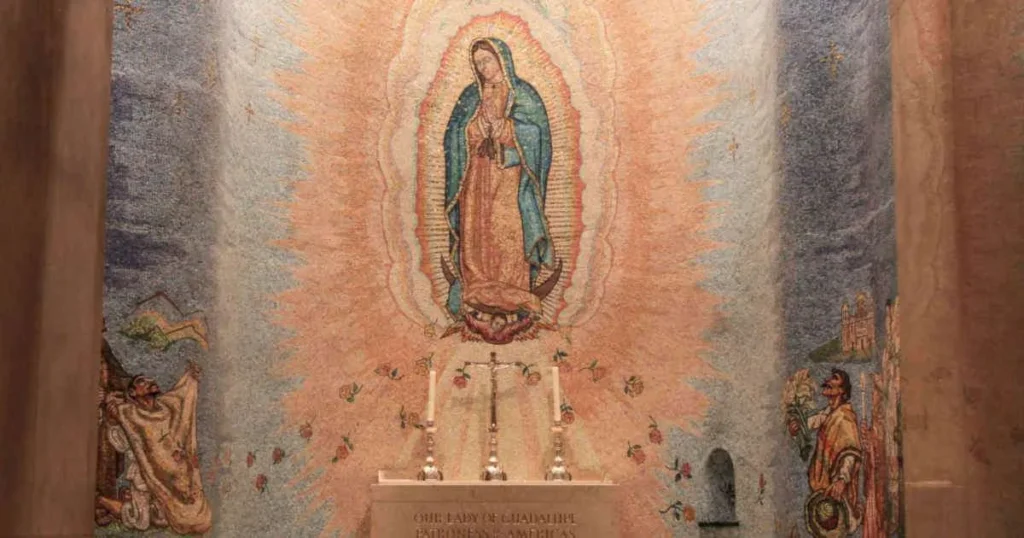
After their baptisms, Juan Diego and María Lucía began to practice their faith as they continued their formation. Most records indicate that María died around the year 1529. Juan grew in his faith, and some extended family members also converted. On December 9, 1531, Juan Diego’s life was forever changed, and the Mother of God immediately strengthened the missionaries’ efforts. Juan was walking some distance to the nearby city of Tlatelolco early in the morning so he could attend daily Mass and catechism class. As he passed by Tepeyac Hill, a heavenly woman appeared to him. She appeared as a mestiza woman, a mixture of Spanish and Indigenous heritage, with dark-toned skin and long black flowing hair. Behind her was an oval of beaming rays that resembled the sun. She was clothed in a rose-colored robe with a blue-green mantle, adorned with gold stars and a golden edge. On her protruding womb was a bow with a four-petal floral design that depicted abundant new life. She wore a black tassel above her womb, which was an Aztec indication of pregnancy. She was standing on a crescent moon held by an angel. Her general appearance was one of great sanctity, peace, gentleness, and high nobility.

As soon as she appeared, she spoke to Juan in his native Nahuatl language, referring to him affectionately as “Juanito, Juan Dieguito…” (My little Juan, my dear Juan Diego), and lovingly introducing herself to him as the Ever-Virgin Mary, the Mother of God. She told Juan that she wanted a church built on that very spot in her honor and instructed him to inform Bishop Zumárraga of her request. Juan did so that same day, but the bishop needed time to think about his request. Juan then returned home by the same route and once again encountered the Mother of God at the same spot. He regretfully informed her that the bishop did not agree to her request and humbly suggested to her that she pick someone more important for the task so that the bishop would more easily agree. Smiling, the Blessed Virgin Mary informed Juan that he was her chosen one and that he should return to renew her request to the bishop.

The following morning, December 10, Juan did as the Mother of God had asked. He returned to the bishop’s residence and informed him that the Virgin Mary appeared a second time, renewing her request. This time, the bishop appeared to be more open and told Juan that if the Mother of God appeared to him a third time, he should ask her for a sign so the bishop could be certain that the request came from her. While returning to his home, the Virgin Mary appeared to him a third time at the same spot and Juan informed her of the bishop’s request. The Mother of God agreed to meet that request and instructed him to return to her at their meeting spot the following day.

The next day Juan’s uncle, Juan Bernardino, came down with a sudden and severe illness, so Juan remained with him all day and was unable to go to meet his heavenly mother. Very early the next morning, Juan Bernardino’s condition worsened, so Juan Diego set off for the city to ask a priest to come to anoint him. Because he was in a hurry and feared being delayed by the Mother of God, Juan took an alternate route to the city, but the Mother of God appeared to him on that route. When Juan informed her of his uncle’s illness, the Mother of God exclaimed with love, “Am I not here, I who am your mother?” She assured Juan that she had already cured his uncle, which was confirmed when Juan arrived home to his uncle who informed Juan that he, too, had experienced an apparition of the Mother of God who healed him. In the meantime, the Mother of God asked Juan to climb a hill where he would find roses that were not in bloom that time of year. He did so, picked them, and returned to her. She rearranged the roses in his cloak (tilma) and told him to go to the bishop and show him the roses as proof for him. So Juan set off for the bishop’s residence.

After arriving, Juan remained waiting for a long time. When he was finally announced and entered the bishop’s residence, he opened his tilma and poured the roses on the ground, telling the bishop that they were the sign he asked for. As he did so, the Mother of God imprinted her image on Juan’s tilma, just as she had appeared to him. The bishop fell to his knees and venerated her. The bishop kept Juan’s tilma in his chapel until he built a chapel in compliance with the wishes of the Mother of God. Bishop Zumárraga led an elaborate procession to the new Tepeyac Hill chapel, where he enshrined the tilma on December 26, 1531. Juan was so transformed by the experience that he successfully requested permission from the bishop to build a hut nearby and live as a hermit and guardian of the image. From that time on, Juan’s prayer life grew deep and his virtues became continuously more pronounced. The story spread rapidly among the Aztec peoples of every tribe, and many came to venerate the holy image, while Juan Diego offered hospitality and further details that inspired many conversions.

The tilma itself is believed to be miraculous for many reasons. The cloth on which the image is imprinted is made from cactus and normally disintegrates after about fifteen years. The tilma, however, is now almost 500 years old and is in perfect condition. The image itself does not appear to have been painted by human hands. There are no brush marks, and it has remained vibrant over the years without fading. No underlying sketch of the image can be found by modern scientific techniques. The eyes of the Virgin have been examined under magnification and reportedly reveal a reflection of the bishop on his knees along with some others nearby. In 1921, a bomb exploded next to the image in an attempt to destroy it, bending a thick medal cross on the same altar but leaving the image undamaged. 

Perhaps the greatest sign of the miraculous nature of the image of Our Lady of Guadalupe is the spiritual impact that it has had upon the native people of Mexico and throughout the world. The fact that Our Lady appeared as a mixture of native and Spaniards was her way of communicating to the natives that God wanted them to be open to the message of the Gospel from the Spanish missionaries. The bishop who built the chapel, the priests who served there, and especially the native Juan Diego himself could be trusted, and the message they had to share was heavenly. Miracles followed and conversions took place at a pace previously unseen by missionaries. Our Lady proved herself to be the greatest of evangelizers. Her appearance as a mixture of Spaniard and Indigenous also sent a message to the Spaniards that they needed to treat their new neighbors as family.

Today the Basilica in which the image of Our Lady of Guadalupe is enshrined remains one of the most sacred places of inspiration and pilgrimage in the Americas. She is patroness of the Americas and is especially revered in Mexico. As we honor this sacred apparition of the Mother of God, ponder the ongoing miracle of the 500-year-old tilma of Saint Juan Diego. To this simple and humble man, God sent His mother as a missionary; through him, the Blessed Virgin Mary’s message resonates today.

Source: https://mycatholic.life/saints/saints-of-the-liturgical-year/12-december-usa-our-lady-of-guadalupe–feast/

Our Lady of Guadalupe Read More »

Luke 1:30-31

Our Lady, the Greatest Evangelist

Then the angel said to her, “Do not be afraid, Mary, for you have found favor with God. Behold, you will conceive in your womb and bear a son, and you shall name him Jesus.”

Reflection:

Of all the saints throughout the ages, none has proved to be as powerful an evangelist as the Mother of God. While on Earth, she lived a mostly hidden life, demonstrating the perfection of virtue to those closest to her. As a young mother, she cared daily for the needs of her divine Son, constantly pondering the mystery of His Incarnation as it unfolded before her eyes. Her love for her Son, lived out during Jesus’ earthly life, overflowed from her Immaculate Heart and continues to do so today.

After being assumed body and soul into Heaven, her work did not cease. As Queen of Heaven and Earth, she continues to intercede for her spiritual children, mediating the grace we need to grow in holiness. Throughout history, many Marian apparitions have been reported. While numerous reports have not been formally approved, some have, including the apparition of Our Lady of Guadalupe in 1531 to Saint Juan Diego.

Following the Spanish conquest of the Aztec Empire in 1521 by Hernán Cortés, the capital was rebuilt into what became Mexico City. Despite the cruelty some Spanish settlers inflicted on the Indigenous people, the Catholic Church, through missionaries and leaders, including Bishop Juan de Zumárraga, sought to protect their rights and dignity while evangelizing them. Many of the Indigenous were understandably suspicious of the missionaries, yet some converted, including a man named Cuauhtlatoatzin, who took the Christian name Juan Diego after his baptism, and his wife, who took the name María Lucía.

On December 9, 1531, while walking to Mass and catechism class, Juan Diego passed Tepeyac Hill, where the Blessed Virgin Mary appeared to him. She spoke to him in his native language, revealed herself as the Mother of God, and asked for a chapel to be built in her honor on that very spot. When Juan took the message to Bishop Zumárraga, the bishop asked for a sign.

On December 12, Juan’s uncle fell seriously ill. While hurrying to find a priest for the Last Rites, Juan took a different route to avoid delaying his journey, but the Mother of God appeared again. She assured him that his uncle was already healed and provided the promised sign for the bishop. She instructed Juan to pick roses blooming unseasonably on the hill; when he brought them to the bishop in his tilma, an image of the Virgin, just as Juan had seen her, appeared on his cloak. Juan Diego’s tilma now hangs in the Basilica of Our Lady of Guadalupe, in Mexico City, fulfilling the Blessed Mother’s request.

While the miraculous image was awe-inspiring, what followed was even more astounding. Over the next decade, millions of Indigenous people embraced the Christian faith, marking one of the most remarkable mass conversions in Church history—all due to the Blessed Mother’s evangelization and intervention. Her love for the Indigenous people and her desire for their salvation brought her to them personally, confirming the truth of the Gospel preached by the Church.

As we honor Our Lady of Guadalupe, reflect today on the tender love of the Mother of God. She deeply desired the salvation of the Indigenous people, just as she desires the salvation of all. Pray for her intercession so that millions more around the world may hear and accept God’s saving message.

Source: https://catholic-daily-reflections.com/2025/12/11/our-lady-the-greatest-evangelist/

Luke 1:30-31 Read More »

Saint Damasus I, Pope

c. 305–384; Patron Saint of archeologists; Pre-Congregation canonization

Pope Saint Damasus I, whom we honor today, was born at a time when the Church was experiencing the worst imperial persecution in the Roman Empire. In 303, two years before Damasus was born, the Emperor Diocletian initiated what came to be called the Great Persecution. Across the Empire there were widespread arrests, the destruction of churches and sacred texts, and the requirement for all citizens to offer sacrifices to the Roman gods. Those who refused were often imprisoned, tortured, and executed. The persecutions continued over the next nine years. Finally, in 313, Emperor Constantine the Great, the ruler of the Western Roman Empire, and Licinius, the Augustus of the Eastern Roman Empire, issued the Edict of Milan, granting religious tolerance to Christians. Saint Damasus was only seven years old when this new era of religious freedom began in the Roman Empire.

Not much is known about Damasus’ early years. His family might have originally been from what is today Western Spain. Damasus might have been born there or in Rome. Records indicate that while he was still young, his family lived in Rome, where he grew up and lived the rest of his life. His father was a married priest who served at a church in honor of Saint Lawrence in Rome. That church was later enlarged by Constantine after the Edict of Milan. The church was originally a small oratory built over the tomb of the deacon Saint Lawrence, martyred in Rome by Emperor Valerian in 258. As a young man, Damasus assisted his father in that church.

In 352, when Damasus was about forty-five, Liberius was chosen as the Bishop of Rome and served in that capacity for the next fourteen years. At the time of Liberius’ papal election, Damasus was an Archdeacon in Rome, serving at the Church of Saint Lawrence.

In 354, one of Constantine the Great’s sons, Emperor Constantius II, was co-emperor of the empire, along with his two brothers. Constantius II supported the Arian heresy that had been plaguing the Church for about thirty-five years, so he sent Pope Liberius into exile to a prison in Beroea for refusing to condemn Saint Athanasius, then the Archbishop of Alexandria, Egypt, for opposing Arianism. Some records indicate that Archdeacon Damasus followed him into exile but returned to Rome shortly afterwards. At the time of Pope Liberius’ exile, Emperor Constantius II attempted to elect Felix II to the papacy. However, when the Roman citizens forced the emperor to recall Pope Liberius to Rome, Antipope Felix had to flee. Pope Liberius died in 366 in Rome.

At the death of Pope Liberius, Damasus was elected as the thirty-seventh Bishop of Rome around the age of sixty-one. Immediately, violent controversy ensued. Supporters of Antipope Felix, who had died a year earlier, rejected Damasus as pope and elected Ursicinus, another deacon in Rome. At that time, both the clergy and laity had a say in the election of their bishops. Emperors also expected the candidate-elect to be presented to him for approval. When Pope Damasus and Antipope Ursicinus were simultaneously elected, the division became so severe that a reported 137 people were killed in the violent clashes. Eventually, the Roman civil authorities intervened and restored peace by supporting Pope Damasus and exiling Antipope Ursicinus. Pope Damasus’ enemies then accused him of murder and even adultery, but the pope rose above these calumnies.

Once Pope Damasus was securely established as the Bishop of Rome, he directed his efforts toward the governance of the Church and the preservation of orthodox doctrine. He convened synods in Rome to address heretical threats and to affirm the Nicene Creed. He remained a staunch opponent of Arianism, a heresy that persisted in various forms, despite being condemned at the First Council of Nicaea in 325. Pope Damasus was also concerned with the rising heresies of Macedonianism, which denied the full divinity of the Holy Spirit, and Apollinarianism, which denied the full humanity of Christ. In 381, he appointed papal legates to represent him at the First Council of Constantinople, the second universal ecumenical council of the Catholic Church. This council not only condemned Macedonianism but also expanded the Nicene Creed to emphasize the divinity of the Holy Spirit. It also affirmed the human and divine natures of Christ, in opposition to Apollinaris’ teachings. Pope Damasus’ dedication to doctrinal orthodoxy significantly shaped the Church’s stance against these heresies and strengthened Nicene Christianity.

Perhaps one of the greatest contributions that Pope Damasus made to the Church was the commissioning of Saint Jerome to produce what is now known as the Vulgate Bible. In 382, Pope Damasus summoned the recently ordained Father Jerome from Constantinople to Rome to serve as his secretary and counselor. Recognizing the need for a reliable Latin Bible due to the existence of many poor translations, all of which lacked cohesion, the pope commissioned Jerome to create a new Latin translation (the vernacular in the empire) from the original Greek and Hebrew sources. This new translation also had the effect of helping the Church to define which books of the Bible make up the inspired Word of God, the official canon. Jerome began this monumental task with the New Testament, translating it from Greek to Latin. Though it took him many years to complete, his translation became the standard Latin translation of the Bible and remains so today.

Pope Damasus also worked hard to improve the liturgy. He introduced the singing of psalms, helped develop the General Roman Calendar, restored churches, and commissioned sacred art. He had a great devotion to the saints (especially the martyrs), restored the catacombs in which they were buried, personally wrote poetic epitaphs for their tombs, and added special feast days in their honor.

Though today the authority of the successor of Saint Peter, the Bishop of Rome, is clearly established as being the supreme pastor of the Church, it was not so at that time. Pope Damasus was instrumental in helping to lay the theological groundwork for that doctrine as it continued to unfold for centuries, strenuously arguing that the see of the Bishop of Rome did not receive its authority from any Church council but from Jesus Himself Who said, “And so I say to you, you are Peter, and upon this rock I will build my church, and the gates of the netherworld shall not prevail against it” (Matthew 16:18).

In 380, Emperor Theodosius I, along with co-Emperors Gratian and Valentinian II, issued the Edict of Thessalonica, which declared that the Christian faith, as defined by the teachings of the Councils of Nicaea and Constantinople, was the official religion of the Roman Empire. This edict helped to further eliminate Arianism and other heresies. It is hard to predict what would have happened during that period had Pope Saint Damasus not been such a strong leader in orthodoxy.

Pope Saint Damasus lived and served during a transformative time for the Church. He was born during the worst imperial persecution of Christians but saw religious tolerance established with the Edict of Milan and saw Christianity become the official religion of the Roman Empire four years before his death. As we honor this great saint, who had such a reverence for the saints who had gone before him, ponder the fact that our Church today professes the faith that he so vigorously fought to defend and define. His doctrinal purity, love for the liturgy, veneration for the saints, and pastoral ministry all contributed to the fruitful growth of the Church throughout Europe, and eventually to the ends of the earth. Commit yourself more fully to imitate Saint Damasus’ love for the orthodox faith so that you will share more fully in the sanctity that he now shares in Heaven.

Source: https://mycatholic.life/saints/saints-of-the-liturgical-year/11-december-saint-damasus-i-pope–optional-memorial/

Saint Damasus I, Pope Read More »

Matthew 11:11-12

Entering the Kingdom of Heaven

“Amen, I say to you, among those born of women there has been none greater than John the Baptist; yet the least in the Kingdom of heaven is greater than he. From the days of John the Baptist until now, the Kingdom of heaven suffers violence, and the violent are taking it by force.”

Reflection:

The two sentences in the passage above can be challenging to comprehend, but the insights of Church Fathers and saints offer us a deeper understanding.

In the first sentence, Jesus declares John the Baptist to be the greatest of those born of women, highlighting John as the last and greatest of the Old Testament prophets. However, John did not live to see the fullness of Christ’s work—His death, resurrection, and the outpouring of the Holy Spirit at Pentecost. This is why Jesus adds, “yet the least in the Kingdom of heaven is greater than he.” In other words, even the smallest person who receives sanctifying grace through Christ’s redemptive work is greater in spiritual privilege than the greatest person before the era of grace.

The second sentence may be even more puzzling. How can the Kingdom of Heaven suffer violence, and who are the violent ones taking it by force? The Greek words translated as “violence” and “violent” can also be understood as “forcefully advancing” and those who “advance with force and determination.” Jesus is teaching that entering the Kingdom of God requires great determination, a forceful rejection of sin, and a vigorous pursuit of holiness.

Together, these sentences reveal Jesus’ message about the incredible blessing of living in the time of grace. We are more privileged than even John the Baptist because we live in the fullness of the Christian dispensation. However, this privilege comes with a responsibility: we must engage in a “violent” battle against our fallen nature, the temptations of the world, and the deceptions of the devil. Entering the Kingdom of God requires zeal, determination, and an all-consuming passion for the things of God.

It’s easy to fall into a mediocre practice of our Christian faith, letting our disordered desires and emotions dictate our actions. But Jesus calls us to something greater. Those who understand the Christian life as a spiritual battle against sin will be prepared to move beyond mediocrity into a fervent, committed embrace of God’s grace, becoming fuller participants in the Kingdom of Heaven.

Reflect today on how actively you are receiving and cooperating with God’s grace. Are you willing to step out of your comfort zone, repent of every sin, and passionately choose to follow Christ? Though this path requires great sacrifice, the reward of the Kingdom of Heaven is worth it a hundredfold.

Source: https://catholic-daily-reflections.com/2025/12/10/entering-the-kingdom-of-heaven/

Matthew 11:11-12 Read More »

Our Lady of Loreto

Patron Saint of aviators and builders

Today’s memorial celebrates one of the most revered relics within the Christian world—The Holy House of Loreto. This small house, which measures 31×13 feet, rests today in Loreto, Italy, inside the Basilica of the Holy House. In the first century, the Apostles revered the Holy House when it was attached to the opening of a cave that completed the home of Jesus, Mary, and Joseph in Nazareth. It is also believed to have been the place where the Annunciation took place, making it the location where the Word became flesh within the womb of the Blessed Virgin Mary. Some traditions also state that the Blessed Virgin Mary was born and raised in this house, but other traditions state she was born in Jerusalem and raised in the Temple. Within the house is the “Altar of the Apostles,” traditionally believed to have been built by the Apostles after the Ascension of Jesus into Heaven, with Saint Peter being the first to offer Mass there. There is also a wooden statue in the altar of the Blessed Virgin Mary holding the Christ Child. The statue of Our Lady of Loreto is a replica of the earlier statue that was destroyed in a fire in the early twentieth century.

This Holy House has a long and legendary history, the truth of which will only be known in Heaven. In the fourth century, one tradition holds that Emperor Constantine the Great, with the help of his mother Saint Helena, commissioned the building of a basilica over the Holy House in Nazareth at the same time the Church of the Holy Sepulchre was built in Jerusalem and the Church of the Nativity was built in Bethlehem. At least by the end of the fifth century, pilgrimages were made to the Holy House in Nazareth.

In the seventh century, Muslims invaded the Holy Land and destroyed the Church over the Holy House. The ruins remained until the Crusaders took back the Holy Land in the eleventh century and built a new Church over the Holy House. Muslims retook the territory of Nazareth in the late twelfth century but permitted the Franciscans to maintain the Holy House. In 1260, however, the invaders destroyed the basilica. Fighting continued until the Christian Crusaders were completely driven out in 1291.

Just prior to the Crusaders leaving the port of Acre, legend holds that on May 12, 1291, angels transferred the Holy House in Nazareth to the small town of Tersatto, modern-day Trsat, Croatia, where it remained for three and a half years. The locals were shocked at its arrival. When they entered, they saw the altar with a cedar statue of the Blessed Virgin Mary holding the Christ Child. A few days later, the Blessed Virgin Mary appeared to a priest in the Holy House, revealing to him its sacred origin. The Blessed Mother then healed the priest of an illness he had been suffering from as proof of what she had said. The Holy House quickly became a place of pilgrimage for the locals and a much-beloved object of devotion. The legend continues that on December 10, 1294, the house was once again picked up by angels and moved to Italy. The heartbroken people of Tersatto built a replica and wrote the words, “The Holy House of the Virgin Mary came from Nazareth on May 10, 1291, and stayed here until December 10, 1294.” Today the spot is marked by the Shrine of Our Lady of Trsat and a Franciscan monastery, which make up one of the most important pilgrim sites in Croatia. 

Upon the arrival of the Holy House in Italy, legend holds that it landed on a hillside overlooking the port of Ancona where it stayed for nine months. Today that spot has a shrine, and the town is called Posatora, from the Latin posat et ora, meaning “to land and pray.” The legend continues that in 1295, the Holy House moved about twenty miles south to a laurel grove near the town of Recanati. Eight months later, the Holy House was transported to a farm owned by two brothers of the Antici family, and four months later it was moved for the final time to the middle of a public road where it sits today, in modern-day Loreto, Italy. The name “Loreto,” could be derived from the Latin word lauretum, which means “place of laurels.”

Upon its final arrival, the people did not know where the house came from until the Blessed Virgin Mary appeared to a hermit, telling him the history and significance of the house. The hermit then told the townspeople, who verified the story by traveling to Tersatto and then to Nazareth. Today, the Holy House is enshrined in a marble frame; its marble exterior sits inside the large Basilica of the Holy House in Loreto.

In the year 1900, a member of the papal household is said to have discovered documents in the Vatican archives that offer a different story about the transfer of the Holy House. In 1291, just prior to the Crusaders leaving the Holy Land, a noble Byzantine family named the Angeli family paid for the removal of the relic and its transfer, probably by ship, to Croatia and then Italy. The name “Angeli,” which means “angels,” could account for the origin of the tradition that angels carried the house from Nazareth. Certainly, this is a very plausible explanation. However, it’s interesting to note that the eighteenth century mystic, Blessed Anne Catherine Emmerich, stated, “I have often in vision witnessed the transporting of the Holy House to Loreto. For a long time, I could not believe it, and yet I continued to see it. I saw the Holy House borne over the sea by seven angels. It had no foundation, but there was under it a shining surface of light…”

Before discounting the miraculous transportation of the house, it is worth noting some scientific evidence. First, the mortar and stones used in the walls of the house come from the Nazareth area and are not found anywhere in Italy. Second, there are no cracks in the walls, indicating they were never dismantled and glued back together. Third, the size of the house matches perfectly the foundation in Nazareth from where it is believed to have come, but it would have been difficult to rebuild the house to the original dimensions. Fourth, in the thirteenth century, transporting a house, without first completely dismantling it, would have been nearly impossible. Fifth, the house landed on a public road, and the road can be seen under the foundation of the house today. At that time, it was not permissible to build a house on a public road, so if it was reconstructed, why choose that spot? Lastly, the fact that there is such a strong tradition of devotion to the house in Croatia and also where the house initially landed in Italy suggests that the miraculous moving of the house truly took place. For these reasons, some might argue that the angelic transportation of the Holy House is actually a far more likely conclusion than the physical transportation of the house by the Crusaders at the direction of the Angeli family.

Regardless of how the Holy House arrived in Italy, it remains a place of deep devotion. Over the centuries, more than 150 canonized saints have made pilgrimages there. Many popes, kings, queens, and other royalty have visited the House, and countless others have been inspired by the story. 

As we celebrate this Holy House today and honor the image of Our Lady of Loreto that resides in that house, ponder Jesus, Mary, and Joseph living there. That house should be seen as an image of our souls in which the Christ Child lives and dwells. When Christ lives within us, our homes will better reflect the environment of the home of the Holy Family. The charity and every other virtue lived within the walls of that home must also permeate our lives, families, and our entire world. Only through the prayers of the Blessed Virgin Mary and the grace of her divine Son will this be possible.

Source: https://mycatholic.life/saints/saints-of-the-liturgical-year/our-lady-of-loreto/

Our Lady of Loreto Read More »

Matthew 11:28-30

The Burden of Sin

“Come to me, all you who labor and are burdened, and I will give you rest. Take my yoke upon you and learn from me, for I am meek and humble of heart; and you will find rest for yourselves. For my yoke is easy, and my burden light.”

Reflection:

Each of us needs to hear these gentle and inviting words more than we realize. On the surface, many people project an image of happiness, as if they have it all together. Social media profiles often present the happy, successful, fun, and impressive aspects of a person’s life. The good news is that there is much to rejoice in, and many people do have blessings to share. However, there are also times when Jesus’ words above are needed more than ever.

What burdens you? What weighs you down the most? Sometimes, we are not even self-aware enough to identify the root cause of our burdens. We might point to external factors beyond our control as the source of our discontentment. The truth, however, is that the deepest burdens we carry are those caused by our own sin. Those who love God with their whole heart, mind, soul, and strength, and love their neighbor with the Heart of Christ, cannot be burdened or overwhelmed by anything in this life when they are free from sin. Even the worst tragedies or the heaviest crosses become opportunities for a deeper encounter with God, resulting in profound peace and joy, even in the midst of suffering.

“Come to me, all you who labor and are burdened, and I will give you rest.” This invitation from Jesus is not just a call to find relief from life’s challenges; it’s an invitation to be unburdened by sin, so that we can carry Jesus’ Cross of pure sacrificial love. Freedom from sin leads to divine love, which is always sacrificial and self-giving. Sacrificial love, in turn, is more fulfilling, light, and joyful than anything else in life. When we learn to love God rather than sin, we begin to love with His Heart, selflessly laying down our lives for others in imitation of Jesus. This act of love then becomes our greatest joy.

Reflect today on this deeply personal invitation spoken from Jesus’ Heart to yours. Hear Him say it to you. Look into your own life, become fully self-aware in Christ, identify the sins that burden you the most, entrust them to our Lord, and let Him free you so that you can love Him and others with His Heart. This is the yoke of Christ, and carrying it will become your greatest joy in life.

Source: https://catholic-daily-reflections.com/2025/12/09/the-burden-of-sin/

Matthew 11:28-30 Read More »