Author name: Sani

Saint Juan Diego, Hermit

1474–1548; Patron Saint of Indigenous peoples; Canonized by Pope John Paul II on July 31, 2002

From 1428 until 1521, the Aztec Empire flourished in what is today central Mexico. The empire was formally established by the Triple Alliance among the city-states of Tenochtitlan, Texcoco, and Tlacopan, which enabled them to exert regional control. The empire featured a complex social hierarchy, advanced agricultural techniques, and an extensive tribute system, whereby conquered peoples paid taxes and performed labor for their conquerors. Grand temples and pyramids were erected, and elaborate polytheistic rituals were part of community life. Tenochtitlan, the capital, was an awe-inspiring city built on an island in Lake Texcoco, in what is now Mexico City. It was into this cultural environment that today’s saint, Juan Diego, was born and raised.

Juan Diego was born in the city of Cuautlitlán, just north of Tenochtitlan. He was given the name Cuauhtlatoatzin at birth, which means “the talking eagle.” Little else is known about his childhood and early years. Given his upbringing within the Aztec Empire, Cuauhtlatoatzin would most likely have been involved in farming, as he was of the peasant class, and would have participated in the rich cultural heritage of the Chichimeca people.

In 1521, Hernán Cortés, the Spanish conquistador, successfully defeated the Aztec Empire by capturing Tenochtitlan. His army of Spanish soldiers received aid from the indigenous Tlaxcalans, who were unhappy with their Aztec rulers. Smallpox also played a role in the Aztec defeat; the disease had spread among the indigenous peoples years earlier upon the arrival of the Spaniards. Since the Aztec people had no immunity, many died, making it easier for Cortés to conquer them. Once New Spain was established, a new Spanish capital was built on Tenochtitlan’s ruins.

Shortly after the founding of New Spain, twelve Franciscan missionaries arrived and began to evangelize. The friars served the needs of the Spaniards but also focused their efforts on evangelizing the natives. Around the year 1524, Cuauhtlatoatzin and his wife were among those to hear the Gospel and receive baptism. They received Christian names, Juan Diego and María Lucía.

In 1528, Bishop Juan de Zumárraga arrived in Mexico City from Spain, becoming the colony’s first bishop. Under Bishop de Zumárraga, the Franciscans continued to share the Gospel with the natives, but conversions were challenging since many of the Spanish settlers treated the natives cruelly. Although the bishop and Franciscans tried to defend the rights and dignity of the indigenous, they often met with strong resistance from the Spanish colonizers. Divine intervention was needed.

After his baptism, Juan Diego began the practice of walking from his home to the Franciscan mission in Tlatelolco to receive ongoing religious instruction and attend daily Mass. On December 9, 1531, Juan was making one such journey. When he passed by Tepeyac Hill, much to his surprise, he encountered a heavenly woman who appeared as a mestiza (a mixture of Spanish and Indigenous features) and spoke in the local Nahuatl language. She announced herself as the Ever-Virgin Mary, Mother of God, and instructed Juan to go to the bishop and tell him to build a chapel on Tepeyac Hill. Juan fulfilled her request, but the bishop was hesitant. Later that evening, as Juan was returning home, the Mother of God appeared to him again, and he informed her that he had failed to convince the bishop. He suggested that she pick someone of more importance for her mission. The Mother of God assured him that he was her choice and asked him to return to the bishop. He went the following morning and repeated the request. This time, the bishop appeared to be open but asked for a sign to prove the apparition was truly from Heaven. Juan returned to the Mother of God, and she agreed to provide a sign the following day.

The next day, December 11, Juan Diego’s uncle, Juan Bernardino, became ill. Juan Diego tended to him, so he was unable to meet his heavenly visitor at Tepeyac Hill. During the night, Juan Bernardino took a turn for the worse and was on the verge of dying. Early on the morning of December 12, Juan Diego set off for Tlatelolco to get a priest to administer the last sacraments to his uncle. Since he was in a hurry and because he had failed to return to the Mother of God on Tepeyac Hill on December 11, Juan took a different route around the hill to try to avoid her.

As he journeyed, the Mother of God appeared to him on the alternate route and asked where he was going. Juan shared the news about his uncle, explaining that his illness was the reason he had failed to show up the previous day for the promised sign. The Mother of God lovingly scolded Juan for his lack of faith, saying to him, “Am I not here, I who am your mother?” She informed him that his uncle had already recovered from his illness and then instructed Juan to climb the hill where he would find flowers not usually in bloom at that time of year. Sure enough, on the rocky peak where normally only weeds and cacti grew, there were beautiful roses. Juan picked them and placed them in his cloak, called a tilma. When he climbed down, the Mother of God rearranged the flowers and told him to bring them to the bishop as his sign. When Juan was brought into the presence of the bishop, he opened his tilma, and the flowers fell to the ground. At the same time, an image of the Mother of God appeared on the tilma, just as she had appeared to Juan. The bishop immediately fell to his knees and believed.

The following day, Juan Diego went to check on his uncle and found him fully recovered. His uncle informed him that the Mother of God had appeared to him also and healed him. She instructed him to present himself to the bishop and tell the bishop about the apparition and his miraculous healing.

After keeping Juan Diego’s tilma in his private chapel at first, the bishop had a small chapel erected on the Tepeyac Hill. On December 26, 1531, he led a procession with the tilma to the chapel. On the way, a man in the procession was accidentally struck in the neck with an arrow that was intended to be part of a display in honor of the Mother of God. The wound was serious and his death was imminent. He was placed before the holy image, the arrow was removed, those gathered beseeched the Mother of God to heal him, and he instantaneously recovered.

This entire experience profoundly affected Juan Diego. Prior to the apparition he already had a strong faith, but afterwards it became even stronger. According to some early sources, Juan Diego’s wife had passed away in 1529, two years prior to the apparition. After the apparition, Juan received permission from the bishop to erect a small hut near the chapel where he lived for the next sixteen years as a hermit, caring for the chapel and image, and welcoming visitors who came to venerate it. According to the official biography from the Vatican that was prepared on the occasion of Saint Juan Diego’s canonization, “Juan Diego received the grace of interior enlightenment and from that moment, he began a life dedicated to prayer and the practice of virtue and boundless love of God and neighbor.”

Today, Saint Juan Diego’s tilma is enshrined in the Basilica of Our Lady of Guadalupe in Mexico City. The tilma itself is truly miraculous. Although it was made of plant fibers that normally disintegrate after about fifteen years, it remains in perfect shape today. The image does not have any brush marks, instead appearing to have been miraculously imprinted upon the fiber. Perhaps the greatest miracle is that this apparition helped bring about the Christianization of the Americas, especially Mexico. By appearing as a mixed race of Spanish and Indigenous, Our Lady offered an invitation to the Indigenous to accept the Gospel from the Spaniards. She bridged the gap between the two cultures and won over many souls.

As we honor Saint Juan Diego, we also anticipate the Feast of Our Lady of Guadalupe in three days, on December 12. Today, however, we ponder this humble and simple man who quickly responded to the grace of God when the Franciscan friars shared the Gospel with him and lovingly responded to the wishes of the Mother of God. His first conversion took place at baptism, but his second conversion could be said to have taken place after the apparition when he more fully dedicated himself to a life of prayer and service of God. Ponder the amazing fact that the Ever-Virgin Mary, Mother of God, chose the humblest of her sons to be the instrument of the greatest of miracles. As you do, know that God can do great things through you if you humble yourself in imitation of Saint Juan Diego.

Source: https://mycatholic.life/saints/saints-of-the-liturgical-year/9-december-saint-juan-diego–optional-memorial/

Saint Juan Diego, Hermit Read More »

Matthew 18:12-13

When Sheep Go Astray

“If a man has a hundred sheep and one of them goes astray, will he not leave the ninety-nine in the hills and go in search of the stray? And if he finds it, amen, I say to you, he rejoices more over it than over the ninety-nine that did not stray.”

Reflection:

Jesus teaches us a powerful lesson using a familiar image: the shepherd who discovers one of his sheep is missing, goes on a diligent search, finds the lost sheep, and rejoices. The hard work of searching through the hills and valleys is rewarded as soon as the shepherd spots that one lost sheep in the distance. He quickly runs to it, picks it up, and carries it back to the flock. While that one sheep is not more valuable than any of the other ninety-nine, there is great joy in finding the one that was lost.

We are all that one lost sheep at various times in our lives. Sometimes we stray just around the corner, while other times we wander far from God. This image of the Good Shepherd diligently seeking out the lost sheep teaches us two essential lessons. First, when we wander away from God and fall into sin, it’s easy to forget how much the Good Shepherd loves us. We might think that God is disappointed or angry with us, but these are lies from the evil one that deter us from turning back to God. Since we will always struggle with sin in this life, we must have a clear image in our minds of the Good Shepherd’s love. We must be keenly aware of the passion, intensity, and determination with which He seeks us out. He does not sit in judgment or condemnation. Like a loving parent, His deepest desire is to find us and for us to allow Him to pick us up and carry us back to His fold.

While this image is crucial for us to consider regarding our personal sins and God’s love for us, it must also serve as a model for how we relate to others when they sin. As we grow closer to God and become more aware of His will and moral law, we might be tempted to judge others, especially within our own families. Though we must never downplay objective sin or become indifferent to the sins of others, we must also reject the role of judge and jury. Instead, we must become instruments of the Good Shepherd to those around us. With Christ, our only intention should be to go out to the lost, find them in their sin, love them despite their sin, and offer to carry them home. We must never reject a person because of his or her sin, even if the person remains obstinately attached to it.

Reflect today on the burning compassion our Lord has for you, even when you sin. Never hesitate to turn back to Him and allow Him to carry you home, rejoicing all the way. Also, reflect on those you know who have strayed from God. Perhaps they no longer attend Mass, are living in an immoral relationship, vocally support something contrary to the Gospel, or struggle with an addiction or sinful attachment. Do not judge them—love them. Be an instrument of the Heart of Jesus for them so that, through you, they may sense the love Jesus has in His Heart for them.

Source: https://catholic-daily-reflections.com/2025/12/08/when-sheep-go-astray/

Matthew 18:12-13 Read More »

Immaculate Conception of the Blessed Virgin Mary

c. 15 BC; Patron Saint of the United States, clothmakers, clothworkers, coopers, upholsterers, the Amazon rainforest, and numerous dioceses, cities, and countries

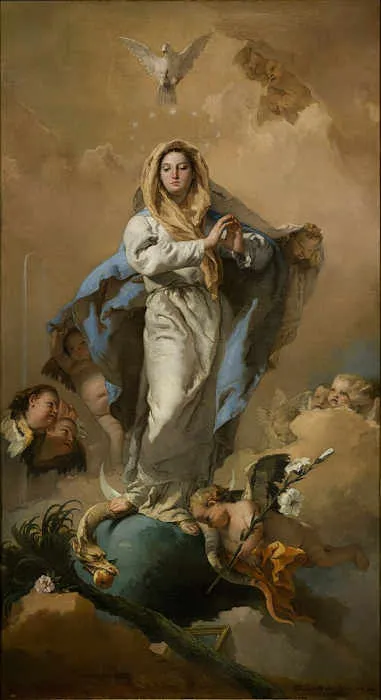
In 1854, Pope Pius IX issued an apostolic constitution called Ineffabilis Deus by which he declared the Immaculate Conception of the Blessed Virgin Mary to be a dogma of faith. This definition was a response to the longstanding devotion and theological consensus that had built up over the centuries. By declaring a dogma of faith, the Holy Father used his highest papal teaching authority, binding every Catholic to accept this teaching.

Ineffabilis Deus begins by stating that the creation of the Blessed Virgin Mary was in the mind of God from all eternity. She is the Father’s “singular delight,” and “under God, one cannot even imagine anything greater, and which, outside of God, no mind can succeed in comprehending fully.” This statement should leave us with a profound faith in the Immaculate Conception and an acknowledgment of the great and incomprehensible mystery we celebrate. Only in Heaven, as we behold the Beatific Vision, will our minds also behold the beauty and profound mystery of God’s greatest act of creation in the person of the Mother of God. Her life is not an end in itself. She is not worshiped. She is not God. She is, however, to be loved and honored in a singularly unique way, for she is God’s most glorious creation and will be honored as such forever.

The first thing we must know about our Immaculate Mother is that she needed a Savior, just as all humans do. Her Savior is her Son, just as He is our Savior. However, in her, salvation was given “by a singular grace and privilege.” We are saved by the washing away of original sin through baptism. The Blessed Virgin Mary was preserved from original sin from the first moment of her conception. Her salvation transcended time in that the merits of salvation won by her Son Jesus’ Incarnation, death, and resurrection saved her from original sin at the very moment of her creation.

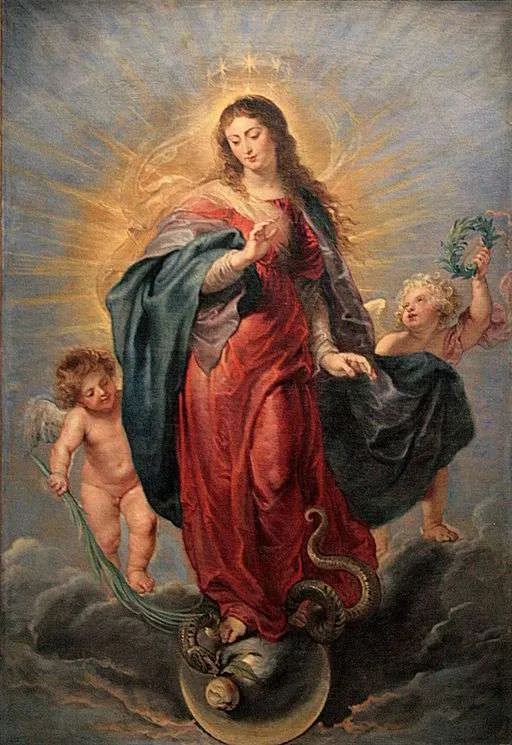
Mary’s role is first alluded to in the book of Genesis. We read about the fall of Adam and Eve, introducing Original Sin into human nature, thus requiring a Savior. Genesis 3:15 presents what many have called the Protoevangelium or “First Gospel” because, in mysterious language, it presents Christ as the New Adam and the Blessed Virgin Mary as the new Eve: “I will put enmity between you and the woman, and between your offspring and hers; They will strike at your head, while you strike at their heel.” The “enmity” between the serpent and the “woman” reveals Mary’s complete opposition to the evil one and to sin. The “offspring” is Jesus and He will crush the head of satan, destroying sin and evil forever. This passage also reveals that Jesus invites His mother to participate in this act of salvation in a unique way. “They will strike at your head…” implying both Jesus and the Blessed Virgin Mary overcame sin and satan together, by the power of God, but through the motherhood of Mary, the new mother of all the living and the mother of those in the new order of grace.

The Blessed Virgin Mary has also been traditionally seen as the new Ark of the Covenant. The first Ark was a sacred vessel that contained the Ten Commandments, manna, and Aaron’s rod. The Ark was a symbol of God’s divine presence that only the High Priest could approach once a year after rigorous purification rituals. The Blessed Virgin Mary, being the new Ark of the Covenant, should also be treated with the greatest veneration, for she bore the divine within her womb and He came forth from her own body. Only the Great High Priest, Jesus her Son, could dare to approach and dwell within her.

At the Annunciation, the Archangel Gabriel came to the Virgin and said, “Hail, full of grace, the Lord is with you!” (Luke 1:28). This passage points to the Immaculate nature of the Blessed Virgin Mary. To be “full of grace” affirms the fact that grace so permeated Mary’s soul that sin had no place within her. Not only was she created free from sin, she also remained sinless throughout her life through the merit of her ongoing assent to God. Her prayerful response to the archangel was not only her response at that moment but was her continuous response to God throughout her life, “Behold, I am the handmaid of the Lord; let it be to me according to your word” (Luke 1:38).

From at least the seventh century, churches in the East celebrated in the liturgy Mary’s conception in Saint Anne’s womb. The Church in the West soon followed, emphasizing the immaculate nature of her conception. In the fifteenth century, Pope Sixtus IV approved a liturgical celebration for the Feast of the Immaculate Conception and then extended that feast to the entire Western Church. In the centuries that followed, successive popes issued clearer teachings in support of the definition of the Immaculate Conception. Because of this ongoing and deepening definition of the Immaculate Conception, Pope Pius IX lifted this teaching to the highest level possible when he issued Ineffabilis Deus in 1854.

If we turn again to the beginning of that constitution in which the Holy Father said that “no mind can succeed in comprehending fully” the Blessed Virgin Mary, then we will realize that the little we know and understand about her remains a deep mystery that we will only fully comprehend in Heaven. Therefore, as we honor the Immaculate Conception and Mary’s immaculate nature, we also must anticipate a continual unfolding of who she is. The dogma of the Immaculate Conception was not the end but the beginning. After that pronouncement, subsequent popes have continued to deepen their teaching on her. In 1904, Pope Pius X spoke of Mary as the Mediatrix of Graces. In 1950, Pope Pius XII defined the dogma of the Assumption of the Blessed Virgin Mary into Heaven; in 1954, he established the Feast of the Queenship of Mary. Vatican II spoke of Mary as Mother of the Church and the Mediatrix of Grace.

As we celebrate this great Solemnity of the Immaculate Conception, try to ponder the incomprehensible nature of the Mother of God. Knowing that she is an impenetrable mystery will help us honor her with the reverence and awe she deserves. The best news of all to ponder is that this perfect creation of God is not a distant icon to adore, she is our own caring mother, a mediatrix of God’s grace. Her tender care for her children will never waver, and her intercession will always bring to us all good things we need to achieve salvation.

Source: https://mycatholic.life/saints/saints-of-the-liturgical-year/8-december-immaculate-conception-of-the-blessed-virgin-mary–solemnity/

Immaculate Conception of the Blessed Virgin Mary Read More »

Luke 1:26-29

The Immaculate Mother of God

The angel Gabriel was sent from God to a town of Galilee called Nazareth, to a virgin betrothed to a man named Joseph, of the house of David, and the virgin’s name was Mary. And coming to her, he said, “Hail, full of grace! The Lord is with you.” But she was greatly troubled at what was said and pondered what sort of greeting this might be.

Reflection:

The Blessed Virgin Mary was “full of grace!” To be “full” means just that—full, lacking in nothing. This fullness of grace signified that she embodied the perfection of every virtue, particularly humility. Humility is seeing oneself in the light of truth, neither exaggerated nor diminished. Mary’s humility is strikingly revealed in her reaction to the angel Gabriel’s greeting—she was “greatly troubled at what was said” and pondered it deeply.

Why would the Mother of God be troubled? Why not simply respond with confidence, saying, “Thank you for noticing that I am full of grace?” Because Mary knew that her fullness of grace was not due to her own merits. It was entirely beyond her natural abilities and was the result of God’s gracious initiative. Mary freely cooperated with grace throughout her life, and she knew that God alone was the source of every gift. Therefore, her initial reaction of being “troubled” was not due to doubt or fear but was the fruit of her wonder and awe at the incomprehensible blessings bestowed upon her. She saw clearly her own lowliness and unworthiness in relation to God, and this profound humility made her the most beautiful of all creatures.

Her heart, filled with wonder and contemplation, not only made Mary the Immaculate Mother of God but also sets before us a model of perfect discipleship. Though we are not “full” of grace as she was, we receive countless graces daily. Like Mary, we must strive to respond to these gifts with humility, awe, and gratitude.

Today, as we honor the Blessed Virgin Mary as the Immaculate Conception, we remember that while Adam and Eve were created in a state of Original Innocence, they fell from grace through disobedience. As a result, humanity inherited a fallen nature. However, by a singular grace, Mary was preserved from the stain of Original Sin from the very moment of her conception. This prevenient grace—a grace that was given to her before any merit or action on her part—was given to her in light of the future merits of her Son, Jesus Christ. Thus, Mary was redeemed in an extraordinary way, and her soul was preserved from concupiscence and all of the effects of sin. Unlike Adam and Eve, who turned away from God, Mary remained faithful to Him throughout her life, earning her the title, “The New Eve.”

As we celebrate the Immaculate Conception, reflect today on the mystery of Mary’s life and soul. While we can understand her unique role in salvation history to a certain degree, the full beauty and depth of her Immaculate Heart will only be fully revealed in Heaven. For now, we are invited to meditate upon her profound humility, her life of grace, and her role as the model of Christian discipleship.

Source: https://catholic-daily-reflections.com/2025/12/07/the-immaculate-mother-of-god/

Luke 1:26-29 Read More »

Second Sunday of Advent

First Reading Isaiah 11:1-10

On that day, a shoot shall sprout from the stump of Jesse,
and from his roots a bud shall blossom.
The spirit of the LORD shall rest upon him:
a spirit of wisdom and of understanding,
a spirit of counsel and of strength,
a spirit of knowledge and of fear of the LORD,
and his delight shall be the fear of the LORD.
Not by appearance shall he judge,
nor by hearsay shall he decide,
but he shall judge the poor with justice,
and decide aright for the land’s afflicted.
He shall strike the ruthless with the rod of his mouth,
and with the breath of his lips he shall slay the wicked.
Justice shall be the band around his waist,
and faithfulness a belt upon his hips.
Then the wolf shall be a guest of the lamb,
and the leopard shall lie down with the kid;
the calf and the young lion shall browse together,
with a little child to guide them.
The cow and the bear shall be neighbors,
together their young shall rest;
the lion shall eat hay like the ox.
The baby shall play by the cobra’s den,
and the child lay his hand on the adder’s lair.
There shall be no harm or ruin on all my holy mountain;
for the earth shall be filled with knowledge of the LORD,
as water covers the sea.
On that day, the root of Jesse,
set up as a signal for the nations,
the Gentiles shall seek out,
for his dwelling shall be glorious.

Responsorial Psalm Psalms 72:1-2, 7-8, 12-13, 17

R. (cf. 7)  Justice shall flourish in his time, and fullness of peace for ever.
O God, with your judgment endow the king,
and with your justice, the king’s son;
he shall govern your people with justice
and your afflicted ones with judgment.
R. Justice shall flourish in his time, and fullness of peace for ever.
Justice shall flower in his days,
and profound peace, till the moon be no more.
May he rule from sea to sea,
and from the River to the ends of the earth.
R. Justice shall flourish in his time, and fullness of peace for ever.
For he shall rescue the poor when he cries out,
and the afflicted when he has no one to help him.
He shall have pity for the lowly and the poor;
the lives of the poor he shall save.
R. Justice shall flourish in his time, and fullness of peace for ever.
May his name be blessed forever;
as long as the sun his name shall remain.
In him shall all the tribes of the earth be blessed;
all the nations shall proclaim his happiness.
R. Justice shall flourish in his time, and fullness of peace for ever.

Second Reading Romans 15:4-9

Brothers and sisters:
Whatever was written previously was written for our instruction,
that by endurance and by the encouragement of the Scriptures
we might have hope.
May the God of endurance and encouragement
grant you to think in harmony with one another,
in keeping with Christ Jesus,
that with one accord you may with one voice
glorify the God and Father of our Lord Jesus Christ.

Welcome one another, then, as Christ welcomed you,
for the glory of God.
For I say that Christ became a minister of the circumcised
to show God’s truthfulness,
to confirm the promises to the patriarchs,
but so that the Gentiles might glorify God for his mercy.
As it is written:
Therefore, I will praise you among the Gentiles
and sing praises to your name.

Alleluia Luke 3:4, 6

R. Alleluia, alleluia.
Prepare the way of the Lord, make straight his paths:
all flesh shall see the salvation of God.
R. Alleluia, alleluia.

Gospel Matthew 3:1-12

John the Baptist appeared, preaching in the desert of Judea
and saying, “Repent, for the kingdom of heaven is at hand!”
It was of him that the prophet Isaiah had spoken when he said:
A voice of one crying out in the desert,
Prepare the way of the Lord,
make straight his paths.

John wore clothing made of camel’s hair
and had a leather belt around his waist.
His food was locusts and wild honey.
At that time Jerusalem, all Judea,
and the whole region around the Jordan
were going out to him
and were being baptized by him in the Jordan River
as they acknowledged their sins.

When he saw many of the Pharisees and Sadducees
coming to his baptism, he said to them, “You brood of vipers!
Who warned you to flee from the coming wrath?
Produce good fruit as evidence of your repentance.
And do not presume to say to yourselves,
‘We have Abraham as our father.’
For I tell you,
God can raise up children to Abraham from these stones.
Even now the ax lies at the root of the trees.
Therefore every tree that does not bear good fruit
will be cut down and thrown into the fire.
I am baptizing you with water, for repentance,
but the one who is coming after me is mightier than I.
I am not worthy to carry his sandals.
He will baptize you with the Holy Spirit and fire.
His winnowing fan is in his hand.
He will clear his threshing floor
and gather his wheat into his barn,
but the chaff he will burn with unquenchable fire.”

Source: https://bible.usccb.org/bible/readings/120725.cfm

Second Sunday of Advent Read More »

Matthew 3:11-12

Repentance—the Foundation of Holiness

“I am baptizing you with water, for repentance, but the one who is coming after me is mightier than I. I am not worthy to carry his sandals. He will baptize you with the Holy Spirit and fire. His winnowing fan is in his hand. He will clear his threshing floor and gather his wheat into his barn, but the chaff he will burn with unquenchable fire.”

Reflection:

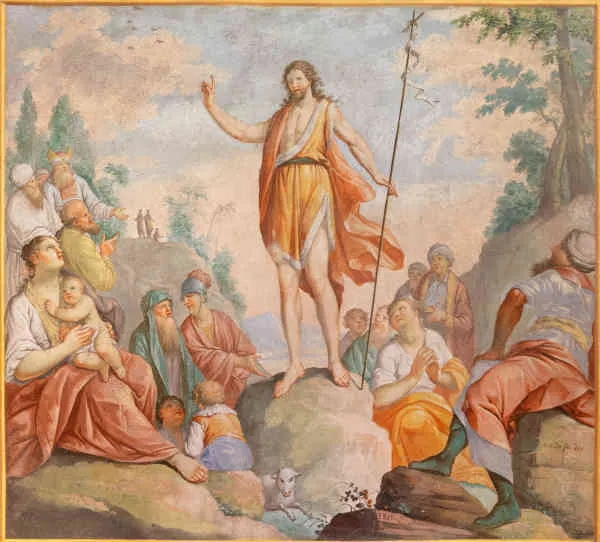
This passage comes just before Jesus is baptized and begins His public ministry. John the Baptist had been ministering in the desert of Judea, preaching, “Repent, for the kingdom of heaven is at hand!” Many came to him to be baptized with a baptism of repentance. But when John saw many scribes and Pharisees coming to him, he said, “You brood of vipers! Who warned you to flee from the coming wrath? Produce good fruit as evidence of your repentance.” The passage above is John’s warning to them—and to us—about what will happen if we fail to repent.

At that time, when wheat was harvested, it was left to dry. Then, a winnowing fan was used to blow the wheat and chaff into the air. The lighter chaff would blow away, while the grains of wheat would fall to the ground to be gathered, milled into flour, and used for baking. John uses this familiar image to depict what Jesus will do with the righteous and the wicked. The righteous are like the grains of wheat that will be gathered and brought to Heaven. The wicked are like the chaff that, once separated from the righteous, will burn in the unquenchable fire of hell.

Though it is comforting to speak of the glories of Heaven and to anticipate being brought there by our Lord, it is necessary to also consider the reality of the unquenchable fires of hell. Pondering the reality of those unquenchable fires is something we should not neglect.

In his spiritual classic, The Spiritual Exercises, Saint Ignatius of Loyola presents a format for a thirty-day directed silent retreat, considered by many to be the ideal retreat experience. During the first week of that retreat, the retreatant focuses primarily upon mortal sin and its consequences—the unquenchable fires of hell. Why would Saint Ignatius begin his retreat this way? Because he understood that the foundation of our growth in union with God is repentance, and repentance requires an honest and thorough examination of sin and its consequences.

Reflect today on the unquenchable fires of hell, and allow yourself to foster a burning desire to flee from every sin that leads to that end. As we enter the second week of the penitential season of Advent, ponder this warning from Saint John the Baptist. Hear him speak those words directly to you. We must fear sin and avoid it, as much as we want to avoid the unquenchable fires of hell. Start with this foundational truth, so that having fostered deep repentance, you are ready to turn your heart and mind toward the glorious promise of Heaven.

Source: https://catholic-daily-reflections.com/2025/12/06/repentance-the-foundation-of-holiness/

Matthew 3:11-12 Read More »

Saint Nicholas, Bishop

c. 270–c. 346; Patron Saint of children, sailors, merchants, archers, repentant thieves, brewers, pawnbrokers, unmarried people, Russia, and numerous countries and cities; Pre-Congregation canonization

Saint Nicholas of Myra, also known as Nicholas of Bari, Nicholas the Wonderworker, and Saint Nick, was a fourth-century bishop in Myra, Asia Minor, modern-day Demre, Turkey. His life is also the origin of the legend of Santa Claus. By the sixth century, his tomb had become widely venerated because of the numerous reported miracles worked through his intercession. In the eleventh century, his body was transferred to Bari, Italy, where it remains today. To this day, his bodily remains excrete a liquid, at first thought to be an oil but now believed to be water, which is collected, mixed with holy water, and distributed to the faithful in bottles every May 9, the day his remains arrived in Bari. The liquid is commonly referred to as the “Manna of Saint Nicholas” and is believed to contain miraculous healing power. For this reason, along with the mythical character of Santa Claus, he remains a highly venerated saint within the Church. 

Very little is known about Saint Nicholas that is historically verifiable. What we do know is that he was the Bishop of Myra, most likely suffered imprisonment during the persecution of Roman Emperor Diocletian, and was one of the bishops who attended the Council of Nicaea in 325. In addition to these historical details, many later legends have developed about his life. 

Nicholas was born into an affluent and devout Christian family. When Nicholas was young, his parents died from an epidemic, leaving him an orphan and heir to his family wealth. Conscious of the exhortation Jesus gave to the rich young man to “sell what you have and give to the poor,” Nicholas did exactly that. He sold his inheritance and distributed it to those in need. Some accounts of his life state that his uncle instead was the Bishop of Myra and that he ordained Nicholas a priest.

One popular legend is that among the recipients of his wealth were three girls whose father could not afford dowries for them to be married. Their future options were grim and included the possibility of their resorting to prostitution to survive. When Nicholas found out about this dire situation, he threw a bag of gold through the window of their home that the father used as a dowry for his first daughter. Nicholas then did this a second time. After the second daughter was married, the father stayed up all night waiting for a third bag of money. When Nicholas threw the third bag through the window, the father ran out and thanked him. Nicholas asked him not to tell anyone. One version of the story states that each night, the bag of gold landed in stockings hung by the fire to dry, leading to the Christmas tradition of placing stockings out for Saint Nick, who secretly fills them.

In another popular story, Nicholas was traveling to the Holy Land by ship. A storm suddenly arose, and the crew were fearful for their lives. Nicholas prayed, and the storm ceased. For this reason, Saint Nicholas is patron saint of sailors and those taking sea voyages.

How Nicholas became a bishop is a mystery. One version of the story is that shortly after Father Nicholas’ return from the Holy Land, the bishop of Myra died. The clergy of Myra then gathered to pick a successor. During their meeting, God inspired them to pick the first person to enter their church the following morning. Because Father Nicholas had spent the entire night in prayer, he was the first person in the church and was chosen bishop.

During his time as Bishop of Myra, a great persecution broke out in the Roman Empire under Emperor Diocletian. In 303, Diocletian, Maximian, Galerius, and Constantius—who made up a tetrarchy that governed the whole Roman Empire—issued a series of edicts outlawing Christianity and imposing the penalties of torture and death on those who practiced the faith. This was the last and the most violent persecution of Christians in the Roman Empire. At some point, between the years of 303 and 306, Bishop Nicholas was among those arrested and tortured. In 305, Diocletian renounced the throne, and in 306, Caesar Constantius died. Constantius’ son, Constantine, then became Caesar in his place and ordered Bishop Nicholas’ release. In 312, Constantine is said to have seen a vision of the Cross with the words, “In this sign, you will conquer.” In 313, he and his co-emperor ​​Licinius issued the Edict of Milan, granting religious tolerance to Christians.

An early list of the bishops who attended the Council of Nicaea in 325 includes Bishop Nicholas. That council was called to address the heresy of Arianism that denied the full divinity of Christ, asserting that the Son was a created being and not co-eternal with the Father. Some legends relate that Bishop Nicholas was so appalled by the Arians at the council that he slapped one of them across the face, was imprisoned for that act, but was released by Jesus and the Blessed Virgin Mary. Other accounts state that the heretic he slapped was Arius himself. The slap is a common motif in sacred art, including Orthodox iconography.

Other legends abound about Saint Nicholas. He is said to have won the release of various individuals unjustly condemned to death, going so far as to stay the sword of the executioner. During a famine, an evil butcher killed three children and pickled their remains to sell them as ham. Bishop Nicholas intervened and raised the pickled children from the dead. While shocking to the modern hearer, the story was widely told in the Middle Ages. An image of that miracle is found in sacred art and is one of the reasons many came to consider Saint Nicholas as the patron saint of children. Still another story relates that during another famine, a ship full of wheat for the emperor arrived in Myra. Bishop Nicholas convinced the sailors to give him enough to feed the people for two years, promising them that the emperor would still receive all his wheat. When the trusting sailors delivered the rest of the wheat to the emperor, it weighed the same as when it was loaded, despite much of it having been given to the people of Myra.

Bishop Nicholas died on or around December 6, 346 (the year of death varies by source), and was canonized by popular acclaim. His feast day became a day when the faithful performed charitable works, especially toward children, a custom that continues today. In 1054, the Catholic Church split between the East and West, resulting in the Catholic and Orthodox Churches. This left the remains of Saint Nicholas in the hands of the Orthodox. In 1071, the Seljuk Turks captured Orthodox-controlled Myra. In 1087, fearful that the Turks would mistreat the relics of their revered saint, Catholic Italian sailors from Bari took part of Saint Nicholas’s remains from his Myra tomb and brought them to Bari, Italy, where the pope later had a church built in the saint’s honor.

Though most of what we know about Saint Nicholas’ life is legendary rather than historically certain, those legends have added much to the faith of the people of God throughout the centuries. These tales have inspired faith and hope and have led to numerous reported miracles.

As we honor this saintly bishop from 1,700 years ago, ponder the faith of the people of God throughout those centuries who have benefitted from the sacred art, pilgrimages to his tomb, and the miraculous Manna of Saint Nicholas. Allow the longtime devotion to him to inspire you, entrusting yourself more fully to his intercession, as well as the intercession of all the saints of Heaven.

Source: https://mycatholic.life/saints/saints-of-the-liturgical-year/december-6—saint-nicholas-bishop–optional-memorial/

Saint Nicholas, Bishop Read More »

Matthew 9:35

Loving the Troubled and Abandoned

“Jesus went around to all the towns and villages, teaching in their synagogues, proclaiming the Gospel of the Kingdom, and curing every disease and illness.”

Reflection:

This one line speaks volumes about Jesus’ public ministry. He didn’t just preach a few sermons or heal a few who were sick. He “went around to all the towns and villages…teaching…proclaiming the Gospel…” and cured “every disease and illness.”

It’s important to contemplate that Jesus’ public ministry lasted approximately three years. Three years of constant preaching, healing, and relating to people. During this time, Jesus encountered many thousands of individuals, and news of His works spread throughout Israel and beyond.

Yet, the rest of today’s Gospel reveals that Jesus’ public ministry, though perfect in every way, was just the beginning. It was the foundation upon which His ongoing ministry would be established through the formation of His Church.

As the Gospel continues, we gain insight into Jesus’ compassionate heart. When He looked at the crowds, “his heart was moved with pity for them because they were troubled and abandoned, like sheep without a shepherd.” His three years of ministry were only the foundation, and His merciful Heart began to overflow with compassion.

Though He is God, Jesus limited Himself to human interactions within time and space, making it impossible for Him to engage personally with every troubled and abandoned soul in His human form. That’s why He told His disciples to “ask the master of the harvest to send out laborers for his harvest.” After this, He summoned His Twelve Apostles, gave them authority to share in His ministry of preaching and healing, and sent them out to the “lost sheep of the house of Israel.”

Later, as recorded in Luke 10:1–2, Jesus expanded His mission even further by sending out seventy (or seventy-two) disciples ahead of Him as He and the Twelve began their final journey to Jerusalem where He would suffer and die. After His resurrection, Jesus further commissioned His Apostles to “Go, therefore, and make disciples of all nations, baptizing them in the name of the Father, and of the Son, and of the holy Spirit, teaching them to observe all that I have commanded you” (Matthew 28:19–20). This mission quickly spread to at least 120 disciples gathered in the upper room, and as the Holy Spirit continued to guide the early Church, thousands of new converts became evangelists, spreading the Word of God.

Reflect today on Jesus’ Sacred Heart, overflowing with compassion for all who feel “troubled and abandoned.” It is your mission to be Christ’s Heart to them—to love them, to long for their burdens to be lifted, and to lead them to Christ, the Good Shepherd. Do not shy away from this mission, for the mission you are given is a continuation of and participation in the one eternal mission of Jesus Himself.

Source: https://catholic-daily-reflections.com/2025/12/05/loving-the-troubled-and-abandoned/

Matthew 9:35 Read More »

Saint John Almond

Profile

John grew up in Ireland. He was educated at Much Woolton, in Rheims, France, and at the English College, Rome, Italy at age 20. He was ordained in 1598. He returned to England as a home missioner in 1602. He was arrested in 1608 and 1612 for the crime of being a priest. The effectiveness of his debating skills against the anti–Catholic powers of the time led to his being one of the Forty Martyrs of England and Wales.

Born

  • c.1577 at Allerton, Lancashire, England

Died

  • hanged, drawn, and quartered on 5 December 1612 at Tyburn, London, England

Venerated

  • 8 December 1929 by Pope Pius XI (decree of martyrdom)

Beatified

  • 15 December 1929 by Pope Pius XI

Canonized

  • 25 October 1970 by Pope Paul VI

Source: https://catholicsaints.info/saint-john-almond/

Saint John Almond Read More »