Author name: Sani

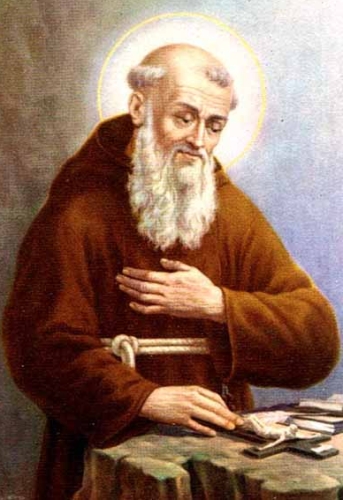
Saint Joseph of Leonessa

Profile

Eufranio was the third of eight children born to John Desideri, a wool merchant, and Serafina Paolini. His parents died when he was 12 years old, and he was raised and educated by his uncle Battista Desideri, a teacher in Viterbo, Italy. Desideri arranged a marriage for Eufranio with a local noble family, but the young man felt a call to religious life. Worry over his vocation and fear of hurting his uncle made Eufranio sick; he returned to Leonessa, Italy to recover. There he met, and was greatly impressed by, a group of Capuchin monks. When Eufranio told his uncle of his desire to join them, his uncle insisted that he continue his studies.

Eufranio agreed, and moved to Spoleto, Italy to do so, but kept in contact with the monks. Following a novitiate year in which the monks did everything to test and dissuade the young man, he joined the Capuchin Franciscans on 8 January 1573 at age 18, taking the religious name Joseph. He suffered through several self-imposed austerities including fasting three days a week and sleeping on bare boards.

Joseph was ordained at Amelia, Italy on 24 September 1580. He was a preacher throughout the regions of Umbria, Lazio and Abruzzi regions of Italy. Father Joseph once converted an entire band of 50 highway bandits, who then showed up as a group for his Lent sermons.

Joseph was a missionary to Muslim Pera near Constantinople (modern Istanbul, Turkey), receiving his commision on 1 August 1587. He was also a chaplain for 4,000 Christian galley slaves. He often offered to take the place of some slave who was being worked to death, but the authorities never accepted.

Ministering to prisoners in a remote camp, Joseph once got home late, and was forced to sleep outside the walls of his assigned area; he was charged with being a spy for being in the wrong place, and spent a month in jail. He preached to any who would listen, brought lapsed Christians back to the Church and converted Muslims. He worked with prisoners during a plague outbreak.

Joseph repeatedly sought an audience with the Sultan; he planned to ask for a decree of religious freedom. His forceful methods led to his being arrested and condemned to death for trespassing on royal property. Hung by hooks over a smoky fire for three days, he was freed (legend says by an angel), and returned to Italy, in autumn 1589.

There Joseph resumed his vocation of wandering preacher to small villages throughout the country. He preached to and for the poor, and spread the teachings of the Council of Trent. He helped establish hospitals, homeless shelters, and food banks. He ministered in prisons, to the sick, and the poor. With his crucifix in hand, he would wade into gang fights and brawls, praying, and preaching peace and good sense.

Born

  • 8 January 1556 at Leonessa, Umbria, Italy as Eufranio Desiderio

Died

  • Saturday 4 February 1612 at Umbria, Italy of cancer and post-operative problems from surgery for that cancer

Name Meaning

  • whom the Lord adds (Joseph)

Beatified

  • 22 June 1737 by Pope Clement XII

Canonized

  • 29 June 1746 by Pope Benedict XIV

Patronage

  • Leonessa, Italy

Representation

  • with Saint Fidelis of Sigmaringen

Source: https://catholicsaints.info/saint-joseph-of-leonessa/

Saint Joseph of Leonessa Read More »
Fifth Sunday in Ordinary Time

First Reading Job 7:1-4, 6-7

Job spoke, saying:
Is not man’s life on earth a drudgery?
Are not his days those of hirelings?
He is a slave who longs for the shade,
a hireling who waits for his wages.
So I have been assigned months of misery,
and troubled nights have been allotted to me.
If in bed I say, “When shall I arise?”
then the night drags on;
I am filled with restlessness until the dawn.
My days are swifter than a weaver’s shuttle;
they come to an end without hope.
Remember that my life is like the wind;
I shall not see happiness again.

Responsorial Psalm Psalms 147:1-2, 3-4, 5-6

R. (cf. 3a) Praise the Lord, who heals the brokenhearted.
or:
R. Alleluia.

Praise the LORD, for he is good;
sing praise to our God, for he is gracious;
it is fitting to praise him.
The LORD rebuilds Jerusalem;
the dispersed of Israel he gathers.

R. Praise the Lord, who heals the brokenhearted.
or:
R. Alleluia.

He heals the brokenhearted
and binds up their wounds.
He tells the number of the stars;
he calls each by name.

R. Praise the Lord, who heals the brokenhearted.
or:
R. Alleluia.

Great is our Lord and mighty in power;
to his wisdom there is no limit.
The LORD sustains the lowly;
the wicked he casts to the ground.

R. Praise the Lord, who heals the brokenhearted.
or:
R. Alleluia.

Second Reading 1 Corinthians 9:16-19, 22-23

Brothers and sisters:
If I preach the gospel, this is no reason for me to boast,
for an obligation has been imposed on me,
and woe to me if I do not preach it!
If I do so willingly, I have a recompense,
but if unwillingly, then I have been entrusted with a stewardship.
What then is my recompense?
That, when I preach,
I offer the gospel free of charge
so as not to make full use of my right in the gospel.

Although I am free in regard to all,
I have made myself a slave to all
so as to win over as many as possible.
To the weak I became weak, to win over the weak.
I have become all things to all, to save at least some.
All this I do for the sake of the gospel,
so that I too may have a share in it.

Alleluia Matthew 8:17

R. Alleluia, alleluia.

Christ took away our infirmities
and bore our diseases.

R. Alleluia, alleluia.

Gospel Mark 1:29-39

On leaving the synagogue
Jesus entered the house of Simon and Andrew with James and John.
Simon’s mother-in-law lay sick with a fever.
They immediately told him about her.
He approached, grasped her hand, and helped her up.
Then the fever left her and she waited on them.

When it was evening, after sunset,
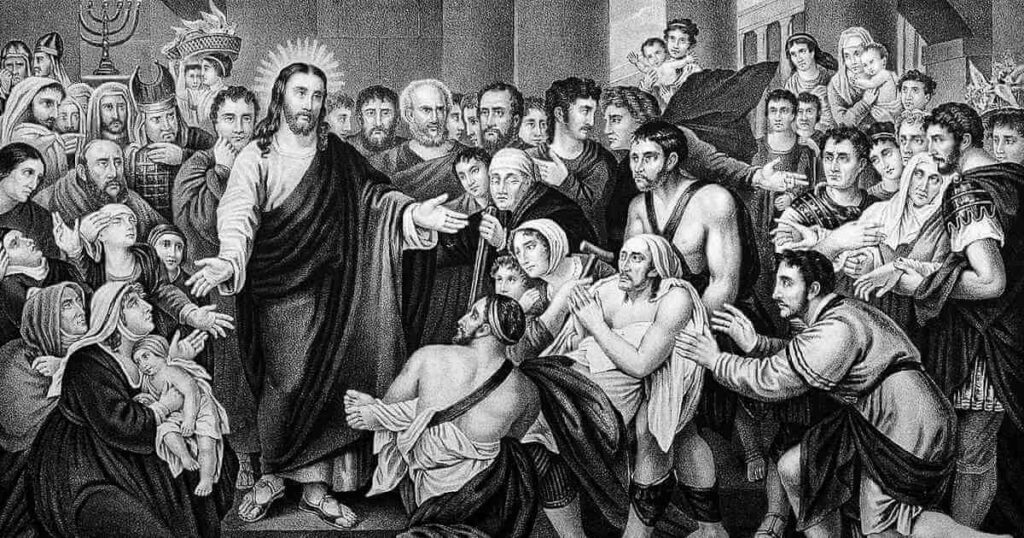
they brought to him all who were ill or possessed by demons.
The whole town was gathered at the door.
He cured many who were sick with various diseases,
and he drove out many demons,
not permitting them to speak because they knew him.

Rising very early before dawn, he left
and went off to a deserted place, where he prayed.
Simon and those who were with him pursued him
and on finding him said, “Everyone is looking for you.”
He told them, “Let us go on to the nearby villages
that I may preach there also.
For this purpose have I come.”
So he went into their synagogues,
preaching and driving out demons throughout the whole of Galilee.

Source: https://bible.usccb.org/bible/readings/020424.cfm

Fifth Sunday in Ordinary Time Read More »

Saint Blaise, Bishop and Martyr

Patron Saint of illnesses of the throat and other illnesses, wool workers, animals, bricklayers, bakers, farm workers; Pre-Congregation canonization

From 1346 to 1353, a bubonic plague commonly referred to as “Black Death” ravaged Europe, Asia, and North Africa. It was the most deadly pandemic in human history, with conservative estimates of its deadly toll reaching higher than 25 million people. Almost half of the people in Europe died in this pandemic.

During that plague, many Catholics prayed fervently. Out of that chaos, a new devotion to the “Fourteen Holy Helpers” emerged. Those holy helpers were fourteen saints who were believed to be powerful intercessors, especially to cure illness. Among those fourteen is today’s saint.

Very little is known about Saint Blaise. The earliest mention of his life was not written until about 200 years after his death, by the medical writer Aëtius Amidenus, who spoke of the intercessory power of Saint Blaise to help unlodge objects stuck in the throat.

The slightly more detailed Acts of Saint Blaise was written about 400 years after his death. Whether or not the stories written of him are true, what is certain is that the faithful have devoutly sought his intercession for centuries, and that practice continues today in the form of the blessing of throats on his feast day.

Legend has it that Blaise was an excellent physician in his hometown of Sebaste, Armenia, modern-day Silvas, Turkey. As a youth, he studied many of the great philosophers. When the Bishop of Sebaste died, Blaise was chosen as the new bishop by the popular acclaim “of all the people.”

Blaise was said to be a man of great faith and virtue, caring for his people in both body and soul. Many came to him for physical healing as a physician but also received many miracles. Many others came to him for spiritual healing, which was imparted by his deep faith. According to that same legend, even animals would listen to him and obey his commands, and he would heal them of ailments.

In the year 313, the co-ruling Roman Emperors, Constantine I and Licinius, jointly issued the Edict of Milan which established religious toleration throughout the Roman Empire. However, the Acts of Saint Blaise states that in 316, the Governor of Cappadocia, acting on an order by Licinius, began to arrest and kill Christians. Bishop Blaise is reported to have been among those arrested.

While on Blaise’s way to jail, the legend continues that a boy was choking on a fishbone, and the boy’s mother sent her son to Blaise for his prayers. Bishop Blaise miraculously cured him on the spot. Another story relates that on that journey to jail, a woman begged him to save her pig who had been seized by a wolf. Bishop Blaise ordered the wolf to release the pig and the wolf obeyed. Out of gratitude, the woman brought Blaise two wax candles to give light to his prison cell.

Despite these miracles, the governor insisted that Bishop Blaise renounce his Christian faith, which Blaise refused to do. Therefore, at the governor’s order, Blaise was ripped apart by metal combs used to comb wool and then beheaded.

Today, Saint Blaise is the patron saint of wool combers because of the legend of his torture and death by the metal combs. He is patron saint of animals because of his alleged authority over them. He is the patron saint of diseases of the throat and other illnesses because of the story that he healed the boy with a fishbone stuck in his throat, was a physician, and miraculously healed many others of their ailments. Two wax candles are used to bless throats today because of the legend of the candles brought to him in jail by the grateful woman.

As we reflect upon these stories that have been passed down through the years, perhaps the most important story to reflect upon is the story of faith that so many people have had for many centuries in the intercession of Saint Blaise.

From the people who might have sought his prayers at the time of his ministry, to those who sought his intercession during the Black Death centuries ago, to the priestly blessings today at Mass using candles to bless throats, God has used Saint Blaise in ways that he could have never foretold. This should reassure us that God wants us to turn to the intercession of the saints in our time of need.

Though God is fully capable of directly answering our prayers, He often chooses to use the mediation of others to impart His grace. Reflect upon your own devotion to Saint Blaise and all the saints. Seek out your special patron. Entrust your prayers to him or her and know that when you do, your patron offers you and your needs to God.

Source: https://mycatholic.life/saints/saints-of-the-liturgical-year/february-3-saint-blase-bishop-and-martyr/

Saint Blaise, Bishop and Martyr Read More »

Mark 6:34

Unexpected Ministry

“Come away by yourselves to a deserted place and rest a while.”

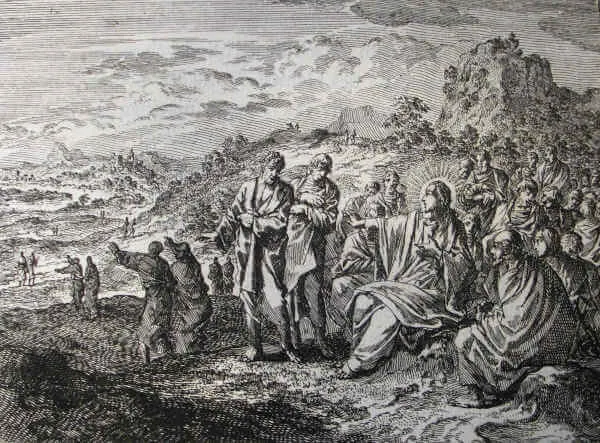
The Twelve had just returned from going about the countryside preaching the Gospel. They were tired. Jesus, in His compassion, invites them to come away with Him to rest for a while. So they get in a boat to cross over to a deserted place. But when the people hear about this, they hurry on foot to the place that their boat was heading. So, when the boat arrives, there is a crowd awaiting them.

Of course, Jesus does not get upset. He does not get discouraged by the burning desire of the people to be with Him and the Twelve. Instead, the Gospel relates that when Jesus saw them, “his heart was moved with pity,” and He began to teach them many things.

In our own lives, after serving others well, it’s understandable to desire rest. Even Jesus desired this for Himself and His Apostles. But the one thing that Jesus permitted to “interrupt” His rest was the clear desire of the people to be with Him and to be fed by His preaching. There is much to learn from this example of our Lord.

For example, there are many times when a parent may only want to be alone for a while, and yet family concerns arise that need their attention. Priests and religious may also have unexpected duties that arise from their ministry that can, at first, appear to interrupt their plans. The same can be said for any vocation or situation in life. We may think we need one thing, but then duty calls and we find we are needed in a different way.

One key to sharing in the apostolic mission of Christ, be it to our families, Church, communities or friends, is to be ready and willing to be generous with our time and energy. It’s true that prudence will dictate the need for rest at times, but at other times the call to charity will supersede what we perceive as a legitimate need for our own rest and relaxation.

And when true charity is demanded of us, we will always find that our Lord gives us the needed grace to be generous with our time. It is often in those moments when our Lord chooses to use us in ways that are truly transforming for others.

Reflect, today, upon the true needs of those around you. Are there people who would greatly benefit from your time and attention today? Are there needs that others have that will require you to change your plans and to give of yourself in a way that is difficult? Do not hesitate to give generously of yourself to others. In fact, this form of charity is not only transforming for those whom we serve, it is often one of the most restful and rejuvenating activities we can also do for ourselves.

Source: https://catholic-daily-reflections.com/2024/02/02/unexpected-ministry-3/

Mark 6:34 Read More »

Presentation of the Lord

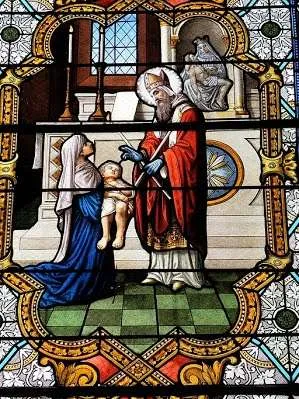
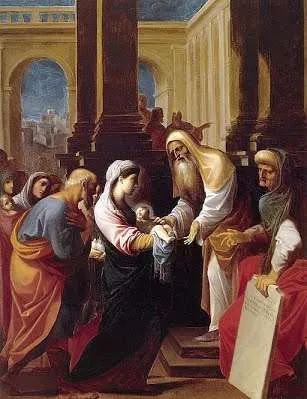
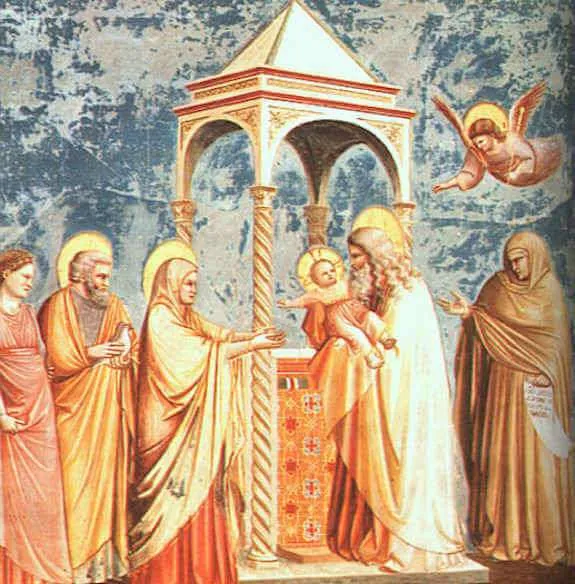
Mary and Joseph were faithful Jews who obeyed the Law of Moses. Jewish Law prescribed that two ritual acts needed to take place for a firstborn son. First, the mother of a newborn son was ritually unclean for seven days, and then she was to “spend thirty-three more days in a state of blood purity” (Leviticus 12). During these forty days she was not to “touch anything sacred nor enter the sanctuary till the days of her purification are fulfilled.” For this reason, today’s feast has at times been called the “Purification of Mary.”

Second, the father of the firstborn son was to “redeem” the child by making an offering to the priest of five shekels so that the priest would then present the child to the Lord (see Numbers 18:16). Recall that the firstborn male of all the Egyptians, animals and children, was killed during the tenth plague, but the firstborn males of the Israelites were spared.

Thus, this offering made for the firstborn son in the Temple was a way of ritually redeeming him in commemoration of protection during that plague. Since Jesus was presented in the Temple for this redemption, today’s feast is now referred to as the “Presentation in the Temple.”

“Candlemass” is also a traditional name given to today’s feast because as early as the fifth century, the custom of celebrating this feast with lighted candles had developed. The lit candles symbolized Simeon’s prophecy that Jesus would be “a light for revelation to the Gentiles.” Lastly, this Feast has been referred to as the “Feast of the Holy Encounter” because God, in the Person of Jesus, encountered Simeon and Anna in the Temple.

Today’s feast is celebrated in our Church forty days after Christmas, marking the day that Mary and Joseph would have brought Jesus into the Temple. Though Mary was pure and free from sin from the moment of her conception, and though the Son of God did not need to be redeemed, Mary and Joseph fulfilled these ritual obligations.

At the heart of this celebration is the encounter of Simeon and Anna with the Christ Child in the Temple. It is in that holy encounter that Jesus’ divinity is manifested by a human prophet for the first time. At His birth, the angels proclaimed His divinity to the shepherds, but in the Temple, Simeon was the first to understand and proclaim Jesus as the Savior of the World. He also prophesied that this salvation would be accomplished by a sword of sorrow that would pierce the Immaculate Heart of Mary.

Anna, a prophetess, also came forward and “gave thanks to God and spoke about the child to all who were awaiting the redemption of Jerusalem” (Luke 2:38). Thus, these ritual acts were also a moment in which Jesus’ divine mission was made manifest to the world.

As we celebrate Mary’s ritual purification and Jesus’ ritual redemption, we should see them as acts in which we are called to participate. First, each of us is unworthy of entering the true Temple of the Lord in Heaven. Yet we are invited to enter that Temple in union with Mary, our Blessed Mother. It was her consent to the will of God that opened the door of God’s grace to us all, enabling us to spiritually become Jesus’ “mother” by allowing Him to be born in our hearts by grace. With her, we are now able to appear before God, purified and holy in His sight.

We must also see Saint Joseph redeeming us as he presented Jesus in the Temple. In offering Christ Jesus to the priest to offer Him to the Father, Saint Joseph also presents all who strive to live in union with Jesus. The hope is that, like Simeon and Anna, others will see God alive within us and experience the Savior of the World through us.

Ponder, today, your soul being the new temple of the Lord, and acknowledge your need to be purified and offered to the Father in Heaven. As Christ continues to enter into the temple of your soul, pray that He will shine forth for others to see so that, like Simeon and Anna, they will encounter our Lord within you.

Source: https://mycatholic.life/saints/saints-of-the-liturgical-year/february-2-presentation-of-the-lord-feast/

Presentation of the Lord Read More »

Luke 2:29-32

The Culmination of a Life of Faith

“Now, Master, you may let your servant go in peace, according to your word, for my eyes have seen your salvation, which you prepared in the sight of all the peoples: a light for revelation to the Gentiles, and glory for your people Israel.” 

Reflection:

At the time of Jesus’ birth, there was a man named Simeon who had spent his whole life preparing for one significant moment. Like all faithful Jews at the time, Simeon was waiting for the coming Messiah. The Holy Spirit had revealed to him that he would indeed see the Messiah before his death—and so this happened when Mary and Joseph brought Jesus into the Temple to offer Him to the Lord as an infant.

Try to imagine the scene. Simeon had lived a holy and devout life. And deep within his conscience, he knew that his life on earth would not come to an end until he was privileged to see the Savior of the World with his own eyes. He knew this by a special gift of faith, an interior revelation of the Holy Spirit, and he believed.

It’s helpful to think about this unique gift of knowledge that Simeon had throughout his life. Normally we gain knowledge through our five senses. We see something, hear something, taste, smell, or feel something, and as a result come to know it to be true. Physical knowledge is very reliable and is the normal way we come to know things. But this gift of knowledge Simeon had was different. It was deeper and was spiritual in nature. He knew he would see the Messiah before he died, not because of some external sensory perception he had received but because of an interior revelation from the Holy Spirit.

This truth begs the question, which type of knowledge is more certain? Something you see with your eyes, touch, smell, hear or taste? Or something that God speaks to you in the depths of your soul by a revelation of grace? Though these types of knowledge are different, it’s important to understand that the spiritual knowledge that is given by the Holy Spirit is far more certain than anything perceived through the five senses alone. This spiritual knowledge has the power to change your life and direct all your actions toward that revelation.

For Simeon, this interior knowledge of a spiritual nature suddenly united with his five senses when Jesus was brought into the Temple. Simeon suddenly saw, heard and felt this Child Whom he knew he would one day see with his own eyes and touch with his own hands. For Simeon, that moment was the culminating moment of his life.

Reflect, today, upon anything that our Lord has spoken to you in the depths of your soul. Too often we ignore His gentle voice as it speaks, preferring instead to live only in the sensory world. But the spiritual reality within us must become the center and foundation of our lives. It is there where God speaks, and it is there where we, too, will discover the central purpose and meaning of our lives.

Source: https://catholic-daily-reflections.com/2024/02/01/the-culmination-of-a-life-of-faith-3/

Luke 2:29-32 Read More »

Saint Brigid of Ireland

Profile

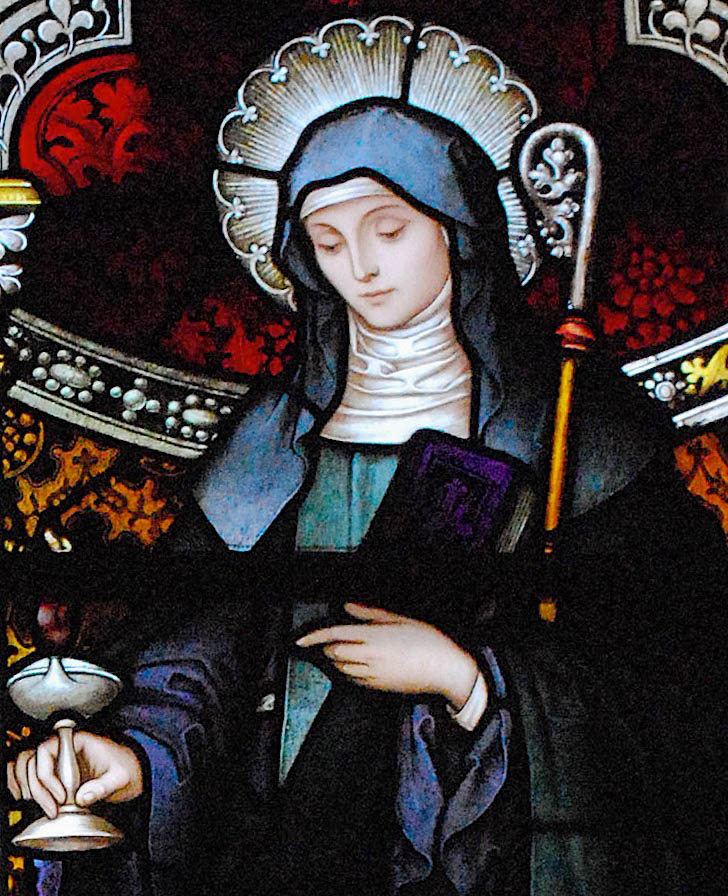
Brigid was the daughter of Dubtach, pagan Scottish king of Leinster, and Brocca, a Christian Pictish slave who had been baptized by Saint Patrick. Just before Brigid’s birth, her mother was sold to a Druid landowner. Brigid remained with her mother till she was old enough to serve her legal owner Dubtach, her father.

Brigid grew up marked by her high spirits and tender heart, and as a child, she heard Saint Patrick preach, which she never forgot. She could not bear to see anyone hungry or cold, and to help them, often gave away things that were Dubtach’s. When Dubtach protested, she replied that “Christ dwelt in every creature”.

Dubtach tried to sell her to the King of Leinster, and while they bargained, she gave a treasured sword of her father‘s to a leper. Dubtach was about to strike her when Brigid explained she had given the sword to God through the leper, because of its great value. The King, a Christian, forbade Dubtach to strike her, saying “Her merit before God is greater than ours”. Dubtach solved this domestic problem by giving Brigid her freedom.

Brigid’s aged mother was in charge of her master’s dairy. Brigid took charge ,and often gave away the produce. But the dairy prospered under her (hence her patronage of milk maids, dairy workers, cattle, etc.), and the Druid freed Brigid’s mother.

Brigid returned to her father, who arranged a marriage for her with a young bard. Bride refused, and to keep her virginity, went to her Bishop, Saint Mel of Ardagh, and took her first vows. Legend says that she prayed that her beauty be taken from her so no one would seek her hand in marriage; her prayer was granted, and she regained her beauty only after making her vows. Another tale says that when Saint Patrick heard her final vows, he mistakenly used the form for ordaining priests. When told of it he replied, “So be it, my son, she is destined for great things.”

Brigid’s first convent started in c.468 with seven nuns. At the invitation of bishops, she started convents all over Ireland. She was a great traveler, especially considering the conditions of the time, which led to her patronage of travelers, sailors, etc.

Brigid invented the double monastery, the monastery of Kildara, which means Church of the Oak, that she ran on the Liffey river being for both monks and nuns. Saint Conleth became its first bishop; this connection and the installation of a bell that lasted over 1000 years apparently led to her patronage of blacksmiths and those in related fields.

Born

  • 453 at Faughart, County Louth, Ireland

Died

  • 1 February 523 at Kildare, Ireland of natural causes
  • interred in the Kildare cathedral
  • relics transferred to Downpatrick, Ireland in 878 where they were interred with those of Saint Patrick and Saint Columba of Iona
  • relics re-discovered on 9 June 1185
  • head removed to Jesuit church in Lisbon, Portugal

Canonized

  • Pre-Congregation

Name Meaning

  • fiery arrow (= brigid)

Patronage

  • babies
  • blacksmiths
  • boatmen
  • cattle
  • chicken farmers
  • children whose parents are not married
  • dairymaids
  • dairy workers
  • fugitives
  • geese
  • infants
  • Ireland
  • mariners
  • midwives
  • milk maids
  • newborn babies
  • nuns
  • poets
  • poultry
  • poultry farmers
  • poultry raisers
  • printing presses
  • sailors
  • scholars
  • travelers
  • watermen
  • Douglas, Lanarkshire, Scotland
  • Ivrea, Turin, Italy
  • Leinster, Ireland
  • Kildare, Ireland, diocese of

Representation

  • abbess, usually holding a lamp or candle, often with a cow nearby
  • abbess with her hand on an altar
  • holding a cross with a flame over her head

Source: https://catholicsaints.info/saint-brigid-of-ireland/

https://en.wikipedia.org/wiki/Brigid_of_Kildare#/media/File:Sainte_Brigitte_%C3%A9glise_Macon.jpg

Saint Brigid of Ireland Read More »

Mark 6:7-8

Relying Upon Divine Providence

“Jesus summoned the Twelve and began to send them out two by two and gave them authority over unclean spirits. He instructed them to take nothing for the journey but a walking stick—no food, no sack, no money in their belts.”

Reflection:

Why would Jesus instruct the Twelve to go forth to preach with authority but to take nothing with them on the journey? Most people who set out on a journey prepare ahead and make sure to pack what they need. Jesus’ instruction was not so much a lesson in relying upon others for basic needs as it was a lesson on reliance upon divine providence for their ministry.

The material world is good in and of itself. All creation is good. Therefore, there is nothing wrong with having possessions and using them for our good and for the good of those who have been entrusted to our care. But there are times when God wants us to rely more upon Him than upon ourselves. The story above is one of those situations.

By instructing the Twelve to go forth on their mission without bringing the basic necessities of life, Jesus was helping them to trust not only in His providence for those basic needs but also to trust that He would provide for them spiritually in their mission of preaching, teaching and healing. They were given great spiritual authority and responsibility and, for that reason, needed to rely upon the providence of God to a far greater extent than others. Thus, Jesus exhorts them to trust Him regarding their basic needs so that they will also be disposed to trust Him on this new spiritual mission.

The same is true in our lives. When God entrusts us with a mission to share the Gospel with another, He will often do so in a way that requires great trust on our part. He will send us forth “empty-handed,” so to speak, so that we will learn to rely upon His gentle guidance. Sharing the Gospel with another is an incredible privilege, and we must realize that we will be successful only if we rely wholeheartedly upon the providence of God.

Reflect, today, upon those to whom you sense God wants you to reach out to with the Gospel. How do you do this? The answer is quite simple. You do so only by relying upon the providence of God. Step out in faith, listen to His guiding voice every step of the way, and know that His providence is the only way that the Gospel message will be effectively shared.

Source: https://catholic-daily-reflections.com/2024/01/31/relying-upon-divine-providence-2/

Mark 6:7-8 Read More »

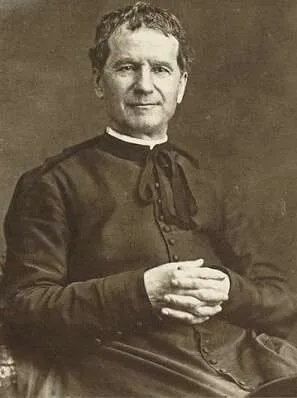
Saint John Bosco, Priest

Patron Saint of apprentices, boys, editors, laborers, magicians, students; Canonized by Pope Pius XI on April 1, 1934

The youngest of three sons, John Bosco was born into a poor family in northwest Italy in the rural hamlet of Becchi. His father, a farmhand for a neighboring family, died when John was only two. His mother continued to raise her sons with much love and affection.

Until the age of twelve, John spent most of his time trying to support the family by working as a shepherd and farmhand like his father. His family’s poverty made it difficult for him to obtain a good education. His learning came from his lived experience, homelife, and the sermons at church that he listened to attentively.

At the age of nine, John had the first of many dreams that would greatly influence him. In his dream, he came across a group of rough boys who were talking and cursing. John became angry with them and raised his fists to threaten them for their cursing. Suddenly, a man appeared in his dream who was radiant like the sun.

The man said to John, “Conquer the hearts of these, your friends, not with violence but with charity. Begin at once. Teach them the evil of vice and the excellence of virtue.” When John asked the man who he was, the man replied, “​​I am the Son of the lady I will send to be your teacher.” With that, the Blessed Mother appeared in the dream and began to teach John about his future mission of caring for boys with kindness.

John began his “ministry” when he was only ten. He would attend the shows of entertainers who performed juggling, magic tricks, and acrobatics. John studied their shows and then attempted to imitate them for other boys, always including prayers within the show and lessons he learned from Sunday sermons.

As was typical with many boys, John and his brother were always fighting with each other. This was one of the reasons that John decided to leave home at age twelve to look for work. A few years later, John caught the attention of a newly ordained priest and future saint, Father Joseph Cafasso, who saw his intellectual gifts and assisted him with his education. By the time John was twenty, Father Cafasso, with the help of some money from John’s mother, helped him enroll in the seminary. After six years of study, at the age of twenty-six, John was ordained a priest.

After ordination, Father John joined his mentor, Father Cafasso, in Turin to continue his studies at the Institute of Saint Francis where Father Cafasso was in charge. The two also engaged in ministry to the poor and imprisoned, cared for girls at a boarding school, and assisted in country parishes. It was in the prisons that Father John became aware of the number of boys who needed help.

Of this experience, he later wrote in his Memoirs, “I saw large numbers of young lads aged from 12 to 18, fine healthy youngsters, alert of mind, but seeing them idle there, infested with lice, lacking food for body and soul, horrified me. Public disgrace, family dishonor, and personal shame were personified in those unfortunates.” He thought to himself, “Who knows?…if these youngsters had a friend outside who would take care of them, help them, teach them religion…they could be steered away from ruin…”

Many of them were repeat offenders, and Father John’s heart was drawn to help them. His dream from when he was nine years old began to come to fruition as he sought to teach them, encourage them, listen to them, and befriend them as a mentor and spiritual father.

Father John’s plan was to found an oratory to provide structure and purpose for these boys. He helped them get jobs by teaching trades. At the same time, he provided them with food and shelter, taught them catechism, and gave them moral guidance and hope. Within ten years, Father John was assisting as many as 800 boys in need.

Less than a decade later, in 1861, some of the boys Father John mentored wanted to follow in his footsteps and assist other boys. Therefore, Father John founded the Society of St. Francis de Sales with a priest, seminarians, and a high school boy.

The Salesian Order was formally approved by the Vatican in 1869. In 1871 Father John expanded his mission by founding a Salesian religious order of women called the Daughters of Mary Help of Christians to care for girls. Finally, in 1874 he founded the Salesian Cooperators, a lay organization that worked with the male and female Salesian Orders.

Saint John Bosco saw a need as he encountered troubled, imprisoned, poor, orphaned, but good-hearted young boys. He followed his inspiration not to be harsh with them, but to offer them loving discipline, friendship, education, skills to support themselves, and a family within his oratory. This loving concern for these young boys overflowed into the hearts of many others, and God used this saintly man to save the souls of many by raising up an army of workers to care for them.

Ponder those in your life who are troubled, abandoned, disgraced, or struggling in other ways. Strive to imitate Saint John Bosco by seeing the good in them and helping to draw that goodness out so that they will find hope in the midst of their struggles with despair.

Source: https://mycatholic.life/saints/saints-of-the-liturgical-year/january-31-saint-john-bosco-priest/

Saint John Bosco, Priest Read More »

Mark 6:3

Christ All Around Us

“’Is he not the carpenter, the son of Mary, and the brother of James and Joseph and Judas and Simon? And are not his sisters here with us?’ And they took offense at him.”

Reflection:

After traveling throughout the countryside performing miracles, teaching the crowds and gaining many followers, Jesus returned to Nazareth where He grew up. Perhaps His disciples were excited to return with Jesus to His native place, thinking that His own townspeople would be overjoyed to see Jesus again because of the many stories of His miracles and authoritative teaching. But the disciples were soon to have quite a surprise.

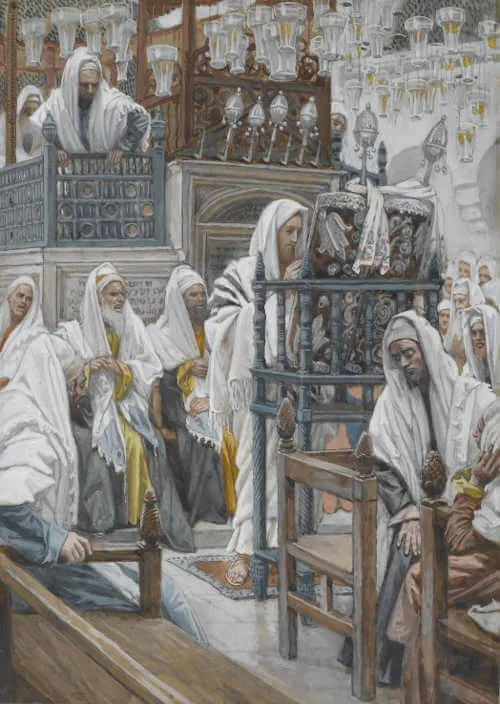
After arriving in Nazareth, Jesus entered the Synagogue to teach, and He taught with an authority and wisdom that confounded the locals. They said among themselves, “Where did this man get all this? What kind of wisdom has been given him?” They were confused because they knew Jesus. He was the local carpenter who worked for years with His father who was a carpenter. He was Mary’s son, and they knew His other relatives by name.

The primary difficulty Jesus’ townspeople had was their familiarity with Jesus. They knew Him. They knew where He lived. They knew Him as He grew up. They knew His family. They knew all about Him. Therefore, they wondered how Jesus could be anything special. How could He now teach with authority? How could He now do miracles? Thus, the townspeople were astonished, and they allowed that astonishment to turn into doubt, judgment and criticism.

The same temptation is something we all deal with more than we may realize. It is often easier to admire a stranger from afar than one whom we know well. When we hear of someone for the first time who is doing something admirable, it’s easy to join in that admiration. But when we hear good news about someone we know well, we can easily be tempted to jealousy or envy and to be skeptical and even critical.

But the truth is that every saint has a family. And every family potentially has brothers and sisters, cousins and other relatives through whom God will do great things. This should not surprise us—it should inspire us! And we should rejoice when those close to us and with whom we are familiar are used powerfully by our good God.

Reflect, today, upon those whom you are familiar with in life, especially your own family. Examine whether or not you struggle with an ability to see beyond the surface and accept that God dwells within everyone. We must constantly seek to discover the presence of God all around us, especially in the lives of those whom we know very well.

Source: https://catholic-daily-reflections.com/2024/01/30/christ-all-around-us-3/ 

Mark 6:3 Read More »