Author name: Sani

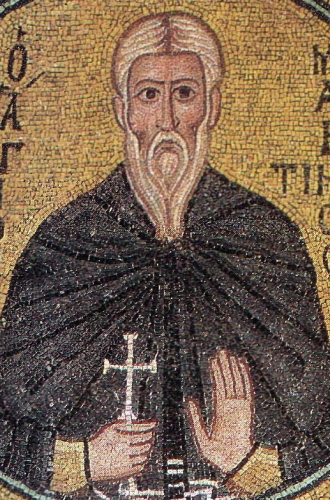
Saint Martinian the Hermit

Profile

Martinian became a hermit at age 18. He was a miracle worker. There are a couple of stories attached to Martinian; in them, the line between fact and a good story probably blurs a little.

Legend says that one day a miserable, bedraggled woman named Zoe showed at his door requesting a traveler‘s hospitality. Martinian took her in, but her true colors soon showed as she cleaned up and showed herself to be a beautiful woman who tried to seduce Martinian. When he realized how tempted he was, he built a fire and put his feet in it; the pain, as you might imagine, was excruciating. Martinian said, “If I cannot stand this fire, how will I tolerate the fires of Hell?” He counseled her while she treated his wounds, converted her, and she became a nun in Bethlehem.

To save himself from his own weakness, the saint moved to a large rock surrounded on all sides by the sea. There he lived on bread and water brought to him by a Christian sailor who visited three times a year. After six years living exposed on the rock, he had a visitor – a young woman who washed up on the rock after her ship had gone down at sea. Before she could speak, he gave her all his provisions, promised to send his friend the sailor to rescue her when he returned, then threw himself into the sea. He washed up on shore, and two months later had the girl rescued. He then spent the rest of his days in Athens.

Born

  • c.350 at Caesarea, Palestine

Died

  • c.398 at Athens, Greece

Canonized

  • Pre-Congregation

Representation

  • dolphin
  • man standing on a rock in the sea

Source: https://catholicsaints.info/saint-martinian-the-hermit/

Saint Martinian the Hermit Read More »

Mark 8:17-18

Comprehending the Mysteries of Heaven

“Do you not yet understand or comprehend? Are your hearts hardened? Do you have eyes and not see, ears and not hear?”

Reflection:

How would you answer these questions that Jesus posed to His disciples if He had posed them to you? It takes humility to admit that you do not yet understand or comprehend, that your heart is in fact hardened, and that you fail to see and hear all that God has revealed. Of course there are various levels to these struggles, so hopefully you do not struggle with them to a grave degree. But if you can humbly confess that you do struggle with these to a certain extent, then that humility and honesty will gain you much grace.

Jesus posed these questions to His disciples within the larger context of a discussion about the leaven of the Pharisees and Herod. He knew that the “leaven” of these leaders was like a yeast that corrupted others. Their dishonesty, pride, desire for honors and the like had a seriously negative affect upon the faith of others. So by posing these questions above, Jesus challenged His disciples to see this evil leaven and to reject it.

Seeds of doubt and confusion are all around us. It seems these days that almost everything the secular world promotes is in some way contrary to the Kingdom of God. And yet, just like the disciples’ inability to see the evil leaven of the Pharisees and Herod, we also frequently fail to see the evil leaven within our society. Instead, we allow the many errors to confuse us and lead us down the path of secularism.

One thing this should teach us is that just because someone has some form of authority or power within society does not mean that they are a truthful and holy leader. And though it’s never our place to judge the heart of another, we absolutely must have “ears to hear” and “eyes to see” the many errors that are held up within our world as good. We must constantly seek to “understand and comprehend” the laws of God and use them as a guide against the lies within the world. One important way to make sure we do this well is to make sure that our hearts never become hardened to the truth.

Reflect, today, upon these questions of our Lord and examine them especially within the broader context of society as a whole. Consider the false “leaven” taught by our world and by so many in positions of authority. Reject these errors and recommit yourself to the full embrace of the holy mysteries of Heaven so that those truths and those truths alone become your daily guide.

Source: https://catholic-daily-reflections.com/2024/02/12/comprehending-the-mysteries-of-heaven-3/

Mark 8:17-18 Read More »

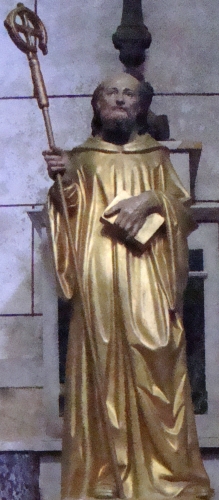
Saint Benedict of Aniane

Profile

Benedict was a born a Visigoth, the son of Aigul, Count of Maguelone. He was educated at the court of Pepin, and was a courtier and cup-bearer to King Pepin and Blessed Charlemagne. He was part of the 773 campaign of Charlemagne. He narrowly escaped drowning in the Tesin near Pavia, Italy while trying to save his brother.

Benedict became a Benedictine monk at Saint Sequanus monastery where he took the name Benedict. He lived two and a half years on bread and water, sleeping on the bare ground, praying through the night, and going barefoot.

In the Frankish empire, monasticism suffered lay ownership and the attacks of the Vikings. Monastic discipline decayed. In 779 Benedict founded the Aniane monastery on his own land; the monks did manual labor, copied manuscripts, lived on bread and water except on Sundays and great feast days when they added wine or milk, if they received any in alms. The results of his austere rule were disappointing, so he adopted the Benedictine Rule, and the monastery grew. He then reformed and inaugurated other houses; Saint Ardo travelled with him and served as his secretary.

Bishop Felix of Urgel proposed that Christ was not the natural, but only the adoptive son of God (Adoptionism); Benedict opposed this heresy, wrote against it, and assisted in the Synod of Frankfurt in 794.

Emperor Louis the Pious built the abbey of Maurmunster as a model abbey for Benedict in Alsace, France, and then Cornelimunster near Aachen, Germany, then made Benedict director of all the monasteries in the empire. The monk instituted widespread reforms, though because of opposition they were not as drastic as he had wanted.

Benedict participated in the synods in Aachen. He was an advisor and supporter of the emperor. He wrote the Capitulare monasticum, a systematization of the Benedictine Rule as the rule for all monks in the empire. He compiled the Codex regularum, a collection of all monastic regulations, and Concordia regularum, showing the resemblance of Benedict’s rule to those of other monastic leaders. The rules stressed individual poverty and chastity with obedience to a properly constituted abbot, himself a monk.

Benedict insisted upon the liturgical character of monastic life, including a daily Conventual Mass and additions to the Divine Office. He stressed the clerical element in monasticism which led to the development of teaching and writing as opposed to manual labor in the field. This direction lapsed some time after Benedict’s death, but had lasting effects on Western monasticism. Benedict is considered the restorer of Western monasticism and is often called “the second Benedict”.

Born

c.747 at Languedoc, France as Witiza

Died

  • 11 February 821 at Cornelimunster, Aachen, Germany of natural causes
  • buried on 12 February 821

Patronage

  • in Aniane and Dijon, France

Representation

  • Benedictine abbot with supernatural fire near him
  • man in a cave with food being lowered to him in a basket
  • man giving the habit to Saint William of Aquitaine

Source: https://catholicsaints.info/saint-benedict-of-aniane/

Saint Benedict of Aniane Read More »

Mark 8:11-12

From the Depths

Jesus had performed many miracles. He healed the sick, restored sight to the blind, hearing to the deaf and fed thousands with only a few fish and loaves of bread. But even after all of that, the Pharisees came to argue with Jesus and demanded a sign from Heaven.

The response of Jesus is quite unique. “He sighed from the depth of his spirit…” This sigh was an expression of His holy sorrow over the hardness of hearts of the Pharisees. If they had the eyes of faith, they would have no need for yet another miracle. And if Jesus would have performed a “sign from heaven” for them, even that would not have helped them. And so Jesus does the only thing He can—He sighed.

At times, this type of reaction is the only good one. We may all face situations in life where others confront us with harshness and stubbornness. When this happens, we will be tempted to argue with them, condemn them, try to convince them we are right, and the like. But sometimes one of the holiest reactions we can have to the hardness of our heart of another is to experience a deep and holy sorrow. We must also “sigh” from the depths of our spirits.

When one is hard of heart, rational talking and arguing will prove to be of little avail. Hardness of heart is also what we traditionally call the “sin against the Holy Spirit.” It’s a sin of obstinacy and stubbornness. In that case, there is little or no openness to the truth. When you experience this in the life of another, silence and a sorrowful heart are often the best reaction. Their hearts need to be softened and your deep sorrow, shared with compassion, may be one of the only responses that can help make a difference.

Reflect, today, upon any person in your life with whom you regularly argue, especially regarding matters of faith. Examine your approach and consider changing how you relate to them. Dismiss their irrational arguments and let them see your heart in the same way that Jesus allowed His divine heart to shine forth in a holy sigh. Pray for them, have hope, and allow your sorrow to help melt the most stubborn of hearts.

Source: https://catholic-daily-reflections.com/2024/02/11/from-the-depths-3/

Mark 8:11-12 Read More »

Sixth Sunday in Ordinary Time

First Reading Leviticus 13:1-2, 44-46

The LORD said to Moses and Aaron,
“If someone has on his skin a scab or pustule or blotch
which appears to be the sore of leprosy,
he shall be brought to Aaron, the priest,
or to one of the priests among his descendants.
If the man is leprous and unclean,
the priest shall declare him unclean
by reason of the sore on his head.

“The one who bears the sore of leprosy
shall keep his garments rent and his head bare,
and shall muffle his beard;
he shall cry out, ‘Unclean, unclean!’
As long as the sore is on him he shall declare himself unclean,
since he is in fact unclean.
He shall dwell apart, making his abode outside the camp.”

Responsorial Psalm Psalms 32:1-2, 5, 11

R. (7) I turn to you, Lord, in time of trouble, and you fill me with the joy of salvation.

Blessed is he whose fault is taken away, whose sin is covered.

Blessed the man to whom the LORD imputes not guilt,
in whose spirit there is no guile.

R. I turn to you, Lord, in time of trouble, and you fill me with the joy of salvation.

Then I acknowledged my sin to you, my guilt I covered not.

I said, “I confess my faults to the LORD,” and you took away the guilt of my sin.

R. I turn to you, Lord, in time of trouble, and you fill me with the joy of salvation.

Be glad in the LORD and rejoice, you just; exult, all you upright of heart.

R. I turn to you, Lord, in time of trouble, and you fill me with the joy of salvation.

Second Reading 1 Corinthians 10:31—11:1

Brothers and sisters,
Whether you eat or drink, or whatever you do,
do everything for the glory of God.
Avoid giving offense, whether to the Jews or Greeks or 
the church of God,
just as I try to please everyone in every way,
not seeking my own benefit but that of the many,
that they may be saved.
Be imitators of me, as I am of Christ.

Alleluia Luke 7:16

R. Alleluia, alleluia.

A great prophet has arisen in our midst,
God has visited his people.

R. Alleluia, alleluia.

Gospel Mark 1:40-45

A leper came to Jesus and kneeling down begged him and said,
“If you wish, you can make me clean.”
Moved with pity, he stretched out his hand, 
touched him, and said to him, 
“I do will it. Be made clean.”
The leprosy left him immediately, and he was made clean.
Then, warning him sternly, he dismissed him at once. 

He said to him, “See that you tell no one anything,
but go, show yourself to the priest 
and offer for your cleansing what Moses prescribed;
that will be proof for them.”

The man went away and began to publicize the whole matter.
He spread the report abroad
so that it was impossible for Jesus to enter a town openly.
He remained outside in deserted places,
and people kept coming to him from everywhere.

Source: https://bible.usccb.org/bible/readings/021124.cfm

Sixth Sunday in Ordinary Time Read More »

Our Lady of Lourdes

Patron Saint of the sick, asthma sufferers

Bernadette Soubirous was born on January 7, 1844, into a humble and very poor family in Lourdes, France. Her father was a miller and her mother washed laundry. The eldest of nine children, Bernadette received a simple education from the Sisters of Charity and Christian Instruction, but frequent illness hindered her studies.

Growing up, she spoke the local dialect of Occitan and learned some French in her teenage years. Her family was so poor that all eleven lived together for free in a relative’s one-room basement that was formerly used as a prison or dungeon.

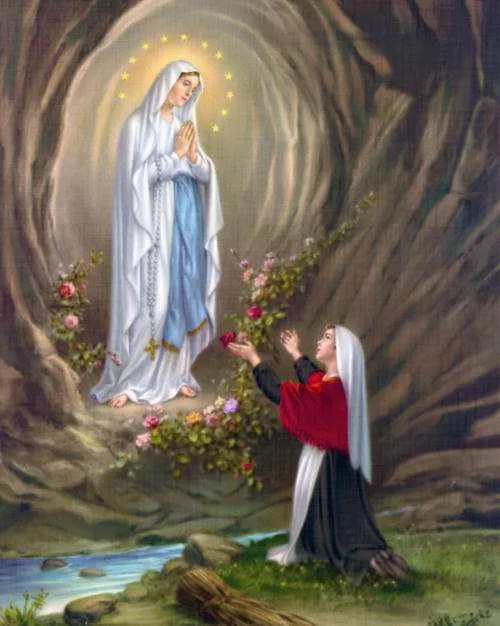
When Bernadette was fourteen years old, she went with her sister and a friend to gather some firewood to heat their home. Bernadette fell behind as they searched for wood near a naturally occurring rock grotto. She then heard the sound of a rushing wind but saw only a wild rose moving.

Then, from within the grotto, she saw a dazzling light and the figure of a small young lady in white with yellow roses on her feet. The other two girls saw nothing. Bernadette asked her sister not to tell anyone, but her sister later told their mother. Bernadette’s mother punished the girls for lying and forbade them to return to the grotto.

Three days later, Bernadette felt drawn to return to the grotto, so she and her two companions begged for permission from her mother who reluctantly agreed. Bernadette brought with her a bottle of holy water. When they arrived at the cave, the three girls knelt to pray the rosary. Before finishing the first decade, the young woman in white appeared. Bernadette sprinkled holy water in her direction, telling her that if she were from God she should stay; if not, she should leave. The woman smiled and stayed for the rest of the rosary and then departed.

By this time, some of the local townspeople began to hear about these encounters. Some were superstitious, thinking it was the souls of dead relatives. Others believed it was the Blessed Virgin Mary. Four days later, Bernadette returned to the cave accompanied by a few grown-ups. When the lady appeared, she spoke to Bernadette for the first time, in Occitan. The lady spoke to Bernadette in a remarkably formal and respectful manner, not the way an adult would normally speak to a poor peasant girl. She asked Bernadette if she was willing to return for the next fourteen days. Bernadette agreed.

Bernadette recounts the following about the next two weeks of visions: “I came back for a fortnight. The vision appeared every day, except one Monday and one Friday. She repeated to me several times that I was to tell the priests they were to build a chapel there, and I was to go to the fountain to wash, and that I was to pray for sinners. During this fortnight, she told me three secrets which she forbade me to tell anyone. I have been faithful until now.”

As word spread, the numbers in attendance grew to 30, 100, 350, 800, 1000, 1,500, culminating with almost 10,000. During the fortnight, the local police got involved and threatened Bernadette and her family. However, Bernadette persevered. The lady asked people to pray for sinners and to do penance.

During the ninth vision, the lady asked Bernadette to drink from a spring of water in the cave. She found only a small muddy puddle so she drank from it. This left mud on her face, which caused many of the onlookers to ridicule her, to the embarrassment of her family. Over the next two days, the little mud puddle turned into a flowing spring of clear water.

Many began to believe when a woman’s paralyzed arm was cured after bathing it in the new spring of water. Throughout the fourteen days, Bernadette continually asked the lady’s name, because the parish priest had asked her to do so. Each time, the lady only smiled. 

Upon the conclusion of the fourteen days, life returned to normal for the next three weeks. However, on March 25, the Feast of the Annunciation, Bernadette was drawn once again to the grotto. This time, she repeatedly asked the lady’s name. The lady responded, “I am the Immaculate Conception.”

Bernadette was a young, simple, and poorly educated peasant girl. She had no idea what the “Immaculate Conception” was. But she repeated the name to herself over and over so she wouldn’t forget. When she told the parish priest, he was stunned. Only four years prior, the pope had issued the Dogma of the Immaculate Conception. This fact, especially, helped convince the Church leaders that the apparitions were authentic.

Since that time, the waters in Lourdes have continued to flow, and over seventy healings have been recorded, studied, and confirmed by a rigorous scientific process. Countless thousands more healings have been professed by the faithful. Millions of people now visit Lourdes every year, making it one of the most frequented pilgrimage sites in the world. The sick flock to this holy grotto to bathe in or drink the miraculous water, seeking a cure for their ailments.

Several years after her visions, Bernadette entered religious life. Of the visions, she would later say, “The Virgin used me as a broom to remove the dust. When the work is done, the broom is put behind the door again.” This “broom” was canonized in 1933. The grotto of Lourdes, however, was much bigger than Bernadette. It was Our Lady’s gift to the people. It was her proclamation that she was the Immaculate Conception and her formal acceptance of the title here on earth.

Source: https://mycatholic.life/saints/saints-of-the-liturgical-year/february-11—our-lady-of-lourdes
Our Lady of Lourdes Read More »

Mark 1:40-41

Restoration

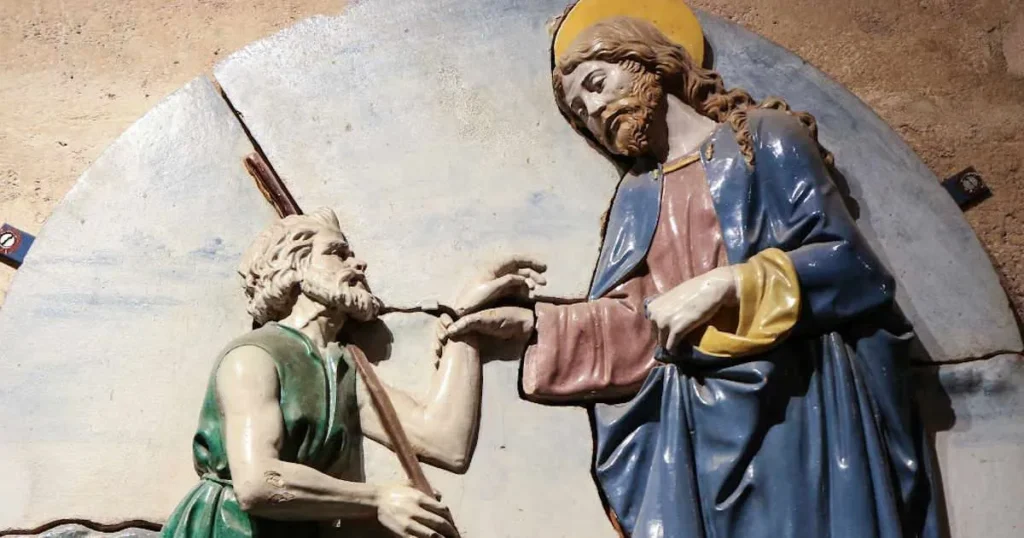
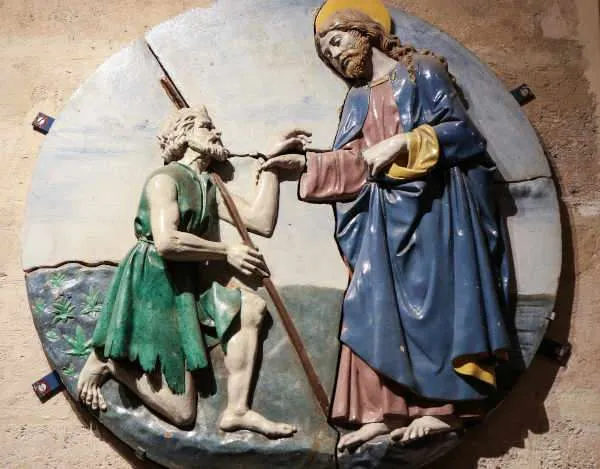
“A leper came to Jesus and kneeling down begged him and said, ‘If you wish, you can make me clean.’ Moved with pity, he stretched out his hand, touched him, and said to him, ‘I do will it. Be made clean.'”

Reflection:

In the Old Testament, Leviticus 14, God gave Moses a purification rite to be used for those who were cured of leprosy. This detailed rite that spanned several days was used to reintegrate a healed leper back into society.

After Jesus healed the leper in today’s Gospel passage, He ordered him to “go, show yourself to the priest and offer for your cleansing what Moses prescribed; that will be proof for them.” Thus, Jesus not only healed the man but instructed him that he was ready to be restored to the community.

At that time, leprosy was a horrible disease, not only for its physical effects, but also because the leper was not permitted to be a part of the society. This was because leprosy was quite contagious. By keeping those infected separate, the disease did not spread as easily to others.

As we ponder this healing, try to imagine not only the pain caused by the leper’s disease, but especially the pain caused by his isolation. Obviously, there were no phones at that time, no video chatting, and no means of communication from a distance. Therefore, isolation would have meant a complete loss of the person’s relationship with his family and friends, as well as his former livelihood, home and all that was a part of his life.

On a spiritual level, the various illnesses that Jesus cured are, in part, to be seen as symbols of sin. In the case of leprosy, we should see this illness as a symbol of the effects of mortal sin. And mortal sin, unless it is cured by God’s forgiveness, has the effect of completely isolating a person from the life of grace.

One becomes cut off from a relationship with God, as well as every other relationship that is centered in Christ. When one commits mortal sin and remains in that sin, that person is not capable of true love, since all grace is gone from their life. Therefore, their relationships become self-centered, demanding and unholy.

For those who have fallen into mortal sin, this leper is a symbol of the way out. First, he came to Jesus and knelt down before Him. He humbled himself before our Lord, acknowledging that Jesus was the answer to his ailment. He then begged Jesus for help.

But the way he begged Jesus is also revealing.: he did not demand a healing but instead simply professed his faith in the fact that Jesus could heal him. And then he knelt there in trust and hope. This leper teaches us the perfect way to approach our Lord when we struggle with serious sin.

Reflect, today, upon this leper. Try to understand his isolation and loss. Try to understand his humility and faith. And seek to imitate the way that he comes to our Lord. Do not be afraid to humble yourself before God as you acknowledge the sins and other needs you have. Profess your faith in His almighty power and love, and place yourself into His hands of merciful love. He will not let you down.

Source: https://catholic-daily-reflections.com/2024/02/10/restoration/

Mark 1:40-41 Read More »

Saint Scholastica, Virgin

Patron Saint of nuns, school, tests, reading, convulsive children; Invoked against storms and rain; Pre-Congregation canonization

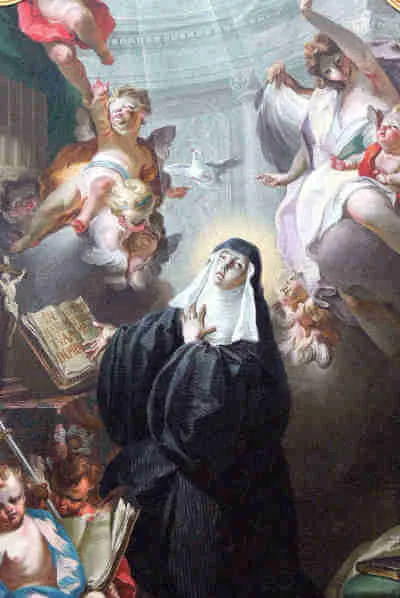
Little is known about the life of Saint Scholastica, yet her influence upon the Church is undeniable. She was born into a wealthy family around the year 480 AD, in the town of Nursia, central Italy, shortly after the fall of the Western Roman emperor. It was a chaotic time, politically speaking, but also a time when God began to manifest His divine stability through her. She had one brother, most likely a twin, by the name of Benedict. Benedict and Scholastica are now honored as great saints. Both had a powerful influence upon monastic life as we have it today, Benedict being the father of Western monasticism and Scholastica its mother.

As a child, Scholastica dedicated herself to the service of God, taking no interest in the things of this world. She lived modestly, despite being raised in a wealthy home. When Benedict left home to become a hermit and to eventually found a monastery with a new monastic rule, she marveled at his hidden life of prayer and work. His vocation called out to her, and she received permission from the local bishop to enter a home of virgins who chose to adopt Benedict’s new monastic rule. Benedict assisted them and made Scholastica the abbess of the home.

Benedict’s new form of monasticism focused on forming permanent, self-contained, and self-supporting monasteries that followed a strict regimen of prayer and work. After aspirants’ callings were tested for a period of time, they made vows, permanently committing themselves to God and the community.

Their lives became structured and ordered under the direction of an abbot or abbess to whom the monks and nuns vowed obedience. Soon after Benedict’s humble monastery on Monte Cassino began to bloom, Scholastica received permission to adopt his rule with a group of virgins, making them the first convent of Benedictine nuns. In the centuries to follow, their way of life spread far and wide across the Western world.

In his book Dialogues, Pope Saint Gregory captures the holy love that Benedict and Scholastica shared. Though Scholastica’s convent was only a few miles from Benedict’s monastery, the two would only get together once a year, in keeping with their strict rule of life. Those meetings fanned into flames their shared love for God and the fruits of their prayer and mutual calling to this new way of life. Each year they met at a nearby house and spent the day conversing on the holiest of topics. When these twins were around the age of sixty-three, they met for what would be their final conversation on earth. They spent the day praising God and engaged in spiritual talk.

After a light dinner, Benedict announced that he and his companions needed to leave and return to the monastery. Scholastica begged him to stay so that they could continue conversing about God throughout the night. Benedict responded to her, “Sister, what are you saying? I simply cannot stay outside my cell.” Scholastica knew, however, that their holy conversation needed to continue, so she bowed her head in prayer, and God sent forth a lightning storm so powerful that Benedict and his brothers could not leave.

Scholastica’s love for Benedict and her desire to continue with the praises of God throughout the night met with God’s approval and God provided the way. They parted the next day, and three days later, Benedict had a vision of his sister’s soul being taken to Heaven in the form of a dove. He had his brothers bring her body to the monastery, and Scholastica was buried in the grave intended for Benedict. Four years later, Benedict died and was buried in the same grave with his sister. The two were united by grace and a shared mission in this life, and they would forever share a grave from which they will rise together on the last day.

Pope Saint Gregory opines that Scholastica’s prayers were answered over Benedict’s objection because her love was great. “She did more which loved more,” he wrote. The witness of these siblings should especially teach us the value of holy friendships that mutually build each other up and give glory to God. We are made not only for communion with God, but for communion with one another. These saintly siblings give witness to this holy fact.

Source: https://mycatholic.life/saints/saints-of-the-liturgical-year/february-10-saint-scholastica-virgin/

Saint Scholastica, Virgin Read More »

Mark 8:2-3

First Things First

“My heart is moved with pity for the crowd, because they have been with me now for three days and have nothing to eat.  If I send them away hungry to their homes, they will collapse on the way, and some of them have come a great distance.”

Reflection:

Jesus’ primary mission was a spiritual one. He came to set us free from the effects of sin so that we could enter the glories of Heaven for all eternity. His life, death and resurrection destroyed death itself and opened the way for all who turn to Him to be saved. But Jesus’ love for the people was so complete that He was also attentive to their physical needs.

First of all, ponder the first line of this statement of our Lord above: “My heart is moved with pity for the crowd…” Jesus’ divine love was intertwined with His humanity. He loved the entire person, body and soul.

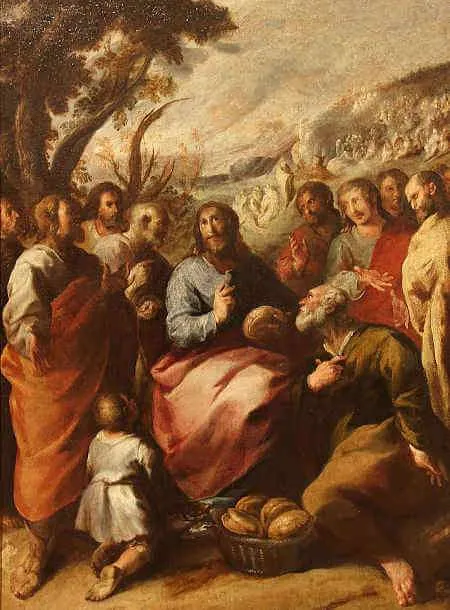
In this Gospel story, the people were with Him for three days and they were hungry, but they were showing no signs of leaving. They had become so amazed by our Lord that they didn’t want to leave. Jesus pointed out that their hunger was serious. If He sent them away, He feared that they would “collapse on the way.” Thus, these facts are the basis for His miracle.

One lesson we can learn from this story is that of our priorities in life. Oftentimes, we may tend to have our priorities reversed. Of course, taking care of the necessities of life is important. We need food, shelter, clothing and the like. We need to care for our families and provide for their basic needs. But too often we elevate these basic necessities in life over our spiritual need to love and serve Christ, as if the two were opposed to each other. But that’s not the case.

In this Gospel, the people who were with Jesus chose to put their faith first. They chose to remain with Jesus despite the fact that they did not have food to eat. Perhaps some people had left a day or two earlier, deciding that the necessity of food took precedence. But those who may have done this missed out on the incredible gift of this miracle in which the entire crowd was fed to the point of being completely satisfied.

Of course, our Lord does not want us to be irresponsible, especially if we have a duty to care for others. But this story does tell us that our spiritual need to be fed by the Word of God should always be our greatest concern. When we put Christ first, all other needs are met in accord with His providence.

Reflect, today, upon your own priorities in life. What’s more important to you? Your next good meal? Or your life of faith? Though these do not have to be opposed to each other, it’s important to always put your love of God first in life. Ponder this vast crowd of people who spent three days with Jesus in the wilderness without food and try to see yourself with them. Make their choice to remain with Jesus your choice also, so that your love of God becomes the primary focus of your life.

Source: https://catholic-daily-reflections.com/2024/02/09/first-things-first-3/

Mark 8:2-3 Read More »

Mark 7:37

Hearing and Speaking the Word of God

“They were exceedingly astonished and they said, ‘He has done all things well. He makes the deaf hear and the mute speak.’”

Reflection:

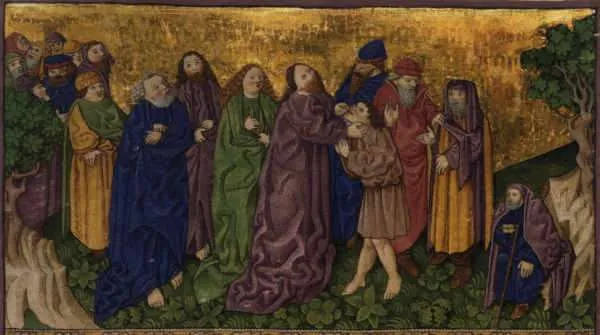
This line is the conclusion to the story of Jesus healing a deaf man who also had a speech impediment. The man was brought to Jesus, Jesus took him off by himself, cried out “Ephphatha!” (that is, “Be opened!”), and the man was cured. And though this was an incredible gift to this man and an act of great mercy toward him, it also reveals that God wants to use us to draw others to Himself.

On a natural level, we all lack the ability to hear the voice of God when He speaks. We need the gift of grace for this. As a result, on a natural level, we are also incapable of speaking the many truths that God wants us to speak. This story teaches us that God also desires to heal our ears so as to hear His gentle voice and to loosen our tongues so that we can become His mouthpiece.

But this story is not only about God speaking to each one of us; it also reveals our duty to bring others to Christ who do not know Him. The friends of this man brought him to Jesus. And Jesus took the man off by himself. This gives us insight into how we help others to come to know our Lord’s voice.

Oftentimes when we want to share the Gospel with another, we tend to talk to them and try to rationally convince them to turn their lives to Christ. And though this can bear good fruit at times, the real goal we must have is to help them to go off with our Lord by themselves for a while so that Jesus can do the healing.

If your ears have truly been opened by our Lord, then your tongue will also be loosened. And only if your tongue is loosened will God be able to draw others to Himself through you. Otherwise your act of evangelizing will only be based on your effort alone.

Therefore, if you have people in your life who do not appear to be listening to the voice of God and following His holy will, then first and foremost commit yourself to listening to our Lord yourself. Let your ears hear Him. And when you do hear Him, it will be His voice that, in turn, speaks through you in the way He desires to reach out to others.

Reflect, today, upon this Gospel scene. Ponder, especially, the friends of this man as they are inspired to bring him to Jesus. Ask our Lord to use you in a similar way. Prayerfully ponder those in your life whom God wants to call to Himself through your mediation and place yourself at the service of our Lord so that His voice can speak through you in the way He chooses.

Source: https://catholic-daily-reflections.com/2024/02/08/hearing-and-speaking-the-word-of-god-3/

Mark 7:37 Read More »