Author name: Sani

Saint Catherine of Siena, Virgin and Doctor of the Church

1347–1380; Patron Saint of Europe, Italy, nurses, the sick, and those ridiculed for their piety; Invoked against fires, miscarriages, temptations; Canonized by Pope Pius II on June 29, 1461; Proclaimed a Doctor of the Church by Pope Paul VI on October 4, 1970; Proclaimed Co-Patron of Europe by Pope John Paul II on October 1, 1999

Caterina di Jacopo di Benincasa (Catherine) was the twenty-third or twenty-fourth child born to loving parents in the thriving city of Siena, Italy. Her twin, as well as half of her twenty-four siblings, did not survive infancy. As a child, Catherine stood out. She was given the nickname “Euphrosyne,” which means “joy,” because of her joyful disposition and deep devotion to God from an early age. At the age of five, she would climb the stairs in her home on her knees as she prayed the Hail Mary on each step. At the age of six, while she was out walking with her brother, she had the first of many visions. She saw Jesus, sitting on a throne, crowned as King, surrounded by Saints Peter, Paul, and John. This supernatural experience drew Catherine even more deeply into a life of childhood prayer, penance, and devotion. Within a year, she had made a personal vow to give her whole life to God. Her prayer life was so evident that her parents gave her a bedroom in the basement so that she could use it as her own personal place of prayer. This “cell” in which she lived and prayed was also in her soul. She would later relate to her spiritual director that when she was troubled or tempted, she would build a cell inside her mind, from which she could never flee. Her prayer life also increased her virtues, and she treated her father as Jesus, her mother as Mary, and her siblings as the Apostles.

When Catherine was a teenager, she firmly opposed her parents’ desire that she marry. She wanted to be devoted to God alone, so she began fasting and praying. She even went so far as to cut her hair short so that she would be less attractive to young men. Eventually, her parents accepted her vocation.

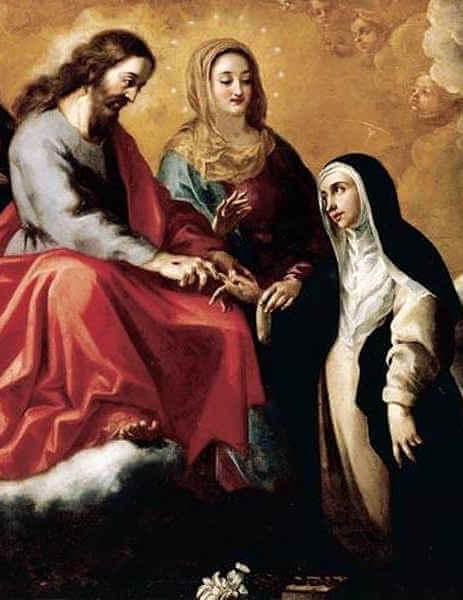
In 1363, just three days after her sixteenth birthday, Catherine joined the Third Order of Saint Dominic. The Third Order was made up of lay people who wore a religious habit but lived at home and worked in the world rather than in a cloister. They served the poor and sick and performed charitable works. For the first several years as a Third Order Dominican, Catherine lived mostly a life of seclusion and prayer. Around the age of twenty-one, she entered into what would later be described as “mystical marriage” with our Lord. While praying, Jesus appeared to her, along with the Virgin Mary and King David as a harpist. Jesus placed a ring on her finger and departed. The ring remained for the rest of her life, although Catherine was the only one who could see it.

Two centuries later, the Spanish Mystic, Saint Teresa of Ávila, would describe mystical marriage this way in her spiritual classic, Interior Castle:

When our Lord is pleased to take pity on the sufferings, both past and present, endured through her longing for Him by this soul which He has spiritually taken for His bride, He, before consummating the celestial marriage, brings her into this His mansion or presence chamber. This is the seventh Mansion, for as He has a dwelling-place in heaven, so has He in the soul, where none but He may abide and which may be termed a second heaven.

Saint Teresa went on to explain that this celestial marriage, this second heaven, is a permanent gift bestowed upon a soul. By His divine foreknowledge, when He is aware of the permanent sanctity of a soul, He bestows this gift of divine union upon the soul. Catherine was one of those who received this rare gift.

After receiving the gift of spiritual marriage, Catherine began a more active ministry to the poor, sick, and imprisoned of Siena. When the bubonic plague—“Black Death”—struck Siena, Catherine and her companions remained hard at work, caring for those affected. Catherine also began to get involved in controversies that were plaguing the Church and State. She wrote hundreds of letters to kings, queens, nobility, religious, priests, and even to the pope himself. At that time, the divisions in the Church were so profound that Catherine engaged in severe penance and prayer. For example, she no longer ate or drank, living only on the Holy Eucharist which she received every day. While in Pisa in 1375, Catherine learned of rebellions within the Church. She fell into ecstasy and received the gift of an invisible stigmata, which appeared physically on her body only after her death. She saw a vision of our crucified Lord and rays of light extended from Jesus’ body to hers, piercing her through.

A dominant focus of her letters to the pope was to urge him to return to Rome. At that time, the papacy had moved to Avignon, France, which became the cause of much internal Church conflict. Anti-popes were elected and confusion was widespread. Catherine knew that the Holy Father, “daddy” as she called him, needed to return to the Eternal City to end the chaos. Her letters, and later her face-to-face conversations, were not only directed to the Holy Father with the affection and sincerity of a loving spiritual daughter, they were also firm, direct, and challenging. In one letter to Pope Gregory XI, she wrote urging him to return to Rome: “I tell you, father in Christ Jesus, come swiftly like a gentle lamb. Respond to the Holy Spirit Who calls you. I tell you, Come, come, come, and do not wait for time, since time does not wait for you.” The pope listened and returned to Rome in 1377. The last few years of Catherine’s life were spent writing letters, visiting towns that were warring against the papacy, and consulting two popes, first Pope Gregory XI and then his successor Pope Urban VI. She rallied the people, gained many followers, addressed political, cultural, and moral abuses, and gave an ongoing witness to Christ crucified through her penitential life.

Her last, and perhaps greatest, gift to the Church was her book entitled, The Dialogue of Divine Providence. It is believed that this book was dictated by Catherine while she remained in ecstasy. It is a conversation between a soul and the Father in Heaven. In addition to this great spiritual masterpiece, 382 of her letters and twenty-six of her prayers have survived.

Saint Catherine was one of the greatest and most influential saints in the history of the Church. In her lifetime she had a powerful impact upon those she encountered, including the pope. In her death, she continues to have a profound impact upon the Church as a Doctor of the Church. None of that would have been possible had she not engaged in fervent prayer and penance throughout her life. Ponder your own prayer life as we honor Saint Catherine, and strive to imitate her burning love for her Lord, her Divine Spouse. That love, fueled by a unquenchable desire for God, is beautifully seen in the following prayer that she herself wrote:

Prayer: Eternal God, eternal Trinity, You have made the Blood of Christ so precious through His sharing in Your Divine nature. You are a mystery as deep as the sea; the more I search, the more I find, and the more I find, the more I search for You. But I can never be satisfied; what I receive will ever leave me desiring more. When You fill my soul, I have an ever greater hunger, and I grow more famished for Your light. I desire above all to see You, the true Light, as You really are. Amen. 

Saint Catherine of Siena, pray for me. Jesus, I trust in You.

Source: https://mycatholic.life/saints/saints-of-the-liturgical-year/april-29-saint-catherine-of-siena-virgin-and-doctor-of-the-church/

Saint Catherine of Siena, Virgin and Doctor of the Church Read More »
John 3:9-11

A Holy Push

Nicodemus answered and said to him, ‘How can this happen?” Jesus answered and said to him, “You are the teacher of Israel and you do not understand this? Amen, amen, I say to you, we speak of what we know and we testify to what we have seen, but you people do not accept our testimony.”

Reflection:

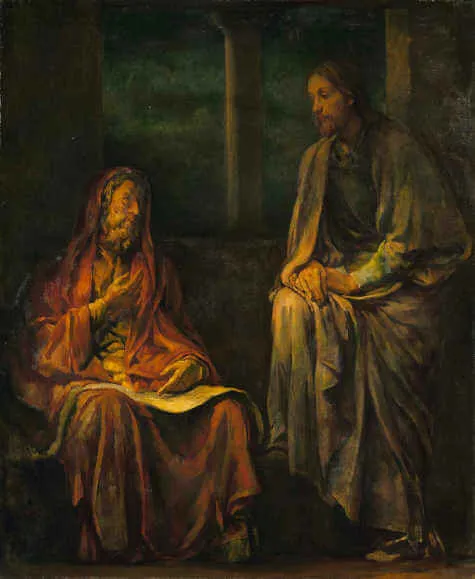
As we reflected upon yesterday, Nicodemus is one of the only Pharisees who ultimately converted, became a follower of Jesus, and is today considered a saint. The only other Pharisees who were recorded by name as converts to Christianity were Saint Paul and Gamaliel. Acts 15:5 also indicates that some other Pharisees ultimately converted.

When the many encounters between Jesus and the Pharisees are considered as a whole, it’s clear that there was great resistance among them toward Jesus and His teaching. They were constantly seeking to trap Him and, of course, ultimately were responsible for His death, along with other leading religious leaders from the Sanhedrin. For that reason, it’s easy to understand that there must have been great pressure upon all the Pharisees to reject Jesus. Each one of them would have felt the power of peer pressure to act in accord with the general view of Jesus’ condemnation. This is the context of this passage above in which Nicodemus questions Jesus. This passage continues yesterday’s Gospel conversation in which Jesus says clearly to Nicodemus that the way to Heaven is to be “born from above.” Nicodemus questions how one can “be born again,” and then Jesus issues this apparent criticism of Him quoted above.

It’s helpful to understand that Jesus’ criticism was not a condemnation of Nicodemus. It was not in the tone of His normal “Woe to you…” statements; rather, it was a gentle but very direct challenge to Nicodemus so as to move him from his questions to faith. And that’s the key. Nicodemus did not come to Jesus to trap and condemn Him like the other Pharisees did. Nicodemus came because he was confused. And most likely, he was confused because he felt great peer pressure from his fellow Pharisees to condemn Jesus.

Understanding this context should help us understand not only the goodness and courage of Nicodemus but also the loving boldness of Jesus. Jesus knew that Nicodemus was open. He knew that Nicodemus could be won over. But Jesus also knew that Nicodemus needed to be challenged in a direct and firm way. He needed a bit of a “holy push” so as to enter into the gift of faith. Of course, Jesus’ challenge ultimately won Nicodemus over.

Reflect, today, upon any way in which you, too, need a “holy push” from our Lord. What form of worldly pressure do you experience in life? Do friends, neighbors, family members or co-workers impose upon you in some way a peer pressure that is contrary to the life of true holiness? If so, ponder the ultimate courage of Nicodemus, Saint Paul and Gamaliel. Let their witness inspire you and allow our Lord to challenge you where you need it the most so that you, too, will receive the “holy push” that you need to be a more faithful follower of Jesus.

Source: https://catholic-daily-reflections.com/2025/04/28/a-holy-push-4/

John 3:9-11 Read More »

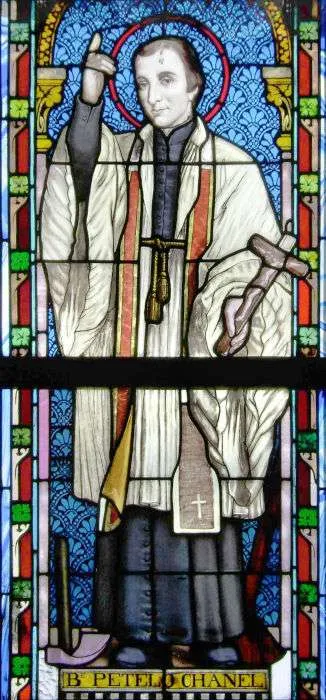
Saint Peter Chanel, Priest and Martyr

1803–1841; Patron Saint of Oceania; Canonized by Pope Pius XII on June 12, 1954

Today’s saint, Saint Pierre Louis Marie Chanel (Peter), was the fifth of eight children. Peter’s father was later described as a good man, but also a man “more inclined to the bottle than to religion.” Peter’s uneducated mother was a strong Christian. As a youth, Peter worked as a shepherd on their sixty-five acre family farm. Their land had recently belonged to the Church but was confiscated by the state at the beginning of the French Revolution and sold to Peter’s father. Aware of this fact, Peter had a desire to make reparation for his family. By the end of his life he would do so, and more, by laying his life down as a priest-martyr on the tiny, remote, and barbaric island of Futuna, in the Pacific Ocean, Oceania.

In the neighboring village of Cras, the parish priest, Father Jean-Marie Trompier, ran a small school for boys that Peter entered. Father Trompier taught the boys throughout the day as he went about his own duties of visiting the sick, celebrating Mass, doing chores, and conversing at meals. Father Trompier had a profound effect upon Peter, instilling in him a desire for both the priesthood and the life of a foreign missionary. When Peter was about sixteen, he was sent to the diocesan minor seminary in Lyons and later to the major seminary in Brou. On July 15, 1827, Peter was ordained a diocesan priest at the age of twenty-four.

Father Peter was first assigned as an assistant parish priest in the town of Ambérieu. Only a few of his sermons from that assignment remain, but they show him to be a zealous and devoted preacher who carefully prepared his sermons. After a year, Father Peter approached the bishop about going on a foreign mission. Instead, the bishop assigned him to a remote parish as pastor, near the Swiss border, in the town of Crozet. The parish in Crozet was in need. Mass attendance was low, and the previous priest had left in frustration. Father Peter spent three years showing great devotion to the sick, preaching with zeal, and organizing Eucharistic processions. By the time of his departure, he had won the hearts of the people and revived the struggling parish.

Though Father Peter was an excellent parish priest, his heart was drawn to the missions. After serving in Crozet for three years, he sought and obtained permission to enter the Society of Mary (Marists). The Marists were a newly formed order whose mission was to live as Mary had—hidden, humble, and simple. Among their charisms was to be missionaries to remote and hidden lands, especially in Oceania.

Although he had hoped to be sent on mission, Father Peter spent the next five years in the minor seminary in Belley where he taught twelve-year-old boys before becoming the spiritual director and bursar. Two years later, he was made Vice-Superior and in 1833 traveled to Rome to assist the community’s founder in gaining final approval for the society. On February 10, 1836, the Marists were approved by Pope Gregory XVI as a Religious Congregation of the universal Church and given the responsibility of evangelizing the peoples of Western Oceania. At the age of thirty-three, Father Peter’s childhood desire came true when he was appointed as superior of a group of seven Marists (four priests and three brothers) and a newly ordained bishop who set out on a ten-month voyage by ship to Oceania. The journey was a brutal one, so much so that one of the priests died of illness along the way.

The group set sail from the port of La Havre, France, on December 24, 1836, and sailed to the Canary Islands; then south around Cape Horn to Valparaíso, Chile; west to the Gambier Islands; then to Fiji, Tongo; and eventually arrived at the small island of Futuna on November 12, 1837. Father Peter and Brother Marie-Nizier Delorme were chosen to disembark on that island.

Futuna and its neighboring island were small, being only about forty-five square miles between the two of them. The 1,000 inhabitants at the time were farmers and fishermen. The people were organized into smaller tribes who banded together into two larger kingdoms. These two kingdoms frequently went to war with each other, one emerging as the Victors and the others as the Vanquished. They were religious people, appeasing angry gods through pagan rituals and worshiping great spirits who often spoke through the chiefs and pagan priests. In earlier years, they had even practiced cannibalism.

King Niuliki, then of the Victor tribe, at first welcomed these visitors warmly. He fed them, invited them into his home, and kept them safe. The first year on the island bore the fruit of only about ten baptisms, mostly children who were dying. The missionaries worked tirelessly at learning the local language. Additionally, they offered Mass openly while intrigued islanders looked on, gave them farming tips, and simply showed them kindness, which was a language the Marists understood and appreciated. After a year and a half on the island, another ship carrying Marist missionaries arrived, to the delight of all.

Over the next year, the work of catechesis continued. When the king’s infant son became ill, Father Peter was given permission to baptize him. He hoped this would open the door to more converts, for he knew that if the king were to agree, everyone would be baptized and abandon their pagan rituals that Father Peter saw as demonic. However, by the end of 1840, the king began to turn on Father Peter because more islanders were becoming catechumens. The king feared the loss of his own power, especially his pagan spiritual authority, so he withdrew his kindnesses and started to become hostile toward the Marists and catechumens. When the king heard that all the inhabitants of the nearby island of Wallis were preparing for baptism, he decided something must be done to keep this from happening on his island. The final spark came when the king’s own son, Meitala, became a catechumen. On April 27, 1841, the king had a long talk with his son, trying to convince him to change his mind. His son refused, so King Niuliki called his son-in-law Musumusu and instructed him to kill both the catechumens and the missionaries. The next day, after unsuccessfully trying to kill the catechumens, Musumusu and some companions went to where Father Peter was staying. First they clubbed Father Peter; then Musumusu delivered a deadly blow to his head with a hatchet. But this brutal end was only the beginning of great things to come.

Soon after, the king regretted what he had done. Many of the islanders who had grown fond of Father Peter mourned his death. This mourning and regret was turned into joy when, over the next few years, all of the inhabitants were baptized. War between the two tribes eventually ceased and peace was established. Today, those islands live their Catholic faith well and rejoice in their martyr who did more for them in death than in life.

As we honor Saint Peter Chanel, ponder the mysterious fact that the Father uses suffering and death for His glory and the salvation of souls when that suffering and death are offered to Him, sacrificially, in union with the death of His divine Son. Ponder the incredible power of God who is able to bring good from evil, and salvation from death itself. Unite your own sufferings to Christ, and know that God wants the unyielding gift of the sacrifice of your life to be given to Him for His glory and for the salvation of souls.

Source: https://mycatholic.life/saints/saints-of-the-liturgical-year/april-28-saint-peter-chanel-priest-and-martyr/

Saint Peter Chanel, Priest and Martyr Read More »

John 3:1-2

Coming Into the Light

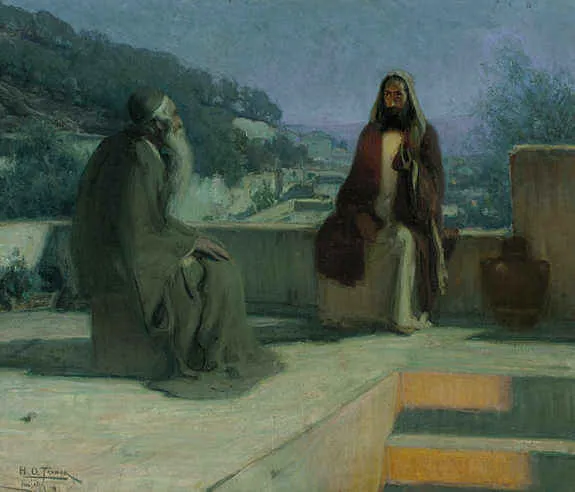
There was a Pharisee named Nicodemus, a ruler of the Jews. He came to Jesus at night and said to him, “Rabbi, we know that you are a teacher who has come from God, for no one can do these signs that you are doing unless God is with him.”

Reflection:

Nicodemus, a Pharisee and a ruler of the Jews, is mentioned three times in the Gospel of John. The passage above comes from the first time he’s mentioned. The second time is when he reminds the Sanhedrin that Jesus should be heard by them before they condemn Him, and the third time is when Nicodemus assists with Jesus’ burial after His death. John’s Gospel is very symbolic. He especially uses the images of light and dark. For example, when Judas went out to betray Jesus, John’s Gospel notes that “it was night.” In the passage above, John’s Gospel notes that Nicodemus came to Jesus “at night.”

Saint Augustine, in commenting upon this passage, says that Nicodemus came to Jesus “at night” because Nicodemus was not yet fully born again and, therefore, was not yet living fully in the light of faith. But the fact that Nicodemus does come to Jesus and questions Him at length shows that he had a spark of faith and that he wanted to deepen that faith. He clearly hoped that Jesus was the Messiah and professed that Jesus was “a teacher who has come from God.”

From early times, prior to the formalization of canonization practices, Nicodemus has been given the title of “saint” within the Catholic Church as well as in the Orthodox Church. He is especially venerated because he stood up against the other religious leaders at the time to defend Jesus and show support for Him. This took courage. He was ridiculed and risked being shunned by the others. But Nicodemus knew there was something special about Jesus, and he persevered in following that inspiration.

In many ways, Nicodemus is a great example for us today in our modern world. More and more, in most secular world cultures, being a follower of Jesus is looked down upon. This is especially true if you choose to live your faith openly and believe all that the Gospels teach. Many Christians find that living their faith openly, especially within the workplace, school environments, and other civic circles, is challenging. And like Nicodemus, many find it easier to come to Jesus “at night,” meaning, in a hidden way. And though Nicodemus started this way, he eventually spoke openly in defense of Jesus in the presence of his fellow Pharisees who, according to some traditions, persecuted him and drove him into exile.

Reflect, today, upon Saint Nicodemus. He allowed the spark of faith within him to grow as He listened to Jesus, struggled with the pressure from his peers, but ultimately openly professed his faith in Christ. And though this hurt his worldly position of honor within the Sanhedrin and among the earthly rulers, it earned Nicodemus an eternal honor in Heaven. Reflect upon the courage he must have had to go against the pressure of his peers by allowing the faith he found in Christ to grow and fill his life with the light of Truth. Seek to imitate this good man and allow yourself to be inspired by his courage so that you, too, will receive the same eternal glory he now enjoys in Heaven.

Source: https://catholic-daily-reflections.com/2025/04/27/coming-into-the-light-3/

John 3:1-2 Read More »

Second Sunday of Easter, Sunday of Divine Mercy

First Reading Acts 5:12-16

Many signs and wonders were done among the people
at the hands of the apostles.
They were all together in Solomon’s portico.
None of the others dared to join them, but the people esteemed them.
Yet more than ever, believers in the Lord,
great numbers of men and women, were added to them.
Thus they even carried the sick out into the streets
and laid them on cots and mats
so that when Peter came by,
at least his shadow might fall on one or another of them.
A large number of people from the towns
in the vicinity of Jerusalem also gathered,
bringing the sick and those disturbed by unclean spirits,
and they were all cured.

Responsorial Psalm Psalms 118:2-4, 13-15, 22-24

R  (1) Give thanks to the Lord for he is good, his love is everlasting.
or:
 Alleluia.
Let the house of Israel say,
            “His mercy endures forever.”
Let the house of Aaron say,
            “His mercy endures forever.”
Let those who fear the LORD say,
            “His mercy endures forever.”
 Give thanks to the Lord for he is good, his love is everlasting.
or:
 Alleluia.
I was hard pressed and was falling,
            but the LORD helped me.
My strength and my courage is the LORD,
            and he has been my savior.
The joyful shout of victory
            in the tents of the just:
 Give thanks to the Lord for he is good, his love is everlasting.
or:
 Alleluia.
The stone which the builders rejected
            has become the cornerstone.
By the LORD has this been done;
            it is wonderful in our eyes.
This is the day the LORD has made;
            let us be glad and rejoice in it.
 Give thanks to the Lord for he is good, his love is everlasting.
or:
 Alleluia.

Second Reading Revelation 1:9-11a, 12-13, 17-19

I, John, your brother, who share with you
the distress, the kingdom, and the endurance we have in Jesus,
found myself on the island called Patmos
because I proclaimed God’s word and gave testimony to Jesus.
I was caught up in spirit on the Lord’s day
and heard behind me a voice as loud as a trumpet, which said,
“Write on a scroll what you see.”
Then I turned to see whose voice it was that spoke to me,
and when I turned, I saw seven gold lampstands
and in the midst of the lampstands one like a son of man,
wearing an ankle-length robe, with a gold sash around his chest.

When I caught sight of him, I fell down at his feet as though dead.
He touched me with his right hand and said, “Do not be afraid.
I am the first and the last, the one who lives.
Once I was dead, but now I am alive forever and ever.
I hold the keys to death and the netherworld.
Write down, therefore, what you have seen,
and what is happening, and what will happen afterwards.”

Alleluia John 20:29

R. Alleluia, alleluia.
You believe in me, Thomas, because you have seen me, says the Lord;
blessed are those who have not seen me, but still believe!
R. Alleluia, alleluia.

Gospel John 20:19-31

On the evening of that first day of the week,
when the doors were locked, where the disciples were,
for fear of the Jews,
Jesus came and stood in their midst
and said to them, “Peace be with you.”
When he had said this, he showed them his hands and his side.
The disciples rejoiced when they saw the Lord.
Jesus said to them again, “Peace be with you.
As the Father has sent me, so I send you.”
And when he had said this, he breathed on them and said to them,
“Receive the Holy Spirit.
Whose sins you forgive are forgiven them,
and whose sins you retain are retained.”

Thomas, called Didymus, one of the Twelve,
was not with them when Jesus came.
So the other disciples said to him, “We have seen the Lord.”
But he said to them,
“Unless I see the mark of the nails in his hands
and put my finger into the nailmarks
and put my hand into his side, I will not believe.”

Now a week later his disciples were again inside
and Thomas was with them.
Jesus came, although the doors were locked,
and stood in their midst and said, “Peace be with you.”
Then he said to Thomas, “Put your finger here and see my hands,
and bring your hand and put it into my side,
and do not be unbelieving, but believe.”
Thomas answered and said to him, “My Lord and my God!”
Jesus said to him, “Have you come to believe because you have seen me?
Blessed are those who have not seen and have believed.”

Now Jesus did many other signs in the presence of his disciples
that are not written in this book.
But these are written that you may come to believe
that Jesus is the Christ, the Son of God,
and that through this belief you may have life in his name.

Source: https://bible.usccb.org/bible/readings/042725.cfm

Second Sunday of Easter, Sunday of Divine Mercy Read More »

Divine Mercy Sunday

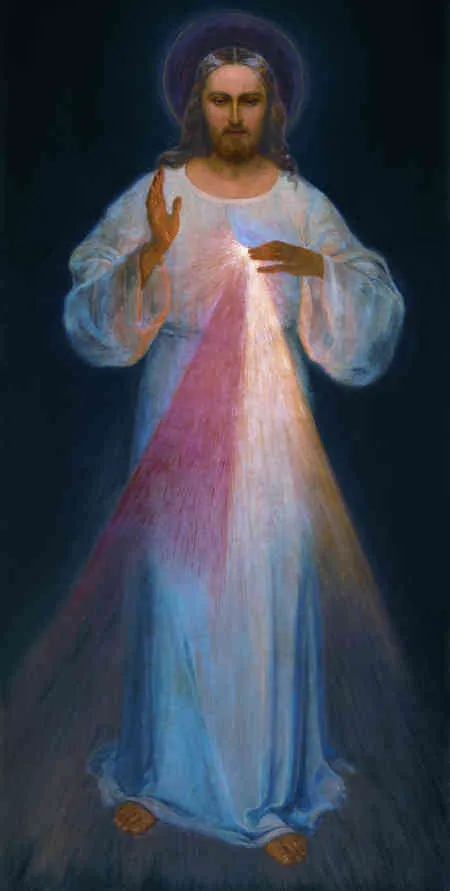
 In the year 2000, Pope John Paul II canonized Saint Maria Faustina Kowolska and added the Feast of Divine Mercy to the Church’s official calendar. Saint Faustina, who died in 1938, was a member of the Congregation of Sisters of Our Lady of Mercy in Krakow, Poland. She came from a simple and poor family of farmers, had only three years of rudimentary education, and performed the humblest of tasks in her convent. But she also was a mystic who was privileged to have many private revelations from our Lord. In obedience to her superior and spiritual director, she recorded these private revelations in six notebooks. Those notebooks are known today under the title: Divine Mercy in My Soul: Diary of Saint Maria Faustina Kowalska. The messages contained within her diary present profound communications from God for our day and age. Though the messages are many, there are several new ways that God is calling us to a new form of devotion.

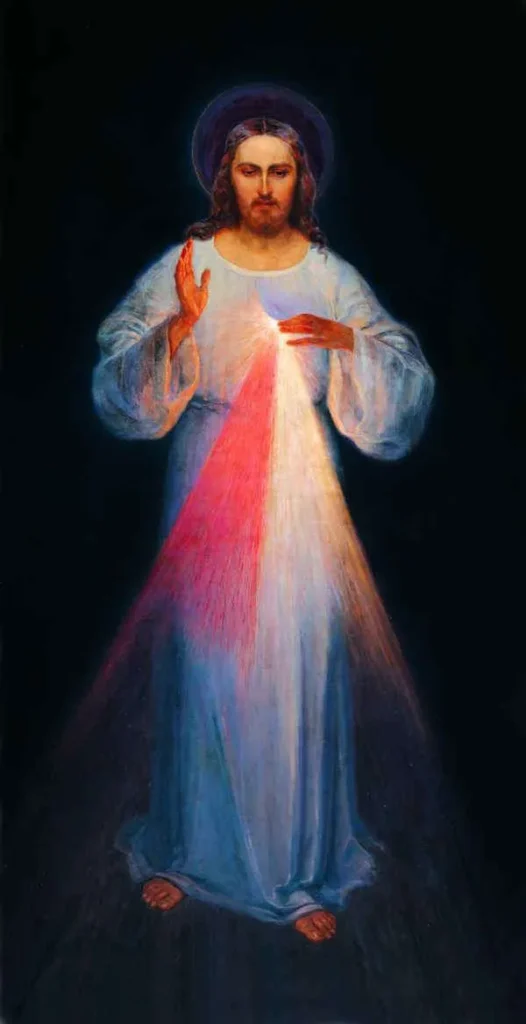
A first way is through meditation on the image of Divine Mercy. Of this, Saint Faustina wrote:

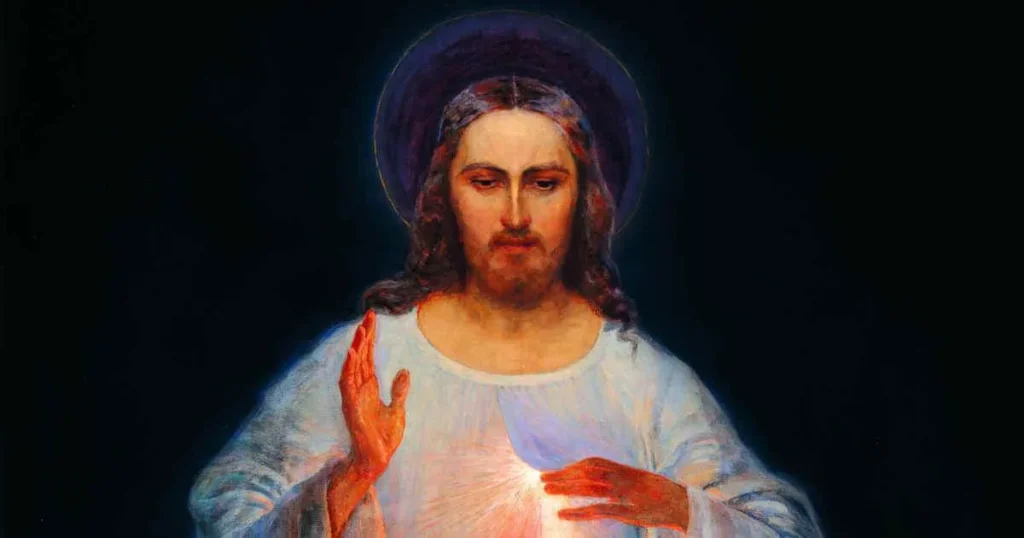
In the evening, when I was in my cell, I became aware of the Lord Jesus clothed in a white garment. One hand was raised in blessing, the other was touching the garment at the breast. From the opening of the garment at the breast there came forth two large rays, one red and the other pale. In silence I gazed intently at the Lord; my soul was overwhelmed with fear, but also with great joy. After a while Jesus said to me, “paint an image according to the pattern you see, with the inscription: Jesus, I trust in You” (#47).

“The pale ray stands for the Water which makes souls righteous; the red ray stands for the Blood which is the life of souls. These two rays issued forth from the depths of My most tender Mercy at that time when My agonizing Heart was opened by a lance on the Cross….Fortunate is the one who will dwell in their shelter, for the just hand of God shall not lay hold of him” (#299).

A second way is through our participation in the Solemnity of Divine Mercy:

“On that day (the 8th day of Easter each year) the very depths of My tender mercy are open. I pour out a whole ocean of graces upon those souls who approach the fount of My mercy. The soul that will go to Confession and receive Holy Communion shall obtain complete forgiveness of sins and punishment. On that day all the divine floodgates through which grace flow are opened. Let no soul fear to draw near to Me, even though its sins be as scarlet. My mercy is so great that no mind, be it of man or of angel, will be able to fathom it throughout all eternity” (#699).

A third way is through the recitation of the Chaplet of Divine Mercy:

Once, as I was going down the hall to the kitchen, I heard these words in my soul: “Say unceasingly the chaplet that I have taught you. Whoever will recite it will receive great mercy at the hour of death. Priests will recommend it to sinners as their last hope of salvation. Even if there were a sinner most hardened, if he were to recite this chaplet only once, he would receive grace from My infinite mercy. I desire that the whole world know My infinite mercy. I desire to grant unimaginable graces to those souls who trust in My mercy” (#687).

A fourth way is by honoring Jesus’ passion at the 3 o’clock hour:

At three o’clock, implore My mercy, especially for sinners; and, if only for a brief moment, immerse yourself in My Passion, particularly in My abandonment at the moment of agony. This is the hour of great mercy for the whole world. I will allow you to enter into My mortal sorrow. In this hour, I will refuse nothing to the soul that makes a request of me in virtue of My Passion” (#1320).

A fifth way is through an apostolic movement to spread the message of Divine Mercy. During her lifetime, Sister Faustina believed Jesus was calling her to found a new congregation, but that never materialized. Jesus, nonetheless, spoke to her in ways that revealed His desire that this “new congregation” be established. Since a formal religious congregation was never founded in her lifetime, we must look to the founding of subsequent congregations and apostolic movements that seek to spread the messages of Divine Mercy. God is calling each of us not only to receive His mercy but to spread that mercy to others in personal and organized ways.

Though Saint Faustina died in 1938, we should see the messages in her Diary as messages God especially desires we learn and live today. God moves slowly and methodically. He first revealed these messages, then allowed them to be studied by the Church for decades, then led Pope John Paul to canonize her and establish the universal Feast of Mercy on the last day of the octave of Easter in the year 2000. For these reasons, we should see this as one of the newest and most relevant devotions in our lifetimes.

As we celebrate Divine Mercy Sunday, ponder the profound significance of this new form of devotion for the Church and world today. We need God’s abundant Divine Mercy to flow from the gates of Heaven upon us more than ever. Only in Heaven will we understand the full depths of God’s Mercy. For now, we must trust all that He has revealed through his humble servant Saint Faustina and respond to the requests He has given to us through her. Commit yourself to the various ways God has called us to call upon His Mercy and do so with as much vigor and devotion you can offer Him. The following is the 3 o’clock prayer Jesus gave to Saint Faustina:

Prayer: You expired, Jesus, but the source of life gushed forth for souls, and the ocean of mercy opened up for the whole world. O Fount of Life, unfathomable Divine Mercy, envelop the whole world and empty Yourself out upon us (#1319). Jesus, I trust in You.

Source: https://mycatholic.life/catholic-prayers/triduum-and-easter-prayers/divine-mercy-sunday/

Divine Mercy Sunday Read More »

The Divine Mercy

Today is the Feast of all Feasts! It is the Feast of Mercy! This Feast originated from the private revelations given to Sr. Maria Faustina Kowolska, a Polish cloistered nun who died in 1938. In the year 2000, she was canonized by Saint Pope John Paul II, and the Feast of Mercy was instituted as a universal Feast of the Church. To better understand this Feast, let’s read some of the private revelations Jesus gave to Saint Faustina:

“Whoever approaches the Fountain of Life on this day will be granted complete forgiveness of sins and punishment” (Diary #300).

“This Feast emerged from the very depths of My mercy, and it is confirmed in the vast depths of my tender mercies” (Diary #420).

“On one occasion, I heard these words: My daughter, tell the whole world about My Inconceivable mercy. I desire that the Feast of Mercy be a refuge and shelter for all souls, and especially for poor sinners. On that day the very depths of My tender mercy are open. I pour out a whole ocean of graces upon those souls who approach the fount of My mercy. The soul that will go to Confession and receive Holy Communion shall obtain complete forgiveness of sins and punishment. On that day all the divine floodgates through which grace flows are opened. Let no soul fear to draw near to Me, even though its sins be as scarlet. My mercy is so great that no mind, be it of man or of angel, will be able to fathom it throughout all eternity. Everything that exists has come forth from the very depths of My most tender mercy. Every soul in its relation to Me will contemplate My love and mercy throughout eternity. The Feast of Mercy emerged from My very depths of tenderness. It is My desire that it be solemnly celebrated on the first Sunday after Easter. Mankind will not have peace until it turns to the Fount of My Mercy” (Diary #699).

“Yes, the first Sunday after Easter is the Feast of Mercy, but there must also be deeds of mercy, which are to arise out of love for Me. You are to show mercy to our neighbors always and everywhere. You must not shrink from this or try to absolve yourself from it” (Diary #742).

“Souls perish in spite of My bitter Passion. I am giving them the last hope of salvation; that is, the Feast of My Mercy. If they will not adore My mercy, they will perish for all eternity” (Diary #965).

“I want to grant complete pardon to the souls that will go to Confession and receive Holy Communion on the Feast of My mercy” (Diary #1109).

In addition to the above quotes about the celebration of the Feast of Mercy, below are some quotes revealing more about The Divine Mercy itself:

“Mankind will not have peace until it turns with trust to My Mercy” (Diary #300).

“My Heart overflows with great mercy for souls, and especially for poor sinners. If only they could understand that I am the best of Fathers to them and that it is for them that the Blood and Water flowed from My Heart as from a fount overflowing with mercy” (Diary #367).

“I desire trust from My creatures. Encourage souls to place great trust in My fathomless mercy. Let the weak, sinful soul have no fear to approach Me, for even if it had more sins than there are grains of sand in the world, all would be drowned in the unmeasurable depths of My mercy” (Diary #1059).

“Tell all people, My daughter, that I am Love and Mercy itself. When a soul approaches Me with trust, I fill it with such an abundance of graces that it cannot contain them within itself, but radiates them to other souls” (Diary #1074).

“My daughter, write that the greater the misery of a soul, the greater its right to My mercy; urge all souls to trust in the unfathomable abyss of My mercy, because I want to save them all” (Diary #1182).

Reflect, today, upon God’s infinite and unfathomable Mercy. The Divine Mercy is especially for those who struggle with sin. Jesus says, “The greater the sinner, the greater the right he has to My mercy” (Diary #723). The Divine Mercy is the very tenderness and compassion of God. Run to Him, trust in Him, open your soul to Him and allow Him to pour forth an ocean of Mercy on this holy day.

Source: https://catholic-daily-reflections.com/2025/04/26/the-divine-mercy-2/

The Divine Mercy Read More »

Our Lady of Good Counsel

Profile

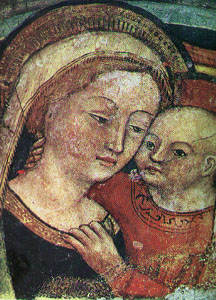
Records dating from the reign of Paul II relate that the picture of Our Lady, at first called La Madonna del Paradiso and now better known as Madonna del Buon Consiglio, appeared at Genazzano, Italy on 25 April 1467. It was in the old church of Santa Maria, which had been under the care of Augustinians since 1356. The venerated icon itself, which is drawn on a scale of wall-plaster a little thicker than a business card, was observed to hang suspended in the air without support; early tradition says that one could pass a thread around the image without touching it. Devotion to Our Lady in Santa Maria sprang up at once. Pilgrims began to pour in, miracles began and continue at the shrine.

In July 1467, Pope Paul deputed two bishops to investigate the alleged wonder-working image; no copy of their report is known to have survived. Devotion to Our Lady increased. In 1630, Pope Urban VIII made a pilgrimage to Genazzano, as did Pope Blessed Pius IX in 1864. On 17 November 1682, Pope Blessed Innocent XI had the picture crowned with gold by the Vatican Basilica. In 1727, Pope Benedict XIII granted the clergy of Genazzano an Office and Mass of Our Lady for 25 April, the anniversary of the apparition, elsewhere the feast being kept a day later so as not to conflict with that of Saint Mark the Evangelist. On 2 July 1753, Pope Benedict XIV approved the Pious Union of Our Lady of Good Counsel for the faithful at large, and himself enrolled therein as its pioneer member; Pope Pius IX and Pope Leo XIII were both later members. On 18 December 1779, Pope Pius VI, while re-approving devotion to Our Lady, granted all Augustinians an Office with hymns, lessons, prayer and Mass proper of double-major rite; with a plenary indulgence also for the faithful, to which Pope Pius VIII added another for visitors to the shrine. On 18 December 1884, Pope Leo XIII approved of a new Office and Mass of second-class rite for all Augustinians, while on 17 March 1903, he elevated the church of Santa Maria – one of the four parish churches in tiny Genazzano – to the rank of minor basilica. On 22 April 1903, he authorized the insertion in the Litany of Loreto of the invocation Mater Boni Consillii to follow that of Mater Admirabilis. The same pontiff on 21 December 1893 had sanctioned the use of the White Scapular of Our Lady of Good Counsel for the faithful.

Patronage

  • for enlightenment
  • Catholic Women’s League of Canada
  • Missionary Sisters of Saint Peter Claver
  • Albania (proclaimed on 15 May 1915 by Pope Benedict XV)
  • Moldova
  • Amargosa, Brazil, diocese of
  • Essen, Germany, diocese of
  • Sandburst, Victoria, diocese of
  • Amargosa, Brazil
  • Serroni, Contursi Terme, Italy

Source: https://catholicsaints.info/our-lady-of-good-counsel/

Our Lady of Good Counsel Read More »

Mark 16:9

The Beauty of Repentance

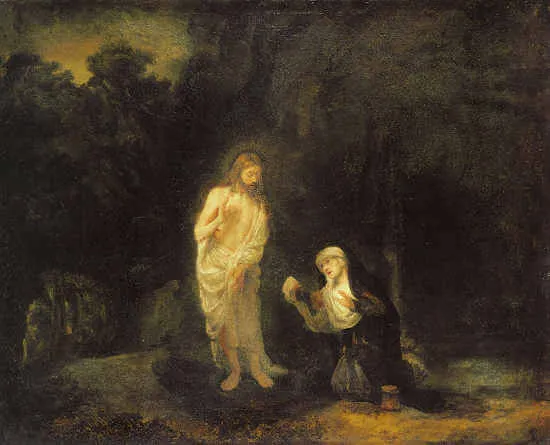
When Jesus had risen, early on the first day of the week, he appeared first to Mary Magdalene, out of whom he had driven seven demons.

Reflection:

The first person recorded in Scripture to whom Jesus appeared was Mary Magdalene. Notably, she was the one out of whom Jesus cast seven demons. Being possessed by seven demons has traditionally been understood to mean that she was completely possessed. Prior to Jesus freeing her, satan and His demons had completely taken over her will by her free submission to evil. And yet, it was to her, a woman with such a horrible past, that Jesus chose to give the honor of His first appearance. What an amazing fact!

Everyone has a past. Some have been grave sinners. Others, like Saint Thérèse of Lisieux, have never committed a mortal sin. Obviously, the beauty of a soul like Saint Thérèse is deeply admirable, and such a soul will be greatly rewarded in Heaven. But what about the grave sinner? What about those like Mary Magdalene who have lived horribly sinful lives? What does our Lord think about them?

The fact that Mary Magdalene is the first person recorded in Scripture to have seen the risen Lord should tell us much about how Jesus views a person who has greatly struggled with serious sin but has later overcome that sin and turned wholeheartedly to our Lord. Sin is demoralizing. When unrepented, it leaves a loss of dignity and integrity. However, even after one has repented, some people will continue to struggle with unhealthy guilt and shame. And for some, these struggles can become a weapon by which the evil one tries to discourage them from feeling worthy to serve our Lord with zeal and passion.

But the truth in the mind of God is that repentant sinners are true jewels and beautiful in the eyes of our Lord. They are worthy of the greatest honors. God does not dwell on our past sin. Instead, our past sin, when it has been repented of and forgiven, will be an eternal sign of the love and mercy of God.

How do you deal with your past sin? First, have you completely acknowledged it, repented of it and sought forgiveness from our Lord? If so, does it still haunt you? Does the evil one still try to remind you of your past and strip away your hope in the mercy of God?

Reflect, today, upon the most grievous of your past sins. If you haven’t yet confessed them, then do so as soon as you can. If you have, try to see your soul through the eyes of God. God does not see your past sins with anger and disgust. Rather, He sees only the depth of your conversion, sorrow and repentance. And, to Him, this is holy and beautiful. Ponder the beauty of your repentant heart and know that, as you do, you will be looking at your own heart through the eyes of God.

Source: https://catholic-daily-reflections.com/2025/04/25/the-beauty-of-repentance-4/

Mark 16:9 Read More »

Saint Mark the Evangelist

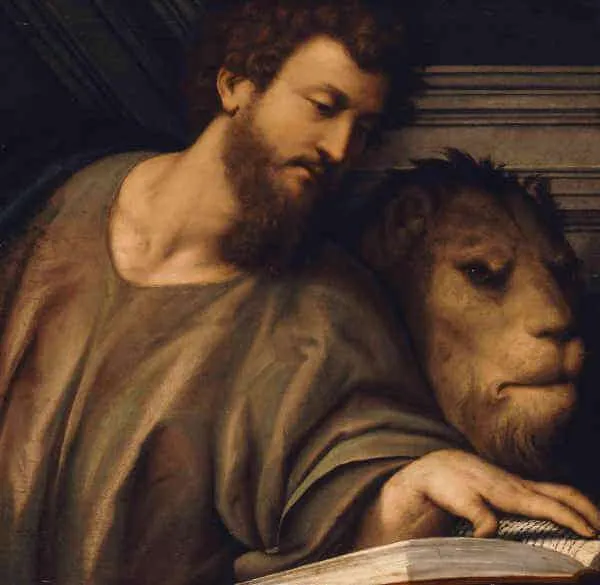
c. 12–c. 68; Patron Saint of attorneys, captives, shoemakers, lions, notaries, glass workers, Egypt, and Venice; Invoked against impenitence, insect bites, scrofulous & struma diseases; Pre-Congregation canonization

Though little is known for certain about Saint Mark’s life, the Gospel attributed to him is unquestionably one of the most important scripts ever written. In a nearly breathless way, Mark recounts Jesus’ public ministry in concise and vivid detail. The shortest of the four Gospels is packed with information. Mark’s Gospel was most likely written primarily for Roman Gentiles, rather than for Jews, which is why he often describes various Jewish customs to the reader.

The Acts of the Apostles and various Epistles speak of “Mark” as well as “John Mark.” Most scholars believe that Mark and John Mark are the same person and the Gospel writer. Saint Mark is believed to have been born in Cyrenaica, modern-day Libya, which was under Roman rule at the time. “John” is his Jewish name, and “Mark” his Roman name. His father might have died when he was young, and his mother, named Mary, most likely moved with Mark to Jerusalem. His mother’s home might have been the location of the Last Supper and also the place where Peter went after the angel released him from prison. “When he realized this, he went to the house of Mary, the mother of John who is called Mark, where there were many people gathered in prayer” (Acts 12:12). As a teenager, Mark might have been nearby when Jesus was arrested. “Now a young man followed him wearing nothing but a linen cloth about his body. They seized him, but he left the cloth behind and ran off naked” (Mark 14:51–52). Many scholars believe that this young man is Mark. Saint Barnabas, the missionary companion of Saint Paul, was either Mark’s cousin or uncle (See Colossians 4:10).

Shortly after Peter escaped from prison and arrived at Mark’s home, Mark traveled north to Antioch in Syria with Barnabas and Paul. From Antioch, he accompanied Barnabas and Paul on a missionary journey to another Antioch in Pisidia, modern-day Turkey. Before completing their journey, Mark left Paul and Barnabas and returned to Jerusalem. It is unclear why Mark left, but Paul was not pleased and saw his departure as Mark abandoning them. Later, when Paul and Barnabas were going to set out on another missionary journey, Barnabas wanted to take Mark with them. Paul was so opposed to the idea that Barnabas and Paul went their separate ways (see Acts 15:37–40). Barnabas took Mark with him to Cyprus, and Paul took another companion with him through Syria and Cilicia.

Mark appears to have been close to the Apostle Peter, because Peter refers to him as “Mark, my son” (1 Peter 5:13) in a letter addressed to several Christian communities. Peter sent greetings to them all from Mark, indicating that Mark was also well known to those communities. That letter from Peter was most likely written from Rome where Peter would later be martyred. It might be that, while Mark was with Peter in Rome, he wrote his Gospel at Peter’s request, basing it on Peter’s preaching.

Though Saint Paul and Mark initially had a difficult relationship as a result of Mark’s early departure from Paul and Barnabas’ missionary journey, they became close toward the end of Paul’s life. Paul refers to him affectionately in a few letters he wrote from prison, calling him his co-worker and indicating that Mark had been very helpful to him (see Philemon 1:24Colossians 4:10–112 Timothy 4:11).

According to later traditions, Mark was ordained a bishop and sent to Alexandria, Egypt, to preach the Gospel (that he himself wrote) and establish the first Church in Africa. He is therefore considered the first bishop of Alexandria. In Alexandria, Mark encountered the wrath of the local Alexandrians and was martyred after almost twenty years of ministering to them. In the eighth century, Saint Bede describes Mark’s death in this way:

Afterwards, being arrested for the faith, he was bound, dragged over stones and endured great afflictions. Finally he was confined to prison, where, being comforted by the visit of an angel, and even by an apparition of our Lord himself, he was called to the heavenly kingdom in the eighth year of the reign of Nero.

As a child, Saint Mark could never have imagined what would become of his life. Not only did he come to know the Messiah as a youth, he later became a bishop and the first to bring the Gospel to the continent of Africa. Most importantly, he became one of God’s most powerful evangelists by faithfully writing down the life of Christ for others to read. Since that time, countless people have read his words, meditated on their meaning, been converted in the depths of their hearts, and given their lives over to Christ.

Ponder the significance of this one man. It appears he began his life fearful of his mission. He ran when Jesus was arrested, left Barnabas and Paul on their missionary journey, but he didn’t give up. He turned back to the mission and ultimately died a martyr, bestowing on us one of the greatest treasures ever given. If you feel regret at any failure, or even numerous failures in your life, take inspiration from Saint Mark. Failures can be remedied. Recommit yourself to God’s mission, and know that, if you do, God will use you in unimaginable ways.

Source: https://mycatholic.life/saints/saints-of-the-liturgical-year/april-25—saint-mark-the-evangelist/

Saint Mark the Evangelist Read More »