Author name: Sani

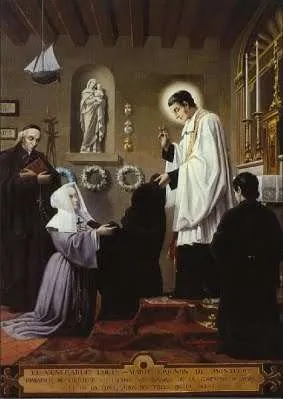
Saint Louis Grignion de Montfort, Priest

1673–1716; Patron Saint of preachers; Canonized by Pope Pius XII on July 20, 1947

Louis Grignion was the second of eighteen children born to Jean-Baptiste and Jeanne Robert Grignion in the small town of Montfort-sur-Meu, northwest France. Several of their children died in infancy, including the firstborn, leaving Louis as the oldest of the surviving siblings. He was given the name Louis at his baptism and later added Marie to his name at his confirmation, a fitting name for one who would later become the definitive source on total consecration to Jesus through Mary.

Louis’ parents were strong Catholics. Three of their sons became priests, and two of their daughters became nuns. However, the family was not without difficulties. Louis’ father had a fierce temper, and Louis was often the recipient of his outbursts. His father longed for wealth and prestige, yet he could not pull the family out of poverty, which often left him frustrated. His father’s outbursts affected Louis such that he himself was tempted with the same vice throughout his life. Nonetheless, those who knew Louis as a child saw him as an “angelic boy” whose spiritual depth was beyond his years. His deep compassion for his mother, who also suffered from her husband’s outbursts, was also well noted. Perhaps it was this compassion for his mother that later led him to a profound devotion to the Blessed Mother.

When he turned twelve, Louis-Marie was sent to the nearby town of Rennes, where he entered a large free school run by the Jesuits. He remained there for about eight years and completed his elementary education, as well as courses in philosophy and theology. During those years, Louis lived a virtuous life, had a strong love for the poor and sick, practiced severe penances, became devoted to the Blessed Virgin Mary and the angels, and prayed often. His mother’s brother, a priest in Rennes, later remarked that Louis was so virtuous that he almost appeared “immune from Adam’s sin.” At that time, he also enjoyed listening to stories from a local priest about his missionary work as an itinerant preacher. This fueled a desire in Louis’ heart for the same.

In 1693, at the age of twenty, Louis’ dream of the priesthood moved forward. He received a scholarship from a benefactor to study in Paris at the famed Seminary of Saint-Sulpice. The school was about 200 miles away from his home, and his father wanted him to arrive in style. He offered Louis a horse, money, and new clothing. Louis, however, wanted to walk to Paris as penance and to do so in poverty, so he rejected the horse but reluctantly accepted the money and new clothing. On his journey, he gave away all his money to the poor, exchanged his new clothing for tattered rags, and begged for food. When he finally arrived in Paris, he discovered that the benefactor had not given enough money for him to enter and reside at Saint-Sulpice, so he obtained modest boarding elsewhere and instead attended school at Sorbonne University for the next two years. Though his meager accommodations and diet were penitential in and of themselves, he continued to add to these mortifications through his own acts of penance. Two years later, after recovering from a serious illness, he was able to move into the poorer accommodations offered at Saint-Sulpice and complete his studies while working at the school library.

As a librarian, Louis-Marie became very familiar with some of the greatest books of theology, especially on Mariology. His faith and devotional practices grew so strong that some of the worldly clergy ridiculed him, thinking him to be a fraud. His frequent visits to the chapel before and after every class, his profound devotion to Mary, his penances, and his loving devotion to the poor and infirm made him stand out. After completing his studies, he was ordained a priest but not given faculties to preach or hear confessions. Eventually, he was invited to assist a priest in Nantes, just south of where he grew up.

Over the next six years, Father Louis had a series of ups and downs. He was especially drawn to the poor and worked on and off as a chaplain at a hospital for the poor. On a spiritual level, his ministry was a great success and the people loved him, especially those who were poor. However, he continually met with opposition from some of the worldly clergy and the social elite, so he was forced to move over and over again, even being without an assignment for a year. Finally, in 1706, discouraged by his ministerial struggles, he decided to walk 1,000 miles to Rome to consult with the Holy Father. On June 6, he was granted an audience with Pope Clement XI who saw through the veneer of this impoverished beggar priest and perceived his God-given vocation. The Holy Father appointed him as Apostolic Missionary and sent him back to France.

Over the next ten years, Father Louis thrived in his new ministry. He began preaching missions from town to town, regularly performed miracles, encountered apparitions of our Blessed Mother, lived a life of extreme poverty and penance, constructed Calvary grottos to foster devotion, and won the hearts of countless people. He confronted the heresies of the day, rejoiced in every persecution he endured (even attempts on his life by heretics), and remained faithful to the commission he was given by our Lady through the pope. Though he continued to endure persecution from the local bishop and clergy, he pressed on. Toward the end of his life, Father Louis wrote a rule of life for a community of priests and brothers, but that community was never fully established before his death. In the years after his death, however, the seeds he planted evolved into two strong communities that continue to thrive today: the Daughters of Wisdom and the Company of Mary.

His most enduring legacy would not become known to the Church for more than a century after his death. During his life, Father Louis wrote several books and many hymns. His books remained unknown until April 22, 1842, when a priest of the community he founded discovered the manuscripts in an old trunk. Soon after, his writings on the Blessed Virgin Mary, especially True Devotion, Secrets of Mary, and Secrets of the Rosary, became among the most widely loved and influential Marian books ever written. Since then, six popes have honored Saint Louis de Montfort and praised his writings and virtues. Saint Pope John Paul II even took his papal motto from the saint’s writings: Totus Tuus, “totally yours.”

Saint Louis de Montfort lived for “God alone” by consecrating himself totally to God through the instrumentality of the Blessed Virgin Mary. He was poor, penitential, devout, and fully committed to the salvation of souls and the care of the poor. Miracles accompanied his ministry, and, when the time was right, the Holy Spirit introduced the Blessed Virgin Mary more fully to the world through him.

As we ponder this great saint today, reflect upon your own devotion to our Blessed Mother. Saint Louis believed that the quickest and safest way to Jesus was through the Blessed Mother. Consider reading through his consecration found in his work, True Devotion, so that Saint Louis’ profound faith will also spark deep faith in your life.

Source: https://mycatholic.life/saints/saints-of-the-liturgical-year/april-28-saint-louis-grignon-de-montfort-priest/

Saint Louis Grignion de Montfort, Priest Read More »
John 21:4-6

One Hundred and Fifty-three Large Fish

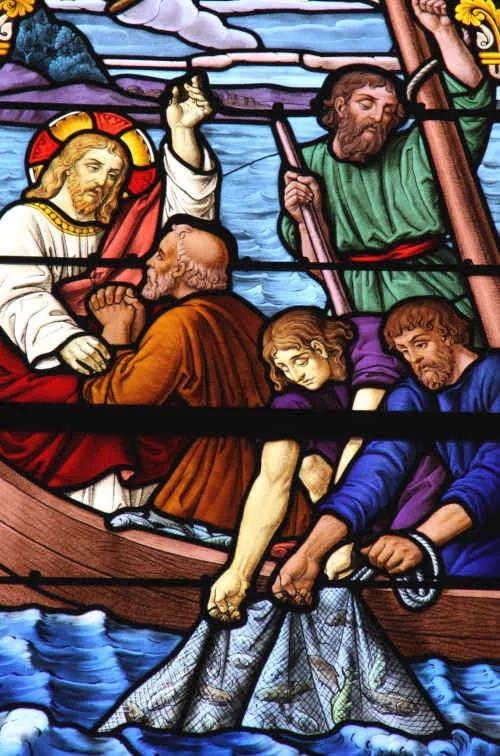
When it was already dawn, Jesus was standing on the shore; but the disciples did not realize that it was Jesus. Jesus said to them, “Children, have you caught anything to eat?” They answered him, “No.” So he said to them, “Cast the net over the right side of the boat and you will find something.” So they cast it, and were not able to pull it in because of the number of fish.

Reflection:

Recall the first time there was a miraculous catch of fish in the Gospels. In Luke 5:1–7, Jesus was preaching to the people on the shore from where He sat in Peter’s boat just a short distance away. After preaching, Jesus told Peter, “Put out into deep water and lower your nets for a catch.” Peter did so and there was such a large catch of fish that the Apostles needed help to haul it in.

In today’s Gospel, some three years later after the Resurrection, Jesus appeared to the disciples from the shore and instructed them to cast their nets “over the right side of the boat.” They did so and caught 153 large fish. In commenting on these two passages, Saint Augustine teaches that the first miraculous catch was a sign that the Gospel would be preached to all people, which is indicated by Jesus simply saying “lower your nets.” But after the Resurrection, Jesus specifically tells the disciples to cast their nets “over the right side” to indicate that grace is now given to those who stand on His right side and are separated from the condemned who are on His left. Thus, this second miraculous catch symbolizes the end of the age when the good and the bad are judged.

Saint Augustine also notes that the 153 large fish, caught off the right side of the boat, are a symbolic representation of those who conform not only to the Ten Commandments but also receive the Seven Gifts of the Holy Spirit by grace. He explains that 10 + 7 = 17 and if you add all the numbers together between 1 and 17 you arrive at 153. Thus, these 153 fish represent everyone who receives His gift of grace and obtains salvation. The boat represents the Church, and the gift of salvation is offered by Christ through His Church.

One clear message we must take from Saint Augustine’s interpretation is that grace and mercy are offered to all, but not received by all. At the end of our lives and at the end of the world, judgment will take place. Those who responded to the offer of grace and mercy, repented of their sins and gave their lives to Christ will eternally share in the Resurrection. But those who refused to follow His Commandments and closed themselves to the transforming power of the Gifts of the Holy Spirit will be separated from eternal joys.

Facing the reality of hell is not pleasant, but it is a message that must not be ignored. It is a message that is real and, therefore, hell is a possibility for us all. Therefore, it is important to remind ourselves from time to time of this spiritual truth. Are you among those 153 large fish found on the right side of the boat? Do you allow the ministers of Christ within the Church, represented by the disciples in the boat, to draw you to Christ through preaching and the Sacraments? Though all of us might quickly answer “Yes” to that question, we should never fail to be attentive to the fact that salvation requires action on our part. It requires that we accept Christ Jesus by following His Commandments and live by the transforming power of the Holy Spirit as it is dispensed by the Church.

Reflect, today, upon the symbolism found in this Resurrection account. Consider the fact that the Gospel has, indeed, been shared with you. Have you listened to the Word of God as it is preached by the Church? Do you immerse yourself in the grace given through the Sacraments? Do you follow the Ten Commandments faithfully? Do you continually open yourself to the Seven Gifts of the Holy Spirit? Seek to be among that catch of fish caught on the “right side.” Never doubt that hell is real and possible. For that reason, never waver from your fidelity to Christ, so that you will remain firmly grounded in His grace and share one day in His Resurrection.

Source: https://catholic-daily-reflections.com/2025/05/03/one-hundred-and-fifty-three-large-fish/

John 21:4-6 Read More »

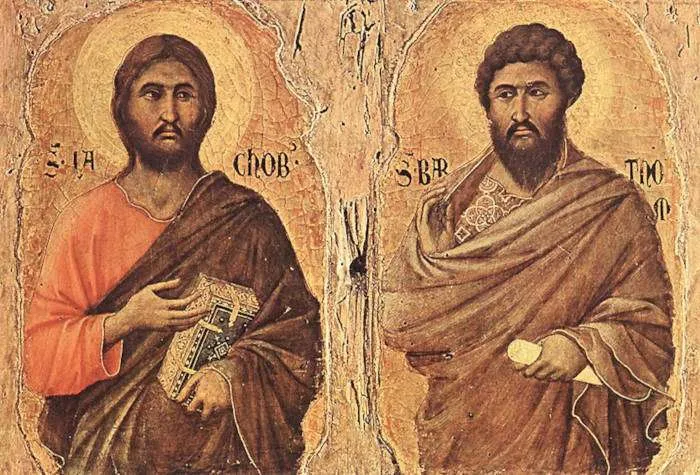
Saints Philip and James

Saint Philip: c. 4–c. 80; Patron Saint of hatmakers and pastry chefs

Saint James: First century BC–c. 62; Patron Saint of pharmacists and the dying; Pre-Congregation canonizations

In the sixth century, Pope Pelagius I traveled to Constantinople and brought the relics of the Apostles Philip and James back to Rome, placing them in what is today called the Church of the Holy Apostles. It is for this reason that we honor these two Apostles together with one feast.

Saint Philip was one of the Twelve Apostles. He was most likely a follower of Saint John the Baptist and was aware of John pointing to Jesus as the Messiah. Philip might have been a brother to Simon Peter and Andrew, making him a fisherman by trade. The day after Simon and Andrew were invited to follow Jesus, Jesus encountered Philip and said, “Follow me” (John 1:43). Philip obeyed. He was from the town of Bethsaida, just north of the Sea of Galilee. Philip’s first act of evangelization was to tell his friend, Nathanael, that they had found the Messiah. Nathanael was reluctant at first, stating to Philip, “​​Can anything good come from Nazareth?” Philip’s response was ideal. He said to his friend, “Come and see” (John 1: 46). When Nathanael came and saw, he immediately professed his faith in Jesus as the Messiah, the Son of God. Early Church theologians believe that Philip followed our Lord from that time forward, witnessing Jesus’ first miracle at Cana.

When Jesus established the Twelve, Philip was among them. He is mentioned in John’s Gospel during the feeding of the 5,000 when Jesus sees the large crowd and then turns to Philip and says, “Where can we buy enough food for them to eat?” (John 6:6). Philip is also mentioned in connection with Greek-speaking Gentiles who want to see Jesus (see John 12:21), possibly indicating that Philip could speak Greek and was known to the Greek community. At the Last Supper, as Jesus was speaking about the Father, Philip said to him, “Master, show us the Father, and that will be enough for us”, to which Jesus gently responded, “Have I been with you for so long a time and you still do not know me, Philip? Whoever has seen me has seen the Father” (John 14:8–14).

After Pentecost, little is known about Philip’s missionary activity. Ancient traditions state he preached in Greece, Phrygia, and Syria, being martyred at an old age in Hierapolis, Phrygia, modern-day southwest Turkey, not far from Ephesus where Saint Paul established a church. Philip is believed to have died either by being crucified upside down or by beheading.

Saint James is also one of the Twelve. The traditional view, from as early as the second century, is that there are only two disciples of Christ in the New Testament with the name James. Some modern scholars identify three or more. If we stick with the traditional view, which was also held by Saint Jerome in the fourth century, then the two Jameses are James the Son of Zebedee and James the Less (also referred to as James the brother of the Lord, and James the Son of Alphaeus). Later authors call him James the Just. If James the Less is also the James who is the Lord’s brother, then James’ father was Alphaeus and his mother was Mary of Clopas, the sister of the Blessed Virgin Mary. This would make James the nephew of the Blessed Virgin and a first cousin to Jesus. He is referred to as Jesus’ “brother” because it was common at that time to refer to cousins and other relatives as brothers and sisters. In Mark’s Gospel, Levi (better known as Matthew) is also referred to as the son of Alphaeus (Mark 2:14) which could make James and Matthew brothers.

In his letter to the Corinthians, Saint Paul relates that the Lord appeared to James after His Resurrection (1 Corinthians 15:7). After Pentecost, James became the first bishop of the Church in Jerusalem. The Acts of the Apostles relates that it was James, as the head of the Jerusalem Church, who oversaw the First Council of Jerusalem and declared the final judgment on behalf of Peter (see Acts 15). Eusebius, a fourth-century bishop, writes that James spent long hours in the Temple of Jerusalem: “…he was in the habit of entering alone into the temple, and was frequently found upon his knees begging forgiveness for the people, so that his knees became hard like those of a camel.” Eusebius also wrote about James’ martyrdom, “…he was thrown from the pinnacle of the temple, and was beaten to death with a club.” Traditionally, the New Testament letter of James is believed to have been written by James the Less, although modern scholars question this fact. That letter was a general letter, most likely sent to all of the Jewish Christian communities. It begins, “James, a slave of God and of the Lord Jesus Christ, to the twelve tribes in the dispersion, greetings” (James 1:1). The letter then goes on to give encouragement in trials and persecutions, exhortations and warnings, and concludes by speaking of the power of prayer.

What we know for certain about these two disciples is that they were among the Twelve Apostles. They were uniquely chosen by the Savior to continue His divine mission of evangelizing the world. They embraced their ministry heroically, establishing communities of believers, preaching the Gospel, offering the sacraments, performing miracles, and governing the early Church. Allow the apostolic zeal and the courageous martyrdom of these apostles to inspire you today with the same zeal and courage, so that God can also send you forth on mission.

Source: https://mycatholic.life/saints/saints-of-the-liturgical-year/may-3—saints-philip-and-james-apostles/

Saints Philip and James Read More »

John 14:8-9

Do You Not Know Me?

Philip said to Jesus, “Master, show us the Father, and that will be enough for us.” Jesus said to him, “Have I been with you for so long a time and you still do not know me, Philip? Whoever has seen me has seen the Father. How can you say, ‘Show us the Father’?”

Reflection:

Today’s liturgical feast is in honor of two of the Apostles, Philip and James the Lesser.  Little is known about James other than that he was chosen by our Lord for the apostolic ministry and that we have one of his letters, which is contained in the New Testament.  James eventually went to Jerusalem and led the Church for a few decades until he was stoned to death as a martyr. Philip preached in Greece, Phrygia and Syria.  He and Saint Bartholomew were thought to have been crucified upside down. Philip preached upside down from the cross until his death.

In the Gospel for today’s Mass, we are presented with an encounter that Philip had with Jesus. Though this encounter appears to be a rebuke of Philip by Jesus, it’s a rebuke that is quite heartfelt. Jesus says, “Have I been with you for so long a time and you still do not know me, Philip?” Jesus did, indeed, spend much time with His disciples. They stayed together, ate together, traveled together and spent much time talking with each other. Therefore, Jesus’ comments to Philip emanated from His real and lived personal relationship with Philip.

Take the first part of that statement to begin with. “Have I been with you so long…” Imagine Jesus saying this to you. Is this something He would be able to say to you? Is it true that you do spend much time with Him? Do you spend time reading the Gospels, speaking to Him from the depths of your heart, conversing with Him, praying to Him and listening to His gentle voice?

But Jesus goes on: “…and you still do not know me…?” This is a humble truth that is important to admit. It is true that even those who have a very deep and transforming life of prayer do not know our Lord deeply enough. There is no limit to the transformation that can take place in our lives when we know Jesus personally.

Jesus’ statement goes on: “Whoever has seen me has seen the Father.” So the next question is this: “Do you know the Father?” Do you know the Father’s love, His care for you, His perfect will? Though the Father and the Son are united as one God, They are still distinct Persons, and we must, therefore, work to establish a relationship of love with each one of them.

As initially mentioned, the comments from Jesus are a gentle rebuke of love to Philip, and He wants to speak this same gentle rebuke to you. But it’s a rebuke of love meant to encourage you to get to know Him better. It’s an invitation to personalize your relationship with Jesus and the Father in a real and concrete way. Do you know Him? Do you know the Son of God? Do you know the Father in Heaven?

Reflect, today, upon these loving questions of our Lord as if they were spoken to you. Let His words encourage you to get to know Him more deeply. Pray for your relationship to become more personal and transforming. And as you get to know our Lord more intimately, know that it is also the Father in Heaven Whom you are getting to know.

Source: https://catholic-daily-reflections.com/2025/05/02/do-you-not-know-me-4/

John 14:8-9 Read More »

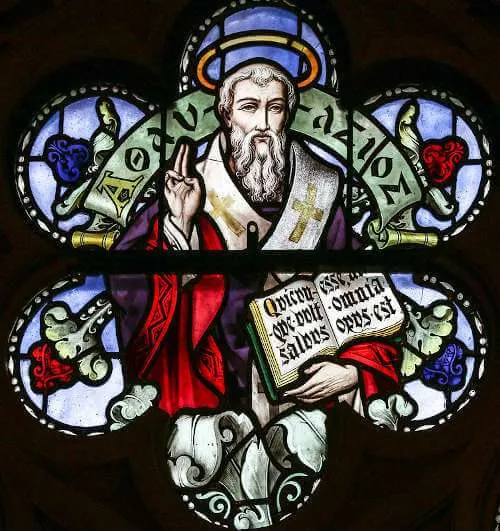
Saint Athanasius, Bishop and Doctor

c. 296–373; Patron Saint of theologians; Pre-Congregation canonization; Proclaimed a Doctor of the Church by Pope Saint Pius V in 1568

Can something be 100% black and 100% white at the same time? Certainly not. It was logic similar to this that created a fierce controversy known as Arianism in the fourth-century Church. Among the greatest opponents of Arianism was Saint Athanasius, whom we honor today.

Arius was a priest from Alexandria, modern-day Egypt. The belief that Jesus was 100% human and 100% divine seemed logically incompatible to him. As a result, Arius taught that the Father created the Son, making the Son subordinate to the Father and neither co-eternal nor co-equal with Him. The debate would finally be resolved at a Church council in Nicaea, called by the Roman Emperor Constantine the Great. The answer came by way of the formulation of the Nicene Creed, which we continue to profess as a Church today. The Nicene Creed got it right, and today’s saint made sure of it. 

Little is known about the early life of Saint Athanasius, but much is known about his unwavering leadership, courage, and depth of faith, due to the voluminous writings he left behind. One story relates that when Athanasius was only a child, he and two friends were playing on the beach when the Bishop of Alexandria noticed them. The bishop observed that young Athanasius was pretending to baptize the other boys, in imitation of the bishop himself. After examining Athanasius’ faith and understanding of the sacrament, the bishop declared that Athanasius’ baptisms of the other boys were truly valid. The bishop then took Athanasius under his wing and saw to it that he received the best education the flourishing Christian city of Alexandria could offer him. He became an excellent student and especially immersed himself in the Holy Scriptures.

At that time, Alexandria was an important trade center, with a mixture of Greek and Roman culture. The faith was strong and the city’s schools were renowned. What came out of Alexandria affected the entire Church. In 311, the Bishop of Alexandria was martyred in one of the final Roman persecutions of the faith. In 313, the Emperor Constantine issued the Edict of Milan, legalizing the practice of the Christian faith.  Upon completing his education, Athanasius was ordained a deacon in Alexandria. As a deacon, his knowledge of Scripture would especially be made known through his first great work, On the Incarnation of the Word, in which he powerfully articulates that Jesus is the divine and eternal Word of the Father. 

With the legalization of Christianity and the end of external persecutions of the Church, a new attack on the Church began—this time from within. Around the year 318, Arius, a priest in a wealthy parish in Alexandria, pronounced from the pulpit that his bishop was a heretic. He promoted his belief that the Son of God was subordinate to the Father, did not share in His divinity, and was, therefore, neither eternal nor co-eternal. The Bishop of Alexandria worked hard to reconcile Arius but to no avail. In 321 a synod of nearly 100 bishops was held in Alexandria, and they rejected the teachings of Arius. Arius subsequently rejected the bishops and fled to Palestine where he continued to spread his errors. With Christianity legal throughout the empire, Arius went on a preaching campaign, even going so far as to compose short hymns he taught the people with words such as, “there was a time when He was not…” Eventually, the Emperor Constantine heard about the controversy and wanted it resolved.

In 325, Constantine called the first ecumenical Church council in the city of Nicaea, near Constantinople, with the cooperation of Pope Sylvester. As the bishops gathered from across the empire, many of them bore the physical marks of persecution by the Roman emperors that had endured throughout their lives. Now, they faced a new enemy, one which sought to deny the divinity of Christ. At the council, Arius was given the freedom to make his case within the hearing of all. The Bishop of Alexandria also made his case. Later testimony also states that Deacon Athanasius was one of the clearest and most convincing voices in support of the divinity of Christ, basing his arguments upon his work On the Incarnation of the Word of God. Of the more than 300 bishops in attendance, only two refused to support the position articulated by the Bishop of Alexandria and Deacon Athanasius. A creed was formulated to clearly and concisely articulate the pure faith of the Church: the Nicene Creed. Those two bishops who refused to accept it, along with Arius, were exiled. Shortly after the council, the Bishop of Alexandria died and thirty-year-old Athanasius was chosen as his successor, to the delight of all of the people.

One might think that the Council of Nicaea, with its issuance of the Nicene Creed, would have ended the troubles, but it did not. Soon after, the exiled bishops who supported Arius gained the support of the Emperor Constantine and convinced him to exile Bishop Athanasius from Alexandria. This was the first of five exiles Bishop Athanasius would endure from four different Roman emperors. In fact, seventeen of his forty-eight years as Bishop of Alexandria were spent in exile.

Romans 8:28 states, “We know that all things work for good for those who love God, who are called according to his purpose.” This Scripture was certainly fulfilled in the life of Saint Athanasius. During his five exiles, he wrote over fifty letters that have survived, numerous works on the faith, and the first detailed biography of a saint, Saint Anthony of the Desert.  His book on Saint Anthony was based on his firsthand knowledge of the life of this desert monk. It is believed that Athanasius spent at least a year with Anthony prior to Anthony’s death, and then spent five or six more years with the community of desert monks Anthony had helped to form. Athanasius’ knowledge of this unique vocation, as well as his participation in it, provided the early Church with a powerful witness of the vocation of solitude and prayer. His book became one of the most copied books of that time and remains very popular today. There is little doubt that that work alone contributed greatly to an understanding of the contemplative life not only of desert monks, but also for religious, clergy, and laity. Additionally, Athanasius’ other works not only eventually led to the complete repudiation of the Arian heresy but provided theologians since that time with treasured insights into the faith, especially into the Incarnation and divinity of Christ.

As we honor this great Doctor of the Church, ponder especially his unwavering devotion to the truth, despite enduring lifelong persecution for it. It would have been easier for him to remain silent, but he did not. If you find yourself compromising your faith at times, take inspiration from Saint Athanasius and seek his intercession today.

Source: https://mycatholic.life/saints/saints-of-the-liturgical-year/may-2–st-athanasius-bishop/

Saint Athanasius, Bishop and Doctor Read More »

John 6:12-13

Superabundance

“Gather the fragments left over, so that nothing will be wasted.” So they collected them, and filled twelve wicker baskets with fragments from the five barley loaves that had been more than they could eat.”

Reflection:

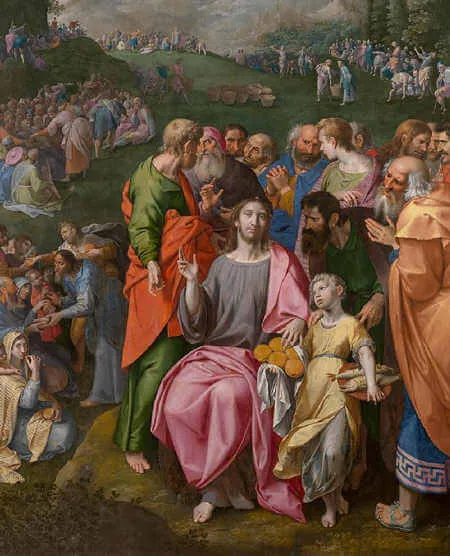
John’s Gospel is filled with much symbolic meaning. The passage above concludes the story of the miracle of the multiplication of the loaves and fishes. After feeding the multitude of people with only five barley loaves and two fish, they were able to fill twelve wicker baskets with what remained. What was the reason for the extra?

Saint Augustine, in commenting upon this passage, explains that Jesus provided more than the people could eat as a way of symbolically representing spiritual truths that were beyond what the vast crowds could comprehend. Thus, Jesus’ teachings spiritually nourished the crowds to the point that they were fully satisfied. But even though the general crowds were satisfied with what Jesus taught them, there was still so much more that He had to teach. These deeper spiritual truths are represented by the extra twelve baskets.

The twelve baskets represent the Twelve Disciples. They were the ones specially chosen by Jesus to receive so much more. Recall the times when Jesus taught the crowds in parables and then, later, would explain the meaning to the Twelve in private. He revealed to them certain truths that most people could not understand and accept.

It is helpful to consider three different groups of people in this miracle and apply those groupings to us today. The first group of people are those who were not even present for the miracle. Those who did not make the journey to be with Jesus in the wilderness. This is the largest group of people within society who go about their daily lives without even seeking minimal nourishment from our Lord.

The second grouping of people is this “large crowd” who followed Jesus to the remote side of the Sea of Galilee to be with Him. These represent those who diligently seek out our Lord every day. These are those who are faithful to the celebration of the Mass, the reading of Scripture, to daily prayer and study. To this grouping of people, our Lord teaches many things, and they are nourished by His holy Word and Sacraments.

The third grouping of people, the Twelve Disciples who are represented by the Twelve wicker baskets left over, are those who are exceptionally faithful to our Lord and continue to be nourished by Him in a superabundant way. These are those who seek to understand and embrace the deepest spiritual truths so as to be nourished and transformed on the deepest level.

Reflect, today, upon the fact that the spiritual food our Lord wishes to offer you is most often far more than you can immediately accept and consume. But understanding that fact is the first step to disposing yourself to receive even more. As you reflect upon this superabundance of spiritual food from our Lord, recommit yourself especially to seek out that remaining “twelve wicker baskets” of spiritual truths. If you do, you will discover that there is truly no end to the transforming depths of the gifts of grace our Lord wishes to bestow upon you.

Source: https://catholic-daily-reflections.com/2025/05/01/superabundance-4/

John 6:12-13 Read More »

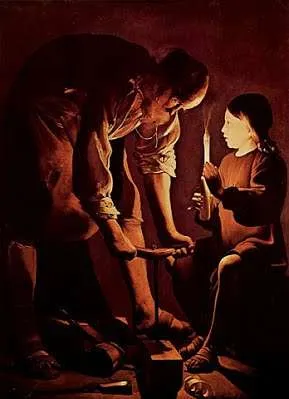
Saint Joseph the Worker

Patron Saint of Workers

Every age has its challenges. Therefore, every age needs a role model to look up to and to help the faithful navigate the particular challenges of their day and age. During the nineteenth and twentieth centuries, Saint Joseph was especially held up to the faithful who engaged in the daily toil of work to support themselves and their families with dignity and love. 

Work was not part of God’s original plan for humanity. Recall that when Adam and Eve were cast out of the Garden of Eden, God said to Adam, “Cursed is the ground because of you! In toil you shall eat its yield…” Thus, working “by the sweat of your brow” is a consequence of Original Sin. However, we must not see this consequence as something evil, but as a means by which we now fulfill our human mission. Human labor has dignity because it is an act of obedience to the will of God and is a participation in the work of God, the work of creation.

The invitation to turn to Saint Joseph as the patron saint of workers emerged over the past two centuries as societies went through drastic social and economic changes. Through the eighteenth century, most societies remained the same as they had always been. The majority of people tilled the land and raised animals to provide food for their families. Some engaged in various trades: a carpenter, blacksmith, tailor, baker, or shoemaker. With the rise of the Industrial Revolution in  the nineteenth century, societies began to change. Machines were developed to perform tasks that had been performed by hand. Workers moved into cities to labor in factories of mass production, and many of the individual tradesmen were left behind. And though production increased, new abuses also arose. Child labor, long hours, unsafe work environments, and low wages were among the new problems. These problems especially affected family life. In response to these new societal problems, the Church held up Saint Joseph as a model for all to emulate.

In 1889, Pope Leo XIII pointed the faithful to Saint Joseph. Unchecked capitalism began to tear families apart as profit started to become the goal of work, rather than as a means of providing for one’s family. An even greater concern was the introduction of the philosophy of socialism, which was coupled with atheism. Socialism presented itself as a friend and ally to the worker, but it did so through objectively distorted means. It sought to eliminate religion, the family, and private ownership of property. Instead, each individual was to become a subject of the state, while the state took the place of God. Work was for the fatherland or motherland, not primarily to care for one’s family. In  Saint Joseph, workers had someone to emulate. Saint Joseph did not work to get rich. He was not a servant of the state. He was not an oppressed laborer who needed liberating. He was a family man who found dignity in work as he provided for his family in a humble way.

On May 1, 1955, in an address to the Catholic Association of Italian Workers, Pope Pius XII took devotion to Saint Joseph one step further. He confronted the growing concerns posed by communism and its socialist philosophy on human labor and family life by instituting the Feast of Saint Joseph the Worker. “The humble craftsman of Nazareth not only personifies to God and the Holy Church the dignity of the laborer, but he is also always the provident guardian of you and your families.” May 1 (May Day) was chosen for the feast because socialist countries celebrated “International Workers’ Day” on that date. A Catholic feast, honoring the laborer in the person of Saint Joseph, was a fitting way of combating socialist ideology and restoring the dignity of labor to its proper place.

Though socialism and communism have faded in many parts of the world, they certainly have not gone away. Their philosophies continue to permeate many political systems. Unchecked capitalism also remains a threat to healthy human development and family life when the common good is overshadowed by selfish gain. The answer is simple: Go to Saint Joseph! We do not have to become intellectuals who comprehend all of the economic and political systems of our times. Instead, we must all turn to holy role models whom we can imitate. For the laborer and the family, Saint Joseph is a just man, a faithful spouse and father, a hard worker whose primary concern is for his family, a guardian and protector, an obedient servant of God, one who is humble and hidden from the spotlight, but faithful in all he does.

As we honor Saint Joseph the Worker, ponder your own call to engage in the dignity of work. As you do, put your work into proper perspective. What is the goal of your work? Do you work in an excessive way, seeking excessive gain? Do you grumble about your work and feel as though it is beneath you, holding you back from personal fulfillment? Strive for the virtuous way of Saint Joseph. Work hard to fulfill your vocation in life, and avoid excesses and extremes. We are made for love, for family, for faith, for charity, and for the glory of God and the salvation of souls. If your goals in life are anything other than these, then go to Saint Joseph the Worker and choose him as your model.

Source: https://mycatholic.life/saints/saints-of-the-liturgical-year/may-1—saint-joseph-the-worker/

Saint Joseph the Worker Read More »

John 3:35

The Meaning of Love

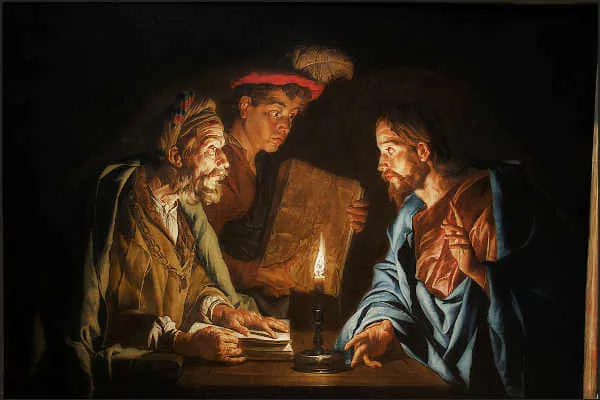
It’s interesting to note that the words of today’s Gospel appear to be from Saint John the Baptist, since they come within the context of his testimony to Jesus. Some commentators, however, suggest that they are words that were actually spoken by Jesus and that the Evangelist inserts them here as a continuation of the testimony of the Baptist, attributing them to Saint John. Regardless of who actually spoke these words, the line quoted above gives us much to reflect upon, in that it gives us insight into the very meaning and practice of true love.

What is love? Is it a feeling? An emotion? A drive or a desire for something or someone? Of course, the secular understanding of love is much different than a divine understanding of love. Oftentimes the secular view of love is more self-centered. To “love” someone or something is to want to possess that person or object. “Love” from a secular view focuses upon the attraction and desire. But true love, from a divine perspective, is very different.

The line quoted above tells us two things: First, we are told that “The Father loves the Son…” But then we are given a definition of that love. We are told that love in this case results in the Father giving “everything over” to the Son. When we consider the word “everything” in this passage, it is clear that this can only refer to the Father giving Himself to the Son in totality. Within the life of the Father, everything means His very essence, His being, His personhood, His whole divine self. The Father does not say, “I want;” rather, the Father says, “I give.” And the Son receives all that the Father is.

Though this is deep and mystical language, it becomes very practical for our lives when we understand that divine love is not about wanting, taking, desiring, feeling, etc. Divine love is about giving. It’s about the giving of oneself to another. And it’s not just about giving some of yourself away, it’s about giving “everything” away.

If the Father gave everything to the Son, does that mean that the Father has nothing left? Certainly not. The beautiful nature of divine love is that it is never ending. The more one gives themself away, the more they have. Thus, the gift of the life of the Father to the Son is infinite and eternal. The Father never ceases to give, and the Son never ceases to receive. And the more the Father gives Himself to the Son, the more the Father becomes the essence of love itself.

The same is true in our lives. It’s easy to fall into the trap of thinking that love should only go so far. But if we are to strive to imitate and participate in the love the Father has for the Son, then we must also understand that love is about giving, not receiving, and that the giving must be a gift of everything, holding nothing back. We must give ourselves away to others without counting the cost and without exception.

Reflect, today, upon your view of love. Look at it from a practical perspective as you think about the people whom you are especially called to love with a divine love. Do you understand your duty to give yourself to them completely? Do you realize that giving yourself away will not result in the loss of your life but in the fulfillment of it? Ponder the divine love that the Father has for the Son and make the radical and holy choice today to strive to imitate and participate in that same love.

Source: https://catholic-daily-reflections.com/2025/04/30/the-meaning-of-love-4/

John 3:35 Read More »

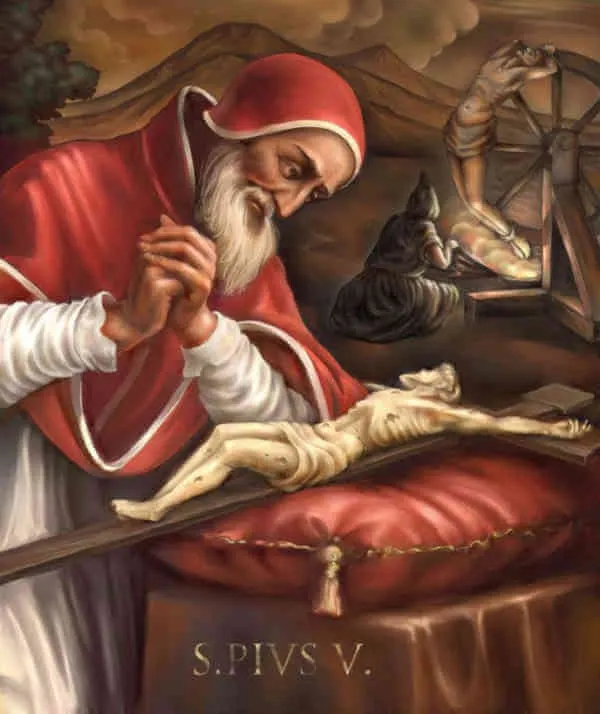
Saint Pius V, Pope

1504–1572; Patron Saint of the Dicastery for the Doctrine of the Faith; Invoked for the reform and defense of the Church; Canonized by Pope Clement XI on May 22, 1712

 In 1517, when Martin Luther published his Ninety-five Theses in Germany, igniting the Protestant Reformation, European kingdoms faced many challenges, and the Church was greatly in need of reform. Relations between the Church and State were constantly strained. Some civil rulers fought to keep their territory Catholic, while others fought to eliminate the Catholic faith. Many of these kingdoms warred against each other, and they were all in constant threat of Muslim invaders. Within the Church, reform was needed to address financial abuses, nepotism, poorly formed clergy, poorly structured governance, theological debates, and a lack of uniform liturgical worship. It was into this historical situation that today’s saint was born.

Antonio Ghislieri was born in the town of Bosco Marengo in northwest Italy. As a child, Antonio was poor and worked to help support his family. At the age of fourteen, he took the name Michele when he joined the Dominican order and received his education from the friars in Vigevano, Bologna, and Genoa. Throughout his formation, he was an excellent and hardworking student who was especially drawn to the study of Sacred Scripture and the teachings of Saint Thomas Aquinas. At the age of twenty-four, he was ordained a priest, and over the next sixteen years he taught theology and philosophy, formed Dominican novices, and served as prior in various friaries. As a young priest, Father Michele continued to deepen his life of prayer, developed a strong devotion to the Blessed Virgin Mary and the Rosary, made all-night vigils, embraced the Dominican charism, fasted, did penance, embraced poverty, and practiced interior silence by which he strove to remain continually recollected, refusing to engage in idle talk.

In 1542, as a way of addressing the ongoing threat posed by the errors introduced by the Protestant Reformation that was slowly finding its way into the Italian states, Pope Paul III reorganized the Italian Inquisition. Shortly afterwards, Father Michele was appointed to serve on several inquisitorial missions, which he did with unwavering determination. In 1556 Pope Paul IV made him Bishop of Sutri, a diocese just north of Rome, and one year later was made a cardinal. As a bishop and then cardinal, he continued to work with zeal, vigorously defending the true faith, weeding out heresy, correcting abuses, tightening Church structures, and personally living out the life of faith and morals to which he was called. He became so well respected, and his courage, clarity, and zeal were so beneficial to the Church, that the Holy Father made him the Grand Inquisitor to all of Christendom. In 1559, he was transferred further north to the Diocese of Mondovì but was regularly called to Rome to consult with the pope. In Mondovì, he vigorously sought to rebuild that diocese after it had been ravaged by wars, fueled by the theological confusion caused by the Protestant Reformation.

Bishop Michele was not a pushover, not even when it came to the pope. One of the ongoing abuses within the Church at that time was nepotism, the practice of bestowing ecclesiastical favors on one’s relatives. When Pope Paul IV announced to his court that he wanted to make his fourteen-year-old nephew a cardinal, Bishop Michele firmly opposed him and stopped that abuse. Though this led the pope to diminish some of Bishop Michele’s inquisitorial authority, it also led many of the cardinals to admire him. As a result, in 1566, Bishop Michele was elected as the new pope and took the name Pius V.

Just three years prior to Pius V’s papal election, the eighteen-year-long Council of Trent completed its final session. That council was the beginning of the Catholic Counter-Reformation that directly addressed theological and liturgical issues and sought to eliminate various abuses within the Church. All that was left to do was to implement the council’s decrees. That was no easy task, but Pope Pius V was unquestionably the man for the job.

From the beginning of his pontificate, Pope Pius V continued to be the holy, prayerful, conscientious, and determined man of God he had been since his youth. Rather than acting like royalty, he acted like a servant. He continued to wear his white Dominican habit (of which he kept only one), which is why the pope wears white today. He took the money set aside for extravagant papal banquets and distributed it to the poor. He visited the sick, built hospitals, prayed twice daily before the Blessed Sacrament, and resisted the entrapments that come with power and wealth. The Papal States, in particular, soon became more like a monastery rather than a kingdom.

To address the theological confusions dividing the Church, he promulgated a new catechism especially for parish priests, instituted catechetical classes for youth, introduced the teachings of Saint Thomas Aquinas in the universities, and continued the good work of the Holy Office of the Inquisition with pastoral zeal. To address ecclesiastical issues, he railed against immoralities within the clergy, more closely attached them to one diocese, mandated the seminary system, reaffirmed the practice of celibacy, exhorted bishops to remain in and serve their diocese as true shepherds, and renewed the weakening discipline within religious houses. To address the spiritual needs of the Church, he especially spread devotion to the holy Rosary, which he himself prayed in its entirety daily, and promulgated a new Breviary and Roman Missal. On a political level, he did not hesitate to chastise, or even penalize, wayward rulers. He defended Europe from Muslim invaders by working with various rulers to form the Holy League, a cooperative effort of Catholic kingdoms within Spain and Italy, that included the Order of Malta.

Throughout history, the Church has always been in need of internal reform. Though Christ never leaves His Church, those who are entrusted with its care are sinners. But among those sinners, God always raises up saints to redirect the Church and Her institutions down the correct path. In the sixteenth century, one of the most notable saints who God used for this purpose was Pope Saint Pius V.

As we honor this saintly pope, ponder your own calling to support the ongoing needs of reform within the Church. Those needs will always be there. Though you are not called to do so from the vantagepoint of the papacy, you are called to do so within the context of your own vocation. Ponder ways that you can reform your own life, your family, your local parish, and the community. Commit yourself to prayerful submission to the will of God, and seek the gift of courage so that God will use you in ways that are beyond your natural abilities.

Source: https://mycatholic.life/saints/saints-of-the-liturgical-year/april-30-saint-pius-v-pope/

Saint Pius V, Pope Read More »

John 3:16

A Summary of Clarity

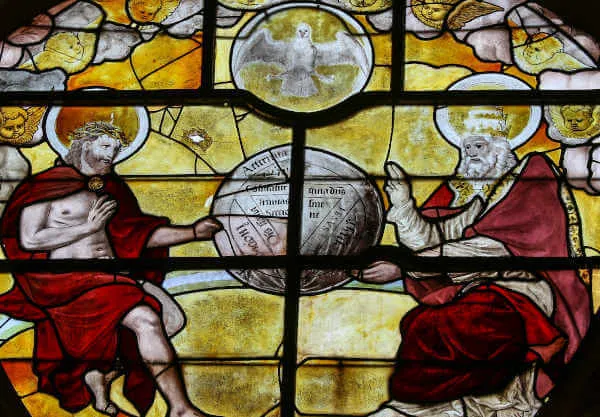
“God so loved the world that he gave his only-begotten Son, so that everyone who believes in him might not perish but might have eternal life.” 

Reflection:

We continue, today, to read from the conversation that Jesus had with Nicodemus, the Pharisee who ultimately converted and is venerated as one of the early saints of the Church. Recall that Jesus challenged Nicodemus as a way of helping him to make the difficult decision to reject the malice of the other Pharisees and to become His follower. This passage quoted above comes from Nicodemus’ first conversation with Jesus and is often quoted by our evangelical brothers and sisters as a summary of the whole Gospel. And indeed it is.

Throughout Chapter 3 of John’s Gospel, Jesus teaches about light and darkness, being born from above, wickedness, sin, condemnation, the Spirit and much more. But in many ways, all that Jesus taught in this chapter and throughout His public ministry can be summed up in this short and to-the-point statement: “God so loved the world that he gave his only-begotten Son, so that everyone who believes in him might not perish but might have eternal life.” This short teaching could be broken down into five essential truths.

First, the Father’s love for humanity, and specifically, for you, is a love so deep that there is no way we will ever fully understand the depths of His love. 

Second, the love the Father has for us compelled Him to give us the greatest gift we could ever receive and the greatest gift the Father could give: His own divine Son. This gift must be prayerfully pondered if we are to come to a deepening understanding of the infinite generosity of the Father.

Third, as we prayerfully enter deeper and deeper into our understanding of this incredible gift of the Son, our only appropriate response is faith. We must “believe in Him.” And our belief must deepen just as our understanding deepens.

Fourth, we must realize that eternal death is always possible. It is possible that we eternally “perish.” That realization will give even greater insight into the gift of the Son, in that we will realize that the first duty of the Son is to save us from eternal separation from the Father.

Lastly, the gift of the Son from the Father is not only to save us but also to draw us to the heights of Heaven. That is, we are given “eternal life.” This gift of eternity is of infinite capacity, value, glory and fulfillment.

Reflect, today, upon this summary of the whole Gospel: “God so loved the world that he gave his only-begotten Son, so that everyone who believes in him might not perish but might have eternal life.” Take it line by line, prayerfully seeking to understand the beautiful and transforming truths revealed to us by our Lord in this holy conversation with Nicodemus. Try to see yourself as Nicodemus, a good person who is trying to understand Jesus and His teachings more clearly. If you can listen to these words with Nicodemus and accept them deeply in faith, then you, too, will share in the eternal glory these words promise.

Source: https://catholic-daily-reflections.com/2025/04/29/a-summary-of-clarity-4/

John 3:16 Read More »