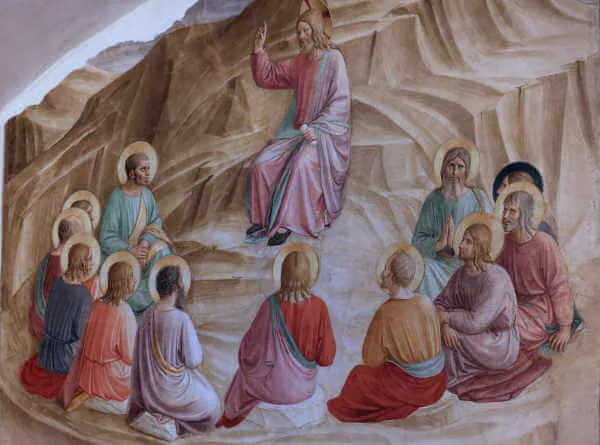
Author name: Sani

John 6:53-55

A "Holy Fear"

“Amen, amen, I say to you, unless you eat the Flesh of the Son of Man and drink his Blood, you do not have life within you. Whoever eats my Flesh and drinks my Blood has eternal life, and I will raise him on the last day. For my Flesh is true food, and my Blood is true drink.”

Reflection:

On a philosophical level, it’s useful to consider various things that appear to be “competing forces.” Good appears to be the opposite of evil. Light the opposite of dark. Heat the opposite of cold. And life the opposite of death. But are they truly opposites in the sense of being competing forces? When considered carefully, it is clear that good and evil, light and dark, heat and cold, and life and death are not actually “competing forces;” rather, evil is simply the absence of good, darkness the absence of light, cold the absence of heat, and death the loss of life. And though this philosophical distinction may not seem that interesting to some, and confusing to others, it is a helpful truth to ponder in light of today’s Gospel.

Today’s Gospel tells us that failure to “eat the Flesh of the Son of Man and drink his Blood” results in death. Death is the loss of life, and the Eucharist is the source of life. Jesus says that if you fail to eat His Flesh and drink His Blood, “you do not have life within you.”

This bold teaching of Jesus should cause us to stop and examine our approach to the Most Holy Eucharist. Sometimes we can fall into the trap of thinking that going to Mass and receiving Communion is something we do as a “favor” to our Lord. But in truth, it’s God’s most profound favor to us, because the Eucharist is the gateway to eternal life. And without it, we have no life within us. Our spirits die because we lose the presence of God.

Looking at the negative effect of not receiving the Most Holy Eucharist can be very useful. Sometimes we need to consider the consequences of our actions as a way of motivating us to greater fidelity. For that reason, considering the fact that failure to eat the Flesh of the Son of God results in death should be very motivating. It should fill us with a holy fear of the loss of the life-giving presence of God within us. This “holy fear” is a true gift from God and is, in fact, one of the Seven Gifts of the Holy Spirit.

Reflect, today, upon your interior attitude toward the Most Holy Eucharist. Do you see your participation in the Holy Mass more as a favor you offer to our Lord? Or do you see it as it is: the life-giving source of eternal life? Reflect upon how important this precious gift truly is and recommit yourself to a faithful and devout participation in this most holy Gift.

Source: https://catholic-daily-reflections.com/2025/05/08/a-holy-fear-4/
John 6:53-55 Read More »

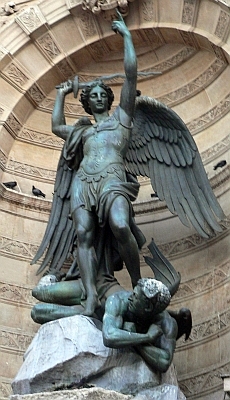
Saint Michael the Archangel

Profile

Saint Michael is an Archangel. He is the leader of the army of God during the Lucifer uprising. Devotion is common to Muslims, Christians and Jews, and there are writings about him in all three cultures. He is considered the guardian angel of Israel, and the guardian and protector of the Church. In the Book of Daniel (12:1), Michael is described as rising up to defend the Church against the Anti-Christ.

The feast of the Apparition of Saint Michael commemorates appearance of the archangel to a man named Gargan in 492 on Mount Gargano near Manfredonia in southern Italy. Gargan and others were pasturing cattle on the mountain; a bull wandered off and hid in a cave. An arrow was shot into the cave, but it came flying back out and wounded the archer. The cowherds went to their bishop who ordered three days of fasting and prayer to seek an explanation for the mystery. At the end of the three days, Michael appeared to the bishop and requested a church built in the honor of the Holy Angels in the cave. If you find medals or holy cards with ‘relics‘ of Michael, they are probably rock chips from the cave, or pieces of cloth that have touched it.

Name Meaning

  • Who is like God? (the battle cry of the army of heaven)

Source: https://catholicsaints.info/michael-the-archangel/

Saint Michael the Archangel Read More »

John 6:51

The Flesh of Our Lord

I am the living bread that came down from heaven; whoever eats this bread will live forever; and the bread that I will give is my Flesh for the life of the world.”

Reflection:

Jesus was starting to stir up the emotions of some within the crowd. They began to ridicule Him because He had said that He was the “bread that had come down from heaven.” Thus, many of those who had sought Jesus out in hopes of another miraculous free meal began to murmur among themselves and ridicule Him. As a result, Jesus began to speak even more clearly and shockingly. He then went even further and said that He is not only the “living bread that came down from heaven” but that those who want to “live forever” must also eat His “Flesh.”

How would you have reacted to such a statement if you were among those within the crowd? Consider the fact that you would have recently seen, with your own eyes, the miracle of the multiplication of the loaves and fishes. Therefore, you would have realized that Jesus was someone special, to say the least. But how would you have reacted to this statement of Jesus, “and the bread that I will give is my Flesh for the life of the world,” if you had heard it spoken at that time? Most likely, your reaction would have been the same reaction that you have right now to the teaching of the Most Holy Eucharist.

Many who heard Jesus speak this way may have thought it was a bit of an unusual thing to say. Some would have reacted strongly, while others would have reacted with indifference. But some would have had an entirely different reaction. Some would have heard Jesus speak these new and shocking words, would have realized that they did not fully understand what He meant, but would have believed deeply on account of the gift of faith. Somehow they would have known, in the depths of their consciences, that they did indeed need to eat the Flesh of Him Who came down from Heaven since He was indeed the Bread of Life.

Believing in the Eucharist, in the fact that these tangible and visible gifts of the Sacred Host and the Precious Blood are, in fact, the Body and Blood, Soul and Divinity of the Eternal Son of God, can only happen through the interior and transforming gift of faith. How else can you believe such a teaching? How else could you believe that these words in today’s Gospel have come true? And that the reception of the Most Holy Eucharist is the pathway to eternal life? The gift of faith in the Most Holy Eucharist is the one and only way to understand, accept and deeply believe what our Lord has spoken in this Holy Gospel.

Reflect, today, upon Jesus speaking these most holy words for the first time: “…the bread that I will give is my Flesh for the life of the world.” As you prayerfully reflect upon these words, ponder how deeply you believe them. How deep is your faith in the Most Holy Eucharist? The Eucharist is the fulfillment of this passage, and our divine Lord invites you to not only believe in His holy words but to allow this truth to transform you in ways beyond what you could ever imagine.

Source: https://catholic-daily-reflections.com/2025/05/07/the-flesh-of-our-lord-4/

John 6:51 Read More »

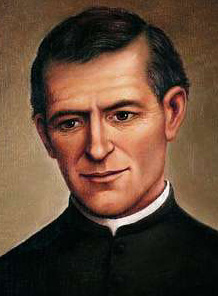
Saint Agostino Roscelli

Profile

Born to a poor farming family, Agostino spent his youth as a mountain shepherd, using his solitary time for prayer. During a parish mission in May 1835, he realized a call to the priesthood, a calling he attacked with prayer which led to financial aid that allowed him to study at Genoa, Italy. He was ordained on 19 September 1846.

He was a priest at Saint Martin d’Albaro in 1846, then the Church of Consolation in Genoa in 1854. He was the chaplain of the provincial orphanage in 1874, a post he held for 22 years. He became a prison chaplain, working especially with prisoners condemned to death.

Agostino established a residential school to train young women who were in danger of starvation or falling into prostitution because they had no support. On 15 October 1876, he founded the Institute of Sisters of the Immaculata to run this and other residential centers he established.

Born

  • 27 July 1818 at Bargone di Casarza Ligure, Italy

Died

  • 7 May 1902 at Genoa, Italy of natural causes

Venerated

  • 21 December 1989 by Pope John Paul II (decree of heroic virtues)

Beatified

  • 7 May 1995 by Pope John Paul II

Canonized

  • 10 June 2001 by Pope John Paul II

Source: https://catholicsaints.info/saint-agostino-roscelli/

Saint Agostino Roscelli Read More »

John 6:40

Holy Sight

“For this is the will of my Father, that everyone who sees the Son and believes in him may have eternal life, and I shall raise him on the last day.”

Reflection:

Do you believe in Jesus? Unquestionably the answer is “Yes.” However, to believe in our Lord is something that must deepen with every passing day. Therefore, if you do have faith in Jesus, you can also admit that you do not have faith enough. In this Gospel passage in which the “Bread of Life Discourse” is continued, Jesus calls us to do two things. First, we must see Him. Second, we must believe. Let’s start with the first.

When Jesus first spoke these words to the crowd, they did see His physical presence. But many of them did not see beyond the surface. They saw His miracles, heard His teaching, but very few saw the deeper reality of Jesus as the Son of the Eternal Father and the Savior of the World.

If you are to believe in our Lord and all that He is, then you must first see Him. One of the best ways to foster this “holy sight” of our Lord is to gaze at Him in the Most Holy Eucharist. When you attend Mass or spend time in adoration and  look upon the Most Holy Eucharist, what do you see? Do you see the Eternal Son? Do you see His holy divinity? Do you see your God and the Lord of all?

As we stand or kneel before our Lord, present in the Most Holy Eucharist, it’s easy to become distracted. It’s easy to allow our minds to wander to the many other aspects of our daily lives and to fail to see the eternal Son of God as He is present to us.

Reflect, today, upon the way you look at our Lord. If you want to deepen your faith, your belief, then start with your sight. Start by considering how you look at Jesus, present in the Most Holy Eucharist. If you are blessed to be with Him this day at the Holy Mass or in adoration, examine the way to see Him. Gaze at Him. Make an intentional act of faith in His divine presence. Acknowledge His Godhead, His glory, His holiness and His sacred presence. If you can look beyond the surface and lift the veil that covers His glory, then this holy gift of sight will give way, also, to the gift of profound faith.

Source: https://catholic-daily-reflections.com/2025/05/06/holy-sight-4/

John 6:40 Read More »

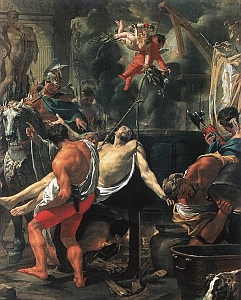
Saint John Before the Latin Gate

About the Feast

This commemorates the attempted martyrdom of Saint John the Apostle in 95. John was bound and brought to Rome, Italy from Ephesus by the order of Domitian; the Senate condemned him to be taken to the Latin Gate and thrown in a cauldron of boiling oil. John stepped out of the cauldron without injury, and instead was exiled to Patmos.

Source: http://catholicsaints.info/saint-john-before-the-latin-gate/

Saint John Before the Latin Gate Read More »

John 6:34-35

The Bread of Life

So they said to Jesus, “Sir, give us this bread always.” Jesus said to them, “I am the bread of life; whoever comes to me will never hunger, and whoever believes in me will never thirst.”

Reflection:

Imagine if you were to never grow hungry or never thirst again. On a natural level, this would be an interesting reality. Of course, if you never had physical hunger or thirst, then you may never enjoy the delight of good food and drink. So why would anyone want to lose out on such delights?

Of course, Jesus was not speaking of natural food and drink, He was speaking of supernatural hunger and thirst. And He was not saying that the spiritual food and drink He came to give us would eliminate our ability to delight in spiritual fulfillment. On the contrary, Jesus was saying that the spiritual food and drink He was to provide would result in never-ending fulfillment and satisfaction.

Chapter 6 of John’s Gospel will continue to be read throughout this week, the Third Week of Easter. This chapter presents us with what is traditionally called the “Bread of Life Discourse.” It’s John’s deep, mystical and profound teaching on the Most Holy Eucharist.

First of all, it’s useful to look at this Gospel within its context. Recall that on the previous day, Jesus performed the miracle of the multiplication of the loaves and fishes, and a crowd of people who had been fed by Him were now seeking more food. Jesus uses their desire for more food to begin to teach them about the Most Holy Eucharist, and He wants to do the same for you.

Put yourself into this scene. What is it that you hunger and thirst for the most? Perhaps you have plenty of physical food, but perhaps you don’t. If you do, what else do you crave? What do you desire? When you have identified your deepest desires right now, use these desires to allow our Lord to teach you about the Bread of Life. It might be useful to say to our Lord, “Here are my current desires in life…” And then, allow yourself to hear Jesus say to you, “I want to give you so much more. I am what you truly long for. If you come to Me, you will have all your desires fulfilled and more.” This is essentially the conversation Jesus had with this crowd throughout John Chapter 6.

Do you believe that the Most Holy Eucharist is capable of fulfilling you on the deepest level? Too often we approach that Sacrament in a lazy and distracted way. As a result, we often fail to truly receive our Lord on a level that provides this deepest delight and satisfaction.

Reflect, today and throughout this week, upon your approach to Holy Communion. The Eucharist is Christ Himself. It’s a gift that has the potential to not only sustain us in every way but also to draw us into the greatest Heavenly delights. Believe Jesus’ words in this holy chapter of John’s Gospel. For if you deepen your belief in all that Jesus has said, you will begin to realize that all you crave in life will begin to be fulfilled by this precious gift in ways beyond your imagination.

Source: https://catholic-daily-reflections.com/2025/05/05/the-bread-of-life-3/

John 6:34-35 Read More »

Saint Augustine of Hippo

Profile

Augustine was a son of a pagan father who converted on his death bed, and of Saint Monica, a devout Christian. Raised a Christian, he lost his faith in youth and led a wild life. He lived with a Carthaginian woman from the age of 15 through 30. He fathered a son whom he named Adeotadus, which means the gift of God. He taught rhetoric at Carthage and Milan, Italy. After investigating and experimenting with several philosophies, he became a Manichaean for several years; it taught of a great struggle between good and evil, and featured a lax moral code. A summation of his thinking at the time comes from his Confessions: “God, give me chastity and continence – but not just now.”

Augustine finally broke with the Manichaeans and was converted by the prayers of his mother and the help of Saint Ambrose of Milan, who baptized him. On the death of his mother, he returned to Africa, sold his property, gave the proceeds to the poor, and founded a monastery. He was a monk, a priest, and a preacher. He became the Bishop of Hippo in 396. He founded religious communities. He fought Manichaeism, Donatism, Pelagianism and other heresies. He oversaw his church and his see during the fall of the Roman Empire to the Vandals. He was a Doctor of the Church. His later thinking can also be summed up in a line from his writings: Our hearts were made for You, O Lord, and they are restless until they rest in you.

Born

  • 13 November 354 at Tagaste, Numidia, North Africa (Souk-Ahras, Algeria) as Aurelius Augustinus

Died

  • 28 August 430 at Hippo, North Africa

Canonized

  • Pre-Congregation

Patronage

  • against sore eyes
  • against vermin
  • brewers
  • converts
  • printers
  • theologians
  • Bridgeport,
  • Connecticut, diocese of
  • Coimbra, Portugal, diocese of
  • Ida, Philippines, diocese of
  • Kalamazoo, Michigan, diocese of
  • Laredo, Texas, diocese of
  • Leiria–Fátima, Portugal, diocese of
  • Ostia, Italy, diocese of
  • Portalegre-Castelo Branco, Portugal, diocese of
  • Saint Augustine, Florida, diocese of
  • Superior, Wisconsin, diocese of
  • Tucson, Arizona, diocese of

  • in Italy
    – Carpineto Romano
    – Pavia
    – Ponte Nizza
    – Riccia
  • Cagayan de Oro, Philippines
  • Isleta Indian Pueblo
  • Saint Augustine, Florida
  • San Austin, Ibiza, Spain
  • Valletta, Malta
  • Münnerstadt Monastery

Representation

  • child
  • dove
  • eagle
  • pen
  • shell
  • flaming heart, an allusion to a passage in his Confessions

Source: https://catholicsaints.info/saint-augustine-of-hippo/

Saint Augustine of Hippo Read More »

John 6:25-27

Food for Eternity

“Rabbi, when did you get here?” Jesus answered them and said, “Amen, amen, I say to you, you are looking for me not because you saw signs but because you ate the loaves and were filled. Do not work for food that perishes but for the food that endures for eternal life, which the Son of Man will give you.”

Reflection:

What do you work for in life? That which ultimately perishes? Or that which is eternal? This is an important question to sincerely answer. Too often we spend most of our lives putting most of our time and energy into those things that have little value for eternity.

The day before the above quoted conversation, Jesus had multiplied the loaves and fishes and fed five thousand households. The people were so impressed that the next day, when they were hungry again, they came looking for Jesus and found Him on the other side of the lake. Jesus, of course, immediately understands the situation. He realizes that the crowd of people who found Him were more interested in another meal than they were in the spiritual food that is eternal. So Jesus gently uses the opportunity to give them this short lesson about what is most important. The “food that endures for eternal life” is ultimately faith in Jesus.

Imagine if you were one of those people who witnessed, first hand, the miracle of the multiplication of the loaves and fishes. What sort of an impact would that have had on you? Would it have drawn you into a deep faith in Jesus, the Son of God? Or would you have been more impressed with the free and miraculous food? What’s interesting is that Jesus feeds the five thousand when they are not expecting it and not desiring it. But when they do come expecting it and desiring it the next day, He refuses. Jesus refuses another miracle because He wants the people to look deeper to the eternal reality. 

In our own lives, living primarily for the deeper and eternal reality is often hard to do. It’s easy to keep our eyes on the superficial and less important aspects of life. How do I make more money? Or buy a new car? Or have a fancier meal? How can I better entertain myself? What new piece of clothing should I buy? And the list goes on. Of course none of these things are evil, but they are all passing and will not have an effect upon our eternal soul. And, in fact, if we give too much attention to the superficial and least important aspects of life, they will have the effect of distracting us from that which is most important.

Reflect, today, upon this challenge from Jesus. Do not work for that which perishes; work for that which is eternal. Look at your priorities in life. Where is your focus? What concerns you the most every day? Hopefully your greatest concern is to grow deeper in faith in the Son of God. Hopefully it is to live the charity that is eternal. If you honestly look at your life and the goals you have and see yourself overly concerned with the things of this world, then allow these words of our Lord to speak to you directly so that you are storing up riches for eternal life.

Source: https://catholic-daily-reflections.com/2025/05/04/food-for-eternity-4/

John 6:25-27 Read More »

Third Sunday of Easter

First Reading Acts 5:27-32, 40b-41

When the captain and the court officers had brought the apostles in
and made them stand before the Sanhedrin,
the high priest questioned them,
“We gave you strict orders, did we not,
to stop teaching in that name?
Yet you have filled Jerusalem with your teaching
and want to bring this man’s blood upon us.”
But Peter and the apostles said in reply,
“We must obey God rather than men.
The God of our ancestors raised Jesus,
though you had him killed by hanging him on a tree.
God exalted him at his right hand as leader and savior
to grant Israel repentance and forgiveness of sins.
We are witnesses of these things,
as is the Holy Spirit whom God has given to those who obey him.”

The Sanhedrin ordered the apostles
to stop speaking in the name of Jesus, and dismissed them.
So they left the presence of the Sanhedrin,
rejoicing that they had been found worthy
to suffer dishonor for the sake of the name.

Responsorial Psalm Psalms 30:2, 4, 5-6, 11-12, 13

R. (2a) I will praise you, Lord, for you have rescued me.
or:
R. Alleluia.
I will extol you, O LORD, for you drew me clear
and did not let my enemies rejoice over me.
O LORD, you brought me up from the netherworld;
you preserved me from among those going down into the pit.
R. I will praise you, Lord, for you have rescued me.
or:
R. Alleluia.
Sing praise to the LORD, you his faithful ones,
and give thanks to his holy name.
For his anger lasts but a moment;
a lifetime, his good will.
At nightfall, weeping enters in,
 but with the dawn, rejoicing.
R. I will praise you, Lord, for you have rescued me.
or:
R. Alleluia.
Hear, O LORD, and have pity on me;
O LORD, be my helper.
You changed my mourning into dancing;
O LORD, my God, forever will I give you thanks.
R. I will praise you, Lord, for you have rescued me.
or:
R. Alleluia.

Second Reading Revelation 5:11-14

I, John, looked and heard the voices of many angels
who surrounded the throne
and the living creatures and the elders.
They were countless in number, and they cried out in a loud voice:
“Worthy is the Lamb that was slain
to receive power and riches, wisdom and strength,
honor and glory and blessing.”
Then I heard every creature in heaven and on earth
and under the earth and in the sea,
everything in the universe, cry out:
“To the one who sits on the throne and to the Lamb
be blessing and honor, glory and might,
forever and ever.”
The four living creatures answered, “Amen, “
and the elders fell down and worshiped.

Alleluia

R. Alleluia, alleluia.
Christ is risen, creator of all;
he has shown pity on all people.
R. Alleluia, alleluia.

Gospel John 21:1-19

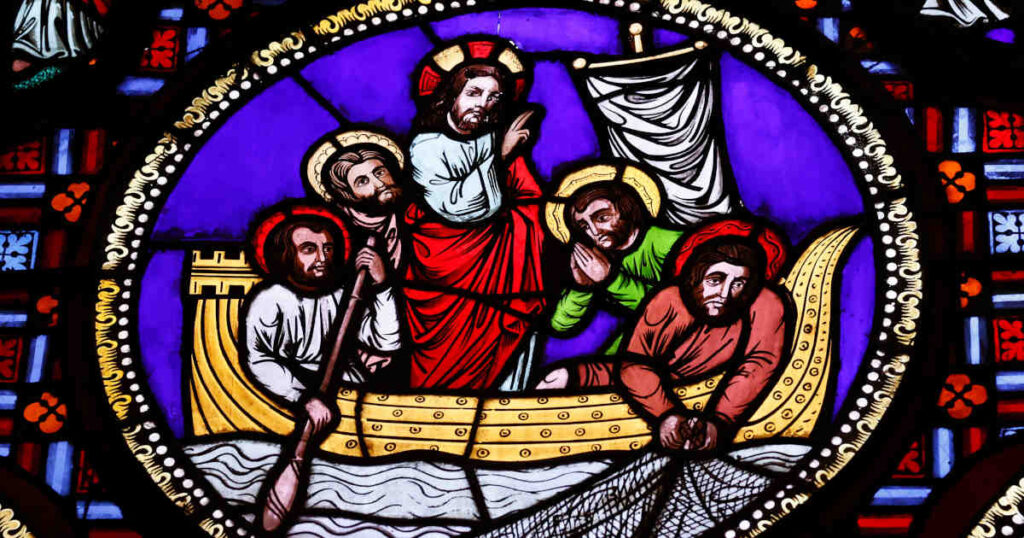
At that time, Jesus revealed himself again to his disciples at the Sea of Tiberias.
He revealed himself in this way.
Together were Simon Peter, Thomas called Didymus,
Nathanael from Cana in Galilee,
Zebedee’s sons, and two others of his disciples.
Simon Peter said to them, “I am going fishing.”
They said to him, “We also will come with you.”
So they went out and got into the boat,
but that night they caught nothing.
When it was already dawn, Jesus was standing on the shore;
but the disciples did not realize that it was Jesus.
Jesus said to them, “Children, have you caught anything to eat?”
They answered him, “No.”
So he said to them, “Cast the net over the right side of the boat
and you will find something.”
So they cast it, and were not able to pull it in
because of the number of fish.
So the disciple whom Jesus loved said to Peter, “It is the Lord.”
When Simon Peter heard that it was the Lord,
he tucked in his garment, for he was lightly clad,
and jumped into the sea.
The other disciples came in the boat,
for they were not far from shore, only about a hundred yards,
dragging the net with the fish.
When they climbed out on shore,
they saw a charcoal fire with fish on it and bread.
Jesus said to them, “Bring some of the fish you just caught.”
So Simon Peter went over and dragged the net ashore
full of one hundred fifty-three large fish.
Even though there were so many, the net was not torn.
Jesus said to them, “Come, have breakfast.”
And none of the disciples dared to ask him, “Who are you?”
because they realized it was the Lord.
Jesus came over and took the bread and gave it to them,
and in like manner the fish.
This was now the third time Jesus was revealed to his disciples
after being raised from the dead.


When they had finished breakfast, Jesus said to Simon Peter,
“Simon, son of John, do you love me more than these?”
Simon Peter answered him, “Yes, Lord, you know that I love you.”
Jesus said to him, “Feed my lambs.”
He then said to Simon Peter a second time,
“Simon, son of John, do you love me?”
Simon Peter answered him, “Yes, Lord, you know that I love you.”
Jesus said to him, “Tend my sheep.”
Jesus said to him the third time,
“Simon, son of John, do you love me?”
Peter was distressed that Jesus had said to him a third time,
“Do you love me?” and he said to him,
“Lord, you know everything; you know that I love you.”
Jesus said to him, “Feed my sheep.
Amen, amen, I say to you, when you were younger,
you used to dress yourself and go where you wanted;
but when you grow old, you will stretch out your hands,
and someone else will dress you
and lead you where you do not want to go.”
He said this signifying by what kind of death he would glorify God.
And when he had said this, he said to him, “Follow me.”

Source: https://bible.usccb.org/bible/readings/050425.cfm

Third Sunday of Easter Read More »