September 2024

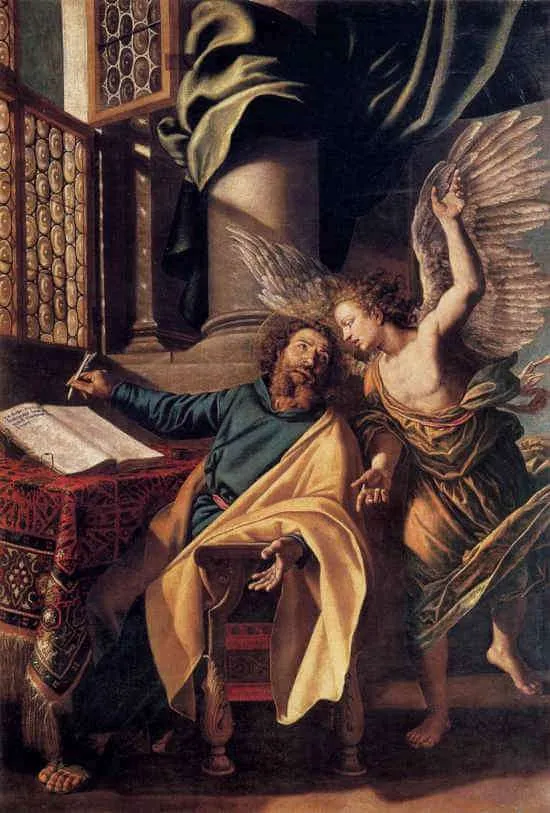
Saint Matthew, Apostle, Evangelist

First Century; Patron Saint of civil servants, accountants, bankers, bookkeepers, customs officers, financial officers, guards, moneychangers, money managers, stockbrokers, and tax collectors; Pre-Congregation canonization

At the time that Jesus began His public ministry, Galilee was part of the Roman Empire. Among the expectations of the Roman authorities was that all who lived under their rule pay taxes. To accomplish this, they often collaborated with local Jews, authorizing them to collect taxes on behalf of the Roman emperor and local governor. The rest of the community often despised the local tax collectors because they were seen as traitors to their people for entering into an oppressive collaboration with the Roman authorities. Even the tax collectors’ families were shunned. For example, their children were often seen as unsuitable as potential spouses. Additionally, many tax collectors were corrupt, imposing more taxes upon the people than they had a legal right to do. The Roman authorities usually overlooked this abuse because they often received a portion of the excess. The tax collectors pocketed the rest. It is within this context that today’s saint, Saint Matthew the Apostle and Evangelist, emerged.

Saint Matthew was most likely born as Levi, the son of Alphaeus. Though nothing is known about his childhood, Levi became a tax collector for the Roman authorities. The name “Levi” implies that he was from the Tribe of Levi, the tribe responsible for Jewish liturgical worship. Though scholars cannot arrive at a definitive conclusion about the details of his life, it is almost universally accepted that the Levi mentioned in Mark 2:14 and Luke 5:27 is the same person mentioned in Matthew 9:9 by the name Matthew. Levi might have been his original name, and Matthew may have been the name given to him by Jesus upon his conversion. The name Matthew means “Gift of Yahweh.”

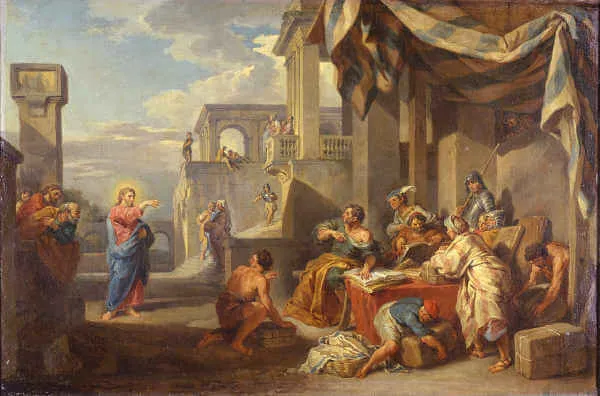
Levi’s call to follow Jesus was short but profound. He was a man clearly weighed down by his decision to betray his Levitical heritage by working for the Roman authorities to collect taxes for them. He might have been corrupt, greedy, and ostracized by his Jewish community. Most likely, his tax collecting took place in Capernaum, where Jesus had been living in Peter’s home. His duties likely involved gathering taxes on goods that came to Capernaum by way of the Sea of Galilee, as well as collecting a toll from those who arrived in that city by boat. When Jesus began His public ministry, many people took notice. Though there is no biblical account of Matthew listening to Jesus preach prior to his being called, it is reasonable to assume that he did hear about our Lord, and possibly even listened to Him preach in Capernaum. Matthew’s Gospel relates the conversion of the tax collector this way, “As Jesus passed on from there, he saw a man named Matthew sitting at the customs post. He said to him, ‘Follow me.’ And he got up and followed him” (Matthew 9:9). There was no hesitancy. In an instant, the tax collector’s life changed.

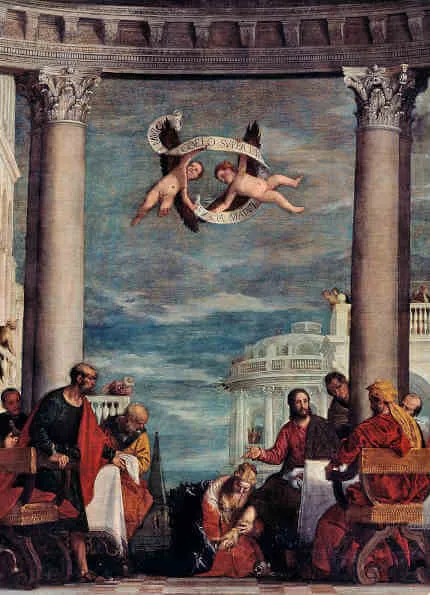
Immediately after Matthew abandoned his occupation, he invited Jesus to dine at his house and Jesus accepted. Dining with them were other tax collectors and sinners. As a result, the self-righteous Pharisees quickly condemned Jesus for associating Himself with these men. Jesus, however, rebukes the Pharisees, saying, “Those who are well do not need a physician, but the sick do. Go and learn the meaning of the words, ‘I desire mercy, not sacrifice.’ I did not come to call the righteous but sinners” (Matthew 9:12–13).

Jesus’ call and Matthew’s response sent shockwaves through the rigid Jewish authorities. They had grown accustomed to making judgment and issuing condemnation. They were politically-minded powermongers who lacked hearts of mercy. When Jesus arrived and acted with mercy for sinners, desiring their conversion, the Pharisees opposed Him, but the sinners responded. Though tax collectors like Matthew were wealthy and lived comfortably, Matthew found something in Jesus that his money could not produce.

Throughout the rest of the Gospels, Matthew’s name is listed with the Twelve. He was present at the Ascension and at Pentecost where he received his commission and the outpouring of the Holy Spirit with the other Apostles. Early Church Fathers state that he remained for some time in Judea, preaching the Gospel and helping the newly formed Church. It is during this period that he might have penned his Gospel. It is also commonly held by the Church Fathers that Matthew eventually went to “Ethiopia,” but not Ethiopia in northeast Africa. Instead, he might have traveled to the territory south of the Caspian Sea, modern-day Iran or Armenia.

One legend holds that while in the territory of ancient Ethiopia, Matthew made many converts. Among them were King Egyptus and his whole household, including his daughter Ephigenia. Matthew is said to have consecrated Princess Ephigenia as a virgin and set her over a newly formed company of virgins who gave their lives solely to Christ as His spouses. When King Egyptus died, Hyracus succeeded him as king and wanted to take Ephigenia as his wife. After making this request to Matthew, Matthew invited the new king to church to be instructed in marriage. Once the king arrived in pomp and circumstance, Matthew preached clearly that the virgin Ephigenia already had a spouse, her Lord Jesus Christ, and that she could, therefore, marry no other. Outraged, King Hyracus sent an assassin who stabbed Matthew in the back and killed him while he stood at the altar. The king then ordered that Ephigenia’s home be burned, but the legend continues that Saint Matthew appeared at the house and redirected the fire to the royal palace, which burned down. Shortly afterward, the king was afflicted with leprosy and killed himself, and his son became possessed by demons but later repented at Saint Matthew’s tomb. After this, King Hyracus’ brother became king and established Christianity as the official religion of his kingdom.

The most enduring gift Saint Matthew left behind is his Gospel. Though some modern scholars question whether he was the original author, early Church Fathers attribute the first Gospel to him unequivocally. Matthew’s Gospel was written by a Jew for his fellow Jews. It was most likely written in Hebrew and Aramaic and later translated into Greek. The original Hebrew and Aramaic texts no longer exist. His Gospel clearly shows that Jesus is the fulfillment of the Old Testament, the long-awaited Messiah. He begins with a lengthy genealogy in which he traces Jesus’ roots back to Abraham, the father of the Jewish nation. Matthew’s Gospel is well structured and organized, offering five major discourses in which he presents the Kingdom of Heaven, the Church’s foundation on Peter, the call to righteousness and obedience to God’s will, unique parables, and the Sermon on the Mount. The Sermon on the Mount especially portrays Jesus as the new Moses, offering the New Law on the new mountain. Though Moses received the Law from God on Mount Sinai, Jesus gives the New Law as God Himself on the Mount of the Beatitudes.

As we honor Saint Matthew, we also celebrate the Gospel itself. Matthew was but a human instrument; the content of his Gospel is the Living Word of God. Ponder the inestimable value of this Gospel that God has used to transform countless lives. By his simple obedience to the will of God, Saint Matthew’s efforts have been exponentially fruitful and will continue to be so until the end of the age.

Source: https://mycatholic.life/saints/saints-of-the-liturgical-year/september-21–st-matthew-apostle/

Saint Matthew, Apostle, Evangelist Read More »
Matthew 9:11-13

Seeking True Satisfaction

“Why does your teacher eat with tax collectors and sinners?” He heard this and said, “Those who are well do not need a physician, but the sick do. Go and learn the meaning of the words, I desire mercy, not sacrifice. I did not come to call the righteous but sinners.”

Reflection:

Just prior to this passage quoted above, Jesus saw Matthew, a tax collector, sitting at his custom post collecting taxes. Jesus walked up to him and said two simple words: “Follow me.” What did Matthew do? He got up and followed Jesus and invited Him to his home for a meal. When the Pharisees saw this, they acted with judgment and cruelty. They said, “Why does your teacher eat with tax collectors and sinners?” Their reaction and Jesus’ subsequent response to them says much about the goodness of our Lord.

When Jesus said that He “did not come to call the righteous but sinners,” He was not speaking of the truly righteous. For example, the most righteous person alive at that time, other than Jesus, was His dear mother. And we can be certain that not only did Jesus call her but that she always responded with her whole heart. However, Jesus was speaking of those who were “self-righteous.” A self-righteous person is one who thinks highly of themself, ignoring the truth of God but choosing, instead, to elevate their own image in their own eyes and in the eyes of others. Simply put, to be self-righteous is to believe a lie and, in fact, to believe the worst of lies. It’s the worst of lies because this sin has the effect of causing a person to remain obstinate and stuck in their sin. The self-righteous person does not see any need for repentance or change in their life. Therefore, they are not open to the Word of God and to allowing that Word to transform them.

Saint Matthew, whom we honor today, was different. He was a sinner indeed. Most likely he was greedy and overly attached to his money. Tax collectors were not highly regarded at that time because they were Jews who worked for the Romans and were, therefore, seen as traitors to their own people. Additionally, they were seen as thieves, because they often extorted more than they should receive so that they could pocket some of the money. For this reason, many Jews also feared the tax collectors because they knew the tax collectors had Rome’s support in this illicit activity.

What’s amazing is that Jesus approached Matthew, the sinner and tax collector, and confidently called him to be a follower. Most likely, Jesus could see into his heart. He knew Matthew was not happy with his life and was searching for more. Therefore, as soon as Jesus called him to follow Him, it is clear that something took place within Matthew’s soul. The fact that he got up and followed our Lord shows that the spiritual draw to Jesus was far more powerful than his desire for earthly wealth.

This same truth applies to each and every one of us. No matter what we find ourselves drawn to and no matter how we seek satisfaction in life, the supernatural truth is that there is only one thing that will satisfy. We could have all the money in the world, all earthly power and prestige, and still, in the depths of our souls, we will not find peace until we turn to Jesus and follow Him. Some people learn this truth early in life, some later in life, and some never discover it at all.

Reflect, today, upon how satisfied you are with your life. Is there something missing? If so, look at your goals and priorities in life. What do you spend most of your time thinking about, talking about and daydreaming about? If it is not our Lord Who occupies your mind, heart and every desire, then you can expect that you will experience discontentment in life. In that case, look to the witness of Saint Matthew. He is a saint today because he responded to Jesus’ invitation to abandon his life of sin and greed so as to follow Him in poverty. But in that worldly poverty and abandonment of earthly things, Saint Matthew became abundantly rich and will remain so forever in Heaven.

Source: https://catholic-daily-reflections.com/2024/09/20/seeking-true-satisfaction-3/

Matthew 9:11-13 Read More »

Saint Andrew Kim Tae-gŏn, Priest; Saint Paul Chŏng Ha-sang; and Companions, Martyrs

Died 1839–1867; Patron Saints of Korea; Canonized by Pope John Paul II on May 6, 1984

From 1392–1897, the Great Joseon Dynasty ruled all of what is today North and South Korea. Though shamanism and Buddhism were among the religious beliefs of Koreans during that period, Confucianism was the main philosophical, ethical, and political system. Within that system, a clear hierarchy was established within the family and social structures, with the king on top. This class system was at the heart of their culture. Ancestors were also highly honored and even ritually worshiped, and various human virtues were emphasized, studied, and fostered.

Catholicism was first introduced into Korea via China. The Jesuit Matteo Ricci was one of the first missionaries to step foot in China and introduce the Catholic faith in 1583. Father Ricci and his companions attempted to blend into the culture, learn the language, and teach math, science, astronomy, and mapmaking. They were the first to translate the catechism into the Chinese language. In 1603, a Korean diplomat named Yi Su-gwang was introduced to Matteo Ricci’s catechism in Beijing and returned to Korea, bringing that material with him. Over the subsequent century, the Catholic faith was studied, debated by Confucian scholars, and eventually outlawed by the king in the mid-eighteenth century after determining that Catholicism contradicted various Confucian teachings, such as societal hierarchies and ancestor worship.

In 1784, a twenty-eight-year-old nobleman named Yi Seung-Hun, who had learned about Catholicism in Korea, accompanied his father on a diplomatic mission to Beijing. While there, he sought out some Catholic priests and was baptized as Peter, becoming the first known Korean convert to Catholicism. When he returned to Korea, he brought with him crucifixes, rosaries, statues, and holy images, and shared his newfound faith over the next decade. Catholicism grew covertly, led by the laity. One of the reasons that Catholicism was so attractive to the Koreans was that it placed all people on the same level, eliminating the unjust hierarchy promoted by Confucianism. Catholicism enabled everyone to see each other as equals, individually loved and redeemed by Christ, making them all brothers and sisters. 

As the faith slowly grew, the converts asked the Chinese Church for priests. In 1795, a Chinese missionary priest named Father James Zhou Wen-mo became the first recorded priest to step onto Korean soil and offer a clandestine Mass. Over the next six years, it is estimated that the Catholic population grew to about 10,000. In 1801, Father James was arrested and martyred. Though he is not named among today’s canonized saints, he and 123 other early Korean martyrs were proclaimed as Venerable by Pope Francis in 2014.

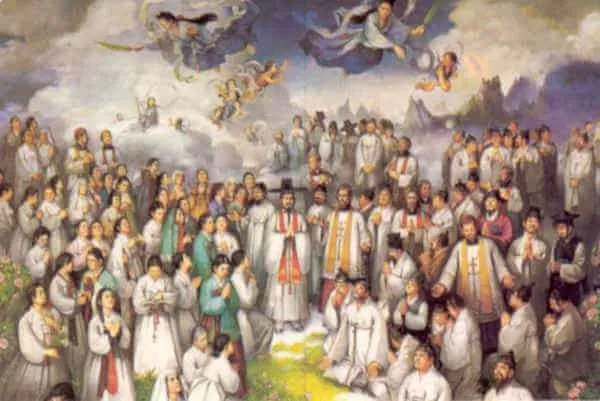
The 103 Korean Martyrs whom we honor today were canonized together by Pope John Paul II during his apostolic visit to Seoul, South Korea, on May 6, 1984, commemorating the 200th anniversary of the first Korean convert. Today’s saints suffered martyrdom in Korea during the years 1839–1867. Most of them were killed during three major persecutions in 1839, 1846, and 1866.

Among the martyrs of the 1839 persecution was forty-three-year-old Bishop Laurent-Marie-Joseph Imbert. In 1836, after joining the Paris Foreign Missions Society, Father Imbert was appointed the Vicar Apostolic of Korea, ordained a bishop, and entered Korea with ten companions in 1837. For about two years, he and his fellow missionaries hid during the day and ministered in secret at night to the covert Catholic population. In August 1839, Bishop Imbert was betrayed to the authorities who were growing increasingly concerned about the threat the Catholic faith posed to the traditional practices of class hierarchy and ancestor worship. Aware of the potential widespread persecution, Bishop Imbert turned himself in to the authorities and subsequently urged two fellow French priests, Fathers Pierre Philibert Maubant and Jacques Honoré Chastan, to do the same, in the hopes that the sacrifice of their lives would spare the lives of their people. After brutal tortures in an attempt to force them to renounce their faith failed, they were executed on September 21. Their bodies were put on public display for several days.

Catholicism, however, could not be stopped. The seed had been planted, began to grow, and was bearing good fruit. The two martyrs specifically mentioned in today’s memorial are Sts. Andrew Kim Tae-gŏn and Paul Chŏng Ha-sang. Paul was born in 1795 into a noble Korean family. He was a lay catechist and a married man. In addition to teaching the Catholic faith, Paul made several trips to Beijing to convince the Paris Foreign Missionary Society to send priests to Korea. He even wrote to the pope with the same request. Partly due to his efforts, Bishop Imbert and his ten missionary companions were sent to minister to the needs of the clandestine Korean Catholic community. In 1839, Catechist Paul Chŏng Ha-sang was martyred during the same persecution that took the life of Bishop Imbert.

Andrew Kim was also born into the noble ruling class of the Joseon Dynasty. His parents were among the many new converts to Catholicism. In 1836, at the age of fourteen or fifteen, Andrew was baptized. Three years later, his father was among the 1839 martyrs and is included in the list of today’s saints. After Andrew was baptized, he traveled 1,300 miles to the Portuguese colony of Macau where he entered seminary. He was later sent to the Philippines to complete his theological training, and in 1845, was ordained in Shanghai as the first Korean priest. Shortly afterward, he secretly returned to Korea via a treacherous sea journey so as to avoid the border guards and to begin his priestly ministry in Korea.

Father Andrew’s ministry in Korea was short-lived, but abundantly fruitful. In addition to offering the Sacraments in secret and teaching the faith, he helped to coordinate the arrival of other French missionary priests. His activity, however, did not go unnoticed. He was arrested in 1846 and subjected to brutal tortures in an attempt to get him to renounce his faith. Father Andrew not only remained strong in the profession of his faith while imprisoned, he also wrote several letters, including a most inspirational one to his parishioners. In that letter, he addressed the hardships that his parishioners would face, offered them hope, pointed them to salvation in Christ, and encouraged them to remain firm in their faith by finding strength in the teachings of the Catholic Church. He died by beheading on September 16, 1846, on the banks of the Han River at the age of twenty-five. 

Persecution of Christians continued for the next twenty years, and in 1866, the worst persecution took place, claiming thousands of lives. In all, it has been estimated that between 10,000–20,000 Christians were martyred in Korea during the nineteenth century. The attempts to stop conversions to Catholicism  in Korea were brutal. Imprisonment was not enough. Death was not sufficient. Cruel torture was the weapon used by the rulers to deter the spread of the faith. The 103 martyrs we honor today tell us that those efforts failed. Furthermore, the 123 martyrs proclaimed as venerable in 2014 give further credence to the fruitfulness of faith in the face of persecution. 

As we honor today’s Korean martyrs, we are reminded that an authentic encounter with Christ so transforms a person that Christ becomes the center of his or her life. Real faith cannot be stopped. These martyrs chose faith over their earthly lives and eternity over temporal comforts. Their united witness should challenge each one of us to examine how deeply we believe in Christ. Is your faith strong enough to endure what they endured? If not, seek their intercession today and recommit yourself to making Jesus Christ the center of your life.

Source: https://mycatholic.life/saints/saints-of-the-liturgical-year/september-20—sts-andrew-kim-taegon-paul-chong-hasang-and-companions/

Saint Andrew Kim Tae-gŏn, Priest; Saint Paul Chŏng Ha-sang; and Companions, Martyrs Read More »

Luke 8:1-2

All In!

Jesus journeyed from one town and village to another, preaching and proclaiming the good news of the Kingdom of God. Accompanying him were the Twelve and some women who had been cured of evil spirits and infirmities… 

Reflection:

Our Lord was on a mission. He traveled on foot from one town to another, “preaching and proclaiming the good news of the Kingdom of God.” His message truly was “good news.” He healed the sick, cast out demons and, most importantly, He forgave sins. As a result, many began to follow Him. Not only did His followers consist of the Twelve whom Jesus personally called and who He would eventually send forth as His Apostles, but others followed Him also. Today’s Gospel also mentions three women by name: Mary of Magdala, Joanna and Susanna. These are but a few of the people who were deeply touched by our Lord, who in turn left all to follow Him.

The choice of these first followers to abandon all and follow Jesus invites us to examine the extent to which we have committed our lives to following Him also. Among the many people who heard Jesus preach, there were undoubtedly various responses. Some rejected Him, others were intrigued by Him, others believed in Him but were not willing to become His disciple, and some did commit themselves wholeheartedly to Jesus and His mission of proclaiming good news. For the latter, the good news they heard changed their lives.

What is your response to our Lord? One good way to properly answer this question is to examine the amount of time and energy you have committed to our Lord and His message of good news. How much time have you spent reading His holy Word, praying to Him, speaking about Him and learning the faith that He has taught? How much does His message affect the decisions you make in life? Being a Christian is not something we can compartmentalize. We cannot have our “faith time” a few moments of each week and then spend the rest of our time on other activities. True, our days will be filled with many activities that are simply normal parts of our lives. We all have duties and responsibilities that occupy much of our days. But being “all in,” so to speak, means that Jesus and His message permeates everything we do. Even our ordinary daily activities such as work, chores, and the like must be done for God’s glory and in accord with His divine will. 

For Jesus’ first followers, though they traveled with Him from town to town and radically changed the course of their daily lives, they still would have engaged in many ordinary activities. But those ordinary activities were ultimately done so as to help them and others fulfill their ultimate mission of listening to and responding to the Word of God.

Reflect, today, upon the extent that you have consecrated every part of your life to our Lord and His mission. Doing so does not necessarily require that you become a public evangelist, spend all day at Church or the like. It simply means that Jesus and His mission are invited into everything you do every day all day. We can never serve our Lord fully enough. As you examine your daily activity, look for ways to bring our Lord into everything you do. Doing so will truly make you one of His faithful disciples who are all in with your life.

Source: https://catholic-daily-reflections.com/2024/09/19/all-in-3/

Luke 8:1-2 Read More »

Saint Januarius, Bishop and Martyr

Died c. 304; Patron Saint of Naples, Italy and blood banks; Invoked against volcanic eruptions; Pre-Congregation canonization

The third-century theologian Tertullian famously wrote, “The more we are mown down by you, the more in number we grow; the blood of Christians is seed.” Sometimes, his phrase is translated as, “The blood of the martyrs is the seed of the Church” (Apologeticus, L.13). There has been no time when this phrase rang truer than in the Roman Empire between the years 303 and 313. In 303 and 304, the Roman Emperor Diocletian issued a series of edicts initiating what has come to be known as the “Great Persecution.” Though the exact reason for this persecution remains unclear, many Christians were imprisoned, tortured, and killed. Others had their properties confiscated or were sent to work in mines under harsh conditions. Among the most famous martyrs of this persecution are Saints George, Catherine of Alexandria, Agnes, Sebastian, Vincent, Pancras, Cosmas, Damian, Anastasia, Lucy, and today’s saint, Saint Januarius.

Januarius is believed to have been born into a wealthy aristocratic family in the city of Benevento, located about 150 miles southeast of Rome, via the Appian Way. Little is known for certain about Januarius’ childhood and life, aside from what was recorded centuries later in various legends. One legend states that he became a priest at the age of fifteen in Benevento and the bishop of either Benevento or Naples at twenty.

When persecutions under Emperor Diocletian began in 303 and 304, chaos ensued across the empire, including Naples. According to legend, four of Bishop Januarius’ friends were arrested: two deacons named Sosius and Proculus, and two laymen named Eutyches and Acutius. To encourage them, Bishop Januarius went to visit them in prison. However, during his visit, he too was arrested and imprisoned by Timothy, the Governor of Campania. Shortly afterward, the bishop’s deacon, Festus, and a lay lector named Desiderius were also arrested when they came to visit Bishop Januarius.

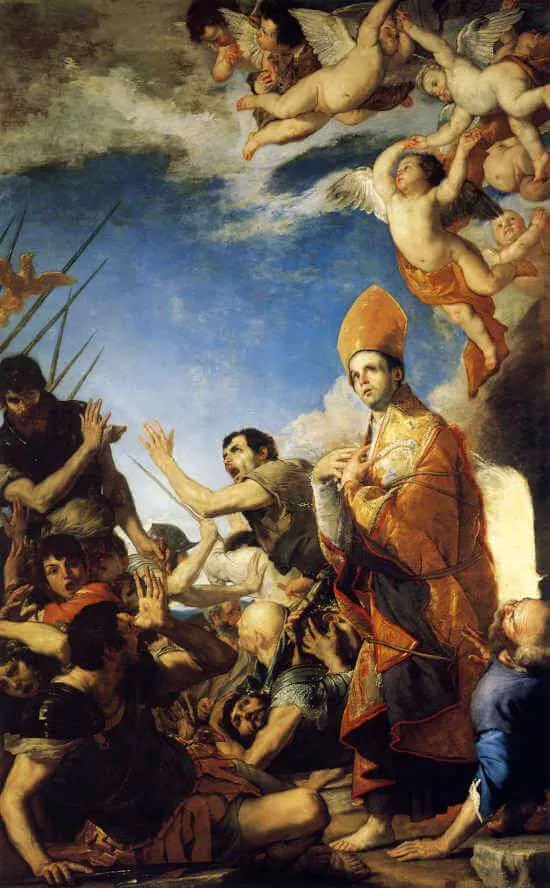
During their interrogations, each Christian boldly professed his faith. They were threatened with death if they refused to offer sacrifices to the Roman gods, but they refused. Consequently, an order was issued for them to be burned. However, when Bishop Januarius was thrown into the flames, he remained unharmed. Next, it was decreed that they be fed to wild beasts in the arena. According to one legend, the beasts became docile and refused to devour them. Ultimately, they were ordered to be beheaded. When the executioner approached, he was struck blind, but Bishop Januarius cured him in front of everyone, leading to many conversions.

After consenting to their martyrdom, all seven men were beheaded. Saint Januarius’ body was taken to Naples and buried in the principal church. Since then, many miracles have been reported by those who prayed at his tomb. It is believed that Naples was saved from volcanic eruptions from nearby Mount Vesuvius due to these miracles.

Though his heroic martyrdom is the greatest witness he could offer, God has continued to use Saint Januarius in a mysterious and ongoing way. Legend holds that, after his death, a holy woman named Eusebia collected some of his blood and stored it in two glass vials. That blood, the blood of a martyr, was later enshrined in the church next to his body. Veneration of Saint Januarius began soon after his death. At some point, an ongoing miraculous phenomenon began to occur. Every year, three times each year, his dried blood liquefies in the presence of the faithful. On some occasions, the blood fails to liquefy, which some interpret as a sign that the faithful should pray for an impending threat to the city. The first written record of the liquefaction of Saint Januarius’ blood is believed to be from 1389, as noted in the chronicle of the cleric Giovanni Diacono of Naples. Records of this annual miracle have continued ever since.

Today, the blood is enclosed in a silver reliquary containing two hermetically sealed vials. The larger one is about four inches high and two and a quarter inches in diameter. Throughout the year, the blood appears as an opaque, dark, and solid mass when viewed in the light. When turned to the side, it does not move. The first instance of liquefaction is on the Saturday before the first Sunday of May, commemorating the translation of the saint’s relics to Naples. The second time is on September 19, the feast of Saint Januarius. The third event takes place on the anniversary of the 1631 eruption of Mount Vesuvius, December 16, when a silver bust believed to house the skull of Saint Januarius is placed on the altar, and the blood is brought out for veneration. The liquefaction usually occurs during the first two times but often fails on December 16.

Although scientists have attempted to explain this phenomenon, no one has successfully cast sufficient doubt on its miraculous nature. It remains a source of deep devotion for Catholics in Naples and continues to inspire many worldwide.

As we honor this ancient saint who continues to inspire us today, ponder the simple truth that miracles do happen. For God, miracles are easy. However, miracles should never be the foundation of our faith in God. True faith comes only from a personal encounter with the Living Lord. Ponder the depth of your own faith. Though this miracle should inspire you, look more deeply and ponder the true source of faith in your life. Seek out the voice of God as that source, spoken gently to you in your conscience. Listen to Him and allow Him to reveal Himself to you, so that God and God alone is the true source of all that you believe and all that you do.

Source: https://mycatholic.life/saints/saints-of-the-liturgical-year/september-19–st-januarius-martyr/

Saint Januarius, Bishop and Martyr Read More »

Luke 7:48-50

Awe at the Forgiveness of Sins

He said to her, “Your sins are forgiven.” The others at table said to themselves, “Who is this who even forgives sins?” But he said to the woman, “Your faith has saved you; go in peace.”

Reflection:

These loving words from Jesus were spoken to a sinful woman who showed up unannounced at a dinner Jesus was having at the house of a Pharisee. The Pharisee looked down upon her in judgment, but she didn’t care. In sorrow for her sins, she anointed Jesus’ feet and humbled herself before Him, bathing His feet with her tears and drying them with her hair.

The conversation ends with Jesus looking at her and telling her “Your sins are forgiven.” Note the reaction of those who were at the table. We are given an insight into their interior thoughts. They said to themselves, “Who is this who even forgives sins?” 

Those who have been born and raised within the faith have always understood that God forgives. We were taught this from an early age, learned much about it in preparation for the Sacrament of Reconciliation, and have heard this message throughout our lives in one form or another. But imagine never hearing about or experiencing the forgiveness of God throughout your life, and then suddenly one day you do. Imagine what these people must have been experiencing as they encountered the forgiveness of sins for the first time in the Person of Jesus as He forgave this sinful woman. They may have been a bit confused by this, but, perhaps more than anything else, they would have experienced a holy awe and amazement at what God had done. They saw this sinful woman come in, they sensed the judgment and demeaning attitude of the Pharisees, they saw her express sorrow and humiliation, and then they saw Jesus forgive her.

Are you amazed at the gift of the forgiveness of your sins and the sins of others? Or do you take forgiveness for granted? The wonder and awe that the people manifested at the forgiveness of the sins of this woman should help us to examine our own attitude toward God’s mercy and forgiveness. We need to continually foster within ourselves the same amazement at God’s mercy that these people had. We must work to never take forgiveness for granted or to see it as just one more normal part of life. Rather, we must see it as extraordinary, ever new, ever glorious and forever awe inspiring.

Reflect, today, upon the awe-inspired words of these first followers of Jesus: “Who is this who even forgives sins?” As you do, let God fill you with the deepest gratitude for the forgiveness He has offered you. Renew your appreciation for this unmerited gift from God and allow that gratitude to become the source of your ongoing amazement at the mercy of God.

Source: https://catholic-daily-reflections.com/2024/09/18/awe-at-the-forgiveness-of-sins-2/

Luke 7:48-50 Read More »

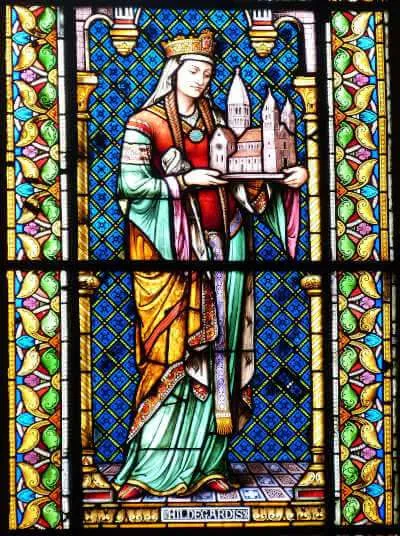
Saint Hildegard of Bingen, Virgin and Doctor of the Church

1098–1179; Patron Saint of philologists and Esperantists; Canonized by Pope Benedict XVI in 2012 (equipollent canonization); Declared a Doctor of the Church by Pope Benedict XVI in 2012

Feudalism, characterized by relationships structured around landholding in exchange for service or labor, was the defining characteristic of the socio-economic system in Europe between the ninth and fifteenth centuries. Within the feudal system, the monarch, princes, dukes, counts, and their immediate family members—known as the upper nobility—were the primary landowners and rulers. Below them were the lower nobility who often managed less land and served the upper nobility as knights, barons, and lesser lords. Depending on their rank, these nobles ruled over territories known as kingdoms, principalities, and duchies. It was within this complex feudal system, with its intricate hierarchy and blend of secular and ecclesiastical authority, that today’s saint was born.

Saint Hildegard of Bingen was born to parents of lower nobility in the village of Bermersheim vor der Höhe, within the Duchy of Franconia, modern-day Germany. Her father was in the service of Count Stephan II of Sponheim, a powerful member of the upper nobility. Hildegard, the tenth child in her family, was offered to the Church as a tithe by her parents when she was eight years old, as was the custom at that time. She was given to the Benedictine monastery at Disibodenberg, about twenty-five miles from her hometown, and was cared for by Jutta von Sponheim, the daughter of Count Stephan II.

Jutta was only six years older than Hildegard. When Jutta was fourteen, she became a hermit next to the men’s Benedictine monastery of Disibodenberg and eventually the magistra, or abbess, of the women’s branch. Despite Hildegard’s sickliness as a child,  Jutta taught her to read Latin well enough to pray the Psalms and Divine Office. Jutta also taught basic catechism and helped to form Hildegard’s life of faith, devotion, and asceticism. Hildegard also learned to play the psaltery, a primitive form of the harp. As Jutta was also of noble descent, she was in a unique position to understand Hildegard and help her on a personal level. Together, they inspired other noble girls to join them. In 1112, after about seven years with the Benedictines, Hildegard took the Benedictine veil under Bishop Otto of Bamberg at the age of fifteen.

In 1136, Abbess Jutta died and Hildegard, at the age of thirty-eight, was elected abbess. Over the next fourteen years, the community continued to grow under Abbess Hildegard’s leadership. By 1150, she had moved her community to Rupertsberg, near Bingen, and later established a second monastery at Eibingen in 1165.

Though Hildegard entered religious life, she received a good—although limited—education. Despite this, she developed vast knowledge in numerous areas, which points first to her high intelligence. However, her knowledge was also infused by what she referred to as “the shadow of the living light.” This “living light” came to her in the form of mystical visions and inspirations from a very early age. She mostly kept these mystical experiences to herself until she was in her forties. During those earlier years, she absorbed this mystical knowledge, pondered it, allowed it to grow and deepen, so that it formed who she later became. More than anyone else, her Teacher was the Holy Spirit, and her knowledge was a divine infusion of Truth that flooded her mind and gave her a supernatural understanding of Scripture, life, God, Heaven, hell, sin, Christ, and the entirety of revelation. Her supernatural knowledge even gave her insight into the natural sciences.

In 1142, at the age of forty-four, Abbess Hildegard intensely sensed God commanding her to begin writing her visions and sharing her divinely infused knowledge. The rest of her life would be spent transcribing all that she understood by this infusion of the living light. The clarity, specificity, and depth of her visions prove that they could only originate from the Holy Spirit. Her first work, completed in 1151, was a written description of twenty-six visions with her commentary on them known as Scivias—“Know the Ways.” These visions and commentaries touch on the creation of the world, the nature of God, Heaven and hell, angels and demons, humanity, the Incarnation, Scriptural interpretations, the fall, redemption, the Church, Sacraments, the end of time, and much more. She offered a summary of all of salvation history in specific and profound language.

After completing her first great visionary work, Hildegard spent the next twenty-eight years writing extensively. She completed two more major visionary works in which she dealt with virtue and vice, God’s relationship with man, and God’s activity in the world. She also wrote in detail on natural sciences, medicine, and women’s health, despite her lack of formal education in these areas. Furthermore, she wrote on the saints and the Rule of Saint Benedict. She penned numerous letters to popes, emperors, abbots, abbesses, and others. She was also an artist and musician, composing beautiful hymns and setting them to music, accompanied by illustrations in the manuscripts. Many of her compositions, with their soaring melodies and beautiful harmonies, are still sung today.

Though Abbess Hildegard lived within the walls of her monastery, she was frequently called upon for counsel by the universal Church. She was often invited to preach in public squares and cathedrals, unusual for women at that time. Her writings were examined and approved by Pope Eugene III and were examined and praised by Saint Bernard of Clairvaux, Hildegard’s contemporary.

Saint Hildegard was officially declared a saint and Doctor of the Church in 2012 by Pope Benedict XVI, even though she had informally been recognized as a saint since the time of her death. Given this recent honor, Saint Hildegard’s writings should be seen as especially relevant for the Church today. Her profound mystical and apocalyptical-like wisdom sheds light for us on many of the deepest mysteries of life.

As we honor this great saint and recent Doctor of the Church, ponder the fact that all true wisdom and knowledge come only from God. The most brilliant minds and greatest scientific advancements will forever pale in comparison to the revelations of God. Seek that wisdom, open yourself more fully to the truths of God, and pray that “living light” of God will teach you all you need to know to be of greater service to His perfect plan for your life.

Source: https://mycatholic.life/saints/saints-of-the-liturgical-year/saint-hildegard-of-bingen/

Saint Hildegard of Bingen, Virgin and Doctor of the Church Read More »

Luke 7:32-35

A Well-Ordered Soul

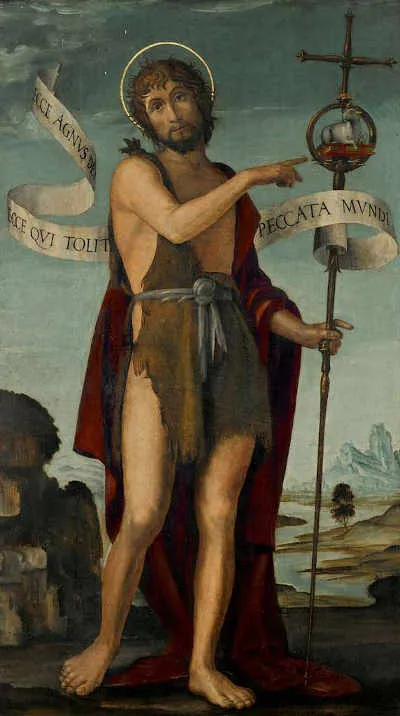
“‘We played the flute for you, but you did not dance. We sang a dirge, but you did not weep.’ John the Baptist came neither eating food nor drinking wine, and you said, ‘He is possessed by a demon.’ The Son of Man came eating and drinking and you said, ‘Look, he is a glutton and a drunkard, a friend of tax collectors and sinners.’ But wisdom is vindicated by all her children.”

Reflection:

Ecclesiastes 3 is a very popular reading for funerals. It says, “There is an appointed time for everything, and a time for every affair under the heavens. A time to give birth, and a time to die; a time to plant, and a time to uproot the plant…A time to weep, and a time to laugh; a time to mourn, and a time to dance.” This reading is consoling to those who are mourning at a funeral because life is filled with many different emotions and experiences. When those at a funeral think about their loved one, they will recall both the good times and the bad, the sorrows and the joys. Doing so helps remind them that even though the funeral is a time of sorrow, joys will follow in the future. This is the natural rhythm of life.

In our Gospel today, Jesus challenged those who failed to have the proper human response at the right time. “We played the flute for you, but you did not dance. We sang a dirge, but you did not weep.” The image of playing a flute and singing a dirge and the subsequent failure to dance and weep reveals a certain disconnect that many people had to John the Baptist and to Jesus Himself during their ministries. In commenting upon this passage, Saint Augustine says that John the Baptist’s preaching was like a dirge that called people to the “weeping” of repentance. However, when he preached, there were many who failed to respond with the appropriate repentance. When Jesus came, He preached and gave witness to the new life of grace that He came to bestow. Though some listened and responded to Him, there were many who did not. Jesus’ message was like the music of the flute that was to inspire people to “dance.” But many failed to respond with the joy that they were invited to experience and live through His transforming message and grace.

There is, indeed, an appointed time for everything and for every affair under Heaven. The mission we have been given is to be attentive to that which God is speaking to us at each and every moment of our lives. At times we must “weep” by looking at our sins honestly, experience the horror of those sins, and passionately reject them. At other times we will “dance” when God invites us into His consoling grace and asks us to see clearly His merciful love. At those moments we are invited to be deeply grateful and to express that gratitude with our whole souls.

Reflect, today, upon the calling you have been given to live in a well-ordered way. Do so by considering how attentive you are to the people around you. Does the attentiveness of your charity help you to see the hurt within the hearts of those who are suffering? Are you compelled to offer them a compassionate ear and merciful heart? When others are experiencing the joys of life, are you able to share that joy with them? Can you do so fully, without jealousy or envy of any kind? When God inspires you to some act of conversion and bestows some grace, do you listen and promptly obey, responding in the most appropriate way? Our souls must become sensitive to the promptings of grace and must respond accordingly. Seek to have a well-ordered soul so that you will live and experience the life that God places before you each day in accord with His perfect will.

Source: https://catholic-daily-reflections.com/2024/09/17/a-well-ordered-soul-4/

Luke 7:32-35 Read More »

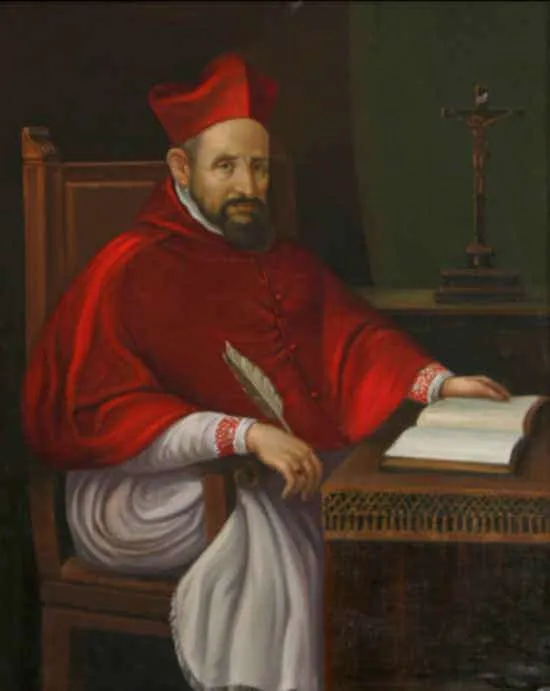
Saint Robert Bellarmine, Bishop and Doctor

1542–1621; Patron Saint of canon lawyers, catechism writers, catechists, and catechumens; Canonized by Pope Pius XI in 1930; Declared a Doctor of the Church by Pope Pius XI in 1931

Robert Bellarmine was the third of ten children born into a noble family in the town of Montepulciano within the Grand Duchy of Tuscany, modern-day Italy, about 100 miles north of Rome. Despite the family’s noble lineage, Robert’s parents were materially poor. When Robert was born, his uncle, Marcello Cervini degli Spannocchi, was a cardinal. When Robert was thirteen, his uncle was elected Pope Marcellus II, but quickly fell ill and died only twenty-two days later.

As a child, Robert was known for his intelligence. He was thought to have had a photographic memory, quickly memorizing pages of books and poems, such as Virgil’s poems in Latin. At the age of eighteen, he entered the Jesuit novitiate in Rome where he excelled. A few years later, when he was asked to teach Greek, which he did not know, he learned it with his students and quickly mastered the language as he taught it. His theological studies immersed him in the scholastic theology of Thomism. He studied in Padua and then Louvain, modern-day Belgium, where he was ordained a priest in 1570 at the age of twenty-eight.

As a newly ordained priest, Father Bellarmine was assigned to teach at the University of Louvain, where he had just completed his theological studies. After six years of teaching there, he was assigned to teach at the Roman College, now the Pontifical Gregorian University in Rome. It was there that he became a spiritual director and confessor to the seminarian and future saint, Aloysius Gonzaga.

Both in Louvain and in Rome, Father Bellarmine became widely respected for his brilliance and preaching. While in Rome, Father Bellarmine’s lectures turned into a three-volume book called De Controversiis, a defense of the Catholic faith in the wake of the Protestant Reformation. Father Bellarmine addressed seventeen controversies that resulted from the Protestant Reformation, and he powerfully and eloquently defended Catholic doctrine against them. This was the first attempt by a Catholic theologian to directly address these controversies in a systematic and comprehensive way. His work became the standard for the theological defense of the faith across all of Europe. Topics included Scripture and Tradition, Christ, the pope and Church, the Sacraments, sin, grace, free will, and good works. Not only did he present the Catholic faith well, he also addressed the errors of Luther, Calvin, Zwigli, and others who were sowing confusion within the Protestant Reformation. Unquestionably, he was the holy hero that was sorely needed in the Church at that time.

In addition to his writing, teaching, and preaching, Father Bellarmine was called upon by popes for administrative and diplomatic tasks. In 1592, at the age of fifty, he was assigned as rector of the Roman College. In 1598, he was created a cardinal and given the role of Cardinal Inquisitor, which required him to serve as a judge in important matters of the Inquisition, such as trials for heresy. During his tenure, he participated in the trial of the former Dominican turned Calvinist, Giordano Bruno, who was found guilty and turned over to the civil authorities, who put him to death.

In 1602 Cardinal Bellarmine was ordained a bishop by Pope Clement VIII and assigned as Archbishop of Capua. When Pope Clement VIII died three years later, Cardinal Bellarmine was among the cardinal-electors and received some votes. Cardinal Alessandro de’ Medici was ultimately elected and chose the name Pope Leo XI, but died twenty-six days later. In the next conclave, Cardinal Bellarmine narrowly escaped being elected, much to his relief. Cardinal Camillo Borghese was chosen instead, taking the name Pope Paul V. Pope Paul V, in keeping with the mandates of the Council of Trent, ordered that the bishops who were living in Rome needed to return to their dioceses to fulfill their duty as shepherds. However, he asked Cardinal Bellarmine to stay, to which he obediently agreed. He resigned his archbishopric and became a prominent member of the Holy Office and other congregations and was the chief advisor and theologian for the Holy See.

Over the next sixteen years, Cardinal Bellarmine became a central figure in the Vatican. He helped resolve divisions within the Church, clarified the Church’s position on relevant topics, helped implement the use of the recently published Roman Catechism, or Catechism of Trent (which he had earlier helped to write), communicated with and even rebuked kings and secular rulers, and served in numerous other capacities. In 1616, Cardinal Bellarmine was involved in responding to the controversial teachings of Galileo, whom he considered a friend. Though the cardinal did not condemn him, he did deliver the Church’s position that, since Galileo’s conclusions could not be substantiated scientifically, the traditional understanding of Scripture must hold. He also explained that if science were to prove Galileo’s view (that the earth revolved around the sun), then the Church had a duty to interpret the Scripture in light of those new facts. It wasn’t until after Bellarmine’s death that the Church went further, erroneously condemning Galileo, much to its later humiliation.

After one more conclave, Cardinal Bellarmine fell ill and retreated into retirement. During these last years of his life, he wrote some beautiful devotional works: “The Mind’s Ascent to God by the Ladder of Created Things,” “The Seven Words on the Cross,” and “On the Art of Dying Well.” His other earlier works include a masterful commentary on the Psalms, the earlier mentioned De Controversiis, his contribution to the Roman Catechism, as well as several other minor works.

Saint Robert Bellarmine was naturally gifted with a brilliant mind. What made him a saint is that he devoted himself and every natural ability to the service and glory of God. God took that offering and did great things through him. As we honor this brilliant and holy saint, ponder the importance of offering to God the gifts and talents you have. What are you good at? What are you capable of? No matter what that is, offer yourself to God and commit yourself to becoming a holy instrument for His eternal glory.

Source: https://mycatholic.life/saints/saints-of-the-liturgical-year/september-17—saint-robert-bellarmine-bishop-and-doctor–optional-memorial/

Saint Robert Bellarmine, Bishop and Doctor Read More »

Luke 7:11-12

Compassion, Hope, and Faith

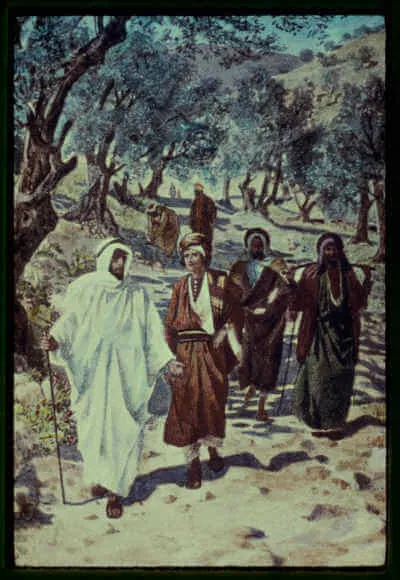
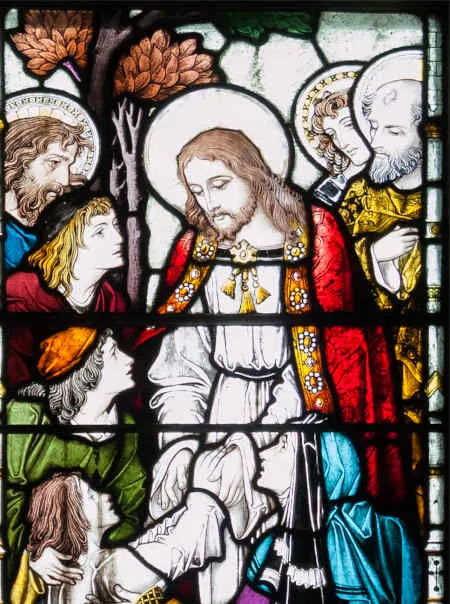
Jesus journeyed to a city called Nain, and his disciples and a large crowd accompanied him. As he drew near to the gate of the city, a man who had died was being carried out, the only son of his mother, and she was a widow. A large crowd from the city was with her.

Reflection:

Try to imagine this mother. She had been married, she and her husband had a child, they raised their child, she and her son watched her husband die, and then she watched her son die and was participating in his funeral. Since he was her only son, she was now alone.

When we think about this woman, it is easy to feel compassion for her. Her heart would have been filled with a sorrow that is tangible to anyone with empathy. Her heart might also have been filled with fear. At that time, a widow would have had a very difficult time taking care of herself in a rural village. With her husband gone, she would have had to rely upon her son to provide for her as she aged. But now that he was gone, her heart would have not only felt the pain of his loss, but also fear for her future. What would become of her? Who would provide food for her year after year? Would she be reduced to begging and poverty?

It is in the context of this very real sorrow and fear that Jesus enters her life. We do not know if she knew anything about Jesus. It appears she was not one of His followers and might not have even heard about Jesus since He had not been ministering publicly for very long. Jesus’ encounter with her and her dead son appears to be unplanned and unexpected. What is it that moves Jesus to raise this man from the dead? It does not appear to be a response to anyone’s faith within the village. It is not even done at anyone’s request. Instead, it appears to be done purely out of Jesus’ compassion for this mother. At least that’s how it seems at first read. And though Jesus clearly acted out of compassion for her, if we consider the entire context, there might also be a secondary motive.

Jesus, his disciples and a large crowd were all walking together through this village. Since Jesus’ miracles were normally performed in response to people’s faith, it is most likely that faith was a contributing factor to this miracle. The faith that called forth this miracle, however, could only have come from the crowds of people who were walking with Jesus from Capernaum. The day prior, these same crowds witnessed Jesus heal the servant of a centurion. They clearly believed in Jesus. As they walked with Him and encountered this funeral procession, it was not only Jesus’ heart that was moved with compassion, it was also the hearts of His followers. Therefore, as Jesus’ followers witnessed this mother’s sorrow and then witnessed Jesus’ own human sorrow and compassion for her, they would have had hope that He would do something. Their hope would have been supernatural in origin, which means that it was also united with faith. By faith, they knew Jesus would act. Thus, in a very real way, the compassion, hope and faith of the people traveling with Jesus would have called forth His almighty power to heal, and Jesus responded.

There are many ways to act as mediators of God’s grace. One way to do so is by growing in compassion for others and hope in God. When we witness the sufferings of others, allow ourselves to feel compassion for them, manifest hope in the power of God to heal, and then stand there, in faith, waiting for God to act, God will be compelled to act. Our holy compassion, hope and faith act as a prayer to which God always responds. The crowds accompanying Jesus through the Village of Nain appear to have acted in this manner and, inspired by their witness, we, too, must act as intercessors for others in the same way.

Reflect, today, upon anyone in your life who resembles this widow of Nain. Who is it that God wants you to notice and to feel compassion for? As your empathetic heart notices those who need your compassion, open yourself, also, to the supernatural gift of hope. Have divine hope that God will heal them. As you do, allow that hope to manifest faith in God and offer that compassion, hope and faith to God as your prayer for those who are in need.

Source: https://catholic-daily-reflections.com/2024/09/16/compassion-hope-and-faith-2/

Luke 7:11-12 Read More »