2023

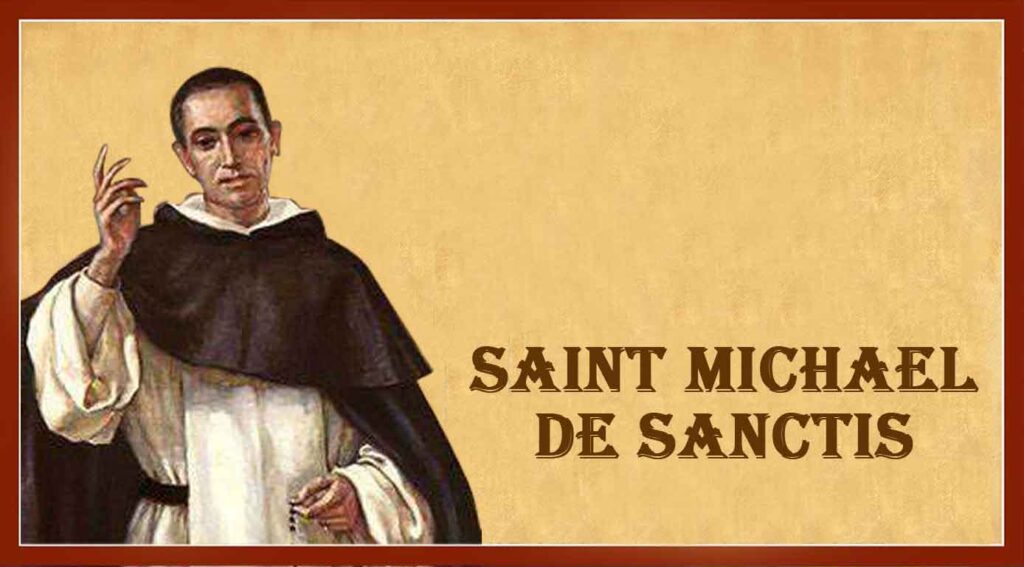
Saint Michael de Sanctis

Saint Michael de Sanctis was born as Michael Argemir. He was also known as Michael of the Saints. At the age of twelve, he came to Barcelona and asked to be received into the monastery of the Trinitarians there.

After a three-year novitiate, he took his vows at that order’s monastery of St. Lambert at Zaragoza in 1607. After meeting a Discalced Trinitarian one day, he felt drawn to that congregation’s more austere lifestyle and, after much deliberation and the permission of his superior, he entered the congregation of the Discalced Trinitarians at Madrid as a novice. He then took his vows at Alcalá, became a priest, and was twice elected superior of the monastery at Valladolid.

During his life, Michael de Sanctis led a life of prayer and mortification. He was devout towards the Holy Eucharist, and is said to have been experienced ecstasies several times during Consecration.

Saint Michael de Sanctis Read More »
Easter Sunday – The Resurrection of the Lord
The Mass of Easter Day

Liturgy of the Word

First Reading: Acts 10:34a, 37-43

Peter proceeded to speak and said:
“You know what has happened all over Judea,
beginning in Galilee after the baptism
that John preached,
how God anointed Jesus of Nazareth
with the Holy Spirit and power.
He went about doing good
and healing all those oppressed by the devil,
for God was with him.
We are witnesses of all that he did
both in the country of the Jews and in Jerusalem.
They put him to death by hanging him on a tree.
This man God raised on the third day and granted that he be visible,
not to all the people, but to us,
the witnesses chosen by God in advance,
who ate and drank with him after he rose from the dead.
He commissioned us to preach to the people
and testify that he is the one appointed by God
as judge of the living and the dead.
To him all the prophets bear witness,
that everyone who believes in him
will receive forgiveness of sins through his name.”

Responsorial Psalm: Psalm 118:1-2, 16-17, 22-23

Response– This is the day the Lord has made; let us rejoice and be glad

Give thanks to the LORD, for he is good,
for his mercy endures forever.
Let the house of Israel say,
“His mercy endures forever.”
R– This is the day the Lord has made; let us rejoice and be glad

“The right hand of the LORD has struck with power;
the right hand of the LORD is exalted.
I shall not die, but live,
and declare the works of the LORD.”
R– This is the day the Lord has made; let us rejoice and be glad

The stone which the builders rejected
has become the cornerstone.
By the LORD has this been done;
it is wonderful in our eyes.
R– This is the day the Lord has made; let us rejoice and be glad

Second Reading: Col 3:1-4

Brothers and sisters:
If then you were raised with Christ, seek what is above,
where Christ is seated at the right hand of God.
Think of what is above, not of what is on earth.
For you have died, and your life is hidden with Christ in God.
When Christ your life appears,
then you too will appear with him in glory.

Sequence - Victimae paschali laudes

Christians, to the Paschal Victim
Offer your thankful praises!
A Lamb the sheep redeems;
Christ, who only is sinless,
Reconciles sinners to the Father.
Death and life have contended in that combat stupendous:
The Prince of life, who died, reigns immortal.
Speak, Mary, declaring
What you saw, wayfaring.
“The tomb of Christ, who is living,
The glory of Jesus’ resurrection;
bright angels attesting,
The shroud and napkin resting.
Yes, Christ my hope is arisen;
to Galilee he goes before you.”
Christ indeed from death is risen, our new life obtaining.
Have mercy, victor King, ever reigning!
Amen. Alleluia.

Alleluia: 1 Cor 5:7

Alleluia, alleluia. Christ, our paschal lamb, has been sacrificed; let us then feast with joy in the Lord. Alleluia, alleluia.

Gospel: Jn 20: 1-9

A reading from the holy Gospel according to John

On the first day of the week,
Mary of Magdala came to the tomb early in the morning,
while it was still dark,
and saw the stone removed from the tomb.
So she ran and went to Simon Peter
and to the other disciple whom Jesus loved, and told them,
“They have taken the Lord from the tomb,
and we don’t know where they put him.”
So Peter and the other disciple went out and came to the tomb.
They both ran, but the other disciple ran faster than Peter
and arrived at the tomb first;
he bent down and saw the burial cloths there, but did not go in.
When Simon Peter arrived after him,
he went into the tomb and saw the burial cloths there,
and the cloth that had covered his head,
not with the burial cloths but rolled up in a separate place.
Then the other disciple also went in,
the one who had arrived at the tomb first,
and he saw and believed.
For they did not yet understand the Scripture
that he had to rise from the dead.

The Readings and Gospel were sourced from:

Easter Sunday – The Resurrection of the Lord
The Mass of Easter Day
Read More »

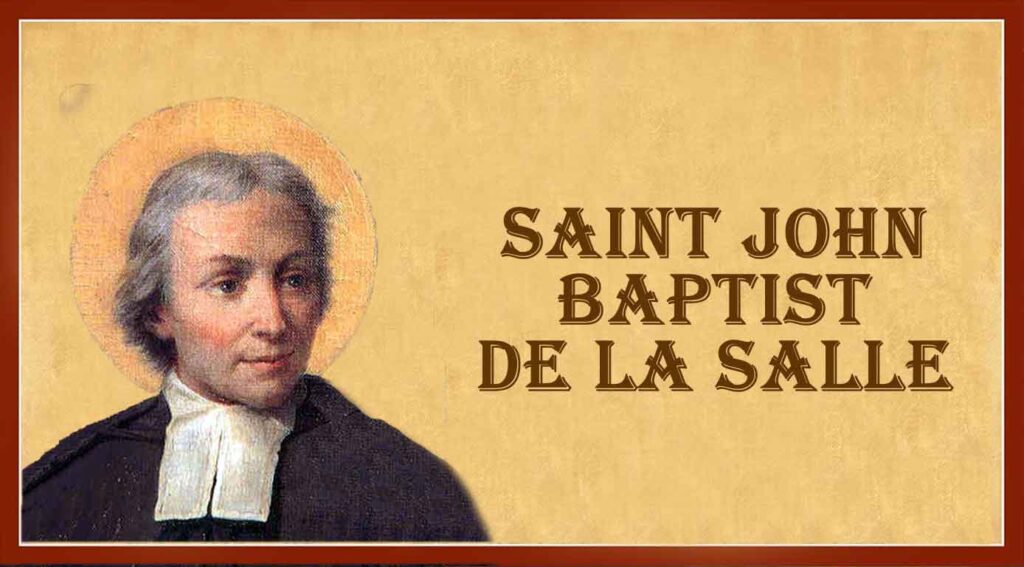
Saint John Baptist de La Salle

Complete dedication to what he saw as God’s will for him dominated the life of John Baptist de La Salle. In 1950, Pope Pius XII named him patron of schoolteachers for his efforts in upgrading school instruction. As a young 17th-century Frenchman, John had everything going for him: scholarly bent, good looks, noble family background, money, refined upbringing. At the early age of 11, he received the tonsure and started preparation for the priesthood, to which he was ordained at 27. He seemed assured then of a life of dignified ease and a high position in the Church.

But God had other plans for John, which were gradually revealed to him in the next several years. During a chance meeting with Monsieur Adrien Nyel, he became interested in the creation of schools for poor boys in Rheims, where he was stationed. Though the work was extremely distasteful to him at first, he became more involved in working with the deprived youths.

Once convinced that this was his divinely appointed mission, John threw himself wholeheartedly into the work, left home and family, abandoned his position as canon at Rheims, gave away his fortune, and reduced himself to the level of the poor to whom he devoted his entire life.

The remainder of his life was closely entwined with the community of religious men he founded, the Brothers of the Christian School (also called Christian Brothers or De La Salle Brothers). This community grew rapidly and was successful in educating boys of poor families, using methods designed by John. It prepared teachers in the first training college for teachers and also set up homes and schools for young delinquents of wealthy families. The motivating element in all these endeavors was the desire to become a good Christian.

Yet even in his success, John did not escape experiencing many trials: heart-rending disappointment and defections among his disciples, bitter opposition from the secular schoolmasters who resented his new and fruitful methods, and persistent opposition from the Jansenists of his time, whose moral rigidity and pessimism about the human condition John resisted vehemently all his life.

Afflicted with asthma and rheumatism in his last years, he died on Good Friday at age 68, and was canonized in 1900.

Sources:

https://www.franciscanmedia.org/saint-of-the-day/saint-john-baptist-de-la-salle/

Saint John Baptist de La Salle Read More »

2 Corinthians 12:9

Verse:

But he said to me, “My grace is sufficient for you, for my power is made perfect in weakness.” Therefore I will boast all the more gladly about my weaknesses, so that Christ’s power may rest on me.

Prayer to the Holy Spirit

Spirit of wisdom and understanding, enlighten our minds to perceive the mysteries of the universe in relation to eternity. Spirit of right judgment and courage, guide us and make us firm in our baptismal decision to follow Jesus' way of love. Spirit of knowledge and reverence, help us to see the lasting value of justice and mercy in our everyday dealings with one another. May we respect life as we work to solve problems of family and nation, economy and ecology. Spirit of God, spark our faith, hope and love into new action each day. Fill our lives with wonder and awe in your presence which penetrates all creation. Amen.

2 Corinthians 12:9 Read More »

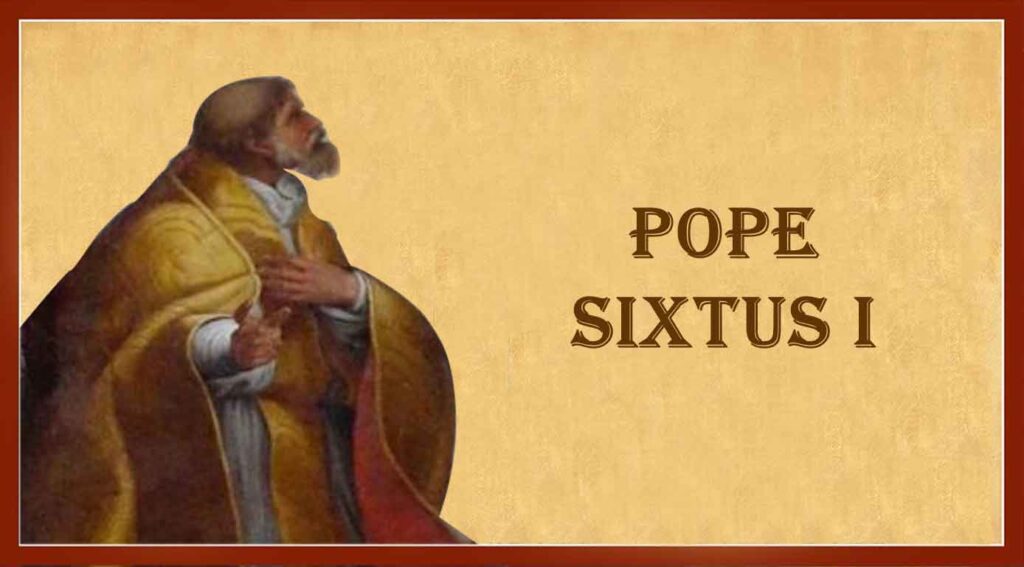
Pope Sixtus I

Pope Sixtus I was the bishop of Rome from c. 115 to his death. He succeeded Alexander I and was in turn succeeded by Telesphorus.

According to the Liberian Catalogue of popes, he served the Church during the reign of Hadrian “from the consulate of Niger and Apronianus until that of Verus III and Ambibulus”, that is, from 117 to 126.

Like most of his predecessors, Sixtus I was believed to have been buried near Peter’s grave on Vatican Hill, although there are differing traditions concerning where his body lies today.

Pope Sixtus I instituted several Catholic liturgical and administrative traditions. According to the Liber Pontificalis (ed. Duchesne, I.128), he passed the following three ordinances:

That none but sacred ministers are allowed to touch the sacred vessels;
That bishops who have been summoned to the Holy See shall, upon their return, not be received by their diocese except on presenting Apostolic letters;
That after the Preface in the Mass, the priest shall recite the Sanctus with the people

Sources:

https://en.wikipedia.org/wiki/Pope_Sixtus_I
George L. Williams (2004). Papal Genealogy: The Families and Descendants of the Popes. p. 9. ISBN 9780786420711.
"Pope St. Sixtus I". The Catholic Encyclopedia. Vol. 14. New York: Robert Appleton Company. 1912.

Pope Sixtus I Read More »

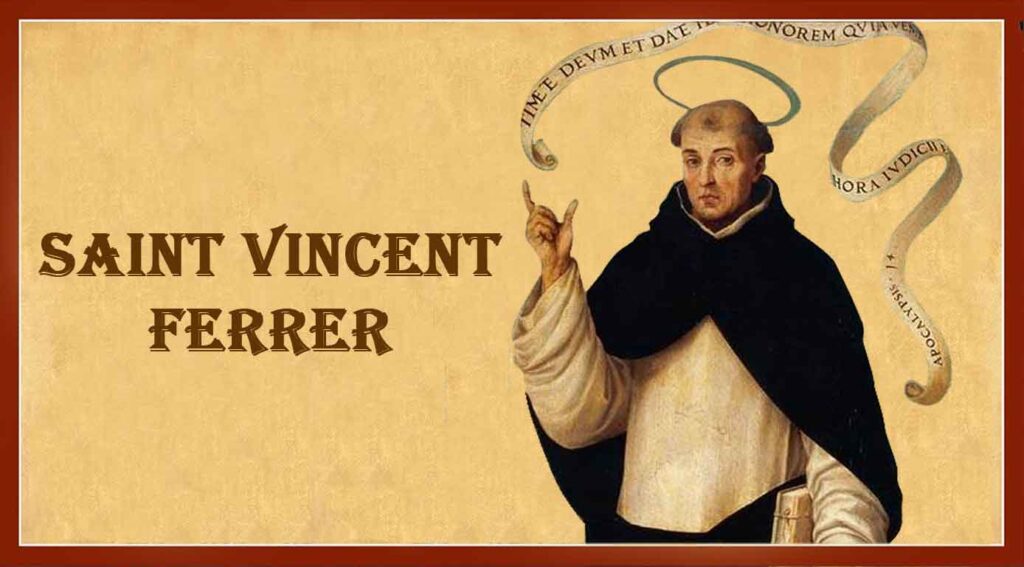
Saint Vincent Ferrer

Saint Vincent Ferrer was a Valencian Dominican friar and preacher, who gained acclaim as a missionary and a logician. He is honored as a saint of the Catholic Church and other churches of Catholic traditions.

Saint Vincent Ferrer began his classical studies at the age of eight, and his study of theology and philosophy at fourteen. Four years later, at the age of eighteen, Ferrer entered the Order of Preachers, commonly called the Dominican Order. As soon as he had entered the novitiate of the Order, though, he experienced temptations urging him to leave. He prayed and practiced penance to overcome these trials. Thus he succeeded in completing the year of probation and advancing to his profession.

For a period of three years, he read solely Sacred Scripture and eventually committed it to memory. He published a treatise on Dialectic Suppositions after his solemn profession, and in 1379 was ordained a Catholic priest at Barcelona. He eventually became a Master of Sacred Theology and was commissioned by the Order to deliver lectures on philosophy. He was then sent to Barcelona and eventually to the University of Lleida, where he earned his doctorate in theology.

He preached to Colette of Corbie and her nuns, and it was she who told him that he would die in France. Too ill to return to Spain, he did, indeed, die in Brittany in 1419. Breton fishermen still invoke his aid in storms, and in Spain he is the patron of orphanages.

Sources:

https://en.wikipedia.org/wiki/Vincent_Ferrer
"Archdiocesan Shrine & Parish of St. Vincent Ferrer". www.facebook.com
"Sant Vicent Ferrer, patró de l'antic Regne de València", by Àngel Canet Català, Vilaweb, 31 March 2008, reprinted in Normalització, (in Catalan). The author of this article references El gran llibre dels sants, by Roger Costa Solé, Ara Llibres, Barcelona, 2007, as his source. Consulted 2016-12-18.
Dress, Clayton J. The Late Medieval Age of Crisis and Renewal, 1300–1500: A Biographical Dictionary. Greenwood Press, 2001. ISBN 0-313-30588-9. (p. 490)

Saint Vincent Ferrer Read More »

Habakkuk 3:19

Verse:

 “The Sovereign Lord is my strength; he makes my feet like the feet of a deer, he enables me to tread on the heights.” - Habakkuk 3:19

Prayer for Strength and Healing

Great Healer and Physician, I ask for strength during the healing process in which I am undergoing. Although I know you are the Great Healer, these times are never easy to partake in. Remind me of all the times you have healed my hurting in the past and give me strength to endure now. Amen.

Habakkuk 3:19 Read More »

Matthew 6:6

Verse:

“But when you pray, go into your room, close the door and pray to your Father, who is unseen. Then your Father, who sees what is done in secret, will reward you.” - Matthew 6:6

A Prayer for Peace

Almighty God, from whom all thoughts of truth and peace proceed, kindle in the hearts of all men the true love of peace, and guide with Your pure and peaceable wisdom those who make decisions for the nations of the earth; that in tranquility Your kingdom may go forward, till the earth be filled with the knowledge of Your love; through Jesus Christ our Lord.
Amen.

Matthew 6:6 Read More »

Saint Isidore of Seville

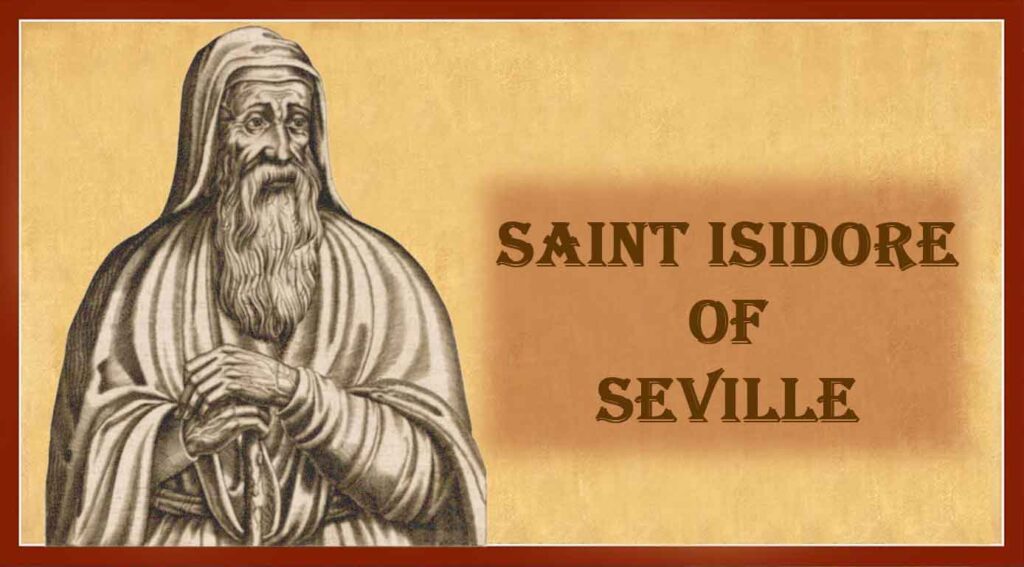
The 76 years of Isidore’s life were a time of conflict and growth for the Church in Spain. The Visigoths had invaded the land a century and a half earlier, and shortly before Isidore’s birth they set up their own capital. They were Arians—Christians who said Christ was not God. Thus, Spain was split in two: One people (Catholic Romans) struggled with another (Arian Goths).

Isidore reunited Spain, making it a center of culture and learning. The country served as a teacher and guide for other European countries whose culture was also threatened by barbarian invaders.

Born in Cartagena of a family that included three other sibling saints—Leander, Fulgentius and Florentina—he was educated by his elder brother, whom he succeeded as bishop of Seville.

An amazingly learned man, he was sometimes called “The Schoolmaster of the Middle Ages” because the encyclopedia he wrote was used as a textbook for nine centuries. He required seminaries to be built in every diocese, wrote a Rule for religious orders, and founded schools that taught every branch of learning. Isidore wrote numerous books, including a dictionary, an encyclopedia, a history of Goths, and a history of the world—beginning with creation! He completed the Mozarabic liturgy, which is still in use in Toledo, Spain. For all these reasons, Isidore has been suggested as patron of the Internet. Several others—including Anthony of Padua—also have been suggested.

He continued his austerities even as he approached age 80. During the last six months of his life, he increased his charities so much that his house was crowded from morning till night with the poor of the countryside.

Sources:

https://www.franciscanmedia.org/saint-of-the-day/saint-isidore-of-seville/

Saint Isidore of Seville Read More »