“Dear children, keep yourselves from idols.” - 1 John 5:21
O God, bountiful in forgiving,
and lovingly desirous of man's salvation,
we humbly beseech Thy mercy in behalf of our friends,
relations and benefactors,
who have passed from this world, that,
through the intercession of Blessed Mary ever Virgin
and all the Saints,
Thou wouldst permit them to come
to the full participation of everlasting happiness.
Through the same Jesus Christ our Lord.
Amen.
https://www.catholic.org/prayers/prayer.php?p=757
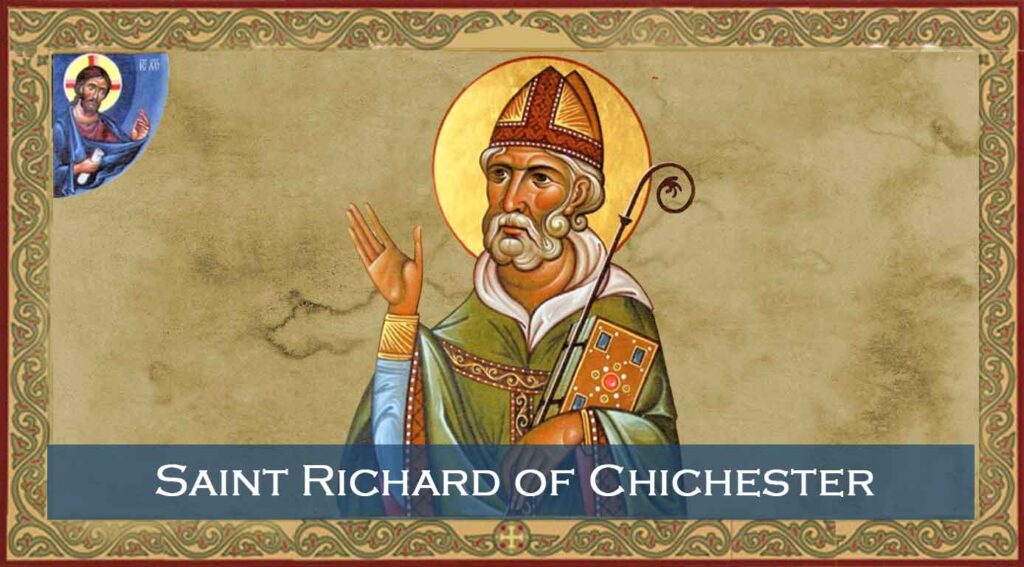
Saint Richard of Chichester, born in Burford, near the town of Wyche, was also known as Richard de Wych. He was an orphan member of a gentry family. According to biographers, friends tried to arrange a match with a certain noble lady for Saint Richard. However, Saint Richard rejected the proposed match, suggesting that his brother might marry her instead; he also reconveyed the estates back to his brother, preferring a life of study and the church.
Educated at the University of Oxford, Richard soon began to teach in the university. From there he proceeded to Paris and then Bologna, where he distinguished himself by his proficiency in canon law. On returning to England in 1235, Richard was elected Oxford’s chancellor.
His former tutor, Edmund of Abingdon, had become archbishop of Canterbury. In 1237, Archbishop Edmund appointed Richard chancellor of the diocese of Canterbury. Saint Richard joined the archbishop during his exile at Pontigny, and was with him when the archbishop died circa 1240. He then decided to become a priest and studied theology for two years with the Dominicans at Orléans. Upon returning to England, Richard became the parish priest at Charing and at Deal, but soon was reappointed chancellor of Canterbury by the new archbishop Boniface of Savoy.
In 1244 Richard was elected Bishop of Chichester. Henry III and part of the chapter refused to accept him, the king favouring the candidature of Robert Passelewe. But Innocent IV confirmed Richard’s election and consecrated him bishop at Lyons in March 1245.
Saint Richard’s private life was supposed to have displayed rigid frugality and temperance. He kept his diet simple and rigorously excluded animal flesh; having been a vegetarian since his days at Oxford. He was also merciless to usurers, corrupt clergy and priests who mumbled the Mass. He was also a stickler for clerical privilege.
After dedicating St Edmund’s Chapel at Dover, he died aged 56 at the Maison Dieu, Dover. Saint Richard of Chichester is the patron saint of Sussex in southern England.
https://en.wikipedia.org/wiki/Richard_of_Chichester
Greenway. Fasti Ecclesiae Anglicanae 1066-1300: volume 5: pp. 1-6.
Lower. The Worthies of Sussex. p. 242
Saint Richard of Chichester Read More »
When Jesus and the disciples drew near Jerusalem
and came to Bethphage on the Mount of Olives,
Jesus sent two disciples, saying to them,
"Go into the village opposite you,
and immediately you will find an ass tethered,
and a colt with her.
Untie them and bring them here to me.
And if anyone should say anything to you, reply,
'The master has need of them.'
Then he will send them at once."
This happened so that what had been spoken through the prophet
might be fulfilled:
Say to daughter Zion,
"Behold, your king comes to you,
meek and riding on an ass,
and on a colt, the foal of a beast of burden."
The disciples went and did as Jesus had ordered them.
They brought the ass and the colt and laid their cloaks over them,
and he sat upon them.
The very large crowd spread their cloaks on the road,
while others cut branches from the trees
and strewed them on the road.
The crowds preceding him and those following
kept crying out and saying:
"Hosanna to the Son of David;
blessed is he who comes in the name of the Lord;
hosanna in the highest."
And when he entered Jerusalem
the whole city was shaken and asked, "Who is this?"
And the crowds replied,
"This is Jesus the prophet, from Nazareth in Galilee."
The Lord GOD has given me
a well-trained tongue,
that I might know how to speak to the weary
a word that will rouse them.
Morning after morning
he opens my ear that I may hear;
and I have not rebelled,
have not turned back.
I gave my back to those who beat me,
my cheeks to those who plucked my beard;
my face I did not shield
from buffets and spitting.
The Lord GOD is my help,
therefore I am not disgraced;
I have set my face like flint,
knowing that I shall not be put to shame.
Response– My God, my God, why have you abandoned me?
All who see me scoff at me;
they mock me with parted lips, they wag their heads:
“He relied on the LORD; let him deliver him,
let him rescue him, if he loves him.”
R– My God, my God, why have you abandoned me?
Indeed, many dogs surround me,
a pack of evildoers closes in upon me;
They have pierced my hands and my feet;
I can count all my bones.
R– My God, my God, why have you abandoned me?
They divide my garments among them,
and for my vesture they cast lots.
But you, O LORD, be not far from me;
O my help, hasten to aid me.
R– My God, my God, why have you abandoned me?
I will proclaim your name to my brethren;
in the midst of the assembly I will praise you:
“You who fear the LORD, praise him;
all you descendants of Jacob, give glory to him;
revere him, all you descendants of Israel!”
R– My God, my God, why have you abandoned me?
Christ Jesus, though he was in the form of God,
did not regard equality with God
something to be grasped.
Rather, he emptied himself,
taking the form of a slave,
coming in human likeness;
and found human in appearance,
he humbled himself,
becoming obedient to the point of death,
even death on a cross.
Because of this, God greatly exalted him
and bestowed on him the name
which is above every name,
that at the name of Jesus
every knee should bend,
of those in heaven and on earth and under the earth,
and every tongue confess that
Jesus Christ is Lord,
to the glory of God the Father.
Verse Before the Gospel: Phil 2:8-9
Christ became obedient to the point of death,
even death on a cross.
Because of this, God greatly exalted him
and bestowed on him the name which is above every name.
Christ Jesus, though he was in the form of God,
did not regard equality with God
something to be grasped.
Rather, he emptied himself,
taking the form of a slave,
coming in human likeness;
and found human in appearance,
he humbled himself,
becoming obedient to the point of death,
even death on a cross.
Because of this, God greatly exalted him
and bestowed on him the name
which is above every name,
that at the name of Jesus
every knee should bend,
of those in heaven and on earth and under the earth,
and every tongue confess that
Jesus Christ is Lord,
to the glory of God the Father.
Verse Before the Gospel: Phil 2:8-9
Christ became obedient to the point of death,
even death on a cross.
Because of this, God greatly exalted him
and bestowed on him the name which is above every name.
At the Procession with Psalms – Gospel Read More »
“May the favor of the Lord our God rest on us; establish the work of our hands for us— yes, establish the work of our hands.” - Psalm 90:17
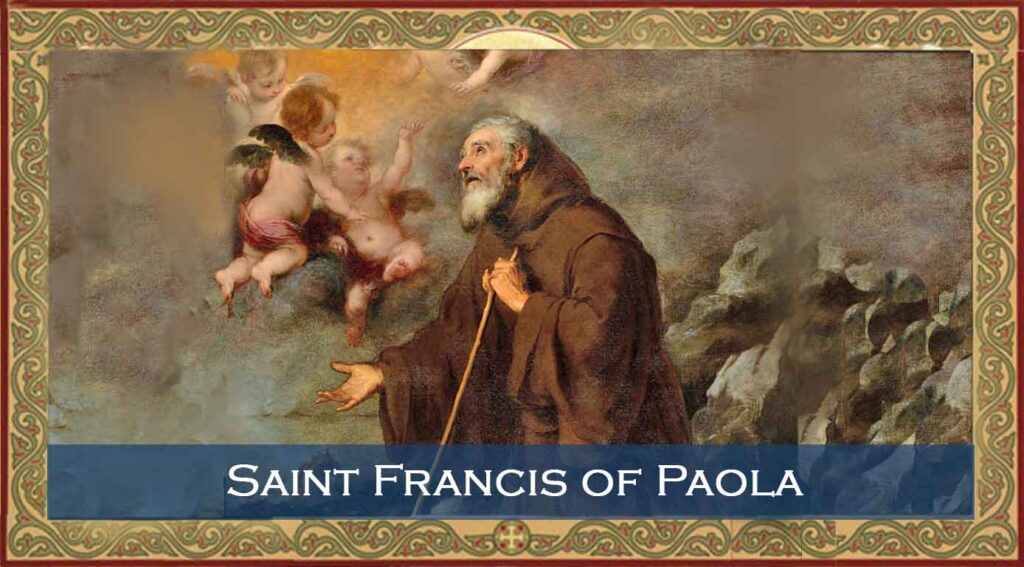
Saint Francis of Paola was an Italian mendicant friar and the founder of the Roman Catholic Order of Minims. He was born in the town of Paola, which lies in the southern Italian Province of Cosenza, Calabria.
In his youth he was educated by the Franciscan friars in Paola. At the age of 13, being admonished by a vision of a Franciscan friar, he entered a friary of the Franciscan Order to fulfill the vow made by his parents.
At the completion of the year he went with his parents on a pilgrimage to Assisi, Rome, and other places of devotion. Returning to Paola, he selected a secluded cave on his father’s estate and there lived in solitude; but later on he found an even-more secluded cave on the sea coast. Here he remained alone for about six years, giving himself to prayer and mortification.
By 1436, he and two followers began a movement that would become the foundation of the Hermits of Saint Francis of Assisi, which would later be renamed as the Minim friars. Their name refers to their role as the “least of all the faithful”. Humility was to be the hallmark of the brothers as it had been in Francis’ personal life. The rule of life adopted by Francis and his religious was one of extraordinary severity. He felt that heroic mortification was necessary as a means for spiritual growth. They were to seek to live unknown and hidden from the world.
The number of his disciples gradually increased, and about 1454, with the permission of Pyrrhus, Archbishop of Cosenza, Francis built a large monastery and church. In 1474 Pope Sixtus IV gave him permission to write a rule for his community, and to assume the title of Hermits of St. Francis.
Saint Francis of Paola established monasteries of nuns, and a third order for people living in the world, after the example of Francis of Assisi. He was no respecter of persons based solely on their worldly rank or position. He rebuked the King of Naples for his ill-doing and in consequence suffered persecution.
https://en.wikipedia.org/wiki/Francis_of_Paola
"CATHOLIC ENCYCLOPEDIA: St. Francis of Paula". www.newadvent.org.
"St. Francis of Paola". Catholic News Agency.
Saint Francis of Paola Read More »
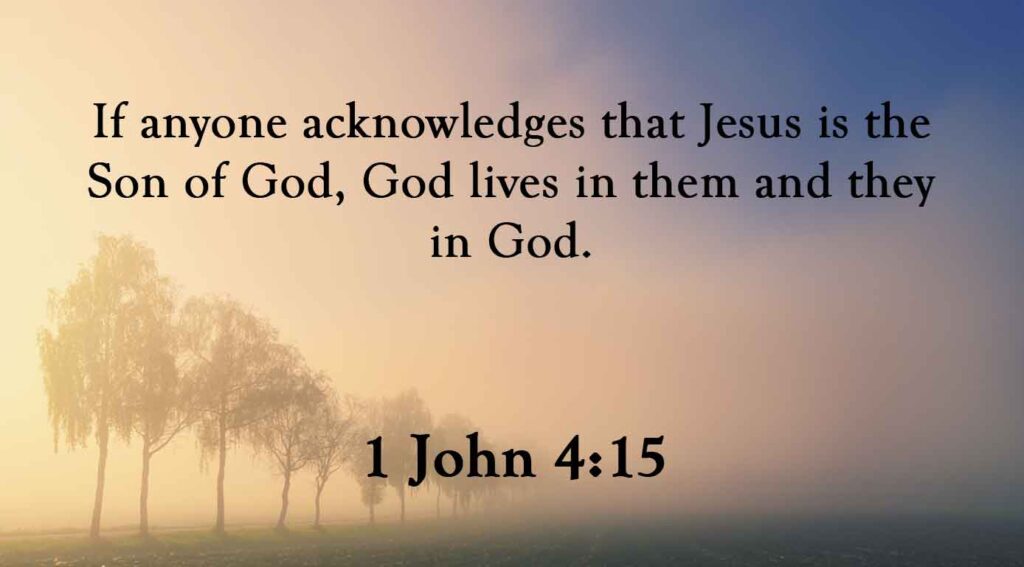
“If anyone acknowledges that Jesus is the Son of God, God lives in them and they in God.” - 1 John 4:15
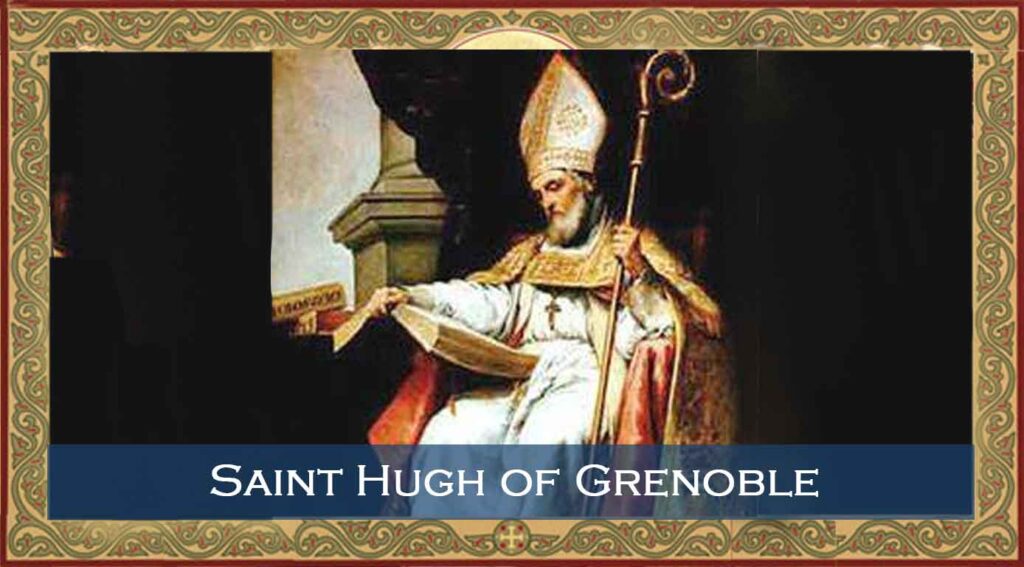
Saint Hugh of Grenoble, also called as Hugh of Châteauneuf, was born at Châteauneuf-sur-Isère, County of Albon. Even at a young age, he already showed piety and theological facility.
While still a layman, Saint Hugh of Grenoble was made a canon of Valence. In 1080, he was elected bishop of Grenoble, though he was not yet ordained. The See of Grenoble had fallen into a very poor state and Saint Hugh was selected to be its Gregorian renovator. Upon his return, he immediately set to the task of reforming the abuses in his new diocese. When he had succeeded in countering abuse and fostering devotion after two years, he tried to resign his bishopric and enter the Benedictine monastery at Cluny. However, the Pope ordered him to continue his episcopal work.
Saint Hugh was also instrumental in the foundation of the Carthusian Order. He received Bruno of Cologne, perhaps his own teacher, and six of his companions in 1084, after seeing them under a banner of seven stars in a dream. Saint Hugh installed the seven in a snowy and rocky Alpine location called Chartreuse. They founded a monastery and devoted their lives to prayer and study, being oft visited by Hugh, who was reported to have adopted much of their way of life. He also founded the nearby Monastère de Chalais, which grew into an independent order.
https://en.wikipedia.org/wiki/Hugh_of_Ch%C3%A2teauneuf
Herbermann, Charles, ed. (1913). Catholic Encyclopedia. Robert Appleton Company.
"Histoire de l'Ordre de Chalais". Fédération des abbayes chalaisiennes. Archived from the original on 2014-05-12.
Saint Hugh of Grenoble Read More »
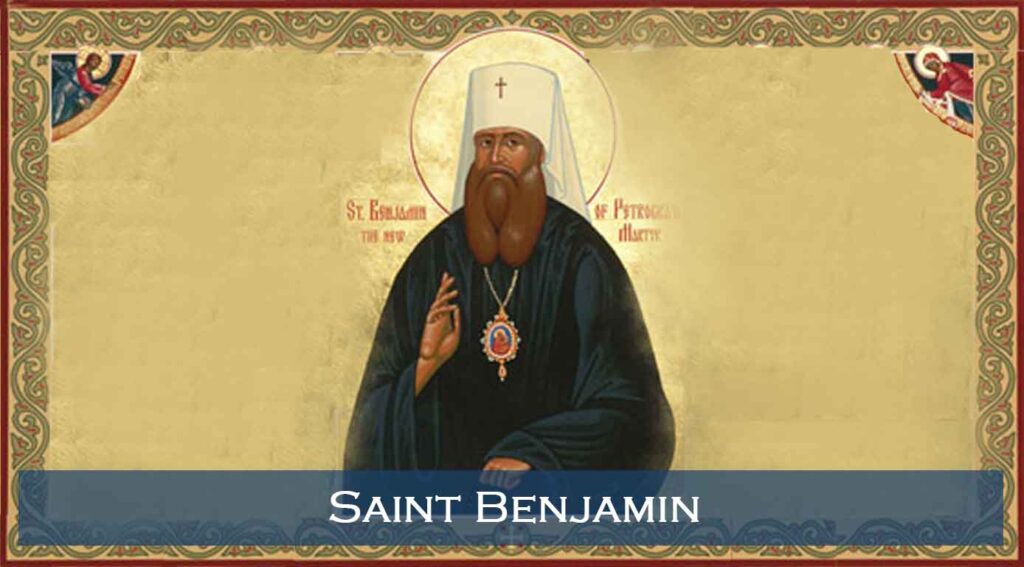
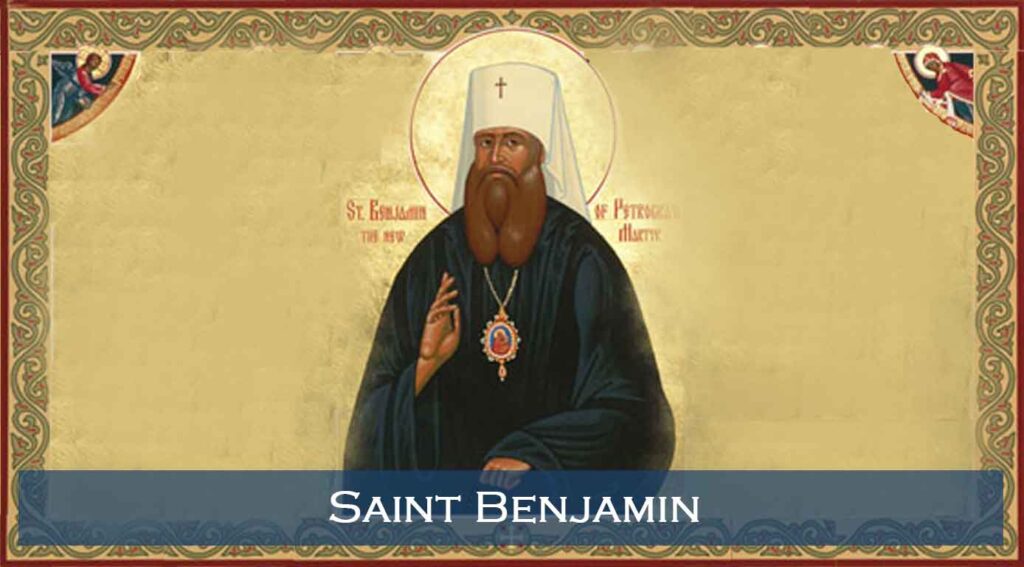
Saint Benjamin was a deacon martyred circa 424 in Persia. He was imprisoned for a year for his Christian faith, and later released with the condition that he abandon preaching or speaking of his religion. His release was obtained by the Eastern Roman Emperor Theodosius II through an ambassador. However, Saint Benjamin declared that it was his duty to preach about Christ and that he could not be silent. As a consequence, Benjamin was tortured mercilessly until his death in the year 424, specifically, “sharpened reeds [were] stuck under the nails of his fingers and toes.”
According to his hagiography, when the king was apprised that Saint Benjamin refused to stop preaching, he “… caused reeds to be run in between the nails and the flesh, both of his hands and feet, and to be thrust into other most tender parts, and drawn out again, and this to be frequently repeated with violence. Lastly, a knotty stake was thrust into his bowels, to rend and tear them, in which torment he expired….”
Saint Benjamin was executed during a period of persecution of Christians that lasted forty years and through the reign of two Persian kings: Isdegerd I, who died in 421, and his son and successor, Varanes V. King Varanes carried on the persecution with such great fury that Christians were submitted to the most cruel tortures.
https://en.wikipedia.org/wiki/Benjamin_the_Deacon_and_Martyr
Shea, John Dawson Gilmary. “Saint Benjamin, Deacon, Martyr”. Pictorial Lives of the Saints, 1889. CatholicSaints.Info. 6 February 2014
nto his urethra, by this account: Collin (1738), p.57, the stake finally thrust up his anus was studded with sharp nails according to the same source, * Collin, Johann E. (1738). Der Kampff und Sieg der ersten Blut-Zeugen Jesu Christi: durch Glauben und Gedult, nach alphabetischer Ordnung entworffen, und in Kupffern vorgestellet. Frankfurt and Leipzig.
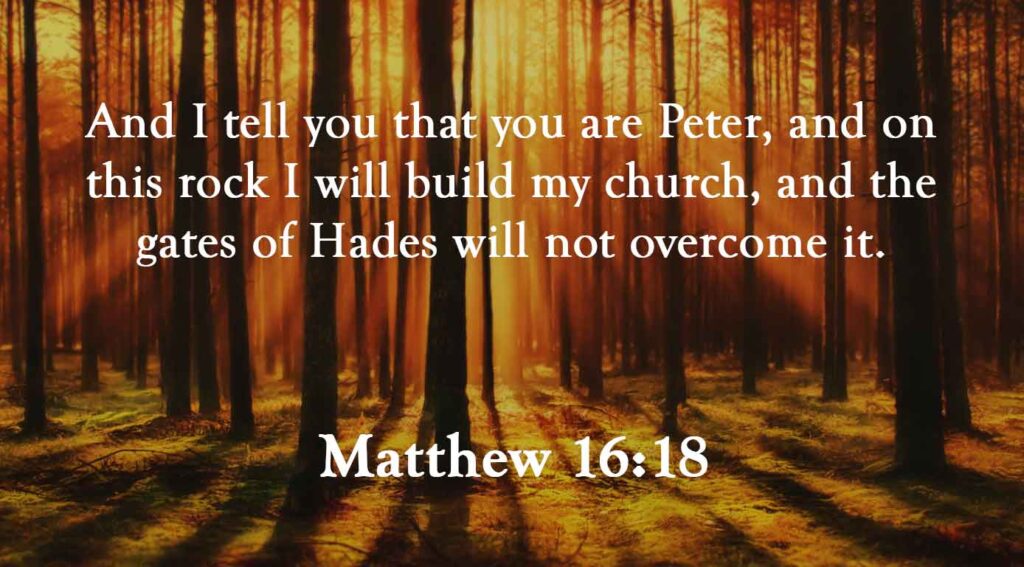
And I tell you that you are Peter, and on this rock I will build my church, and the gates of Hades will not overcome it.
Add San Jose Filipino Ministry as a new recipient, Send your donation using"donate@dosjfm.org"
Payable to - San Jose Filipino Ministry
Address - Poong Jesus Nazareno Filipino Catholic Center (PJNFCC); 3700 W. Orange Ave., Anaheim CA 92804
Poong Jesus Nazareno Filipino Catholic Center (PJNFCC); 3700 W. Orange Ave., Anaheim CA 92804
Phone: (657) 214-2507
Mobile (657) 208-2038
info@dosjfm.org

Poong Jesus Nazareno Filipino Catholic Center (PJNFCC); 3700 W. Orange Ave., Anaheim CA 92804
Phone: (657) 214-2507
Mobile (657) 208-2038
info@dosjfm.org
Add San Jose Filipino Ministry as a new recipient, Send your donation using"donate@dosjfm.org"
Payable to - San Jose Filipino Ministry
Address - 1235 S Magnolia Ave
Anaheim, CA 92804-5115
San Jose Filipino Ministry. All rights reserved. 2021 © Powered by Phoenix Virtual Solutions
Sponsored by EverClear Hospice and Palliative Care