Author name: Sani

Sixteenth Sunday in Ordinary Time

First Reading Genesis 18:1-10a

The LORD appeared to Abraham by the terebinth of Mamre,
as he sat in the entrance of his tent,
while the day was growing hot.
Looking up, Abraham saw three men standing nearby.
When he saw them, he ran from the entrance of the tent to greet them;
and bowing to the ground, he said:
“Sir, if I may ask you this favor,
please do not go on past your servant.
Let some water be brought, that you may bathe your feet,
and then rest yourselves under the tree.
Now that you have come this close to your servant,
let me bring you a little food, that you may refresh yourselves;
and afterward you may go on your way.”
The men replied, “Very well, do as you have said.”

Abraham hastened into the tent and told Sarah,
“Quick, three measures of fine flour! Knead it and make rolls.”
He ran to the herd, picked out a tender, choice steer,
and gave it to a servant, who quickly prepared it.
Then Abraham got some curds and milk,
as well as the steer that had been prepared,
and set these before the three men;
and he waited on them under the tree while they ate.

They asked Abraham, “Where is your wife Sarah?”
He replied, “There in the tent.”
One of them said, “I will surely return to you about this time next year,
and Sarah will then have a son.

Responsorial Psalm Psalms 15:2-3, 3-4, 5

R.(1a) He who does justice will live in the presence of the Lord.
One who walks blamelessly and does justice;
who thinks the truth in his heart
and slanders not with his tongue.
R. He who does justice will live in the presence of the Lord.
Who harms not his fellow man,
nor takes up a reproach against his neighbor;
by whom the reprobate is despised,
while he honors those who fear the LORD.
R. He who does justice will live in the presence of the Lord.
Who lends not his money at usury
and accepts no bribe against the innocent.
One who does these things
shall never be disturbed.
R. He who does justice will live in the presence of the Lord.

Second Reading Colossians 1:24-28

Brothers and sisters:
Now I rejoice in my sufferings for your sake,
and in my flesh I am filling up
what is lacking in the afflictions of Christ
on behalf of his body, which is the church,
of which I am a minister
in accordance with God’s stewardship given to me
to bring to completion for you the word of God,
the mystery hidden from ages and from generations past.
But now it has been manifested to his holy ones,
to whom God chose to make known the riches of the glory
of this mystery among the Gentiles;
it is Christ in you, the hope for glory.
It is he whom we proclaim,
admonishing everyone and teaching everyone with all wisdom,
that we may present everyone perfect in Christ.

Alleluia Cf. Luke 8:15

R. Alleluia, alleluia.
Blessed are they who have kept the word with a generous heart
and yield a harvest through perseverance.
R. Alleluia, alleluia.

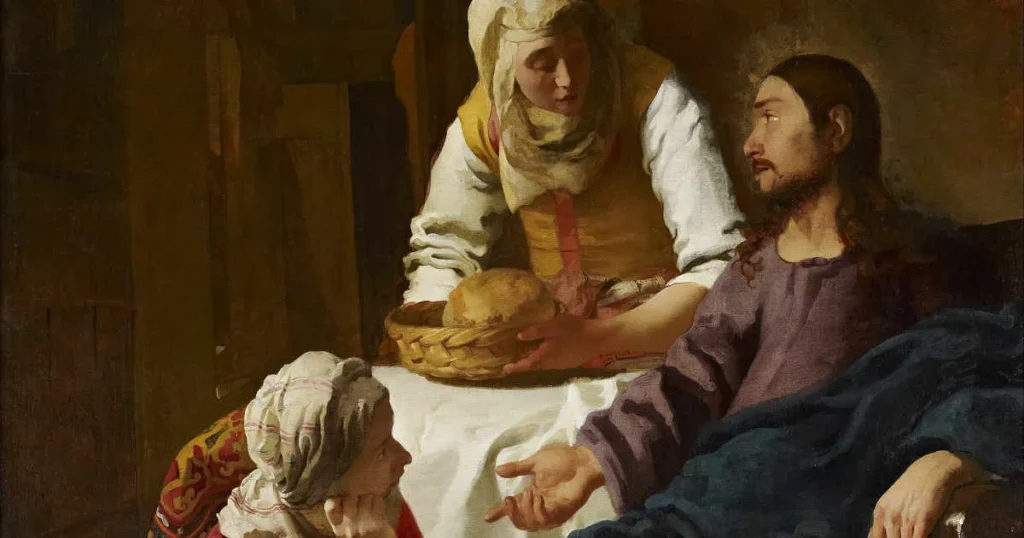
Gospel Luke 10:38-42

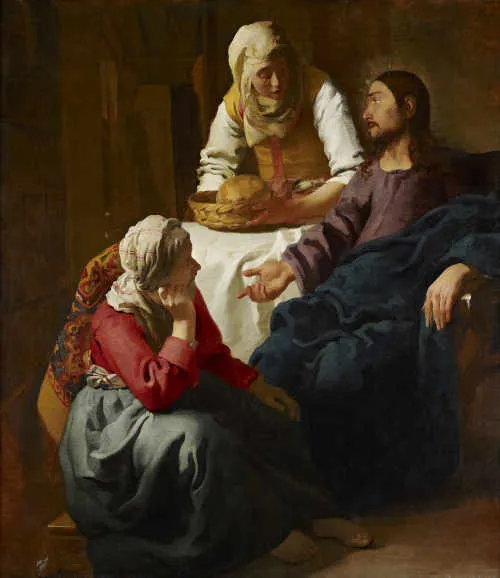
Jesus entered a village
where a woman whose name was Martha welcomed him.
She had a sister named Mary
who sat beside the Lord at his feet listening to him speak.
Martha, burdened with much serving, came to him and said,
“Lord, do you not care
that my sister has left me by myself to do the serving?
Tell her to help me.”
The Lord said to her in reply,
“Martha, Martha, you are anxious and worried about many things.
There is need of only one thing.
Mary has chosen the better part
and it will not be taken from her.”

Source: https://bible.usccb.org/bible/readings/072025.cfm

Sixteenth Sunday in Ordinary Time Read More »
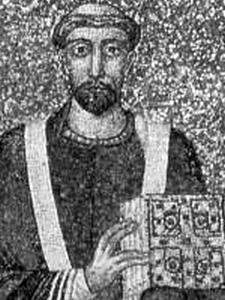
Saint Apollinaris, Bishop and Martyr

First Century–c. 79 (Or possibly died late Second Century); Patron Saint of Ravenna and Emilia-Romagna, Italy; Invoked against gout, venereal disease, and epilepsy; Pre-Congregation canonization

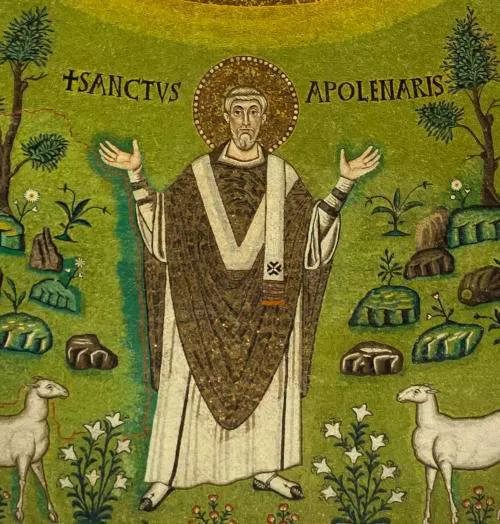
On May 9, 549, Bishop Maximian of Ravenna, located in modern-day Italy, dedicated a church to Saint Apollinaris. This church, one of the few Italian churches with a treasure of Byzantine art, still stands. Its greatest treasure, however, is the remains of the saint himself. Though little is certain about his life, he has been honored for centuries as the first bishop of Ravenna, and many have sought his intercession.

According to one tradition, Apollinaris was born in Antioch, in modern-day Turkey. Saints Paul and Barnabas preached in Antioch (Acts 11:26), and it was there that followers of Christ were first referred to as Christians. The Apostolic Constitutions, a document from the late fourth century, also notes that Saint Peter preached in Antioch and served as the town’s first bishop before becoming the first bishop of Rome. It’s possible that while in Antioch, Apollinaris was converted to the faith by Saint Peter, or even earlier by Jesus Himself, being one of the seventy-two sent out on mission by Jesus. Regardless, tradition states that Saint Peter ordained Apollinaris as a bishop and sent him to Ravenna to serve as that city’s first bishop.

In Ravenna, Bishop Apollinaris preached the Good News, attracting many converts. Like many early disciples, he was also a miracle worker. At that time, Ravenna was an important port city for the Roman Empire, replete with buildings, roads, aqueducts, bathhouses, and marketplaces. The predominant religion was that of the Roman Empire, honoring various pagan gods and goddesses with temples and rituals. Therefore, when Bishop Apollinaris arrived in Ravenna and began to preach the Gospel of Jesus Christ, many perceived Christianity as a direct threat to their way of life and beliefs. Citizens who opposed him beat him and drove him out of the city. Tradition holds that he was found close to death on the seashore, where fellow Christians rescued and hid him.

Despite this persecution and determined to complete his mission, Bishop Apollinaris returned to Ravenna. This time, he was captured, forced to walk on burning coals, and expelled from the city once again. He then traveled about sixty miles to the west to the town of modern-day Emilia-Romagna, where he continued his mission and won over many converts.

Undeterred from converting the people of Ravenna, Bishop Apollinaris returned for a third time, only to face great resistance again. This time, it is said that he was cut with knives and had scalding water poured on his wounds. After his persistent preaching of the Gospel, his abusers silenced him by beating his mouth with rocks. After several days chained in a dungeon, he was not only ejected from the city again but also placed on a ship to Greece, effectively ridding the citizens of Ravenna of him.

In Greece, Bishop Apollinaris continued his ministry of preaching and performing miracles. However, after winning over many converts, the local pagan priests complained that his presence was disrupting their communication with the gods and goddesses through their oracle. As a result, Bishop Apollinaris was placed on a ship and returned to Ravenna.

By the time Bishop Apollinaris returned to Ravenna, Vespasian was the Roman Emperor. While Emperor Vespasian did not engage in an empire-wide persecution of Christians, he was aware of the complaints against them. Legend has it that to address these new “pagans,” who were called Christians, Vespasian ordered the exile of certain Christians, including Bishop Apollinaris. After being dragged out of the city a fourth time, Apollinaris was beaten in Classis, just south of Ravenna, and again left for dead. Whether he died as a result of this final beating is unknown, but he is nonetheless honored as a martyr on the Church’s liturgical calendar. Saint Apollinaris is believed to have served as the first Bishop of Ravenna for twenty to twenty-six years. Other historical evidence from the seventh century suggests that he may have actually lived a century later, dying during the persecution of Emperor Septimius Severus in the late second century.

Though reliable data falls short in determining the historical accuracy of the legends attributed to Saint Apollinaris, the fact of his veneration has been well known at least since the sixth century, when the aforementioned Basilica in Ravenna was first dedicated. Popes in the sixth and seventh centuries encouraged his veneration. Other churches were built in his honor in Rome, Bologna, France, and Germany. Today, his intercession is still sought, and his relics are revered in the Basilica of Sant’Apollinare Nuovo, Ravenna.

As we honor this early bishop of the Church, consider the fact that his work of sharing the Gospel continues to have an effect upon many people. First, the converts he made helped spread the Gospel in the early Church, and the Church is what it is today because of such heroic saints. Second, his witness to the Gospel continues to inspire many who hear his story and become inspired by his life. As you seek his intercession today, commit to following his example. When you face opposition to the Gospel or hostility from the modern secular world towards your faith, stand strong and strive to remain strong in the faith, bearing witness in every way you are called.

Source: https://mycatholic.life/saints/saints-of-the-liturgical-year/july-20—saint-apollinaris-bishop-and-martyr/

Saint Apollinaris, Bishop and Martyr Read More »

Luke 10:38-39

Serving with Generosity

Jesus entered a village where a woman whose name was Martha welcomed him. She had a sister named Mary who sat beside the Lord at his feet listening to him speak.

Reflection:

It’s interesting that it was Martha who welcomed Jesus, but it was Mary who sat at His feet listening to Him. As the story goes on, we discover that Martha took her responsibility of hospitality seriously; she was very busy preparing a meal. But it appears that Mary needed a different form of hospitality from our Lord Himself. As Martha prepared to feed Jesus so as to care for His physical hunger, Mary sought to be fed by our Lord so as to feed her spiritual hunger. And interestingly, it was the generosity of Martha who was diligent in preparing the meal that made it possible for her sister to receive the spiritual food she longed for.

When we read this story, we can easily become critical of Martha because she complained to Jesus about her sister. It is easy to see Martha’s frustration in her words, “Lord, do you not care that my sister has left me by myself to do the serving? Tell her to help me.” And though Martha may have been a little impatient, Jesus’ response to her was gentle and corrective. “Martha, Martha, you are anxious and worried about many things. There is need of only one thing. Mary has chosen the better part and it will not be taken from her.” What was that “better part?” It was Mary’s prayerful attentiveness to Jesus. She was hungry for His teaching, and Jesus offered it to her in a very personal and loving way. And though this image of Mary before Jesus is a beautiful image to ponder and to use as a model of our own prayer, there is also something important to be said about Martha’s role in making Mary’s prayer possible.

Because Martha was diligent in taking care of the duties of hospitality, Mary felt the freedom to sit at Jesus’ feet. Perhaps the ideal response from Martha would have been to notice that Mary was being spiritually fed by our Lord and to rejoice in that fact, giving her the continued freedom to sit at Jesus’ feet. If Martha would have realized this, then she would have continued working in the background so that her sister could continue listening to Jesus. But even though Martha did interrupt this sacred moment for her sister, the fact remains that her initial diligence in taking care of preparing the meal did give Mary some time alone with Jesus.

In a similar way, we will all be given various opportunities in life to take care of the daily mundane tasks that are needed within a family or community. It is easy to fall into the trap of thinking that unless everyone does their equal part, then things are not fair. But being “fair” should not be our focus. True charity, especially within the family, means that, first and foremost, we look for opportunities to better the lives of those around us. For example, spending extra time cleaning a home so that others can enjoy it more adds much to family life. Or spending hours preparing a nice meal for family or friends may afford everyone the opportunity of time well spent together. These are only a couple of the countless ways that our diligence and generosity toward others is fruitful, especially within family life.

Reflect, today, upon these two women and the unique calling they each were given at the time of Jesus’ visit to their house. One was called to be fed by our Lord as she sat at His feet. The other was called to work hard so as to make it easier for her sister to receive that spiritual nourishment. Know that both of these callings are important. For that reason, if God calls you to be more like Martha at times, rejoice in that fact and work hard at serving in many ways. If God calls you to be more like Mary at times, then rejoice in those moments and sit prayerfully at the feet of our Lord, being fed by His holy Words.

Source: https://catholic-daily-reflections.com/2025/07/19/serving-with-generosity/

Luke 10:38-39 Read More »

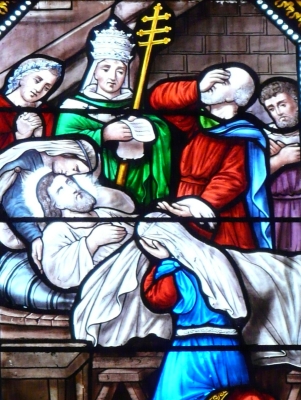
Pope Saint Symmachus

Profile

Symmachus was the son of Fortunatus. He was baptized in Rome, Italy. He was the Archdeacon under Pope Anastasius II. He chosen 51st pope in 498.

An anti-pope, Laurentius, was elected the same day by a minority with Byzantine sympathies and with the support of Emperor Anastasius; King Theodoric the Great supported Symmachus who ascended to the throne. Any sort of campaigning for the papacy during the life of a sitting pope was outlawed by canon law. In 501, Senator Festus, a supporter of Laurentius, accused Symmachus of assorted crimes; the pope refused to answer the charges, claimed that secular rulers had no jurisdiction over a pope, and the Synodus Palmaris of 23 October 502 confirmed this decision. The schism with Laurentius continued for years, and at one point Theodoric installed the anti-pope in the Lateran Palace and proclaimed him the legal pontiff; Theodoric later decided that Laurentius was too Byzantine, and had him removed.

During all the turmoil, Symmachus spent largely to support bishops of Africa who were persecuted by the Arian Vandals. He also gave aid to northern Italians who suffered from the invasions of barbarians.

Born

  • in Sardinia, Kingdom of Odoacer (part of modern Italy)

Papal Ascension

  • 22 November 498

Died

  • 19 July 514 in Rome, Ostrogothic Kingdom (in modern Italy) of natural causes

Canonized

  • Pre-Congregation

Source: https://catholicsaints.info/pope-saint-symmachus/

Pope Saint Symmachus Read More »

Matthew 12:14-16

A Different Kind of Messiah

The Pharisees went out and took counsel against Jesus to put him to death. When Jesus realized this, he withdrew from that place. Many people followed him, and he cured them all, but he warned them not to make him known.

Reflection:

This passage goes on to say that Jesus withdrew to a more deserted place to fulfill the prophecy of Isaiah the Prophet (Isaiah 42:1–4). That prophecy is the first of what is referred to as “The Songs of the Suffering Servant.” In these songs or poems of Isaiah, the Messiah is presented to us as one who would be sent on a mission from God, would suffer injustice for the sake of others, would be rejected, and ultimately be vindicated and exalted. The mission of the Suffering Servant was to bring justice and salvation to all, including to the Gentiles.

At that time, the idea of a messianic king was still prominent in the minds of many. They anticipated the coming of a messiah who would be a political leader and would lead the people of Israel out of oppression, making them a free, prosperous and powerful nation. But Jesus acts in the opposite manner. Instead of raising up an army to combat the evil intentions of the Pharisees and to overthrow the Romans, Jesus withdrew from them and invited people to come to Him for healing and to receive His teachings.

Jesus perfectly fulfills the prophecy of Isaiah by becoming the Suffering Servant. And because His messianic role was much different than what many people had anticipated, Saint Matthew points us to the Old Testament prophecy of Isaiah as a way of clearly showing that Jesus truly was the promised Messiah. He was just not the form of messiah that many expected. He was One Who was humble and gentle of heart. He was One Who would redeem people by the Blood of His Cross. And He was One Who would extend salvation to all people, not only the people of Israel.

One lesson this teaches us is that even today we can have false expectations of God. It is easy for us to set forth our own idea of what God should do and what true justice demands. But we also read in Isaiah, “For my thoughts are not your thoughts, neither are your ways my ways, says the Lord. For as the heavens are higher than the earth, so are my ways higher than your ways and my thoughts than your thoughts” (Is. 55:8–9).

Just as it must have been difficult for the people of Israel to come to accept the promised Messiah as a servant Who suffers and Who redeems all people through that suffering, so it is often difficult for us to accept our Lord as He is. It is difficult to shed our own ideas of what we want God to do and this is especially difficult when He calls us to share in His own suffering and servanthood. To serve, suffer, sacrifice our lives, and the like can be difficult to accept. But this is the way of our Lord—it is the way of the Suffering Servant of God.

Reflect, today, upon your own expectations of God. Do you have a long list of things that you think God should do? Do you pray for that list of your ideas, thinking that if you only ask enough, God will grant your requests? If your requests flow from His perfect will, then praying for them in faith will bring them about. But if they flow more from you and your own ideas of what God should do, then all the prayers in the world will not bring them to be. If this is your struggle, then try to start anew by turning your eyes to the Servant Who Suffers for the salvation of all. Reflect upon the fact that God’s thoughts and ways are most often very far above your own thoughts and ways. Try to humble yourself before the Suffering Servant and abandon all ideas that do not flow from His Heart.

Source: https://catholic-daily-reflections.com/2025/07/18/a-different-kind-of-messiah-3/

Matthew 12:14-16 Read More »

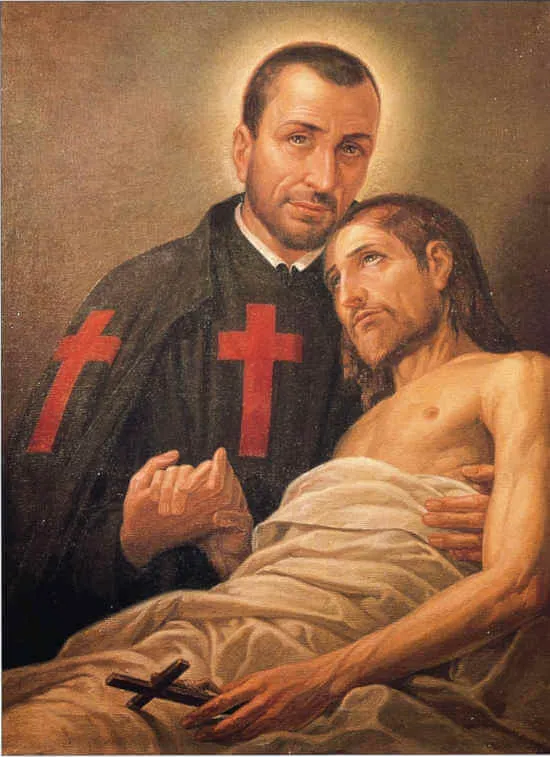
Saint Camillus de Lellis, Priest

1550–1614; Patron Saint of the sick, hospitals, hospital workers, nurses, and nursing associations; Invoked against the vice of gambling; Canonized by Pope Benedict XIV on June 29, 1746

 Camillus was born in the Kingdom of Naples. His mother was in her late forties when he was born, and his father was a soldier who was often away from home. Before his birth, his mother had a dream that she would give birth to a son who would wear a red cross on his chest and lead others with the same cross. However, Camillus’ mother died when he was young, leaving him mostly on his own. In his teenage years, Camillus joined his father on military campaigns where he fell into the vice of gambling and constantly experienced destitution. He wounded his leg on one campaign, which never properly healed.

In Camillus’ mid-twenties, his military regiment was disbanded, and he found his way to a Franciscan friary where he obtained menial work. One day, a saintly friar spoke with him, saying, “God is everything. The rest is nothing. One should save one’s soul which does not die.” This had a profound impact on Camillus. Shortly afterward, he fell on his knees and prayed, “Lord, I have sinned. Forgive this great sinner! How unhappy I have been for so many years not to have known you and not to have loved you. Lord, give me time to weep for my sins for a long time.” After this initial conversion, he applied to the friars for admission as an apprentice, but his application was rejected due to his unhealed leg wound.

Since the wound on his leg was deemed incurable, Camillus traveled to Rome and found work at Saint James Hospital for the Incurable. There, he received treatment while caring for the sick and dying. He also began living a life of deep prayer and penance.

At that time, hospitals for the dying were not as they are today. Many hospital workers were society’s rejects. Caring for the sick and dying was considered a lowly and undesirable task, and many did it only to make a meager living, not as a sincere act of mercy. Camillus’s newfound faith and penitential life made him stand out in the hospital. He became such an inspiration that he was made the hospital’s director. As director, he tried to form a lay association of charitable hospital workers, but his efforts proved fruitless. Fortunately for him, he met Saint Philip Neri, who became his spiritual director. Saint Philip encouraged him in his work and suggested that he become a priest to bring his calling to fruition. Thus, with the help of Saint Philip, he found a benefactor, completed his theological studies, and was ordained a priest at the age of thirty-four.

As a priest, he and his group of merciful hospital workers began serving the sick at Holy Spirit Hospital in Rome. They made quite an impression. They served not for money or because they could find no other work. They served out of charity, according to the vocation given to them by God. In addition to caring for those at the hospital, they ministered to the homebound and to everyone they found sick or dying. In 1586, after Camillus had been a priest for only two years, Pope Sixtus V formally approved his new congregation, named the Order of Clerks Regular, Ministers of the Infirm (M.I.), later known as the Camillians. In addition to taking the traditional three vows of poverty, chastity, and obedience, they took a fourth vow of “service to the sick poor, including the plague-ridden, in their corporeal and spiritual needs, even at risk to their own life, having to do this out of sincere love for God.” In 1591, Pope Gregory XV raised the congregation to the level of a Religious Order. They wore a black habit with a large red cross over their chest, just as his mother had dreamt before he was born.

In the years that followed, Father Camillus and his new order of ministers to the infirm expanded to other hospitals and towns, cared for those suffering from various plagues, and tended to soldiers wounded in battle. By the time of Camillus’ death, the order had expanded throughout Italy and even into Hungary. Though his wounded leg remained a source of much suffering throughout his life, he never allowed it to deter him from his work, even if he had to crawl to a patient’s bedside. His holiness was evident, as were the gifts of prophecy and healing. After his death, religious sisters were formed according to his order’s charism, as were lay associations.

In his service of the poor and sick, Saint Camillus was serving Christ. When he ministered to those who were suffering the most, with the most repulsive infirmities, he was drawn to them as he was drawn to the suffering Christ. His tenderness and compassion did much for their physical well-being, but it did much more for their eternal souls.

As we honor this great founder and saintly convert, consider the contrast we find in his life. He was mostly abandoned and fell into grave sin as a youth, but God touched him and transformed him, doing great things through his life. As you consider his life, consider also your own weaknesses and sins and know that there is always hope for you and for others, and that God can transform your life in glorious ways, doing great things in and through you.

Source: https://mycatholic.life/saints/saints-of-the-liturgical-year/july-14—saint-camillus-de-lellis-priest/

Saint Camillus de Lellis, Priest Read More »

Matthew 12:1-2

Freedom From Condemnation

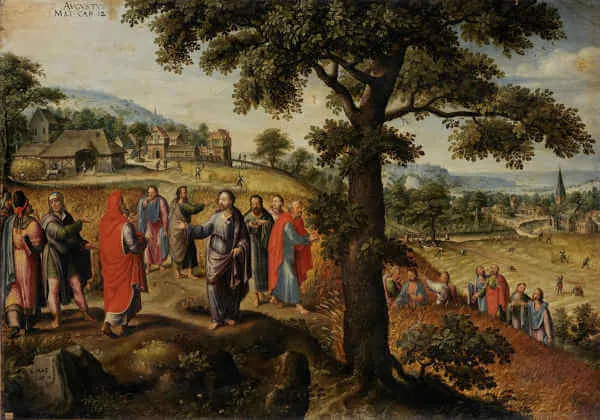
Jesus was going through a field of grain on the sabbath. His disciples were hungry and began to pick the heads of grain and eat them. When the Pharisees saw this, they said to him, “See, your disciples are doing what is unlawful to do on the sabbath.”

Reflection:

When Moses gave the Ten Commandments to the people, there was a prohibition against working on the Sabbath. The Third Commandment said, in part, that “you shall not do any work” on the Sabbath (Exodus 20:10). By the time of Jesus, the Pharisees had added much commentary to this law and expanded it to include as many as 39 different forms of work that they believed was forbidden. Included in their list were the practices of harvesting and milling of grain. For that reason, when the Pharisees saw that the disciples were picking heads of grain and rubbing the grain off the husks so that they could eat it, the Pharisees condemned them for violating what they interpreted to be an offense against the Third Commandment.

The first thing we can note from this passage is that the disciples were hungry. They were exceptionally devoted to Jesus and had been traveling with Him from town to town so that He could preach the Gospel. They had given up occupation, home, family and income so as to be singly devoted to Jesus and His mission. And as a result of this, they were living in poverty and relying upon the generosity of others. It is in this context that they chose to eat the most humble of foods: grain that they picked as they walked. They didn’t complain that there wasn’t a hot meal waiting for them at their destination. They were accepting of the many long journeys by foot that they made. They were okay with the fact that they did not get to sleep in their own bed every night. But they did have the basic human need for food, so they picked this grain as they walked to fulfill this basic need of hunger.

Though there are many lessons we can learn from this passage, one clear lesson is that of the temptation to judge and condemn others. When we fall into the trap of judging others, there are a few things that are common. First, judging and condemning often is based on perceived wrongs that are inflated and exaggerated. The Pharisees clearly inflated and exaggerated this “sin” of the disciples. In our lives, judgmentalness almost always makes the perceived sin of another far more serious than it is, if it is sin at all.

Another common temptation that flows from a judgmental and condemning heart is the failure to even understand the condemned party. In this case above, the Pharisees did not even inquire into the reason the disciples were picking and eating grain. They didn’t ask if they had been without food for some time or how long they had been traveling. It didn’t matter to them that they were hungry, and most likely, very hungry. So also with us, it is common that when we judge and condemn another, we arrive at our verdict without even seeking to understand the situation.

Lastly, it needs to be said that judging others is not our right. Doing so is usually reckless and caused by our own self-centeredness. God did not give the Pharisees the authority to expand the Third Commandment into 39 forbidden practices, nor did He give them the authority to apply those interpretations to the perceived actions of the disciples. And God does not give us the authority to judge others either. If another is clearly caught in a cycle of objectively grave sin, we must do all we can to help draw them out of that sin. But even in that case, we have no right to judge or condemn.

Reflect, today, upon any tendency you have toward being judgmental and condemning of others. If you see this tendency within yourself, spend time thinking about the Pharisees. Their self-righteousness was ugly and damaging. The negative example they set should inspire us to turn away from such acts of condemnation and to reject those temptations the moment they come.

Source: https://catholic-daily-reflections.com/2025/07/17/freedom-from-condemnation-4/

Matthew 12:1-2 Read More »

Saint Alexius of Rome

Profile

Alexius was the only son of a wealthy Christian Roman senator. The young man wanted to devote himself to God, but his parents arranged a marriage for him. On his wedding day, his fiancée agreed to release him and let him follow his vocation. He fled his parent‘s home disguised as a beggar, and lived near a church in Syria. A vision of Our Lady at the church pointed him out as exceptionally holy, calling him the “Man of God”. This drew attention to him, which caused him to return to Rome, Italy where he would not be known. He came as a beggar to his own home. His parents did not recognize him, but were kind to all the poor, and let him stay there. Alexis lived for seventeen years in a corner under the stairs, praying, and teaching catechism to small children. At his death, an unseen voice was heard to proclaim him ‘The Man of God’, and afterwards his family found a note on his body which told them who he was and how he had lived his life of penance from the day of his wedding until then, for the love of God.

Died

  • early 5th century

Canonized

  • Pre-Congregation

Patronage

  • Alexians
  • beggars
  • belt makers
  • nurses
  • pilgrims
  • travelers

Representation

  • dying man with a letter in his hand
  • man holding a ladder
  • man in a pilgrim‘s habit holding a staff
  • man lying beneath a staircase
  • man lying on a mat
  • old and very ragged beggar with a dish
  • dish
  • old man dressed as a pilgrim
  • cross
  • palm (his sufferings and patience led some to consider him a martyr)

Source: https://catholicsaints.info/saint-alexius-of-rome/

Saint Alexius of Rome Read More »

Matthew 11:29-30

The Yoke of Christ

“Take my yoke upon you and learn from me, for I am meek and humble of heart; and you will find rest for yourselves. For my yoke is easy, and my burden light.”

Reflection:

For those first followers of Jesus, a “yoke” was a familiar term. Many would have worked with oxen and other animals on a regular basis to plow their fields. To do so, they would place a wooden yoke over the oxen, which was a form of harness that was also attached to the plow, making it easier for the oxen to till the soil. To be strapped with a yoke was an indication of servitude, since that was the role of the oxen.

In commenting upon this passage, Saint Augustine (in Sermon 126) analogized the yoke of Christ with the wings of a bird. A bird’s wings are large in comparison to its body. As a result, if someone were to conclude that removing the wings from a bird would make its life easier by ridding it of that excess weight, such an action would have the effect of keeping it bound to the earth. But give its wings back and that “yoke” will enable it to soar through the skies.

So it is with the yoke of our Lord. If we accept the invitation to be a servant of God and we take upon ourselves the yoke of Christ for the fulfillment of our mission of service, we will discover that the act of serving lightens us, refreshes us, invigorates us and energizes us. Service of God is what we are made for, just as a bird is made to have wings. And like the bird, if we remove the yoke of service of God from our lives, then we are weighed down and cannot accomplish the good we are meant to do.

We are also told in this passage that we are not to carry our yoke; rather, we are meant to carry Christ’s yoke. “Take my yoke upon you…,” Jesus said. Carrying Jesus’ yoke means we are called to live our lives with Him and in Him. He came to serve and to give His life for others. It is our duty to do the same by allowing Him to do so within us. It is Christ and His servitude that must be the motivation and foundation of our lives.

Reflect, today, upon your call to be a servant in Christ. How is God calling you to serve? Whom is God calling you to serve? And as you answer that question, how do you see your act of service? Does service seem burdensome to you? Or do you understand that it is what you are made for? If you do see humble service as a burden, then perhaps that is because you have not actually tried to serve with and in Christ Himself. Try to ponder Jesus placing His yoke upon your shoulders. Say “Yes” to that act and to the mission of humble service you are called to fulfill. Doing so wholeheartedly will not only refresh you, it will also give meaning and purpose to your life.

Source: https://catholic-daily-reflections.com/2025/07/16/the-yoke-of-christ-4/

Matthew 11:29-30 Read More »

Our Lady of Mount Carmel

Late Twelfth–Early Thirteenth Century; Patron Saint of Bolivia and the Carmelite Order; Invoked for those in Purgatory

At the base of Mount Carmel, on the northwest coast of Israel, lies a Carmelite monastery named Stella Maris, Latin for “Star of the Sea.” This monastery is built over a cave believed to have been where the prophet Elijah, inspired by God, challenged 450 prophets of Baal in a contest to the death. Elijah triumphed. Shortly after, Elijah prophesied the end of a three-year drought when, in the passage above, his servant reported to him that he saw a “cloud as small as a man’s hand rising from the sea.” That small cloud quickly transformed into a heavy rainfall over the parched earth. Later Carmelites interpreted Elijah’s vision as a prefiguration of the Blessed Virgin Mary. She was seen as the small cloud rising from the sea, a true “Star of the Sea,” and the rain that would emerge from her to end the three-year drought was perceived as the grace and mercy poured out by her Son, Jesus.

It is believed that following the time of Elijah, other hermits emulated Elijah and his successor, Elisha, by becoming hermits in the caves of Mount Carmel. Although some traditions hold that these holy hermits embraced Christ and lived on this sacred mountain from the time of Christ, written records only confirm their presence from the thirteenth century onwards. It was then, in 1209, that a group of hermits asked Bishop Albert, the Latin Patriarch of Jerusalem, to provide them with a rule of life. Bishop Albert did so, and the Order of Brothers of The Blessed Virgin Mary of Mount Carmel, later known as the Carmelites, was formed. One of their first acts was to erect a chapel dedicated to Mary, Star of the Sea, Stella Maris. In 1226, their rule was approved by Pope Honorius.

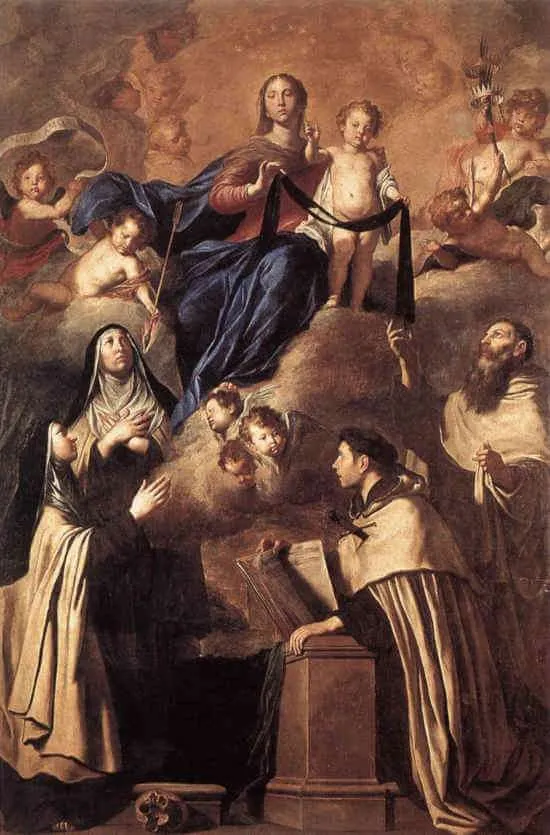
Shortly after the order’s founding on Mount Carmel, Muslim invaders conquered nearby territories, leading some of the hermits to flee from the Holy Land to other parts of Europe, including Aylesford, England. Though records are uncertain, it is believed that one of the first men to join the Carmelite hermits in England was a man named Simon Stock. The Carmelites were a new form of religious life, living as hermits rather than as a more ordered community like the Benedictines, Cistercians, and Augustinians. As a result, they found it challenging to gain wide acceptance. In 1247, Simon Stock is believed to have been elected Superior General of the Carmelites at the age of eighty-two. In an attempt to help the new order gain wider acceptance within the Church, Simon and his fellow hermits sought out the intercession of the Blessed Virgin Mary. She responded and, in 1251, appeared to Simon while holding the Christ Child in one arm and a brown scapular in the other. She said to him, “Receive, my beloved son, this habit of thy order: this shall be to thee and to all Carmelites a privilege, that whosoever dies clothed in this shall never suffer eternal fire…It shall be a sign of salvation, a protection in danger, and a pledge of peace.”

In the centuries that followed, the Carmelites continued to develop a deep devotion to the Blessed Virgin Mary, especially clothing themselves in the scapular habit and developing liturgies in her honor. In the fifteenth century, the Carmelite order expanded to include women in religious service and also developed into a lay third order. In 1726, Pope Benedict XIII placed this Carmelite devotion to our Blessed Mother on the universal calendar of the Church under the title of Our Lady of Mount Carmel.

Throughout the centuries, many popes have spoken in favor of the scapular and devotion to Our Lady of Mount Carmel. In 1908, the Congregation for Indulgences at the Vatican issued a summary of this devotion as follows:

It is permitted to the Carmelite Fathers to preach that the Christian people may piously believe in the help which the souls of brothers and members, who have departed this life in charity, have worn in life the scapular, have ever observed chastity, have recited the Little Hours of the Blessed Virgin, or, if they cannot read, have observed the fast days of the Church, and have abstained from flesh meat on Wednesdays and Saturdays (except when Christmas falls on such days), may derive after death—especially on Saturdays, the day consecrated by the Church to the Blessed Virgin—through the unceasing intercession of Mary, her pious petitions, her merits, and her special protection.

As we honor Our Lady of Mount Carmel, we honor not only our Blessed Mother but also her central role in the Carmelite orders and the devotions to her that they have promoted, especially the devotion of the scapular. Reflect on your own devotion to our Blessed Mother. If you wear the scapular, renew your faith in her motherly intercession that is obtained through this holy devotion. If you do not wear the scapular, consider doing so as an outward sign of your interior devotion to her and your trust in her intercession.

Source: https://mycatholic.life/saints/saints-of-the-liturgical-year/july-16—our-lady-of-mount-carmel/

Our Lady of Mount Carmel Read More »