Author name: Sani

Saint Ephrem, Deacon and Doctor

c. 306–373; Patron Saint of spiritual directors and spiritual leaders; Pre-Congregation canonization; Declared a Doctor of the Church by Pope Benedict XV in 1920

Ephrem was born in the town of Nisibis, near Syria’s border with present-day Turkey. At the time of Ephrem’s birth, Nisibis was part of the Roman Empire. Nisibis was a diverse city of Syrians, Arameans, Arabs, Greeks, Jews, Parthians, Romans, and Iranians. Among the religious beliefs were Judaism, Christianity, and polytheism. Aramaic was commonly spoken, and to a lesser extent, Greek and Latin.

When Ephrem was just a boy, Emperor Constantine the Great issued the Edict of Milan, legalizing Christianity throughout the empire. Ephrem likely learned the faith from his mother at an early age. Stories from his youth, however, suggest that even though he was raised in the Christian faith, he failed to practice it. One story relates that one day when Ephrem was walking through a field and saw a cow, he decided to have fun by throwing rocks at it, forcing the beast to run. Ephrem pursued the cow, pelting it all the more until the poor animal died. When Ephrem later encountered the cow’s owner, he denied ever seeing the animal. He would come to regret his double sin.

Some months later, Ephrem was spending time with a friend who was a shepherd. After the shepherd had too much to drink, he lost the sheep to thieves or wolves. As a result, the shepherd and Ephrem were arrested and imprisoned on the charge that they stole the sheep. Within that prison, something life-changing took place. An angel was sent to chastise Ephrem, explaining that even though he was innocent of the crime against the sheep, he was not innocent of other crimes, such as the death of the cow. The angel’s holy rebukes did wonders in Ephrem’s soul, and he was filled with remorse and repentance as he came face-to-face with Divine Justice. By God’s grace, when the sorrowful Ephrem was released from prison after two months, he vowed to turn his life around.

Some time after his release, Ephrem consulted with the local bishop-monk, Saint James of Nisibis, seeking spiritual direction. Bishop James took Ephrem under his wing and began to teach him in his school, mentoring him in the ways of monastic life. At that time, Syrian monasticism was different from the monastic life that was developing in Egypt. In Egypt, monks would escape into the wilderness, seeking silence and solitude from the Roman Empire and society, so that they could focus exclusively on God. Saint Anthony of the Desert is among the most renowned of these desert fathers. In northern Syria, where Ephrem lived, those who sought out the monastic life did so within the community of believers. They lived as ascetics, doing penance and praying devoutly, but they also remained servants of the local church, serving the community and addressing their needs. This is the life that Ephrem undertook after vowing to live in poverty and celibacy.  As a hermit, he spent time in the solitude of caves and in the wilderness. Within the community, he performed good works.

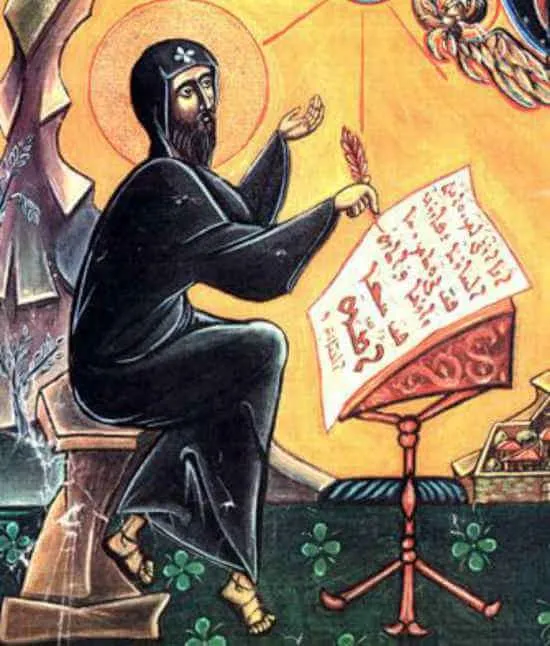
Over the next forty to fifty years, Ephrem studied under Bishop James and lived an ascetic life of prayer, penance, and service. He used his many gifts for the glory of God. Ephrem’s enduring legacy is his writings. He was a prolific writer of hymns, poems, biblical commentaries, and homilies. It is believed that during his lifetime, he composed as many as 400 hymns and 3,000 poems that were tools for catechetics and worship. They were rich in imagery, theologically precise, insightful, melodic, and covered important topics such as the Incarnation, the Blessed Virgin Mary, the sacraments, and the purpose of the Christian life. His hymns and poems were also apologetical, meaning, a defense of the faith. At that time, numerous heresies abounded, and some heretics sought to push their beliefs on others by composing hymns, since a hymn was easily remembered. Ephrem took the same approach, only with orthodox poems and hymns that sought to dispel the heresies’ errors. Ephrem’s gifts of artistically presenting the deep truths of the faith led many over the centuries to refer to him as the “Harp of the Holy Spirit.” 

Around the year 350, Ephrem’s mentor, Bishop James, formally opened the School of Nisibis, which became an important center for education within the Syriac church. Ephrem assisted the bishop, becoming a respected and influential teacher.

In 363, Roman Emperor Jovian lost a battle to the Persians and had to surrender the Roman town of Nisibis. All Christians were expelled from Nisibis. Ephrem settled in the town of Edessa, about 125 miles to the west, a flourishing Christian city. In Edessa, Ephrem continued to teach, write, and serve the community in any way he could. He founded a school there, which became another important Christian center for learning. In Edessa, Ephrem became known as the saint of daily living because he often came out of his solitude to teach people how to live the faith in a practical way. At some point, he was ordained a deacon, and as a deacon, he became a true servant of others. When famine hit Edessa, he helped distribute food to the poor. When a plague struck, he cared for the sick. During a plague in 373, Ephrem contracted the disease and became a martyr of charity.

Though Saint Ephrem died in the fourth century, he was declared a Doctor of the Church in 1920 by Pope Benedict XV. Saint Ephrem is the only Syrian Doctor of the Church and is not only highly revered in the Eastern Catholic Church but in the Orthodox Church as well. It might be that the 1920 declaration was done in part as a way of further bridging the gap between the Catholic Church and the Orthodox Church.

As we honor this great saint, ponder especially the powerful effect that music has upon the human person. What types of songs do you listen to? Consider following the example of Saint Ephrem by filling your mind with hymns that give praise and glory to God and do so in a clear and theologically rich way. Such a habit will certainly help you grow in holiness.

Source: https://mycatholic.life/saints/saints-of-the-liturgical-year/june-9—saint-ephrem-deacon-and-doctor/

Saint Ephrem, Deacon and Doctor Read More »
Matthew 5:13-14

Salt and Light of the World

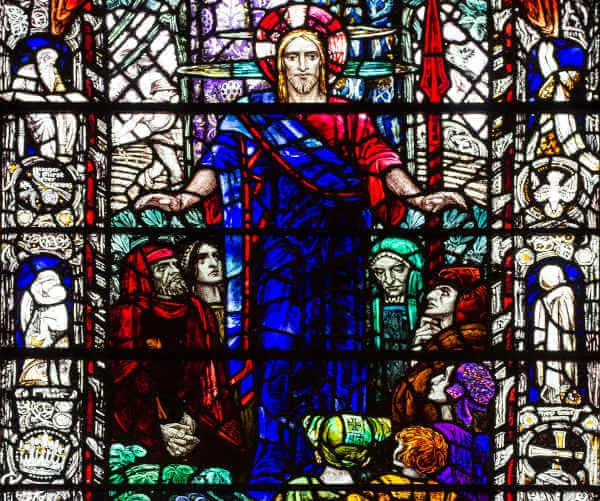
Jesus said to his disciples: “You are the salt of the earth. But if salt loses its taste, with what can it be seasoned? It is no longer good for anything but to be thrown out and trampled underfoot. You are the light of the world…”

Reflection:

Every Christian has two primary duties in life. First, we must strive for personal holiness. And second, we must work to help others achieve this same degree of holiness. This is what it means to be the “salt of the earth” and the “light of the world.”

Consider salt. Salt is a preservative, and it also adds flavor to food. It does so by entering the food and, in a sense, disappearing. So it must be with us. First, our Lord must enter our lives and preserve us from the corruption of sin. But as He does so, He will also bring out our goodness in a way that the “flavor” of holiness is evident to others. In this way, we will be used as salt for others. This is especially done by our works of charity.

Saint Thérèse of Lisieux said in her autobiography, “I see now that true charity consists in bearing with the faults of those about us, never being surprised at their weaknesses, but edified at the least sign of their virtue.” She believed that this was especially the way we act as salt and light to others. We help to preserve others from sin by being merciful to them when they are weak. We enrich their lives by seeing their goodness and rejoicing in it. And we do so in a hidden way. By our gentleness and compassion, our kindness and mercy, we preserve others and help them to grow in God’s abundant grace. And we do so, many times, without them even realizing how God used us.

Consider, also, light. The world in which we live is oftentimes quite dark and despairing. There is corruption all around us and temptations abound. Thus, the light of Christ must be made manifest far and wide. Those all around us need to see clearly the path to holiness and happiness. Again, this is possible if we first work to become light itself. Christ, the true Light of the World, must so permeate our lives that we find it almost automatic to shine brightly in a fallen world. When Christ is alive in us, we will radiate joy and peace, calm and conviction, moral goodness and determination. And when we live this way, we will not have to “impose” the Gospel on others; rather, God’s light will simply shine and be a beacon of hope to those who come into our presence.

Reflect, today, upon these two missions in life. First, ponder your call to holiness. How does God want to bring light into your own life, preserve you from all sin and add spiritual flavor for holy living? Second, who does God want you to love with His love? Who needs hope and joy, mercy and kindness, words of wisdom and encouragement? Be holy and then allow that holiness to shine forth to others and you will indeed be the salt of the earth and the light of the world.

Source: https://catholic-daily-reflections.com/2025/06/09/salt-and-light-for-the-world-4/

Matthew 5:13-14 Read More »

Blessed Virgin Mary, Mother of the Church

Celebrated the Monday after Pentecost

Little is said about the most glorious Mother of God in the Scriptures. In many ways, she lived a quiet and hidden life. Since her Assumption into Heaven, the Church has prayerfully pondered her life and role in the mystery of salvation. Little by little, saint after saint and pope after pope have shed greater light upon her singularly unique and glorious role in the Father’s eternal plan. As the Church’s understanding of the Blessed Mother has deepened, new titles and new dogmas have been proclaimed about Mary. In 2018, a new liturgical memorial honored her with the title “Blessed Virgin Mary, Mother of the Church.”

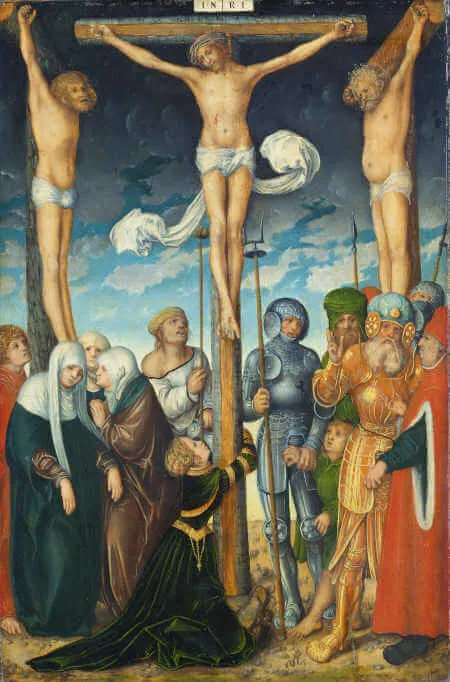
To understand the Blessed Virgin Mary’s role as Mother of the Church, we need to begin with Scripture. As Jesus hung on the Cross, John’s Gospel records that the mother of Jesus and two other women stood before Him, alongside John, the disciple whom Jesus loved. From the Cross, Jesus entrusted His mother to John’s care. “When Jesus saw his mother and the disciple there whom he loved, he said to his mother, ‘Woman, behold, your son.’ Then he said to the disciple, ‘Behold, your mother.’ And from that hour the disciple took her into his home” (John 19:26–27).

In 1895, in his encyclical on the rosary, Pope Leo XIII wrote about that Gospel passage:

Now in John, as the Church has constantly taught, Christ designated the whole human race, and in the first rank are they who are joined with Him by faith…She was, in very truth, the Mother of the Church, the Teacher and Queen of the Apostles, to whom, besides, she confided no small part of the divine mysteries which she kept in her heart” (Adiutricem #6).

In 1964, Pope Saint Paul VI promulgated the Vatican II document Lumen Gentium (Dogmatic Constitution on the Church). After presenting a complete picture of the mystery of the Church, the final chapter of that constitution presents “The Blessed Virgin Mary, Mother of God in the Mystery of Christ and the Church.” That chapter highlights her singularly unique and maternal role within the Church. Lumen Gentium did not go so far as to ascribe the title “Mother of the Church” to the Blessed Mother, but it did go into great detail about her maternal role within the Church. Four years later, in a motu proprio letter, Pope Paul VI referenced Lumen Gentium and took it a step further by bestowing upon the Mother of God the title “Mother of the Church.”

…we believe that the Blessed Mother of God, the New Eve, Mother of the Church, continues in heaven her maternal role with regard to Christ’s members, cooperating with the birth and growth of divine life in the souls of the redeemed (Solemni Hac Liturgia #15).

Since that time, Pope John Paul II, Pope Benedict XVI, and Pope Francis have continually referred to the Mother of God as the Mother of the Church. What does the title “Mother of the Church” mean? On September 17, 1997, Pope John Paul II defined it this way in a Wednesday catechesis:

The title “Mother of the Church” thus reflects the deep conviction of the Christian faithful, who see in Mary not only the mother of the person of Christ, but also of the faithful. She who is recognized as mother of salvation, life and grace, mother of the saved and mother of the living, is rightly proclaimed Mother of the Church. (#5).

On March 3, 2018, Pope Francis announced that a new memorial would be added to the General Roman Calendar and celebrated on the Monday after Pentecost Sunday, entitled “The Blessed Virgin Mary, Mother of the Church.”

In the decree instituting this memorial, Cardinal Robert Sarah, Prefect of the Congregation for Divine Worship, said:

This celebration will help us to remember that growth in the Christian life must be anchored to the Mystery of the Cross, to the oblation of Christ in the Eucharistic Banquet and to the Mother of the Redeemer and Mother of the Redeemed, the Virgin who makes her offering to God.

It is significant that the Blessed Virgin Mary, Mother of God, was entrusted to the Church in the person of Saint John the Apostle at the foot of the Cross. From the Cross, the Church was conceived by the outpouring of grace that flowed from Jesus’ Sacred Heart. At Pentecost, our Blessed Mother was present as the Church was born.

Today, the Mother of the Church reigns in Heaven next to her Son; from there, she continues to nurture the Church as a loving mother. She not only intercedes for us but also mediates her Son’s saving grace, making her the ongoing instrument of grace and mother of all.

Because our understanding of the role of the Blessed Virgin Mary has continually unfolded over the centuries, it is fair to say that we do not yet fully understand her glorious role in the Father’s plan of salvation. Some have proposed that she be given the dogmatic titles “Mediatrix of All Grace” and “Co-Redemptrix.” Regardless of what comes next in our ever deepening understanding of the role of the Blessed Mother, we can be certain that those who one day gaze upon the essence of God Himself as he reveals all truth will immediately become aware of the most profound mysteries of Mary’s hidden life.

As we honor the Blessed Virgin Mary, Mother of the Church, know that she is your spiritual mother insofar as you are a member of Christ’s Body, the Church. By giving birth to the Head, she gives birth to the members. As members of that Body, it is essential that we seek spiritual nourishment from the Blessed Virgin Mary. She is our mother and queen. From her, we are born into God’s grace. She is the chosen instrument and mediatrix of grace. Rely upon her motherly intercession and mediation, and entrust yourself more fully to her care.

Source: https://mycatholic.life/saints/saints-of-the-liturgical-year/mary-mother-of-the-church-memorial/

Blessed Virgin Mary, Mother of the Church Read More »

John 19:25-27

Your Heavenly Mother

Standing by the cross of Jesus were his mother and his mother’s sister, Mary the wife of Clopas, and Mary of Magdala. When Jesus saw his mother and the disciple there whom he loved, he said to his mother, “Woman, behold, your son.”  Then he said to the disciple, “Behold, your mother.”  And from that hour the disciple took her into his home.

Reflection:

The memorial we celebrate today, which was added to the Roman Liturgical Calendar in 2018 by Pope Francis, highlights the truth that the Blessed Virgin Mary is not only the Mother of the Person of Christ, and, therefore, the Mother of God, she is also the Mother of the Church, that is, the Mother of all the faithful. The Blessed Virgin Mary is your mother. And as your mother, she is truly tender, compassionate, caring and merciful, bestowing upon you everything that a perfect mother desires to bestow. She is the fiercest of mothers who will stop at nothing to protect her children. She is a mother wholly devoted to you, her dear child.

The Gospel passage chosen for this memorial depicts our Blessed Mother standing at the foot of the Cross. She would have been no other place than directly beneath her Son as He endured His last agony. She did not flee in fear. She was not overwhelmed by grief. She did not sulk in self-pity. No, she stood by her Son with the perfect love and strength of a devoted, caring, compassionate and faithful mother.

As she stood by her Son in His hour of suffering and death, Jesus turned to her and entrusted the Apostle John to her maternal care. From the early Church Fathers until the most recent teachings of the Church today, this act of entrusting John to Mary and Mary to John by Jesus has been understood as an entrustment of all the faithful to the maternal care of Mother Mary. Mother Mary is, therefore, not only the Mother of the Redeemer, Christ Himself, she also becomes the Mother of all the redeemed, the mother of us all, the Mother of the Church.

Consider the spiritual mother you have in Heaven. A mother is one who gives life. Your mother in Heaven is entrusted with the task of bestowing upon you the new life of grace won by the Cross. And as your mother, she will not withhold anything from you that is to your benefit. A mother is also one who is tender with her children. The Immaculate Heart of our mother in Heaven is one that is filled with the greatest tenderness toward you. Though her caresses are not physical, they are much deeper. She caresses with the tenderness of grace which she imparts to you as you pray and turn to her in your need. She gives you the grace of her Son, poured out upon the Cross as the blood and water sprung forth as a font of mercy. Mother Mary pours that mercy upon you as a tender and devoted mother would. She holds nothing back.

If you are unaware of the love in the heart of our Blessed Mother for you, use this memorial as an opportunity to deepen your understanding of her role in your life. Many children take their mothers for granted, not fully understanding the depth of their love. So it is with our Mother in Heaven. We will never fully comprehend her love and her constant motherly workings in our life until we join her in Heaven face to face.

Reflect, today, upon Mother Mary standing by you in every moment of your life. See her there in your joys and in your sorrows, during your moments of temptation and struggles, in your moments of confusion and clarity. See her there by your side, bestowing every good spiritual gift upon you when you need it the most. She is a true mother, and she is worthy of your love and gratitude.

Source: https://catholic-daily-reflections.com/2025/06/08/your-heavenly-mother-4/

John 19:25-27 Read More »

Pentecost Sunday

First Reading Acts 2:1-11

When the time for Pentecost was fulfilled,
they were all in one place together.
And suddenly there came from the sky
a noise like a strong driving wind,
and it filled the entire house in which they were.
Then there appeared to them tongues as of fire,
which parted and came to rest on each one of them.
And they were all filled with the Holy Spirit
and began to speak in different tongues,
as the Spirit enabled them to proclaim.

Now there were devout Jews from every nation under heaven
staying in Jerusalem.
At this sound, they gathered in a large crowd,
but they were confused
because each one heard them speaking in his own language.
They were astounded, and in amazement they asked,
“Are not all these people who are speaking Galileans?
Then how does each of us hear them in his native language?
We are Parthians, Medes, and Elamites,
inhabitants of Mesopotamia, Judea and Cappadocia,
Pontus and Asia, Phrygia and Pamphylia,
Egypt and the districts of Libya near Cyrene,
as well as travelers from Rome,
both Jews and converts to Judaism, Cretans and Arabs,
yet we hear them speaking in our own tongues
of the mighty acts of God.”

Responsorial Psalm Psalms 104:1, 24, 29-30, 31, 34

R. (cf. 30) Lord, send out your Spirit, and renew the face of the earth.
or:
R. Alleluia.
Bless the LORD, O my soul!
O LORD, my God, you are great indeed!
How manifold are your works, O LORD!
the earth is full of your creatures;
R. Lord, send out your Spirit, and renew the face of the earth.
or:
R. Alleluia.
May the glory of the LORD endure forever;
may the LORD be glad in his works!
Pleasing to him be my theme;
I will be glad in the LORD.
R. Lord, send out your Spirit, and renew the face of the earth.
or:
R. Alleluia.
If you take away their breath, they perish
and return to their dust.
When you send forth your spirit, they are created,
and you renew the face of the earth.
R. Lord, send out your Spirit, and renew the face of the earth.
or:
R. Alleluia.

Second Reading 1 Corinthians 12:3b-7, 12-13

Brothers and sisters:
No one can say, “Jesus is Lord,” except by the Holy Spirit.

There are different kinds of spiritual gifts but the same Spirit;
there are different forms of service but the same Lord;
there are different workings but the same God
who produces all of them in everyone.
To each individual the manifestation of the Spirit
is given for some benefit.

As a body is one though it has many parts,
and all the parts of the body, though many, are one body,
so also Christ.
For in one Spirit we were all baptized into one body,
whether Jews or Greeks, slaves or free persons,
and we were all given to drink of one Spirit.

Sequence Veni, Sancte Spiritus

Come, Holy Spirit, come!
And from your celestial home
 Shed a ray of light divine!
Come, Father of the poor!
Come, source of all our store!
 Come, within our bosoms shine.
You, of comforters the best;
You, the soul’s most welcome guest;
 Sweet refreshment here below;
In our labor, rest most sweet;
Grateful coolness in the heat;
 Solace in the midst of woe.
O most blessed Light divine,
Shine within these hearts of yours,
 And our inmost being fill!
Where you are not, we have naught,
Nothing good in deed or thought,
 Nothing free from taint of ill.
Heal our wounds, our strength renew;
On our dryness pour your dew;
 Wash the stains of guilt away:
Bend the stubborn heart and will;
Melt the frozen, warm the chill;
 Guide the steps that go astray.
On the faithful, who adore
And confess you, evermore
 In your sevenfold gift descend;
Give them virtue’s sure reward;
Give them your salvation, Lord;
 Give them joys that never end. Amen.
 Alleluia.

Alleluia

R. Alleluia, alleluia.
Come, Holy Spirit, fill the hearts of your faithful
and kindle in them the fire of your love.
R. Alleluia, alleluia.

Gospel John 20:19-23

On the evening of that first day of the week,
when the doors were locked, where the disciples were,
for fear of the Jews,
Jesus came and stood in their midst
and said to them, “Peace be with you.”
When he had said this, he showed them his hands and his side.
The disciples rejoiced when they saw the Lord.
Jesus said to them again, “Peace be with you.
As the Father has sent me, so I send you.”
And when he had said this, he breathed on them and said to them,
“Receive the Holy Spirit.
Whose sins you forgive are forgiven them,
and whose sins you retain are retained.”

Source: https://bible.usccb.org/bible/readings/060825-Day.cfm

Pentecost Sunday Read More »

Pentecost Sunday

Today, we celebrate the most glorious Solemnity of Pentecost, the promised Gift of the Father and the Son to Jesus’ disciples. After rising from the dead, Jesus appeared to His disciples for forty days. During those appearances, He offered them proof of His resurrection, continued to teach them, and reminded them of all He had revealed to them about His death and Resurrection, preparing them for the next step of their mission. “While meeting with them, he enjoined them not to depart from Jerusalem, but to wait for ‘the promise of the Father about which you have heard me speak; for John baptized with water, but in a few days you will be baptized with the holy Spirit’” (Acts 1:4–5).

During the ten days after Jesus’ Ascension, the eleven Apostles gathered together in the upper room with the mother of Jesus and many other disciples, totaling 120 in all. The gathering place was most likely the same place that the Apostles ate the Passover meal, the first Eucharist, with Jesus. As they met, the first order of business was to choose a successor to Judas. They cast lots, and Matthias was chosen to be one of the Twelve.

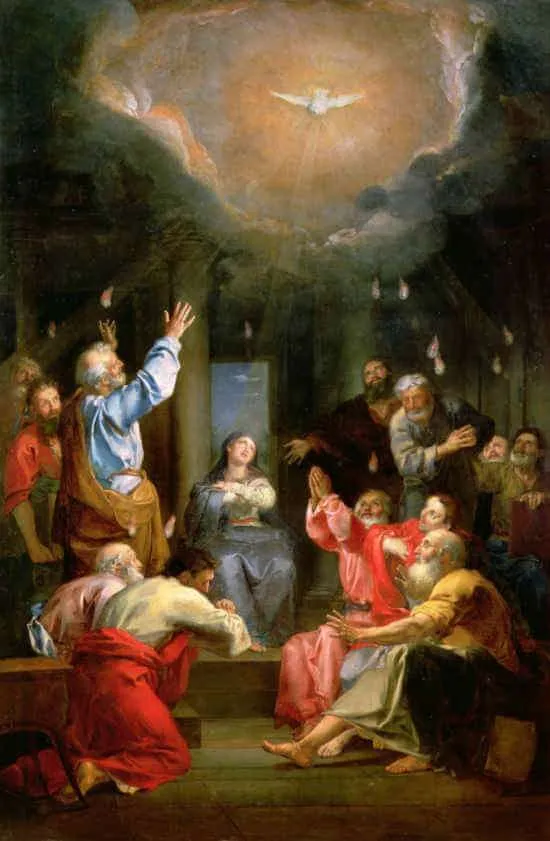
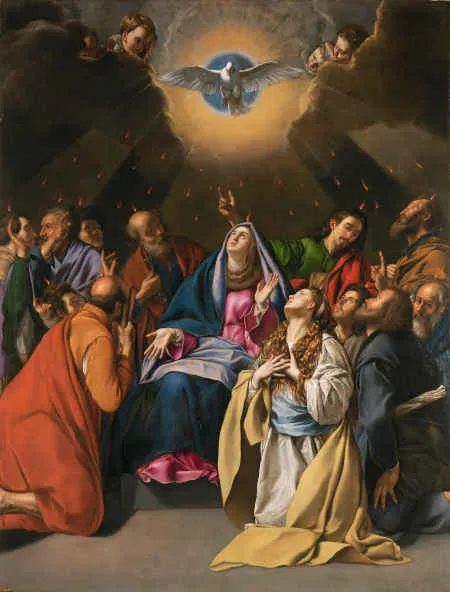
On the fiftieth day after Jesus’ Resurrection, ten days after His Ascension, the 120 disciples were once again gathered in the upper room when they experienced something beyond their imagination. From the sky came a noise like a strong driving wind. It filled the room they were in. Tongues, as of fire, fell upon all gathered, and they were given the gift of tongues, which enabled them to speak in different languages—by the power of the Holy Spirit—to the diverse groups of people in Jerusalem. This is what Jesus had promised them, and suddenly they understood as they received the Gift of God.

After receiving the Holy Spirit, the disciples went out into the community of Jerusalem and began to boldly proclaim the Gospel to all. The inhabitants of Jerusalem were shocked and confused. Some accused the disciples of being drunk and scoffed at them. Some, however, quickly believed. Peter then stood up and gave a stirring and powerful sermon that presented the whole mystery of salvation. He spoke of Jesus as the Savior and the need to repent and be baptized. “Those who accepted his message were baptized, and about three thousand persons were added that day” (Acts 2:41). The new followers then devoted themselves to the teaching of the Apostles and to the celebration of the Eucharist. A strong Christian community was formed in Jerusalem.

As the community continued to grow, learn the teachings of the Apostles, and receive the outpouring of the Holy Spirit, miracles took place. Peter and John cured a blind man. Soon, there were 5,000 converts to Christ who were filled with the Holy Spirit. More miracles took place at the hands of all of the Apostles, people from the surrounding villages came and were converted, and the new believers lived as one, sharing their food and resources with others.

Soon the members of the Sanhedrin became concerned. They thought they had stopped Jesus, but they saw that the Apostles were converting thousands. The Apostles were arrested and jailed, but an angel let them out in the night, and they appeared in the Temple the next day, continuing to preach and heal. The bewildered Sanhedrin members did not know what to do. They hoped that the new excitement would soon subside and everything would go back to normal—but it didn’t.

Recognizing the need to better care for the poor with the money and provisions the thousands of disciples held in common, the Apostles appointed seven men to be deacons for the task, so that the Apostles could continue to preach, heal, and offer the sacraments. Shortly afterward, blood was shed. Stephen, one of the newly ordained deacons, was martyred. “On that day, there broke out a severe persecution of the church in Jerusalem, and all were scattered throughout the countryside of Judea and Samaria, except the apostles” (Acts 8:1).

The above illustrates the role of the Holy Spirit. Pentecost was the birthday of the Church. The Holy Spirit’s mission was to form the Church and empower each baptized member of Christ’s body to fulfill his or her specific duty. Some were to preach, some cared for the poor, some shed their blood for their faith, and others were to be sent to other towns and villages. The scattering of the community of the believers in Jerusalem was clearly permitted by the Holy Spirit as a way of expanding the Church beyond Jerusalem. The newly converted and empowered disciples traveled far and wide to expand the newborn Church that grew at a rapid pace as the new Body of Christ matured and fulfilled its mission.

In the years and centuries ahead, the Holy Spirit continued to form the Church. The Apostles were inspired to write what is today the New Testament so that future believers would have firsthand accounts of the Gospel. From there, the successors to the Apostles, in union with the successor of Saint Peter, helped to form the Sacred Tradition, which is the ongoing deepening revelation of the Word of God to address new questions that arose. Jesus’ promise to Peter and his successors that He would give to him the keys to the Kingdom of Heaven, so that he and his successors could bind and loose on earth as it is in Heaven, evolved and helped the Church to mature. The Holy Spirit enabled the growing communities to continue to take nourishment through the Sacraments. The believers were empowered to pray and to enter into a personal relationship with Him Who rose and is now seated at the right hand of the Father. Other believers were filled with charisms needed to build up the Church. The Gospel continued to be preached to the ends of the earth, and the people of God were drawn into lives of profound holiness and union with God. This is all effected by the Gift of the Holy Spirit first given at Pentecost and continually given today.

In addition to building up the Church and enabling it to fulfill its divine mission, the Holy Spirit also sanctifies every individual believer, especially through the bestowal of the Seven Gifts of the Holy Spirit. According to the Catechism of the Catholic Church, “The seven gifts of the Holy Spirit are wisdom, understanding, counsel, fortitude, knowledge, piety, and fear of the Lord…They complete and perfect the virtues of those who receive them. They make the faithful docile in readily obeying divine inspirations” (#1831). Additionally, the Holy Spirit instills twelve fruits: “The fruits of the Spirit are perfections that the Holy Spirit forms in us as the first fruits of eternal glory. The tradition of the Church lists twelve of them: ‘charity, joy, peace, patience, kindness, goodness, generosity, gentleness, faithfulness, modesty, self-control, chastity’” (#1832). These graces are first given in Baptism and perfected in Confirmation. Each baptized and confirmed member of Christ has the potential to fully realize these graces so as to grow in holiness and fulfill their divine mission.

As we celebrate the great Solemnity of Pentecost, call on the Holy Spirit in your life. Too often we receive Baptism and Confirmation with a closed mind and heart. We fail to allow the Holy Spirit to become fully active in our lives. Pray to the Holy Spirit today, and open yourself more fully to all that God wishes to bestow upon you so that you will become holy and a more active member of His Body, the Church.

Source: https://mycatholic.life/saints/saints-of-the-liturgical-year/pentecost/

Pentecost Sunday Read More »

Acts 2:2-4

Come to Us Holy Spirit

And suddenly there came from the sky a noise like a strong driving wind, and it filled the entire house in which they were. Then there appeared to them tongues as of fire, which parted and came to rest on each one of them. And they were all filled with the Holy Spirit and began to speak in different tongues, as the Spirit enabled them to proclaim. 

Reflection:

Happy birthday! Today, as we celebrate the coming of the Holy Spirit at Pentecost, we also celebrate the birth of the Church. Thus, today is a celebration of your membership in the life of the Church. As a human institution, the Church has always suffered on account of the sins of Her members. This sad truth is something that we are increasingly aware of today. But the Church itself is the Spotless Bride of Christ. It is the Body of Christ on earth, in Heaven and in Purgatory. Those of us on earth are members of the Church Militant. Those in Heaven are members of the Church Triumphant. And those in Purgatory are members of the Church Suffering. But all of us are united under Christ our Head as members of His holy Body, the Church.

We profess our faith in the Church every Sunday. We profess that we believe in “one, holy, catholic and apostolic Church.” What exactly does this mean? First, it means that by the power and working of the Holy Spirit, those who profess faith in Christ are united as “one.” This oneness is a spiritual union that will endure for eternity. It is unbreakable and restores us to the life we were created to live. That is, a life of union with God and others, a communion of humanity with God.

As one family, the Church is also “holy.” Holiness is another way of saying that we are made whole by the blood of Christ, sharing in His redemption. By His mercy, our sins are forgiven and we become children of the Father in Heaven, sharing the eternal life of the Son.

The word “catholic” refers to the truth that the offer of salvation is given to all. It is a universal calling given to all people who will accept this gift. God did not come to save only a few but all, and many will accept this gift of salvation.

We are “apostolic,” in that God chose to establish His Church through the mediation of His Apostles. They were uniquely called to become instruments by which the saving Truth is proclaimed and the grace won by the Cross is distributed. The work of the Apostles continues today through their successors, the bishops, and those who are co-workers with the bishops, the priests. Sinful though they may be, God uses them, nonetheless, to bestow His grace and truth upon the world.

As a member of the one Body of Christ, you are also invited by God to enlarge His family through the sharing of the Gospel and by your life of deep prayer. You are called and sent, and this takes place by the outpouring of the Holy Spirit that we especially celebrate today.

Reflect, today, upon the incredible privilege it is to be invited to be a member of the Family of God, the Church. And reflect, also, upon the important duty you have to extend that invitation to others. Pray to the Holy Spirit, asking for an increase in His seven-fold gifts in your life so that You can help share the saving message of the Gospel to those whom God wants to reach through you.

Source: https://catholic-daily-reflections.com/2025/06/07/come-to-us-holy-spirit/

Acts 2:2-4 Read More »

Saint Deochar

Profile

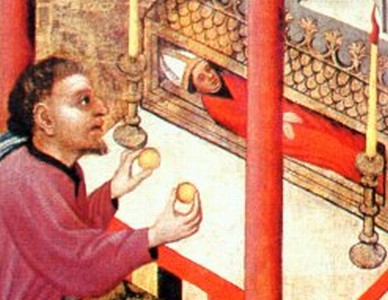
Deochar is a hermit in the Franconia forests near Fulda, an area in modern Germany. He was a spiritual student of Blessed Alcuin at Aachen, Germany. He became a Benedictine monk and first abbot of Herriedon abbey; he was chosen for the position by Blessed Charlemagne. He was appointed as missus regius (king‘s messenger), a royal office, in 802. He helped translate the relics to Saint Boniface to Fulda in 819. He attended the synod of Mainz, Germany in 829. A famous miracle ascribed to him was healing a young boy‘s blindness by prayer.

Born

  • late 8th century, probably in Bavaria, Germany

Died

  • 847 at the abbey of Herriedon, Germany of natural causes
  • interred in the church of Saint Vitus
  • some relics were moved to Saint Lawrence church, Nuernberg, Germany in 1316
  • these relics were moved to Eichstätt, Germany in 1845

Canonized

  • Pre-Congregation

Patronage

  • blind people
  • eye patients
  • Eichstätt, Germany

Representation

  • man enthroned under Christ among the apostles
  • man giving thanks before an altar while nearby is the boy whose blindness was healed
  • man standing in front of an open tomb, which may be identified as that of Saint Boniface

Source: https://catholicsaints.info/saint-deochar/

Saint Deochar Read More »

John 21:24-25

A Holy Awe

It is this disciple who testifies to these things and has written them, and we know that his testimony is true. There are also many other things that Jesus did, but if these were to be described individually, I do not think the whole world would contain the books that would be written.

Reflection:

As we conclude our Easter season, we are given the conclusion of the Gospel of Saint John to ponder. Recall that John’s Gospel has been a central focus throughout the Easter Season. Therefore, if you have been prayerfully reading the Gospel for Mass each day for the past several weeks, then you have truly immersed yourself in this holy Gospel.

The Gospel of Saint John is much different from the other three Synoptic Gospels. John’s language is mystical and symbolic. John presents the seven miracles as the seven “signs” that reveal Jesus’ divinity. Jesus is identified as I AM, the Son of the Father, the Vine, the Bread of Life, the Light of the World, the Eternal Word, and more. John points to the Crucifixion as Jesus’ hour of glory in which He takes up His throne of the Cross for the salvation of the world. And John’s teaching on the Eucharist is truly profound.

John states that the reason he wrote his Gospel was so “that you may come to believe that Jesus is the Messiah, the Son of God, and that through this belief you may have life in his name” (John 20:31). John clearly loved our Lord and understood Him, not only by personal experiences while Jesus was alive on earth but also through a profound level of prayer in his later years. And this depth of understanding and mystical knowledge is communicated in such a way that the reader is easily drawn into John’s prayerful understanding.

As John concludes His testimony about Jesus, he states something worth pondering. He states that Jesus did so many things that were not recorded by him or others, that if they were all written down, the whole world would not contain the books that would be written. First of all, everything that was written down could be the source of prayerful study for a lifetime. John’s Gospel alone could never be exhausted of its meaning. But then consider this final line of John’s Gospel and try to take it as a literal statement for a moment. If that statement were literally true, that the whole world could not contain the books that would record all that Jesus did, then this fact should leave us with a holy awe. In fact, the reason this must be true is because what Jesus did within each and every mind and heart He touched is truly indescribable. Volumes upon volumes could not thoroughly describe it. His divine action of saving souls, rescuing people from sin and death, and pointing them to eternal life is more than our feeble minds can fully comprehend. 

Reflect, today, upon the holy Gospel of Saint John. As we do conclude this Easter Season and our reading of John’s Gospel, allow yourself to sit in awe of the infinite activity of our divine Lord in the lives of those who have turned to Him. Consider every movement of grace in their lives that has been accomplished with such care and love by our Lord. Reflect upon the fact that for eternity you will be contemplating the Eternal Word made Flesh, the Messiah, the Great I AM, the Son of the Father and every other name given to Him Who is our God and King. Saint John loved our Lord and understood Him deeply because he spent his life prayerfully pondering all that Jesus did. Continue to commit yourself to this holy pondering so that you will be drawn more deeply into this contemplation with holy awe.

Source: https://catholic-daily-reflections.com/2025/06/06/a-holy-awe-4/

John 21:24-25 Read More »

Saint Norbert, Bishop

c. 1080–1134; Patron Saint of expectant mothers and Bohemia; Canonized by Pope Gregory XIII on July 28, 1582

Saint Norbert did not begin his life as a saint. He was born in the town of Xanten, within the Holy Roman Empire and the Kingdom of Germany, to noble parents. Because of his nobility, he was educated at the Church of Saint Victor in Xanten and later became a canon in that church. Though not ordained, he was considered a cleric, receiving the ministry of subdeacon. In his role as a canon, Norbert prayed the Divine Office each day with the other canons and received a salary for this simple duty—the primary reason he accepted the canonry. However, he soon discovered a way to increase his income. He paid someone to take his place praying the Divine Office each day in Xanten and moved to the court of the Prince-Archbishop of Cologne. Soon after, he became a member of the court of Holy Roman Emperor Henry V and was put in charge of distributing the royal alms. The income from his canonry and his position at the court enabled him to live a very comfortable lifestyle.

In the court of King Henry, Norbert witnessed firsthand an ongoing controversy between the pope and the emperor. In 1111, Henry V traveled to Rome to resolve a dispute called “the lay investiture controversy.” The emperor wanted to retain spiritual authority to appoint and invest bishops, to which the pope was opposed. Once negotiations broke down, Henry apprehended the pope and held him captive until the pope agreed to his terms. The pope finally agreed, but once Henry left, the pope excommunicated Henry. Norbert was sympathetic to the pope’s position and was shaken by this controversy.

Over the next year, Norbert began to have a moral awakening. That awakening came to a head one day as he rode his horse during a violent storm. Lightning struck, knocking him off his horse. In that near-death experience, Norbert sensed God asking him why he was living such a vain life, to which Norbert replied, “Lord, what do you want me to do?” The Lord responded, “Turn from evil and do good; seek peace and pursue it.” This experience initiated a profound conversion. He resigned from the emperor’s court and spent the next three years in prayer and penance in the Abbey of Siegburg, just south of Cologne.

After his three-year-long period of prayer and penance, Norbert approached the Prince-Archbishop of Cologne in 1115 and requested priestly ordination, which was granted. He then returned to his hometown, to the church of Saint Victor in Xanten to celebrate Mass and preach. The newly converted Father Norbert was not well received by the younger and worldly canons of that church. His newfound zeal and opposition to worldly living convicted them. They eventually forced him to leave. After leaving, Father Norbert sold all his property and possessions, distributed the money to the poor, and began walking from town to town across Europe, often barefoot, preaching the Gospel, calling for the reform of the Church, and begging for food as he went.

In 1118, controversy with King Henry V continued under the new pope, Gelasius II. Soon after, the pope had to flee Rome for fear of Henry. While the pope was in exile, Father Norbert met up with him in France and sought his direction for his priestly ministry. The pope encouraged Father Norbert and granted him universal faculties to preach and minister anywhere he felt called.

In 1119, after Pope Gelasius died, Father Norbert sought out the counsel of his successor, Pope Calixtus II, who encouraged him to found a religious order. At the invitation of the bishop of the Diocese of Laon, in northern France, Father Norbert and his one companion decided to found their monastery of priests in a remote part of the diocese called Prémontré, a valley within a forest. Upon arriving, they were joined by twelve others. They built small huts around a chapel and later built a larger monastery. They adopted the rule of Saint Augustine and structured their daily life in such a way that they could become true contemplatives so that they could then bring that contemplative union they enjoyed into their priestly ministry to the people. The order was named Canons Regular of Prémontré, or the Premonstratensians. Later, it would become known as the Norbertines after their founder. Within a few years of its founding, women’s branches were established, and more than a dozen monasteries were erected in France, Germany, and Belgium.

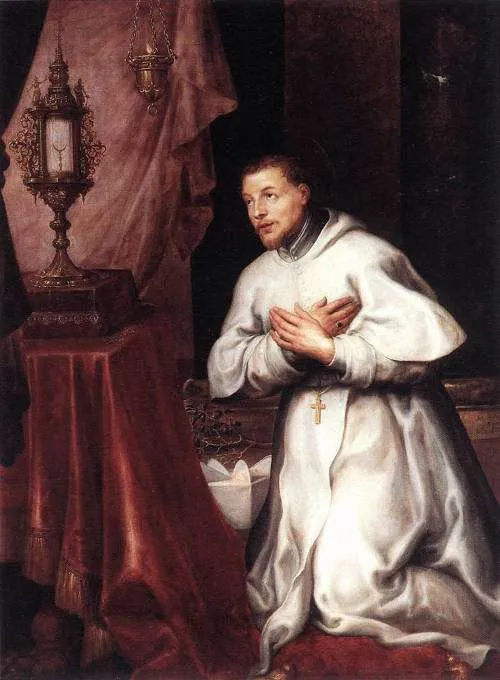
Father Norbert continued his traveling, founding, and preaching. While traveling through the city of Antwerp, in modern-day Belgium, Father Norbert came upon a large group of people who had started following a heretical itinerant preacher named Tanchelm. Among his heretical teachings was a denial of the true presence of Christ in the Eucharist. Tanchelm was so fierce that he even had his followers confiscate, desecrate, and discard the Eucharist in hidden places. To combat that heresy, Father Norbert preached powerfully, won over many of Tanchelm’s followers, and then commissioned them to gather up the desecrated hosts. When they found the hosts, they were discovered to be untouched and unsoiled, despite many of them being thrown into dirt and moisture. The hosts were gathered together, and Father Norbert carried them in procession back to the local church. For this reason, sacred art often depicts him carrying a monstrance or ciboria containing the Blessed Sacrament.

In 1126, Father Norbert and his companions traveled to Rome to obtain final papal approval for his new order from Pope Honorius II. On their way home, they traveled through the city of Würzburg, where Father Norbert cured a blind woman. He also cast out demons and restored peace between feuding noble families. The people were so impressed that they and others from Magdeburg rallied to have him appointed as their bishop. The king of the Germans and the papal legate agreed, and the pope appointed him as Archbishop of Magdeburg, a post Norbert reluctantly accepted.

Bishop Norbert served as archbishop for about eight years until his death. As archbishop, he continued to work on reforming the Church by weeding out immoralities among the clergy, resolving schisms, securing the right of the Church to govern itself without the interference of the civil authority, helping the Premonstratensian Order to grow, and preaching to the people, converting many.

Saint Norbert started his life as a worldly cleric, living a lavish lifestyle. After experiencing a profound encounter with God, he entered a period of deep prayer to more clearly discern God’s will. During this time, God took hold of him and never let go, leading him to great fruitfulness for the Church. If you find yourself pursuing worldly goals, let Saint Norbert’s story inspire you. Choose to focus on that which is eternal, and God will begin to work great spiritual transformations within your soul today.

Source: https://mycatholic.life/saints/saints-of-the-liturgical-year/june-6—saint-norbert-bishop/

Saint Norbert, Bishop Read More »