Author name: Sani

Matthew 12:1-2

Freedom From Condemnation

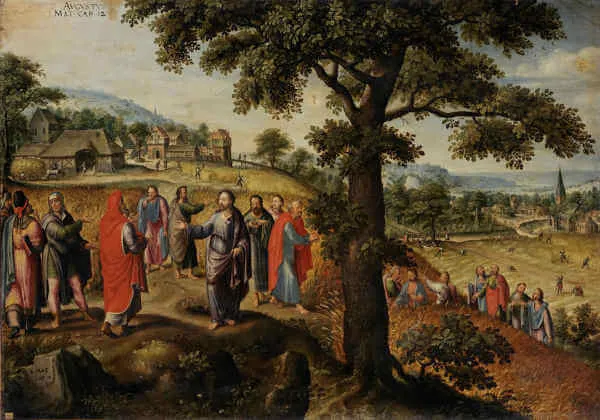
Jesus was going through a field of grain on the sabbath. His disciples were hungry and began to pick the heads of grain and eat them. When the Pharisees saw this, they said to him, “See, your disciples are doing what is unlawful to do on the sabbath.”

Reflection:

When Moses gave the Ten Commandments to the people, there was a prohibition against working on the Sabbath. The Third Commandment said, in part, that “you shall not do any work” on the Sabbath (Exodus 20:10). By the time of Jesus, the Pharisees had added much commentary to this law and expanded it to include as many as 39 different forms of work that they believed was forbidden. Included in their list were the practices of harvesting and milling of grain. For that reason, when the Pharisees saw that the disciples were picking heads of grain and rubbing the grain off the husks so that they could eat it, the Pharisees condemned them for violating what they interpreted to be an offense against the Third Commandment.

The first thing we can note from this passage is that the disciples were hungry. They were exceptionally devoted to Jesus and had been traveling with Him from town to town so that He could preach the Gospel. They had given up occupation, home, family and income so as to be singly devoted to Jesus and His mission. And as a result of this, they were living in poverty and relying upon the generosity of others. It is in this context that they chose to eat the most humble of foods: grain that they picked as they walked. They didn’t complain that there wasn’t a hot meal waiting for them at their destination. They were accepting of the many long journeys by foot that they made. They were okay with the fact that they did not get to sleep in their own bed every night. But they did have the basic human need for food, so they picked this grain as they walked to fulfill this basic need of hunger.

Though there are many lessons we can learn from this passage, one clear lesson is that of the temptation to judge and condemn others. When we fall into the trap of judging others, there are a few things that are common. First, judging and condemning often is based on perceived wrongs that are inflated and exaggerated. The Pharisees clearly inflated and exaggerated this “sin” of the disciples. In our lives, judgmentalness almost always makes the perceived sin of another far more serious than it is, if it is sin at all.

Another common temptation that flows from a judgmental and condemning heart is the failure to even understand the condemned party. In this case above, the Pharisees did not even inquire into the reason the disciples were picking and eating grain. They didn’t ask if they had been without food for some time or how long they had been traveling. It didn’t matter to them that they were hungry, and most likely, very hungry. So also with us, it is common that when we judge and condemn another, we arrive at our verdict without even seeking to understand the situation.

Lastly, it needs to be said that judging others is not our right. Doing so is usually reckless and caused by our own self-centeredness. God did not give the Pharisees the authority to expand the Third Commandment into 39 forbidden practices, nor did He give them the authority to apply those interpretations to the perceived actions of the disciples. And God does not give us the authority to judge others either. If another is clearly caught in a cycle of objectively grave sin, we must do all we can to help draw them out of that sin. But even in that case, we have no right to judge or condemn.

Reflect, today, upon any tendency you have toward being judgmental and condemning of others. If you see this tendency within yourself, spend time thinking about the Pharisees. Their self-righteousness was ugly and damaging. The negative example they set should inspire us to turn away from such acts of condemnation and to reject those temptations the moment they come.

Source: https://catholic-daily-reflections.com/2025/07/17/freedom-from-condemnation-4/
Matthew 12:1-2 Read More »

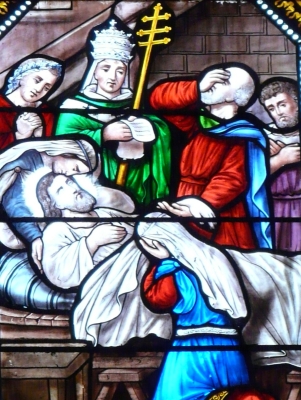
Saint Alexius of Rome

Profile

Alexius was the only son of a wealthy Christian Roman senator. The young man wanted to devote himself to God, but his parents arranged a marriage for him. On his wedding day, his fiancée agreed to release him and let him follow his vocation. He fled his parent‘s home disguised as a beggar, and lived near a church in Syria. A vision of Our Lady at the church pointed him out as exceptionally holy, calling him the “Man of God”. This drew attention to him, which caused him to return to Rome, Italy where he would not be known. He came as a beggar to his own home. His parents did not recognize him, but were kind to all the poor, and let him stay there. Alexis lived for seventeen years in a corner under the stairs, praying, and teaching catechism to small children. At his death, an unseen voice was heard to proclaim him ‘The Man of God’, and afterwards his family found a note on his body which told them who he was and how he had lived his life of penance from the day of his wedding until then, for the love of God.

Died

  • early 5th century

Canonized

  • Pre-Congregation

Patronage

  • Alexians
  • beggars
  • belt makers
  • nurses
  • pilgrims
  • travelers

Representation

  • dying man with a letter in his hand
  • man holding a ladder
  • man in a pilgrim‘s habit holding a staff
  • man lying beneath a staircase
  • man lying on a mat
  • old and very ragged beggar with a dish
  • dish
  • old man dressed as a pilgrim
  • cross
  • palm (his sufferings and patience led some to consider him a martyr)

Source: https://catholicsaints.info/saint-alexius-of-rome/

Saint Alexius of Rome Read More »

Matthew 11:29-30

The Yoke of Christ

“Take my yoke upon you and learn from me, for I am meek and humble of heart; and you will find rest for yourselves. For my yoke is easy, and my burden light.”

Reflection:

For those first followers of Jesus, a “yoke” was a familiar term. Many would have worked with oxen and other animals on a regular basis to plow their fields. To do so, they would place a wooden yoke over the oxen, which was a form of harness that was also attached to the plow, making it easier for the oxen to till the soil. To be strapped with a yoke was an indication of servitude, since that was the role of the oxen.

In commenting upon this passage, Saint Augustine (in Sermon 126) analogized the yoke of Christ with the wings of a bird. A bird’s wings are large in comparison to its body. As a result, if someone were to conclude that removing the wings from a bird would make its life easier by ridding it of that excess weight, such an action would have the effect of keeping it bound to the earth. But give its wings back and that “yoke” will enable it to soar through the skies.

So it is with the yoke of our Lord. If we accept the invitation to be a servant of God and we take upon ourselves the yoke of Christ for the fulfillment of our mission of service, we will discover that the act of serving lightens us, refreshes us, invigorates us and energizes us. Service of God is what we are made for, just as a bird is made to have wings. And like the bird, if we remove the yoke of service of God from our lives, then we are weighed down and cannot accomplish the good we are meant to do.

We are also told in this passage that we are not to carry our yoke; rather, we are meant to carry Christ’s yoke. “Take my yoke upon you…,” Jesus said. Carrying Jesus’ yoke means we are called to live our lives with Him and in Him. He came to serve and to give His life for others. It is our duty to do the same by allowing Him to do so within us. It is Christ and His servitude that must be the motivation and foundation of our lives.

Reflect, today, upon your call to be a servant in Christ. How is God calling you to serve? Whom is God calling you to serve? And as you answer that question, how do you see your act of service? Does service seem burdensome to you? Or do you understand that it is what you are made for? If you do see humble service as a burden, then perhaps that is because you have not actually tried to serve with and in Christ Himself. Try to ponder Jesus placing His yoke upon your shoulders. Say “Yes” to that act and to the mission of humble service you are called to fulfill. Doing so wholeheartedly will not only refresh you, it will also give meaning and purpose to your life.

Source: https://catholic-daily-reflections.com/2025/07/16/the-yoke-of-christ-4/

Matthew 11:29-30 Read More »

Our Lady of Mount Carmel

Late Twelfth–Early Thirteenth Century; Patron Saint of Bolivia and the Carmelite Order; Invoked for those in Purgatory

At the base of Mount Carmel, on the northwest coast of Israel, lies a Carmelite monastery named Stella Maris, Latin for “Star of the Sea.” This monastery is built over a cave believed to have been where the prophet Elijah, inspired by God, challenged 450 prophets of Baal in a contest to the death. Elijah triumphed. Shortly after, Elijah prophesied the end of a three-year drought when, in the passage above, his servant reported to him that he saw a “cloud as small as a man’s hand rising from the sea.” That small cloud quickly transformed into a heavy rainfall over the parched earth. Later Carmelites interpreted Elijah’s vision as a prefiguration of the Blessed Virgin Mary. She was seen as the small cloud rising from the sea, a true “Star of the Sea,” and the rain that would emerge from her to end the three-year drought was perceived as the grace and mercy poured out by her Son, Jesus.

It is believed that following the time of Elijah, other hermits emulated Elijah and his successor, Elisha, by becoming hermits in the caves of Mount Carmel. Although some traditions hold that these holy hermits embraced Christ and lived on this sacred mountain from the time of Christ, written records only confirm their presence from the thirteenth century onwards. It was then, in 1209, that a group of hermits asked Bishop Albert, the Latin Patriarch of Jerusalem, to provide them with a rule of life. Bishop Albert did so, and the Order of Brothers of The Blessed Virgin Mary of Mount Carmel, later known as the Carmelites, was formed. One of their first acts was to erect a chapel dedicated to Mary, Star of the Sea, Stella Maris. In 1226, their rule was approved by Pope Honorius.

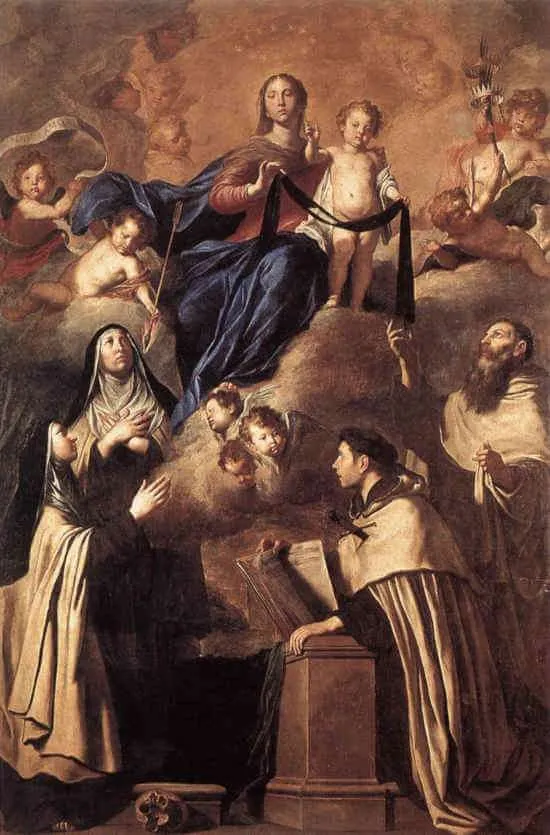
Shortly after the order’s founding on Mount Carmel, Muslim invaders conquered nearby territories, leading some of the hermits to flee from the Holy Land to other parts of Europe, including Aylesford, England. Though records are uncertain, it is believed that one of the first men to join the Carmelite hermits in England was a man named Simon Stock. The Carmelites were a new form of religious life, living as hermits rather than as a more ordered community like the Benedictines, Cistercians, and Augustinians. As a result, they found it challenging to gain wide acceptance. In 1247, Simon Stock is believed to have been elected Superior General of the Carmelites at the age of eighty-two. In an attempt to help the new order gain wider acceptance within the Church, Simon and his fellow hermits sought out the intercession of the Blessed Virgin Mary. She responded and, in 1251, appeared to Simon while holding the Christ Child in one arm and a brown scapular in the other. She said to him, “Receive, my beloved son, this habit of thy order: this shall be to thee and to all Carmelites a privilege, that whosoever dies clothed in this shall never suffer eternal fire…It shall be a sign of salvation, a protection in danger, and a pledge of peace.”

In the centuries that followed, the Carmelites continued to develop a deep devotion to the Blessed Virgin Mary, especially clothing themselves in the scapular habit and developing liturgies in her honor. In the fifteenth century, the Carmelite order expanded to include women in religious service and also developed into a lay third order. In 1726, Pope Benedict XIII placed this Carmelite devotion to our Blessed Mother on the universal calendar of the Church under the title of Our Lady of Mount Carmel.

Throughout the centuries, many popes have spoken in favor of the scapular and devotion to Our Lady of Mount Carmel. In 1908, the Congregation for Indulgences at the Vatican issued a summary of this devotion as follows:

It is permitted to the Carmelite Fathers to preach that the Christian people may piously believe in the help which the souls of brothers and members, who have departed this life in charity, have worn in life the scapular, have ever observed chastity, have recited the Little Hours of the Blessed Virgin, or, if they cannot read, have observed the fast days of the Church, and have abstained from flesh meat on Wednesdays and Saturdays (except when Christmas falls on such days), may derive after death—especially on Saturdays, the day consecrated by the Church to the Blessed Virgin—through the unceasing intercession of Mary, her pious petitions, her merits, and her special protection.

As we honor Our Lady of Mount Carmel, we honor not only our Blessed Mother but also her central role in the Carmelite orders and the devotions to her that they have promoted, especially the devotion of the scapular. Reflect on your own devotion to our Blessed Mother. If you wear the scapular, renew your faith in her motherly intercession that is obtained through this holy devotion. If you do not wear the scapular, consider doing so as an outward sign of your interior devotion to her and your trust in her intercession.

Source: https://mycatholic.life/saints/saints-of-the-liturgical-year/july-16—our-lady-of-mount-carmel/

Our Lady of Mount Carmel Read More »

Matthew 11:25

Rejoicing at the Gift of Faith

At that time Jesus exclaimed: “I give praise to you, Father, Lord of heaven and earth, for although you have hidden these things from the wise and the learned you have revealed them to the childlike.”

Reflection:

This passage is in stark contrast to the passage just before it in which Jesus chastised the towns of Chorazin, Bethsaida and Capernaum for not repenting and believing in Him. And as soon as Jesus issued those rebukes, He turned His eyes to Heaven and offered praise to the Father for revealing the hidden mysteries of the Kingdom of Heaven to those who were “childlike.”

One of the greatest threats to a pure and childlike faith is intellectual pride. Those who consider themselves as “wise and learned” are often tempted to rely upon their own reasoning abilities to come to conclusions and beliefs in life. The problem is that even though the matters of our faith are fully reasonable, they go beyond the conclusions that human reason alone can achieve. We cannot figure out God by ourselves. We need the gift of faith for that, and the gift of faith begins with a spiritual communication from God through which He reveals to us Who He is and what is true. Only the childlike, meaning, those who are humble, are able to hear this form of communication from God and respond.

This passage also reveals to us that Jesus passionately rejoices in this form of humble faith. He gives “praise” to the Father in Heaven for witnessing such faith, because Jesus knows that this form of faith originates from the Father. 

In your life, it is important that you regularly ponder whether you are more like the wise and learned or like those who are childlike. Though God is an infinite and incomprehensible mystery, He must be known. And the only way we can come to know God is if He reveals Himself to us. And the only way God will reveal Himself to us is if we remain humble and childlike.

As we come to childlike faith, we must also imitate the praise that Jesus offered the Father for the faith that He witnessed in the lives of His followers. We, too, must turn our eyes to those who clearly manifest this pure knowledge of God by the gift of faith. As we see this faith lived, we must rejoice and offer praise to the Father. And this act of praise must be given not only when we see faith alive in others, it must also be given when we see the gift of faith grow within our own soul. We must foster a holy awe of what God does within us, and we must rejoice in that experience.

Reflect, today, upon Jesus giving praise to the Father as He witnesses the faith born in the hearts of His followers. When Jesus looks at you, what does He do? Does He issue chastisements? Or does His Sacred Heart rejoice and give praise for what He sees. Give joy to the Heart of Christ by humbling yourself to the point that you, too, are counted among the childlike who truly know and love God. 

Source: https://catholic-daily-reflections.com/2025/07/15/rejoicing-at-the-gift-of-faith-4/

Matthew 11:25 Read More »

Saint Bonaventure, Bishop and Doctor

c. 1217–1274; Invoked against intestinal problems; Canonized by Pope Sixtus IV on April 14, 1482; Proclaimed the Seraphic Doctor of the Church by Pope Sixtus V in 1588

Saint Bonaventure was born sometime during the last decade of Francis of Assisi’s life and would be closely tied to the saint and his Franciscan order for all of his own life. Born in Civita di Bagnoregio, present-day Italy, the baby was baptized Giovanni di Fidanza, after his father. The region was then part of the Papal States, located about seventy miles north of Rome and fifty miles southwest of Assisi. At the time of Giovanni’s birth, the Franciscan order had expanded to include around 5,000 members in less than a decade.

As a child, Giovanni was miraculously healed by Saint Francis of Assisi and may have acquired the name Bonaventure as a result. According to one legend, when Francis cured Giovanni, the future saint exclaimed, “O buona ventura!” which translates to, “O good fortune!” Some biographies suggest that the cure may have occurred after Francis’ death through the intercession of Giovanni’s mother. Regardless, Saint Bonaventure later recounted the miracle, stating, “For I, who remember as though it happened but yesterday how I was snatched from the jaws of death, while yet a child, by his invocation and merits, should fear to be convicted of the sin of ingratitude did I refrain from publishing his praises.” Little else is known about Giovanni’s childhood.

As a young man, Giovanni traveled to Paris for his studies and joined the Franciscans in 1243, formally adopting the name Bonaventure. He stayed in Paris and embarked on a rigorous study regimen, with a special focus on the Sacred Scriptures and the Sentences of Bishop Peter Lombard. His doctoral thesis was titled Questions on the Knowledge of Christ. During his time in Paris, a theological battle was brewing between traditional academics and the new Franciscan and Dominican mendicant orders. Unlike previous orders that lived in large monasteries and sustained themselves by owning large tracts of land, these two new orders were traveling preachers living out the vow of poverty. Their novel approach to religious life, combined with their rapid growth, incited envy and suspicion within traditional academic circles. Father Bonaventure, a Franciscan, was at the forefront of this battle through his writings, in which he clarified the theological and Scriptural basis of the mendicant charism. After about fourteen years in Paris, Father Bonaventure was recognized as a Doctor and Master of Theology at the University of Paris. His Dominican counterpart, Father Thomas Aquinas, also received his doctorate degree on the same day, October 23, 1257.

The still-new Franciscan and Dominican orders were growing rapidly, necessitating solid guidance. Francis had always been reluctant to let his friars advance to further studies, as he was aware of the pitfalls academic pride could pose. Before his death in 1226, Francis appointed future-saint Anthony of Padua in charge of academics for the Franciscans. For the next twenty-five years, the Franciscans were trying to define their identity in the Church and to determine the future direction of the order. Should they remain simple, poor, and uneducated mendicant preachers? Or should some of them become university professors and leaders within the Church? God chose Father Bonaventure to help the Franciscans navigate these questions.

Within a year of Bonaventure’s receiving his doctorate in 1257, the Franciscans held a General Chapter, during which they elected him as the order’s Minister General. Father Bonaventure served in this leading role for the next seventeen years. It was truly an extraordinary time for the Franciscans. Forty years after Bonaventure’s birth, the Franciscans had grown from 5,000 friars to 30,000 and had spread across Europe, North Africa, the Middle East, and even China. Father Bonaventure had a monumental task ahead.

One of Father Bonaventure’s initial goals was to unify the Franciscans. There were many different views of their founder, numerous written legends, various interpretations of his charism, and a split within the order seemed likely. Father Bonaventure addressed this by gathering and unifying all the norms that governed the daily life of the friars. He then collected all the biographies of Saint Francis and wrote his own definitive biography based on the accounts of firsthand witnesses and the most reliable sources. In 1263, at a General Chapter in Pisa, Father Bonaventure’s biography was adopted by the order as the sole and authentic biography.

In 1265, the pope appointed Father Bonaventure as the Archbishop of York.  Bonaventure resisted, believing this not to be his calling. Before Bonaventure was even ordained, the pope allowed him to resign to continue his work as Minister General of the Franciscans.

Over the next nine years, Father Bonaventure continued to guide the Franciscans through their growing pains. He also wrote numerous letters, sermons, commentaries, and profound spiritual and mystical theological works. His theology was always very Christ-centered, just as Saint Francis had been fully Christ-centered. He understood and articulated the charism of their founder in a rich and theological way that remained faithful to the simple wisdom of Saint Francis. Saint Francis had always been concerned with the pitfalls that some experienced when they engaged in advanced theological studies. His concern was that for some, study did not lead to Christ; instead, it led just to intellectual theologizing. Father Bonaventure was aware of this concern and worked to ensure that his deep theological articulations fostered personal faith and love of God, rather than just intellectual knowledge. He was also deeply devoted to the Mother of God. His profound and mystical writings would later result in Pope Sixtus V naming him the Seraphic Doctor of the Church.

Father Bonaventure had gained such a reputation that popes regularly sought his counsel. In 1274, Pope Gregory X ordained him a bishop and appointed him as a cardinal. He then tasked him with guiding the significant Second Council of Lyon, which aimed at restoring the unity of the Eastern and Western Churches. Before the council concluded, for unknown reasons, Cardinal Bonaventure passed away at the age of fifty-six.

Saint Bonaventure was, in many ways, the new face of the new Franciscan order. God inspired the order through Saint Francis and shortly after, He directed the zeal of its members through Saint Bonaventure’s profound mystical wisdom.

As we honor this great saint, ponder, especially, his intellectual approach to the faith. He was brilliant, but he always used that brilliance to point others to an authentic conversion of heart. He didn’t engage in theology for the sake of theology; he did it for the love of Christ, in imitation of the charism of Saint Francis. Ponder your own knowledge of Christ and pray to this Seraphic Doctor, asking him to intercede for you so that your knowledge of Christ will lead you and others to a deeper love of Christ Himself.

Source: https://mycatholic.life/saints/saints-of-the-liturgical-year/july-15—saint-bonaventure-bishop-and-doctor/

Saint Bonaventure, Bishop and Doctor Read More »

Matthew 11:21-22

Becoming Lukewarm

“Woe to you, Chorazin! Woe to you, Bethsaida! For if the mighty deeds done in your midst had been done in Tyre and Sidon, they would long ago have repented in sackcloth and ashes. But I tell you, it will be more tolerable for Tyre and Sidon on the day of judgment than for you.”

Reflection:

Chorazin and Bethsaida were Jewish towns that Jesus visited frequently to preach and to perform many “mighty deeds.” They were located just north of His city of residence, Capernaum. Tyre and Sidon were pagan coastal cities northeast of Chorazin and Bethsaida, in modern-day Lebanon, and were towns known for their immoral living. Though Jesus did not spend much time in those cities, He did visit them at times. During Jesus’ first recorded visit there, recall His encounter with the Syrophoenician woman who begged Him to heal her daughter (Matthew 15:21–28). The Gospel passage quoted above took place prior to Jesus making that journey.

Why was Jesus so harsh toward the towns He spent so much of His time in. Why did He rebuke Chorazin, Bethsaida and Capernaum? To answer this, it’s important to remember that Jesus spent most of His time preaching to the “lost sheep of the house of Israel.” In other words, His primary mission during His public ministry was to share the Gospel with those who were descendants of Abraham and had been entrusted with the Law of Moses, the teachings of the prophets and the liturgical rites. For that reason, Jesus not only preached with perfection to these people, He also did miracle after miracle. And though there were many who did believe in Him and became His disciples, there were many others who were indifferent or who flatly refused to believe in Him.

Today, Chorazin, Bethsaida and Capernaum could be seen as symbols of those Catholics who were born and raised in the faith and were given good formation by their parents and others. Many parents whose children have gone astray from the faith wonder what they did wrong. But the truth is that even Jesus Himself was rejected, despite His perfect preaching, perfect charity and undeniable miracles. And the same happens today. There are many who, despite being raised within the holy faith given to us by Christ Himself, reject that faith and turn a blind eye to the Gospel and the Church.

Jesus’ rebuke of those towns should echo today in the minds of those who, despite being given so much in regard to a good upbringing, have rejected God. Of course, that rejection is not always absolute and total. More often, it is a rejection in degrees. First, the rejection comes in the form of missing Mass. Then moral compromises. Then a lack of faith. And eventually confusion, doubt and a complete loss of faith sets in.

If you are one who has started down the road of becoming more and more lukewarm in your faith, then the rebuke of these towns by Jesus should be understood to also be directed at you in love. “Every one to whom much is given, of him will much be required…” (Luke 12:48). Therefore, to those who have been taught the faith well, much is expected. And when we fail to live up to that which is demanded of us by God out of love, a holy rebuke is exactly what we need.

Reflect, today, upon whether the rebuke Jesus issues toward these towns is also issued toward you. Have you been blessed with a good formation in the faith? If so, have you done all you can to help nourish that faith and grow in your love of God? Or have you allowed your faith to dim, to become lukewarm and to begin to wither and die? If you have been given much, have been raised in the faith and have been privileged with good examples in your life, then know God expects much of you. Answer that high calling that is given to you and respond to God with all your heart.

Source: https://catholic-daily-reflections.com/2025/07/14/becoming-lukewarm-4/

Matthew 11:21-22 Read More »

Saint Kateri Tekakwitha

1656–1680; Patron Saint of Canada, Native Americans, ecologists, environment, exiles, orphans, people ridiculed for their piety, and the physically impaired; Canonized by Pope Benedict XVI on October 21, 2012

Jesuit missionaries arrived in modern-day Canada in 1625. By 1636, Saint Isaac Jogues and his companions made their way to present-day Auriesville, New York. After being captured and imprisoned by the Mohawks, they escaped but courageously returned to continue sharing the Gospel. They were martyred the following year, in 1646. Ten years later, in the area of their martyrdom, Saint Kateri Tekakwitha was born. There is little doubt that the blood spilt by these first North American martyrs helped to fuel the faith of this first Native American saint.

Tekakwitha was her given Mohawk name as a child, a name which might mean “she who bumps into things.” This could be due to the fact that she had poor eyesight and felt her way around. Alternatively, her name might also mean, “she who puts things into order.” Her mother was a Christian from the Algonquin tribe who had been taken captive and later forced to marry a Mohawk chief when her village was raided by the Mohawks. The couple had two children, Tekakwitha and her younger brother. When Tekakwitha was four years old, smallpox ravaged her village, taking the lives of her parents and baby brother. The disease left Tekakwitha’s face scarred and her vision blurred, making it difficult to see in sunlight. After her parents’ death, her aunt and uncle adopted her.

Though Tekakwitha was never baptized by her Christian mother, she did learn about the Catholic faith and embraced it from an early age. Perhaps her mother’s premature death prompted her to cherish the lessons she learned from her as a young child. Her aunt and uncle, however, were not Christian, and they encouraged her to abandon her beliefs. Tekakwitha’s daily life consisted of chores and playtime with other girls. She worked in fields of corn, beans, and squash; picked roots in the forest used for medicines and dye; gathered firewood; and became proficient at working with beads and basket weaving. She also spent long periods of time alone in the woods where she practiced her faith, reflecting and praying the best she could, given her limited Christian formation.

When Tekakwitha was around the age of thirteen, in accord with tribal custom, her uncle arranged for her to be married to a young man her age. When told of her engagement, she refused it. “I have consecrated myself entirely to Jesus, the Son of Mary, and He alone I have chosen as a husband, and He alone will take me for a wife.”

Around this time, the French settlers entered into a peace treaty with the Mohawk. As a result, Jesuits were permitted to enter the settlement and begin sharing the faith. One day, Tekakwitha met Father Jacques de Lamberville and announced to him, “My name is Tekakwitha and I wish to become a Christian.” Around the age of eighteen, Tekakwitha became a catechumen and diligently studied the Catholic faith. On Easter Sunday, 1676, at the age of twenty, she was baptized and took the name Catherine, Kateri in Mohawk, after Saint Catherine of Siena.

After her baptism, Kateri was persecuted and ridiculed by others within her settlement. Because she would not work on Sundays, she was refused food on those days. Children taunted her and threw rocks at her in response to their parents’ criticism. She was even threatened with torture and death. One year after Kateri’s baptism, Father de Lamberville encouraged her to secretly move 200 miles north to their Catholic settlement near Montreal, the Mission of Saint Francis Xavier. He sent with her a letter to those at the mission in which he stated, “Guard well this treasure and you will soon discover the jewel that I have sent you.” It took Kateri two months to travel through forests to reach the mission. Once she arrived, her evident devotion resulted in permission to make her First Holy Communion earlier than most converts, which took place on Christmas Day of that same year, surrounded by other faithful Catholics.

For the next two and a half years, Kateri embraced her faith with profound devotion. She attended Mass daily, often twice a day, and spent most of her free time in the chapel, praying on her knees. She entered into deep trances, and her spirit would be snatched up to Heaven for a time. When this happened, the countenance of her face would become lovely to behold. She not only prayed profoundly, she also inflicted severe penances upon herself, grew in virtue, was known for her exceptional kindness, and loved praying the rosary, which she wore around her neck. She often made crosses out of sticks and placed them in the forest so she would be reminded to pray every time she came upon one. Her personal motto was, “Who can tell me what is most pleasing to God that I may do it?” Though she could not read or write, she memorized many Bible stories and would tell others those stories with great delight and inspiration.

On March 25, 1679, with the assistance of her spiritual director, Kateri made a private vow of perpetual virginity. She had wanted to found a religious order for native girls but was prohibited from doing so because of her poor health. One year later, after her health continued to deteriorate, she died at the age of twenty-four. She had spent four years as a baptized Christian and one year as a consecrated virgin. As soon as she died, the scars on her face disappeared, and God made her face as beautiful as her soul. Word of her death spread rapidly from village to village, all across New France (Canada) and even to the Royal Court. “The saint has died!” they said. Everyone knew who the “saint” was. After her death, many miracles took place, especially for those who prayed at her tomb, including many deep conversions.

Saint Kateri Tekakwitha has been given the affectionate name, “Lily of the Mohawks.” A lily is a symbol of purity, which Kateri manifested in her life. Lilies bloom only for a short time, just as her life was short. Though her life was largely hidden, her virtues, prayer life, and deep union with God were on display for all to see. She stood out for her wholehearted determination to please God in everything she did. Not only did she inspire other natives in her settlement, she even deeply inspired the Jesuit priests who ministered to her. It was they who wrote and told her story.

As we honor Saint Kateri today, ponder the calling God gives to us all to become pure and holy, and to radiate that purity of heart in such a way that others take note. Allow Saint Kateri to inspire you to follow her example, and try to embrace her motto as your own, “Who can tell me what is most pleasing to God that I may do it?”

Source: https://mycatholic.life/saints/saints-of-the-liturgical-year/july-14—saint-kateri-tekakwitha-virgin—usa-memorial/

Saint Kateri Tekakwitha Read More »

Matthew 10:37-38

Authentic Love

“Whoever loves father or mother more than me is not worthy of me, and whoever loves son or daughter more than me is not worthy of me; and whoever does not take up his cross and follow after me is not worthy of me.”

Reflection:

At first read, this appears to be a difficult teaching of our Lord. But when properly understood, it is clear that it helps us keep our relationships with God and with our family properly ordered in charity and truth. Following this command will never result in a lack of love for family; rather, it will help us to love solely with the heart of Christ.

What does this teaching of Jesus require of us? Simply put, if a family member, or anyone else, imposes expectations on us that are contrary to the will of God, then we must choose the will of God over those other expectations. To understand this more clearly, think about how one might choose to love “father or mother” or “son or daughter” more than God. Say, for example, that a child chooses to go astray in their moral or faith life, and they want their parents to support them in their sin. But the parents remain firm in their moral convictions and, out of love, offer no support for the immoral lifestyle their child has chosen. This would become especially difficult for the parents if the child becomes angry and criticizes the parents, with the claim that the parents are being judgmental and are lacking in love. What the child is actually requesting is “Mom and dad, you must love me more than God and His laws.” And if the parents do not support their child’s misguided lifestyle, the relationship may be deeply wounded. Perhaps that is one of the reasons that Jesus followed this command by saying, “and whoever does not take up his cross and follow after me is not worthy of me.” Love always involves the Cross. At times, it is a cross of personal self-sacrifice and self-giving. And at other times, it’s a cross by which our love is misunderstood, and we are deemed as “unloving” by those we actually love the most. When parents truly love their child, they will care first and foremost for their child’s eternal salvation and moral living, and they will not choose “friendship” with their child over truth.

Of course, this same truth applies to every relationship we will have and even to our “relationship” to society as a whole. More and more, there are those who demand of us all that we support them in behaviors that are objectively disordered and contrary to the will of God. We are told that if we oppose these choices that some make, then we are judgmental and hateful. But this is exactly what Jesus is speaking about. If we choose to “love” others more than God and His holy will, meaning, if our first priority is to make people “feel” supported in the immoral and confused decisions they make, then we are not actually loving them at all. At least not with the love of God. Instead, we are prioritizing their sin over the truth they so deeply need to know so as to be set free and to enter into an authentic relationship of love with the God of Truth.

Reflect, today, upon true love. Love is only true love when it is grounded and centered in God and every moral law He has set forth. Reflect upon your own relationships, especially with family and those closest to you. Do you love them with the pure love of God? Does your love remain firmly rooted in the will of God? Or do you, at times, choose to compromise the truths of faith and morality so as to appease the misguided expectations of others. Kindness, gentleness and compassion must always be present. But moral truth must also be just as present and must be the foundation of every virtue we exercise in our relationships with everyone. Do not be afraid to love others exclusively with the mind and heart of God. Doing so is the only way to have true love for everyone in your life so as to help save their souls.

Source: https://catholic-daily-reflections.com/2025/07/13/authentic-love-5/

Matthew 10:37-38 Read More »

Fifteenth Sunday in Ordinary Time

First Reading Deuteronomy 30:10-14

Moses said to the people:
“If only you would heed the voice of the LORD, your God,
and keep his commandments and statutes
that are written in this book of the law,
when you return to the LORD, your God,
with all your heart and all your soul.

“For this command that I enjoin on you today
is not too mysterious and remote for you.
It is not up in the sky, that you should say,
‘Who will go up in the sky to get it for us
and tell us of it, that we may carry it out?’
Nor is it across the sea, that you should say,
‘Who will cross the sea to get it for us
and tell us of it, that we may carry it out?’
No, it is something very near to you,
already in your mouths and in your hearts;
you have only to carry it out.”

Responsorial Psalm Psalms 69:14, 17, 30-31, 33-34, 36, 37

R. (cf. 33)  Turn to the Lord in your need, and you will live.
I pray to you, O LORD,
 for the time of your favor, O God!
In your great kindness answer me
 with your constant help.
Answer me, O LORD, for bounteous is your kindness:
 in your great mercy turn toward me.
R. Turn to the Lord in your need, and you will live.
I am afflicted and in pain;
 let your saving help, O God, protect me.
I will praise the name of God in song,
 and I will glorify him with thanksgiving.
R. Turn to the Lord in your need, and you will live.
“See, you lowly ones, and be glad;
 you who seek God, may your hearts revive!
For the LORD hears the poor,
 and his own who are in bonds he spurns not.”
R. Turn to the Lord in your need, and you will live.
For God will save Zion
 and rebuild the cities of Judah.
The descendants of his servants shall inherit it,
 and those who love his name shall inhabit it.
R. Turn to the Lord in your need, and you will live.

Second Reading Colossians 1:15-20

Christ Jesus is the image of the invisible God,
the firstborn of all creation.
For in him were created all things in heaven and on earth,
the visible and the invisible,
whether thrones or dominions or principalities or powers;
all things were created through him and for him.
He is before all things,
and in him all things hold together.
He is the head of the body, the church.
He is the beginning, the firstborn from the dead,
that in all things he himself might be preeminent.
For in him all the fullness was pleased to dwell,
and through him to reconcile all things for him,
making peace by the blood of his cross
through him, whether those on earth or those in heaven.

Alleluia Cf. John 6:63c, 68c

R. Alleluia, alleluia.
Your words, Lord, are Spirit and life;
you have the words of everlasting life.
R. Alleluia, alleluia.

Gospel Luke 10:25-37

There was a scholar of the law who stood up to test Jesus and said,
“Teacher, what must I do to inherit eternal life?”
Jesus said to him, “What is written in the law?
How do you read it?”
He said in reply,
“You shall love the Lord, your God,
with all your heart,
with all your being,
with all your strength,
and with all your mind,
and your neighbor as yourself.”
He replied to him, “You have answered correctly;
do this and you will live.”

But because he wished to justify himself, he said to Jesus,
“And who is my neighbor?”
Jesus replied,
“A man fell victim to robbers
as he went down from Jerusalem to Jericho.
They stripped and beat him and went off leaving him half-dead.
A priest happened to be going down that road,
but when he saw him, he passed by on the opposite side.
Likewise a Levite came to the place,
and when he saw him, he passed by on the opposite side.
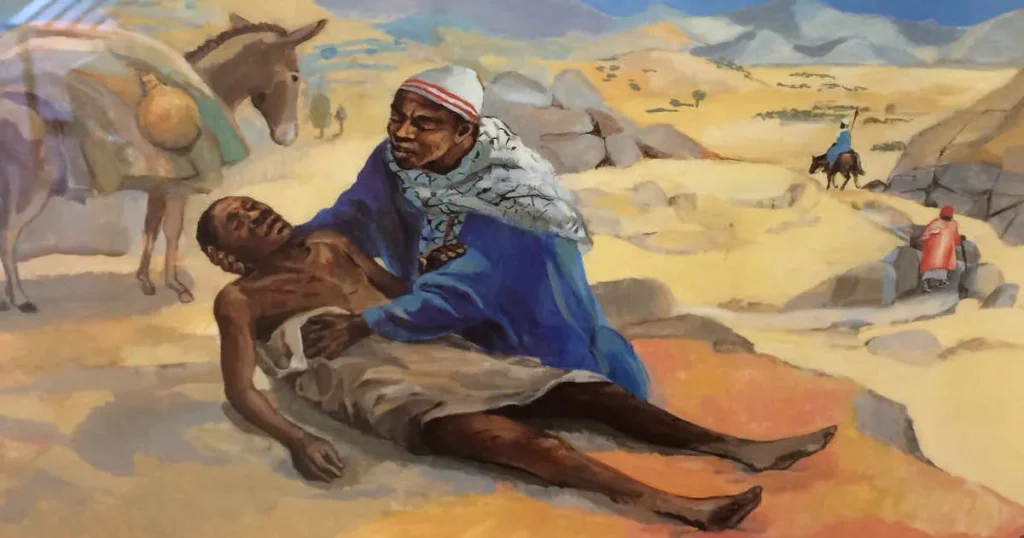
But a Samaritan traveler who came upon him
was moved with compassion at the sight.
He approached the victim,
poured oil and wine over his wounds and bandaged them.
Then he lifted him up on his own animal,
took him to an inn, and cared for him.
The next day he took out two silver coins
and gave them to the innkeeper with the instruction,
‘Take care of him.
If you spend more than what I have given you,
I shall repay you on my way back.’
Which of these three, in your opinion,
was neighbor to the robbers’ victim?”
He answered, “The one who treated him with mercy.”
Jesus said to him, “Go and do likewise.”

Source: https://bible.usccb.org/bible/readings/071325.cfm

Fifteenth Sunday in Ordinary Time Read More »