Author name: Sani

Luke 11:5-6

Praying with Fervor and Detachment

Jesus said to his disciples: “Suppose one of you has a friend to whom he goes at midnight and says, ‘Friend, lend me three loaves of bread, for a friend of mine has arrived at my house from a journey and I have nothing to offer him…’” 

Reflection:

Unless your friend were truly a very close friend, you may hesitate in waking them and their family at midnight to ask to borrow some food. And even if it were a very close friend, you would probably hesitate for fear of disturbing them. But in this parable, the “friend” is God. Jesus just finished giving His disciples the “Our Father” prayer, and now He adds this parable as a way of expressing the great confidence and determination with which we must pray to the Father. The parable concludes by stating that even if the person in bed does not get up to meet the request, they will do so “because of his persistence.” And though God always is attentive to our prayer, our persistence is an essential quality we must have.

When we pray to God with persistence, never doubting the goodness and generosity of God, God will pour forth upon us everything that is good. Of course, if our prayer is for something that is selfish or not in accord with the will of God, then all the begging in the world will not be effective. But when we pray as the “Our Father” prayer teaches us, then we can be certain that our fidelity to that prayer, prayed with the utmost trust and persistence, will effect the good gifts of the will of God in our lives.

One of the seven petitions of the “Our Father” prayer is “Thy Kingdom come, Thy will be done on earth as it is in Heaven.” This is a truly beautiful petition that requires not only ongoing persistence but also detachment from our preference in life. To pray that “God’s” will be done and that “His” Kingdom come is a way of also saying that you surrender all of your preferences to God. You come to God acknowledging that your will may not be God’s will. Thus, this petition expresses detachment in a powerful way.

Reflect, today, upon the importance of praying with the utmost fervor and persistence to God. Reflect, also, upon the importance of doing so with detachment. What does God want of you? What is His holy will for your life? Seek that will and that will alone with all your heart and you will discover that His will truly will come to be in your life.

Source: https://catholic-daily-reflections.com/2025/10/08/praying-with-fervor-and-detachment-4/

Luke 11:5-6 Read More »

Saint Faustina Kowalska, Virgin

1905–1938; Patron Saint of The Divine Mercy devotion; Canonized by Pope John Paul II on April 30, 2000

Helen Kowalska was born the third of ten children in the village of Glogowiec, Poland, which was then under the control of the Russian Empire. Poland regained its independence thirteen years later, in 1918, after World War I. The Kowalskas were quite poor, but they had a rich Catholic faith and held onto their vibrant Polish culture in the face of Russian attempts to eliminate it. As a child, Helen received only three years of schooling but loved to pray, was pious, obeyed her parents, and was sensitive to human suffering. She would later write in her Diary, “From the age of seven, I experienced the definite call of God, the grace of a vocation to the religious life.” At that time, she relates that she first heard God speak to her in her soul and sensed “an invitation to a more perfect life.” When she asked her parents about becoming a nun, they repeatedly refused. At the age of fourteen, Helen left her family home and became a housemaid in the nearby city to help financially support her family. After her parents refused her permission to enter religious life again when she was eighteen, she relates “I turned myself over to the vain things of life, paying no attention to the call of grace, although my soul found no satisfaction in any of these things.” Despite her refusals of grace, Jesus was persistent.

One day, in her eighteenth year, she was at a dance with her sisters. Everyone was having fun at the dance, but Helen was experiencing “deep torments.” As she started to dance, she suddenly had a vision of Jesus at her side—bloodied, beaten, racked with pain, and stripped of His clothing. Jesus said to her, “How long shall I put up with you and how long will you keep putting Me off?” Soon after, Helen sneaked away to the Cathedral of Saint Stanislaus Kostka where she fell prostrate before the Blessed Sacrament and begged God for direction. As she prayed, she heard these words, “Go at once to Warsaw; you will enter a convent there.” She went home, told her sister to say goodbye to her parents, and took the train seventy-five miles to Warsaw with only the dress on her back.

Once Helen got off the train, she prayed to the Mother of God who directed her to a small town where she was given lodging for the night. The next day, while praying in a nearby church, she heard Jesus tell her, “Go to that priest and tell him everything; he will tell you what to do next.” The priest arranged for Helen to stay with a holy woman of the parish for the time. During her brief stay, Helen began knocking on the door of every convent she could find, but they all turned her down. Finally, she knocked on the door of the Congregation of the Sisters of Our Lady of Mercy where the mother superior sent her to the chapel to pray and ask Jesus if He accepted her. Helen then went to the chapel to pose the question to Jesus, and He responded, “I do accept; you are in My Heart.” When Mother Michael asked Helen what Jesus’ response was, Helen told her Jesus accepted her. Mother Michael then responded, “If the Lord has accepted, then I also will accept.” To test Helen’s vocation, Mother Michael sent her away for a year to make some money for her wardrobe. Mother Michael later wrote about this encounter in her diary, stating that Helen “was no one special.” After a year of working as a housemaid near Warsaw, Helen returned to the convent on August 1, 1925, and at the age of twenty was accepted into the Congregation of the Sisters of Our Lady of Mercy. Of that day, she later wrote, “I felt immensely happy; it seemed to me that I had stepped into the life of Paradise. A single prayer was bursting forth from my heart, one of thanksgiving.”

Within a few weeks, however, Helen was frustrated with the convent’s busy schedule and lack of prayer time, so she decided to leave. The night before she was going to tell Mother Michael of her decision, Jesus appeared to her in her cell, beaten and bloody. When she asked Jesus who did this to Him, He responded, “It is you who will cause Me this pain if you leave this convent. It is to this place that I called you and nowhere else; and I have prepared many graces for you.” With that, she changed her mind, went to Krakow to finish her novitiate, and on April 30, 1926, she received the habit and was given the name Sister Maria Faustina of the Blessed Sacrament.

Sister Faustina spent the next twelve years of her life in various convents of the Sisters of Our Lady of Mercy in Warsaw, Vilnius, Płock, and Kraków. It was in Kraków where she died on October 5, 1938, at the age of 33. Throughout her time as a religious sister, Sister Faustina worked primarily as a cook, gardener, and doorkeeper. Her daily duties were intertwined with incredible mystical experiences, in which Jesus regularly appeared to her to deliver to her His message of The Divine Mercy. Under obedience to her superiors, beginning in 1934, she diligently wrote down these visions and private revelations in six notebooks. These private revelations are now contained in a single book called The Diary of Saint Maria Faustina Kowalska: Divine Mercy in My Soul. The book and the devotions contained within it are among the most prominent devotions within the Church today.

In her diary, Saint Faustina articulates several ways that Jesus wants devotion to His Mercy to spread. The first way is by meditating upon the image of Divine Mercy. This image is of Jesus, with two rays of light shining from His Heart, one blue and one red, signifying the Sacraments of Baptism and the Eucharist. Jesus ordered that this image be painted and honored throughout the world, with the inscription “Jesus, I Trust in You” on the bottom. The second way is by instituting the Solemnity of Divine Mercy on the eighth day of Easter. Pope John Paul II added this solemnity to the universal calendar of the Church in the year 2000, when he canonized Saint Faustina. The third way is by praying the Chaplet of Divine Mercy, which Jesus Himself taught to Saint Faustina. The goal of this chaplet is to obtain mercy, trust in Christ’s mercy, and show mercy to others. The fourth way is by honoring the three o’clock hour every day, the hour in which our Lord died and poured forth His Mercy. Finally, Jesus wanted to raise up many apostles of Mercy, who both live mercifully toward others and help spread devotion to His Mercy.

Within two decades after Sister Faustina’s death, the messages of Divine Mercy spread far and wide. Her spiritual director, Father Michael Sopoćko, played a significant role in the initial spread. New religious congregations were founded to spread devotion to Divine Mercy, the image and prayers in the diary extended to other continents, and her diary became exceptionally popular across Poland. Today, the official biography of Saint Faustina, released by the Vatican at the time of her canonization, states, “The years she had spent at the convent were filled with extraordinary gifts, such as: revelations, visions, hidden stigmata, participation in the Passion of the Lord, the gift of bilocation, the reading of human souls, the gift of prophecy, or the rare gift of mystical engagement and marriage.” However, the Vatican actually banned her diary and every devotion attached to it in 1959, stating it had “serious theological reservations” because the diary had “an excessive focus on Faustina herself.” In 1965, then-Cardinal Karol Wojtyła received permission from the Vatican to open an initial informative process into Kowalska’s life and virtues, and submitted his positive findings two years later. However, it wasn’t until 1978, the year that Cardinal Wojtyła was elected Pope John Paul II, that the Vatican lifted its ban on Saint Faustina’s writings, and the process of her canonization was initiated, culminating in her canonization on the eighth day of Easter, 2000, the first universal Church celebration of Divine Mercy Sunday.

For reasons we will only understand in Heaven, God chose this poor, simple, devout, and humble young woman to deliver a message to the world that would become one of the most central and important messages ever delivered. The Divine Mercy of God must be accepted, pondered, lived, and given to others. Mercy is God’s love; it is everything and all things.

As we honor this great saint, ponder the fact that the message God gave to us through her was not for some previous generation; it is for today. Reflect upon your own devotion to The Divine Mercy. Do you pray the Chaplet, venerate the image, honor the three o’clock hour, participate in Divine Mercy Sunday, and seek to spread this sacred devotion as an apostle of Divine Mercy? Know that this is a universal invitation from God; it is an invitation and exhortation given to you. Commit yourself to the truths of Divine Mercy and allow that abundant Mercy to flood your soul.

Source: https://mycatholic.life/saints/saints-of-the-liturgical-year/saint-faustina-kowalska/
Saint Faustina Kowalska, Virgin Read More »

Luke 11:1

The Perfect Prayer

Jesus was praying in a certain place, and when he had finished, one of his disciples said to him, “Lord, teach us to pray just as John taught his disciples.”

Reflection:

What a great prayer for us to pray also, “Lord, teach us to pray…” Jesus’ response to this disciple was to present him with the “Our Father” prayer. Of this prayer, Saint Andre Bessette said, “When you say the Our Father, God’s ear is next to your lips.” The great mystical Doctor of the Church Saint Teresa of Ávila gave this advice while praying the Lord’s Prayer: “Much more is accomplished by a single word of the Our Father said, now and then, from our heart, than by the whole prayer repeated many times in haste and without attention.” And Saint Thérèse of Lisieux said that the “Our Father” prayer was one of the prayers she prayed when she felt so spiritually barren that she could not summon up a single worthwhile thought.

At the Holy Mass, when the priest invites the people of God to pray the “Our Father,” he says, in part, that this prayer is one that “…we dare to say.” This is an interesting statement which especially reveals the childlike boldness we are called to have as we pray this prayer sincerely from the heart. It is exceptionally bold to call God our “Father.”

Chapter 11 of My Catholic Worship, which offers a teaching on this perfect prayer, states the following about this boldness:

Each Christian is to see the Father as my Father.  We must see ourselves as God’s children and approach Him with the confidence of a child.  A child with a loving parent is not afraid of that parent.  Rather, children have the greatest trust that their parents love them no matter what.  Even when they sin, children know they are still loved.  This must be our fundamental starting point for all prayer.  We must start with an understanding that God loves us no matter what.  With this understanding of God, we will have all the confidence we need to call on Him.

Since many of us are very familiar with this ideal prayer taught to us by our Lord Himself, there is a temptation to pray this prayer in a somewhat rote way. We can easily fail to say it from the depths of our hearts, making each word our own, offered with the utmost confidence to our loving Father in Heaven.

How do you pray the Lord’s Prayer? Do you pray it out of habit, failing to fully comprehend and mean the words you pray? Most likely this is the case for many.

Reflect, today, upon this most holy prayer given to us by the Son of God Himself. He is the author of this perfect prayer, so we should use it as the foundation of all of our prayer. Try to follow the advice of Saint Teresa of Ávila quoted above. Take each word of that prayer and pray it slowly, intentionally and with love. Begin by acknowledging God as your Father. Ponder the infinite care He has for you as a perfect father would. See Him in a real, intimate, and personal way. This perfect prayer begins by acknowledging Who God is and then continues with seven perfect petitions. After praying the introduction to this prayer, pick one of the seven petitions to meditate upon so that the richness of this prayer will have a transformative effect upon your soul.

Source: https://catholic-daily-reflections.com/2025/10/07/the-perfect-prayer-4/

Luke 11:1 Read More »

Our Lady of the Rosary

In the twelfth and thirteenth centuries, the Albigensian heresy was flourishing in southern France. The Albigensians were Christian dualists who believed the Old Testament God was the source of the material world, which was evil, and the New Testament God was the source of the spiritual realm that was good. They rejected the sacraments and promoted extreme asceticism as a way of rejecting the material world.

In 1203, Saint Dominic was traveling through southern France on a diplomatic mission when he encountered this grave heresy. In the two decades to follow, he devoted himself wholeheartedly to rooting out this heresy through preaching and debates. Legend has it that at some point, frustrated with the difficulties he was facing in that mission, he retreated for a few days of prayer and fasting to beseech Our Lady for guidance. Our Lady appeared to him, giving him the Rosary, revealing the mysteries to be meditated upon during the fifteen decades, and exhorting him to preach the mysteries and to pray the decades as a spiritual weapon. The word “Rosary” comes from the Latin rosarium, which means “rose garden.” Each Hail Mary is a spiritual rose; together, they make up the garden of roses. Saint Dominic did as Our Lady instructed him and became quite successful in converting the heretics.

Today’s feast of Our Lady of the Rosary has its roots in a feast named Our Lady of Victory. In the late sixteenth century, the Muslims of the Ottoman Empire were expanding into southeastern Europe and the Mediterranean region. In 1571, Pope Pius V, who was a Dominican, formed an alliance between the Papal States, Spain, Venice, and several other smaller Christian states, called the Holy League, in order to stop Ottoman aggression. On October 7 of that year, the Holy League confronted the Ottoman navy in the Mediterranean, and the pope called upon all of Europe to pray the Rosary for victory. Victory was achieved. In gratitude, Pope Pius V instituted the Feast of Our Lady of Victory to be celebrated on the first Sunday of October every year. Two years later, Pope Gregory XIII changed the name to the Feast of the Holy Rosary. In 1671, the feast was extended to all of Spain, and in 1716, after another important victory against the Muslims, the feast was extended to the entire Church. In 1913, Pius X changed the date from the first Sunday in October to October 7 to preserve the Sunday celebration. Today, this feast is celebrated under the title of Our Lady of the Rosary as a mandatory memorial on the Roman Calendar.

Though war is always gravely unfortunate and should be avoided if at all possible, defense of one’s family and nation is a moral duty when an unjust aggressor attacks. In this case, prayer is the greatest weapon of war, and after the Mass, the Rosary is the greatest prayer to be prayed.

In addition to physical war to protect one’s nation, the Rosary is among the greatest spiritual weapons to fight against every form of evil. Often, even during times of national peace, spiritual chaos ensues. Today, due to instant worldwide communication technologies, we are well aware of the many spiritual evils that plague societies and peoples everywhere: wars, corruption, immoral living, flamboyant sins of the flesh, murders, thefts, crimes of hate, moral decay, poverty, and so much more. Rather than just criticizing and condemning such evils, praying the Rosary for those intentions is the best way to combat them.

As we celebrate this feast in honor of the holy Rosary and Our Lady, seek to renew your trust in her intercession, using this powerful spiritual weapon. Every crime, abuse, cruelty, hatred, and evil of any kind is first and foremost a spiritual defect. It is a sin. The greatest remedy for sin is repentance. The greatest method of winning over sinful hearts to repentance is through prayer, and one of the greatest forms of prayer is the Rosary. The Church, in its popes, bishops, and saints, has held up the Rosary throughout the centuries. Countless saints prayed its beads every day, offering a spiritual bouquet to Our Lady so she could, in turn, lavish the spiritual roses of that bouquet upon the world.

Source: https://mycatholic.life/saints/saints-of-the-liturgical-year/october-7—our-lady-of-the-rosary/

Our Lady of the Rosary Read More »

Luke 10:40-42

Fidelity to Daily Prayer

Martha, burdened with much serving, came to him and said, “Lord, do you not care that my sister has left me by myself to do the serving? Tell her to help me.” The Lord said to her in reply, “Martha, Martha, you are anxious and worried about many things. There is need of only one thing. Mary has chosen the better part and it will not be taken from her.”

Reflection:

In many ways, this statement of our Lord summarizes the most important and central message of the Gospel. We are all called to choose “the better part” every day.

Jesus was close friends with Martha, Mary and Lazarus. He frequently visited their home, which was only a short distance from Jerusalem. On this occasion, when Jesus was visiting their home, one of these siblings, Mary, had placed herself at Jesus’ feet, listening to Him and conversing with Him. Martha was busy with the important details of hospitality and appeared to be upset with Mary, so she confronted Jesus, asking Him to tell Mary to help her. But in so doing, she was also unknowingly trying to dissuade Mary from the most important purpose of her life.

As Mary sat at the feet of Jesus, she gave us an example of the most important focus we must have in life. Though our days will be filled with many necessary duties, such as cooking, cleaning, working, entertainment, and caring for others, we must never forget that which we were made for and that which we will be doing for all eternity: adoration of our glorious God.

Consider all that occupies your day. Though most of what you do may be important, do you daily take time out to adore our Lord, listen to Him and glorify Him through your prayer? We can often make time for many other important duties in life, as well as those that are not so important. We may spend hours on chores, immerse ourselves in movies, devote whole evenings to reading, fulfill our duties in the workplace, but only devote a minute or two each day, if even that, to silent prayer and adoration of our God!

What would happen to your life if you chose “the better part” for a full hour every day? What if you decided that the first hour of your day would be dedicated to an imitation of Mary in the Gospel passage and that you would do nothing but adore Jesus through silent prayer and meditation? At first, you may think of the many other tasks you could be doing at that moment. You may decide that you do not have the time for extended prayer every day. But is that true? Perhaps you are actually being Martha to yourself, saying to yourself that you should do more important things with your time and that Jesus will understand if you do not spend time with Him alone in adoration and prayer every day. If that is you, then be very attentive to this Gospel passage. In many ways, Jesus deeply desires to say this about you. He wants to say of you that you have chosen the better part for an extended period of time every day and that this will not be taken from you.

Reflect, today, upon that which is most important in life. Dispel excuses and temptations to simply fulfill all the other important duties of life, neglecting that which is most important. Reflect upon the simple truth that Jesus does want you to devote much time to Him every day for silent prayer and adoration. Do not give into excuses and distractions. Commit yourself to remain at the feet of Jesus, adoring Him, listening to Him and loving Him. If you do, you will find that your life is more ordered and that the time you spend in prayer bears more good fruit than every other important duty you fulfill every day.

Source: https://catholic-daily-reflections.com/2025/10/06/fidelity-to-daily-prayer-4/

Luke 10:40-42 Read More »

Saint Bruno, Priest

1030–1101; Patron Saint of possessed people; Equivalent canonization by Pope Leo X in 1514

Saint Bruno is believed to have been born into the wealthy and influential Hardebüst family in the city of Cologne, in modern-day Germany. His family’s status would have ensured him a good education and a successful career. As a teenager, he was sent to the prestigious Cathedral School of Rheims, in the Kingdom of France, about 200 miles from his hometown. After completing his studies, he returned to Cologne where he was made a canon at Saint Cunibert Church. It is most likely at that time that he was ordained a priest. In 1056, when Canon Bruno was about twenty-six years old, he was called back to Rheims by the bishop, given a canonry at the Cathedral, taught at the School of Rheims, and was later made rector of the school. These distinctions speak to his character, holiness, and intelligence. Canon Bruno spent the next twenty-plus years in this capacity, after which time he was made chancellor of the Archdiocese of Rheims.

While he was chancellor, a corrupt and worldly man named Manassès of Gournay was made Archbishop of Rheims. The honest canons firmly opposed the archbishop’s ways, and Canon Bruno led the way. The archbishop was deposed by a local council, but he appealed to the pope and became violent toward his opposition. Around this time, Bruno left Rheims, probably for Rome, until the matter was resolved. Finally in 1080, the pope deposed the archbishop, and there was a cry from the clergy and laity to appoint Bruno as the next archbishop. Bruno, however, had other plans. He resigned from his prestigious positions in Rheims and set out to answer God’s call to a new life.

Bruno is believed to have first traveled about 100 miles south to Molesme where he met with a monk and future founder of the Cistercian order, Saint Robert. After a short stay, he decided to travel farther south with six companions to found a new order under the authority of Bishop Hugh of Châteauneuf, Bishop of Grenoble. Bishop Hugh welcomed Bruno and his companions and told them about a dream he had in which he saw God build a house in the desert for His glory with seven stars showing the way. The bishop believed the seven men were the stars in his dream, so he enthusiastically supported their new mission. With the bishop’s support, Bruno and his companions traveled into the mountain country called Chartreuse, where they built hermitages and embraced a radical life of prayer, study, and manual labor. Peter the Venerable, an abbot of Cluny, later described their early life this way: “There, they continue to dwell in silence, reading, praying, and also undertaking manual work, especially in the copying of books. Within their cells, at the signal given by the church bell, they perform part of the canonical prayer. For Vespers and Matins, they all gather in church. On certain days of celebration they depart from this pace of life…They then have two meals, they sing in church all the regular hours and all, without exception, take their meal in the refectory.”

Bruno enjoyed about six years of solitude in Chartreuse when, in 1090, he was called to Rome by the pope. Pope Urban II, who was elected pope in 1088, found himself in serious conflict with the Holy Roman Emperor and Antipope Clement III. Pope Urban was Bruno’s former student and called on him to become a counselor to assist with the chaos. Bruno obediently went to the aid of Pope Urban, serving him quietly and personally within the Lateran Palace in Rome. Shortly after his arrival, however, the Holy Roman Emperor took Rome by force, and Bruno and Pope Urban had to flee.

Around the year 1091, Pope Urban wanted to make Bruno the Archbishop of Reggio, but Bruno once again opposed the idea, and the pope chose another. After pleading to return to his hermitage in Chartreuse, the pope agreed to allow him to found a new hermitage in Italy so he was closer and could be called upon if needed. He and some companions settled in the wilderness of Calabria where they built a hermitage named Sainte-Marie-de-la-Tour. Of this new life, Bruno wrote in a letter, “I am living in the wilderness of Calabria far removed from habitation. There are some brethren with me, some of whom are very well educated and they are keeping an assiduous watch for their Lord, so as to open to him at once when he knocks.” Bruno died in this hermitage a decade later.

Though Bruno never formally wrote a rule for his newly founded order, he did leave them a way of life. Twenty-six years after his death, statutes were written down that guided their monastic-hermitical vocation. Bruno was quickly considered a saint, but in keeping with their hidden vocation, the order never formally petitioned the pope to canonize him. Over the next five hundred years, the Carthusians grew to 198 monasteries with about 5,600 members. In 1514, during a general chapter of the order, a request was made to Pope Leo X to confirm Bruno’s merits and authorize a liturgical feast for the order. The pope approved and granted an equipollent (equivalent) canonization, which required no lengthy process, but was done solely on the pope’s authority. In 1623, that Carthusian feast was extended to the entire Church and placed on the Roman Calendar.

It is often said that the Carthusian Order is the only order that has never needed to be reformed. The hermit-monks have stayed true to their statutes from the beginning, and remain so today. They live the most radical form of religious life in the Church. They accept no visitors, exist in absolute solitude together, live contemplative lives, embrace penances, intercede for the Church and world, and seek perfect union with God.

“Our principal endeavor and our vocation is to devote ourselves to the silence and solitude of the cell. It is holy ground, the place where God and his servant frequently converse, as between friends. There, the faithful soul is often united to the Word of God, the bride with her Spouse, earth is joined to heaven and the human to the divine” (Statutes 4.1). Furthermore, they live solitude in community: “The grace of the Holy Spirit gathers solitaries together to form a communion in love, as an image of the Church, which is one, though spread throughout the world” (Statutes 21.1). They gather several times a day in their chapel for communal prayer, in addition to long periods of private prayer in their hermitages. Though the monks refrain from talking during the week, they go for a two-hour walk on Sunday during which they freely converse. Though separated from the world, their lives are dedicated to ongoing prayer for the Church and world, and they give a silent witness to the world of that which is most important: union with God.

As we honor Saint Bruno today, we also call to mind the radical life of solitude and prayer that he and so many Carthusians have lived after him. Allow their witness to call you to a life of deeper prayer and solitude. Ponder the ways that the busyness of life and the anxieties of the world need to be purged from your life. Consider spending more time alone, in prayer, detached from all that distracts you. Many hermits have discovered the infinite joy of union with God in prayer and solitude. Once this union is discovered, it sheds light on the foolishness of a worldly life and the shallowness it presents. Allow Saint Bruno to speak to you by the witness of his life so that you will be among those who discover what he discovered.

Source: https://mycatholic.life/saints/saints-of-the-liturgical-year/october-6–st-bruno/

Saint Bruno, Priest Read More »

Luke 10:25

Openness to the Gospel

There was a scholar of the law who stood up to test Jesus and said, “Teacher, what must I do to inherit eternal life?”

Reflection:

The question is very good. We should all seek to understand, with all our hearts, what we must do to inherit eternal life. Of course the problem is that this scholar of the law did not ask this question with sincerity and openness. Rather, he asked Jesus this question to test our Lord. This scholar, as well as other scribes, Pharisees, Sadducees and elders, was envious of Jesus and sought to find fault with Him. This scholar appeared to be concerned that Jesus was teaching contrary to the Law of Moses. But what does our Lord do? He says nothing more than to put the question back to the scholar, asking him, “What is written in the law? How do you read it?” The scholar answers correctly, according to the Law of Moses, and Jesus responds to him, “You have answered correctly; do this and you will live.” Thus, the test was passed.

What’s interesting and helpful to ponder in this exchange is the way Jesus responds to this scholar. Because Jesus knew the scholar’s heart, and because He knew that this scholar was not asking with humility and openness, Jesus responded with great prudence, inviting the scholar of the law himself to answer his own question. Though we are not able to read another’s heart in the way our Lord did, we should learn a lesson from Him on how to respond to others who have as their goal to trick, trap, test, and twist our words if they disagree with us. This is especially important in matters of faith and morality. If you are striving to live the Gospel with all your heart and you encounter the “testing” of others as a result of the holy life you are striving for, ponder Jesus’ actions here. Too often, when another challenges us or tests us, we become defensive and even offended. As a result, we can enter into arguments back and forth that bear little or no fruit. Jesus did not argue. He did not allow this test to trip Him up. Rather, He only offered responses that could not be doubted. Jesus knew that this scholar was not interested in the deepest spiritual truths. He was only interested in finding fault. Therefore, the deeper and fuller Gospel message could not be offered.

We should also learn from this passage the importance of coming to Jesus with an open heart, sincerely seeking the deepest spiritual answers to life. We ought never test Jesus. Instead, in humility, we must believe that He is the source of all truth and that He has every answer in life that we seek.

Reflect, today, upon two things. First, reflect upon how completely open you are to all that Jesus has to say. If you were to ask our Lord this question, “What must I do to inherit eternal life?,” what would Jesus say to you? Would He only be able to offer you general answers in the form of questions? Or would Jesus see the open and sincere nature of your heart and be able to speak in great depth and detail to you? Second, reflect upon anyone with whom you constantly have to defend yourself for the practice of your faith. If this is your experience, perhaps reexamine your approach, realizing that the deepest pearls of your faith should only be shared with those who are sincerely open and are seeking to embrace them with all their heart.

Source: https://catholic-daily-reflections.com/2025/10/05/openness-to-the-gospel-4/

Luke 10:25 Read More »

Twenty-seventh Sunday in Ordinary Time

First Reading Habakkuk 1:2-3; 2:2-4

How long, O LORD?  I cry for help
 but you do not listen!
 I cry out to you, “Violence!”
 but you do not intervene.
 Why do you let me see ruin;
 why must I look at misery?
 Destruction and violence are before me;
 there is strife, and clamorous discord.
 Then the LORD answered me and said:
 Write down the vision clearly upon the tablets,
 so that one can read it readily.
 For the vision still has its time,
 presses on to fulfillment, and will not disappoint;
 if it delays, wait for it,
 it will surely come, it will not be late.
 The rash one has no integrity;
 but the just one, because of his faith, shall live.

Responsorial Psalm Psalms 95:1-2, 6-7, 8-9

R. (8) If today you hear his voice, harden not your hearts.
Come, let us sing joyfully to the LORD;
 let us acclaim the Rock of our salvation.
Let us come into his presence with thanksgiving;
 let us joyfully sing psalms to him.
R. If today you hear his voice, harden not your hearts.
Come, let us bow down in worship;
 let us kneel before the LORD who made us.
For he is our God,
 and we are the people he shepherds, the flock he guides.
R. If today you hear his voice, harden not your hearts.
Oh, that today you would hear his voice:
 “Harden not your hearts as at Meribah,
 as in the day of Massah in the desert,
Where your fathers tempted me;
 they tested me though they had seen my works.”
R. If today you hear his voice, harden not your hearts.

Second Reading 2 Timothy 1:6-8, 13-14

Beloved:
I remind you, to stir into flame
the gift of God that you have through the imposition of my hands.
For God did not give us a spirit of cowardice
but rather of power and love and self-control.
So do not be ashamed of your testimony to our Lord,
nor of me, a prisoner for his sake;
but bear your share of hardship for the gospel
with the strength that comes from God.

Take as your norm the sound words that you heard from me,
in the faith and love that are in Christ Jesus.
Guard this rich trust with the help of the Holy Spirit
that dwells within us.

Alleluia 1 Peter 1:25

R. Alleluia, alleluia.
The word of the Lord remains forever.
This is the word that has been proclaimed to you.
R. Alleluia, alleluia.

Gospel Luke 17:5-10

The apostles said to the Lord, “Increase our faith.”
The Lord replied,
“If you have faith the size of a mustard seed,
you would say to this mulberry tree,
‘Be uprooted and planted in the sea,’ and it would obey you.

“Who among you would say to your servant
who has just come in from plowing or tending sheep in the field,
‘Come here immediately and take your place at table’?
Would he not rather say to him,
‘Prepare something for me to eat.
Put on your apron and wait on me while I eat and drink.
You may eat and drink when I am finished’?
Is he grateful to that servant because he did what was commanded?
So should it be with you.
When you have done all you have been commanded,
say, ‘We are unprofitable servants;
we have done what we were obliged to do.'”

Source: https://bible.usccb.org/bible/readings/100525.cfm

Twenty-seventh Sunday in Ordinary Time Read More »

Blessed Francis Xavier Seelos, Priest

1819–1867; Invoked against cancer; Beatified by Pope John Paul II on April 9, 2000

Francis Xavier Seelos was born in the town of Füssen, in the Kingdom of Bavaria, modern-day Germany, into a family of twelve children, nine of whom survived into adulthood. His parents were deeply devout and had him baptized the same day he was born. His father later became the sacristan of the local parish church, and Francis assisted him as an altar boy. From an early age, Francis manifested a strong faith and devotion to God, often playing priest with his friends. At the age of five, he began his education in a one-room schoolhouse for boys. At the age of twelve, he completed his primary school, receiving marks of excellence for diligence, conduct, religion, reading, and handwriting. It was then that he expressed a sincere interest in becoming a priest. When the local pastor learned of this, he helped arrange for him to attend secondary school at the Institute of Saint Stephen in Augsburg, about eighty miles north of their hometown. Around the age of twenty, Francis went to the Ludwig-Maximilian University in Munich where he studied philosophy and theology for three years. During this time, he became acquainted with the Congregation of the Most Holy Redeemer (Redemptorists) and was admitted to that order at age twenty-two.

The Redemptorists were founded in 1732 by Saint Alphonsus Liguori for the purpose of evangelization and pastoral care. Their ministry was especially devoted to the poor and abandoned, and all who were materially or spiritually marginalized. They also preached parish missions, preaching in down-to-earth and practical ways, helping people to encounter a personal relationship with Christ their Redeemer, through catechesis, preaching, confession, and spiritual direction.

Francis especially felt drawn to minister to the spiritual needs of the German-speaking people of the United States. At that time, there were many first-generation German-speaking Catholics in the U. S. who formed close bonds among themselves, centered around German-speaking churches. These newly established communities were quite different from the well-established communities the immigrants had known in Europe. After reading about the needs of these immigrants, Francis requested and received permission to travel to the United States to complete his studies. After a month-long journey by ship, he arrived in the port of New York in 1843, completed his studies, and was ordained a priest in Baltimore on December 22, 1844, at the age of twenty-five. He celebrated his first Mass on Christmas Day.

As a newly ordained priest, Father Seelos was assigned to the Redemptorist Church of Saint Philomena, Pittsburgh, Pennsylvania, as an assistant. The pastor of that parish was none other than Father John Neumann, who was also the superior of the Redemptorists. Eight years after Father Seelos arrived, Father Neumann became the Bishop of Philadelphia, and later the first American bishop to be canonized a saint. Father Seelos’ time with Father Neumann taught him much about pastoral ministry and filled him with an active zeal for souls, helping him to become a good spiritual director and confessor.

In 1851, Father Seelos became pastor of Saint Philomena and Rector of the local Redemptorist community. A year later, he was assigned as pastor of the massive parish of Saint Alphonsus in Baltimore, Maryland, where he served for a few years before illness led to a transfer to a smaller parish. For the next nine years, Father Seelos served in a variety of parishes in Maryland and also was appointed as the Redemptorist novice master to oversee the seminarians.

Throughout the first nineteen years of ministry, Father Seelos became well known and well loved as a good pastor and compassionate confessor. While he drew his own parishioners to Christ, many people from neighboring parishes also flocked to him. His homilies were rich in biblical themes, practical, and understandable by all. He was manifestly sincere, always showed a deep concern for the poor, sick, and marginalized, and formed those same pastoral virtues in his seminarians. He was generous with his time, always more concerned with the needs of his people than his own. He was an excellent shepherd to the youth, whom he saw as the future of the Church, making their formation the highest priority.

Around the age of forty-one, the bishop of Pittsburgh recommended Father Seelos for the episcopacy. Father Seelos, however, wrote to the Holy Father and stated that it would be a “calamity” if he were to be made a bishop. The Holy Father respected his wishes and passed him over.

In 1863, two years after the start of the Civil War, the United States Congress passed the Enrollment Act, a law that required every able-bodied man between the ages of twenty and forty-five to register for military service. Being far more concerned about the spiritual welfare of the people than the demands of warfare, Father Seelos personally met with President Abraham Lincoln to request an exemption for Redemptorist seminarians, which was warmly granted.

In that same year, a fellow Redemptorist accused Father Seelos of not being firm enough with the seminarians, as was the custom in Europe. As a result, Father Seelos saw an opportunity to serve God in a new way. Between the years of 1863 to 1866, he dedicated himself to the parish missions, a central ministry of the Redemptorists. He preached at both English- and German-speaking parishes across Connecticut, Illinois, Michigan, Missouri, New Jersey, New York, Ohio, Pennsylvania, Rhode Island, and Wisconsin.

After two years as an itinerant preacher of parish missions, and after a year as a simple priest in a parish in Detroit, Father Seelos was assigned to Saint Mary of the Assumption Church in New Orleans. As a parish priest once again, Father Seelos threw himself into his ministry. His smile, joyful and welcoming demeanor, and pastoral zeal made a powerful impact. He especially showed deep concern for the poor and marginalized, and many sought out his spiritual guidance and prayers. A year later, when yellow fever broke out in the city, Father Seelos selflessly ministered to the sick, without concern for himself. As a result, he contracted the disease and died on October 4, 1867, at the age of forty-eight.

In many ways, Father Seelos’ life was not extraordinary. He did not become a bishop, found a new order, write profound theological treatises, or die a martyr. What made him extraordinary was that he lived as an ordinary shepherd of souls with extraordinary diligence and love. He was a pastor at heart, and the people of God were profoundly affected by his priestly ministry. One hundred and thirty-three years after his death, he was beatified by Pope John Paul II during the jubilee year of 2000, leaving many in hopeful anticipation of a future canonization.

As we honor this holy priest who was extraordinary in his ministry, ponder the fact that we are all capable of living extraordinary lives within the ordinary rhythm of life. Sanctity is not about doing great things; it’s about doing our daily duty with great love, one moment at a time, loving one soul at a time. If you see your life as one that reflects the ordinary, allow Blessed Francis Xavier Seelos to inspire you to live that ordinary life with extraordinary love and virtue, touching lives in every way God inspires you to do so.

Source: https://mycatholic.life/saints/saints-of-the-liturgical-year/usaoctober-5—blessed-francis-xavier-seelos-priest/

Blessed Francis Xavier Seelos, Priest Read More »

Luke 17:5-6

Nourished by Faith

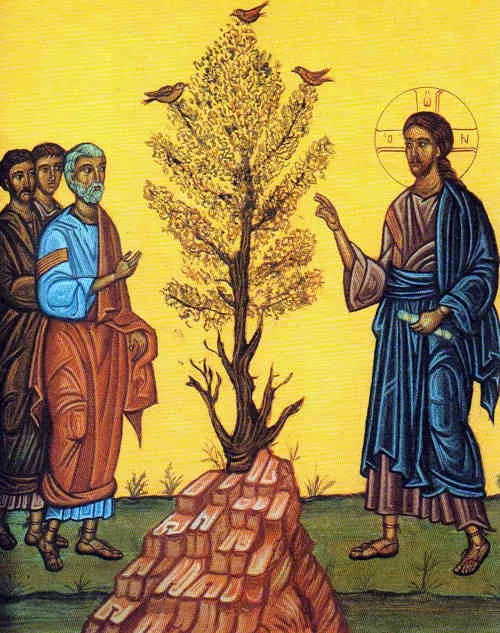
The apostles said to the Lord, “Increase our faith.” The Lord replied, “If you have faith the size of a mustard seed, you would say to this mulberry tree, ‘Be uprooted and planted in the sea,’ and it would obey you.”

Reflection:

Is it possible to completely uproot a tree and plant it in the sea? It’s certainly hard to imagine how. It is especially hard to imagine doing so with a simple command of faith. Uprooting a tree is hard enough to imagine, but it is even more difficult to imagine a tree being planted in the sea. Though water is necessary, one cannot plant a tree in the sea and expect it to grow. But that’s partly the point. We often underestimate the power of true faith. Saint Matthew’s Gospel says that faith can move mountains. Saint Luke’s says it can uproot a tree and replant it in the sea. All it takes to do so is faith the size of a mustard seed.

How much faith is equal to a mustard seed? A mustard seed is small, very small. It measures only about one millimeter in length. People who worked the soil at that time would have known that it was among the smallest of seeds they planted. For that reason, Jesus uses this familiar image to teach the apostles that faith, even a little faith, is powerful.

Jesus’ teaching comes in response to a prayer on the part of the apostles. “Increase our faith,” they said. Jesus’ response, inviting them to have only a little faith, implies that their faith was quite weak. To increase their faith to the size of a mustard seed suggests that they did not even have a little faith yet. Most likely they were aware of that fact, and that was the reason they asked Jesus to increase their faith. They perceived their lacking and turned to Him Who could help.

One of the first steps to increasing faith is to humbly admit our lack of faith. In our pride, we often want to convince ourselves and others that we are filled with faith. But if that were the case, God would be doing incredible things through us. He would be doing that which is otherwise humanly impossible.

Obviously, faith does not give us magical powers by which we can literally command a tree to uproot itself and plant itself in the sea. This imagery is meant to tell us that faith will work miracles of faith, not necessarily physical miracles. In fact, if God ever did use us and our faith to work a physical miracle, it would only happen because it was a motivation for the far more important gift of the increase of faith.

What, then, can a little faith do? It can uproot sin from your heart and from the hearts of those around you. It can nourish you and others in ways that seem impossible. Just as a tree cannot normally be planted in the sea and survive, the gift of faith, even a little faith, will enable the soul to be nourished and strengthened in ways that otherwise seem impossible. A martyr perfectly illustrates this fact. Normally, persecution and death are not considered to be nourishing to a person. But when a person has faith and suffers martyrdom on account of Christ, then their soul will be fed by the persecution itself. And that is among the greatest of miracles possible. Suffering, persecution, illness, poverty, and every other difficulty imaginable are transformed by God into a source of nourishment when we endure them with true faith.

Reflect, today, upon the prayer of the apostles: “Increase our faith.” Some of the greatest mystics taught that faith darkens the intellect. By this darkening, they mean that, by faith, God will lead us into the unknown, on a path that He alone is aware of. We will become instruments of His transforming grace in ways that are completely beyond our natural abilities. Pray for an increase of faith. When our Lord hears your humble prayer, by which you also confess your lack of faith, He will increase that faith, uproot sin and evil, and plant your soul in places in which you become nourished in ways that you could have never imagined possible.

Source: https://catholic-daily-reflections.com/2025/10/04/nourished-by-faith/

Luke 17:5-6 Read More »