Author name: Sani

Luke 12:49-50

A Blazing Fire of Mercy

Jesus said to his disciples: “I have come to set the earth on fire, and how I wish it were already blazing! There is a baptism with which I must be baptized, and how great is my anguish until it is accomplished!”

Reflection:

There is much that we can take from these teachings of our Lord. Not only did Jesus say, “I have come to set the earth on fire…” He also said that it’s His desire that this fire be “blazing!”

Fire is powerful. A blazing fire, for example, can purify the precious metal gold. When heated to a liquid state, the impurities rise to the surface for easy removal. Fire can also consume. When a blazing fire completes its burning, what’s left are only ashes. Many great saints have reflected upon the image of fire as an image of the purification God wants to do within our souls. Saint John of the Cross, for example, reflected in depth upon this image. He explained that entering into divine union was similar to a log burning. At first, as the log begins to burn, it crackles and pops. This is because the impurities within the wood, such as moisture or sap, do not burn as the wood burns. But as a log continues to burn, as Saint John explains, eventually the log becomes one with the fire. At first, you can distinguish the log from the fire when only part of the log is burning. But once the entire log is engulfed in the flames and all the impurities are burnt out, you have a piece of wood that is one with the fire. It glows and emits light and heat.

When we ponder these words from Jesus regarding His desire to “set the earth on fire,” we must first see this as His desire to purify our souls. Within our souls, there are many impurities that need to be removed if we are to become one with God, emitting His radiance and glory.  This purification involves a process of allowing God to bring our sins to the surface so that they are seen and can be removed. But this is only possible if we allow the blazing fire of God’s purifying love to consume us.

Oftentimes in life, we are content with simply being mediocre in our faith journey. We pray, go to Mass on Sunday, and try to be good. But this is not the life our Lord wants for us. He wants a life that is radically consumed with the blazing fire of His love. He wants us to become so purified from our sin that He is able to become one with us, sending forth the radiance of His glory through our lives. 

Reflect, today, upon this image of a blazing and purifying fire. Use the image of gold melting to the point that all impurities rise to the surface. Or use the image that Saint John of the Cross uses with the log. God wants so much more from you. He wants to transform you and use you in ways beyond your imagination. Do not be afraid to make the radical decision to allow the blazing and purifying fire of our Lord’s mercy to transform you. And don’t wait for this to start tomorrow—kindle that flame today.

Source: https://catholic-daily-reflections.com/2025/10/22/a-blazing-fire-of-mercy-4/

Luke 12:49-50 Read More »

Saint John Paul II, Pope

1920–2005; Patron Saint of World Youth Days; Canonized by Pope Francis on April 27, 2014

Karol Józef Wojtyła, the future Saint John Paul II, was born in the Polish town of Wadowice, the youngest of three children, just two years after Poland regained its independence after 123 years of partitions and foreign rule by the Russian, Austrian, and Prussian empires. As a youth, he was known to his friends as Lolek, an affectionate form of his name Karol (Charles). Though Poland was free as he grew up, Karol suffered many hardships. He never knew his older sister who died just hours after she was born. When Karol was eight, his mother died, and when he was twelve, his older brother died, leaving only Karol and his father, Karol, Sr.. Despite these tragedies, Karol’s father had a profound impact upon his life. He would later say that “his example for me was in some way the first seminary, a sort of domestic seminary.” Karol Sr. taught his son to pray, trust in God, be devoted to the Blessed Virgin, and love his Polish culture. Karol Jr. often saw his father on his knees in their small home, praying his rosary.

Karol Jr. received his early education in his hometown and then attended the Marcin Wadowita High School, a state-run institution. He was active in extracurricular activities, such as drama, sports, and poetry. In 1938, Karol and his father moved to Kraków where he attended the Jagiellonian University, focusing his studies on philosophy and languages. He eventually became fluent in at least eight languages and had a competency in several others. Jagiellonian University was the oldest university in Poland, dating back to its founding in 1364 by King Casimir the Great. After Karol attended the university for a year, Nazi Germany invaded Poland on September 1, 1939, marking the beginning of World War II. On November 6, 1939, the Gestapo gathered 180 professors and staff of the university and arrested them, sending them to concentration camps in an attempt to suppress Polish culture and intellectual life. Jagiellonian University was closed, and all young men were required to work. In response, Karol Wojtyła, along with hundreds of other students, continued their education underground, risking their lives. In addition to his underground studies, Karol worked in a quarry and a chemical factory to avoid deportation by the Nazis.

In 1940, a friend introduced Karol to Carmelite spirituality, and his prayer life began to blossom. On February 18, 1941, Karol’s father died, leaving him without any immediate family members. Though devastated by the numerous hardships he had endured by the age of twenty-one, his prayer life continued to flourish, and he sensed a new calling to the priesthood. A year and a half later, Karol made up his mind, went to talk to Archbishop Adam Stefan Sapieha of Kraków, and was invited to begin studies in a clandestine underground seminary run by the archbishop. On August 6, 1944, an estimated 6,000 to 8,000 Poles, mostly young men of military age, were arrested, detained, and sent to Plaszow concentration camp in an attempt to stop a Polish uprising. Karol hid at his uncle’s house and narrowly escaped. After that, he moved into the archbishop’s residence and remained hidden there until Kraków was liberated by the Soviet Red Army on January 19, 1945, after which time the seminary was reopened.

On November 1, 1946, Karol was ordained a priest by the recently elevated Cardinal Sapieha. The cardinal then sent him to Rome where he received his doctorate in theology from the Angelicum. His thesis was titled, “The Doctrine of Faith in Saint John of the Cross.” During his time in Rome, Father Wojtyła traveled to the Capuchin monastery located in the city of San Giovanni Rotondo, where the famous mystic Padre Pio resided. A close friend of Father Wojtyła later related that during that visit, Father Wojtyła went to Padre Pio for confession, and Padre Pio informed Father Wojtyła that he would one day “ascend to the highest office in the Church.” In 2002, Padre Pio was canonized by none other than Pope John Paul II, his penitent from 1947.

After returning to Poland the following year, Father Wojtyła spent the next ten years engaging in pastoral ministry in parishes, taught ethics at the Jagiellonian University and Catholic University of Lublin, received a second doctorate in philosophy from the Jagiellonian University, and wrote poems, plays, and contemporary faith-based articles. During this period, Father Wojtyła also worked as a university chaplain. He soon began to gather groups of students together for prayer and discussions. His gatherings grew and soon they turned into kayaking and camping trips, called Środowisko. Since priests were not permitted to openly engage in such trips during the time of Communist control of Poland, Father Wojtyła had his friends call him Wujek, which meant “uncle.” 

In 1958, while on a two-week camping trip with his friends, “Wujek” received a letter from the local post office summoning him immediately to the Primate, Cardinal Wyszynski, in Warsaw. After kayaking back, hitching a ride from a milk truck, and putting on his cassock, Father Wojtyła appeared before Cardinal Wyszynski who informed him that Pope Pius XII had named him an auxiliary bishop in Krakow. At the age of thirty-eight, he was to become the youngest bishop in the history of Poland. After spending hours in prayer at a nearby convent and a midnight train ride, Wujek made it back to his friends in time to offer Sunday Mass for them. When he informed them of the appointment, they were shocked and asked what they should now call him. He responded, “Don’t worry, Wujek will remain Wujek.” As a new bishop, Bishop Wojtyła continued to live simply, maintained his friendships, and lived out his ministry—just as he had for the previous ten years.

In 1962, Bishop Wojtyła became the temporary administrator of the Archdiocese of Kraków after the archbishop died. He also took part in the Second Vatican Council, making important contributions. In 1964, Pope Paul VI appointed him Archbishop of Kraków and made him a cardinal in 1967.

After Pope Paul VI died on August 6, 1978, Cardinal Wojtyła joined the other cardinals in electing John Paul I. However, the new pope only lived for thirty-three days. After the funeral and much disagreement in the next conclave over two Italian choices, the cardinals turned their eyes to a new choice, the fifty-eight-year-old cardinal of Kraków. He was elected on October 16, 1978, taking the name Pope John Paul II, the first non-Italian pope in 455 years. Padre Pio’s prophecy had come true.

When Pope John Paul II first appeared to the people gathered at Saint Peter’s Basilica, he said to the largely Italian crowd, “…the cardinals have called for a new bishop of Rome. They called him from a faraway land—far and yet always close because of our communion in faith and Christian traditions.” In his inaugural homily, Pope John Paul II spoke words that would echo throughout his papacy, “Do not be afraid. Open wide the doors for Christ. To His saving power, open the boundaries of States, economic and political systems, the vast fields of culture, civilization and development…” This young, energetic, prayerful, charismatic, and brilliant theologian, philosopher, linguist, pastor, and friend was about to make an indelible mark on the Church and world.

Pope John Paul II made trips to 129 countries during his pontificate, gathering some of the largest crowds in human history. He met with heads of state, held massive open-air Masses in stadiums, initiated World Youth Day celebrations, met with religious leaders of other faiths, survived an assassination attempt, and commanded a powerful and endearing presence everywhere he went, almost always speaking in the native language.

In 1979, Pope John Paul II made a historic visit to his homeland. When he arrived, a movement was sparked that could not be stopped and led to the downfall of communism in Poland and across Europe within a decade. When he arrived, he kissed the ground and spoke directly to his people. He was a Pole, and they were Poles, and he encouraged them to never forget that. He spoke of solidarity with one another, and what came to be known as the Solidarity Movement began. Over the next year, an underground workers’ union called “Solidarity” formed and grew rapidly. By September 1981, about one-third of Poland’s working-class population were members. In 1983, Lech Wałęsa, the president of the Solidarity movement was awarded the Nobel Peace Prize, and in 1990, Wałęsa became the first President of Poland to be elected by popular vote, leading to an end of the Soviet Union and opening the door for the expansion of democracies across Eastern Europe.

Pope John Paul II was the most prolific writer in the history of the papacy. The Church was still trying to find its way after Vatican II, and Pope John Paul II guided it at every turn. He wrote on morality, dogma, spirituality, mariology, sexuality, family life, marriage, the dignity of the person, the economy, society as a whole, and much more. He wrote fourteen encyclicals, fourteen apostolic exhortations, forty-five apostolic letters, eleven apostolic constitutions, thirty motu proprio, many catecheses, homilies, plays, and books. He reformed the Church’s Code of Canon Law and promulgated the Catechism of the Catholic Church.

Pope John Paul II was also prolific in his canonizations, canonizing more saints than all of predecessors combined. He canonized 482 and beatified 1,338. His canonizations were also new in that they sought to honor people of every walk of life. One of his most significant canonizations was that of Saint Faustina Kowolska, a Polish nun entrusted with the message of Divine Mercy. During her canonization in the year 2,000, the pope instituted the Solemnity of Divine Mercy Sunday on the second Sunday of the octave of Easter, in accord with the private revelations that Jesus gave to Saint Faustina.

Pope John Paul II not only lived well, he also died well. After suffering with Parkinson’s disease in public view for years, unable to walk and barely able to talk, he died on April 2, 2005, on the eve of Divine Mercy Sunday.

Saint John Paul II was one of the most visible figures in the history of the world. He navigated the Church through a tumultuous period, becoming the third longest-reigning pope in history. As we honor him today, ponder the effect that this saint had upon your own life. There is no doubt that Saint John Paul II has affected you in ways that you will only comprehend in Heaven. Give thanks to God for the gift of his life, and seek his prayers this day.

Source: https://mycatholic.life/saints/saints-of-the-liturgical-year/october-22—st-john-paul-ii-pope/
Saint John Paul II, Pope Read More »

Luke 12:39-40

The Lord is Coming, Today

Jesus said to his disciples: “Be sure of this: if the master of the house had known the hour when the thief was coming, he would not have let his house be broken into. You also must be prepared, for at an hour you do not expect, the Son of Man will come.”

Reflection:

These words from Jesus should cause us to sit up and take notice. This parable, followed by the rest of today’s Gospel, exhorts us to always be prepared for our particular judgment at the conclusion of our earthly life. There are various reasons these words should be heeded.

First of all, the obvious reason is that life for any of us could end at any time. We only need to recall various tragedies in which people have suddenly died from a car accident or from some other unexpected reason. Furthermore, there truly will be a specific moment in time when our Lord does return to earth for the Final Judgment. That moment will take place in an instant without any warning. It’s easy to presume that this end of the world when our Lord “comes to judge the living and the dead” will not happen for hundreds or perhaps even thousands of years. But the simple truth is that it could be at any time, when those who are alive least expect it.

With that said, there is another important reason to always be prepared and ready to meet our Lord for our particular judgment. Even though our particular judgment will take place in a definitive way at the end of our life when we see our Lord face-to-face, we also encounter Him every day, all day, receiving daily rewards for our fidelity or judgment for our sins. It is useful to see this “hour you do not expect” as every moment of every day. If you can live every day with this ongoing expectation that our Lord is coming to you, today, then every moment can be turned into a moment of much grace.

Think about your day today. Does God want to come to you, to inspire you and to lead you to fulfill His holy mission today? Indeed He does. He has a specific mission for you today that will not be there tomorrow. He wants you to be aware of His presence right now so that you can respond to Him with much generosity.

Reflect, today, upon the importance of always being vigilant and attentive to God’s presence in your life. He wishes to speak to you, day and night, so as to guide you into a life of true holiness. If you can build a habit of attentiveness to His continual comings, then you will truly be prepared for that final coming when you meet our Lord face-to-face.

Source: https://catholic-daily-reflections.com/2025/10/21/the-lord-is-coming-today-4/

Luke 12:39-40 Read More »

Saint Margaret Mary Alacoque, Virgin

1647–1690; Patron Saint of devotees of the Sacred Heart and those who have lost a parent while young; Invoked against polio and rheumatic fever; Canonized by Pope Benedict XV on May 13, 1920

 Margaret Alacoque was born either in the small town of Terreau or Hautecour, in the Duchy of Burgundy within the Holy Roman Empire, in modern-day France. She was one of five surviving children, and the only surviving daughter. In her autobiography, she states that from babyhood Jesus claimed her as His own, and once she reached consciousness, Jesus showed her the “ugliness of sin.” As a child, she used to say over and over, “To God I give my purity, and vow perpetual chastity.” One day she prayed it as a vow during Consecration at Mass; however, she admitted that she had no idea what “purity” or “chastity” meant. She only knew she wanted them.

Margaret’s father died when she was very young. Her early education came from other villagers and servants, since her mother spent all her time trying to provide for her children. At the age of nine, she was sent to live with the Poor Clare nuns who educated her. However, after being there only two years, she fell seriously ill, probably with rheumatic fever, and was unable to walk for four years. One day, it was suggested to her that she dedicate herself to the Blessed Virgin Mary, vowing to be one of her daughters if she were cured. As soon as she dedicated herself to Mary, she was cured and the Blessed Mother became the mother of her heart, teaching and correcting her. Shortly afterward, while praying the rosary, the Blessed Mother appeared to her and said, “I am surprised, my daughter, that you are so careless in my service!” This loving reprimand had a profound effect upon Margaret, so much so that when she was confirmed, she added the name Mary to her name, making her Margaret Mary.

Another struggle, turned into a blessing, came in the form of financial hardships after her father’s death. Three of her father’s relatives took charge of the family estate, controlling every aspect of their family’s life. This oppression continued until Margaret Mary was seventeen years old, when her older brother reached the legal age to take back control from his father’s relatives. During those years, however, the oppression and cruelty Margaret Mary and her family endured enabled her to understand the suffering of Jesus more deeply. In fact, Jesus often appeared to her in His suffering and beaten state, teaching her to unite her sufferings and injustices to His own. Jesus spoke to her regularly. Later in life, after revealing these sensible experiences with our Suffering Lord, she was surprised that others did not have the same mystical encounters as she did. These years were also filled with frequent visits to the Blessed Sacrament. When her guardians refused to allow her to go to church to pray, she would spend long hours, and even days, out back in the garden or by the cowshed in solitude on her knees, praying with a sorrowful heart.

Late in Margaret Mary’s teenage years, her mother encouraged her to marry and to abandon the idea of religious life to which she had committed herself since childhood. Because her mother was a widow, she would have little means of caring for herself. Her only hope was that Margaret wed so that she could be cared for in her daughter’s household. Her mother tearfully begged her, over and over, to get married. As a result, Margaret Mary began socializing more and attending dances with her brothers. This tormented her heart; every time she returned home, she was profoundly aware of Jesus’ sorrow. On at least one occasion, after returning home from a dance, Jesus appeared to her as He looked during His scourging at the pillar, revealing His love for her and that her sins caused His suffering. Margaret could take no more of it: little by little, she recommitted herself to her childhood vow to enter religious life.

Once Margaret Mary’s family understood that she had made up her mind to become a nun, they tried to get her to join the Ursulines, which a relative had joined. She desired, however, to embrace the more rigorous life of the Visitation Sisters. Though it seemed that everyone opposed her, she persevered, and, on May 21, 1571, she entered the Visitation Convent at Paray-le-Monial. As soon as she entered the parlor for her initial visit, she interiorly heard Jesus say, “It is here that I would have thee be.” After some doubts by her superiors as to whether she was a good fit for the Visitation Sisters, she received the habit and took her vows on November 6, 1572.

During Margaret Mary’s novitiate, Jesus revealed to her that He had a special mission for her. She was to become a blank canvas on which Jesus’ sufferings would be written and revealed. After Margaret Mary made her vows, Jesus repeatedly appeared to her, revealing to her His desire that His Sacred Heart be honored, and uniting her soul more deeply with His sufferings. On the eve of every first Friday, Jesus inspired her to make a holy hour from 11:00 p.m. until midnight, lying prostrate so as to enter into His human sorrow that He suffered while abandoned by the Apostles in the Garden. On the first Friday, she was instructed to receive Holy Communion. Jesus instructed her that He desired all people to love Him and to come to know the love of His Heart. On the Friday after the octave of the Solemnity of Corpus Christi, Jesus asked that a feast be established in honor of His Sacred Heart. At one point, Jesus said to her, “My divine Heart is so inflamed with love for mankind, and for you in particular, that it can no longer contain within itself the flames of its burning charity and must spread them abroad by your means.” She saw Jesus’ Heart on fire and crowned with thorns. The flames represented Jesus’ burning love for humanity, and the thorns represented the sinful and ungrateful response of men.

Jesus made twelve promises to those who would honor His Sacred Heart: “I will give them all the graces necessary for their state of life. I will establish peace in their families. I will console them in all their troubles. They shall find in My Heart an assured refuge during life and especially at the hour of their death. I will pour abundant blessings on all their undertakings. Sinners shall find in My Heart the source of an infinite ocean of mercy. Tepid souls shall become fervent. Fervent souls shall speedily rise to great perfection. I will bless the homes where an image of My Heart shall be exposed and honored. I will give to priests the power of touching the most hardened hearts. Those who propagate this devotion shall have their names written in My Heart, never to be effaced. The all-powerful love of My Heart will grant to all those who shall receive Communion on the First Friday of nine consecutive months the grace of final repentance; they shall not die under my displeasure, nor without receiving their Sacraments; My heart shall be their assured refuge at that last hour.”

Sister Margaret Mary shared her visions with Mother de Saumaise, who doubted their authenticity. Her superiors expressed concern that Sister Margaret Mary was not living the normal prayer life of a Visitation sister. They expected her to pray certain vocal prayers and engage in various prescribed meditations. But how could she? She was a mystic, being drawn into a profound communion with Jesus. He was already with her, communing with her in the depth of her soul. She certainly could not abandon Jesus Himself so as to engage in more superficial prayers.

Eventually, her superior began to believe Margaret Mary but had her submit her visions and mystical experiences to theologians who judged her to be delusional. Many of the sisters doubted her also. By God’s providence, Jesuit Father and future saint, Claude de la Colombiere, became the sisters’ confessor. Upon listening to Margaret Mary, he believed her and helped to support the authenticity of these visions. Toward the end of Margaret Mary’s life, her community began to accept the revelations and observed the Feast of the Sacred Heart, building a chapel to the Sacred Heart three years before her death. Seventy-five years after her death, after thorough examination, Pope Clement XIII approved devotion to the Sacred Heart of Jesus, paving the way for Margaret Mary’s canonization, which would not take place until 1920, and the inclusion of this feast on the General Roman calendar, which took place in 1929.

Today, there is no doubt that Saint Margaret Mary Alacoque lived a profoundly mystical life and that the revelations she received came directly from Jesus. During her life, however, she suffered greatly through mystical union with her crucified Lord. She faced continual opposition as she sought to fulfill God’s will, being mocked, ridiculed, and considered delusional. But God uses those whom this world writes off for great things. The devotion to the Sacred Heart of Jesus that our Lord gave to the Church through her has become an enduring and transforming devotion in countless lives.

As we honor this great saint, ponder your own depth of devotion to Jesus’ suffering Heart. Reflect upon the twelve promises Jesus made to those who honor His Heart. As you do, renew and deepen your devotion to Him in this way so that you will become a greater recipient of His abundant mercy.

Source: https://mycatholic.life/saints/saints-of-the-liturgical-year/october-17–st-margaret-mary-alacoque/

Saint Margaret Mary Alacoque, Virgin Read More »

Luke 12:35-36

Being Vigilant Throughout Life

Jesus said to his disciples: “Gird your loins and light your lamps and be like servants who await their master’s return from a wedding, ready to open immediately when he comes and knocks.”

Reflection:

What does it mean to “Gird your loins?” This phrase, which is not commonly used today, literally means “tighten your belt.” It traditionally refers to one who is wearing a long robe that makes it difficult to move quickly and easily. Thus, to gird your loins means that you tuck in the long robe and tighten your belt so that you are prepared for some physical activity. It was also commonly used to exhort those preparing for battle to get ready. Symbolically, then, this phrase simply means to be ready for something difficult or challenging. It means to be vigilant and prepared. Spiritually speaking, Jesus is telling His disciples to be ready for the spiritual battle that awaits them.

Jesus then tells His disciples to light their lamps. That phrase could have a variety of meanings, such as “Do not remain in the darkness of sin or ignorance” or “Let the light of charity shine forth as you navigate through life” or “Allow the light of truth to shine within your mind.” Hence, by the light of faith, they are to be prepared and vigilant, ready to do all that the Lord sends them to do.

Today’s Gospel ends by Jesus saying that the disciples will be truly blessed if they remain vigilant even until the second or third watch of the night. Some Church Fathers see this as a reference to three periods in one’s life: childhood being the first watch, middle age being the second, and old age being the third watch.

With these meanings understood, one message we can take from this Gospel is that Jesus is calling us to be vigilant in our faith at every moment of our lives. For those who have lived many years, it may be useful to look back at how faithful you have been throughout every period of your life. God wants to use you in many ways during childhood, through your middle age, and even in old age. The journey of faith must never end. Instead, it must continually deepen as you age. But this will only be possible if you “gird your loins” and “light your lamps.” You must continually be vigilant, continually attentive to the light of faith, and continually be ready to act every time God inspires you to act.

Reflect, today, upon the lifelong journey of faith and service of God to which you are called. Being a Christian is not simply something you are born into. If you were born into the faith, then ponder especially what you have done throughout your life to daily deepen and strengthen that faith. Ponder whether or not you have diligently responded to the countless inspirations of the Holy Spirit to spread the light of faith to others. If you have been truly faithful throughout your life, then give thanks to God and recommit yourself to this fidelity for the rest of your life. If you have lacked faith and vigilant attentiveness to the will of God, then place that in the hands of God’s mercy and resolve from this day forward to do all you can to respond to the will of God the moment God calls. 

Source: https://catholic-daily-reflections.com/2025/10/20/being-vigilant-throughout-life-4/

Luke 12:35-36 Read More »

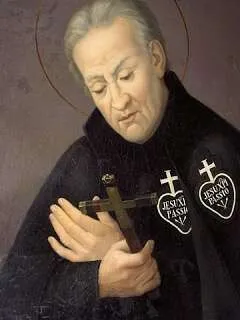
Saint Paul of the Cross, Priest

1694–1775; Patron Saint of Hungary and Ovada, Italy; Canonized by Pope Pius IX on June 29, 1867

Paulo Francesco Danei, now known as Saint Paul of the Cross, was born in Ovada, in what is today northwestern Italy. In a family of sixteen, he was the oldest of the six children who survived infancy. His parents were devout Catholics who instilled their faith in their children. His father, a merchant and man of great faith, was more concerned about God and the lives of the saints than he was about worldly goods. Paul’s devout mother introduced her children to a devotion to the Blessed Mother and used to tell them about Christ’s Passion and the lives of the saints, especially the desert hermits. This sparked a great faith in Paul and a desire for prayer and solitude, a desire that never left him. He would later say of his mother, “If I am saved, as I hope through God’s mercy I will, it will be due to the training of my mother.” As a child, his prayer life grew deep, he loved to engage in mortification, and he often tearfully meditated on the Passion of Christ.

At the age of seven, Paul and his family relocated to the nearby town of Cremolino, where he received elementary education from Carmelite priests. He was a hardworking student who balanced his time of prayer and study, attending daily Mass and receiving Holy Communion as often as he could. When he turned sixteen, his family moved again, and Paul was sent to live with a host family in Genoa to complete his education.

When Paul was around twenty, he heard a sermon by his parish pastor, at which time a sudden and clear light shone in his soul that illuminated the depth of his misery. He would later refer to that moment as his conversion. Profoundly aware of his sin, he made a general confession to his parish priest, seeking to be cleansed of every sin, attachment, and disordered desire he had. This led to an increase in virtue and a desire for more prayer and penance. His penances became severe—scourging himself, sleeping on a board, fasting, and striving to enter more fully into the Passion of Christ. He said of this time in his life, “In those first years, our Lord filled me with hunger for two things: for Holy Communion and for suffering.”

As his prayer life profoundly deepened, so did his temptations. He saw the battle within himself raging, and he knew he had to be a soldier for Christ. In 1715, Pope Clement XI encouraged young men to assist the Venetian Republic in its war against the Ottoman Empire. Paul decided to join them, thinking this might be the way for him to fight for Christ. Once enlisted, he remained fervent in his prayer and virtue. One day, while waiting for deployment, he entered a Church in the town of Crema where God clearly and emphatically made it known to Paul that the battle He was calling him to fight was of a much higher and more noble purpose. As a result, he received an honorable discharge from his duties as a soldier and began his journey home. In the town of Novello, he stayed with a wealthy elderly couple who were childless. The couple became so fond of Paul that they decided to make him their heir. Paul, however, refused, since he desired nothing of this world.

Back home, Paul submitted himself to spiritual direction by his parish priest. Seeing Paul as an unusually devout young man, the priest put him through a series of tests. He showed him great severity in Confession, publicly humiliated him at times, and treated him as the worst of sinners. One day, he decided to impose an even more severe trial on Paul by ordering him to participate in a local town dance. Paul was completely opposed to the idea but obeyed. When he stepped onto the floor, however, all the strings of the instruments broke at once, bringing an end to the dance. This convinced the parish priest that Paul did, indeed, have a very special calling from God.

Since his family was of modest means, with his father always struggling to provide, Paul’s uncle, Father Christopher Danei, came up with a plan. With the permission of Paul’s parents, he found a wealthy and virtuous young woman with whom he offered to arrange a marriage. His uncle also informed Paul’s parents that he would leave all his money to Paul, so he could help provide for the family. Everyone loved the idea, except Paul. His uncle insisted, so Paul reluctantly met with her, but he knew marriage was not for him. Afterwards, his entire family continued to plead with him to wed for the family’s sake and to carry on the family name as the eldest son. Paul turned to prayer and shortly after, before any arrangements were made, his uncle suddenly died. Paul was already named the heir, but he renounced the entire inheritance, choosing only to keep his uncle’s prayerbook, leaving the rest to his family.

At the age of twenty-four, Paul was elected president of the local Confraternity at which he gave well-received regular spiritual exhortations. Soon afterward, many in the town flocked to listen to him. Around this time, he also taught catechism to children and formed an association of young men whom he would take on long walks to discuss the faith, especially the Passion of Christ, inspiring many of these young men to enter religious life. Paul also began caring for the poor and infirm, showing much devotion to those who were dying and seeing to it that they received a proper burial. He continued his apostolic works on many levels, and God gifted him with great charisms. He was given the ability to read souls and compassionately tell penitents their sins, leading to conversions and humble confessions. Paul especially worked to convert the young men who were hardened in their sins, prophesying their fate to them if they did not repent. His prophecies always came true. This won the admiration and holy fear of the townspeople, who began to consider him a living saint.

Around the age of twenty-six, Paul was introduced to three new spiritual directors who helped him immensely. His prayer was reaching the highest heights of contemplation, and God was continually speaking directly to his heart, slowly revealing His plan for Paul. One day, when Paul was returning from church, he had a vision, “Suddenly, I saw myself clothed in a tunic; a white cross on the breast; under the cross also in letters of white, the Holy Name of Jesus…” At another time, Paul had a vision of the Blessed Mother who held out to him a habit with the words, “JESU XPI PASSIO,” which means “The Passion of Jesus Christ.” Some time later, the Blessed Virgin appeared to Paul again, clothed in the habit she had shown to Paul previously. “My child! You see how I am clothed in mourning. It is because of the sorrowful Passion of my beloved Son, Jesus. You are to found a congregation in which all the members will clothe themselves in black and mourn continually for the Passion and Death of my dear Son.” Paul related all of these things to his bishop at the advice of his spiritual director, and the bishop, after consulting others, agreed that these inspirations and visions came from God. Soon after, Paul bid farewell to his family and went to the bishop’s private chapel where the bishop clothed him in the black habit, but without the emblem on the breast which would eventually mark the Passionist Congregation. The bishop then ordered him to write the Rule of the new congregation. Paul wrote the Rule during a forty-day retreat and then presented it to the bishop. After the bishop sought the advice of another priest, he approved the Rule for the new diocesan congregation of the “Poor of Jesus.”

Paul was sent to a remote hermitage to begin his new life but soon after was moved by the bishop to the church of Saint Stephen. The bishop knew Paul’s life was to be more than a life of prayer and personal sanctity: it was also to be apostolic. Once at Saint Stephen, two others joined Paul, one being his brother, John Baptist. Paul began to teach catechism at the order of the bishop and then started preaching. His preaching drew many, and conversions were plentiful. Miracles were worked, the townspeople began to turn from sin, and the Passion of Christ was ever on Paul’s lips.

In September of 1721, less than a year after Paul finished writing his Rule, he decided to travel to Rome to see the Holy Father, thinking that just like Saint Francis he would walk right into the papal palace and receive permission to found his new community. He arrived in Rome and presented himself at the papal palace, but because his poverty was evident from his clothing and exhaustion, the guards didn’t even let him pass the gate. They treated him roughly, told him that vagabonds arrived all day, and that he should go away. He then proceeded to Saint Mary Major, stopping at a fountain on the way and sharing his last loaf of bread with a beggar.  At Saint Mary Major, before an ancient icon of the Blessed Mother, he made a vow to promote devotion to and grateful remembrance of the Passion of Jesus. It was through that experience of rejection, which he united with Jesus through the intercession of the Mother of God, that the Passionists’ charism became clearer to him. Soon after, he returned home to his hermitage with his brother.

In 1725, Paul and his brother went to Rome and lived in the Hospice of Saint Gallican where they tended to the suffering and dying. This experience of severe suffering became their primary source of inspiration for what would happen next. The cardinal who oversaw the hospice had a great affection for Paul and his brother. One day, the cardinal informed them that he believed they should be ordained priests, so he ordered them to prepare for ordination out of obedience. Over the next several months they intensely studied theology under a Franciscan and were ordained priests on June 7, 1727, at Saint Peter’s Basilica by Pope Benedict XIII.

Over the next fifteen years, Father Paul cared for the sick, preached missions, and lived a life of deep prayer, allowing God to work numerous miracles through him. Slowly, others joined him and his brother, and in 1741 Pope Benedict XIV gave final approval to their Rule, establishing them as the Congregation of the Discalced Clerks of the Most Holy Cross and Passion of Our Lord Jesus Christ (Passionists). From that time on, Father Paul and the Passionists continued to grow. By the time of his death in 1775, there were hundreds of brothers and priests dedicated to a life of prayer and preaching centered on the Passion of Christ. There were twelve monasteries, or “Retreats” as they called them, and there was also a monastery for contemplative Passionist nuns. In addition to leaving a written Rule, Saint Paul wrote an estimated 2,000 letters in which his spiritual advice and profound insights into Christ’s Passion are most evident.

Saint Paul of the Cross was drawn to the Passion of Christ from an early age. He discovered that his own sufferings were the most precious gift he could receive when he united those sufferings to Christ. He had a profound love for the Eucharist, his “Sacramental Spouse,” Whom he received frequently in Holy Communion, an uncommon practice at that time. His bold preaching of the Cross, flowing from his deep prayer, drew many to Christ, bringing about many conversions. Throughout his ministry, he taught on the Divine Indwelling, by which one retreats to the interior desert, in order to speak to God and lose oneself in Him. He endured fifty years of spiritual darkness but united that darkness with the sufferings of Christ, drawing him into an intimate solidarity with, and compassion for, both Jesus Crucified and the sinners He came to save. This charism forged the foundation of the whole Passionist edifice.

As we honor this great saint, mystic, and founder, ponder the simple fact that Saint Paul discovered great joy in suffering because he found Christ in suffering. This discovery was of supernatural origin and can only be understood through the light of faith. Ponder your own view of suffering and seek to discover what Saint Paul discovered, so that you, too, will come to know our Crucified Lord more deeply.

Source: https://mycatholic.life/saints/saints-of-the-liturgical-year/-st-paul-of-the-cross/

Saint Paul of the Cross, Priest Read More »

Luke 12:13-15

The Reality of Greed

Someone in the crowd said to Jesus, “Teacher, tell my brother to share the inheritance with me.” He replied to him, “Friend, who appointed me as your judge and arbitrator?” Then he said to the crowd, “Take care to guard against all greed, for though one may be rich, one’s life does not consist of possessions.”

Reflection:

What’s interesting in Jesus’ statement is that of all the people who ever walked the earth, no one is more worthy to be a “judge and arbitrator” of an injustice than Jesus Himself. Yet He refuses to intervene. Why is that? It appears to be a just request from the person, but instead of intervening Jesus tells a parable about greed.

Material possessions can be very seductive. That’s a fact. Yet many people have a very hard time admitting their attachment to possessions and money. They rationalize that they have worked hard, have earned what they have and should be able to indulge a bit. Some good-minded people who have many possessions appease their consciences by giving a small portion of what they have to charitable causes and then conclude that they can keep the rest for themselves. But what does Jesus think about that?

In and of themselves, material possessions are neither good nor bad. The problem is the sin of greed. Greed is an interior disposition by which a person becomes more attached to the passing things of this world than they are to God and His holy will. Though it might be possible to have many possessions and still remain interiorly detached from them, this is quite difficult. But having possessions is not the ultimate problem. Desiring possessions is the real problem. Therefore, even those with very little can fall into the same trap by becoming attached to what they do not have and by believing that the attainment of more will satisfy.

Jesus refused to act as “judge and arbitrator” in this case because it was clear to Him that the person making the request was struggling with greed. Jesus was far more concerned about this person’s interior attachments than He was about the inheritance being properly shared. Earthly justice means very little from the perspective of eternity. This may be hard for many to understand and accept. Doesn’t justice demand fairness? Not if the desire to be treated fairly is based on some sin such as greed. In that case, it is far better for the soul to be cheated out of their inheritance than it is to receive their fair share. In fact, if a person does struggle with greed, one of the best things for their soul might be to be cheated out of their own possessions. This will only be understood when we see that spiritual riches are infinitely greater than material riches.

Reflect, today, upon your interior desires. Look at them honestly. What do you desire the most in life? Do you dream of becoming rich? If so, does that desire consume much of your thinking? Reflect upon the scenario in which you were supposed to receive a very large inheritance but were cheated out of it. How would you react? The right reaction would be to care more for the soul of the person who cheated you than to care about actually being cheated. A person who is fully detached from material possessions will care little about losing such an inheritance or gaining one. It will truly matter not. If that is hard to accept, know that this is a sign that your soul is too attached to the things of this world. Pray for freedom from all greed. That is the only way to obtain the true riches of God.

Source: https://catholic-daily-reflections.com/2025/10/19/the-reality-of-greed-3/

Luke 12:13-15 Read More »

Saints Jean de Brébeuf, Isaac Jogues, Priests and Martyrs; and their Companions, Martyrs

Saint René Goupil (1606–1642); Saint Isaac Jogues (1607–1646); Saint Jean de la Lande (Unknown–1646); Saint Antoine Daniel (1601–1648); Saint Gabriel Lalemant (1610–1649); Saint Jean de Brébeuf (1593–1649); Saint Charles Garnier (1606–1649); Saint Noël Chabanel (1613–1649); Patron Saints of North America; Canonized by Pope Pius XI on June 29, 1930

In the early seventeenth century, Dutch explorers made first contact with the Iroquois Confederacy in modern-day Albany, New York. The Confederacy was a political and military alliance of six Iroquoian-speaking native tribes located primarily in modern-day New York State. It was formed for inter-tribal security, diplomacy, and governance based on the tribes’ Great Law of Peace. The participating tribes were the Mohawk, Oneida, Onondaga, Cayuga, Seneca, and Tuscarora. The Dutch, and later British, engaged in fur trading in exchange for European items, such as metal tools, firearms, and alcohol.

Around the same time, French explorers came into contact with the Huron-Wendat Confederacy, who were continually at war with the Iroquois. Tensions between the two native confederacies centered around disputes over hunting grounds and trade routes associated with their new European alliances. The French were unique among the European settlers in that—in addition to establishing trade, political, and military alliances—they also sought to share the Gospel of Jesus Christ with the natives. The Jesuits were the driving force behind that work of evangelization. Though the French did establish some relations with the Iroquois Confederacy, their alliance with the Huron-Wendat Confederacy led the Iroquois to distrust the French and remain at war with the Huron-Wendat tribes. 

When French Jesuits began arriving in North America, their first mission was at Port-Royal, Acadia, modern-day Nova Scotia. In 1613, a mission was established on the Mount Desert Island of modern-day Maine. In 1625, Notre-Dame-des-Anges was established near modern-day Quebec City, and in the same year, a mission was established at the mouth of the Saguenay River in Quebec. Among the first Jesuits to arrive was Father Jean de Brébeuf, one of more than 100 Jesuits who would arrive in the seventeenth century, eight of whom would die as martyrs.

In 1642, a layman named René Goupil was working as a medic for the Jesuit Missionaries near Quebec and was invited to accompany Father Isaac Jogues and a group of forty others, including Huron-Wendat chiefs, on a missionary expedition. While traveling, the group was attacked by Mohawk members of the Iroquois Confederation and taken to the village of Ossernenon near modern-day Auriesville, New York. Upon being seized by the Mohawks, René cried out to Father Jogues, “O my father, God be blessed; He has permitted it, He has willed it—His holy will be done. I love it, I desire it, I cherish it, I embrace it with all the strength of my heart.” Once captured, they were cruelly tortured, their fingers crushed and fingernails torn out. Father Jogues continually encouraged his companions, baptizing an elder Huron, hearing René’s confession, and preparing them for death. Years earlier, René had entered the Jesuit novitiate but had to leave because he suffered from deafness. Once captured, however, René made the Jesuit profession and was received into the order as a lay brother by Father Jogues on the spot.

Over the next six weeks, the tortures continued with beatings to the point of disfigurement. The captives’ fingers were cut off, and they were abused every day by numerous Mohawks within the camp. On September 29, Father Jogues and Brother René were walking in the village when two young Iroquois men told them to follow them. They did so, sensing this was the end. Suddenly, one of the Iroquois men turned and tomahawked Brother René in the head. He was the first Jesuit to be martyred. Father Jogues later learned that Brother René was killed because an Iroquois elder witnessed Brother René making the sign of the Cross on the forehead of an Iroquois child, and ordered his execution.

After more than a year in captivity, Father Jogues was able to escape and make his way back to France with the help of a sympathetic Mohawk and Dutch settlers. He was given a hero’s welcome in France, and Pope Urban VIII gave him permission to celebrate Mass, despite losing his fingers. At that time, the Blessed Sacrament could only be touched by the thumb and forefinger. In 1644, after being back in France for a year and a half, Father Jogues returned to the missions, desiring to continue the work and to accept martyrdom if God willed it. In 1646, he returned to the place of his previous captivity with Jesuit lay brother Jean de Lalande. Father Jogues’ desire was to establish peace with the Iroquois so that the Jesuits could continue their work of evangelization. He believed he was in a unique position to establish that peace. As they journeyed, they were captured and brought back to the same village of Ossernenon. This time, the Iroquois only kept them captive for a short period of time before Father Jogues was tomahawked in the head and beheaded on October 18, 1646. The next day, when Brother Jean de Lalande went to tend to his body, he was also martyred.

The other martyrs we honor today are Saints Antoine Daniel, Gabriel Lalemant, Jean de Brébeuf, Charles Garnier, and Noël Chabanel. Father Jean de Brébeuf arrived in New France and settled near Quebec in 1625 where he learned the Huron language and wrote a catechism in Huron, as well as a French–Huron dictionary for use by other Jesuits. In 1639, Father de Brébeuf, along with other French Jesuits, settlers, and soldiers, traveled farther west, down the Saint Lawrence River, deeper into Huron-Wendat territory and settled on the eastern side of Lake Huron, near the town of Midland, Ontario, Canada, to establish a Jesuit mission named Sainte-Marie among the Hurons. It was the first European settlement in modern-day Ontario. Sainte-Marie served as a central Jesuit mission to the Huron-Wendat Confederacy and as a headquarters for Jesuit activities in the area. From it, smaller missions were established in the area.

Each of the five remaining Jesuits was martyred in 1648–1649 at the missions served by Sainte-Marie. Father Antoine Daniel was captured at the Saint-Joseph mission on July 4, 1648, just after celebrating the Holy Mass. He was still in his vestments when he was shot with arrows and then burned in the chapel. Fathers Gabriel Lalemant and Jean de Brébeuf were serving at the Huron-Wendat village of Saint-Louis when it was attacked by the Iroquois on March 16, 1649. After several hours of extreme torture, including having hot coals placed on their bodies and being scalped, they died. On June 14, the remaining Jesuits and settlers abandoned and burned the Sainte-Marie Mission, to keep it from being desecrated by the Iroquois, and so they could flee to smaller and safer locations to continue their work. Fathers Charles Garnier and Noël Chabanel fled to Saint-Jean mission, and, despite the deaths of their fellow Jesuits, they continued their work. On December 7, 1649, their mission was attacked, and Father Garnier was shot with arrows and tomahawked to death. Father Chabanel was tracked down and killed; his body was never recovered.

These heroic saints helped lay the foundation of faith not only for the native peoples but also for the European settlers who arrived and populated North America. They epitomize a selfless desire to lay down their lives for others, even those who acted in excessively brutal ways. The torture they received did not lead to bitterness but to praise and thanksgiving to God that they were found worthy to imitate Christ’s death.

As we honor the North American Martyrs, ponder your own depth of sacrifice you are willing to make for the good of those around you. Family, friends, community, or workplace, we must continually look out for the good of others in a selfless way. Seek inspiration from today’s saints and strive to follow in their footsteps, through the unique form of martyrdom God asks of you.

Source: https://mycatholic.life/saints/saints-of-the-liturgical-year/october-19—saints-jean-de-brbeuf-isaac-jogues-and-companions/

Saints Jean de Brébeuf, Isaac Jogues, Priests and Martyrs; and their Companions, Martyrs Read More »

Twenty-ninth Sunday in Ordinary Time

First Reading Exodus 17:8-13

In those days, Amalek came and waged war against Israel.
Moses, therefore, said to Joshua,
“Pick out certain men,
and tomorrow go out and engage Amalek in battle.
I will be standing on top of the hill
with the staff of God in my hand.”
So Joshua did as Moses told him:
he engaged Amalek in battle
after Moses had climbed to the top of the hill with Aaron and Hur.
As long as Moses kept his hands raised up,
Israel had the better of the fight,
but when he let his hands rest,
Amalek had the better of the fight.
Moses’hands, however, grew tired;
so they put a rock in place for him to sit on.
Meanwhile Aaron and Hur supported his hands,
one on one side and one on the other,
so that his hands remained steady till sunset.
And Joshua mowed down Amalek and his people
with the edge of the sword.

Responsorial Psalm Psalms 121:1-2, 3-4, 5-6, 7-8

R.(cf. 2)  Our help is from the Lord, who made heaven and earth.
I lift up my eyes toward the mountains;
whence shall help come to me?
My help is from the LORD,
who made heaven and earth.
R. Our help is from the Lord, who made heaven and earth.
May he not suffer your foot to slip;
may he slumber not who guards you:
indeed he neither slumbers nor sleeps,
the guardian of Israel.
R. Our help is from the Lord, who made heaven and earth.
The LORD is your guardian; the LORD is your shade;
he is beside you at your right hand.
The sun shall not harm you by day,
nor the moon by night.
R. Our help is from the Lord, who made heaven and earth.
The LORD will guard you from all evil;
he will guard your life.
The LORD will guard your coming and your going,
both now and forever.
R. Our help is from the Lord, who made heaven and earth.

Second Reading 2 Timothy 3:14-4:2

Beloved:
Remain faithful to what you have learned and believed,
because you know from whom you learned it,
and that from infancy you have known the sacred Scriptures,
which are capable of giving you wisdom for salvation
through faith in Christ Jesus.
All Scripture is inspired by God
and is useful for teaching, for refutation, for correction,
and for training in righteousness,
so that one who belongs to God may be competent,
equipped for every good work.

I charge you in the presence of God and of Christ Jesus,
who will judge the living and the dead,
and by his appearing and his kingly power:
proclaim the word;
be persistent whether it is convenient or inconvenient;
convince, reprimand, encourage through all patience and teaching.

Alleluia Hebrews 4:12

R. Alleluia, alleluia.
The word of God is living and effective,
discerning reflections and thoughts of the heart.
R. Alleluia, alleluia.

Gospel Luke 18:1-8

Jesus told his disciples a parable
about the necessity for them to pray always without becoming weary.
He said, “There was a judge in a certain town
who neither feared God nor respected any human being.
And a widow in that town used to come to him and say,
‘Render a just decision for me against my adversary.’
For a long time the judge was unwilling, but eventually he thought,
‘While it is true that I neither fear God nor respect any human being,
because this widow keeps bothering me
I shall deliver a just decision for her
lest she finally come and strike me.'”
The Lord said, “Pay attention to what the dishonest judge says.
Will not God then secure the rights of his chosen ones
who call out to him day and night?
Will he be slow to answer them?
I tell you, he will see to it that justice is done for them speedily.
But when the Son of Man comes, will he find faith on earth?”

Source: https://bible.usccb.org/bible/readings/101925.cfm

Twenty-ninth Sunday in Ordinary Time Read More »

Luke 18:1

Justice Through Mercy

Jesus told his disciples a parable about the necessity for them to pray always without becoming weary.

Reflection:

In our parable for today, we have the witness of a widow who came to a dishonest judge and continuously begged him for a just judgment. Though the judge did not care about the woman, he eventually rendered a just decision for her because she was so persistent. It’s interesting that Jesus used the image of a “dishonest judge” to teach us about persistent prayers being answered. He does so because He wants us to understand that if even those who are dishonest respond to persistence, then so much more will the Just Judge of Heaven respond to persistence.

Will God answer any prayer you pray if you offer that prayer day and night, day after day without fail? Does God eventually give into our requests as a parent might give into a child who keeps begging for something? Not exactly. One of the most important qualifiers mentioned in this parable is the word “just.” We read that the woman’s plea before the judge was, “render a just decision for me…” At the conclusion of the parable, Jesus gives this interpretation: “Will not God then secure the rights of his chosen ones who call out to him day and night?” When we pray, we ought not pray for whatever we want. We ought not pray for our preference, selfish desires, or our own ideas. We must pray only for the justice of God. When we do so with unwavering perseverance, God will secure our rights and bring forth His justice.

Justice, in the mind of God, is not only about righting certain wrongs. The prime example of this is the death of our Lord Himself. Clearly, Jesus was purely innocent and yet He suffered greatly. For that reason, would we conclude that the suffering and death of the Son of God was an injustice? Not really. The reason for this is that justice can be achieved best by mercy. Because Jesus embraced the injustice of His suffering and death and turned it into a free embrace out of love, this “injustice” became a sacrifice of love by which an abundance of mercy was bestowed. Jesus had every right to call down fire from Heaven and to destroy those who sinned against Him. But He had a far better plan. Instead, by choosing to accept the injustice of the Cross, and by freely embracing it with His own will, the injustice was transformed and a far greater good came forth.

In our own lives, whenever we are wronged by another, we are often tempted to anger and to desire revenge in the name of justice. We want them to pay for what they did. If you ever feel that way, know that the greatest form of justice is mercy. Know that your free embrace of injustice brings forth the transforming power of God in a way that punishment or retribution could never accomplish. This is the form of justice we must pray for night and day. We must beg God for the ability to accept all sufferings with love, to offer those sufferings as a sacrifice, and to allow them to be transformed into mercy. If this is our persistent prayer, we can be certain that our prayer will be answered.

Reflect, today, upon anything for which you desire justice. Is there anything that has been unfair in your life? Do you dwell upon any hurt inflicted upon you by another? As you call those things to mind, know that the power of your persistent prayer has the potential to transform those sufferings into God’s mercy. Beg for this gift and know that God will always answer those prayers.

Source: https://catholic-daily-reflections.com/2025/10/18/justice-through-mercy/

Luke 18:1 Read More »