Author name: Sani

Saint Paola Elisabetta Cerioli

Profile

Paola was born to Italian nobility, the youngest of 16 children of Francesco Cerioli and Francesca Corniani; she was born with a heart condition and slight spinal deformity that gave her a lifetime of frail health. She was educated in Bergamo, Italy. On 30 April 1835, at age 19, she entered into an arranged marriage with 59 year old Gaetano Busecchi; he was a difficult man with poor health, and their 19-year marriage was a bit of a trial. She was a mother of three–one died in infancy, one at age one, and her son Carlo died in 1854 at age 16; her husband died a few months later. A wealthy widow alone, Paola began sharing her wealth with poor and caring for orphans and neglected children, sometimes taking them into her own home. Feeling a call to religious life, she took a vow of chastity on 25 December 1856, vows of poverty and obedience on 8 February 1857. She founded the Institute of the Sisters of the Holy Family in Comonte di Seriate, Bergamo, Italy in December 1867, taking taking the name Paola Elisabetta; it’s mission is to help abandoned children and work with new parents. She founded a corresponding men’s Congregation of the Holy Family on 4 November 1863.

Born

  • 28 January 1816 in Soncino, Cremona, Italy as Constanse Honorata Cerioli

Died

  • 24 December 1865 in Comonte di Seriate, Bergamo, Italy of natural causes

Venerated

  • 2 July 1939 by Pope Pius XII (decree of heroic virtues)

Beatified

  • 19 March 1950 by Pope Pius XII

Canonized

  • 16 May 2004 by Pope John Paul II

Source: https://catholicsaints.info/saint-paola-elisabetta-cerioli/

Saint Paola Elisabetta Cerioli Read More »

Luke 1:68-69

We Need a Savior

“Blessed be the Lord, the God of Israel; for he has come to his people and set them free. He has raised up for us a mighty Savior, born of the house of his servant David…”

Reflection:

These words are the beginning of Zechariah’s song of praise, traditionally called the Benedictus, which he prayed as soon as his mouth was opened at the circumcision of his newborn son, John the Baptist. Priests and religious pray this beautiful song in the Liturgy of the Hours every morning. It recounts the whole plan of salvation that God began with Abraham, outlines the role of the prophets, and points to Zechariah’s son, John, as the “prophet of the Most High” who will “go before the Lord to prepare his way, to give his people knowledge of salvation by the forgiveness of their sins” (Luke 1:76–77).

As we prepare for the great Solemnity of Christmas Day, Zechariah’s song gives us much to ponder. He begins by blessing God Who “has come to his people and set them free.” Christmas is not only about the Most High God Who took on the form of an infant long ago. It’s also an ongoing coming to us by grace and the Sacraments. That same Most High God continuously descends into our souls as He is made visible to us in the Sacraments, especially the Eucharist. Therefore, each of us must sing Zechariah’s song with the same vigor and conviction every time we attend Mass or encounter God’s presence in our lives.

Why did God come to us? He came to set us free. Christmas must be a time when we acknowledge the ways that our sin oppresses us. We need a Savior. We need freedom. We need forgiveness. The only way to be receptive to our Savior is to humbly acknowledge how much we need Him.

We see this in Zechariah’s song when he speaks of the role his son John would play in the whole plan of salvation. John was to give God’s people “knowledge of salvation by the forgiveness of their sins.” Seeing our sins is essential. Our culture tempts us to downplay sin, to see it as normal or even acceptable. Some hold up their sin with great pride. We must avoid being influenced by this tendency and recognize our sin with clarity and honesty.

Understanding the kind of God we have greatly helps us to see our sin and our need for a Savior. Zechariah goes on to say, “In the tender compassion of our God the dawn from on high shall break upon us, to shine on those who dwell in darkness and the shadow of death, and to guide our feet into the way of peace.” Our God is not only compassionate, He offers us a “tender compassion.” He did not come to condemn, but to free us from “darkness and the shadow of death” so that we could be led into the “way of peace.” Deep down, we all want this. The only way to receive it is by listening to John the Baptist’s preaching that we must acknowledge our sins and repent.

Reflect today on the true meaning of Christmas. God became Man to save us from darkness, sin, and death. He came to set us free from all that binds us, oppresses us, and misguides us. He came to free us from the evil one’s lies and the many ways that those lies have permeated our lives and culture. Join with Zechariah today in his song of praise for the gift of salvation, and strive to pray his prayer with the same faith he had.

Source: https://catholic-daily-reflections.com/2025/12/23/we-need-a-savior/

Luke 1:68-69 Read More »

Saint John of Kanty (Cantius), Priest

c. 1390–1473; Patron Saint of teachers, students, priests, pilgrims, Lithuania, and Poland; Canonized by Pope Clement XIII on July 16, 1767

Jan Kanty (John Cantius in English) was born in 1390 in the small town of Kęty, in the Kingdom of Poland. Kęty is about ten miles south of Oświęcim, which the Nazis renamed Auschwitz, the location of the largest and most horrific concentration camp in World War II. Kęty is also thirteen miles west of Wadowice, where Pope Saint John Paul II was born 530 years later.

As a youth, John proved to be both intelligent and devout, receiving his early education in his hometown. Around the age of twenty-three, he enrolled in the Kraków Academy where he studied philosophy. Kraków Academy was the only university in the Kingdom of Poland at that time, being founded in 1364 by King Casimir III the Great. In 1817 it was renamed the Jagiellonian University and is where Pope John Paul II studied. During John Cantius’ studies, he was introduced to the spiritual movement called Devotio Moderna (Modern Devotion), which emphasized personal devotion, humility, and interior conversion, especially through the meditation upon Sacred Scripture and personal prayer.

Around the year 1418, John earned his doctorate in philosophy, taught philosophy classes at the Kraków Academy, and studied theology for three years. Upon completing his theological studies, John was ordained a priest and became the rector at the school of the Canons Regular of the Most Holy Sepulcher in Miechow, about twenty-five miles north of Kraków, where he served for about eight years. The Canons Regular of the Most Holy Sepulcher followed the Rule of Saint Augustine. One of Father John’s duties was to work as a copyist of Scripture and books, since the printing press had not yet been invented. As a copyist, Father John grew in an intimate knowledge of Sacred Scripture. He also copied the works of Saint Augustine, inspiring within him a deep love of Augustinian philosophy and theology. Throughout his life, Father John copied more that 18,000 pages of text that still exist, and most likely many more that do not. 

In 1429, Father John happily accepted a position at Kraków Academy. He became a beloved professor of Sacred Scripture, philosophy, and theology. His disposition was always humble, cheerful, serious, and godly. Most notably, Father John had a reputation for making complex philosophical and theological concepts accessible to his students, combining depth with clarity and practical application. He also continued his theological studies at the Kraków Academy, earning a doctorate in theology, and later fulfilled additional administrative responsibilities as the head of the Philosophy Department, and eventually as head of the Theology Department.

In addition to being an excellent professor, Father John took care of the spiritual needs of his students with compassion and concern. In the pulpit, Father John was known as a powerful preacher and a defender of orthodoxy. At that time, one of the raging debates within the Church was conciliarism, an assertion that the pope should submit to the authority of Church councils. Father John became a staunch defender of the papacy, which had a profound effect upon his colleagues and students.

Father John also became well known and well loved within the city of Kraków for his exceptional generosity and love of the poor. Whatever he had was theirs, minus the meager amount he needed to provide for his own needs. His clothing, money, and food were not off limits. One story relates that one time he even gave away his shoes to a poor person. When asked why he was going barefoot, he replied that a poor person needed his shoes more than he did.

Father John’s prayer life was greatly enhanced by his penitential life. He slept on the floor and ate very little. He made an 1,800-mile pilgrimage on foot to the Holy Land, carrying with him his one sack of belongings. He made four such pilgrimages to Rome, a mere 900-mile walk each way. 

As with many saints, miracles are also attributed to him. One legend relates that he came upon a poor young lady who was a servant to a strict and severe woman. While on an errand to fetch some milk, she accidentally dropped her jar, breaking it and spilling the milk. Father John had compassion for her, prayed over the jar, and miraculously fixed it. Even the milk was returned. Other stories relate miraculous healings of the sick and the recovery of stolen money. Many more miracles were attributed to his intercession by those who visited his tomb after his death. These later miracles drew pilgrims from across Europe to the university’s Collegiate Church of Saint Anne, where he was buried.

As we honor Saint John Cantius, ponder the fact that his attributes that made him so beloved were his humility, generosity, simplicity, concern for others, and diligence in his daily duty. These are qualities that we can all imitate in our own lives and are qualities that can produce saints. Consider any ways that you struggle with these qualities, and seek to imitate this humble servant of God.

Source: https://mycatholic.life/saints/saints-of-the-liturgical-year/23-december-saint-john-of-kanty-priest–optional-memorial/

Saint John of Kanty (Cantius), Priest Read More »

Luke 1:59-63

Our Identity in Christ

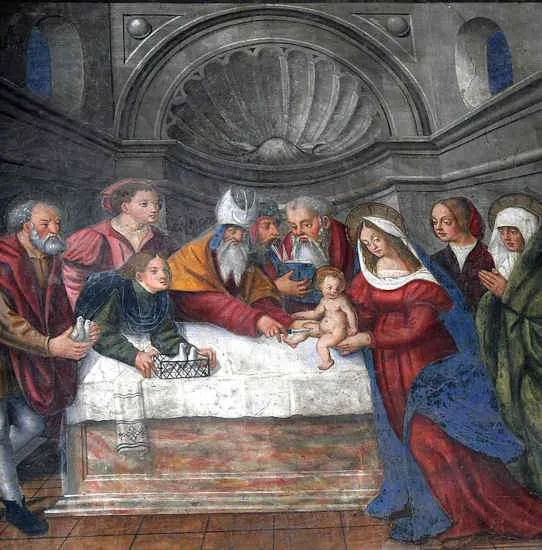
When they came on the eighth day to circumcise the child, they were going to call him Zechariah after his father, but his mother said in reply, “No. He will be called John.” But they answered her, “There is no one among your relatives who has this name.” So they made signs, asking his father what he wished him to be called. He asked for a tablet and wrote, “John is his name,” and all were amazed.

Reflection:

At the time of John the Baptist’s birth, it was customary for family, neighbors, and others within the community to gather for a child’s circumcision on the eighth day. According to Genesis 17:1–14, when God appeared to Abraham and established a covenant with him and his descendants, circumcision was instituted as the external sign of this covenant for every male child on the eighth day. Over time, it also became customary to name the child as part of the ceremony.

The naming of a child in Jewish tradition was significant. A child’s name connected him to his family and continued the family lineage. It was a way of honoring the family member whose name the child was given. Customarily, the firstborn male was named after his father or another significant relative. That’s why the family and friends who gathered for John’s naming and circumcision were surprised when he was not named Zechariah after his father and even more surprised when he was given the name John, a name that no other relative had.

The inclusion of this story in the Gospel narrative indicates that John’s name and its departure from Jewish custom hold special significance. Giving him a name that no other family member had was God’s way of indicating that John’s family, identity, and mission extended beyond his blood relatives. The name John means “God is gracious” or “God has been gracious.” Hence, John’s name points beyond his life to God, the Source of grace. His mission was universal, preparing the way of the Lord for all people. Through John, the gateway of God’s grace and mercy is proclaimed, and Jesus, the source of grace and salvation, enters. 

As we reflect on John the Baptist and his unique identity, we should also ponder our own identity in Christ. While family is the first and most important community where we come to know God and learn to love, God also calls us to an identity that transcends our biological family. We receive our most important identity through baptism. Just as circumcision was the sign of the Old Covenant, baptism is the sacrament that initiates us into the New Covenant in Christ.

Through baptism, we take on a new identity and become members of the one, eternal family of God. All who are in a state of grace are brothers and sisters in Christ, with God as our Father and the Blessed Virgin Mary as our spiritual mother.

Reflect today on your identity in Christ. In many cultures, it is customary to receive a new name at baptism, symbolizing this new identity. Ponder the identity given to you through baptism, the identity that defines who you truly are. Embrace this identity with all your heart.

Source: https://catholic-daily-reflections.com/2025/12/22/our-identity-in-christ/

Luke 1:59-63 Read More »

Saint Flavian of Acquapendente

Profile

Flavian was the father of Saint Bibiana and Saint Demetria; He was married to Saint Dafrosa of Acquapendente. He was a former prefect of imperial Rome. Julian the Apostate had him branded on the forehead as a slave for remaining loyal to his faith. He was exiled to Acquapendente, Tuscany, Italy. He was a martyr.

Died

  • 362 at Acquapendente, Italy of the results of torture and abuse
  • he collapsed and died while in prayer

Canonized

  • Pre-Congregation

Source: https://catholicsaints.info/saint-flavian-of-acquapendente/

Saint Flavian of Acquapendente Read More »

Luke 1:46; 52-53

Hungering for God

Mary said: “My soul proclaims the greatness of the Lord; my spirit rejoices in God my savior… He has cast down the mighty from their thrones and has lifted up the lowly. He has filled the hungry with good things, and the rich he has sent away empty.”

Reflection:

The last two sentences quoted from our Blessed Mother’s song of praise give us much to ponder. She, who is the Mother of God and full of grace, rejoiced that God “cast the mighty down from their thrones” and “the rich he sent away empty.” It’s understandable that she rejoiced in God Who “has lifted up the lowly” and “has filled the hungry with good things,” but the first two statements might give us pause.

In this context, when people are “mighty” and “rich,” we must understand this to mean those who act in a self-sufficient way, not recognizing their need for God. This tendency is easy to fall into. It is especially tempting for those who are successful in life. Without a deep prayer life and awareness of God’s activity in our lives, we can easily fall into the trap of thinking that we are in charge of our own destiny. When this happens, the most merciful thing God can do for us is to cast us down from our self-sufficient throne and send us away to experience the emptiness of our worldly riches.

The key to happiness in life is not attaining great power or riches. The key is found in humility, by which we recognize our absolute need for and dependence on God. Why? Because as the great Saint Augustine wrote in his book Confessions, “You have formed us for Yourself, and our hearts are restless until they rest in You, oh Lord.”

Would you be happier if you were rich or poor? Powerful or powerless? Famous or unknown? These questions cannot be answered because neither riches nor poverty, power nor powerlessness, fame nor obscurity have anything to do with true happiness. Though each person falling into any of these categories can find happiness, the categories themselves do not determine that happiness. True happiness comes by discovering God within one’s spiritual poverty and hunger.

When we perceive our souls correctly, we will understand Saint Augustine’s famous quote. We will realize that God alone fulfills us, and that doing His will enables us to become who we were created to be. When that discovery happens, we will hunger and thirst for God, and doing the will of God will become the all-consuming desire of our souls. Our God, in His great mercy and love for us, loves such a humble and hungry soul, lavishing spiritual riches upon it.

Reflect today on the intense interior fulfillment our Blessed Mother had. She did not live in a lavish castle with numerous servants. She was not the governor of her town, exercising great temporal power. But she was happy beyond what we can imagine because in her lowliness, humility, and hunger for God, she found perfect satisfaction. As you ponder her happiness, seek her intercession and strive to follow her example, no matter what temporal or worldly situation you find yourself in.

Source: https://catholic-daily-reflections.com/2025/12/21/hungering-for-god/

Luke 1:46; 52-53 Read More »

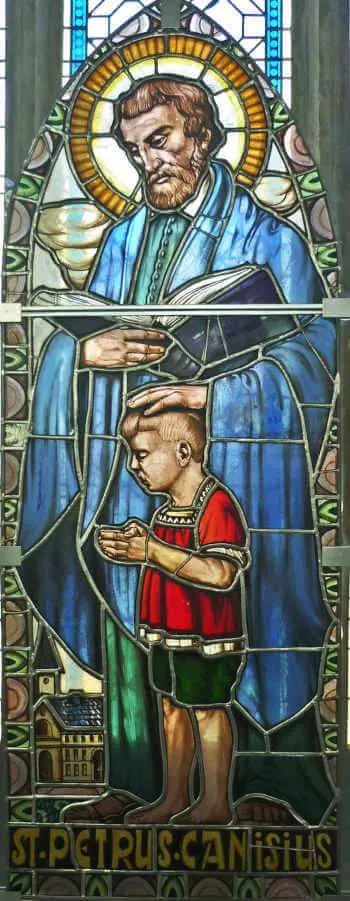
Saint Peter Canisius, Priest and Doctor

1521–1597; Patron Saint of the Catholic press, Germany, and writers of catechisms; Canonized and declared a Doctor of the Church by Pope Pius XI on May 21, 1925

On October 31, 1517, Father Martin Luther, a German Augustinian monk and theologian, nailed his Ninety-five Theses that criticized various Catholic Church practices to the door of the Castle Church in Wittenberg, Germany. This event is often considered to be the beginning of the Protestant Reformation that threw the Church into turmoil over the next century. Theological debates were fierce, the Church began to splinter, and cities and nations fought, leading to violence and deaths. Though the sixteenth century was chaotic for the faith, many saints emerged to defend the truth and reform the Church. We honor one of those saints today—Saint Peter Canisius.

Pieter Kanis (Peter) was born in the city of Nijmegen, in the Duchy of Guelders of the Holy Roman Empire, modern-day Netherlands. His father was well educated and served as the mayor of the town. Shortly after Peter’s birth, his mother died. In 1536, when Peter was fifteen, his father sent him to the University of Cologne, and for a short time to the University of Louvain, where he studied the arts, civil and canon law, and theology. In Cologne, Peter frequently visited the Cologne Charterhouse of the Carthusian monks of Saint Barbara. Though much of Germany had been thrown into turmoil as a result of the Protestant Reformation, the Cologne Charterhouse remained firmly Catholic. Peter especially learned from the monks a spirituality referred to as Devotio Moderna (Modern Devotion), which emphasized personal conversion, the internalization of faith, prayerful meditation on Christ’s life, simplicity, and humility. This spirituality would become a defining characteristic of Peter’s life and future ministry.

In 1540, at the age of nineteen, Peter received his Master’s Degree of Arts. His father wanted him to marry a wealthy noblewoman, but Peter’s deepening faith led him to make a personal commitment to a life of celibacy. That same year, the future Saints Ignatius of Loyola, Francis Xavier, Peter Faber, and four others co-founded what would become the Society of Jesus, or Jesuits. Over the next two decades, the Jesuits grew to an estimated 1,000 members, founded about thirty-five schools, and became missionaries to non-Christian territories. The Jesuits also played a significant role in the Catholic Counter-Reformation, becoming staunch defenders of the Catholic Church.

In 1543, Peter made a thirty-day retreat with the new Jesuit Father Peter Faber using the Spiritual Exercises written by Father Ignatius of Loyola. The primary goals of the Spiritual Exercises are personal conversion and the discernment of God’s will. They are especially designed to help a person arrive at a major life decision and resolution. Upon the completion of his thirty-day retreat, Peter Kanis discerned a call to enter the Jesuits. It was around that time that Peter began using the Latinized form of his name, Peter Canisius.

In 1545, the Holy Father opened the Council of Trent that helped lay the theological groundwork for the Catholic-Counter Reformation. The council clarified Catholic doctrines that were under attack due to the Protestant Reformation and enacted various reforms that were sorely needed within the Church. The Council of Trent continued to hold sessions until 1563.

In 1546, Peter Canisius was ordained a priest and was asked to attend the Council of Trent as an assistant to Cardinal Otto Truchsess von Waldburg, Bishop of Augsburg. In 1548, Peter went to Rome with Father Ignatius for further studies, and the following year was sent to Sicily where he assisted at the College of Messina, preaching and carrying out humble domestic duties. In 1549, he received his doctoral degree and made his final profession as a Jesuit.

Fully professed, well trained in Catholic doctrine, and intimately united to Christ through a life of personal prayer and devotion, Father Peter Canisius was ready for his life’s mission. At that time, Pope Paul III asked Father Ignatius of Loyola to recommend a Jesuit priest whom he could send to Germany to help renew the Catholic faith that was in turmoil. Father Peter Canisius was chosen. After meeting with the pope, Father Peter went to Saint Peter’s Basilica to pray to Saints Peter and Paul, asking them to make the apostolic blessing he received from the Holy Father permanent, so he could fulfill the daunting task ahead of him. He later wrote in his journal that he sensed great consolation at that moment. He had a conviction that he was being sent as an apostle to Germany, and that the Apostles Peter and Paul would accompany him.

In 1549, Father Peter set out for the Duchy of Bavaria, modern-day southern Germany, where he first served as dean, rector, and vice chancellor of the University of Ingolstadt. He quickly sought to personalize the faith and to win over hearts and minds. His concern for the students and faculty reached far beyond academics and good doctrine. He was also concerned with forming them spiritually, helping them come to know Christ through prayer and the Sacraments.

In 1554, he was asked to become the Bishop of Vienna, but he declined, preferring to continue his Jesuit mission of teaching and preaching. Instead, he served as the interim diocesan administrator for a year where he continued to share his intimate love for Christ and the people by engaging in pastoral work, such as serving in hospitals and prisons. It was there that he also took up the pen and began to write his influential German catechism: Summa Doctrinae Christianae (Summary of Christian Doctrine). This three-volume catechism was written for three different groups of people: theology students, older youth who were educated, and younger youth needing initial instruction. He wrote in a clear, concise, and down-to-earth way, using a question-and-answer format. One of Father Peter’s deep convictions was that those who had left the faith often did so out of ignorance, not out of ill-will. He believed that if their questions were answered with kindness and clarity, the true faith would once again be accepted. Pope Benedict XVI, a German born in 1927, said of these catechisms, “So it was that still in my father’s generation people in Germany were calling the Catechism simply ‘the Canisius.’ He really was the Catechist of Germany for centuries…”

After his time in Vienna, Father Peter worked nonstop. He founded the College of Prague in 1556, served as the first superior of the Jesuits in northern Germany, coordinated a network of Jesuit communities and colleges, was entrusted with diplomatic missions, and continued to contribute to the Council of Trent. In 1580, he moved to Fribourg, Switzerland, where he spent the last seventeen years of his life preaching and writing. His writings were voluminous, flooding Germany with devotionals, theological commentaries, spiritual texts, apologetic works, educational guides, and translations of Latin texts into German. He was so influential that 300 years after his death, Pope Leo XIII proclaimed him the “Second Apostle of Germany” (after Saint Boniface).

As we honor this great apostle of the Catholic faith, ponder the reasons for his success. He loved Christ, and he loved God’s people. He didn’t teach with arrogance or pride. He wasn’t harsh or heavy-handed. Instead, he won hearts as he won minds, gently but clearly leading people back to the faith, introducing them to the Person of Christ, and showing them the way to Heaven. Seek Saint Peter Canisius’ intercession today, praying that you, too, will become an evangelist in his mold. Commit yourself to sharing the Gospel with compassion, while never wavering from the truth.

Source: https://mycatholic.life/saints/saints-of-the-liturgical-year/21-december-saint-peter-canisius-priest-and-doctor–optional-memorial/

Saint Peter Canisius, Priest and Doctor Read More »

Fourth Sunday of Advent

First Reading Isaiah 7:10-14

The LORD spoke to Ahaz, saying:
Ask for a sign from the LORD, your God;
let it be deep as the netherworld, or high as the sky!
But Ahaz answered,
“I will not ask!  I will not tempt the LORD!”
Then Isaiah said:
Listen, O house of David!
Is it not enough for you to weary people,
must you also weary my God?
Therefore the Lord himself will give you this sign:
the virgin shall conceive, and bear a son,
and shall name him Emmanuel.

Responsorial Psalm Psalms 24:1-2, 3-4, 5-6

R. (7c and 10b) Let the Lord enter; he is king of glory.
The LORD’s are the earth and its fullness;
the world and those who dwell in it.
For he founded it upon the seas
and established it upon the rivers.
R. Let the Lord enter; he is king of glory.
Who can ascend the mountain of the LORD?
or who may stand in his holy place?
One whose hands are sinless, whose heart is clean,
who desires not what is vain.
R. Let the Lord enter; he is king of glory.
He shall receive a blessing from the LORD,
a reward from God his savior.
Such is the race that seeks for him,
that seeks the face of the God of Jacob.
R. Let the Lord enter; he is king of glory.

Second Reading Romans 1:1-7

Paul, a slave of Christ Jesus,
called to be an apostle and set apart for the gospel of God,
which he promised previously through his prophets in the holy Scriptures,
the gospel about his Son, descended from David according to the flesh,
but established as Son of God in power
according to the Spirit of holiness
through resurrection from the dead, Jesus Christ our Lord.
Through him we have received the grace of apostleship,
to bring about the obedience of faith,
for the sake of his name, among all the Gentiles,
among whom are you also, who are called to belong to Jesus Christ;
to all the beloved of God in Rome, called to be holy.
Grace to you and peace from God our Father
and the Lord Jesus Christ.

Alleluia Matthew 1:23

R. Alleluia, alleluia.
The virgin shall conceive, and bear a son,
and they shall name him Emmanuel.
R. Alleluia, alleluia.

Gospel Matthew 1:18-24

This is how the birth of Jesus Christ came about.
When his mother Mary was betrothed to Joseph,
but before they lived together,
she was found with child through the Holy Spirit.
Joseph her husband, since he was a righteous man,
yet unwilling to expose her to shame,
decided to divorce her quietly.
Such was his intention when, behold,
the angel of the Lord appeared to him in a dream and said,
“Joseph, son of David,
do not be afraid to take Mary your wife into your home.
For it is through the Holy Spirit
that this child has been conceived in her.
She will bear a son and you are to name him Jesus,
because he will save his people from their sins.”
All this took place to fulfill what the Lord had said through the prophet:
Behold, the virgin shall conceive and bear a son,
and they shall name him Emmanuel,

which means “God is with us.”
When Joseph awoke,
he did as the angel of the Lord had commanded him
and took his wife into his home.

Source: https://bible.usccb.org/bible/readings/122125.cfm

Fourth Sunday of Advent Read More »

Matthew 1:20

Saint Joseph, Our Patron and Protector

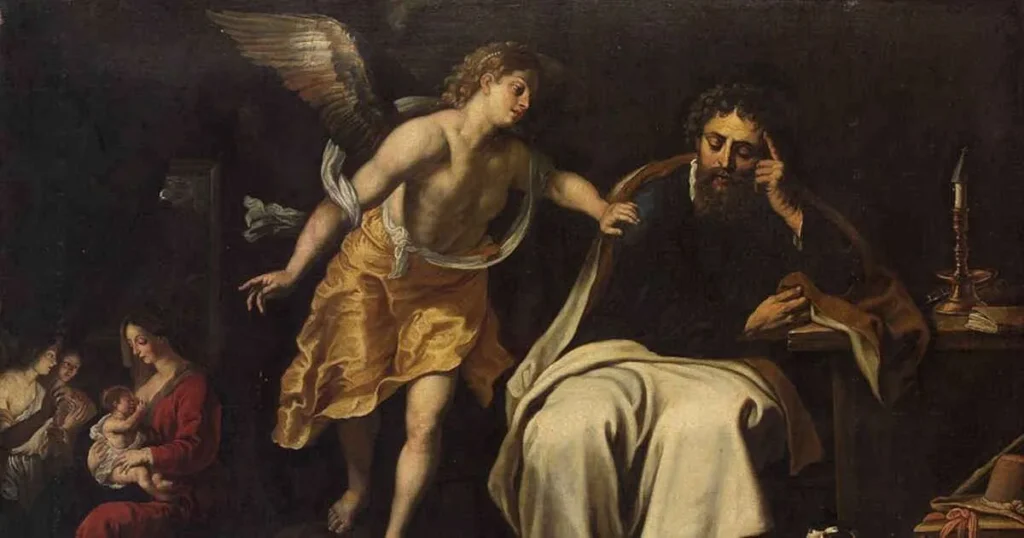
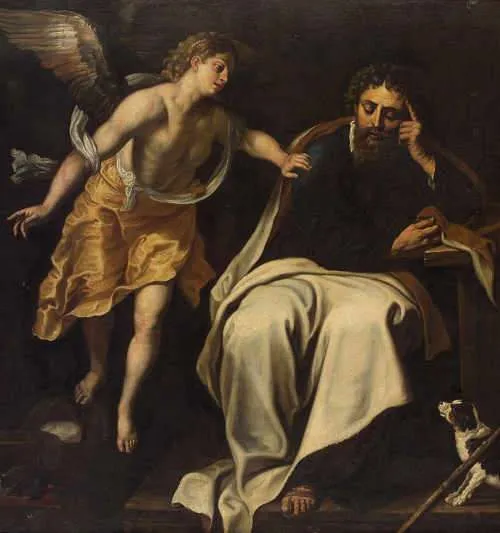
Such was his intention when, behold, the angel of the Lord appeared to him in a dream and said, “Joseph, son of David, do not be afraid to take Mary your wife into your home. For it is through the Holy Spirit that this child has been conceived in her.”

Reflection:

Joseph knew that the penalty for adultery was death by stoning. His heart must have been deeply conflicted. On one hand, the virtues of his betrothed wife, Mary, were abundantly clear. Mary radiated holiness. Impurity was foreign to her Immaculate Heart. Yet she was pregnant, and Joseph was not the father. What should he do?

To protect Mary from public shame, Joseph decided to do what he believed was the most merciful thing—he “decided to divorce her quietly. Such was his intention…” Though little is known about Joseph, this Gospel passage identifies him as “a righteous man.” Many saints, popes, and Church documents highlight his unquestionable sanctity. He was not immaculate and free from sin as was his wife, but God the Father would have chosen a righteous and holy man to be the foster father of the Son of God.

Joseph’s actions reveal his deep faith. As he slept, “the angel of the Lord appeared to him in a dream and said, ‘Joseph, son of David, do not be afraid to take Mary your wife into your home. For it is through the Holy Spirit that this child has been conceived in her.’” The angel explained to him that Isaiah prophesied that the Messiah would be born of a virgin (see Isaiah 7:14) and that Joseph was to take Mary and her unborn Son into his home and care for them. When he awoke, he did as the angel commanded.

Joseph’s dream was no ordinary dream. The Holy Spirit accompanied the angel and instilled the certitude of faith in Joseph’s mind, empowering his will to obey God’s will. Joseph became the father and guardian of the Savior of the World. On December 8, 1847, Pope Pius IX declared Saint Joseph to be the Universal Patron and Protector of the Catholic Church. Just as he protected the Son of God, so he intercedes for us who are members of Christ’s body, the Church.

As our Advent season enters its final week, we are reminded of the role that Jesus’ foster father played not only in the life of the Holy Family, but also about the role Saint Joseph continues to play in the life of the Church and in each one of our lives. His intercessory power from Heaven is great, and we should not hesitate to call upon his prayers, especially when we need protection, struggle with fear, or face some grave challenge.

Reflect today on your personal devotion to Saint Joseph. Ponder, especially, his deep faith and obedience to the will of God as was communicated to him in a dream. Strive to imitate that obedience in your own life, never hesitating to undertake the mission God has given you. Turn to Saint Joseph in prayer and know that his powerful intercession will help protect you and win God’s grace in the areas you need it the most.

Source: https://catholic-daily-reflections.com/2025/12/20/saint-joseph-our-patron-and-protector/

Matthew 1:20 Read More »

Saint Ursicinus of Saint-Ursanne

Profile

Ursicinus was a friend of Saint Columbanus. He was a missionary to Switzerland. He built a monastery at Saint Ursanne in the Swiss Juras, and served as its abbot. He could not bear wine nor those who served it to him.

Born

  • c.552 in Ireland

Died

  • c.625 near modern St-Ursanne, Jura, Switzerland of natural causes

Canonized

  • Pre-Congregation

Patronage

  • against stiff neck
  • in France
    – Besançon
  • in Germany
    – Mainz
  • in Switzerland
    – Basel
    – Saint-Ursanne

Representation

  • abbot with three lilies in his hand
  • abbot holding a book and fleur-de-lys, surrounded by fleur-de-lys

Source: https://catholicsaints.info/saint-ursicinus-of-saint-ursanne/

Saint Ursicinus of Saint-Ursanne Read More »