Author name: Sani

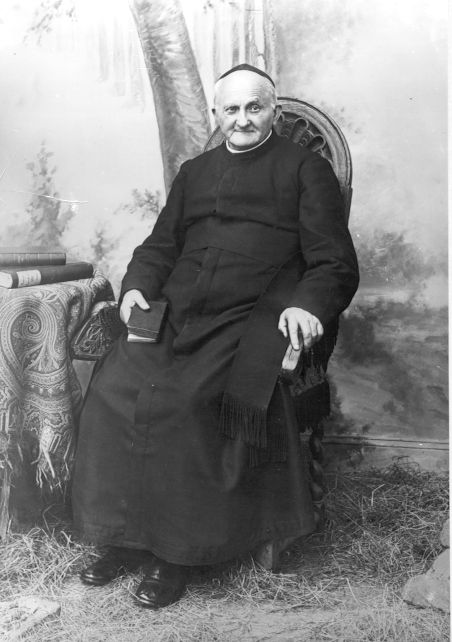
Saint Arnold Janssen

Profile

Arnold felt an early call to the priesthood, and was ordained in August 1861. Well educated, he taught science and catechism for twelve years.

Arnold was a chaplain and director of the Ursuline convent at Kempen in 1873. He was the Director of the diocesan Apostleship of Prayer in 1874, and was an editor of a journal about missionary work in 1873.

Arnold established the religious congregation Society of the Divine Word in Steyl, Netherlands in 1875; it received papal approval in 1901. The Society, which soon had houses in the Netherlands, Austria, and Germany, was composed of missionary priests who worked in Tonga, New Guinea, Japan, Paraguay, and throughout North America.

In 1889, Arnold founded the Missionary Sisters, Servants of the Holy Ghost to assist the priests in their mission. The Sisters serve as teachers in mission lands, especially of young girls. With the help of Blessed Maria Virgo, Arnold formed the sisters a contemplative branch named Sister Servants of the Holy Spirit of Perpetual Adoration who devote themselves to adoration of the Blessed Sacrament, and prayer for the success of missionary efforts. These sisters are nicknamed Pink Sisters because of the color of their habit.

Born

  • 5 November 1837 at Goch, North Rhein-Westphalia, Germany
  • His baptismal patron was Saint Arnold of Arnoldsweiler.

Died

  • 15 January 1909 in Steyl, Netherlands of natural causes

Venerated

  • 10 May 1973 by Pope Paul VI (decree of heroic virtues)

Beatified

  • 19 October 1975 by Pope Paul VI

Canonized

  • 5 October 2003 by Pope John Paul II

Source: https://en.wikipedia.org/wiki/Arnold_Janssen#/media/File:Arnold_Janssen.jpg

Saint Arnold Janssen

Saint Arnold Janssen Read More »

Mark 2:19-20

To Fast or Not to Fast

“Can the wedding guests fast while the bridegroom is with them? As long as they have the bridegroom with them they cannot fast. But the days will come when the bridegroom is taken away from them, and then they will fast on that day.”

Reflection:

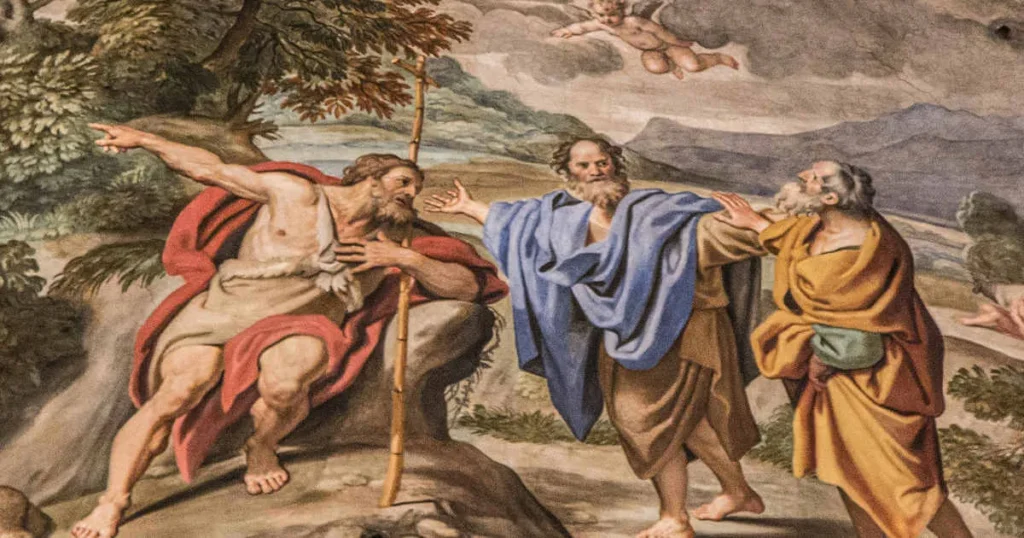
The passage above reveals Jesus’ response to the disciples of John the Baptist and some Pharisees who question Jesus about fasting. They point out that the disciples of John and the Pharisees each follow the Jewish laws on fasting, but Jesus’ disciples do not. Jesus’ answer goes to the heart of the new law on fasting.

Fasting is a wonderful spiritual practice. It helps to strengthen the will against disordered fleshly temptations and helps to bring purity to one’s soul. But it needs to be pointed out that fasting is not an eternal reality. One day, when we are face-to-face with God in Heaven, there will no longer be any need to fast or do any form of penance. But while on earth, we will struggle and fall and lose our way, and one of the best spiritual practices to help us return to Christ is prayer and fasting combined.

Fasting becomes necessary “when the bridegroom is taken away.” In other words, fasting is necessary when we sin and our union with Christ begins to fade. It is then that the personal sacrifice of fasting helps open our hearts once again to our Lord. This is especially true when habits of sin form and become deeply ingrained. Fasting adds much power to our prayer and stretches our souls so as to be able to receive the “new wine” of God’s grace where we need it the most.

Reflect, today, upon your approach to fasting and other penitential practices. Do you fast? Do you make regular sacrifices so as to strengthen your will and help you to turn more fully to Christ? Or has this healthy spiritual practice been somewhat neglected in your life? Renew your commitment to this holy endeavor today and God will work powerfully in your life.

Source: https://catholic-daily-reflections.com/2024/01/14/to-fast-or-not-to-fast-3/

Mark 2:19-20 Read More »

Saint Felix of Nola

Profile

Felix was the elder son of Hermias, a Syrian soldier who had retired to Nola, Italy. After his father‘s death, Felix sold off most of his property and possessions, gave the proceeds to the poor, and pursued a clerical vocation. He was ordained by, and worked with Saint Maximus of Nola.

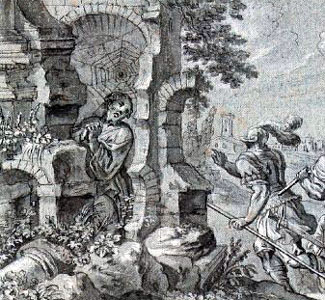
When Maximus fled to the mountains to escape the persecution of Decius, Felix was arrested and beaten for his faith instead. Legend says he was freed by an angel so he could help his sick bishop. Felix hid Maximus from soldiers in a vacant building. When the two were safely inside, a spider quickly spun a web over the door, fooling the imperial forces into thinking it was long abandoned, and they left without finding the Christians. The two managed to hide from authorities until the persecution ended with the death of Decius in 251.

After Maximus‘ death, Felix was chosen as bishop of Nola, but declined, favoring Quintus, a “senior” priest who had seven days more experience than Felix. He worked to farm his remaining land, and gave most of the proceeds to people even poorer than himself. Much of the little information we have about Felix came from the letters and poetry of Saint Paulinus of Nola, who served at a porter at the door of a church dedicated to Saint Felix, and who gathered information about him from churchmen and pilgrims.

Though Felix died of natural causes, he is normally listed as a martyr because of the torture, imprisonment, and privations he experienced in the persecutions.

Born

  • 3rd century at Nola, near Naples, Italy

Died

  • c.255 of natural causes
  • buried at Nola, Italy
  • for centuries his tomb was the site of pilgrimages

Canonized

  • Pre-Congregation

Patronage

  • against eye disease
  • against eye trouble
  • against false witness
  • against lies
  • against perjury
  • domestic animals
  • eyes
  • Nola, Italy

Representation

  • cobweb
  • deacon in prison
  • spiderweb
  • young priest carrying an old man (Maximus) on his shoulders
  • young priest chained in prison with a pitcher and potsherds near him
  • young priest with a bunch of grapes (symbolizes his care of the aged Maximus)
  • young priest with a spider
  • young priest with an angel removing his chains

Source: https://catholicsaints.info/saint-felix-of-nola/

Saint Felix of Nola Read More »

Second Sunday in Ordinary Time

First Reading 1 Sm 3:3b-10, 19

Samuel was sleeping in the temple of the LORD
where the ark of God was.
The LORD called to Samuel, who answered, “Here I am.”
Samuel ran to Eli and said, “Here I am. You called me.”
“I did not call you, ” Eli said. “Go back to sleep.”
So he went back to sleep.
Again the LORD called Samuel, who rose and went to Eli.
“Here I am, ” he said. “You called me.”
But Eli answered, “I did not call you, my son. Go back to sleep.”

At that time Samuel was not familiar with the LORD,
because the LORD had not revealed anything to him as yet.
The LORD called Samuel again, for the third time.
Getting up and going to Eli, he said, “Here I am. You called me.”
Then Eli understood that the LORD was calling the youth.

So he said to Samuel, “Go to sleep, and if you are called, reply,
Speak, LORD, for your servant is listening.”
When Samuel went to sleep in his place,
the LORD came and revealed his presence,
calling out as before, “Samuel, Samuel!”
Samuel answered, “Speak, for your servant is listening.”

Samuel grew up, and the LORD was with him,
not permitting any word of his to be without effect.

Responsorial Psalm Ps 40:2, 4, 7-8, 8-9, 10

R. (8a and 9a) Here am I, Lord; I come to do your will.

I have waited, waited for the LORD,
and he stooped toward me and heard my cry.
And he put a new song into my mouth,
a hymn to our God.

R. Here am I, Lord; I come to do your will.

Sacrifice or offering you wished not,
but ears open to obedience you gave me.
Holocausts or sin-offerings you sought not;
then said I, “Behold I come.”

R. Here am I, Lord; I come to do your will.

“In the written scroll it is prescribed for me,
to do your will, O my God, is my delight,
and your law is within my heart!”

R. Here am I, Lord; I come to do your will.

I announced your justice in the vast assembly;
I did not restrain my lips, as you, O LORD, know.

R. Here am I, Lord; I come to do your will.

Second Reading 1 Cor 6:13c-15a, 17-20

Brothers and sisters:
The body is not for immorality, but for the Lord,
and the Lord is for the body;
God raised the Lord and will also raise us by his power.

Do you not know that your bodies are members of Christ?
But whoever is joined to the Lord becomes one Spirit with him.
Avoid immorality.
Every other sin a person commits is outside the body,
but the immoral person sins against his own body.

Do you not know that your body
is a temple of the Holy Spirit within you,
whom you have from God, and that you are not your own?
For you have been purchased at a price.
Therefore glorify God in your body.

Alleluia Jn 1:41, 17b

R. Alleluia, alleluia.

We have found the Messiah:
Jesus Christ, who brings us truth and grace.

R. Alleluia, alleluia.

Gospel Jn 1:35-42

John was standing with two of his disciples,
and as he watched Jesus walk by, he said,
“Behold, the Lamb of God.”
The two disciples heard what he said and followed Jesus.

Jesus turned and saw them following him and said to them,
“What are you looking for?”
They said to him, “Rabbi” — which translated means Teacher —,
“where are you staying?”
He said to them, “Come, and you will see.”

So they went and saw where Jesus was staying,
and they stayed with him that day.
It was about four in the afternoon.

Andrew, the brother of Simon Peter,
was one of the two who heard John and followed Jesus.
He first found his own brother Simon and told him,
“We have found the Messiah” — which is translated Christ —.

Then he brought him to Jesus.
Jesus looked at him and said,
“You are Simon the son of John;
you will be called Cephas” — which is translated Peter.

Source: https://bible.usccb.org/bible/readings/011424.cfm

Second Sunday in Ordinary Time Read More »

John 1:40-42

Being a Witness of Christ

“Andrew, the brother of Simon Peter, was one of the two who heard John and followed Jesus. He first found his own brother Simon and told him, ‘We have found the Messiah’ — which is translated Christ —. Then he brought him to Jesus.”

Reflection:

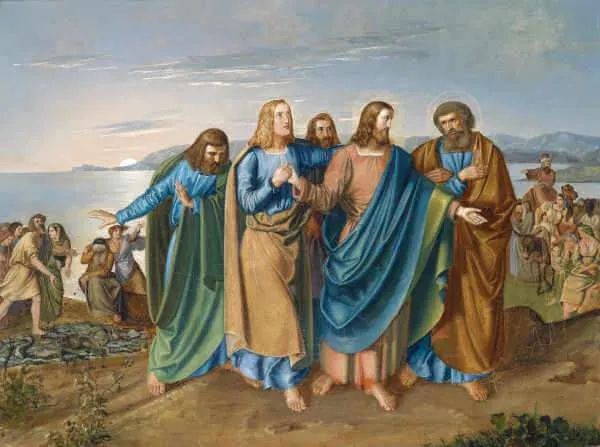
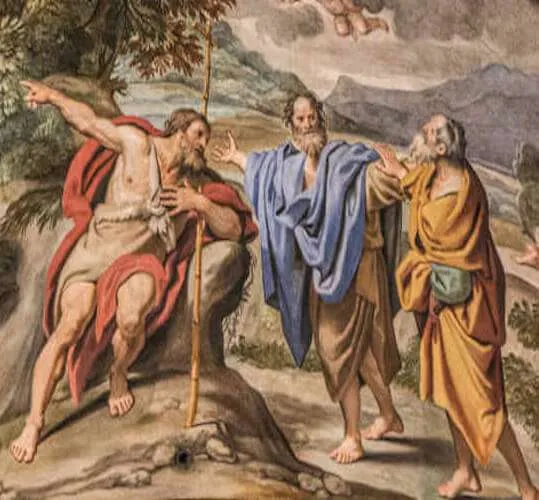
Andrew was a follower of Saint John the Baptist until John directed him to Jesus. One day John saw Jesus walk by and pointed to Jesus, telling Andrew and another disciple, “Behold, the Lamb of God.” The two disciples followed after Jesus. After spending the day with Jesus, Andrew was so impressed that the next day he excitedly went to find his brother, Simon Peter, to tell him about Jesus. As is mentioned in the passage above, he enthusiastically tells Peter, “We have found the Messiah.” Then, once Peter meets Jesus, Peter also becomes His disciple.

A similar experience occurs between the brothers Philip and Nathanael (see John 1:43–51). Jesus calls Philip to follow Him, and he does. After coming to believe that Jesus is the Messiah, Philip goes to tell his brother Nathanael that he has found “the one about whom Moses wrote in the law, and also the prophets.” Nathanael believes and follows our Lord. Thus, a series of conversions began after John the Baptist gave testimony that Jesus was the “Lamb of God.”

Though we can be certain that Jesus did not need the testimony of John the Baptist to convert Andrew, nor the testimony of Andrew to convert Simon Peter, nor the testimony of Philip to convert Nathanael, this is how it happened. Jesus chose to use these three to bring about the conversion of others.

In God’s divine plan of salvation, He regularly uses the mediation of others to bring forth the conversion of hearts. We see this on many levels. First and foremost, He uses our Blessed Mother as the Mediatrix of Grace to bring forth His grace upon us all. She is the instrument and Jesus is the source. Through her mediation, there are other saints who act as intercessors. And there are countless angels who also act as distributors of God’s grace and mercy. God is the source of all but uses the heavenly hosts to bring forth His grace upon us all.

The same is true within our earthly existence. In addition to the numerous angels and saints who act as intercessors and mediators, God uses each one of us to bring about His Kingdom here and now in the lives of many. Every time we speak God’s words or witness to God through our actions, we become instruments of God’s mercy. And if we fully commit ourselves to the divine will, there are many who will be converted by God’s grace through us.

Reflect, today, upon the holy and sacred calling you have received to act as a mediator of God’s infinite grace and mercy. First, think about the many people God wants to touch through you. Also think about the fact that those people might never be drawn to God if you fail to act. God can do all things and touch many people in varied ways, but the fact remains that He does want to use you for His mission. Say “Yes” to that mission so that you, like many others, will share in the glorious calling of being an intercessor and a mediator of God’s grace.

Source: https://catholic-daily-reflections.com/2024/01/13/being-a-witness-of-christ/

John 1:40-42 Read More »

Mark 2:14

Discerning the Will of God

“As he passed by, he saw Levi, son of Alphaeus, sitting at the customs post. Jesus said to him, ‘Follow me.’ And he got up and followed Jesus.”

Reflection:

How do you know the will of God for your life? In his spiritual classic, The Spiritual Exercises, Saint Ignatius of Loyola presented three ways in which we come to know the will of God. (See mycatholic.life/ignatius for more.)

The first way is the clearest and most definitive way. It is a time in which the person experiences a “clarity beyond doubting” as a result of a special grace of God. In describing this experience, Saint Ignatius mentions the passage quoted above as an illustration of this experience.

There is little said about this call of Levi in the Gospel of Mark, which is also recorded in Matthew’s Gospel (Matthew 9:9). Levi, who is also known as Matthew, was going about his occupation of collecting taxes at his customs post. It appears that Jesus spoke only these two simple words to Levi: “Follow me.”

As a result of these two words, Levi abandons his former life and becomes a follower of Jesus. Why would Levi do such a thing? What was it that convinced him to follow Jesus? Clearly there was much more than just a two-word invitation from Jesus that convinced him to respond.

That which convinced Levi was a special grace of God which produced within his soul a “clarity beyond doubting.” Somehow Levi just knew that God was calling him to abandon his former life and embrace this new life. There was no long discussion, no weighing of the pros and cons, no prolonged thinking about it. Levi just knew, and he responded.

Though this form of clarity in life is rare, it’s important to be aware of the fact that sometimes God does act this way. This is a great gift when it happens! And though this depth of instant clarity is not always the way God speaks to us, it’s important to acknowledge that God does speak to us this way at times.

Reflect, today, upon this call of Levi. Ponder this inner certitude he was given in that moment. Try to imagine what he experienced and what others may have thought of his choice to follow Jesus. Be open to this same grace; and if you ever feel as if God speaks to you with such clarity, be ready and willing to respond without hesitation.

Source: https://catholic-daily-reflections.com/2024/01/12/discerning-the-will-of-god-3/

Mark 2:14 Read More »

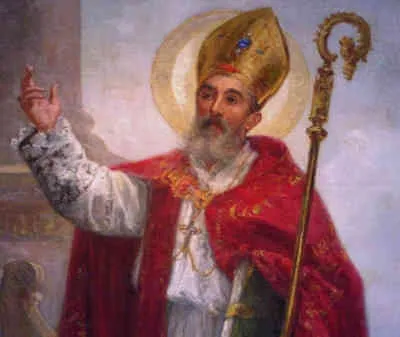
Saint Hilary of Poitiers, Bishop and Doctor

Patron Saint of children academically behind, children learning to walk, mothers, and the sick Invoked against rheumatism and snakebites, Pre-Congregation canonization, Proclaimed a Doctor of the Church in 1851 by Pope Pius IX

Born into a wealthy pagan family in Poitiers, France, Hilary was well educated in the classics. As he looked into his own soul, however, he knew that he did not exist for the sole purpose of seeking pleasure, enjoying leisure, obtaining wealth, or merely satisfying his fleshly desires.

Hilary reasoned that the human soul did not exist simply to die. Instead, it must exist for something more, something eternal, something glorious. When his pagan culture did not suffice and philosophy fell short, Hilary finally found what he was searching for when he stumbled upon the Scriptures.

Hilary was first struck by the mysterious name of God in the Old Testament: “I AM WHO I AM.” God had revealed Himself as eternal, without beginning or end—Existence itself. Then Hilary discovered the Son of God in the Gospel of John 1:1–14. Of this discovery, Hilary said, “My soul measured the mighty workings of God, wrought on the scale of His eternal omnipotence . . .by a boundless faith . . .that God was in the beginning with God, and that the Word became flesh and dwelt among us . . .” (De Trinitate 1.12).

Hilary had the will to believe, and in the years that followed he was given the power and gift to understand the beauty, mystery, omnipotence, and nature of the Most Holy Trinity. Shortly after these discoveries of faith, Hilary was baptized a Christian and went on to defend the doctrine of the Trinity against the “insanity and ignorance of men.” He so impressed the faithful that they chose him to be their bishop, a dignity to which he reluctantly agreed.

Among those who shared in the “insanity and ignorance” of that time were a group of bishops and laity who followed the heresy of Arianism, which denied the divinity of Christ, instead holding that the Son was inferior to the Father. This heresy was especially strong in the Eastern Church but was starting to spread throughout France.

After Hilary was a bishop for only about five years, the emperor, an Arian himself, ordered every bishop to pledge their support for this heresy. Hilary refused. Instead, he vigorously defended the truth, and for his brave stance was exiled to Phrygia, in modern-day Turkey. In His love and providence, God used Hilary’s time of exile in powerful ways.

While in Phrygia, Bishop Hilary spent much time studying and writing. He had already composed a marvelous commentary on the Gospel of Matthew while in Poitiers, and now he set his mind to his greatest work, De Trinitate (On the Trinity). Drawing from his classical education, his knowledge of Greek, his love of the Scriptures, and from the “insanity” and “ignorance” of Arianism itself, Bishop Hilary composed a comprehensive defense of the doctrine of the Trinity as it was taught in the Nicene Creed. Bishop Hilary caused so much trouble for the Arians in Phrygia that the Arian bishops pleaded with the emperor to send him back home, a request the emperor honored.

On his return to Poitiers, Bishop Hilary took the long way home through Greece and Italy, preaching all the way, weeding out the beginnings of Arianism in the Western Church. His effectiveness came not only from his clear teaching, but also from his conciliatory approach and resolute determination. Back in Poitiers, he continued to preach, write, attend councils, and even to compose hymns. The hymns were his way of introducing the doctrines of the faith to the people of God in song. He was a true pastor who burned with a desire that everyone come to a deeper knowledge of the One God—Father, Son, and Holy Spirit.

Source: https://mycatholic.life/saints/saints-of-the-liturgical-year/january-13-saint-hilary-of-poitiers-bishop-and-doctor/
Saint Hilary of Poitiers, Bishop and Doctor Read More »

Saint Marguerite Bourgeous

Profile

Marguerite was the sixth of twelve children of devout parents. When Marguerite was 19, her mother died, and the young lady cared for her younger brothers and sisters; her father died when she was twenty-seven. After raising her family, Marguerite prayed to know what to do with her life. The governor of Montreal, Canada, was in France looking for teachers for the New World. He invited Marguerite to come to Montreal to teach school and religion classes. She agreed and spent the rest of her life in North America.

Marguerite gave away her share of her parents’ inheritance to other members of the family, and in 1653, she sailed for Canada. She began construction of a chapel to honor Our Lady of Good Help, and opened her first school in 1658. She returned to France in 1659 to recruit more teachers, and returned with four; in 1670, she went to France again, and brought back six more. These brave women became the first sisters of the Congregation of Notre Dame.

Marguerite and her sisters helped people in the colony survive when food was scarce, opened a vocational school, taught young people how to run a home and farm. Marguerite’s congregation grew to 18 sisters, seven of them were Canadian. They opened missions, and two sisters taught at the Native American mission. Marguerite received the first two Native American women into the congregation.

In 1693, Mother Marguerite handed over her congregation to her successor, Marie Barbier, the first Canadian to join the order. Marguerite’s religious rule was approved by the Church in 1698, and Marguerite spent her last few years praying and writing an autobiography. On the last day of 1699, a young sister lay dying. Mother Marguerite asked the Lord to take her life in exchange. By the morning of 1 January 1700, the sister was completely well, Mother Marguerite had a raging fever, suffered 12 days, and died on 12 January 1700.

Born

  • 17 April 1620 at Troyes, Aube, France

Died

  • 12 January 1700 at Montreal, Quebec, Canada of fever

Venerated

  • 19 June 1910 by Pope Saint Pius X

Beatified

  • 12 November 1950 by Pope Pius XII

Canonized

  • 31 October 1982 by Pope John Paul II

Patronage

  • against death of parents
  • against impoverishment
  • against poverty
  • people rejected by religious orders
  • poor people

Source: https://catholicsaints.info/saint-marguerite-bourgeous/

https://www.catholic.org/saints/saint.php?saint_id=1373

Saint Marguerite Bourgeous Read More »

Mark 2:3-4

An Act of the Greatest Charity

“They came bringing to him a paralytic carried by four men. Unable to get near Jesus because of the crowd, they opened up the roof above him. After they had broken through, they let down the mat on which the paralytic was lying.”

Reflection:

This paralytic is a symbol of certain people in our lives who seem to be incapable of turning to our Lord by their own effort. It’s clear that the paralytic wanted healing, but he was unable to come to our Lord by his own effort. Therefore, the friends of this paralytic carried him to Jesus, opened the roof (since there was such a large crowd), and lowered the man down before Jesus.

The paralysis of this man is a symbol of a certain type of sin. It’s a sin for which someone desires forgiveness but is incapable of turning to our Lord by their own effort. For example, a serious addiction is something that can so dominate a person’s life that they cannot overcome this addiction by their own effort. They need the help of others to even be able to turn to our Lord for help. 

We each must see ourselves as the friends of this paralytic. Too often when we see someone who is trapped in a life of sin, we simply judge them and turn away from them. But one of the greatest acts of charity we can offer another is to help provide them with the means they need to overcome their sin. This can be done by our counsel, our unwavering compassion, a listening ear, and by any act of fidelity to that person during their time of need and despair.

How do you treat people who are caught in the cycle of manifest sin? Do you roll your eyes at them and turn away? Or do you firmly determine to be there for them to give them hope and to assist them when they have little or no hope in life to overcome their sin? One of the greatest gifts you can give to another is the gift of hope by being there for them to help them turn fully to our Lord.

Reflect, today, upon a person you know who seems to be not only caught in the cycle of sin but has also lost hope to overcome that sin. Prayerfully surrender yourself over to our Lord and commit yourself to the charitable act of doing anything and everything you can so as to help them fully turn to our divine Lord.

Source: https://catholic-daily-reflections.com/2024/01/11/an-act-of-the-greatest-charity-3/

Mark 2:3-4 Read More »

Saint Theodosius the Cenobiarch

Profile

Born to a pious family, Theodosius began his studies at an early age, and became a lector while still a youth. The example of Abraham led him to leave home in order to properly follow God. He met Saint Simeon Stylites in Antioch; Simeon recognized him as a holy man and leader, and invited Theodosius onto his pillar for prayer, blessing, and advice. He travelled to Jerusalem where legend says he worked with Saint Longinus the Centurian, who would have been nearly 500 years old at the time. He was also a head of a church near Bethlehem.

Theodosius was a hermit in the desert of Judah, living in a cave. Word of his holiness began to attract disciples, and Theodosius built a monastery at Cathismus to house them. They were so many there had to be a section for Greeks, for Armenians, for Persians, etc., but they all happily worked and prayed together. Next to the monastery he built a hospital for the sick, a hospice for the aged, and a mental hospital. He was a friend of and co-worker with Saint Sabbas. Appointed visitor to all cenobitical communities of Palestine the patriarch of Jerusalem.

Opposed heresies, including Eutychianism and Monophysitism. Emperor Anastatius, a supporter of Eutychianism, sent Theodosius a large bribe, hoping to sway the influential monk to his thinking; Theodosius distributed the money to the poor, and continued to preach against heresy. Because of his orthodox views, Anastatius removed him from his position in 513, but he soon resumed his duties under emperor Justinian.

In poor health in his old age, he was stricken with a condition that made his skin dry as stone. He continued to work until his health gave out, and then he spent his time praying for his community. He died at age 105.

Born

  • 423 at Garissus, Cappadocia (modern Turkey)

Died

  • 529 at Cathismus of natural causes
  • buried in the cave where he live as a hermit
  • it became a noted site for pilgrimages and miracles

Canonized

  • Pre-Congregation

Name Meaning

  • Cenobriach = head of people living a life in common

Representation

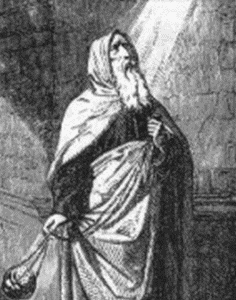
  • abbot hermit with iron bands on his neck and arms, chains and a money bag near him

Patronage

  • file maker

Source: https://catholicsaints.info/saint-theodosius-the-cenobiarch/

Saint Theodosius the Cenobiarch Read More »