Author name: Sani

John 1:40-42

Being a Witness of Christ

“Andrew, the brother of Simon Peter, was one of the two who heard John and followed Jesus. He first found his own brother Simon and told him, ‘We have found the Messiah’ — which is translated Christ —. Then he brought him to Jesus.”

Reflection:

Andrew was a follower of Saint John the Baptist until John directed him to Jesus. One day John saw Jesus walk by and pointed to Jesus, telling Andrew and another disciple, “Behold, the Lamb of God.” The two disciples followed after Jesus. After spending the day with Jesus, Andrew was so impressed that the next day he excitedly went to find his brother, Simon Peter, to tell him about Jesus. As is mentioned in the passage above, he enthusiastically tells Peter, “We have found the Messiah.” Then, once Peter meets Jesus, Peter also becomes His disciple.

A similar experience occurs between the brothers Philip and Nathanael (see John 1:43–51). Jesus calls Philip to follow Him, and he does. After coming to believe that Jesus is the Messiah, Philip goes to tell his brother Nathanael that he has found “the one about whom Moses wrote in the law, and also the prophets.” Nathanael believes and follows our Lord. Thus, a series of conversions began after John the Baptist gave testimony that Jesus was the “Lamb of God.”

Though we can be certain that Jesus did not need the testimony of John the Baptist to convert Andrew, nor the testimony of Andrew to convert Simon Peter, nor the testimony of Philip to convert Nathanael, this is how it happened. Jesus chose to use these three to bring about the conversion of others.

In God’s divine plan of salvation, He regularly uses the mediation of others to bring forth the conversion of hearts. We see this on many levels. First and foremost, He uses our Blessed Mother as the Mediatrix of Grace to bring forth His grace upon us all. She is the instrument and Jesus is the source. Through her mediation, there are other saints who act as intercessors. And there are countless angels who also act as distributors of God’s grace and mercy. God is the source of all but uses the heavenly hosts to bring forth His grace upon us all.

The same is true within our earthly existence. In addition to the numerous angels and saints who act as intercessors and mediators, God uses each one of us to bring about His Kingdom here and now in the lives of many. Every time we speak God’s words or witness to God through our actions, we become instruments of God’s mercy. And if we fully commit ourselves to the divine will, there are many who will be converted by God’s grace through us.

Reflect, today, upon the holy and sacred calling you have received to act as a mediator of God’s infinite grace and mercy. First, think about the many people God wants to touch through you. Also think about the fact that those people might never be drawn to God if you fail to act. God can do all things and touch many people in varied ways, but the fact remains that He does want to use you for His mission. Say “Yes” to that mission so that you, like many others, will share in the glorious calling of being an intercessor and a mediator of God’s grace.

Source: https://catholic-daily-reflections.com/2024/01/13/being-a-witness-of-christ/

John 1:40-42 Read More »

Mark 2:14

Discerning the Will of God

“As he passed by, he saw Levi, son of Alphaeus, sitting at the customs post. Jesus said to him, ‘Follow me.’ And he got up and followed Jesus.”

Reflection:

How do you know the will of God for your life? In his spiritual classic, The Spiritual Exercises, Saint Ignatius of Loyola presented three ways in which we come to know the will of God. (See mycatholic.life/ignatius for more.)

The first way is the clearest and most definitive way. It is a time in which the person experiences a “clarity beyond doubting” as a result of a special grace of God. In describing this experience, Saint Ignatius mentions the passage quoted above as an illustration of this experience.

There is little said about this call of Levi in the Gospel of Mark, which is also recorded in Matthew’s Gospel (Matthew 9:9). Levi, who is also known as Matthew, was going about his occupation of collecting taxes at his customs post. It appears that Jesus spoke only these two simple words to Levi: “Follow me.”

As a result of these two words, Levi abandons his former life and becomes a follower of Jesus. Why would Levi do such a thing? What was it that convinced him to follow Jesus? Clearly there was much more than just a two-word invitation from Jesus that convinced him to respond.

That which convinced Levi was a special grace of God which produced within his soul a “clarity beyond doubting.” Somehow Levi just knew that God was calling him to abandon his former life and embrace this new life. There was no long discussion, no weighing of the pros and cons, no prolonged thinking about it. Levi just knew, and he responded.

Though this form of clarity in life is rare, it’s important to be aware of the fact that sometimes God does act this way. This is a great gift when it happens! And though this depth of instant clarity is not always the way God speaks to us, it’s important to acknowledge that God does speak to us this way at times.

Reflect, today, upon this call of Levi. Ponder this inner certitude he was given in that moment. Try to imagine what he experienced and what others may have thought of his choice to follow Jesus. Be open to this same grace; and if you ever feel as if God speaks to you with such clarity, be ready and willing to respond without hesitation.

Source: https://catholic-daily-reflections.com/2024/01/12/discerning-the-will-of-god-3/

Mark 2:14 Read More »

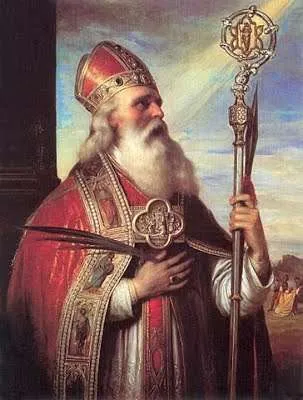
Saint Hilary of Poitiers, Bishop and Doctor

Patron Saint of children academically behind, children learning to walk, mothers, and the sick Invoked against rheumatism and snakebites, Pre-Congregation canonization, Proclaimed a Doctor of the Church in 1851 by Pope Pius IX

Born into a wealthy pagan family in Poitiers, France, Hilary was well educated in the classics. As he looked into his own soul, however, he knew that he did not exist for the sole purpose of seeking pleasure, enjoying leisure, obtaining wealth, or merely satisfying his fleshly desires.

Hilary reasoned that the human soul did not exist simply to die. Instead, it must exist for something more, something eternal, something glorious. When his pagan culture did not suffice and philosophy fell short, Hilary finally found what he was searching for when he stumbled upon the Scriptures.

Hilary was first struck by the mysterious name of God in the Old Testament: “I AM WHO I AM.” God had revealed Himself as eternal, without beginning or end—Existence itself. Then Hilary discovered the Son of God in the Gospel of John 1:1–14. Of this discovery, Hilary said, “My soul measured the mighty workings of God, wrought on the scale of His eternal omnipotence . . .by a boundless faith . . .that God was in the beginning with God, and that the Word became flesh and dwelt among us . . .” (De Trinitate 1.12).

Hilary had the will to believe, and in the years that followed he was given the power and gift to understand the beauty, mystery, omnipotence, and nature of the Most Holy Trinity. Shortly after these discoveries of faith, Hilary was baptized a Christian and went on to defend the doctrine of the Trinity against the “insanity and ignorance of men.” He so impressed the faithful that they chose him to be their bishop, a dignity to which he reluctantly agreed.

Among those who shared in the “insanity and ignorance” of that time were a group of bishops and laity who followed the heresy of Arianism, which denied the divinity of Christ, instead holding that the Son was inferior to the Father. This heresy was especially strong in the Eastern Church but was starting to spread throughout France.

After Hilary was a bishop for only about five years, the emperor, an Arian himself, ordered every bishop to pledge their support for this heresy. Hilary refused. Instead, he vigorously defended the truth, and for his brave stance was exiled to Phrygia, in modern-day Turkey. In His love and providence, God used Hilary’s time of exile in powerful ways.

While in Phrygia, Bishop Hilary spent much time studying and writing. He had already composed a marvelous commentary on the Gospel of Matthew while in Poitiers, and now he set his mind to his greatest work, De Trinitate (On the Trinity). Drawing from his classical education, his knowledge of Greek, his love of the Scriptures, and from the “insanity” and “ignorance” of Arianism itself, Bishop Hilary composed a comprehensive defense of the doctrine of the Trinity as it was taught in the Nicene Creed. Bishop Hilary caused so much trouble for the Arians in Phrygia that the Arian bishops pleaded with the emperor to send him back home, a request the emperor honored.

On his return to Poitiers, Bishop Hilary took the long way home through Greece and Italy, preaching all the way, weeding out the beginnings of Arianism in the Western Church. His effectiveness came not only from his clear teaching, but also from his conciliatory approach and resolute determination. Back in Poitiers, he continued to preach, write, attend councils, and even to compose hymns. The hymns were his way of introducing the doctrines of the faith to the people of God in song. He was a true pastor who burned with a desire that everyone come to a deeper knowledge of the One God—Father, Son, and Holy Spirit.

Source: https://mycatholic.life/saints/saints-of-the-liturgical-year/january-13-saint-hilary-of-poitiers-bishop-and-doctor/

Saint Hilary of Poitiers, Bishop and Doctor Read More »

Saint Marguerite Bourgeous

Profile

Marguerite was the sixth of twelve children of devout parents. When Marguerite was 19, her mother died, and the young lady cared for her younger brothers and sisters; her father died when she was twenty-seven. After raising her family, Marguerite prayed to know what to do with her life. The governor of Montreal, Canada, was in France looking for teachers for the New World. He invited Marguerite to come to Montreal to teach school and religion classes. She agreed and spent the rest of her life in North America.

Marguerite gave away her share of her parents’ inheritance to other members of the family, and in 1653, she sailed for Canada. She began construction of a chapel to honor Our Lady of Good Help, and opened her first school in 1658. She returned to France in 1659 to recruit more teachers, and returned with four; in 1670, she went to France again, and brought back six more. These brave women became the first sisters of the Congregation of Notre Dame.

Marguerite and her sisters helped people in the colony survive when food was scarce, opened a vocational school, taught young people how to run a home and farm. Marguerite’s congregation grew to 18 sisters, seven of them were Canadian. They opened missions, and two sisters taught at the Native American mission. Marguerite received the first two Native American women into the congregation.

In 1693, Mother Marguerite handed over her congregation to her successor, Marie Barbier, the first Canadian to join the order. Marguerite’s religious rule was approved by the Church in 1698, and Marguerite spent her last few years praying and writing an autobiography. On the last day of 1699, a young sister lay dying. Mother Marguerite asked the Lord to take her life in exchange. By the morning of 1 January 1700, the sister was completely well, Mother Marguerite had a raging fever, suffered 12 days, and died on 12 January 1700.

Born

  • 17 April 1620 at Troyes, Aube, France

Died

  • 12 January 1700 at Montreal, Quebec, Canada of fever

Venerated

  • 19 June 1910 by Pope Saint Pius X

Beatified

  • 12 November 1950 by Pope Pius XII

Canonized

  • 31 October 1982 by Pope John Paul II

Patronage

  • against death of parents
  • against impoverishment
  • against poverty
  • people rejected by religious orders
  • poor people

Source: https://catholicsaints.info/saint-marguerite-bourgeous/

https://www.catholic.org/saints/saint.php?saint_id=1373

Saint Marguerite Bourgeous Read More »

Mark 2:3-4

An Act of the Greatest Charity

“They came bringing to him a paralytic carried by four men. Unable to get near Jesus because of the crowd, they opened up the roof above him. After they had broken through, they let down the mat on which the paralytic was lying.”

Reflection:

This paralytic is a symbol of certain people in our lives who seem to be incapable of turning to our Lord by their own effort. It’s clear that the paralytic wanted healing, but he was unable to come to our Lord by his own effort. Therefore, the friends of this paralytic carried him to Jesus, opened the roof (since there was such a large crowd), and lowered the man down before Jesus.

The paralysis of this man is a symbol of a certain type of sin. It’s a sin for which someone desires forgiveness but is incapable of turning to our Lord by their own effort. For example, a serious addiction is something that can so dominate a person’s life that they cannot overcome this addiction by their own effort. They need the help of others to even be able to turn to our Lord for help. 

We each must see ourselves as the friends of this paralytic. Too often when we see someone who is trapped in a life of sin, we simply judge them and turn away from them. But one of the greatest acts of charity we can offer another is to help provide them with the means they need to overcome their sin. This can be done by our counsel, our unwavering compassion, a listening ear, and by any act of fidelity to that person during their time of need and despair.

How do you treat people who are caught in the cycle of manifest sin? Do you roll your eyes at them and turn away? Or do you firmly determine to be there for them to give them hope and to assist them when they have little or no hope in life to overcome their sin? One of the greatest gifts you can give to another is the gift of hope by being there for them to help them turn fully to our Lord.

Reflect, today, upon a person you know who seems to be not only caught in the cycle of sin but has also lost hope to overcome that sin. Prayerfully surrender yourself over to our Lord and commit yourself to the charitable act of doing anything and everything you can so as to help them fully turn to our divine Lord.

Source: https://catholic-daily-reflections.com/2024/01/11/an-act-of-the-greatest-charity-3/

Mark 2:3-4 Read More »

Saint Theodosius the Cenobiarch

Profile

Born to a pious family, Theodosius began his studies at an early age, and became a lector while still a youth. The example of Abraham led him to leave home in order to properly follow God. He met Saint Simeon Stylites in Antioch; Simeon recognized him as a holy man and leader, and invited Theodosius onto his pillar for prayer, blessing, and advice. He travelled to Jerusalem where legend says he worked with Saint Longinus the Centurian, who would have been nearly 500 years old at the time. He was also a head of a church near Bethlehem.

Theodosius was a hermit in the desert of Judah, living in a cave. Word of his holiness began to attract disciples, and Theodosius built a monastery at Cathismus to house them. They were so many there had to be a section for Greeks, for Armenians, for Persians, etc., but they all happily worked and prayed together. Next to the monastery he built a hospital for the sick, a hospice for the aged, and a mental hospital. He was a friend of and co-worker with Saint Sabbas. Appointed visitor to all cenobitical communities of Palestine the patriarch of Jerusalem.

Opposed heresies, including Eutychianism and Monophysitism. Emperor Anastatius, a supporter of Eutychianism, sent Theodosius a large bribe, hoping to sway the influential monk to his thinking; Theodosius distributed the money to the poor, and continued to preach against heresy. Because of his orthodox views, Anastatius removed him from his position in 513, but he soon resumed his duties under emperor Justinian.

In poor health in his old age, he was stricken with a condition that made his skin dry as stone. He continued to work until his health gave out, and then he spent his time praying for his community. He died at age 105.

Born

  • 423 at Garissus, Cappadocia (modern Turkey)

Died

  • 529 at Cathismus of natural causes
  • buried in the cave where he live as a hermit
  • it became a noted site for pilgrimages and miracles

Canonized

  • Pre-Congregation

Name Meaning

  • Cenobriach = head of people living a life in common

Representation

  • abbot hermit with iron bands on his neck and arms, chains and a money bag near him

Patronage

  • file maker

Source: https://catholicsaints.info/saint-theodosius-the-cenobiarch/

Saint Theodosius the Cenobiarch Read More »

Mark 1:40-41

Be Made Clean

“A leper came to him and kneeling down begged him and said, ‘If you wish, you can make me clean.’ Moved with pity, he stretched out his hand, touched the leper, and said to him, ‘I do will it. Be made clean.’”

Reflection:

If we come to our divine Lord with faith, kneel down before Him and present our need to Him, then we also will receive the same response given to this leper: “I do will it. Be made clean.” These words should give us hope in the midst of any and every challenge in life.

What is it that our Lord wills for you? And what is it that He desires to make clean in your life? This story of the leper coming to Jesus does not mean that our Lord will grant any and every request we bring to Him. Instead, it reveals that He wills to make us clean of that which afflicts us the most.

Leprosy in this story should be seen as a symbol of the spiritual ills that afflict your soul. First and foremost, it should be seen as a symbol of the sin in your life that has become habitual and slowly does great damage to your soul.

At that time, leprosy not only caused grave physical damage to a person, but it also had the effect of isolating them from the community. They had to live apart from others who did not have the disease; and if they came near others, they had to show they were lepers by certain external signs so that people would not come in contact with them. Thus, leprosy had both personal and communal ramifications.

The same is true with many habitual sins. Sin does damage to our souls, but it also affects our relationships. For example, a person who is habitually harsh, judgmental, sarcastic or the like will experience the ill effects of these sins on their relationships.

Returning to the statement of Jesus above, consider that sin which not only affects your soul the most but also your relationships. To that sin, Jesus wishes to say to you, “Be made clean.” He wants to strengthen your relationship by cleansing the sin within your soul. And all it takes for Him to do that is for you to turn to Him on your knees and to present your sin to Him. This is especially true within the Sacrament of Reconciliation.

Reflect, today, upon your closest relationships in life. And then consider which of your sins most directly hurts those relationships. Whatever comes to mind, you can be certain that Jesus wants to rid you of that spiritual leprosy within your soul.

Source: https://catholic-daily-reflections.com/2024/01/10/be-made-clean-3/

Mark 1:40-41 Read More »

Saint William of Bourges

Profile

William was a member of the family of the Counts of Nevers. His father, Baldwin, planned a military life for him. He was educated by his maternal uncle, Peter the Hermit, archdeacon of Soissons, France. Drawn to religious life from an early age, William became a priest, canon in Soissons, and later in Paris.

William was a monk in the Order of Grandmont, noted for his austerities, his devotion to the Blessed Sacrament, and for the time spent praying at the altar. Internal dissension in the Order caused him to leave Grandmont for the recently formed Cistercians, taking the habit at Pontigny.

William was an abbot at Fontaine-Jean in Sens, France and at Chaalis near Senlis, France in 1187.

William was reluctant in being the Archbishop of Bourges, France in 1200, accepting the position only after receiving orders from the general of his order, and from Pope Innocent III. He lived an even more austere life, defended clerical rights against the state, cared personally for the poor, sick, imprisoned and debauched, and converted many Albigensians in his diocese to orthodox Christianity. Witnesses claim he performed 18 miracles during his life, and another 18 after his death.

Born

  • 12th century in Nevers, France

Died

  • 10 January 1209 at Bourges, France of natural causes while in prayer

Canonized

  • 17 May 1217 by Pope Honorius III

Source: https://en.wikipedia.org/wiki/William_of_Donjeon#/media/File:Saint_Guillaume_de_Bourges.jpg

Saint William of Bourges

Saint William of Bourges Read More »

Mark 1:32-34

More Demons Driven Out

“When it was evening, after sunset, they brought to him all who were ill or possessed by demons. The whole town was gathered at the door. He cured many who were sick with various diseases, and he drove out many demons, not permitting them to speak because they knew him.”

Reflection:

Today we read that Jesus once again “drove out many demons…” The passage then adds, “…not permitting them to speak because they knew him.” 

Why would Jesus not permit these demons to speak? Many of the early Church fathers explain that even though the demons had an understanding that Jesus was the promised Messiah, they did not understand fully what that meant and how He would accomplish His ultimate victory. Therefore, Jesus did not want them to speak only half-truths about Him, as the evil one often does, thus misleading the people. So Jesus always forbade these demons from speaking about Him publicly.

It’s important to understand that all of the demonic spirits failed to understand the full truth that it would be Jesus’ death that ultimately destroys death itself and sets all people free. For that reason, we see that these diabolical forces continually conspired against Jesus and tried to attack Him throughout His life. They stirred up Herod when Jesus was a baby, which forced Him into exile in Egypt.

Satan himself tempted Jesus just prior to the beginning of His public ministry so as to try to dissuade Jesus from His mission. There were many diabolical forces who continually attacked Jesus throughout His public ministry, especially through the ongoing hostility of the religious leaders at the time. And it can be presumed that these demons may have initially thought they won the battle when they accomplished their goal of having Jesus crucified. 

The truth, however, is that Jesus’ wisdom continually confounded these demons and ultimately transformed their evil act of having Him crucified into an ultimate victory over sin and death itself by rising from the dead. Satan and his demons are real, but compared to the truth and wisdom of God, these diabolical forces reveal their complete foolishness and weakness. Just like Jesus, we need to rebuke these tempters in our lives and command that they be silent. Too often we allow their half truths to mislead us and confuse us.

Reflect, today, upon the importance of confidently rebuking the evil one and the many lies he tempts us to believe. Rebuke him with the truth and authority of Christ and pay no attention to what he says.

Source: https://catholic-daily-reflections.com/2024/01/09/more-demons-driven-out-3/

Mark 1:32-34 Read More »

Saint Adrian of Canterbury

Profile

In the mid-640‘s, Adrian’s family fled to Naples, Italy ahead of the Arab invasion. He was quite young when he became a Benedictine monk. He was an abbot of Hiridanum, Isle of Nisida, Bay of Naples. He became acquainted with Emperor Constans II, who later introduced him to Pope Saint Vitalian. He later on became Vitalian’s advisor.

Adrian was twice offered the Archbishopric of Canterbury, England; he declined, citing unworthiness. When Saint Theodore of Tarsus was sent instead, Adrian went as his assistant with special support to aid the monastic movement in the region. 

Adrian was detained in France due to suspicions of espionage for the emperor. He arrived in England in 669. He became an abbot of Saint Peter‘s, a monastery founded by Augustine of Canterbury.

Adrian and Theodore were highly successful missionaries in largely pagan England. In addition, Adrian was a great teacher of languages, mathematics, poetry, astronomy, and Bible study. Under his leadership, the School of Canterbury became the center of English learning. He worked to unify the customs of the English with the Church, and to promote Roman customs.

Born

  • c.635 in Libya Cyrenaica, North Africa as Hadrian

Died

  • 9 January 710 of natural causes at Canterbury, England, and buried there
  • His tomb became a site of miracles.
  • His body was found incorrupt in 1091.

Canonized

  • Pre-Congregation

Patronage

  • Canterbury, England

Source: https://catholicsaints.info/saint-adrian-of-canterbury/

Saint Adrian of Canterbury Read More »