Author name: Sani

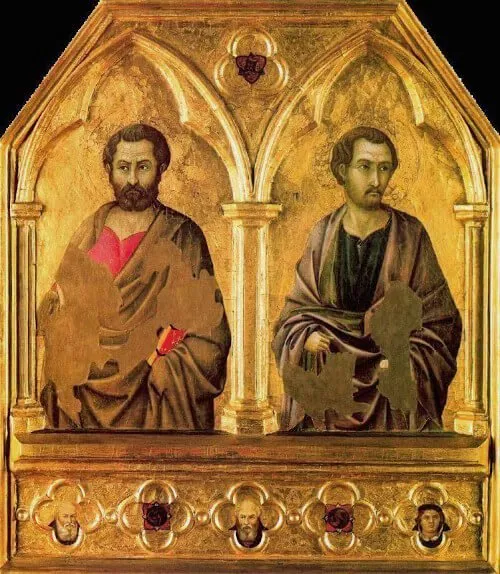
Saints Simon and Jude, Apostles

First Century; Patron Saint of curriers, woodcutters, and tanners (Simon); hopeless causes and hospital workers (Jude); Pre-Congregation canonization

Today, the Church honors Saints Simon and Jude, two of the Twelve Apostles chosen by our Lord. They were two of the first bishops through whom our Lord established His Church and from whom every bishop, priest, and deacon is a spiritual descendant.

Very little is known about these two Apostles, other than what is briefly mentioned about them in the New Testament, and even that is a little confusing. They are both listed among the Twelve whom Jesus names Apostles: Matthew 10:2–4Mark 3:16–19Luke 6:13–16Acts 1:13.

Today’s Simon is not Simon Peter, the Prince of the Apostles, but rather “Simon the Cananean” (Matthew and Mark) and “Simon the Zealot” (Luke and Acts). Both names mean the same thing. “Cananean” does not refer to the Land of Canaan but is a translation of an Aramaic word meaning “zealous.”

It’s interesting to note that Jesus chose a variety of different people as His Apostles. Perhaps the most stark contrast is found between Simon the Zealot and Matthew the tax collector. As a zealot, Simon would have been very committed to his Jewish identity and would have been firmly opposed to Roman oppression and taxation. He would have had an immediate aversion to Matthew, who previously served the Romans by collecting taxes for them from the Jews. The fact that Jesus did not choose like-minded Apostles shows His inclusion of all people. Jesus did not have a favorite type of person. He was not bound by cultural ties, ideologies, or social classes. He was not nationalistic in the sense of being a separatist or isolationist. He was interested in all people, those of every background and experience, and His Apostles reveal that fact. Jesus might have chosen Simon because He wanted to reach out to those who were firmly committed to their Jewish heritage, traditions, and beliefs, and Simon was able to reach those people.

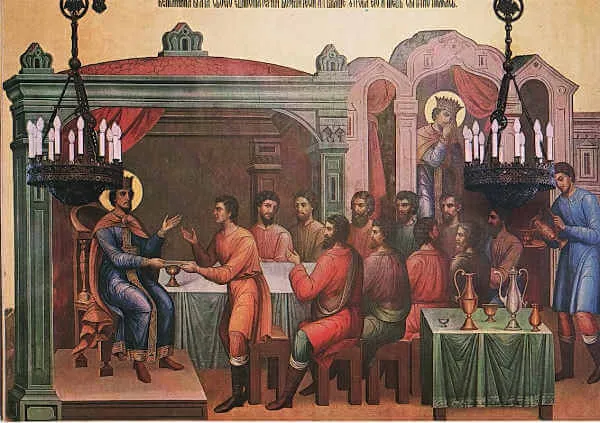
Jude is referred to as “Judas son of James” (Luke and Acts) and “Thaddeus” (Matthew and Mark). The only other reference that is certain about Jude comes from John’s Gospel during the Last Supper in which Jude is referred to as “Judas, not the Iscariot…” (John 14:22). During the Last Supper, Jesus compassionately instructed His Apostles that He would soon be leaving them, but they should have courage and wait for His Advocate, the Holy Spirit. Jude, expressing a bit of confusion, asked Jesus, “Master, [then] what happened that you will reveal yourself to us and not to the world?” In other words, Jude was asking Jesus why He doesn’t just manifest His divinity to everyone, in a clear and convincing way, so that they will all believe in Him. Jesus’ answer is mysterious, but He essentially points out that belief in Him must come by the inspired gift of faith, and that obedience to that faith, and to the will of God, will result in divine union.

There is also a reference in two of the Gospels identifying Simon and Jude as Jesus’ brothers: “Is he not the carpenter’s son? Is not his mother named Mary and his brothers James, Joseph, Simon, and Judas?” (Matthew 13:55Mark 6:3). However, most scholars today believe these two are not the same as the Apostles but are cousins of Jesus. It was custom at that time to refer to one’s cousin as brother or sister. It is possible that the Judas identified as Jesus’ brother is the author of the Epistle of Jude in the New Testament, rather than the Apostle. However, that point is debated, and even Pope Benedict XVI at a General Audience in 2006 pointed to the tradition that the Epistle of Jude was, indeed, written by the Apostle. If that’s the case, then it might be that these two Judes are one and the same.

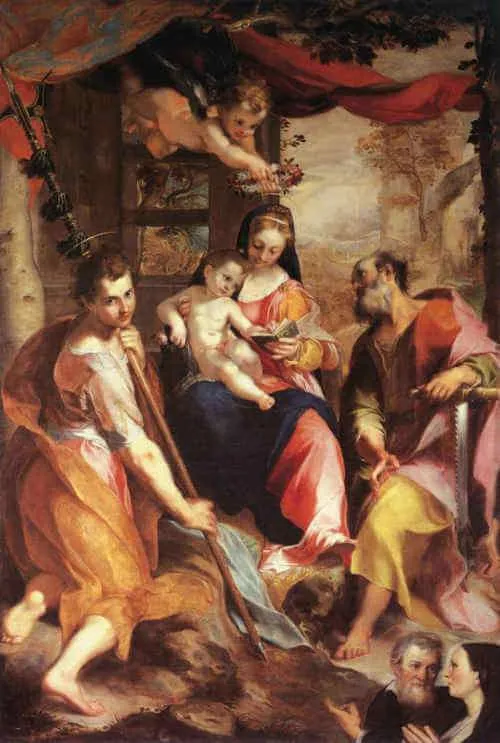
Regarding their deaths, nothing is known other than unreliable apocryphal sources, such as the Passion of Simon and Jude, and other fourth-century and later sources. One of the most common traditions is that Simon and Jude traveled to Persia to preach the Gospel and were both killed there in the year 65. Simon is traditionally believed to have been sawed in half, and Jude is traditionally believed to have been beaten with a club. They often appear in sacred art holding the instruments of their deaths. Other traditions state they ministered in Armenia, Beirut, Lebanon, Roman Britain, Egypt, and/or Samaria and died by arrows, crucifixion, and even a peaceful death.

The Epistle that has been traditionally attributed to Saint Jude the Apostle is a short but passionate letter in which he warns all Christians against immorality and heresy trying to enter the early Church. Some suggest it is for this reason that he is named Patron Saint of Hopeless Causes, because of his passionate plea. Another tradition states that because Jude shared a name with Judas Iscariot, the betrayer, Saint Jude’s intercession was rarely sought. However, after the intercession of every other Apostle and saint was sought, people in the early Church would turn to Saint Jude as their last hope. There are many ancient traditions holding that Saint Jude has provided many miracles throughout the centuries.

As we honor these Apostles, what we know for certain is that they were instrumental in the early Church. Being among the first bishops, they bore the sacred responsibility of transmitting the Sacraments and the teachings of Jesus to a nascent Church. One day in Heaven, we will see clearly the effects of their pastoral ministry. Today, we rejoice in what we do not fully know, trusting that their lives gave great glory to God and won the salvation of many souls.

Source: https://mycatholic.life/saints/saints-of-the-liturgical-year/october-28–sts-simon-and-jude/

Saints Simon and Jude, Apostles Read More »
Luke 6:12

Sent Forth by Christ

Jesus went up to the mountain to pray, and he spent the night in prayer to God. When day came, he called his disciples to himself, and from them he chose Twelve, whom he also named Apostles…

Reflection:

Simon and Jude were among those very select few who were chosen by Jesus Himself to be His Apostles. Today’s Simon is not the same person as Simon Peter, and today’s Jude is not the same person as Judas Iscariot. Little is known about these two Apostles. Simon is referred to as a zealot in the Gospels, which could have meant he was a member of a more radical sect within Judaism. Jude is popularly known as the Patron Saint of Hopeless Causes. Some suggest this is because he was often the last Apostle to be prayed to by the early Christian faithful on account of the fact that he shared a name with Judas Iscariot, and praying to Jude reminded people of that betrayer. If that was the case, then in God’s providence, since Jude became the last Apostle to be prayed to, he also became the last hope for many and, thus, the patron saint for those with truly hopeless causes.

One tradition states that Saints Simon and Jude are linked together in the Roman Canon and also share the same feast day because they were both martyred together on the same day, possibly in Syria, Lebanon, or Persia. However, the true details of their missionary journeys and martyrdom is unclear. The one thing that is certain about these Apostles, however, is that they were Apostles. They were chosen by our Lord and appointed by Him as two of the first bishops of our Church and were given a mandate to share the Gospel to the ends of the earth.

From our perspective today, being one of those chosen Twelve is an incredible privilege. The effect of their ministry in establishing the first Christian communities has resulted in our worldwide universal Catholic Church. These men most likely did not realize the impact that their faithful service would have upon the world.

As we honor these two Apostles, we are also reminded that each one of us is called to go forth to proclaim the Gospel to the ends of the earth. We each do so in a way specific to the calling and mission that Christ has entrusted to us. We are each called to make an eternal difference in the lives of those whom we serve. And if we are faithful to our mission, we can be certain that the effects of our apostolic service will be felt in the lives of countless others until the end of the world.

Reflect, today, upon Jesus choosing these two men and appointing them as Apostles. As you do, listen to God’s voice as He also speaks to you. Do not underestimate the importance of accepting the mission that Jesus gives to you. Say “Yes” to Him in imitation of these two Apostles and know that your choice to serve our Lord in this way will not only have a great effect in your life, it will also have an effect in the lives of many others for all eternity. 

Source: https://catholic-daily-reflections.com/2024/10/27/sent-forth-by-christ-3/

Luke 6:12 Read More »

Thirtieth Sunday in Ordinary Time

First Reading Jeremiah 31:7-9

     Thus says the LORD:
    Shout with joy for Jacob,
        exult at the head of the nations;
        proclaim your praise and say:
    The LORD has delivered his people,
        the remnant of Israel.
    Behold, I will bring them back
        from the land of the north;
    I will gather them from the ends of the world,
        with the blind and the lame in their midst,
    the mothers and those with child;
        they shall return as an immense throng.
    They departed in tears,
        but I will console them and guide them;
    I will lead them to brooks of water,
        on a level road, so that none shall stumble.
    For I am a father to Israel,
        Ephraim is my first-born.

Responsorial Psalm Psalms 126:1-2, 2-3, 4-5, 6

R. (3)    The Lord has done great things for us; we are filled with joy.
When the LORD brought back the captives of Zion,
    we were like men dreaming.
Then our mouth was filled with laughter,
    and our tongue with rejoicing.
R. The Lord has done great things for us; we are filled with joy.
Then they said among the nations,
    “The LORD has done great things for them.”
The LORD has done great things for us;
    we are glad indeed.
R. The Lord has done great things for us; we are filled with joy.
Restore our fortunes, O LORD,
    like the torrents in the southern desert.
Those that sow in tears
    shall reap rejoicing.
R. The Lord has done great things for us; we are filled with joy.
Although they go forth weeping,
    carrying the seed to be sown,
They shall come back rejoicing,
    carrying their sheaves.
R. The Lord has done great things for us; we are filled with joy.

Second Reading Hebrews 5:1-6

Brothers and sisters:
Every high priest is taken from among men
and made their representative before God,
to offer gifts and sacrifices for sins.
He is able to deal patiently with the ignorant and erring,
for he himself is beset by weakness
and so, for this reason, must make sin offerings for himself
as well as for the people.
No one takes this honor upon himself
but only when called by God,
just as Aaron was.
In the same way,
it was not Christ who glorified himself in becoming high priest,
but rather the one who said to him:
    You are my son:
        this day I have begotten you;

just as he says in another place:
    You are a priest forever
        according to the order of Melchizedek.

Alleluia Cf. 2 Timothy 1:10

R. Alleluia, alleluia.
Our Savior Jesus Christ destroyed death
and brought life to light through the Gospel.
R. Alleluia, alleluia.

Gospel Mark 10:46-52

As Jesus was leaving Jericho with his disciples and a sizable crowd,
Bartimaeus, a blind man, the son of Timaeus,
sat by the roadside begging.
On hearing that it was Jesus of Nazareth,
he began to cry out and say,
“Jesus, son of David, have pity on me.”
And many rebuked him, telling him to be silent. 
But he kept calling out all the more,
“Son of David, have pity on me.”
Jesus stopped and said, “Call him.”
So they called the blind man, saying to him,
“Take courage; get up, Jesus is calling you.”
He threw aside his cloak, sprang up, and came to Jesus. 
Jesus said to him in reply, “What do you want me to do for you?” 
The blind man replied to him, “Master, I want to see.” 
Jesus told him, “Go your way; your faith has saved you.” 
Immediately he received his sight
and followed him on the way.

Source: https://bible.usccb.org/bible/readings/102724.cfm

Thirtieth Sunday in Ordinary Time Read More »

Saint Emilina of Boulancourt

Profile

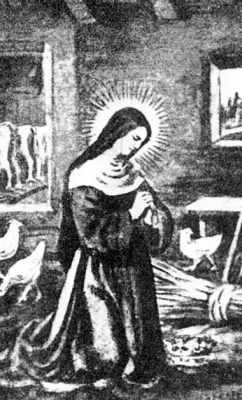
Emilina joined the Cistercian Abbey of Boulancourt at Longeville, France when she was still very young. She was noted for her deep prayer life, fasts, and austere, sometimes severe self-imposed penances such as wearing a pointed chain under her habit, walking barefooted throughout the year and fasting from food and liquids three days a week. Word of her devotion soon spread, and pilgrims came to consult her about holiness and prayer. She had the gift of prophesy, and sometimes prophesied about visitors before they arrived. She never sought honor or glory for herself from her gifts, but dealt with visitors humbly and patiently, always concerned with their conversion and relationship with God.

Born

  • 1115 at France

Died

  • 1178 at Longeville, France of natural causes
  • a perpetual flame is maintained at her tomb

Source: https://catholicsaints.info/saint-emilina-of-boulancourt/

Saint Emilina of Boulancourt Read More »

Mark 10:46-47

I Want to See

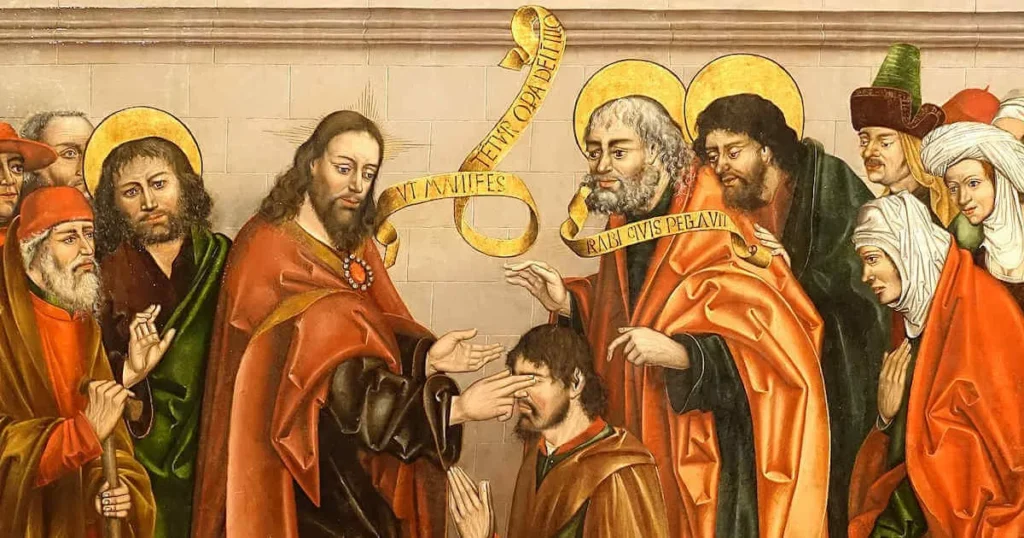
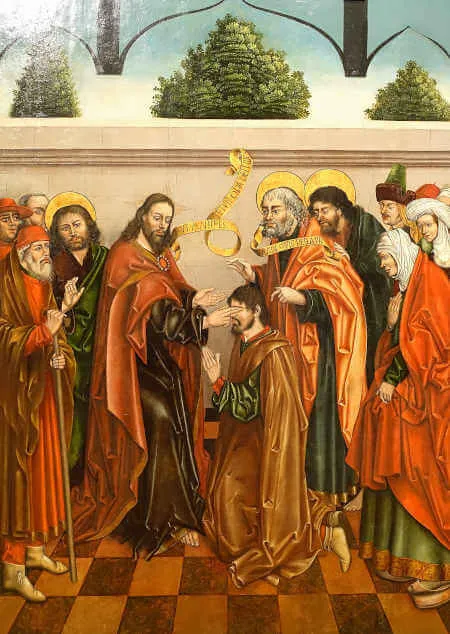
As Jesus was leaving Jericho with his disciples and a sizable crowd, Bartimaeus, a blind man, the son of Timaeus, sat by the roadside begging. On hearing that it was Jesus of Nazareth, he began to cry out and say, “Jesus, son of David, have pity on me.

Reflection:

Imagine the humiliation you might experience if your only way to survive each day was to sit on the side of the road and beg. As a blind man at that time, Bartimaeus was not able to work and support himself. Many saw his blindness as a curse from God and the result of his sin or the sins of his parents. He would have been treated as an outcast of society and as a burden to his family and community. Thus, the mental and emotional trauma a blind person experienced at that time would have been just as difficult to deal with as the physical blindness itself.

The symbolism in this story is extraordinary and teaches us many things about our Christian journey. First, we must strive to identify with Bartimaeus’ humility and weakness. On a spiritual level, we are all blind and, in our fallen natural state, we are spiritual outcasts. This means that we cannot attain Heaven by ourselves. Bartimaeus is a symbol of our fallen natural state. We need to humble ourselves every day and see ourselves as people in dire need who are incapable of saving our own souls.

Bartimaeus is also a symbol of what we must do in order to be drawn out of the blindness and misery we experience in life. The moment he heard that Jesus was walking by, he cried out for mercy. But he didn’t just cry out to our Lord. He did so with perseverance. The people who heard him crying out rebuked him and told him to stop. But their rebukes only led him to be more fervent in his prayer. Also, it appears that Jesus ignored him at first. Why would Jesus do that? It certainly wasn’t because Jesus didn’t care. It was because our Lord knew that Bartimaeus would persevere and He wanted him to do so. Jesus wanted Bartimaeus’ prayer to become more resolute, and it did.

The prayer of Bartimaeus must become the way we pray. It is very easy to become discouraged in life and to lose hope. When that happens, our prayer becomes weak and ineffective. At times, we will experience many other temptations to give up on prayer. The rebukes by the crowd are a symbol of the many temptations we will experience to give up on prayer. When those temptations come, we must double our effort and strengthen our resolve. Jesus’ silence at first must also be seen as an invitation to pray with greater faith. If we pray and feel as though God is not listening, we must know that God does hear us and His initial silence is His way of inviting us closer and to a deeper level of faith and prayer.

When Jesus stopped and told the disciples to bring Bartimaeus to Him, Bartimaeus immediately got up, threw off his cloak and went to our Lord. His cloak is a symbol of everything we need to shed in life that keeps us from immediately and quickly responding to the promptings of grace. Though there is nothing wrong with having a cloak, in that moment it was a slight hindrance to his prompt response to Jesus. So also with us; we must be ready and willing to eliminate anything that keeps us from responding to God the moment He calls to us.

Finally, Bartimaeus’ prayer was perfect. “Master, I want to see.” Spiritually speaking, we must work to foster the deepest desire to see God, to see our Lord. If we desire the gift of faith, the ability to see spiritual truths and understand them, then our Lord will answer that prayer. Our Lord will also say to us, “Go your way; your faith has saved you.”

Reflect, today, upon this poor blind beggar, Bartimaeus. See in his humble soul a model of how you must see yourself and of how you must pray. Observe the humility of your fallen state, the isolation you experience from your sin, and the perseverance you need to have in prayer. Follow the example of Bartimaeus, and our Lord will remove the blindness of your heart so that you can follow Him more fully every day.

Source: https://catholic-daily-reflections.com/2024/10/26/i-want-to-see-3/

Mark 10:46-47 Read More »

Saint Alfred the Great

Profile

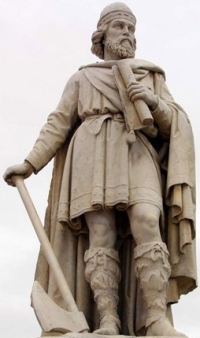
Alfred was the youngest of five sons of King Ethelwulf of Wessex. Ideal Christian king of Wessex, he came to the throne during a Danish invasion. Alfred defeated the Danes and preserved the growth of the Church in England. Patron of learning, he established a court school, and invited British and foreign scholars to work there. He personally translated several religious works into Anglo-Saxon. His laws made no distinction between British and Welsh subjects, a first.

Born

  • 849 at Wantage, Berkshire, England

Died

  • 26 October 899 of natural causes

Canonized

  • Pre-Congregation

Name Meaning

  • elf counsel
  • all peace
  • supernaturally wise counselor

Patronage

  • academics, scholars

Source: https://catholicsaints.info/saint-alfred-the-great/

Saint Alfred the Great Read More »

Luke 13:7-9

Cultivating the Soil of Your Heart

“‘For three years now I have come in search of fruit on this fig tree but have found none. So cut it down. Why should it exhaust the soil?’ He said to him in reply, ‘Sir, leave it for this year also, and I shall cultivate the ground around it and fertilize it; it may bear fruit in the future. If not you can cut it down.’”

Reflection:

How much good fruit is born from your life? This is an important question to answer honestly. One of the best ways to discern whether or not we are serving the will of God is to look at the fruit being born from our lives.

Good fruit is born in various ways and manifests itself in various forms. However, the fruit you must look for is twofold. First, it is the fruit found within your own soul resulting from a life of true prayer and union with God. Second, we must look for the fruit that is born of charity in our actions toward others.

When you look honestly at your own soul, what do you see? Often, you may see a sort of war within you in which your disordered passions and appetites fight against the Spirit of God. Good spiritual fruit will require interior purification. Through prayer, fasting, spiritual reading and the like, you must look for ways in which God’s Spirit takes control of your disordered human nature and reorders it in accord with His holy will. Though we are all sinners and will all fall at times, we must work diligently to overcome every action, desire and temptation that we can objectively discern to be contrary to the will of God. At times, your fallen human nature can so forcefully draw you into sin that it can confuse your intellect and lead you to rationalization of your sins. But if you want the fruit of God’s presence in your life, then you must continually choose to make your interior life a fruitful garden in which the virtues of God grow and are nourished in abundance. So, again, what do you honestly see as you look into your own soul?

As God nourishes the virtues within us, and our disordered passions and appetites fall under the control of the Spirit of God, then we will also discover a need to allow the interior fruits of God’s love to flow forth from our lives into the lives of others. We will begin to desire selfless and sacrificial living. We will begin to desire to put others first. We will consider others’ lives as precious and filled with dignity. And we will overcome judgment, harshness, anger, and the like. We will find ourselves desiring the good of others and will supernaturally be drawn to do many small acts of kindness toward all. But it all starts with one’s interior life which our Lord desires to cultivate and fertilize with His grace so that the interior fruits of His love will grow within and ultimately become very manifest in one’s daily exterior actions toward all.

Reflect, today, upon your soul being like this fig tree that has not been bearing fruit. See our Lord coming to you and asking you to allow Him to cultivate the ground and fertilize it. Know that this requires change on your part. If you are to bear good fruit, then you need this intervention by our Lord. Work with Him, be diligent, and do all you can to begin to bear an abundance of good fruit so that you are not among those who are ultimately cut down by God’s justice.

Source: https://catholic-daily-reflections.com/2024/10/25/cultivating-the-soil-of-your-heart-2/

Luke 13:7-9 Read More »

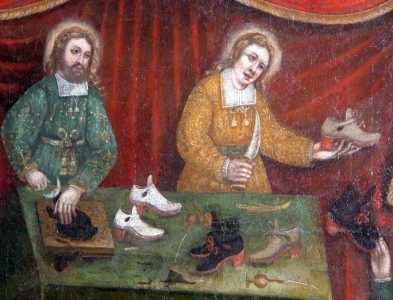
Saint Crispin

Profile

Crispin was a member of the imperial Roman nobility. He was the brother of Saint Crispian with whom he evangelized Gaul in the middle 3rd century. They worked from Soissons, France, and preached in the streets by day, made shoes by night. Their charity, piety, and contempt of material things impressed the locals, and many converted in the years of their ministry. He was martyred under emperor Maximian Herculeus, being tried by Rictus Varus, governor of Belgic Gaul and an enemy of Christianity. A great church was built at Soissons in the 6th century in their honor; Saint Eligius ornamented their shrine.

Because of his association with shoes, shoe-making, etc. a shoeshine kit is called a “Saint-Crispin”; an awl is “Saint Crispin’s lance”; and if your shoes are too tight, you are “in Saint Crispin’s prison.”

Died

  • tortured and beheaded c.286 at Rome, Italy

Canonized

  • Pre-Congregation

Patronage

  • cobblers
  • glove makers
  • lace makers
  • lace workers
  • leather workers
  • saddle makers
  • saddlers
  • shoemakers
  • tanners
  • weavers
  • Worshipful Company of Cordwainers

Representation

  • cobbler‘s last
  • leather awl
  • shoe

Source: https://catholicsaints.info/saint-crispin/

Saint Crispin Read More »

Luke 12:57-59

The Convictions of Your Heart

Why do you not judge for yourselves what is right? If you are to go with your opponent before a magistrate, make an effort to settle the matter on the way; otherwise your opponent will turn you over to the judge, and the judge hand you over to the constable, and the constable throw you into prison. I say to you, you will not be released until you have paid the last penny.

Reflection:

The Church Fathers offer many different interpretations of this passage. Among them, Saint Bede says that our “opponent” can be seen as the Word of God, in the sense that the Word of God makes war upon our weaknesses and sins. When we listen to the Word of God, our Lord will convict us of our faults so that we can reconcile our lives with the Truth of the Word of God Himself.

When you think about God’s holy Word, in its entirety, what most convicts you? Sometimes we try to downplay such personal convictions. We rationalize our actions and dismiss what God is saying to us. Are there any teachings of Jesus that you recall that have truly stung you to the heart? If so, this is a grace, and it’s an opportunity to fulfill the lesson from our Lord taught in the passage above. God does not convict our hearts so as to condemn us. Rather, He convicts us, as an opponent to our sin, so that we can “make an effort to settle the matter on the way.” The conscience is a wonderful gift from our Lord and can be likened to this passage above. It is a form of courtroom where our Lord desires not to have to issue punishment upon us. Instead, He desires that we engage His holy Word, listen to what He says, and settle our sin by repenting immediately.

Among the many lessons taught by our Lord, it is often the lesson that jumps out at us, even in a startling way, that we need to pay attention to the most. God often brings His most urgent teachings to us by causing us to feel a sense of guilt that cannot be denied. If we listen to these convictions, then we will not have any need to stand before the Judge. But if we do not, if we bury these convictions, downplay them and ignore them, then our Lord will find it necessary to keep at us. We will begin to experience His judgment, and we will see the effects of being out of His good graces. And in the end, if we fail to repent of the more serious sins in our lives, then we will even be held accountable for the smallest of sins. We will be required to “pay the last penny.”

Reflect, today, upon the idea that the Word of God, all that our Lord has taught us, is the opponent to the sin in your soul. This good and holy opponent wants only what is best for you. Commit yourself to an ongoing reading of God’s holy Word so that you will be continually disposed to hear all that God wants to say to you and so that you will be able to reconcile with our Lord before He is compelled to issue forth His judgments. 

Source: https://catholic-daily-reflections.com/2024/10/24/the-convictions-of-your-heart-3/

Luke 12:57-59 Read More »

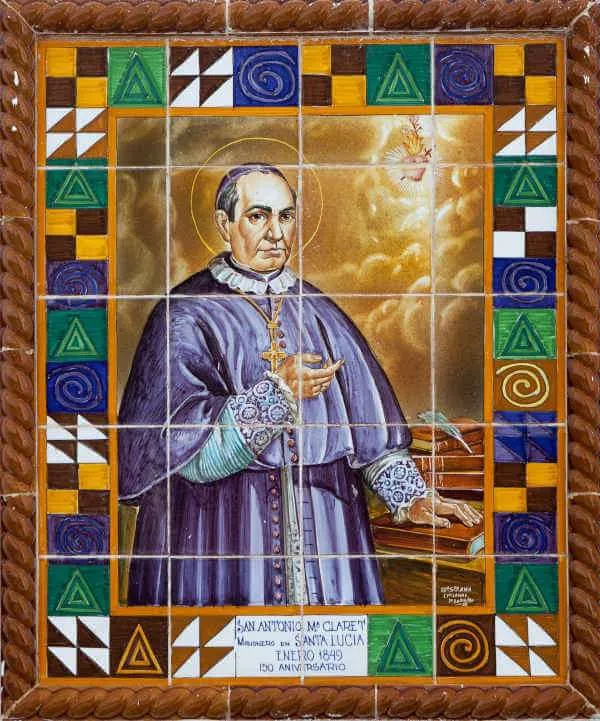
Saint Anthony Mary Claret, Bishop

1807–1870; Patron Saint of the Catholic press, textile merchants, and weavers; Canonized by Pope Pius XII on May 7, 1950

Anthony Adjutor John Claret y Clara was born in the small town of Sallent, in the Province of Barcelona, Spain. Sallent was primarily an agricultural and textile-based town, where life centered around the local Catholic church. His parents were devout Catholics who raised their children well in the faith. Anthony was the fifth of eleven children, but only five survived to adulthood. His father ran a factory that manufactured thread and cloth, and provided a sufficient income for his family.

As a child, Anthony developed a compassionate heart. He relates in his autobiography that when he was only five, he would often lie down at night and try to ponder eternity. He would then consider those who are miserable in this life and whether they would suffer for eternity. This thought filled him with holy sorrow and a desire to help as many people as possible avoid such a fate.

At the age of six, Anthony was sent to the local school where he excelled in his education. He memorized the entire catechism, even though he didn’t fully understand what it meant. As he matured, he notes that he had regular moments when a light went on, and he would understand a lesson. His parents were excellent teachers of the Catholic faith. Every day his father would read a spiritual book to his children and give them some edifying lessons. Anthony took it all in and not only learned the lessons but grew in virtue. As early as elementary school, Anthony made it known that he wanted to be a priest. He would often make a visit to the parish church in the evening and surrender himself to his Lord. He also grew in a deep devotion to our Blessed Mother from an early age, praying the rosary every day.

During his teenage years, in addition to attending school, Anthony regularly worked in his father’s factory, learning the trade of manufacturing well. He was even put in charge of overseeing all of the workers. At the age of eighteen, his father agreed to send Anthony to Barcelona where he studied manufacturing techniques, design, Castilian, and French grammar. Anthony excelled so greatly that some local businessmen wanted Anthony and his father to start a new factory in Barcelona. Of this time, Anthony later wrote, “My ceaseless preoccupation with machines, looms, and creations had so obsessed me that I could think of nothing else.” However, he declined the offer to start a new business, because he knew something else awaited him.

After four years in Barcelona, Anthony finally realized he needed to leave and pursue his vocation. He wanted to become a Carthusian and live as a hermit. Eventually, his spiritual director convinced him to study philosophy in the diocesan seminary in Vich, about twenty-five miles from his family home. As a seminarian, he was able to shed his obsession for manufacturing that had plagued him for the previous four years. Once purified and able to refocus on his prayer life, he realized that the diocesan priesthood was God’s will, not the Carthusians. He completed his studies there and was ordained a priest on June 13, 1835. His first assignment was in his hometown, where he spent the next four years continuing his theological studies.

In 1839, Father Anthony felt God calling him to become a foreign missionary, so he traveled to Rome to apply for missionary work from the Congregation for the Propagation of the Faith. After arriving in Rome, he spent some time on retreat with the Jesuits, and his retreat master encouraged him to join their order so that he could work as a missionary with them. He agreed. After a few months, things were going very well. However, one day he had a mysterious pain in his leg. The Jesuit superiors saw it as a sign from God that God wanted him to do something other than become a Jesuit. After consultation, the saintly Superior General stated, “It is God’s will that you go quickly, quickly to Spain. Have no fear. Courage!” That is exactly what Father Anthony did.

Back in Spain, he was assigned to a parish in Viladrau where he soon preached a mission. It was such a success that he preached one in a neighboring village. Each mission he preached was more effective than the previous one, and many people were converting. Additionally, God started performing many miracles through him. He healed many who were sick and cast out many demons. His fame grew far and wide. He heard many confessions, spread devotion to our Blessed Mother, celebrated the Eucharist, and preached the Word of God with great zeal. After eight months in Viladrau, the bishop relieved him of his parish duties, and Father Anthony moved to Vich as a base from which he began traveling from parish to parish giving missions. He was granted the title of “Apostolic Missionary” by the Vatican, granting him faculties to preach in any diocese. His only goals were to glorify God and save souls. From 1843 to 1848, Father Anthony continually walked across Catalonia, preaching, living in poverty, and converting many sinners. During this time, he also wrote pamphlets, prayers, devotions, and other catechetical materials, which he distributed everywhere he went. In 1848, he founded a publishing house which, over the next two decades, distributed millions of books, booklets, and leaflets. Shortly after, he was sent to the Canary Islands where he preached for fifteen months, having the same powerful effect.

For some time, Father Anthony had been prayerfully considering the idea of founding a religious congregation dedicated to the preaching of missions. After returning to Vich in 1849, he founded the Congregation of Missionary Sons of the Immaculate Heart of Mary, later known as the Claretian Missionaries, or Claretians. The goal of this new congregation was to train priests specifically for the purpose of preaching missions, evangelizing, and saving souls. However, very shortly after he founded the congregation, he was appointed as Archbishop of Santiago de Cuba. It was then that he added “Mary” to his name: Archbishop Anthony Mary Adjutor John Claret y Clara. After his episcopal ordination, he arrived in Cuba in February, 1851, and spent the next six years reforming the clergy, creating new parishes, making pastoral visits on foot to every parish three different times, and renewing the faith of the people in powerful ways. He co-founded the Religious of Mary Immaculate Claretian Missionary Sisters; preached against slavery; established schools, hospitals, and credit unions for the poor; continued to write; and won many sinners back to God.

To Bishop Claret’s surprise, Queen Isabel II called him back to Spain to serve as her personal confessor and spiritual director in 1857, so he moved to Madrid. For the next ten years, he accompanied the Queen on her travels, always preaching missions in the towns they visited. He diligently continued to write and publish, and grew even deeper in his prayer. In 1868, due to a revolution in Spain, the queen and her court, including Bishop Claret, had to flee to France for safety. Shortly after, he attended Vatican I where he strongly advocated for papal infallibility. He then returned to France and took refuge in the Cistercian monastery of Fontfroide, near Narbonne, where he spent the final months of his life.

Saint Anthony Mary Claret was a man who continually sought to glorify God and save souls. At the heart of his life was prayer. His prayer drew him into deep union with God, and that union produced an abundance of good fruit. As we honor this saintly priest, missionary, mystic, miracle worker, bishop, writer, confessor, and founder, consider these words from his autobiography, “…whenever I see sinners, I grow restless, I cannot quiet down, I cannot be consoled, my heart goes out to them.” Saint Anthony’s heart burned with a profound love of every sinner, and he dedicated his life to their salvation. Ponder your own attitude toward sinners, especially those who have sinned against you, and seek to imitate Saint Anthony’s example.

Source: https://mycatholic.life/saints/saints-of-the-liturgical-year/october-24—anthony-mary-claret/

Saint Anthony Mary Claret, Bishop Read More »