Author name: Sani

Saint Josaphat, Bishop and Martyr

1580–1623; Patron Saint of Ukraine; Invoked for the reunification of Eastern and Western Christians; Canonized by Pope Pius IX on June 29, 1867

From the time of the Great Schism in 1054, many Christians in the Eastern (Byzantine) Empire have separated from the pope, creating what is generally called the Orthodox Church. The separation continues, although some of the Eastern Churches have reunited with Rome. In 1439, an attempt was made at the Council of Florence to reunite East and West. It was successful for a short time, but when the Turks conquered Constantinople in 1453, the reunion slowly disintegrated. In 1596, after years of discussions, under an agreement known as the Union of Brest, the majority of Ruthenian Orthodox bishops agreed to reunite with Rome under the pope. In that agreement the Ruthenians professed obedience to the pope as the supreme pontiff, but they were able to keep their Slavic liturgical traditions and celebrate the Byzantine Liturgy, retain married priests, maintain their own canon law and church governance, and hold onto certain theological distinctions within the Creed. Though many Orthodox supported this reunification, many others did not. It was into this time in history that Saint Josaphat, whom we honor today, lived and died for this unity within the Church.

At his birth in the town of Volodymyr, in the Polish-Lithuanian Commonwealth, modern-day Ukraine, our saint was given the name John Kuncevyc. He was baptized into the Orthodox Church, not the Catholic Church, and his parents were faith-filled Orthodox Christians. As a youth, he received a good education and learned the faith well. He was often more interested in praying than playing games. He served at church services, loved the Slavic religious traditions, embraced a life of penance and mortification from an early age, and loved the Divine Office, which he diligently prayed. As a young man, in order to assist his family financially, he worked as a merchant in a nearby city.

In 1604, eight years after his local diocese reunited with Rome, John entered religious life as a monk at the Monastery of Holy Trinity of the Order of Saint Basil the Great in Vilnius. Upon entering, he was given the religious name Josaphat. After five years in the monastery, Brother Josaphat was ordained a Catholic priest in the Eastern Rite and remained at the monastery for the next eight years, becoming prior of his and several other monasteries.

As a monk, he diligently studied the history of the Church, the liturgy, and other documents pertaining to the unity of the Church. He practiced extreme mortifications, and his prayer life grew deep. In addition to his love of the Divine Office and Liturgy, he continuously prayed the Jesus Prayer: “Lord Jesus Christ, Son of God, have mercy on me.” It was later reported by some of his brother monks that he prayed it so often that he could even be heard whispering it as he slept.

Father Josaphat’s prayer and study led him to become a firm supporter of the Union of Brest, and he did all he could to encourage his fellow monks and laypeople to embrace full union with Rome. His reputation as a wise and holy monk spread far and wide, and many came to seek his spiritual advice. He also attracted many young men to the monastery who became monks at his encouragement. He was a spiritual leader, a man of prayer, and a man on a mission of unification. He not only convinced many of the Orthodox holdouts to embrace the Catholic faith, he even drew some who had become Calvinists after the Protestant Reformation. He was so successful that he earned the nickname “Soul-snatcher.”

Father Josaphat’s ministry was so impactful that, in 1617, he was ordained as the Bishop of Vitebsk and, one year later, was elevated to the Archbishopric of Polotsk. This was an important see because tensions remained high, and the faithful, monks, and clergy remained divided about the reunification with Rome. Some feared that they would lose their liturgical traditions to more latinized ones, and others disagreed for theological reasons, but Archbishop Josaphat was convinced that full unification with Rome, while retaining their beloved religious traditions, was the will of God. He zealously devoted the next six years of his forty-three years of life to the cause.

As archbishop, he made the education of his clergy a high priority by issuing a catechism that he instructed them to memorize. He imposed discipline for priestly living, had large meetings to discuss pastoral initiatives, renewed the church buildings, and opposed everyone who opposed unification, including the Grand Chancellor of Lithuania who was overly sympathetic to those who opposed unification.

Within two years of Josaphat’s ordination as Archbishop of Polotsk, some Ruthenian Orthodox factions who refused to embrace unity with Rome secretly gathered and, with the help of the Orthodox Patriarch of Jerusalem, ordained new Ruthenian Orthodox bishops, including an archbishop, setting up a second hierarchical Church. The new Orthodox archbishop began to spread rumors that Josaphat was planning on making the Church fully Latin, throwing out their Slavic traditions. Violence ensued over the next few years, and even clergy battled clergy. Archbishop Josaphat predicted his own martyrdom but remained in the fight for unity.

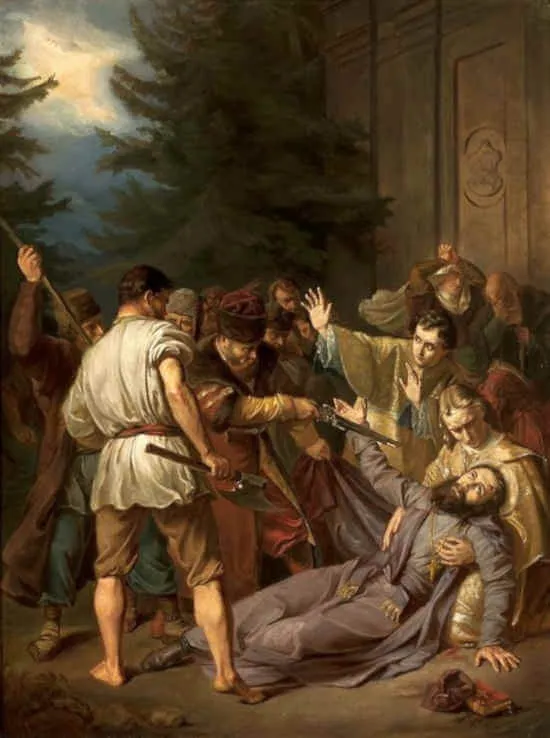
In 1623, an Orthodox priest led a revolt against the archbishop’s house, which included Orthodox men, women, and children. With stones and sticks they attacked the archbishop’s house, broke in, cornered Josaphat in a room, beat him, slit his head with an ax, shot him, dragged his dead body through the town naked, and threw him into the Dvina River.

Though this might at first appear to be a horrible end to a holy life, God, Who is all-powerful, is able to bring good from evil. In many ways, Saint Josaphat’s martyrdom was a turning point for the Ruthenian Catholics. While divisions remained high, those embracing unity found in Saint Josaphat a martyr and an inspiration. A martyr’s blood is a powerful weapon in the hands of God, and God used his death to help solidify unification with Rome in the hearts and minds of those open to divine grace.

As we honor this saint of Christian unity, ponder the sad reality that so many Christians who profess their faith in Christ remain divided. This is even found within the Catholic Church itself. Use this memorial of Saint Josaphat as an opportunity not only to ponder the painful divisions in our churches and world but also as an occasion to pray for oneness in Christ. Seek Saint Josaphat’s intercession today, and, in imitation of his life, offer your own sacrifices, prayers, and mortification to God, begging for the grace of true and lasting Christian unity.

Source: https://mycatholic.life/saints/saints-of-the-liturgical-year/november-12—st-josaphat-bishop-and-martyr/

Saint Josaphat, Bishop and Martyr Read More »
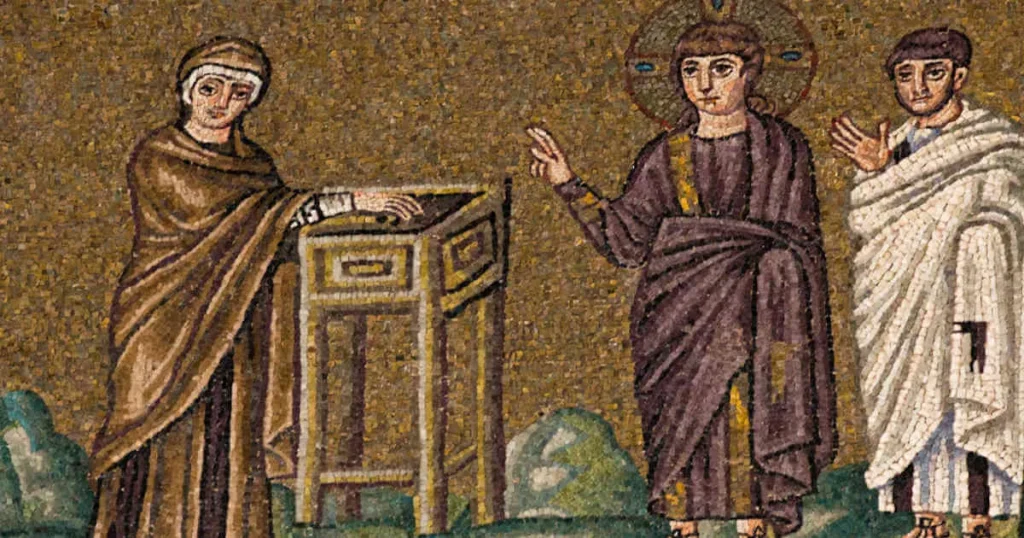
Luke 17:7-9

Servants of the Master

Jesus said to the Apostles: “Who among you would say to your servant who has just come in from plowing or tending sheep in the field, ‘Come here immediately and take your place at table?’ Would he not rather say to him, ‘Prepare something for me to eat. Put on your apron and wait on me while I eat and drink. You may eat and drink when I am finished?’ Is he grateful to that servant because he did what was commanded?”

Reflection:

In most cultures today, the idea of having a servant whom you command to wait on you is far from ideal. Jesus uses this image because the people to whom He was speaking would have easily related. He used it as a way of humbling them because when the illustration is properly understood, He was identifying each one of them as the servant, not the master. Only God is the Master.

When it comes to our service of God, there is no limit to the commands that God will give. At first, that might seem harsh, but it’s not because the commands that God gives to us are dictates of perfect love. We need His commands. We need the order He provides. We need to enter into perfect obedience to Him. We need to listen to everything He tells us and obey it to perfection. Seeing God as our Master and ourselves as His servants will only appear harsh when we fail to understand what sort of Master He is.

Recall the beautiful words of our Blessed Mother when she was given the command from the Archangel Gabriel. The angel said to her, “You will conceive in your womb and bear a son, and you shall name him Jesus.” This was not a question posed to her; it was a command of love. Mary did not hesitate and did not refuse. She said, “Behold, I am the handmaid of the Lord. May it be done to me according to your word.”

At the conclusion of today’s Gospel, Jesus went on to say, “When you have done all you have been commanded, say, ‘We are unprofitable servants; we have done what we were obliged to do.’” In many ways, this is exactly what our Blessed Mother did. She was a servant of God’s perfect commands, and she knew that her love for God obliged her to follow His will.

When you think about your service of the will of God, do you see it as you doing God a favor? Do you see obedience to God’s dictates as an act of generosity on your part and your cooperation with those dictates as above and beyond your natural duties? Hopefully not. Hopefully you understand that you, like our Blessed Mother, are a servant of the one true Master of all. Hopefully you also see the commands of God as the roadmap toward a life of complete fulfillment. When we understand Who the Master is, we will never hesitate in being a servant, or even a slave. We will not hesitate in freely surrendering ourselves over to His will in complete and unwavering obedience. God alone knows what is best for us, and we need to give Him complete control over our lives.

Reflect, today, upon the image of a master and a slave. As you do, try to shed every preconceived image you have that includes harshness, cruelty, dominance and control. Instead, try to see the image of a divine Master Whose only concern is for the servant. Try to see a Master Who perfectly loves the servant. Reflect upon your own need for such a Master in your life. Pray that you will be able to surrender complete control over to God in all things so that He can direct your life into the glorious things He has in store for you.

Source: https://catholic-daily-reflections.com/2024/11/11/servants-of-the-master-2/

Luke 17:7-9 Read More »

Saint Martin of Tours, Bishop

316 or 336–397; Patron Saint of beggars, cavalry, equestrians, geese, horses, innkeepers, Pontifical Swiss Guards, quartermasters, reformed alcoholics, soldiers, tailors, and winemakers; Invoked against alcoholism and poverty; Pre-Congregation canonization

Saint Martin of Tours has been one of the most revered and loved saints in European history for two primary reasons: he lived a life of heroic sanctity, and someone wrote it all down. Sulpicius Severus is believed to have been a wealthy man who converted to Christianity through the ministry of Bishop Martin. He then became a priest, interviewed Bishop Martin before he died, and wrote a book about Martin’s incredible life. The book was copied over and over again and became one of the standard texts for religious and laity alike for many centuries. Numerous churches and monasteries bear Martin’s name as a result of his popularity.

Martin was born in Sabaria in Pannonia, within the Roman Empire, modern-day Szombathely, Hungary. Some early records state he was born in 316, others in 336. When Martin was young, his family moved to Ticinum, modern-day Pavia, northern Italy. He was born in the Roman Empire during an important period of change. In 313, Emperor Constantine issued the Edict of Milan, legalizing Christianity. Constantine then became a Christian himself, and it became known that he favored Christians over those who remained pagans. As a result, many people began converting, some for political and economic reasons.

Martin’s father was a soldier who advanced to the rank of military tribune. As a child, Martin became interested in Christianity, but his parents clung to Roman paganism, dismissing the newly legalized Christianity. Martin, however, was not satisfied with his parents’ choice. So, at the age of ten, he went to the local Catholic Church and asked to become a Christian. He was enrolled as a catechumen and began the lengthy process of preparing for Baptism, which would not take place until ten years later. When he was twelve years old, he asked his parents to permit him to become a hermit, but they refused. At the age of fifteen, in compliance with a state law requiring sons of military officers to enlist in the Roman military, Martin became a soldier. Despite being surrounded by many who lived immoral lives, Martin remained true to his faith and lived quite virtuously. His language was always respectful, he treated others with exceptional kindness, he often gave most of his money and belongings to the poor, he humbled himself by serving those who were supposed to serve him, and he continued his preparation for Baptism.

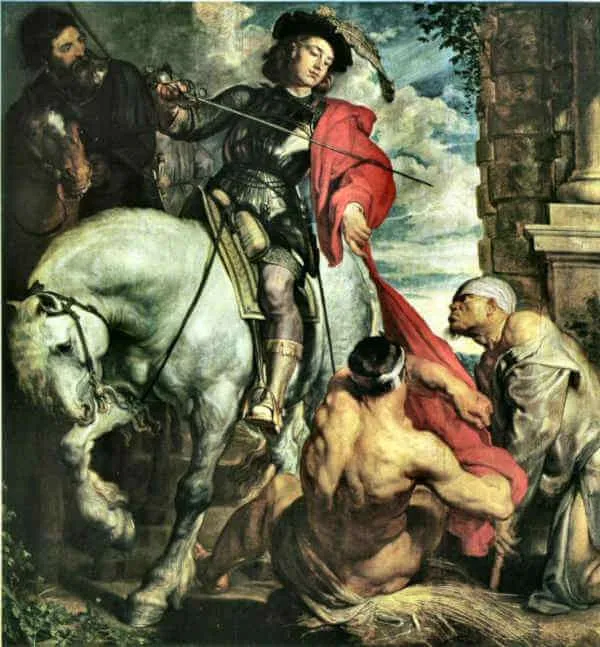
One day, while riding his horse through a town in the middle of winter, Martin came upon a poor man who was poorly dressed and shivering. The man begged people for help, but they ignored him. Martin knew he had to assist, but he had already given his money and other clothing away to the needy. All he had left was the military cloak he wore on his own back, so he dismounted his horse, took out his sword, cut the cloak in two, and gave half to the poor man. His fellow soldiers later laughed at his small funny-looking cloak. That night, Martin had a dream in which Jesus appeared to him wearing the half-cloak and said to a multitude of angels who surrounded them, “Martin, still only a catechumen, has clothed me.” When he awoke, he knew what he needed to do. He sought baptism, which he received at the age of twenty.

Martin remained in the military for two more years at the request of a friend. One day, the commanding officer was passing out bonuses to the soldiers as they prepared for battle the next day. When Martin was called forward, he stated, “I have been your soldier until now. Let me serve God henceforth. Give your bonus to someone who’ll fight for you. I am Christ’s soldier, and it’s not right for me to engage in battle.” Martin was accused of being a coward because they were going into battle the following day. To that accusation he replied, “If you believe I’m acting out of fear, I’ll stand unarmed in front of the enemy lines tomorrow. Shielded only by my faith in Jesus and the sign of the cross, I’ll face them without armor.” Martin was then thrown into prison to wait for the battle, which never happened because the opposing side sought peace. Martin was soon after released from the military.

Having heard of the renowned bishop and future Saint Hilary of Poitiers, Martin traveled to Poitiers in present-day France and stayed with the bishop for some time, learning from him the orthodox faith. He was also ordained a deacon and made an exorcist by Bishop Hilary. After Bishop Hilary was forced into exile for combating Arianism in the imperial court, and after Deacon Martin had a dream about converting his pagan parents, he decided to return to his hometown. On the way, he was attacked by robbers, but upon being asked who he was, he told one of the robbers that he was a Christian. Deacon Martin then shared the Gospel with the man, who repented, let Martin go, and later converted. When Deacon Martin arrived home, he converted his mother to the Christian faith but could not move his father. Others in his hometown also converted.

After encountering the wrath of some Arian priests whom he opposed, and even the Arian Archbishop of Milan, Deacon Martin and a priest spent time living as hermits on the Island of Gallinara. There they lived on herbs and wild roots. One day Martin ate a poisonous root by mistake, but through fervent prayer, God healed him.

Upon hearing that Bishop Hilary’s exile from Poitiers had ended, Deacon Martin moved to a town near the holy bishop and established a monastery. From there, he began preaching throughout the region and performing many miracles. He restored an unbaptized catechumen to life. When the catechumen returned to life, he stated that it was due to Martin’s prayers. On another occasion, Martin brought a slave back to life who had hung himself. 

In 371, Martin was chosen by the consent of the people as the Bishop of Tours. Though he initially opposed it and tried to hide, he was tricked and led to the cathedral where his ordination awaited. Once ordained the Bishop of Tours, Bishop Martin moved outside the city and established hermitages with other clerics where he led a life of prayer. For the next twenty-six years, he lived both an eremitical life and also engaged in an active ministry. He traveled throughout Gaul (France), preaching, converting many, performing miracles, and casting out demons. He opposed heresies, worked with other orthodox bishops—such as the future Saint Ambrose of Milan—destroyed pagan temples, and gained the respect of all. His opponents feared him, and his supporters praised God every time they witnessed his ministry in action.

Though Saint Martin of Tours lived a life of heroic virtue and deep prayer, his life and veneration reveal the importance of sharing the stories of the saints with others. After his death, his life has continued to inspire many. As we honor Saint Martin, ponder any ways that God might want to use you as He used Sulpicius Severus, Saint Martin’s biographer. Though you might not be called to write a book about a saint you know, consider ways in which you can share the Gospel by learning more about the saints and sharing their stories with others.

Source: https://mycatholic.life/saints/saints-of-the-liturgical-year/saint-martin-tours/

Saint Martin of Tours, Bishop Read More »

Luke 17:1-2

Loving Every Sinner

Jesus said to his disciples, “Things that cause sin will inevitably occur, but woe to the one through whom they occur.  It would be better for him if a millstone were put around his neck and he be thrown into the sea than for him to cause one of these little ones to sin.”

Reflection:

Having a millstone placed around your neck and thrown into the sea is very descriptive. Jesus is using very evocative language. A millstone was a large round stone with a hole in the center. If it were placed around someone’s neck and they were thrown into the sea, they would obviously sink to the bottom and die. Thus, Jesus is clearly stating that this awful fate is actually better than the fate of those who cause “one of these little ones to sin.”

First of all, it should be clarified that no one can actually cause us to sin. Sin is our own free choice, and we, and we alone, will be held accountable for our own sin. One thing that Jesus is pointing out here is that even though every person must take responsibility for their own actions and their own sins, we must also take responsibility for the ways that we act as tempters of others. We are all sinners. Therefore, by our sin, we will all tempt others to sin also. Sometimes we will tempt people to sin by provoking them to anger. At other times we will tempt others to sin by setting a poor example. And on the contrary, we also have the ability to “tempt” people to virtue. Or more properly speaking, to inspire and encourage them.

With that said, Jesus explains that the fate of those who act as tempters of others, especially the “little ones,” will suffer consequences graver than an untimely death. The little ones of which Jesus speaks should be understood as those who are weak in faith, overly sensitive, particularly vulnerable at that time in their life, and susceptible to outside influence. This could be a child, or it could be someone who is currently teetering on the edge of despair, confusion, anger, or any serious sin. When you encounter people like this, how do you treat them? Jesus has a deep heart of compassion for these people and wants us to have the same depth of compassion. But sometimes we fail. We may be negligent in our duty to reach out to them. Even this negligence could be a form of causing “one of these little ones to sin.” Of course, it is even far worse if we were to actively agitate them, harshly judge them, provoke their anger, draw them into some sin of weakness and false consolation by our temptation, etc. The simple truth is that Jesus loves those who are weak, vulnerable and sinful, and He wants us to love them with His heart. When we fail to do so, Jesus will hold us accountable for their further fall from grace.

Reflect, today, upon the person or persons in your life that appear especially vulnerable, sinful, confused and lost at this time. Who is it that struggles with anger, or an addiction or some sinful lifestyle? Ponder your attitude toward them. Are you judgmental, condemning, belittling and the like? Do you tempt them to fall further into any sins of weakness they commit in a vulnerable state, thus leading them into further sin? Or, when you encounter someone who is greatly struggling, do you turn to them with the deepest compassion and mercy, forgiving any ways that they may sin against you, and work hard only to be there for them in their need, no matter how hard it is on you? Commit yourself to a profound love of all of God’s “little ones” and seek to serve them with the heart of Christ so that one day they will eternally rejoice with you in Heaven.

Source: https://catholic-daily-reflections.com/2024/11/10/loving-every-sinner-3/

Luke 17:1-2 Read More »

Thirty-second Sunday in Ordinary Time

First Reading 1 Kings 17:10-16

In those days, Elijah the prophet went to Zarephath.
As he arrived at the entrance of the city,
a widow was gathering sticks there; he called out to her,
“Please bring me a small cupful of water to drink.” 
She left to get it, and he called out after her,
“Please bring along a bit of bread.” 
She answered, “As the LORD, your God, lives,
I have nothing baked; there is only a handful of flour in my jar
and a little oil in my jug. 
Just now I was collecting a couple of sticks,
to go in and prepare something for myself and my son;
when we have eaten it, we shall die.” 
Elijah said to her, “Do not be afraid. 
Go and do as you propose.
But first make me a little cake and bring it to me. 
Then you can prepare something for yourself and your son. 
For the LORD, the God of Israel, says,
‘The jar of flour shall not go empty,
nor the jug of oil run dry,
until the day when the LORD sends rain upon the earth.'” 
She left and did as Elijah had said. 
She was able to eat for a year, and he and her son as well;
the jar of flour did not go empty,
nor the jug of oil run dry,
as the LORD had foretold through Elijah.

Responsorial Psalm Psalms 146:7, 8-9, 9-10

R. (1b) Praise the Lord, my soul!
or:
R. Alleluia.
The LORD keeps faith forever,
    secures justice for the oppressed,
    gives food to the hungry.
The LORD sets captives free.
R. Praise the Lord, my soul!
or:
R. Alleluia.
The LORD gives sight to the blind.
    The LORD raises up those who were bowed down;
the LORD loves the just.
    The LORD protects strangers.
R. Praise the Lord, my soul!
or:
R. Alleluia.
The fatherless and the widow he sustains,
    but the way of the wicked he thwarts.
The LORD shall reign forever;
    your God, O Zion, through all generations. Alleluia.
R. Praise the Lord, my soul!
or:
R. Alleluia.

Second Reading Hebrews 9:24-28

Christ did not enter into a sanctuary made by hands,
a copy of the true one, but heaven itself,
that he might now appear before God on our behalf. 
Not that he might offer himself repeatedly,
as the high priest enters each year into the sanctuary
with blood that is not his own;
if that were so, he would have had to suffer repeatedly
from the foundation of the world. 
But now once for all he has appeared at the end of the ages
to take away sin by his sacrifice. 
Just as it is appointed that human beings die once,
and after this the judgment, so also Christ,
offered once to take away the sins of many,
will appear a second time, not to take away sin
but to bring salvation to those who eagerly await him.

Alleluia Matthew 5:3

R. Alleluia, alleluia.
Blessed are the poor in spirit,
for theirs is the kingdom of heaven.
R. Alleluia, alleluia.

Gospel Mark 12:38-44

In the course of his teaching Jesus said to the crowds,
“Beware of the scribes, who like to go around in long robes
and accept greetings in the marketplaces,
seats of honor in synagogues, 
and places of honor at banquets.
They devour the houses of widows and, as a pretext
recite lengthy prayers. 
They will receive a very severe condemnation.”

He sat down opposite the treasury
and observed how the crowd put money into the treasury. 
Many rich people put in large sums.
A poor widow also came and put in two small coins worth a few cents. 
Calling his disciples to himself, he said to them,
“Amen, I say to you, this poor widow put in more
than all the other contributors to the treasury. 
For they have all contributed from their surplus wealth,
but she, from her poverty, has contributed all she had,
her whole livelihood.”

Source: https://bible.usccb.org/bible/readings/111024.cfm

Thirty-second Sunday in Ordinary Time Read More »

Saint Leo the Great, Pope and Doctor

c. 400–461; Pre-Congregation canonization; Declared a Doctor of the Church by Pope Benedict XIV in 1754

When Cardinal Ratzinger was elected pope, taking the name Benedict XVI, the first words he spoke from the balcony of Saint Peter’s Basilica referred to his predecessor, Pope John Paul II, whom he referred to as “the great pope.” Since then, many have referred to him as “John Paul the Great.” Prior to that, only three popes came to be universally called “the Great”—Saint Gregory the Great (590–604), Saint Nicholas the Great (858–867), and the pope we honor today, Saint Leo the Great (440–461), who was the first pope to receive that title.

Leo was born in Tuscany, within the Western Roman Empire, at a time when the empire was experiencing decline due to ongoing threats of barbarian invasions, internal administrative disputes, and a difficult economic situation. Leo considered himself a Roman, since he spent his early years in the city. While still young, he was ordained a deacon in Rome under Pope Celestine and served him and his successor, Pope Sixtus III, in this capacity from 430–439. Deacons in Rome served the Church in important ways—as organizers of charitable works, liturgical services, and diplomatic missions; as administrators; and often as papal advisors. Deacon Leo quickly became highly respected in Rome as a man of unmatched theological learning and pastoral wisdom, prudence, and courage. 

In 439, a dispute broke out in the northern part of the Roman Empire between a Roman prefect named Albinus and a prominent Roman general named Aetius. Seeing the need for a resolution so as to avoid internal conflict and even war, the Western Roman emperor asked the pope to send Deacon Leo to broker peace. While on the diplomatic mission, Pope Sixtus III died and the Roman clergy quickly chose Deacon Leo as the new pontiff. Word was sent to him, and he returned to Rome, was ordained a bishop on September 29, 440, and took charge of the keys of Saint Peter.

As the newly elected pope, Pope Leo wasted no time. At the heart of his mission was unity in the true faith, under the Vicar of Christ. At that time, papal primacy was not as clear as it is today. Not all supported the idea that the pope was the universal pastor and teacher of the faith, holding universal authority.

One way Pope Leo taught about papal primacy was by exercising it. When he became aware of heresies, he exercised discipline. He discovered that some clerics in Aquileia were holding on to the heresy of Pelagianism and instructed the bishop that they could not be admitted to communion unless they fully and publicly renounced their error. In Rome, when he discovered a sect of Manichæism, he sought the members out, engaged them in public debate, burned their books with the support of the civil authorities, and did all he could to purge them from the Church. When he learned that the heresy of Priscillianism was growing in Spain, he wrote at length to the Spanish bishops, pointing out the heresy, and advising them on ways to root it out. In all of this, Pope Leo began to emerge as “the” pope, not just one spiritual father among many others. He saw himself as the Vicar of Christ and acted as the Vicar of Christ, helping to further solidify this teaching of papal primacy.

During the first few centuries of the Church, various problems and heresies emerged and were dealt with by local bishops, councils, and synods. In the fourth and fifth centuries, once Christianity was legalized and supported in the Roman Empire, four ecumenical (universal) councils took place that addressed the entire Church and clarified the universal teaching on various Christological beliefs, while also condemning heretical views. Nicea was the first of the ecumenical councils and took place in 325. The other councils were Constantinople (381), Ephesus (431), and Chalcedon (451). At each of these councils, the pope played a role, consenting with the decisions either in person or through papal legate. Such was the case with Pope Leo at the Council of Chalcedon.

The Council of Chalcedon was called by the Roman emperor in response to the Monophysite heresy, which taught that Christ had only a single nature that was either divine or a fusion of divine and human. Pope Leo exercised his authority over the Church by refusing to permit the council to move forward unless his papal legates presided over it. The emperor agreed. Of this council, Pope Benedict XVI said, “This Council, held in 451 and in which 350 Bishops took part, was the most important assembly ever to have been celebrated in the history of the Church.” He went on to explain that Chalcedon was the culmination and fulfillment of the previous three ecumenical councils, providing the Church with a definitive understanding of the nature of Christ, the Trinity, and the Mother of God.

Pope Leo sent a lengthy letter with his legates to the Council of Chalcedon, which was originally sent to the Archbishop of Constantinople, in which he articulated that Christ had two distinct natures coexisting in one person, not just one nature. His famous letter, referred to as the “Tome of Leo,” stated in part:

Without detriment, therefore, to the properties of either of the two natures and substances which are joined in the one person, majesty took on humility; strength, weakness; eternity, mortality; and, in order to pay off the debt which attached to our condition, inviolable nature was united with passible nature, so that, as suited the cure of our ills, one and the same Mediator between God and men, the Man Jesus Christ, could die with the one nature and not die with the other. Thus true God was born in the whole and perfect nature of true man; complete in what was His own, complete in what was ours.

Once the letter was read to all the gathered bishops, they jointly cried, “Peter has spoken through Leo!” A decree was then formulated, based on Pope Leo’s letter, that taught the orthodox position and declared the Monophysite position to be a heresy.

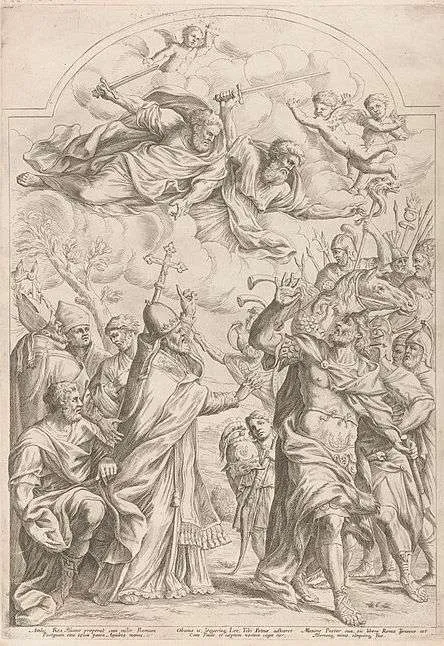
In 451, barbarians from the north arrived in northern Italy with the intention of conquering the Western Roman Empire. Before the invaders advanced to Rome, Pope Leo went out to meet them to broker peace. When he met up with their leader, Attila the Hun, legend has it that Saints Peter and Paul appeared behind the pope with swords and in a threatening position. The sight was so overwhelming to Attila that he and his army withdrew in fear for their lives.

Pope Leo’s final years in Rome were spent preaching and teaching. He left behind about 100 sermons and 150 letters, all of which present many clear teachings on Christ and the Church in a pastoral and convincing way. These letters and sermons have had a profound influence on later Catholic thought. Pope Leo also fostered personal devotions, fasting, and almsgiving. He enlivened the liturgy, helped the sick, built churches, and preached the Gospel to his people.

As we honor Saint Leo the Great, reflect upon the fact that this one man had an enormous impact on the life of the Church. Though he is widely unknown today, his impact is still felt by the faithful, given the direction in which he steered the Church during his papacy, and because of the influence his writings had on the ongoing formulation of Christian doctrine. Offer a prayer of gratitude to God for his life, and pray for the pope today and every pope to follow, that they will turn to Saint Leo the Great as an example for their own papal ministry.

Source: https://mycatholic.life/saints/saints-of-the-liturgical-year/november-10–st-leo-the-great/

Saint Leo the Great, Pope and Doctor Read More »

Mark 12:41-42

Giving Your Whole Livelihood

Jesus sat down opposite the treasury and observed how the crowd put money into the treasury. Many rich people put in large sums. A poor widow also came and put in two small coins worth a few cents.

Reflection:

If you were in charge of the Temple treasury, which would you prefer? The rich putting in large sums of money? Or one poor widow putting in two small coins? Of course, an honest answer to that question might be hard to give. Much good can be done with large sums of money, right? Wouldn’t it be better to accept more than a few cents? The dilemma one would experience in this situation reveals a misperception that we regularly encounter in life. Is more better than less? Is wealth better than poverty? Is success better than failure? It all depends upon the spiritual reality at hand.

Take, for example, success vs. failure. Say one person sets off on a selfish and immoral business venture that quickly produces a huge income. Many would consider that a success. Say another person prayerfully sought to fulfill the will of God and started some other business. After years of trying, that business failed and went into bankruptcy. Which situation is better? Clearly, the one who sought to fulfill the will of God is the winner. Why? Because the spiritual fruit of fidelity to the will of God, despite worldly setbacks, produced an eternal treasure more valuable than earthly wealth.

God judges the heart, not the worldly outcome. In fact, from a worldly perspective alone, Jesus’ life was a complete failure. He was arrested, charged with a capital crime, beaten and killed. His earthly kingdom—desired by many of his followers—was never established. Many of them abandoned Him when He was killed. Even after He rose from the dead, He didn’t establish an earthly kingdom.

Of course, in the spiritual realm, the realm of eternal realities, Jesus’ life was infinitely successful. His death destroyed death itself, and His Resurrection enabled all who believe in Him to share in eternal life. His spiritual Kingdom is now in full bloom and will one day be visible to all.

Back to our original question. If you were in charge of the Temple treasury, and you were given the same option that Jesus pointed to of receiving the large sums of money from the rich, or the two coins from the poor widow, it would certainly be better to accept the two coins. If that is hard to comprehend, then it is a sign that you live more according to the values of the world than the values of the spiritual Kingdom of God. The poor widow gave more than two small coins; she also gave the spiritual gift of her generosity and complete trust in God. She gave all she had and trusted that God would take care of her and use her gift for good. This is infinitely more fruitful for the building of the Kingdom of God than the gift of someone’s excess of money. God does not need our money, but we need to give it, be detached from it, and be ready and willing to give everything we have, all that we are, our entire livelihood to God. This is trust. This is a spiritual gift that will have far greater eternal ramifications for the salvation of souls than all the money in the world.

Reflect, today, upon the compliment Jesus pays to this poor widow. “She, from her poverty, has contributed all she had, her whole livelihood.” Do you contribute your whole livelihood? Do you dedicate everything you have, all your energies and gifts, and all that you are to the service of God for His glory? We are called to give everything to God—not just a portion of our lives. Reflect upon how well you imitate this poor widow and seek to follow her holy example.

Source: https://catholic-daily-reflections.com/2024/11/09/giving-your-whole-livelihood/

Mark 12:41-42 Read More »

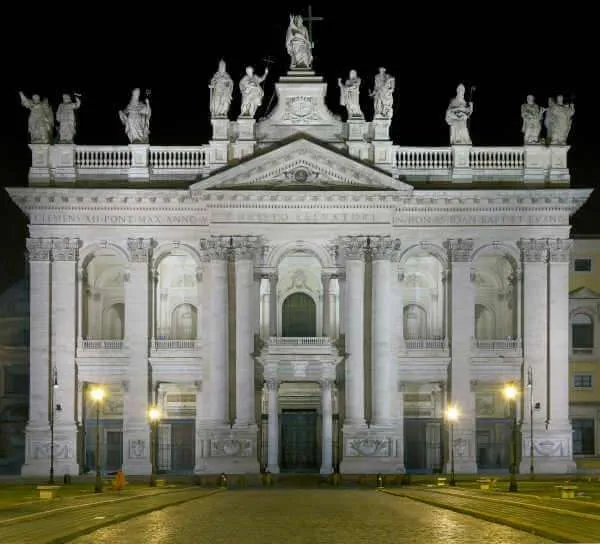
Dedication of the Lateran Basilica

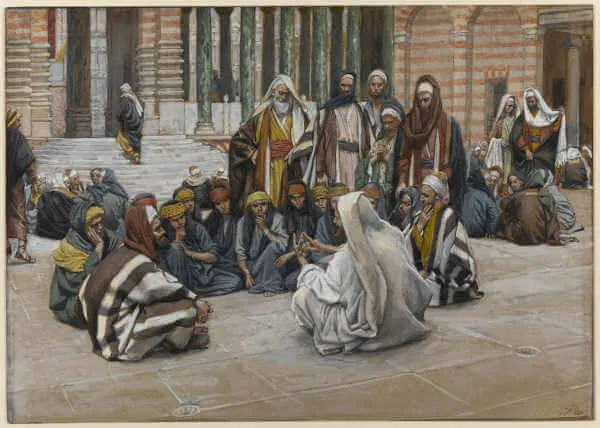
“Destroy this temple and in three days I will raise it up.” The Jews said, “This temple has been under construction for forty-six years, and you will raise it up in three days?” But he was speaking about the temple of his Body. John 2:19–21

Reflection:

The most important temple is the temple of a person’s soul because God dwells within each one of us. In the most secret center of our being is that sacred sanctuary where we meet God. Saint Teresa of Ávila called it the Presence Chamber, the most central and interior dwelling place within us.

In addition to the temple of the soul, there are many sacred places throughout the world. There are shrines, churches, basilicas, grottos, cathedrals, and other holy places that are set aside for the sole purpose of worship of God. They are to be a Heaven on earth, a place where we join with the Seraphim, Cherubim, and Thrones in their angelic praises of the Most Holy Trinity. Today’s feast commemorates one such place, the most important church on earth.

In the city of Rome, there are four major basilicas. The first three are Saint Peter’s Basilica in Vatican City, the Basilica of Saint Paul Outside the Walls, and the Basilica of Saint Mary Major. The fourth is the Archbasilica Cathedral of the Most Holy Savior and of Saints John the Baptist and John the Evangelist in the Lateran, also called Saint John Lateran, or the Lateran Basilica for short. Of the four major basilicas, the oldest and most important is Saint John Lateran, the dedication of which is remembered today. Though the pope now lives next to Saint Peter’s Basilica, Saint John Lateran is the official cathedral of Rome. That means Saint John Lateran is not only the mother church of the Archdiocese of Rome but also the mother church of the entire world.

The church building has a long and storied history. In the year 64, the erratic and cruel Roman Emperor Nero blamed a devastating fire in Rome on the Christians. In retaliation, he ordered the  execution of many Christians, including Saints Peter and Paul. In 65, there was a conspiracy to kill Nero with the help of the Counsel-designate Plautius Lateranus (Lateran). When Nero learned of the plot, he immediately beheaded Lateranus and confiscated his home, the Lateran Palace. Subsequent Roman emperors used the palace in various ways over the next 250 years, such as a military fort. In 312, when Constantine the Great became the sole ruler of the Western Roman Empire, he took possession of the Lateran Palace. The following year, after issuing the Edict of Milan with Emperor Licinius of the Eastern Roman Empire, Constantine donated the Lateran Palace to Pope Miltiades who first used it to conduct a synod of bishops and then began constructing the first Basilica in Rome. Upon its completion in the year 324, it was dedicated by Pope Sylvester and given the name the “House of God,” with a special designation to Christ the Savior. With that, the first cathedral in the most important diocese was established.

Constantine the Great did much to help the Catholic Church flourish after legalizing its practice. He saw to it that the Lateran Basilica was beautifully decorated with gold and silver. He also built many other churches in Rome, Jerusalem, Bethlehem, and Constantinople. Up until that time, the church had suffered greatly, always fearing persecution and death. Now, it had its first cathedral in the heart of Rome, beautifully decorated, with the Roman Emperor’s full support.

Though the basilica was first dedicated to Christ the Savior, in the tenth century Pope Sergius III added a new baptistry and rededicated the basilica to Saint John the Baptist. In the twelfth century, Pope Lucius II dedicated the basilica to Saint John the Evangelist. The basilica, therefore, honors Christ the Savior first and the two Saint Johns as the co-patrons.

Though the Lateran Basilica has remained the pope’s cathedral from the time of its dedication, the Lateran Palace, next to the Basilica, was the papal residence from 324–1305. In 1305, Pope Clement V was elected to the papacy and refused to move to Rome. In 1309, he moved the entire papal court to Avignon, France, where it remained until Pope Gregory XI returned to Rome from Avignon in 1377. Upon the pope’s return to Rome, the Lateran Palace was in disrepair due to two fires, so the pope eventually built a new palace next to Saint Peter’s on Vatican Hill, where every subsequent pope has resided until today.

As we honor the mother church of the whole world, ponder the importance of a church building. A church is sacred because it is exclusively dedicated to the worship of God. Saint John Lateran is an exclusive-purpose church. It is the pope’s cathedral from which the entire Church is governed and the central place of worship for the world. As we honor the dedication of that church in 324, pray for the Church today. Pray for your local parish, religious institutions, religious orders, dioceses, national conferences, and the Universal Church headed in Rome. Our churches and sacred places exist to be places where we come to encounter God. Pray for the pope in a particular way today, that Saint John Lateran will always be a place where he, and every pope after him, will encounter God in a profound way.

Source: https://mycatholic.life/saints/saints-of-the-liturgical-year/november-9—feast-of-the-dedication-of-the-lateran-basilica-rome/

Dedication of the Lateran Basilica Read More »

John 2:19-21

Being Shocked by Our Lord

Jesus answered and said to them, “Destroy this temple and in three days I will raise it up.” The Jews said, “This temple has been under construction for forty-six years, and you will raise it up in three days?” But he was speaking about the temple of his Body.

Reflection:

We celebrate, today, the Lateran Basilica in Rome, the mother church of the entire Roman Catholic Church. It was given to the Bishop of Rome in the fourth century and remained the pope’s primary residence until the building of St. Peter’s Basilica, at a time when the Lateran Basilica was falling into ruins. However, the Lateran Basilica to this day remains the most important Church in the world, since it is officially the Cathedral Church of Rome.

As we honor this church, we honor more than a building. The Lateran Basilica is a symbol of the one true Church of Jesus Christ. Its interior is beautiful and awe-inspiring so as to point us to the unimaginable beauty of the Church Herself, which is the Mystical Body of Christ.

Today’s Gospel depicts Jesus entering the Temple and driving the money changers out with a whip and the animals they were selling for profit. As He did so, He cried out, “Take these out of here, and stop making my Father’s house a marketplace.” Psalm 69 is then quoted: Zeal for your house will consume me.

Jesus loves His Church as His own Body—because that is what it is. As His Body, the members of His Church are called and sent to act as His instruments, members of His saving action. Much more than a church building, today we honor the Church Herself—which means we honor you, insofar as you are a member of the Body of Christ. And in light of this Gospel passage for today’s Feast, we are reminded of the zeal that our Lord has for the cleansing of His Church.

How is the Church purified? It is purified by the cleansing of Her members. That means that Jesus desires, with perfect zeal, to drive out every sin from your soul, cleansing the filth that keeps you from fulfilling your essential role as a member of His Body.

Sometimes we become slack in our own commitment to be purified. We can easily become comfortable with the sins we commit, and we can form habits that are hard to break. When this happens, it is useful to ponder this story of the cleansing of the Temple and see it as Jesus’ desire to cleanse our own soul. At times, we need to be shaken up, challenged, confronted and encouraged with the unwavering zeal in the heart of our Lord.

Reflect, today, upon this powerful image of Jesus cleansing the Temple. As you do, apply it to your own life. The people selling and buying in the Temple must have been shocked at Jesus’ zeal and actions. If you have become complacent with your sins, try to allow this holy shock to also wake you up. Allow our Lord’s zeal to affect you, and know that His purifying actions are acts of love by which He desires to free you to become a more fully functioning member of His holy Church.

Source: https://catholic-daily-reflections.com/2024/11/08/being-shocked-by-our-lord-3/

John 2:19-21 Read More »

Saint Elizabeth of the Trinity

Profile

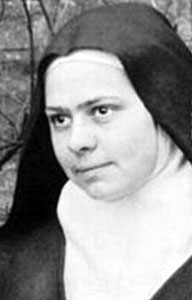
Elizabeth was the daughter of Captain Joseph Catez and Marie Catez. Her father died when she was seven, leaving her mother to raise her and her sister Marguerite. She was noted as a lively, popular girl, extremely stubborn, given to fits of rage, with great reverence for God, and an early attraction to a life of prayer and reflection. She was a gifted pianist. She visited the sick and taught catechism to children.

Much against her mother‘s wishes, she entered the Discalced Carmelite monastery in Dijon, France on 2 August 1901. Though noted for great spiritual growth, she was also plagued with periods of powerful darkness, and her spiritual director expressed doubts over Elizabeth’s vocation. She completed her novitiate, and took her final vows on 11 January 1903. She became a spiritual director for many, and left a legacy of letters and retreat guides. Her dying words: I am going to Light, to Love, to Life!

Born

  • Sunday 18 July 1880 in a military camp in the diocese of Bourges, France as Elizabeth Catez

Died

  • 9 November 1906 at Dijon, Côte-d’Or, France of Addison’s disease, a hormone disorder whose side effects are painful and exhausting

Venerated

  • 12 July 1982 by Pope John Paul II (decree of heroic virtues)

Beatified

  • 25 November 1984 by Pope John Paul II
  • the beatification miracle involved the healing of a priest from “genitourinary tuberculosis with right renal tuberculosis, right nephrectomy, in a subject with progressing Pott’s disease” c.1964 through the intercession of Blessed Elizabeth

Canonized

  • 16 October 2016 by Pope Francis
  • canonization celebrated at Saint Peter’s Square, Vatican City, Rome, Italy
  • the canonization miracle involved the July 2002 healing of a woman from “Sjøgren’s syndrome”, which includes xerostomia, which prevented the woman from eating solid foods, neurogenic bladder condition, and motor impairment; the healing was instant, and occurred when the woman was on pilgrimage to the Discalced Carmelite monastery in Dijon where Saint Elizabeth had lived for several years

Patronage

  • against bodily ills
  • against the death of parents
  • against illness
  • against sickness
  • sick people

Source: https://catholicsaints.info/saint-elizabeth-of-the-trinity/

Saint Elizabeth of the Trinity Read More »