Author name: Sani

John 7:25-27

Dismissing False Expectations

Some of the inhabitants of Jerusalem said, “Is he not the one they are trying to kill? And look, he is speaking openly and they say nothing to him. Could the authorities have realized that he is the Christ? But we know where he is from. When the Christ comes, no one will know where he is from.”

Reflection:

Though Jesus was perfect, His sermons flawless, and His miracles astonishing, many remained hardened in their disbelief. People of the time had various expectations about the Messiah. Some were looking for a mysterious, heavenly figure; others, a political leader; still others envisioned the Messiah would suddenly appear without prior knowledge of His origins. These expectations were all based on an incomplete understanding of the prophets.

The Messiah’s arrival uprooted many of the preconceived ideas about who He would be. He arrived as a poor carpenter, raised in the unimpressive village of Nazareth, and without any ambitions to overthrow the Roman occupation of Israel. Yet, Jesus performed miracles. His sermons penetrated hearts, winning over many humble converts. His mere presence exuded confidence, purpose, and dignity. Could He really be the Messiah?

Just like the people of Jesus’ time, it is easy for us to develop preconceived ideas about Who God is and how our lives should change once we choose to follow Him. If you give your life to Christ, what do you expect from Him? Do you expect that God will bless you with great success in business? Your children will love and obey God? Your family and friends will be perfectly united? Material provisions will enable you to live a comfortable life? Or do you expect rejection, suffering, and death? We must always align our expectations with God’s will, knowing that His ultimate plan is for our salvation.

Some of the Jews rejected Jesus because He did not meet their expectations of Who the Messiah would be. The particular group in today’s Gospel held the belief that the Messiah would arrive on the scene instantaneously, and no one would know where He came from. Their comment, “But we know where He is from,” reflects their disbelief, as they were expecting a more mysterious or sudden appearance. That misunderstanding of the prophets resulted in them rejecting Jesus, the true Messiah.

Similarly, it is easy for us to have certain expectations about God that, when not fulfilled, lead to doubt or confusion. This is our fault for forming false expectations about what should happen once we choose to follow Christ. The remedy is simple—turn to the Gospel and believe what Jesus said.

What did Jesus say? That He would suffer greatly at the hands of the scribes, Pharisees, and elders of the people. That He would be handed over, tortured, and crucified, but that He would also rise on the third day. And that is exactly what happened.

When we choose to follow Christ, does Jesus promise that life will be easy, comfortable, and that we will be loved by all? Certainly not. He tells us that we will suffer the same fate He did, but if we persevere through the crosses of life, we will share in His ultimate victory.

Reflect today on any false notions you might have about being a Christian. Embracing the Gospel—culminating in Christ’s Passion—is difficult. The call to live sacrificially, to lay our lives down for others, to do penance, live selflessly, be generous, repent of every sin, pray continuously, and embrace Christ’s Cross with unwavering determination is difficult at first. Doing so is only possible if we dismiss false expectations about being a Christian, so that the full Gospel and its demands will not shock us but inspire us to follow Christ down the path He has chosen for us.

Source: https://catholic-daily-reflections.com/2026/03/19/dismissing-false-expectations/

John 7:25-27 Read More »

Saint Joseph, Husband of the Blessed Virgin Mary

First Century; Patron Saint of the Universal Church, fathers, carpenters, and a happy death

The Father in Heaven sent His Son into the world to be born of the Virgin Mary. The Father chose her who was the Immaculate Conception to bear His Son in her womb, bring Him into the world, and raise Him from infancy to adulthood. But the Father also needed to choose a foster father for His divine Son. Of all the men in Israel that He could have chosen, He chose Joseph of Nazareth, a carpenter. Today’s solemnity not only honors him, but it also points us to his marital union with the Blessed Virgin Mary and to the effect that that marriage had not only upon him, Mary and Jesus, but also upon us as members of the Body of Christ.

Joseph was likely born in the small town of Bethlehem, where Jesus was also born, but he moved to Nazareth with Mary and Jesus after returning from Egypt in order to keep Jesus safe from Archelaus, the ruler of Judea. Though there are a number of apocryphal writings about him from the first several centuries, nothing is known about him for certain except what is contained in the Gospels. But the Gospels tell us all we need to know about this holy, obedient, and just man, who was given authority over the Son of God and continues to exercise a holy authority over the entire Church.

Saint Joseph was truly the father of Jesus. Of this truth, Saint Augustine writes, “By reason of their faithful marriage, both of them deserve to be called Christ’s parents, not only his mother but also his father, who was a parent in the same way that he was the mother’s spouse: in mind, not in the flesh.” Joseph’s fatherhood is also clearly established by the fact that the angel gave him the responsibility of naming Jesus. “She will bear a son and you are to name him Jesus…” (Matthew 1:21).

Saint Joseph was obedient to the Father in Heaven, and that obedience deepened his union with Mary his spouse, making their marriage the ideal family for the Son of God. Pope Saint John Paul II speaks of this fact in his apostolic exhortation Guardian of the Redeemer, when he says, “One can say that what Joseph did united him in an altogether special way to the faith of Mary. He accepted as truth, coming from God, the very thing that she had already accepted at the Annunciation” (#4). Saint Joseph’s obedience is clearly seen in his response to four dreams by which an angel instructs Joseph how best to guard and protect the Son of God. Joseph acts immediately, in obedience, to the angel’s instructions. The Vatican II document, Dei Verbum states, “‘The obedience of faith’ must be given to God as he reveals himself. By this obedience of faith man freely commits himself entirely to God, making ‘the full submission of his intellect and will to God who reveals,’ and willingly assenting to the revelation given by him” (#5). Thus, since Saint Joseph’s obedience was absolute, then that obedience fully united him to the Blessed Virgin Mary, in her obedience, and to the Father in Heaven. His obedience to the Father also enables him to become a powerful instrument of the Father’s authority on earth, exercised through him.

Saint Joseph exercised the authority of the Father by protecting the Son of God and expecting obedience from the Son as His earthly father. That Jesus was obedient to Joseph is made clear in the Gospels: “He went down with them and came to Nazareth, and was obedient to them…” (Luke 2:52). The Son of God could only be obedient to the will of His Father. Therefore, in order for Joseph to exercise authority over Jesus, he had to enact nothing other than the will of the Father to which he, himself, was obedient.

On December 8, 1847, Pope Pius IX declared Saint Joseph to be the Universal Patron and Protector of the Catholic Church. This unique title reflects the same truth that Mary is the Mother of God and the Mother of the entire Church. Since she was the mother of the Son of God, and we, the Church, are members of the Body of Christ, then she is our Mother. And since Joseph was the father of the Son of God, His guardian and protector, over whom he was given authority, and from Whom he received obedience, then we, too, can trust in Joseph’s guardianship over us. We must have confidence in submitting to his spiritual authority in our lives, for we are members of the Body of Christ.

As we honor Saint Joseph as the husband of Mary today, ponder the effect of that unique marriage bond. Saint Joseph was not perfect, but his absolute obedience to the Father’s will and his unity in marriage to the Mother of God makes him our father, just as he was the father of Jesus. As a loving father, he will direct us with the authority of God the Father, will protect us in times of trouble as he did for Jesus and Mary, and must always be seen as one uniquely chosen to be the father of the family to which we belong.

Source: https://mycatholic.life/saints/saints-of-the-liturgical-year/march-19-saint-joseph-husband-of-the-blessed-virgin-mary/

Saint Joseph, Husband of the Blessed Virgin Mary Read More »

Matthew 1:19-20

Our Call to Righteousness

Joseph her husband, since he was a righteous man, yet unwilling to expose her to shame, decided to divorce her quietly. Such was his intention when, behold, the angel of the Lord appeared to him in a dream and said, “Joseph, son of David, do not be afraid to take Mary your wife into your home…

Reflection:

In Jewish tradition, righteousness meant living in full conformity with God’s covenant. This included keeping the Law of Moses, but also having faith in the Lawgiver—God. One does not become righteous by external observance of the Law alone, but by faith in God. Recall that “Abram put his faith in the LORD, who attributed it to him as an act of righteousness” (Genesis 15:6). Saint Paul explains that Abraham was righteous because “He did not doubt God’s promise in unbelief; rather, he was empowered by faith and gave glory to God and was fully convinced that what he had promised he was also able to do” (Romans 4:20–21). Noah was also identified as righteous, because “Noah walked with God” (Genesis 6:9).

Today, we honor another man Scripture defines as righteous: Saint Joseph. By calling him righteous, the Gospel associates him with these fundamental Old Testament figures who lived by faith, but it also elevates Joseph above them all, given that his faith bore witness not to the Old Testament Covenant, but to the Messiah. His fidelity to God’s call to care for and protect his immaculate spouse and the Christ Child, even at personal cost, is an inspiring witness. It shows us that righteousness is ultimately expressed in sacrificial love and trust in God—trust that brings forth the Savior of the World.

Joseph’s righteousness is expressed not in words but in actions. He listens to God’s angel in a dream and responds with complete trust, taking Mary into his home and embracing his role in the mystery of the Incarnation. Joseph’s faith is especially manifested by the fact that what the angel revealed to him and asked him to do was confounding. He was asked to believe that his spouse became pregnant “through the Holy Spirit” and that her Child “will save his people from their sins” (Matthew 1:21). Joseph’s response manifested faith, courage, and generosity: “When Joseph awoke, he did as the angel of the Lord had commanded him and took his wife into his home” (Matthew 1:24).

Joseph emulates the response we must all make to God. Like Abraham, whose faith was tested when God asked the unthinkable, Joseph’s faith informed and guided his human reason with the mystery of God’s Wisdom. Like Joseph, we are often called to trust God when His plan surpasses our understanding. Whether it involves our vocation, a trial, or an unexpected turn in life, Joseph’s example teaches us that faith allows us to see with God’s eyes, guiding our reason to respond with trust and obedience. Imitating him takes courage, but like Joseph, we must hear God say to us, “Do not be afraid.” Walking by faith, not by sight, takes courage, fidelity, and resolve.

Today’s Solemnity especially highlights Joseph’s vocation as husband of the Blessed Virgin Mary. Though he was a carpenter, the primary way he fulfilled his God-given responsibilities was to care for his wife and Child. He did this by providing for them and protecting them, fleeing to Egypt to escape Herod’s wrath, and later to Nazareth, far from his hometown of Bethlehem. His fidelity to God’s will, especially in taking Mary as his wife, likely brought confusion and misunderstanding from his extended family and associates. Yet Joseph accepted this earthly shame with grace, choosing obedience to God over the opinions of men. For him, God’s will came first, and his faith in action was the source of his righteousness.

Reflect today on the vocation and mission God has given to you. No matter your calling or life’s circumstances, there will always be tests and trials. The true test of our righteousness is not found in the avoidance of trials, but in the way we face them with faith and trust in God. If the Father in Heaven would permit Saint Joseph, the Blessed Virgin Mary, and the Christ Child to face earthly struggles, then we can be assured of the same. Today, Saint Joseph teaches us how to respond to those trials. Ponder those difficulties that you tend to avoid or complain about, and imitate Saint Joseph by seeking God’s mysterious will and following it with all your heart.

Source: https://catholic-daily-reflections.com/2026/03/18/our-call-to-righteousness/

Matthew 1:19-20 Read More »

Saint Cyril of Jerusalem, Bishop and Doctor

c. 315–c. 387; Pre-Congregation canonization; Declared a Doctor of the Church by Pope Leo XIII in 1883

When Constantine the Great legalized Christianity throughout the Roman Empire in the year 313, many were hopeful that the sufferings Christians had endured during the first few centuries of the Church had finally come to an end. But the sufferings only changed. Politics entered the Church, emperors inserted themselves into doctrine, and theological and territorial divisions became fierce. The theological divisions in the fourth century were primarily over the divine and eternal nature of the Son of God. Arius, a priest from Alexandria in North Africa, believed that the Father created the Son, making the Son subordinate to the Father and neither co-eternal nor co-equal with the Father. These teachings came to be known as the Arian Heresy. Others believed that the Son was “begotten of the Father,” meaning He existed from all eternity with the Father and was of the same divine nature. This theological battle was initially addressed in the year 325 at the Council of Nicaea. However, after the Council of Nicaea, the controversy continued until the confusion was finally settled in 381 by the Council of Constantinople. It was in this fifty-six-year period of Church history and controversy that today’s saint was born, lived, and fought for the true faith.

Cyril was born in or near the city of Jerusalem around the year 315 A.D. Little is known about his early life, other than that he was well educated in the Scriptures and philosophy. It is believed that he was ordained a deacon for the Church of Jerusalem around the age of twenty by Saint Macarius, Bishop of Jerusalem, who was a staunch opponent of the Arian Heresy. After Macarius died, Saint Maximus, another opponent of Arianism, became Bishop of Jerusalem and ordained Cyril a priest when Cyril was about twenty-eight years old. During his priestly ministry, Cyril became a true shepherd of souls. He was entrusted by Bishop Maximus with the responsibility of assisting him as a preacher and catechist. Cyril preached every Sunday and catechized those preparing for the Sacraments of Initiation. A set of twenty-four of his catechetical instructions have been preserved and are remarkable for their content and clarity. The lectures begin with a prologue, followed by eighteen lessons that were taught to the catechumens before they were baptized. The lessons explained what they needed to know about baptism, how to change from pagan morals, the meaning of the Creed, and the errors of Arianism. Once baptized, Cyril’s last six lessons led the neophytes through a period of mystagogy in which they were taught how to live the new life they received from the Sacraments of Baptism, Confirmation, and the Most Holy Eucharist, as well as lessons on prayer, especially found in the Lord’s Prayer.

Bishop Maximus either died or was deposed around the year 348, and Cyril was chosen to succeed him. He was ordained a bishop by Archbishop Acacius of Caesarea Maritima, from the metropolitan see just west of Jerusalem. Archbishop Acacius was sympathetic to Arianism, so he and others might have believed that Cyril was also sympathetic to Arianism, which he was not.

Soon after becoming the Bishop of Jerusalem, a miraculous sign, visible to all, appeared over the holy site of Jesus’ crucifixion. A large cross of light, surrounded by a rainbow, appeared in the sky and stretched for about two miles over the city. This sign was initially perceived as God’s affirmation of Bishop Cyril but might have also been a sign of the sufferings Cyril would soon endure. The suffering began as Cyril fought Acacius on two fronts. Bishop Cyril claimed the right of independent governance from Acacius in the See of Jerusalem. He also opposed the Arian Heresy that Acacius taught. As a result of these tensions, Acacius, other Arian bishops, and emperors persecuted Cyril, leveled false accusations against him, and deposed and exiled him from Jerusalem three times during his almost forty years as a bishop.

Despite suffering through these theological and political Church controversies, Bishop Cyril was a true shepherd of his flock, preaching and catechizing just as he had done as a priest. His gentle, pastoral, conciliatory, and humble approach to his ministry led some more orthodox bishops to suspect him of being sympathetic to the Arians. For that reason, after Cyril returned from his final exile in 378, the great Saint Gregory of Nazianzens was sent to investigate him. Gregory’s conclusion was that Cyril was orthodox, which ended all doubt. In 381, the Council of Constantinople gave further clarity on the Arian Heresy, further clarified the Creed of Nicaea, and affirmed Bishop Cyril’s office of Bishop of Jerusalem. He returned and remained a holy shepherd of his people until his death six years later. One eyewitness visiting Jerusalem on pilgrimage wrote in her journal that Bishop Cyril’s catechetical lessons were delivered in the Church of the Holy Sepulchre and were so well received by the people that whenever he completed a lesson, all the people would enthusiastically applaud.

Throughout the history of the Church, bitter divisions and the persecution of the orthodox defenders of the faith have been prevalent. Those who emerged as saints were those who persevered, remained faithful, never despaired, and continued to spread the pure faith of the Church, given to Her by Christ. Saint Cyril was one of those shining examples. As we honor him, ponder your own commitment to the entire Truth of the Gospel. When challenged, do you shy away, cower, become confused, and give in to despair? Or do you lovingly stand firm in the Truth, retaining hope that, in the end, Christ will be victorious? Seek to imitate this great Doctor of the Church by embracing not only his orthodoxy but also the charity that fueled his zeal for souls.

Source: https://mycatholic.life/saints/saints-of-the-liturgical-year/march-18-saint-cyril-of-jerusalem-bishop-and-doctor/

Saint Cyril of Jerusalem, Bishop and Doctor Read More »

John 5:17-18

Doing the Father’s Work

Jesus answered the Jews: “My Father is at work until now, so I am at work.” For this reason they tried all the more to kill him, because he not only broke the sabbath but he also called God his own father, making himself equal to God.

Reflection:

The context of today’s Gospel is important. The lines above come at the conclusion of the story of Jesus healing the paralytic at the Pool of Bethesda. The man had been crippled for thirty-eight years, and Jesus healed him, telling the man, “Rise, take up your mat, and walk” (John 5:8). Though the miracle was awe-inspiring, the rigid Pharisees quickly chastised the man for carrying his mat, which they saw as a violation of the Sabbath law.

While God commanded through Moses, “Remember the sabbath day, and keep it holy” (Exodus 20:8), it was the Pharisees who created lengthy and detailed interpretations of that commandment. They identified numerous forms of work they believed were forbidden, including carrying a mat.

When Jesus healed the man and told him to rise and pick up his mat, the Pharisees believed Jesus violated the Law of Moses in two ways. First, they claimed that the healing itself was a form of work and thus a violation of the Sabbath. Second, they saw Jesus’ instruction to the man to pick up his mat as a disregard for the prohibition against work, encouraging the man to break the Sabbath.

To us, these condemnations may seem extreme and legalistic, but to the Pharisees, Jesus acted unlawfully and they began to persecute Him.

What is useful to ponder is Jesus’ response to the criticism. When someone criticizes us, we might become defensive, respond in kind with criticism, or even backtrack in our actions. Criticism and persecution can tempt us to fear, and that fear can pressure us into compliance to avoid consequences. Jesus, however, did not take this approach.

Instead, Jesus reaffirms His divine authority to perform works of mercy on the Sabbath, declaring Himself Lord of the Sabbath. He says, “My Father is at work until now, so I am at work.” In other words, Jesus connects His work of healing with the ongoing work of the Father, the source of the Law. If His act of healing came from the Father—the One who gave the Ten Commandments—then His healing could not be a violation of the Law.

The rest of today’s Gospel is a longer discourse on this point: “The Son cannot do anything on his own, but only what he sees the Father doing; for what he does, the Son will do also.” Jesus declares His oneness with the Father, revealing their perfect unity of being and action. This unity, rooted in their shared divine nature, is central to our understanding of the Trinity—Father, Son, and Holy Spirit—consubstantial and eternally one in being.

Jesus’ goal was not to defend Himself against the Pharisees’ criticism or to resolve the conflict. His goal was to proclaim the truth, even though it would further enrage the Pharisees. He did not fear their judgment, was not intimidated by their condemnation, and did not allow their rigid legalism to stop Him. Instead, He spoke clearly and openly to them about the truth, in love.

Reflect today on how you handle rash judgment, criticism, and false accusations. Do you let criticism lead to fear or anxiety? Do you respond with anger or try to defend yourself? Or do you confront errors with truth, sharing that truth with love and confidence? Fear and anger come in many forms and can deeply affect the way we relate to others. Though they are different emotions, they are often interwoven, emerging together in our hearts. Pray that God will dispel all fear and replace anger with courage and truth. Like Jesus, we must speak and act in communion with the Father’s will, rejecting the intimidation and manipulation of those who falsely accuse us.

Source: https://catholic-daily-reflections.com/2026/03/17/doing-the-fathers-work/

John 5:17-18 Read More »

Saint Patrick, Bishop

c. 387–c. 460 or 493 (Actual dates are uncertain); Patron Saint of Ireland; Invoked against snake bites; Pre-Congregation canonization

Patrick was born in Roman-ruled Britain to loving parents, perhaps as an only child. His father was a senator and a deacon, and his grandfather was a married priest. Despite his Christian upbringing and the clerical influences of his father and grandfather, Patrick struggled with his faith, stating later that when he was young he “did not know the true God.” This testimony, and the quotes to follow, come from his own hand, preserved in his Confessio, Saint Patrick’s short autobiographical confession about the workings of God’s grace in his life and ministry.

At the age of sixteen, Patrick’s life took a dramatic turn for the worse; at least, that’s how it first appeared. Gaelic slave traders from Ireland arrived by ship and raided Patrick’s village. Though young women and children were often their preferred targets, a young, healthy boy could also profit them. Patrick was captured and “was taken into captivity in Ireland with many thousands of people.”

At the time of Patrick’s captivity, Ireland was a pagan country made up of more than a hundred small, family-based clans governed by local chiefs. Most clans united with other clans to form several larger kingdoms. Their religious beliefs were a mixture of polytheism, in which gods were honored and called upon, and animism, in which the natural world was believed to contain spirits who could be communicated with. Their druids (priests) engaged in demonic spells, incantations, curses, and dark magic.

It was Patrick’s conviction that, because he and his fellow slaves had drawn away from God and did not keep God’s precepts, the Lord brought down upon them the “fury of his being,” permitting them to be scattered throughout Ireland as slaves. But God’s just punishments are always inflicted upon his children for the purpose of converting their hearts, which is exactly what happened to Patrick. “And there the Lord opened my mind to an awareness of my unbelief, in order that, even so late, I might remember my transgressions and turn with all my heart to the Lord my God, Who had regard for my insignificance and pitied my youth and ignorance.”

While in captivity, Patrick was made a swineherd for one of the clans and spent much of his time in the forests, enduring the snow, ice, and rain. But his time alone, experiencing the suffering and loneliness of captivity, greatly benefited his soul. At first, Patrick didn’t know God. Then, he began to think about God. Then he began to speak to God. Within six years, he was praying a hundred prayers every day and a hundred prayers every night. As a result, Patrick testified that “the Spirit was burning in me at that time.” After receiving chastisements from God for his lack of faith, Patrick’s heart was changed and filled with gratitude for all that God had done in his soul. He realized that his only “way to repay Him is to exalt Him and confess His wonders before every nation under heaven.”

Once Patrick had converted, God’s plan for his life changed. While asleep one night, Patrick heard a voice say to him, “Soon you will depart for your home country,” and shortly afterward, “Behold, your ship is ready.” By an intuition of grace, Patrick knew what he had to do. He escaped and ran 200 miles (about 184 modern miles). God directed him on the way and led him to a ship where Patrick convinced the captain to let him board. Three days later, they were back in Britain on a remote shore. Patrick and some pagans disembarked from the ship and began a twenty-eight-day journey through the wilderness to find civilization. On the journey, the pagans mocked Patrick’s faith, but when they ran out of food, Patrick prayed and God miraculously provided them with a herd of pigs. The pagans were impressed and Patrick won their respect. This was the first of many times that God used Patrick to change hardened hearts. Then, Patrick was reunited with his parents at last.

Back in Britain, Patrick continued to pray, study Scripture, and learn the Catholic faith. His prayer led him into deep union with God. He had dreams and visions, including a vision in which he heard the voice of the Irish say to him, “We beg you, holy youth, that you shall come and shall walk again among us.” Patrick knew that he had to return, not as a slave, but as a missionary. Despite opposition from his family, Patrick was determined to answer God’s call.

Since Patrick had learned much about Irish culture and language, he was an ideal candidate for missionary work. After years of study, probably in France, he was ordained a bishop and sent by the Church back to Ireland to convert the pagans, his captors, to Christ. And that he did. It was by the courageous witness of his character, aided perhaps by miraculous signs and unwavering faith, that one of the kings converted. After being successful in one kingdom, Bishop Patrick moved to another. When he arrived in a new territory, he always sought to convert the local king and chiefs first. Once they were open to the Gospel, the people followed.

During the fewer than thirty years that Patrick evangelized the people of Ireland, he endured many hardships, including another short captivity, the constant danger of being killed, and staunch opposition from the druid spiritual leaders. But he also converted countless pagans, baptized and confirmed “so many thousands,” built churches, established religious life, ordained native clergy, and changed pagan Ireland as a whole into one of the greatest Catholic nations on earth.

Saint Patrick’s influence on Ireland was so profound that many later biographers have attributed numerous legends to him. Though most of these legends cannot be verified, the stories highlight the remarkable spiritual transformation of a hostile pagan nation by the faith and courage of one man. God humbled Patrick, changed his heart, set him on fire, and then used that fire to purify many thousands of people. In the centuries that followed, those converts went forth to the ends of the earth, bringing the same Gospel to others that Patrick first preached to them.

As we honor Saint Patrick, seek to imitate him by joining him in his initial humiliation. See your sins and pray that God purifies you by any means necessary. Convert your heart. Increase your daily prayer. Allow your heart to become inflamed by God’s Spirit. Say “Yes” to Him when He calls, and go where He sends you. Like Saint Patrick, God wants to send you on a mission, but He cannot do so until you fully convert your heart to His.

Source: https://mycatholic.life/saints/saints-of-the-liturgical-year/march-17-saint-patrick-bishop/

Saint Patrick, Bishop Read More »

John 5:6-8

Divine Initiative and Intervention

When Jesus saw him lying there and knew that he had been ill for a long time, he said to him, “Do you want to be well?” The sick man answered him, “Sir, I have no one to put me into the pool when the water is stirred up; while I am on my way, someone else gets down there before me.” Jesus said to him, “Rise, take up your mat, and walk.” Immediately the man became well, took up his mat, and walked.

Reflection:

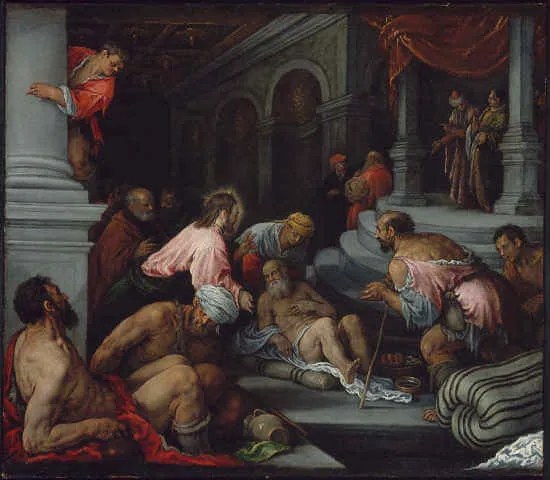
Let us begin by imagining the overwhelming joy of this man, who was healed after he had been ill for thirty-eight years. He lay on a mat near the Pool of Bethesda, a place where tradition held that the first to enter the water after it was stirred would be healed. Some later traditions associated the stirring of the waters with the Archangel Raphael, whose name means ‘healing of God.’ While Scripture does not link Raphael to this story, his healing nature from other biblical traditions makes the association meaningful for reflection.

When Jesus approaches the paralyzed man and asks, “Do you want to be well?” the question seems almost unnecessary. Who wouldn’t desire healing after suffering for so long? Yet this question points to a deeper reality—one that transcends physical illness. The man’s condition and Jesus’ question symbolize the spiritual paralysis that can afflict any soul trapped in habitual sin. Just as the man could not heal himself, so too are we unable to free ourselves from the weight of sin without divine intervention. Jesus asks us the same question today: Do we truly want to be freed from our spiritual paralysis?

The man’s response to Jesus also reveals an important truth. He says, “Sir, I have no one to put me into the pool when the water is stirred up; while I am on my way, someone else gets down there before me.” This admission reflects a deep hopelessness that those who struggle with habitual sin often experience. Years of failure to overcome sin can lead to discouragement, even resignation. But this very discouragement is where grace begins to work. In acknowledging our inability to heal ourselves, we open the door to Christ’s healing power.

Perhaps Jesus chose this man precisely because he had lost all hope. After thirty-eight years of suffering, he had no one to help him and no expectation of healing. Yet Jesus, in His mercy, intervened. This is a powerful message for all who struggle with sin and despair of overcoming it: There is always hope in Christ. He takes the initiative when we cannot, bringing healing where we least expect it.

Picture Christ coming to you today, asking, “Do you want to be well?” Our response should mirror the man’s humility: Lord, I am powerless to free myself from my sin. In this admission of weakness, we allow Christ to work in us. It is through our humility that we prepare to receive His grace.

Reflect today on any sin—whether venial or grave—that has become a habitual part of your life. Have you grown resigned to these sins, thinking they are impossible to overcome? Are there sins you have become so accustomed to that you no longer recognize their spiritual harm? Christ asks you today: Do you want to be healed? Acknowledge your weakness, confess your inability to heal yourself, and wait on the Lord. Be attentive, and you will see He is already taking divine initiative, working in ways you might not yet realize.

Source: https://catholic-daily-reflections.com/2026/03/16/divine-initiative-and-intervention/

John 5:6-8 Read More »

Saint Julian of Anazarbus

Profile

Julian was a prominent citizen of senatorial rank. He was arrested for his faith during the persecutions of Diocletian, he was tortured then put on display for abuse for a year in cities all over Cilicia, being led around behind a camel. He was a martyr. He was also praised by Saint John Chrysostom in a homily during the enshrinement of his relics.

Born

Anazarbus, Cilicia (in modern Turkey)

Died

sewn into a sack full of vipers and scorpions, and thrown into the sea to drown c.302
relics enshrined in Antioch

Canonized

Pre-Congregation

Patronage

Rimini, Italy

Representation

man being thrown into the sea in a sack
man in a coffin which is floating into shore and on which sits four angels
man bound on a camel being led through the streets

Source: https://catholicsaints.info/saint-julian-of-anazarbus/

Saint Julian of Anazarbus Read More »

John 4:48-50

Miracles and Faith

“Unless you people see signs and wonders, you will not believe.” The royal official said to him, “Sir, come down before my child dies.” Jesus said to him, “You may go; your son will live.” The man believed what Jesus said to him and left.

Reflection:

What is the most precious gift our Lord could give to you? If your spouse, child, or close friend were gravely ill, would a miracle be the gift you sought? If your financial situation were dire, would you ask for monetary assistance? If you were suffering from a chronic disease, would your prayer be for a cure?

Though we should entrust these situations to God’s grace, it’s important to understand that the gift of faith far surpasses any immediate miracle, assistance, or relief we might seek. Faith is a most precious gift because it enables us to turn away from our limited assessment of earthly situations and be open to God’s wisdom, which far surpasses anything we could conceive of by ourselves.

Though Jesus performed many miracles, He regularly challenged those whose faith was based on their desire for signs and wonders. In today’s Gospel, a royal official, likely of high rank, traveled from Capernaum to Cana, about twenty miles, because his child was dying. His journey illustrates faith in Jesus’ divine authority, but his faith was imperfect—he believed Jesus had to be physically present to heal his son. Jesus heals the child from a distance, but He also challenges the official and the crowd: “Unless you people see signs and wonders, you will not believe.” Jesus desires a faith that trusts in His word, not one that depends on visible signs.

When we pray with a litany of requests, God in His mercy hears us. Sometimes He grants them, and sometimes He doesn’t. But He wants us to know that such prayers are not the ideal. God already knows our needs better than we do. He knows our struggles within family, finances, health, and every other detail of our lives.

The ideal prayer is one of adoration and trust. It’s a prayer that surrenders everything to God without dictating the outcome. It trusts God’s wisdom more than our own, enabling us to rest in His loving care, unburdened by our difficulties.

The royal official’s faith grew when he believed Jesus’ word without needing Him to be physically present. This is evident when he learned that his son was healed at the exact time Jesus said, “Your son will live.” The official’s faith was deepened, and his whole household came to believe. This shows how true faith, once rooted in trust, grows and spreads to others.

If this man’s faith had not matured, it could have been lost if another crisis arose and no miracle followed. A deeper faith rests in God’s will, whether or not another miracle occurs. The same is true for us. Our faith must not depend on God’s answer to our prayers. If He allows suffering, we must trust Him. If He heals, we must trust Him. Our faith must remain strong, rooted in Who God is, not in what He does.

Reflect today on the depth of your faith and how it shapes your prayers. Believe, worship God for who He is, love Him above all else, and trust His perfect will. Then entrust yourself and your loved ones to His providence, believing that God knows what is best.

Source: https://catholic-daily-reflections.com/2026/03/15/miracles-and-faith-3/

John 4:48-50 Read More »

Fourth Sunday of Lent

First Reading 1 Samuel 16:1b, 6-7, 10-13a

The LORD said to Samuel:
“Fill your horn with oil, and be on your way.
I am sending you to Jesse of Bethlehem, 
for I have chosen my king from among his sons.”

As Jesse and his sons came to the sacrifice, 
Samuel looked at Eliab and thought, 
“Surely the LORD’s anointed is here before him.”
But the LORD said to Samuel: 
“Do not judge from his appearance or from his lofty stature, 
because I have rejected him.
Not as man sees does God see, 
because man sees the appearance 
but the LORD looks into the heart.”
In the same way Jesse presented seven sons before Samuel, 
but Samuel said to Jesse, 
“The LORD has not chosen any one of these.”
Then Samuel asked Jesse,
“Are these all the sons you have?”
Jesse replied,
“There is still the youngest, who is tending the sheep.”
Samuel said to Jesse,
“Send for him; 
we will not begin the sacrificial banquet until he arrives here.”
Jesse sent and had the young man brought to them.
He was ruddy, a youth handsome to behold 
and making a splendid appearance.
The LORD said,
“There—anoint him, for this is the one!”
Then Samuel, with the horn of oil in hand, 
anointed David in the presence of his brothers; 
and from that day on, the spirit of the LORD rushed upon David.

Responsorial Psalm Psalms 23: 1-3a, 3b-4, 5, 6

R. (1)  The Lord is my shepherd; there is nothing I shall want.
The LORD is my shepherd; I shall not want.
    In verdant pastures he gives me repose;
beside restful waters he leads me;
    he refreshes my soul.
R. The Lord is my shepherd; there is nothing I shall want.
He guides me in right paths
    for his name’s sake.
Even though I walk in the dark valley
    I fear no evil; for you are at my side
With your rod and your staff
    that give me courage.
R. The Lord is my shepherd; there is nothing I shall want.
You spread the table before me
    in the sight of my foes;
you anoint my head with oil;
    my cup overflows.
R. The Lord is my shepherd; there is nothing I shall want.
Only goodness and kindness follow me
    all the days of my life;
and I shall dwell in the house of the LORD
    for years to come.
R. The Lord is my shepherd; there is nothing I shall want.

Verse Before the Gospel John 8:12

I am the light of the world, says the Lord;
whoever follows me will have the light of life.

Gospel John 9:1-41

As Jesus passed by he saw a man blind from birth.
His disciples asked him,
“Rabbi, who sinned, this man or his parents, 
that he was born blind?”
Jesus answered,
“Neither he nor his parents sinned; 
it is so that the works of God might be made visible through him.
We have to do the works of the one who sent me while it is day.
Night is coming when no one can work.
While I am in the world, I am the light of the world.”
When he had said this, he spat on the ground
and made clay with the saliva,
and smeared the clay on his eyes,
and said to him, 
“Go wash in the Pool of Siloam” —which means Sent—.
So he went and washed, and came back able to see.

His neighbors and those who had seen him earlier as a beggar said, 
“Isn’t this the one who used to sit and beg?”
Some said, “It is, “
but others said, “No, he just looks like him.”
He said, “I am.”
So they said to him, “How were your eyes opened?”
He replied,
“The man called Jesus made clay and anointed my eyes
and told me, ‘Go to Siloam and wash.’
So I went there and washed and was able to see.”
And they said to him, “Where is he?”
He said, “I don’t know.”

They brought the one who was once blind to the Pharisees.
Now Jesus had made clay and opened his eyes on a sabbath.
So then the Pharisees also asked him how he was able to see.
He said to them,
“He put clay on my eyes, and I washed, and now I can see.”
So some of the Pharisees said,
“This man is not from God,
because he does not keep the sabbath.”
But others said,
“How can a sinful man do such signs?”
And there was a division among them.
So they said to the blind man again, 
“What do you have to say about him,
since he opened your eyes?”
He said, “He is a prophet.”

Now the Jews did not believe 
that he had been blind and gained his sight 
until they summoned the parents of the one who had gained his sight.
They asked them,
“Is this your son, who you say was born blind?
How does he now see?”
His parents answered and said, 
“We know that this is our son and that he was born blind.
We do not know how he sees now,
nor do we know who opened his eyes.
Ask him, he is of age;
he can speak for himself.”
His parents said this because they were afraid
of the Jews, for the Jews had already agreed 
that if anyone acknowledged him as the Christ,
he would be expelled from the synagogue.
For this reason his parents said,
“He is of age; question him.”

So a second time they called the man who had been blind 
and said to him, “Give God the praise!
We know that this man is a sinner.”
He replied,
“If he is a sinner, I do not know.
One thing I do know is that I was blind and now I see.”
So they said to him,
“What did he do to you?
How did he open your eyes?”
He answered them,
“I told you already and you did not listen.
Why do you want to hear it again?
Do you want to become his disciples, too?”
They ridiculed him and said, 
“You are that man’s disciple;
we are disciples of Moses!
We know that God spoke to Moses, 
but we do not know where this one is from.”
The man answered and said to them,
“This is what is so amazing, 
that you do not know where he is from, yet he opened my eyes.
We know that God does not listen to sinners, 
but if one is devout and does his will, he listens to him.
It is unheard of that anyone ever opened the eyes of a person born blind.
If this man were not from God,
he would not be able to do anything.”
They answered and said to him,
“You were born totally in sin,
and are you trying to teach us?”
Then they threw him out.

When Jesus heard that they had thrown him out,
he found him and said, Do you believe in the Son of Man?”
He answered and said, 
“Who is he, sir, that I may believe in him?”
Jesus said to him,
“You have seen him,
the one speaking with you is he.”
He said,
“I do believe, Lord,” and he worshiped him.
Then Jesus said,
“I came into this world for judgment, 
so that those who do not see might see, 
and those who do see might become blind.”

Some of the Pharisees who were with him heard this 
and said to him, “Surely we are not also blind, are we?”
Jesus said to them,
“If you were blind, you would have no sin; 
but now you are saying, ‘We see,’ so your sin remains.

Source: https://bible.usccb.org/bible/readings/031526.cfm

Fourth Sunday of Lent Read More »