Author name: Sani

John 8:58-59

Living in the Moment

Jesus said to them, “Amen, amen, I say to you, before Abraham came to be, I AM.” So they picked up stones to throw at him; but Jesus hid and went out of the temple area.

Reflection:

When Moses encountered God in the burning bush, God revealed His name: I AM. The Catechism of the Catholic Church teaches that this revelation of God’s name “​​is at once a name revealed and something like the refusal of a name.” It expresses that God is “infinitely above everything that we can understand or say.” He is the “hidden God.” He is also a “God who makes himself close to men” at each and every moment of our lives (See CCC #206).

In our Gospel today, Jesus identifies Himself with this hidden God. He states that He alone knows His Father and that the Father glorifies Him because He is the great I AM. To the people of that time, this was a shocking revelation, at least to those who failed to comprehend this truth in faith. But that mysterious name reveals to us not only the essence of God, it also reveals how we ought to relate to this infinite, hidden, exalted and glorious God.

As Jesus revealed His identity, He did not say, “before Abraham came to be, I was.” He says, “I AM.” This reveals that Jesus not only existed before Abraham, but that His existence transcends all time. He always and everywhere IS. Though this might seem overly philosophical to some, it is an important concept to understand for two important reasons. First, it gives us greater insight into God. But, second, it reveals to us how we ought to relate to God every day.

God is not a God of the past. He is not a God of the future. He is a God of the present moment. If we are to enter into a relationship with God, then we must realize that we can only encounter Him in the present moment. He is the Here and Now, so to speak. And we must seek Him here and now, in this present moment alone.

Sometimes we find ourselves dwelling on the past. To the extent that our past has helped or hurt us in this present moment, we need to address it. But the way this is done is by seeking God’s healing grace today, allowing the past to disappear into His abundant mercy. Other times we try to live in the future, becoming anxious about what is to come. But God does not dwell in the future for, to Him, all time is here and now. Therefore, we ought not to become anxious about the future, worry about it or try to live in it now. All we have is this present moment, and it is in this moment that God comes to meet us. He is here, and we must meet Him here, turning to Him and His grace today.

Reflect, today, upon this deep and mysterious revelation from our Lord. Think about his identity as the great “I AM.” Ponder that name. Ponder its meaning. See it as a way by which Jesus is inviting you to encounter Him in this present moment alone. Live in this moment. The past is gone; the future is not yet here. Live where God exists, here and now, for that is the only place that you will meet our Lord.

Source: https://catholic-daily-reflections.com/2025/04/09/living-in-the-moment-3/

John 8:58-59 Read More »

Saint Liborius of Le Mans

Profile

Liborius was born to a noble family of Gaul. He was a priest. He became the Bishop of Le Mans, France in 348. He was a friend of Saint Martin of Tours. He served his diocese for 45 years, building many churches. The translation of his relics from Le Mans to Paderborn, Germany led to a sister-city relation that has lasted for over 1,000 years.

Born

  • early 4th century Gaul (modern France)

Died

  • 396 of natural causes
    some relics at Amelia, Umbria, Italy
  • some relics transferred to Paderborn, Germany in 836

Canonized

  • Pre-Congregation

Patronage

  • abdominal pains
  • against calculi
  • against colic
  • against fever
  • against gall stones
  • against gravel
  • against kidney disease
  • against kidney stones
  • in France
  • Le Mans
  • in Germany
  • Paderborn, archdiocese of
  • Paderborn, city of
  • Paderborn Cathedral

Representation

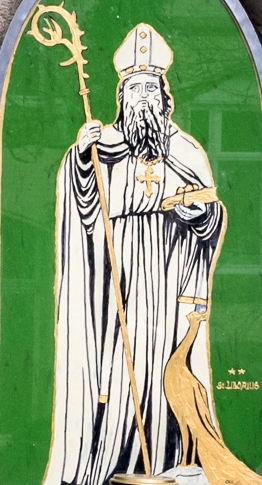
  • bishop carrying small stones on a book
  • bishop with a peacock
  • peacock (legend says that when his relics were taken to Paderborn, the procession was led by a peacock)
  • pebbles

Source: https://catholicsaints.info/saint-liborius-of-le-mans/

Saint Liborius of Le Mans Read More »

John 8:31-32

The Truth Will Set You Free

Jesus said to those Jews who believed in him, “If you remain in my word, you will truly be my disciples, and you will know the truth, and the truth will set you free.”

Reflection:

These words have the potential to make a transforming difference in our lives. Note that Jesus spoke these words “to those Jews who believed in him.” That is, those who had accepted His word and were, therefore, His true disciples. We who also believe in Jesus should consider these words carefully. The heart of this teaching is twofold: you must come to “know the truth” so that the truth you come to know “will set you free.” 

This teaching of Jesus is exceptionally helpful on both a psychological and spiritual level. First of all, on a purely psychological level, one of the greatest helps to good mental health is the truth. Most often when one struggles with various forms of depression, it’s because they are seeing aspects of their life with confusion. “Why did this person do this to me?” Or “How will I ever get through this?” Or “My life is a mess and there is no way out.” These and other similar thoughts will inevitably lead to depression for one simple reason: they are based on erroneous thinking.

One of the best forms of psychological counseling is what could be called “truth therapy.” Every despairing question that we have and every depressing conclusion that we have come to in life must be reexamined in the light of the mind of God. What does God think? What is in the mind of God in this regard? Those truths that are waiting to be discovered are the truth that “will set you free.” Depression is more easily overcome when we look at our life in the way that God looks at our life. This produces hope, and hope brings freedom to the chains of depression and confusion.

On a spiritual level, these principles apply all the more. The truth about sin, forgiveness, salvation and Heaven must be known deeply and embraced fully. When we deny the truth of sin or forgiveness, then we live within a lie and we remain bound by that lie. True spiritual freedom that leads to salvation and eternity in Heaven is obtained only when we wholeheartedly embrace the holy and perfect spiritual truth given to us by God. We must clearly know our sin, repent of it, seek the forgiveness of God, amend our lives and live the new life of grace to which we are called.

Reflect, today, upon this powerfully transforming teaching of Jesus: “know the truth, and the truth will set you free.” What psychological and spiritual truths do you need to more deeply know? What confusion or blindness remains? Seek the remedy of the Truth as it is in the mind of God and know that freedom awaits.

Source: https://catholic-daily-reflections.com/2025/04/08/the-truth-will-set-you-free-4/

John 8:31-32 Read More »

Saint Dionysius of Alexandria

Profile

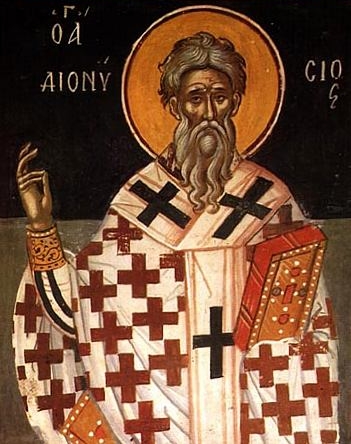
Dionysius studied under Origen, and eventually became the head of the catechetical school of Alexandria, Egypt. He became the Archbishop of Alexandria. In 250, during the persecutions of Decius, Dionysius tried to flee the city, but was caught and imprisoned. He was rescued by Christians and hid in the Libyan desert until 251. During the Novatian schism, Dionysius supported Pope Cornelius, and helped unify the East. He was exiled during the persecution of Valerian in 257 to the desert of Mareotis; he returned to Alexandria when toleration was decreed by Gallienus in 260. Dionysius dealt leniently with the Christians who had lapsed during the persecutions. He wrote a noted commentary on Revelations. He is the Greek Father of the Church.

Born

  • c.190 in Alexandria, Egypt

Died

  • 265 of natural causes

Canonized

  • Pre-Congregation

Source: https://catholicsaints.info/saint-dionysius-of-alexandria/

Saint Dionysius of Alexandria Read More »

John 8:30

The Language of Jesus

Because he spoke this way, many came to believe in him.

Reflection:

Jesus had been teaching in veiled but deeply profound ways about Who He was. In prior passages, He referred to Himself as the “bread of life,” the “living water,” the “light of the world,” and He even took upon Himself the ancient title of God “I AM.” Furthermore, He continually identified Himself with the Father in Heaven as His Father with Whom He was perfectly united and by Whom He was sent into the world to do His will. For example, just prior to the line above, Jesus states clearly, “When you lift up the Son of Man, then you will realize that I AM, and that I do nothing on my own, but I say only what the Father taught me” (John 8:28). And it was because of this that many came to believe in Him. But why?

As John’s Gospel continues, Jesus’ teaching remains mysterious, deep and veiled. After Jesus speaks profound truths about Who He is, some listeners come to believe in Him, while others become hostile to Him. What is the difference between those who come to believe and those who ultimately kill Jesus? The simple answer is faith. Both those who came to believe in Jesus and those who orchestrated and supported His murder heard the same teaching of Jesus. Yet their reactions were so very different.

The same is true for us today. Just like those who heard these teachings for the first time from Jesus’ own lips, we also are presented with the same teaching. We are given the same opportunity to listen to His words and either receive them with faith or reject them or be indifferent. Are you one of the many who came to believe in Jesus because of these words?

Reading these veiled, mysterious and deep teachings of Jesus as they are presented in the Gospel of John requires a special gift from God if these words will have any impact upon our lives whatsoever. Faith is a gift. It’s not just a blind choice to believe. It’s a choice based on seeing. But it’s a seeing made possible only by an interior revelation from God to which we give our assent. Thus, Jesus as the Living Water, the Bread of Life, the great I AM, the Light of the World, and the Son of the Father will only make sense to us and will only have an effect upon us when we are open to and receive the interior light of the gift of faith. Without that openness and reception, we will remain either hostile or indifferent.

Reflect, today, upon the deep, veiled and mysterious language of God. When you read this language, especially in the Gospel of John, what is your reaction? Ponder your reaction carefully; and, if you find you are any less than one who has come to understand and believe, then seek the grace of faith this day so that our Lord’s words will powerfully transform your life.

Source: https://catholic-daily-reflections.com/2025/04/07/the-language-of-jesus-5/

John 8:30 Read More »

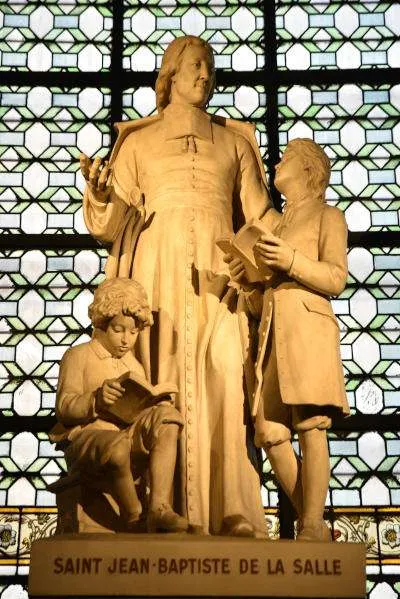
Saint John Baptist de La Salle, Priest

1651–1719; Patron Saint of educators; Canonized by Pope Leo XIII on May 24, 1900

Saint John Baptist de La Salle died on Good Friday, perhaps as a divine sign of the sacrificial life he had lived for the salvation of souls. This wasn’t his first death. His first death was of the life he had lived and the renunciation of the world for the sake of the unexpected mission God gave him.

The Reims Cathedral in France was founded in the fifth century. The first Frankish king to be baptized was baptized there by Saint Remigius, leading to the baptism of many others and the Christianization of the kingdom. After that time, the cathedral became the place where most French kings were crowned throughout the centuries. In its thirteenth-century reconstruction, the Reims Cathedral became one of the most ornate and beautiful Gothic cathedrals in France.

Today’s saint was born into an upper-class family in Reims, and from his youth enjoyed a life of honor and social prestige, as well as an excellent and expensive education. His parents were very devout. When John was eleven, he received tonsure, and he and his parents made a promise of his lifelong service to the Church. At the age of sixteen, he became a canon of the Reims Cathedral. Canons acted as caretakers of the cathedral and advisors to the archbishop. John was then sent to complete his education at some of the finest schools in France. Shortly after beginning his studies of theology at age twenty-one, his parents both died, and he had to return home to care for his six younger siblings and to oversee the family estate. Over the next five years, he completed his theological studies and was ordained a priest at the age of twenty-six. After ordination, he completed his doctorate of theology and immersed himself in the life of a young and well-respected priest.

Father de La Salle’s spiritual director, Father Nicolas Roland, was a saintly man who had a heart for the poor and the education of children. He helped found a new religious order called the Sisters of the Child Jesus whose mission was to care for the sick and educate poor girls. Father de La Salle became their chaplain and confessor and assisted them with their work. When Father Roland was dying, he exhorted Father de La Salle to continue the work of educating the poor youth. Father de La Salle reluctantly agreed, not realizing what he was getting himself into. Soon after, Father de La Salle came in contact with a layman, Adrian Nyel, whom he assisted to found a school for poor boys in Reims, followed by a second one.

Father de La Salle found himself in a dilemma. Naturally speaking, he did not feel drawn to the work of establishing schools for the poor, but he found it difficult to resist the sisters and Adrian who were so passionate about this work, and divine inspiration tugged on his heart. He tried to withdraw but later continued to assist them. Little did he know that he had just begun what would become his life’s work—and a transforming legacy within the Church.

As time went on, Father de La Salle saw a need to better educate the teachers. He himself had received such an excellent education that he was well aware of the teachers’ lack of skills and their poor personal formation. The children that these men were teaching were often very poorly brought up and were “far from salvation,” he would later recount. In response, Father de La Salle began inviting the teachers into his own home, sharing meals with them, and teaching them how to be better teachers and men of God. Eventually, he invited them to live with him in his family home so that he could devote even more time to them. This didn’t sit well with some of his proud relatives who disdained the idea of him so closely associating himself with the lower social class.

Father de La Salle began to experience resistance and criticism. His social peers accused him of trying to make a name for himself as a founder. Some said he was ambitious. They wondered why he was not interested in maintaining the family’s good name, by associating with the peasants. What about his canonry? Would he abandon that prestigious position in favor of educating poor boys and working with simple and poorly educated teachers? Even the bishop raised similar concerns. These criticisms weighed heavily on Father de La Salle, but he prayerfully continued to follow divine inspiration. He resigned as a canon of the cathedral and devoted himself to the full-time work of the education of the poor.

When his parents had died, Father de La Salle had inherited a small fortune. Though he considered using that money to found new schools, he decided instead to give it to the poor who were suffering from a famine in another city, and to rely completely on divine providence for the establishment of more schools. Soon after, he founded the Institute of the Brothers of the Christian Schools. The brothers lived in common but did not pursue ordination to the priesthood. Instead, they devoted themselves exclusively to the education of poor young boys.

To better assist the brothers, Father de La Salle began to write and organize so as to form the brothers in the art of education. He developed a clear system and classroom structure which was new, ordered, and effective. Teaching poor boys from poorly formed families was challenging. The teachers had to become true masters of teaching, not only of academics but also of forming the boys in virtue and ordered living. Father de La Salle believed that every poor child should be educated for free. He also believed that the youth should learn to read and study in French rather than in Latin. This was a new approach to education. Though he faced much resistance within and outside of the Church, he pressed on. He opened schools for teachers, and his methods and institute grew rapidly.

Father de La Salle remarked later in life that if he had known what God would ask of him from the beginning, he would have never said “Yes.” But God, in His perfect wisdom, led him one step at a time, and Father de La Salle only had to respond to one gentle prompting of grace at a time. Ponder the way God wants to work with you in the same way. He will most likely not reveal His entire plan for your life all at once. Instead, He will lead you and guide you today, giving you the grace you need to respond to His unfolding plan each moment. Say “Yes” today, tomorrow, and every day thereafter, and at the end of your life you will be amazed at how far God has brought you.

Source: http://mycatholic.life/saints/saints-of-the-liturgical-year/april-7-saint-john-baptist-de-la-salle-priest/
Saint John Baptist de La Salle, Priest Read More »

John 8:20

The "Hour" of Jesus

But no one arrested him, because his hour had not yet come.

Reflection:

This short line comes at the end of today’s Gospel after Jesus, once again, directly confronted the Pharisees.  He confronts them, in this situation, by speaking the truth of His union with the Father and the power and authority He had on account of this union.  The Pharisees attempt to confront and challenge Him but He speaks the truth right back to them in clear language.  Their response to Jesus’ words is not recorded but it’s clear that they do not know what to say and it’s clear that they remain skeptical and desirous of trapping Jesus.

This passage quoted above reveals to us the profound truth that neither the malice of the Pharisees nor that of anyone else could ultimately triumph since Jesus’ “hour had not yet come.”  What does this mean?  Here are two truths we should take from this line.

First, malice cannot overpower the will of God.  Since God the Father did not permit Jesus’ arrest at that time, those with evil intentions were powerless to do so.  Jesus was able to speak clearly and openly, challenging the Pharisees with the truth, and they could do nothing to stop it.  Though His words stung them to the heart, they could do no more than listen and grow in anger and obstinacy toward our Lord.  But they could not harm Him.  This shows that God is ultimately in control of even the malice of others and will only allow malice to appear to triumph when He sees some greater purpose for allowing such a thing to happen.  

Secondly, it reveals that there is a coming “hour” when Jesus will be handed over to sinful men.  But in John’s Gospel, this hour is not an hour of shame and disgrace for Jesus; rather, it is an hour of total triumph over sin and death.  From a worldly perspective we know that His hour of arrest, persecution and Crucifixion takes on the public appearance of horror and disgrace for Jesus.  It appears as if He lost and the Pharisees won.  But from the perspective of God, which is the only true perspective, Jesus triumphs gloriously.  In fact, the Father ultimately permits the malice of the Pharisees to be the instrument of Jesus’ glorification through the sufferings He endured in this hour.  From the divine perspective, His hour does not become one of defeat; rather, it becomes one of ultimate victory.

Reflect, today, upon the coming hour of Jesus.  Soon we will enter into the glories of Holy Week and ponder, once again, that the Father did permit Jesus to enter into the most cruel suffering and death imaginable.  We will be confronted with the apparent scandal of His arrest and the illusion of the victory of the malicious leaders of the day.  But their victory is only an illusion since the permissive will of the Father had other intentions.  Begin preparing for this annual celebration of the hour of Jesus and enter into it with the utmost confidence and faith.

Source: https://catholic-daily-reflections.com/2025/04/06/the-hour-of-jesus-3/

John 8:20 Read More »

Fifth Sunday of Lent

First Reading Isaiah 43:16-21

Thus says the LORD,
            who opens a way in the sea
            and a path in the mighty waters,
who leads out chariots and horsemen,
            a powerful army,
till they lie prostrate together, never to rise,
            snuffed out and quenched like a wick.
Remember not the events of the past,
            the things of long ago consider not;
see, I am doing something new!
            Now it springs forth, do you not perceive it?
In the desert I make a way,
            in the wasteland, rivers.
Wild beasts honor me,
            jackals and ostriches,
for I put water in the desert
            and rivers in the wasteland
            for my chosen people to drink,
the people whom I formed for myself,
            that they might announce my praise.

Responsorial Psalm Psalms 126:1-2, 2-3, 4-5, 6

R. (3)  The Lord has done great things for us; we are filled with joy.
When the LORD brought back the captives of Zion,
            we were like men dreaming.
Then our mouth was filled with laughter,
            and our tongue with rejoicing.
R. The Lord has done great things for us; we are filled with joy.
Then they said among the nations,
            “The LORD has done great things for them.”
The LORD has done great things for us;
            we are glad indeed.
R. The Lord has done great things for us; we are filled with joy.
Restore our fortunes, O LORD,
            like the torrents in the southern desert.
Those that sow in tears
            shall reap rejoicing.
R. The Lord has done great things for us; we are filled with joy.
Although they go forth weeping,
            carrying the seed to be sown,
They shall come back rejoicing,
            carrying their sheaves.
R. The Lord has done great things for us; we are filled with joy.

Second Reading Philippians 3:8-14

Brothers and sisters:
I consider everything as a loss
because of the supreme good of knowing Christ Jesus my Lord.
For his sake I have accepted the loss of all things
and I consider them so much rubbish,
that I may gain Christ and be found in him,
not having any righteousness of my own based on the law
but that which comes through faith in Christ,
the righteousness from God,
depending on faith to know him and the power of his resurrection
and the sharing of his sufferings by being conformed to his death,
if somehow I may attain the resurrection from the dead.

It is not that I have already taken hold of it
or have already attained perfect maturity,
but I continue my pursuit in hope that I may possess it,
since I have indeed been taken possession of by Christ Jesus.
Brothers and sisters, I for my part
do not consider myself to have taken possession.
Just one thing: forgetting what lies behind
but straining forward to what lies ahead,
I continue my pursuit toward the goal,
the prize of God’s upward calling, in Christ Jesus.

Verse before the Gospel Joel 2:12-13

Even now, says the Lord,
return to me with your whole heart;
for I am gracious and merciful.

Gospel John 8:1-11

Jesus went to the Mount of Olives.
But early in the morning he arrived again in the temple area,
and all the people started coming to him,
and he sat down and taught them.
Then the scribes and the Pharisees brought a woman
who had been caught in adultery
and made her stand in the middle.
They said to him,
“Teacher, this woman was caught
in the very act of committing adultery.
Now in the law, Moses commanded us to stone such women.
So what do you say?”
They said this to test him,
so that they could have some charge to bring against him.
Jesus bent down and began to write on the ground with his finger.
But when they continued asking him,
he straightened up and said to them,
“Let the one among you who is without sin
be the first to throw a stone at her.”
Again he bent down and wrote on the ground.
And in response, they went away one by one,
beginning with the elders.
So he was left alone with the woman before him.
Then Jesus straightened up and said to her,
“Woman, where are they?
Has no one condemned you?”
She replied, “No one, sir.”
Then Jesus said, “Neither do I condemn you.
Go, and from now on do not sin any more.”

Source: https://bible.usccb.org/bible/readings/040625-YearC.cfm

Fifth Sunday of Lent Read More »

Saint Henry Walpole

Profile

Henry was educated at Norwich, Cambridge and Gray’s Inn, London, England. He was an adult convert to Catholicism. He studied for the priesthood at Rheims, France in 1582, and English College, Rome, Italy in 1583. He joined the Jesuits in 1584. He was ordained on 15 December 1588 at Paris, France. He became the chaplain to the English soldiers stationed in Brussels, Belgium. He was the Vice-governor of the College of Saint Alban at Valladolid, Spain in early 1593. He returned to England on 4 December 1593 to minister to covert Catholics around York. He was arrested the next day for the crime of priesthood, serving time in York and the Tower of London, and being repeatedly tortured before his martyrdom. He is one of the Forty Martyrs of England and Wales.

Born

  • 1558 at Docking, Norfolk, England

Died

  • hanged, drawn, and quartered on 7 April 1595 at York, England

Venerated

  • 8 December 1929 by Pope Pius XI (decree of martyrdom)

Beatified

  • 15 December 1929 by Pope Pius XI

Canonized

  • 25 October 1970 by Pope Paul VI

Source: https://catholicsaints.info/saint-henry-walpole/

Saint Henry Walpole Read More »

John 8:1-3

Scandalized by Mercy

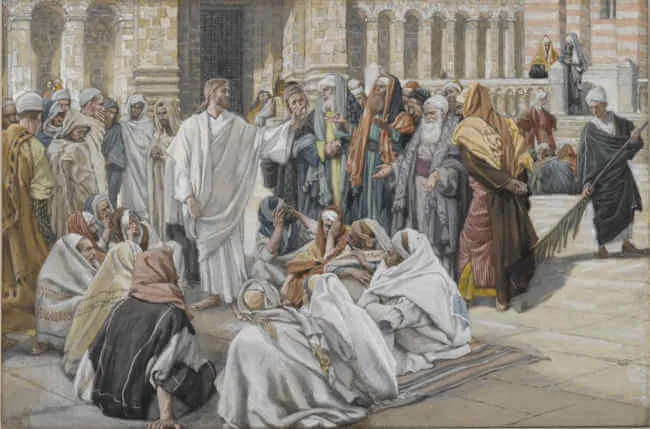
Jesus went to the Mount of Olives. But early in the morning he arrived again in the temple area, and all the people started coming to him, and he sat down and taught them. Then the scribes and the Pharisees brought a woman who had been caught in adultery and made her stand in the middle. 

Reflection:

What a painful and humiliating experience this must have been for this woman! Fortunately, the Savior of the World was there to care for her and to help her navigate this situation through His abundant mercy. Though she was a sinner, God’s mercy offered a remedy for her sin and its consequences.

Interestingly, this story is not included in some of the most ancient manuscripts of the Gospel of John. Saint Augustine believed that it was excluded by some of the early copyists of this Gospel because they were moral rigorists and were scandalized by the depths of Jesus’ mercy. They feared that if this incredible act of mercy was conveyed to others, it would lead to a relaxation of moral rules.

The scribes and Pharisees who brought this woman to Jesus also appeared to be scandalized by Jesus’ mercy. Thus, the depths of mercy offered to this woman was one of many occasions in which Jesus was merciful to a point that was hard for the people to comprehend.

How about you? How far are you willing to go when it comes to mercy? It is easy for us to resort to condemnation when we see the sins of others. We might feel justified in condemning them and even obliged to do so out of a desire to condemn sin itself. But Jesus’ action shows that the sin must not be equated with the sinner. Sin must be condemned and was condemned by our Lord when He said to this woman, “Go, and from now on do not sin any more.” Though He condemned her sin, he did not condemn her: “Neither do I condemn you.”

The mercy of God is incomprehensible. For example, recall that Jesus cried out from the Cross, “Father, forgive them, they know not what they do.” Imagine the surprise that the first hearers of those words would have had. How could this man ask that God forgive the people who were murdering Him? Perhaps the only person who truly understood this prayer of mercy from the Cross was Jesus’ own mother as she stood there gazing at Him with love.

An important lesson for us to learn from Jesus’ depth of mercy is that, at first, it will most likely scandalize us also. Mercy to this extent is supernatural. It challenges our natural reason and calls us to a new way of thinking and relating to others. The only way to overcome the “scandal” we might feel in the face of God’s mercy is to live it ourselves. Doing so will require that we put on new eyes to see sin, mercy and forgiveness through the eyes of God. If doing so shakes you to the core of your being, that might be a good sign. Are you allowing the apparent scandal of God’s abundant mercy to transform you so that it is no longer a shock or scandal to you, but is experienced as good and holy and from the Heart of our God?

Reflect, today, upon how deeply you understand God’s mercy. Do you rejoice when mercy is offered to another? Or do you find yourself condemning? Our Lord said, “Let the one among you who is without sin be the first to throw a stone at her.” None of us are without sin; therefore, none of us has the right to cast a stone at another. Allow the apparent scandal of God’s mercy to challenge you so that you come to not only understand God’s infinite mercy but also to act as an instrument of that mercy to everyone.

Source: https://catholic-daily-reflections.com/2025/04/05/scandalized-by-mercy/

John 8:1-3 Read More »