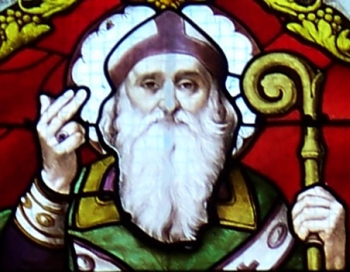
Saint Anathalon of Milan
Saint Anathalon of Milan Read More »
Profile
Anathalon was a spiritual student of Saint Barnabas the Apostle. He was a first-century bishop of Milan, Italy, and assigned by Saint Barnabas. He evangelized the entire region.
Died
Brescia, Italy
Canonized
Pre-Congregation
Source: https://catholicsaints.info/saint-anathalon-of-milan/
Saint Anathalon of Milan Read More »
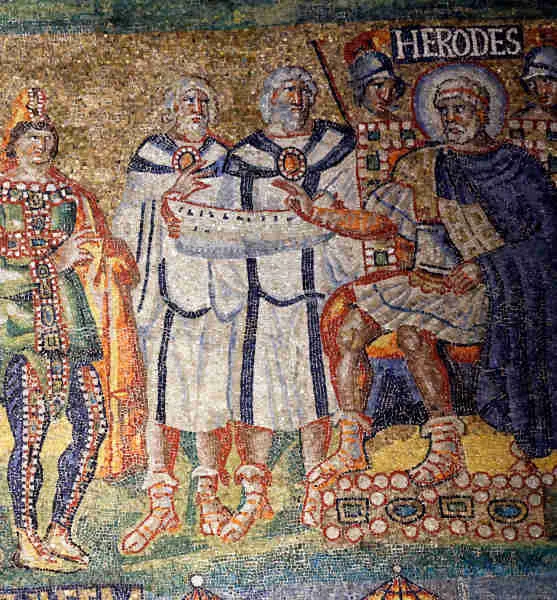
Herod the tetrarch heard about all that was happening, and he was greatly perplexed because some were saying, “John has been raised from the dead”; others were saying, “Elijah has appeared”; still others, “One of the ancient prophets has arisen.” But Herod said, “John I beheaded. Who then is this about whom I hear such things?” And he kept trying to see him.
Reflection:
Something peculiar happens when those who refuse to live according to God’s will witness His presence in the lives of others—they become unsettled, even confused. Herod was one of these souls. Though Jewish by name, he lived a life of self-indulgence, pride, and moral compromise. Upon hearing of Jesus and His mighty works, Herod’s fascination was mingled with inner disturbance. His conscience was especially agitated by guilt over his execution of John the Baptist.
Herod’s perplexity did not arise from a sincere openness to faith, but from fear, guilt, and superstition. Sin had so darkened his heart that he could not perceive the grace of God manifest in Christ. The Gospel tells us that despite Herod’s interior turmoil, “he kept trying to see Him.” This desire reveals a divided soul—one curious about the truth, yet unwilling to embrace it.
Herod offers us not an example of virtue, but a warning. Those who resist the will of God may still catch glimpses of Him through the holiness of others. But without repentance, such encounters bring neither peace nor clarity. In Herod’s case, his fascination resulted first in torment, then in silence. When Jesus finally stood before Herod during the Passion, our Lord did not utter a word. That silence was a judgment upon his hardened heart.
Looking at Herod’s life, many might have envied him. He was rich, powerful, dined in luxury, lived in magnificent palaces, and enjoyed the protection of Rome. Though such monarchs are rare today, the allure of worldly wealth and fame remains strong. The modern equivalents—the celebrities, influencers, and elite—draw millions of admirers. Social media exalts their lifestyles, while the world glorifies indulgence, comfort, and social prestige.
But to what end? Is it to enjoy life in the moment, seizing every earthly pleasure? What happens when this life ends and we stand before the Judgment Seat of God? At that hour, every fleeting comfort will vanish, and we will be left with the state of our soul. Herod’s worldly success was ultimately empty. He lacked peace in this life, and, without conversion, his eternal fate was sealed in that same unrest.
Herod’s life is depicted in the Gospels for a reason. From his example, we must lift the veil of worldly and sensory indulgence and see them for what they are—not only in light of their eternal consequences, but also the interior ruin they cause even now. Such a life has no power to save, no ability to satisfy beyond the moment, and always leaves the soul perplexed and curious—a curiosity that ends in confusion.
Those whose hearts are fixed on such indulgence will always hunger for more and never be satisfied. The best way to avoid the lure of sinful indulgence is to immerse ourselves in the purifying truths of the Gospel. Truth both purifies and liberates. It frees the soul to become the temple of God it was created to be—radiant with holiness, living in joyful union with Him and in spiritual communion with others. Nothing could be greater in this life, and nothing else will satisfy in the next.
Reflect today on any lingering confusion, fear, or disordered curiosity you may carry when encountering Christ in your life. Do you approach Him like Herod—curious but uncommitted—or with a heart that is ready to be purified and transformed? Let the example of Herod lead you away from perplexity and into conversion. Truth Himself stands before you. Do not remain merely curious. Surrender in faith, and the riches of God’s Kingdom will be yours.
Source: https://catholic-daily-reflections.com/2026/09/23/the-good-life/
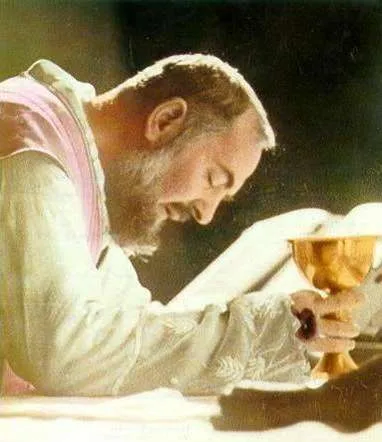
Saint Padre Pio was born Francesco Forgione in Pietrelcina, Italy, a rural town of about 4,000 people. As a child, he was called Franci (Frankie). His parents were peasant farm laborers, and the children assisted with the work. Franci was the third of seven (or eight) children, two (or three) of whom died in infancy, which was quite common at that time. The town centered around the local church of Saint Anna with continuous feasts, Masses, processions, novenas, and parish festivals. The main festival each year was in honor of their patroness, Our Lady of Deliverance, which lasted three days every August. After the day’s work was completed, most evenings were spent with neighbors, eating macaroni, singing, telling stories, and playing in the fields.
The Forgione family was quite devout, and Franci exhibited extraordinary piety from a very early age. The family was especially devoted to the saints and the Blessed Virgin Mary, a love that would remain with Franci throughout his life. As a toddler, Franci often had nightmares. He would later say that he believed the devil was tormenting him at that young age. He also later recalled that, as early as he could remember, he was able to communicate with his guardian angel and had regular visions of the Blessed Mother and Jesus. From the age of five, Franci dedicated himself to God and the Blessed Virgin. He was a good student, even though only three years of public schooling was available in his village. He also suffered from various illnesses throughout his childhood.
At the age of ten, Franci encountered a bearded Capuchin friar who was traveling the countryside begging for food and provisions for his community. Franci was so impressed with him that he informed his parents, “I want to be a friar with a beard!” Though initially amused, his parents took his request seriously and visited the Capuchin friary about thirteen miles north. The friars agreed Franci could join them, but he needed a better preparatory education. Because his parents could not afford to send him to private school or hire a tutor, his father decided to travel to America to earn money for his education. Once in America, his father sent nine American dollars home each week, and Franci received his education. At the age of fifteen, he entered the Capuchins, receiving the name Pio, possibly after Pope Pio I, whose relics were in his hometown church of Saint Anna, or possibly in honor of Pio of Benevento, the provincial.
Just five days before he entered the Capuchins, however, Franci experienced worries about leaving the only life he knew and entering religious life. As he was praying, he had what is known as an “intellectual vision” in which his mind saw what he would later describe as “a majestic Man of rare beauty, resplendent as the sun.” This Man took him by the hand and led him to a “formidable warrior” and “mysterious creature” that he was told to do battle with. He hesitated but the Man encouraged him. He fought and won, and the creature fled. The Man then placed a crown of indescribable beauty on his head and informed him he would have to continually fight the creature but would always win with His help. Three days later, after receiving the Holy Eucharist, Franci realized that his life as a Capuchin would be a continuous battle against the creature from hell, but the Man at his side was Christ Who would never leave him. He had one more vision two days later, the night before his departure, of Jesus and the Blessed Virgin who consoled and strengthened him as he prepared for his new vocation. These visions would come true during his sixty-five years as a friar.
Life as a novice brought with it much structure and discipline. The friars gathered for prayer seven times a day, spent long hours studying, lived in a very simple and small cell, went barefoot, fasted often, and engaged in manual labor. In 1907, at the age of nineteen, Pio took his final vows, and in 1910, at the age of twenty-three, he was ordained a priest. Throughout his seven years of preparation for ordination, Friar Pio was continually in poor health. His fellow friars also reported that he regularly fell into ecstasy in prayer, levitating at times, weeping at others, so immersed that he lost track of time and place. Once ordained, his health was so poor that he was permitted to move to his family home in hopes of recovery. He remained there until 1916 when, at the age of twenty-nine, he was sent to Our Lady of Grace Capuchin Friary, in San Giovanni Rotondo, where he would live the rest of his life, other than a short period of time when he was drafted for military service and quickly discharged for poor health during World War I.
In San Giovanni Rotondo, Padre Pio quickly became known as a mystic. His Masses were exceptionally devout and lengthy due to his prolonged ecstasies. He heard confessions often and gave spiritual counsel to many. His most famous advice was to “pray, hope, and don’t worry.” On September 20, 1918, while praying after Mass, Padre Pio had a vision of a Man, dripping with blood from His hands, feet, and side. Suddenly, Padre Pio’s body was pierced with those wounds as he received the stigmata. He openly carried those wounds for exactly fifty years. They bled up to a cup of blood every day, had a heavenly aroma to them, and caused great pain, especially a wound he had on his shoulder where Christ carried the Cross. Countless doctors examined the wounds over the subsequent fifty years, none of whom was able to give a scientific explanation. Over the next thirteen years, people flocked to see this living saint and mystic. He began to manifest the charisms of healing, bilocation, levitation, prophecy, numerous miracles, and the gift of tongues, in which foreign visitors heard him speak in their own language. He had the ability to read hearts, would spend weeks at a time eating nothing but the Holy Eucharist, and would sleep very little or not at all. Miraculous and profound conversions resulted from his ministry.
To the normal Catholic, these miraculous events were beyond inspiring; to some of the Church authorities they were cause for concern. In 1922, a lengthy investigation began, and restrictions were placed on his priestly ministry. In 1931, the Holy See banned Padre Pio from public ministry and private communications with the people of God. Two years later, Pope Pius XI reversed the restrictions stating, “I have not been badly disposed toward Padre Pio, but I have been badly informed.” Though able to minister publicly, Padre Pio remained under scrutiny and suspicion by various Church authorities for the next thirty years until he was fully exonerated by Pope Paul VI after his papal election in 1963.
In addition to his miraculous ministry consisting of daily Mass, preaching, and countless hours in the confessional, Padre Pio constructed a hospital for those in extreme need. The Holy See granted him special permission to oversee and govern the hospital himself, which was beyond the normal rights and duties for friars.
On September 22, 1968, Padre Pio celebrated a televised solemn Mass attended by thousands to commemorate the fiftieth anniversary of his reception of the stigmata. The following day, his wounds disappeared and he passed to Heaven. An estimated 100,000 people attended his funeral.
In many ways, Saint Padre Pio was a once-in-a-millenium saint. Though other saints have borne the stigmata, no one bore it so openly for so long. He lived continually in divine union, was used by God in the most miraculous of ways, brought about countless conversions, and believed that his real work would take place after his death. Since 1968, that work has continued as his story has been told, his intercession felt, and miracles continue to occur. His body now lies at rest in the Padre Pio Pilgrimage Church in San Giovanni Rotondo, one of the most frequented pilgrimage sites in the world.
As we honor this amazing saint, allow yourself to be inspired by his miraculous life. Ponder even more deeply the life of prayer and union with God that he led. His sanctity went far beyond miracles. It was primarily the result of prayer, penance, virtuous living, and unwavering obedience to the will of God. Every one of us is capable of this same level of sanctity, even if God does not use us in a miraculous and charismatic way. Seek holiness through prayer and penance, and seek Saint Padre Pio’s intercession to help you.
Source: https://mycatholic.life/saints/saints-of-the-liturgical-year/september-23—st-pio-of-pietrelcina-padre-pio-priest/
Saint Pio of Pietrelcina (Padre Pio), Priest Read More »
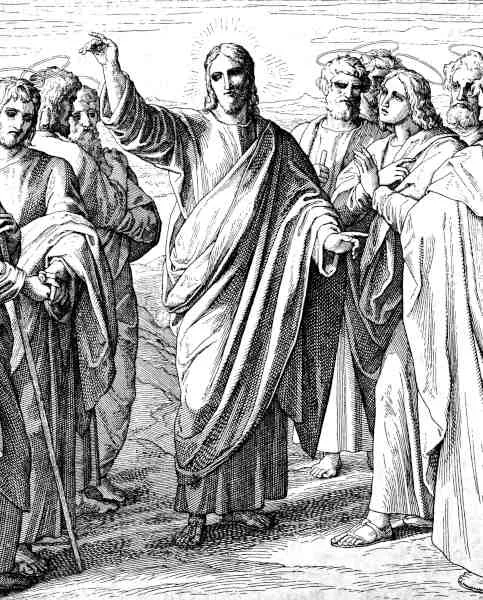
Jesus summoned the Twelve and gave them power and authority over all demons and to cure diseases, and he sent them to proclaim the Kingdom of God and to heal the sick. He said to them, “Take nothing for the journey, neither walking stick, nor sack, nor food, nor money, and let no one take a second tunic.”
Reflection:
Imagine having the power to lay hands on the sick and heal them. Though it may seem like something from the world of fantasy or superheroes, it is, in truth, a participation in divine authority over nature. While children might dream of such power through comic books or cartoons, the power granted to the Apostles was not only real, it was given for a much higher purpose: to draw souls into eternal salvation.
By this point in Luke’s Gospel, the Twelve had been chosen and appointed as Apostles for at least several weeks, if not months. In Luke 6, Jesus called them after spending the night in prayer on a mountain. Since then, they had been formed by listening to His teachings—such as the Sermon on the Plain—witnessing miracles and exorcisms, seeing Him forgive sins, watching in awe as He calmed a stormy sea, and even beholding Him raise the dead.
After this brief but intense period of formation, Jesus sent them on mission. For this mission, Jesus bestowed upon them His own divine power—to heal, cast out demons, and proclaim the Kingdom of God.
As He sent them, He gave an important instruction: “Take nothing for the journey, neither walking stick, nor sack, nor food, nor money, and let no one take a second tunic.” Why would He ask this of them? It wasn’t because of a lack of concern for their needs; rather, He was teaching them a vital spiritual lesson: To be effective instruments of His power and message, they had to rely completely on divine providence.
Imagine being one of the Twelve, entering an unfamiliar village and seeing a crippled man begging at the gate. Suddenly, you feel inspired to lay hands on him and declare his healing. The prompting is so strong, you act. As soon as you say, “Be healed,” the man rises and walks, to the amazement of all. By day’s end, lines of the sick, crippled, and demon-possessed come to you, and each one is healed or delivered.
The next day, a large crowd gathers in the town square. You invite them to sit, then begin preaching all you had heard Jesus teach. As you speak, some are moved to tears; others look to Heaven in joy. Hearts are touched. Chains fall. Lives are changed—all through the instrumentality of your words and presence.
Such a moment would easily lead to the temptation of pride, marveling at all you had done. But Jesus knew this. That’s why, as the day ended and the crowd dispersed, the Apostles had to seek food and shelter from others. That simple act—relying on the kindness of strangers—was a daily reminder that the power they exercised was not their own. They entered towns empty-handed to remember that it was not they who worked wonders or saved souls, but Christ acting and speaking through them.
When God uses us for His glorious purposes, we too will be tempted by the sin of pride. We may marvel at ourselves, seek recognition from others, or expect to be treated as if we were the source of God’s grace. This very real danger must be taken seriously by anyone engaged in Christ’s apostolate. Unless Christ works through us, we can do nothing. We are weak and sinful, and the merit of every good act belongs to Christ alone. We must never forget this sobering truth, especially the more deeply we become involved in His ministry.
Reflect today on how fully you rely on divine providence. Are there times when you are tempted to take credit for what God does through you? Do you seek affirmation and recognition when you serve our Lord? Ask Jesus to give you the grace of humility and detachment, so that you desire only to be a pure instrument of His mercy, never seeking your own glory but always pointing back to Him.
Source: https://catholic-daily-reflections.com/2026/09/22/relying-on-divine-providence/
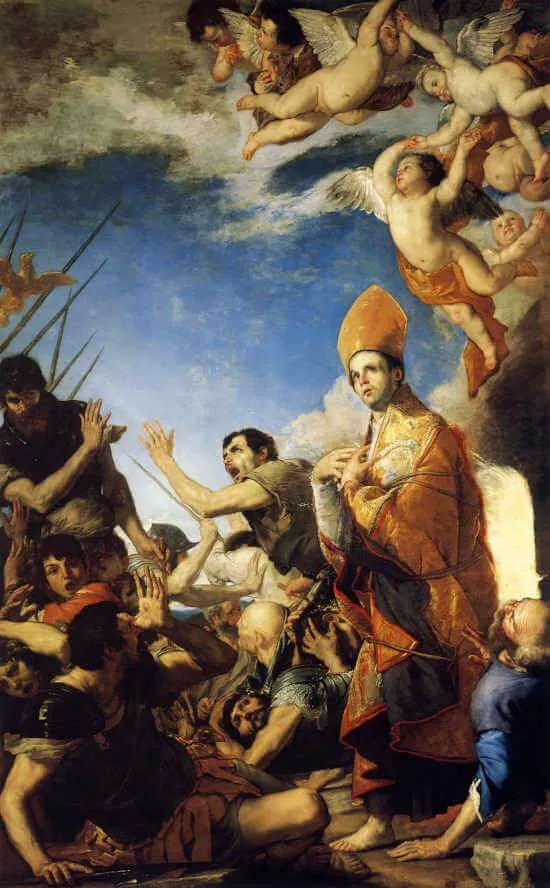
The third-century theologian Tertullian famously wrote, “The more we are mown down by you, the more in number we grow; the blood of Christians is seed.” Sometimes, his phrase is translated as, “The blood of the martyrs is the seed of the Church” (Apologeticus, L.13). There has been no time when this phrase rang truer than in the Roman Empire between the years 303 and 313. In 303 and 304, the Roman Emperor Diocletian issued a series of edicts initiating what has come to be known as the “Great Persecution.” Though the exact reason for this persecution remains unclear, many Christians were imprisoned, tortured, and killed. Others had their properties confiscated or were sent to work in mines under harsh conditions. Among the most famous martyrs of this persecution are Saints George, Catherine of Alexandria, Agnes, Sebastian, Vincent, Pancras, Cosmas, Damian, Anastasia, Lucy, and today’s saint, Saint Januarius.
Januarius is believed to have been born into a wealthy aristocratic family in the city of Benevento, located about 150 miles southeast of Rome, via the Appian Way. Little is known for certain about Januarius’ childhood and life, aside from what was recorded centuries later in various legends. One legend states that he became a priest at the age of fifteen in Benevento and the bishop of either Benevento or Naples at twenty.
When persecutions under Emperor Diocletian began in 303 and 304, chaos ensued across the empire, including Naples. According to legend, four of Bishop Januarius’ friends were arrested: two deacons named Sosius and Proculus, and two laymen named Eutyches and Acutius. To encourage them, Bishop Januarius went to visit them in prison. However, during his visit, he too was arrested and imprisoned by Timothy, the Governor of Campania. Shortly afterward, the bishop’s deacon, Festus, and a lay lector named Desiderius were also arrested when they came to visit Bishop Januarius.
During their interrogations, each Christian boldly professed his faith. They were threatened with death if they refused to offer sacrifices to the Roman gods, but they refused. Consequently, an order was issued for them to be burned. However, when Bishop Januarius was thrown into the flames, he remained unharmed. Next, it was decreed that they be fed to wild beasts in the arena. According to one legend, the beasts became docile and refused to devour them. Ultimately, they were ordered to be beheaded. When the executioner approached, he was struck blind, but Bishop Januarius cured him in front of everyone, leading to many conversions.
After consenting to their martyrdom, all seven men were beheaded. Saint Januarius’ body was taken to Naples and buried in the principal church. Since then, many miracles have been reported by those who prayed at his tomb. It is believed that Naples was saved from volcanic eruptions from nearby Mount Vesuvius due to these miracles.
Though his heroic martyrdom is the greatest witness he could offer, God has continued to use Saint Januarius in a mysterious and ongoing way. Legend holds that, after his death, a holy woman named Eusebia collected some of his blood and stored it in two glass vials. That blood, the blood of a martyr, was later enshrined in the church next to his body. Veneration of Saint Januarius began soon after his death. At some point, an ongoing miraculous phenomenon began to occur. Every year, three times each year, his dried blood liquefies in the presence of the faithful. On some occasions, the blood fails to liquefy, which some interpret as a sign that the faithful should pray for an impending threat to the city. The first written record of the liquefaction of Saint Januarius’ blood is believed to be from 1389, as noted in the chronicle of the cleric Giovanni Diacono of Naples. Records of this annual miracle have continued ever since.
Today, the blood is enclosed in a silver reliquary containing two hermetically sealed vials. The larger one is about four inches high and two and a quarter inches in diameter. Throughout the year, the blood appears as an opaque, dark, and solid mass when viewed in the light. When turned to the side, it does not move. The first instance of liquefaction is on the Saturday before the first Sunday of May, commemorating the translation of the saint’s relics to Naples. The second time is on September 19, the feast of Saint Januarius. The third event takes place on the anniversary of the 1631 eruption of Mount Vesuvius, December 16, when a silver bust believed to house the skull of Saint Januarius is placed on the altar, and the blood is brought out for veneration. The liquefaction usually occurs during the first two times but often fails on December 16.
Although scientists have attempted to explain this phenomenon, no one has successfully cast sufficient doubt on its miraculous nature. It remains a source of deep devotion for Catholics in Naples and continues to inspire many worldwide.
As we honor this ancient saint who continues to inspire us today, ponder the simple truth that miracles do happen. For God, miracles are easy. However, miracles should never be the foundation of our faith in God. True faith comes only from a personal encounter with the Living Lord. Ponder the depth of your own faith. Though this miracle should inspire you, look more deeply and ponder the true source of faith in your life. Seek out the voice of God as that source, spoken gently to you in your conscience. Listen to Him and allow Him to reveal Himself to you, so that God and God alone is the true source of all that you believe and all that you do.
Source: https://mycatholic.life/saints/saints-of-the-liturgical-year/september-19–st-januarius-martyr/
Saint Januarius, Bishop and Martyr Read More »
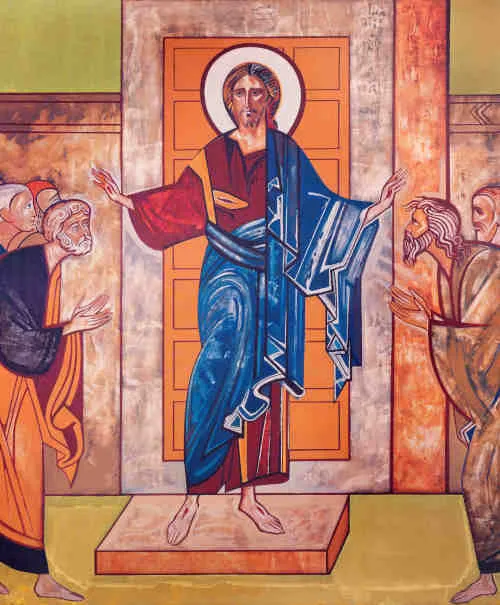
The mother of Jesus and his brothers came to him but were unable to join him because of the crowd. He was told, “Your mother and your brothers are standing outside and they wish to see you.” He said to them in reply, “My mother and my brothers are those who hear the word of God and act on it.”
Reflection:
In biblical Greek, the word translated as “brothers” can refer not only to biological siblings but also to close relatives, kinsmen, or even spiritual brethren, depending on the context. For example, the Greek translation of Genesis 13:8 describes Abraham and Lot as “brothers,” even though Lot is Abraham’s nephew. In Acts 1:15, Peter stood up in the midst of the “brothers,” referring to the larger group of about 120 gathered disciples. And in Romans 1:13, Saint Paul addresses his “brothers” in Rome, meaning all the believers gathered in that city.
Therefore, when we read that Jesus’ mother and His “brothers” came to see Him, the Church has always maintained that this is not a reference to biological siblings—since Jesus is the only Son of the Blessed Virgin Mary—but to extended relatives, likely from Nazareth, such as cousins or other close kin.
Nonetheless, at first glance, another point of confusion could arise from this passage. It might appear that Jesus is distancing Himself not only from His extended kin, but even from His own mother. But is that the case? Certainly not. In fact, a clearer spiritual reading of this passage reveals quite the opposite.
Considering the Blessed Virgin Mary’s arrival and Jesus’ statement that “My mother and my brothers are those who hear the word of God and act on it,” who better fulfills this than His own mother? No one. Though she was conceived in grace, receiving the singular privilege of being preserved from original sin from the first moment of her existence, she still possessed free will. Like Adam and Eve—who were created in a state of original innocence—Mary could have freely chosen to turn from God in selfishness and sin. But she didn’t.
Throughout her life, the Mother of God, who was conceived immaculately, chose, by her free will, to cooperate with grace in every moment. Furthermore, unlike Lucifer—who, according to tradition, saw the glory of his being and desired to exalt himself as god—Mary, seeing the glory of her Immaculate Heart, chose the path of humility and perfect obedience. She never exalted herself but always magnified the Lord.
Today’s Gospel, in fact, highlights a central mystery and glory of her life: her humility. Jesus knew her humility. As her divine Son, He knew her better than she knew herself. He created her and loved her with the perfection of divine love. Out of that love, He revealed her hidden sanctity by speaking a truth that many might misunderstand but that she, in her simplicity and grace, would fully understand. That truth Jesus spoke would be proclaimed for all eternity: She, more than anyone else, heard the Word of God and acted upon it.
This statement is glorious because it highlights Mary’s virtue and reveals the depth of her relationship with Jesus. Their bond was not merely biological. She was not first and foremost His mother because she gave birth to Him but because she heard His Word and responded to it with perfect fidelity. That is why she is the most perfect disciple.
While it would be an unimaginable gift to be Jesus’ mother or one of His biological relatives, Jesus uses this moment to extend an even greater invitation to all of us to become His spiritual kin. He opens the door for all to share in the dignity of divine kinship by listening to His Word and putting it into practice. This is not a lesser calling; it is the very heart of Christian discipleship.
Reflect today on the sublime vocation to which you are called. You may not have carried Christ in your womb, but you are invited to carry Him in your heart through grace and obedience. Hear His Word. Cherish it. Act upon it. In doing so, you will not only become a disciple, you will become family and a more perfect disciple.
Source: https://catholic-daily-reflections.com/2026/09/21/the-most-perfect-disciple/
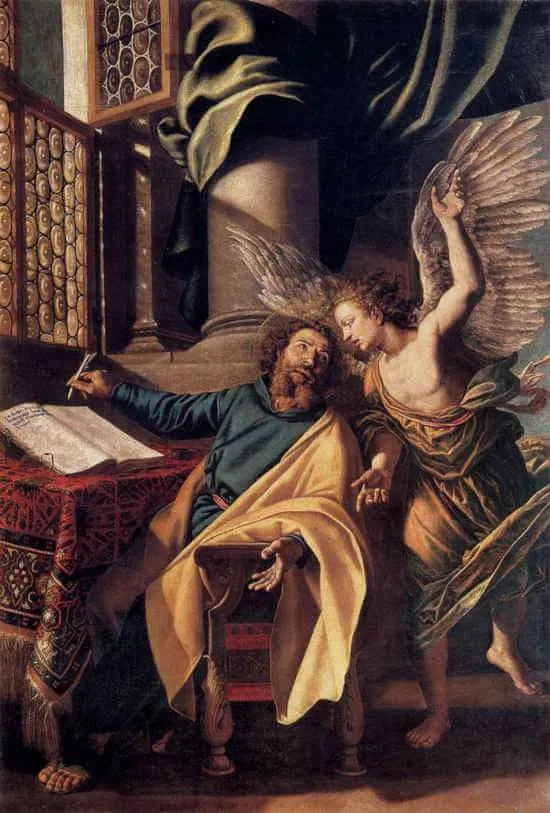
At the time that Jesus began His public ministry, Galilee was part of the Roman Empire. Among the expectations of the Roman authorities was that all who lived under their rule pay taxes. To accomplish this, they often collaborated with local Jews, authorizing them to collect taxes on behalf of the Roman emperor and local governor. The rest of the community often despised the local tax collectors because they were seen as traitors to their people for entering into an oppressive collaboration with the Roman authorities. Even the tax collectors’ families were shunned. For example, their children were often seen as unsuitable as potential spouses. Additionally, many tax collectors were corrupt, imposing more taxes upon the people than they had a legal right to do. The Roman authorities usually overlooked this abuse because they often received a portion of the excess. The tax collectors pocketed the rest. It is within this context that today’s saint, Saint Matthew the Apostle and Evangelist, emerged.
Saint Matthew was most likely born as Levi, the son of Alphaeus. Though nothing is known about his childhood, Levi became a tax collector for the Roman authorities. The name “Levi” implies that he was from the Tribe of Levi, the tribe responsible for Jewish liturgical worship. Though scholars cannot arrive at a definitive conclusion about the details of his life, it is almost universally accepted that the Levi mentioned in Mark 2:14 and Luke 5:27 is the same person mentioned in Matthew 9:9 by the name Matthew. Levi might have been his original name, and Matthew may have been the name given to him by Jesus upon his conversion. The name Matthew means “Gift of Yahweh.”
Levi’s call to follow Jesus was short but profound. He was a man clearly weighed down by his decision to betray his Levitical heritage by working for the Roman authorities to collect taxes for them. He might have been corrupt, greedy, and ostracized by his Jewish community. Most likely, his tax collecting took place in Capernaum, where Jesus had been living in Peter’s home. His duties likely involved gathering taxes on goods that came to Capernaum by way of the Sea of Galilee, as well as collecting a toll from those who arrived in that city by boat. When Jesus began His public ministry, many people took notice. Though there is no biblical account of Matthew listening to Jesus preach prior to his being called, it is reasonable to assume that he did hear about our Lord, and possibly even listened to Him preach in Capernaum. Matthew’s Gospel relates the conversion of the tax collector this way, “As Jesus passed on from there, he saw a man named Matthew sitting at the customs post. He said to him, ‘Follow me.’ And he got up and followed him” (Matthew 9:9). There was no hesitancy. In an instant, the tax collector’s life changed.
Immediately after Matthew abandoned his occupation, he invited Jesus to dine at his house and Jesus accepted. Dining with them were other tax collectors and sinners. As a result, the self-righteous Pharisees quickly condemned Jesus for associating Himself with these men. Jesus, however, rebukes the Pharisees, saying, “Those who are well do not need a physician, but the sick do. Go and learn the meaning of the words, ‘I desire mercy, not sacrifice.’ I did not come to call the righteous but sinners” (Matthew 9:12–13).
Jesus’ call and Matthew’s response sent shockwaves through the rigid Jewish authorities. They had grown accustomed to making judgment and issuing condemnation. They were politically-minded powermongers who lacked hearts of mercy. When Jesus arrived and acted with mercy for sinners, desiring their conversion, the Pharisees opposed Him, but the sinners responded. Though tax collectors like Matthew were wealthy and lived comfortably, Matthew found something in Jesus that his money could not produce.
Throughout the rest of the Gospels, Matthew’s name is listed with the Twelve. He was present at the Ascension and at Pentecost where he received his commission and the outpouring of the Holy Spirit with the other Apostles. Early Church Fathers state that he remained for some time in Judea, preaching the Gospel and helping the newly formed Church. It is during this period that he might have penned his Gospel. It is also commonly held by the Church Fathers that Matthew eventually went to “Ethiopia,” but not Ethiopia in northeast Africa. Instead, he might have traveled to the territory south of the Caspian Sea, modern-day Iran or Armenia.
One legend holds that while in the territory of ancient Ethiopia, Matthew made many converts. Among them were King Egyptus and his whole household, including his daughter Ephigenia. Matthew is said to have consecrated Princess Ephigenia as a virgin and set her over a newly formed company of virgins who gave their lives solely to Christ as His spouses. When King Egyptus died, Hyracus succeeded him as king and wanted to take Ephigenia as his wife. After making this request to Matthew, Matthew invited the new king to church to be instructed in marriage. Once the king arrived in pomp and circumstance, Matthew preached clearly that the virgin Ephigenia already had a spouse, her Lord Jesus Christ, and that she could, therefore, marry no other. Outraged, King Hyracus sent an assassin who stabbed Matthew in the back and killed him while he stood at the altar. The king then ordered that Ephigenia’s home be burned, but the legend continues that Saint Matthew appeared at the house and redirected the fire to the royal palace, which burned down. Shortly afterward, the king was afflicted with leprosy and killed himself, and his son became possessed by demons but later repented at Saint Matthew’s tomb. After this, King Hyracus’ brother became king and established Christianity as the official religion of his kingdom.
The most enduring gift Saint Matthew left behind is his Gospel. Though some modern scholars question whether he was the original author, early Church Fathers attribute the first Gospel to him unequivocally. Matthew’s Gospel was written by a Jew for his fellow Jews. It was most likely written in Hebrew and Aramaic and later translated into Greek. The original Hebrew and Aramaic texts no longer exist. His Gospel clearly shows that Jesus is the fulfillment of the Old Testament, the long-awaited Messiah. He begins with a lengthy genealogy in which he traces Jesus’ roots back to Abraham, the father of the Jewish nation. Matthew’s Gospel is well structured and organized, offering five major discourses in which he presents the Kingdom of Heaven, the Church’s foundation on Peter, the call to righteousness and obedience to God’s will, unique parables, and the Sermon on the Mount. The Sermon on the Mount especially portrays Jesus as the new Moses, offering the New Law on the new mountain. Though Moses received the Law from God on Mount Sinai, Jesus gives the New Law as God Himself on the Mount of the Beatitudes.
As we honor Saint Matthew, we also celebrate the Gospel itself. Matthew was but a human instrument; the content of his Gospel is the Living Word of God. Ponder the inestimable value of this Gospel that God has used to transform countless lives. By his simple obedience to the will of God, Saint Matthew’s efforts have been exponentially fruitful and will continue to be so until the end of the age.
Source: https://mycatholic.life/saints/saints-of-the-liturgical-year/september-21–st-matthew-apostle/
Saint Matthew, Apostle, Evangelist Read More »
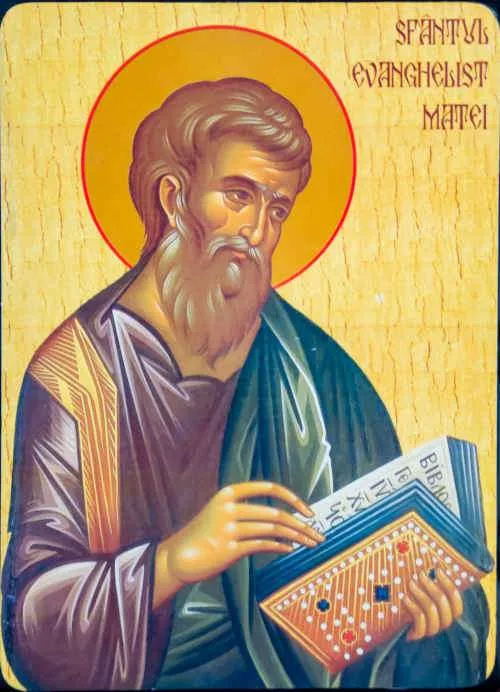
As Jesus passed by, he saw a man named Matthew sitting at the customs post. He said to him, “Follow me.” And he got up and followed him.”
Reflection:
Saint Matthew, whom we honor today, makes following Christ seem so simple. Jesus said, “Follow me,” and Matthew did so, leaving behind his former life and all the baggage he carried. Or did he? Though Matthew’s instant response is inspiring, we should not presume that everything became easy from that moment on. When we have deeply ingrained habits of sin, it takes time and grace to root them out. But none of that healing can begin until we take the first step, which Matthew courageously did in today’s Gospel.
After leaving his customs post, Matthew hosted a dinner for Jesus in his home. Though his home may have been comfortable and the food rich, Matthew—like any new convert—had a long way to go. Tax collectors were despised by nearly everyone, except fellow tax collectors and those branded as sinners. The Jews saw them as traitors to both faith and nation, often barring them from synagogue and Temple worship. Their families, too, were commonly treated with contempt, sometimes even disowned. Ironically, even the Romans, for whom they collected taxes, looked down on them, as they were not true members of the Empire.
This religious and social isolation inflicted deep suffering on these “sinners.” Though tax collectors may have lived outwardly lavish lives, their hearts often bore the sting of loneliness and rejection. It was into this wounded world that Jesus stepped when He encountered Matthew.
The fact that Matthew followed Jesus quickly and eagerly reveals much about Matthew’s inner life. He had heard of this new preacher—perhaps even whispers that He might be the Messiah—and the news had stirred something within. When this rabbi not only noticed him but spoke compassionately to him, commanding him to follow and accepting an invitation to dine in his home, it must have awakened a flood of emotion. Perhaps for the first time in years, Matthew felt something stirring within that had long been buried. Freedom, excitement, hope, and curiosity filled him, and he was willing to walk away from the past and begin anew.
But conversion is not the end; it’s only the beginning. Consider the weeks, months, and years that followed. Like us, Matthew likely wrestled with second thoughts. He would have struggled with guilt and shame, felt unworthy to be among Jesus’ disciples, missed aspects of his old life, and faced the unfamiliar turmoil of inner transformation.
For Matthew, as for all disciples, conversion is the first step. Discipleship is the ongoing journey by which the light of Heaven slowly and steadily penetrates every dark corner of our hearts. We begin to see our attachments more clearly, to understand the harm we’ve caused others, and to navigate the confusion that often arises when grace begins its work within.
Today, we honor Saint Matthew because he kept going after that first step. The three years he spent at Jesus’ side during the public ministry would have been years of profound transformation. After the Ascension, that transformation deepened as the Holy Spirit enlightened him from within, leading him to even more glorious things.
Reflect today on the long and often painful journey of conversion and purification that Saint Matthew endured faithfully until the end. According to tradition, Matthew eventually traveled to the region south of the Caspian Sea—modern-day Iran or Armenia—where he gave his life in martyrdom. His most enduring legacy, however, is the Gospel he wrote. If God could use a tax collector and sinner like Matthew to do such great things, He can use each of us as well. Seek Saint Matthew’s intercession. Ponder his Gospel. And pray for the grace to imitate his holy perseverance, one step at a time.
Source: https://catholic-daily-reflections.com/2026/09/20/from-sinner-to-saint/
Seek the LORD while he may be found,
call him while he is near.
Let the scoundrel forsake his way,
and the wicked his thoughts;
let him turn to the LORD for mercy;
to our God, who is generous in forgiving.
For my thoughts are not your thoughts,
nor are your ways my ways, says the LORD.
As high as the heavens are above the earth,
so high are my ways above your ways
and my thoughts above your thoughts.
R. (18a) The Lord is near to all who call upon him.
Every day will I bless you,
and I will praise your name forever and ever.
Great is the LORD and highly to be praised;
his greatness is unsearchable.
R. The Lord is near to all who call upon him.
The LORD is gracious and merciful,
slow to anger and of great kindness.
The LORD is good to all
and compassionate toward all his works.
R. The Lord is near to all who call upon him.
The LORD is just in all his ways
and holy in all his works.
The LORD is near to all who call upon him,
to all who call upon him in truth.
R. The Lord is near to all who call upon him.
Brothers and sisters:
Christ will be magnified in my body, whether by life or by death.
For to me life is Christ, and death is gain.
If I go on living in the flesh,
that means fruitful labor for me.
And I do not know which I shall choose.
I am caught between the two.
I long to depart this life and be with Christ,
for that is far better.
Yet that I remain in the flesh
is more necessary for your benefit.
Only, conduct yourselves in a way worthy of the gospel of Christ.
R. Alleluia, alleluia.
Open our hearts, O Lord,
to listen to the words of your Son.
R. Alleluia, alleluia.
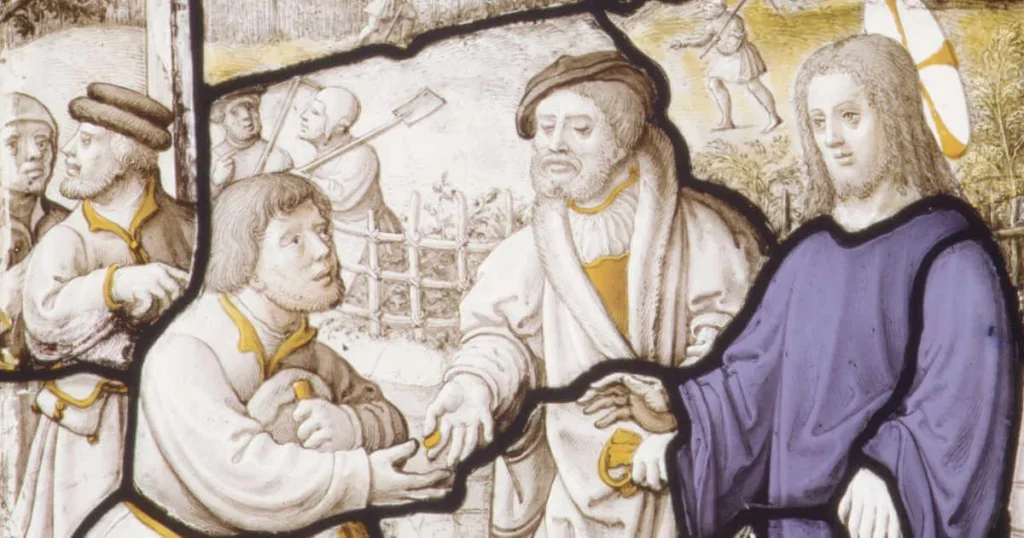
Jesus told his disciples this parable:
“The kingdom of heaven is like a landowner
who went out at dawn to hire laborers for his vineyard.
After agreeing with them for the usual daily wage,
he sent them into his vineyard.
Going out about nine o’clock,
the landowner saw others standing idle in the marketplace,
and he said to them, ‘You too go into my vineyard,
and I will give you what is just.’
So they went off.
And he went out again around noon,
and around three o’clock, and did likewise.
Going out about five o’clock,
the landowner found others standing around, and said to them,
‘Why do you stand here idle all day?’
They answered, ‘Because no one has hired us.’
He said to them, ‘You too go into my vineyard.’
When it was evening the owner of the vineyard said to his foreman,
‘Summon the laborers and give them their pay,
beginning with the last and ending with the first.’
When those who had started about five o’clock came,
each received the usual daily wage.
So when the first came, they thought that they would receive more,
but each of them also got the usual wage.
And on receiving it they grumbled against the landowner, saying,
‘These last ones worked only one hour,
and you have made them equal to us,
who bore the day’s burden and the heat.’
He said to one of them in reply,
‘My friend, I am not cheating you.
Did you not agree with me for the usual daily wage?
Take what is yours and go.
What if I wish to give this last one the same as you?
Or am I not free to do as I wish with my own money?
Are you envious because I am generous?’
Thus, the last will be first, and the first will be last.”
Source: https://bible.usccb.org/bible/readings/092026.cfm
Twenty-fifth Sunday in Ordinary Time Read More »
From 1392–1897, the Great Joseon Dynasty ruled all of what is today North and South Korea. Though shamanism and Buddhism were among the religious beliefs of Koreans during that period, Confucianism was the main philosophical, ethical, and political system. Within that system, a clear hierarchy was established within the family and social structures, with the king on top. This class system was at the heart of their culture. Ancestors were also highly honored and even ritually worshiped, and various human virtues were emphasized, studied, and fostered.
Catholicism was first introduced into Korea via China. The Jesuit Matteo Ricci was one of the first missionaries to step foot in China and introduce the Catholic faith in 1583. Father Ricci and his companions attempted to blend into the culture, learn the language, and teach math, science, astronomy, and mapmaking. They were the first to translate the catechism into the Chinese language. In 1603, a Korean diplomat named Yi Su-gwang was introduced to Matteo Ricci’s catechism in Beijing and returned to Korea, bringing that material with him. Over the subsequent century, the Catholic faith was studied, debated by Confucian scholars, and eventually outlawed by the king in the mid-eighteenth century after determining that Catholicism contradicted various Confucian teachings, such as societal hierarchies and ancestor worship.
In 1784, a twenty-eight-year-old nobleman named Yi Seung-Hun, who had learned about Catholicism in Korea, accompanied his father on a diplomatic mission to Beijing. While there, he sought out some Catholic priests and was baptized as Peter, becoming the first known Korean convert to Catholicism. When he returned to Korea, he brought with him crucifixes, rosaries, statues, and holy images, and shared his newfound faith over the next decade. Catholicism grew covertly, led by the laity. One of the reasons that Catholicism was so attractive to the Koreans was that it placed all people on the same level, eliminating the unjust hierarchy promoted by Confucianism. Catholicism enabled everyone to see each other as equals, individually loved and redeemed by Christ, making them all brothers and sisters.
As the faith slowly grew, the converts asked the Chinese Church for priests. In 1795, a Chinese missionary priest named Father James Zhou Wen-mo became the first recorded priest to step onto Korean soil and offer a clandestine Mass. Over the next six years, it is estimated that the Catholic population grew to about 10,000. In 1801, Father James was arrested and martyred. Though he is not named among today’s canonized saints, he and 123 other early Korean martyrs were proclaimed as Venerable by Pope Francis in 2014.
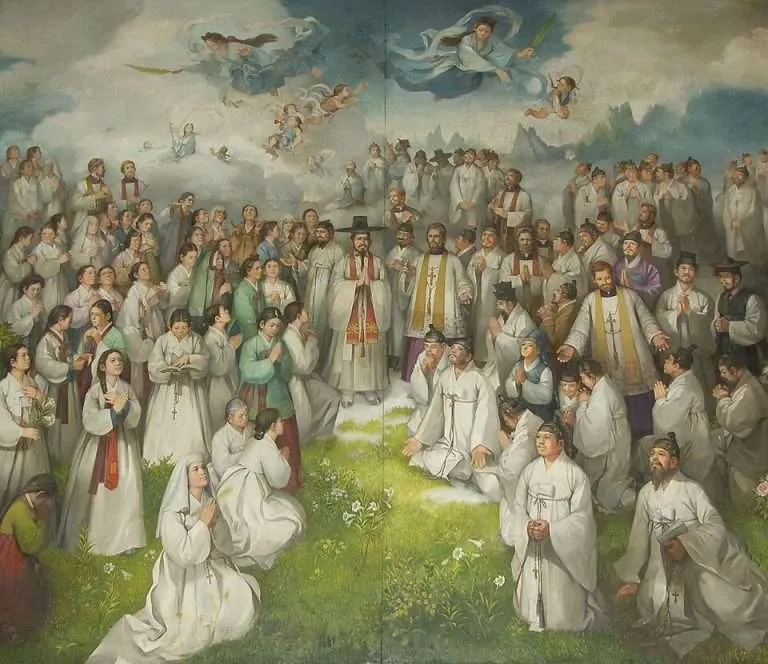
The 103 Korean Martyrs whom we honor today were canonized together by Pope John Paul II during his apostolic visit to Seoul, South Korea, on May 6, 1984, commemorating the 200th anniversary of the first Korean convert. Today’s saints suffered martyrdom in Korea during the years 1839–1867. Most of them were killed during three major persecutions in 1839, 1846, and 1866.
Among the martyrs of the 1839 persecution was forty-three-year-old Bishop Laurent-Marie-Joseph Imbert. In 1836, after joining the Paris Foreign Missions Society, Father Imbert was appointed the Vicar Apostolic of Korea, ordained a bishop, and entered Korea with ten companions in 1837. For about two years, he and his fellow missionaries hid during the day and ministered in secret at night to the covert Catholic population. In August 1839, Bishop Imbert was betrayed to the authorities who were growing increasingly concerned about the threat the Catholic faith posed to the traditional practices of class hierarchy and ancestor worship. Aware of the potential widespread persecution, Bishop Imbert turned himself in to the authorities and subsequently urged two fellow French priests, Fathers Pierre Philibert Maubant and Jacques Honoré Chastan, to do the same, in the hopes that the sacrifice of their lives would spare the lives of their people. After brutal tortures in an attempt to force them to renounce their faith failed, they were executed on September 21. Their bodies were put on public display for several days.
Catholicism, however, could not be stopped. The seed had been planted, began to grow, and was bearing good fruit. The two martyrs specifically mentioned in today’s memorial are Sts. Andrew Kim Tae-gŏn and Paul Chŏng Ha-sang. Paul was born in 1795 into a noble Korean family. He was a lay catechist and a married man. In addition to teaching the Catholic faith, Paul made several trips to Beijing to convince the Paris Foreign Missionary Society to send priests to Korea. He even wrote to the pope with the same request. Partly due to his efforts, Bishop Imbert and his ten missionary companions were sent to minister to the needs of the clandestine Korean Catholic community. In 1839, Catechist Paul Chŏng Ha-sang was martyred during the same persecution that took the life of Bishop Imbert.
Andrew Kim was also born into the noble ruling class of the Joseon Dynasty. His parents were among the many new converts to Catholicism. In 1836, at the age of fourteen or fifteen, Andrew was baptized. Three years later, his father was among the 1839 martyrs and is included in the list of today’s saints. After Andrew was baptized, he traveled 1,300 miles to the Portuguese colony of Macau where he entered seminary. He was later sent to the Philippines to complete his theological training, and in 1845, was ordained in Shanghai as the first Korean priest. Shortly afterward, he secretly returned to Korea via a treacherous sea journey so as to avoid the border guards and to begin his priestly ministry in Korea.
Father Andrew’s ministry in Korea was short-lived, but abundantly fruitful. In addition to offering the Sacraments in secret and teaching the faith, he helped to coordinate the arrival of other French missionary priests. His activity, however, did not go unnoticed. He was arrested in 1846 and subjected to brutal tortures in an attempt to get him to renounce his faith. Father Andrew not only remained strong in the profession of his faith while imprisoned, he also wrote several letters, including a most inspirational one to his parishioners. In that letter, he addressed the hardships that his parishioners would face, offered them hope, pointed them to salvation in Christ, and encouraged them to remain firm in their faith by finding strength in the teachings of the Catholic Church. He died by beheading on September 16, 1846, on the banks of the Han River at the age of twenty-five.
Persecution of Christians continued for the next twenty years, and in 1866, the worst persecution took place, claiming thousands of lives. In all, it has been estimated that between 10,000–20,000 Christians were martyred in Korea during the nineteenth century. The attempts to stop conversions to Catholicism in Korea were brutal. Imprisonment was not enough. Death was not sufficient. Cruel torture was the weapon used by the rulers to deter the spread of the faith. The 103 martyrs we honor today tell us that those efforts failed. Furthermore, the 123 martyrs proclaimed as venerable in 2014 give further credence to the fruitfulness of faith in the face of persecution.
As we honor today’s Korean martyrs, we are reminded that an authentic encounter with Christ so transforms a person that Christ becomes the center of his or her life. Real faith cannot be stopped. These martyrs chose faith over their earthly lives and eternity over temporal comforts. Their united witness should challenge each one of us to examine how deeply we believe in Christ. Is your faith strong enough to endure what they endured? If not, seek their intercession today and recommit yourself to making Jesus Christ the center of your life.
Source: https://mycatholic.life/saints/saints-of-the-liturgical-year/september-20—sts-andrew-kim-taegon-paul-chong-hasang-and-companions/
Sts. Andrew Kim Tae-gŏn, Priest, and Paul Chŏng Ha-sang, and Companions, Martyrs Read More »
Add San Jose Filipino Ministry as a new recipient, Send your donation using"donate@dosjfm.org"
Payable to - San Jose Filipino Ministry
Address - Poong Jesus Nazareno Filipino Catholic Center (PJNFCC); 3700 W. Orange Ave., Anaheim CA 92804
Poong Jesus Nazareno Filipino Catholic Center (PJNFCC); 3700 W. Orange Ave., Anaheim CA 92804
Phone: (657) 214-2507
Mobile (657) 208-2038
info@dosjfm.org

Poong Jesus Nazareno Filipino Catholic Center (PJNFCC); 3700 W. Orange Ave., Anaheim CA 92804
Phone: (657) 214-2507
Mobile (657) 208-2038
info@dosjfm.org
Add San Jose Filipino Ministry as a new recipient, Send your donation using"donate@dosjfm.org"
Payable to - San Jose Filipino Ministry
Address - 1235 S Magnolia Ave
Anaheim, CA 92804-5115
San Jose Filipino Ministry. All rights reserved. 2021 © Powered by Phoenix Virtual Solutions
Sponsored by EverClear Hospice and Palliative Care