April 2026

Mark 16:9-11

Faith and Hope vs. Fear and Despair

When Jesus had risen, early on the first day of the week, he appeared first to Mary Magdalene, out of whom he had driven seven demons. She went and told his companions who were mourning and weeping. When they heard that he was alive and had been seen by her, they did not believe.

Reflection:

Today’s Gospel from Saint Mark offers a concise summary of three of Jesus’ resurrection appearances. Rather than presenting these appearances in detail or as separate encounters, Mark strings them together to convey one clear message: fear and despair resulting from suffering must give way to faith and hope because of the Resurrection.

Mark’s Gospel begins with Jesus’ appearance to Mary Magdalene, simply stating that Jesus appeared to her. Immediately, Mark relates that Mary went to tell Jesus’ companions, including the eleven and some other followers. When Mary went to tell them Jesus had appeared to her, she found them “mourning and weeping.” After she told them Jesus had risen, “they did not believe.”

“Mourning and weeping” are the result of fear, doubt, and despair. While mourning in the form of holy sorrow can arise from genuine charity, as taught in the Beatitudes, mourning as sadness stems from a heart overcome by fear, anxiety, or doubt—each of which can lead to despair. The fruit of despair, as Mark reveals here, is disbelief.

After this account, Mark relates a shortened version of Jesus’ appearance to two disciples on the way to Emmaus. That same Easter day on which Jesus rose and appeared to Mary Magdalene, He appeared to these two disciples. They quickly returned to Jerusalem to share their experience with the eleven and other disciples, who had already disbelieved Mary Magdalene’s testimony. Once again, “they did not believe them either.”

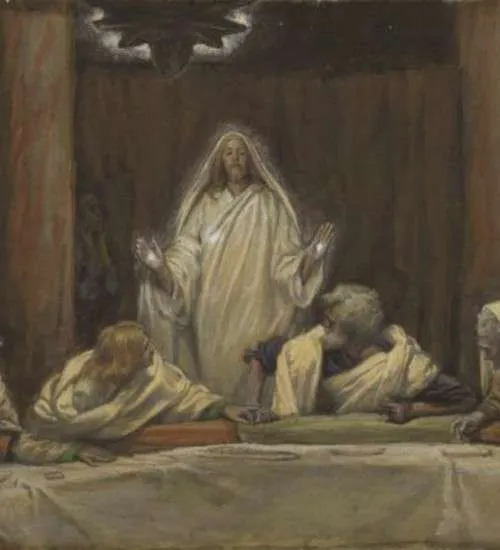
Finally, later on the same day, Mark states: “as the Eleven were at table, he appeared to them and rebuked them for their unbelief and hardness of heart because they had not believed those who saw him after he had been raised” (Mark 16:14). Saint Mark the Evangelist wants us to know that even the eleven remaining Apostles, along with the other disciples, did not immediately believe in the Resurrection. They did not believe until Jesus appeared before them, revealing their hardness of heart that prevented true faith in His word. Jesus rebuked them for this unbelief, showing that the heart closed to faith cannot receive the hope He offers.

If Jesus’ closest companions struggled with faith in the Resurrection and the hope that such faith brings, then we should each prayerfully reflect upon the depth of faith—or lack thereof—we have in the Resurrection.

Practically speaking, what does it mean to have faith in the Resurrection? It means that we will not face life’s crosses with self-pity, sadness, discouragement, or despair. If we understand the glory and transforming power of Christ’s Resurrection, we will immediately perceive every suffering we endure as an opportunity for grace and triumph, not defeat.

Because the disciples did not yet understand the Resurrection, they were mourning without hope. Their minds could not comprehend that the death they had witnessed just days before was now transformed into the most glorious event in human history. When Jesus appeared to them as a group, His rebuke was an act of love, to teach them they must change their understanding of His death and see it through the lens of His Resurrection. We must do the same in our lives.

Reflect today on any cross you carry or suffering you endure. Learn from the sadness and despair that led to disbelief among the disciples. Listen to our Resurrected Lord who lovingly rebukes you and invites you to see the great value in every suffering that you unite to His Cross. His Resurrection must bring a clarity that instills hope into our lives. Commit to live as the disciples did, after Jesus rebuked them, rejoicing that Jesus’ Resurrection conquers all.

Source: https://catholic-daily-reflections.com/2026/04/10/faith-hope-vs-fear-despair/

Mark 16:9-11 Read More »

Saint Maddalena of Canossa

Profile

One of five children born to a wealthy and famous family, Maddalena’s father died and her mother abandoned them all to a governess when she was five years old. She was a nun, who studied in the Carmel of Trent, Italy and then in Conegliano, Italy. She developed a ministry to the poor in Verona, Italy based in the Canossa Castle of her family. She was the founder of the Canossian Daughters of Charity and the Canossian Sons of Charity with a mission of providing free education to poor children. By the end of the 20th century, there were more than 2,600 Canossians working around the world.

Born

  • 1 March 1774 in Verona, Italy

Died

  • 10 April 1835 in Verona, Italy of natural causes

Canonized

  • 2 October 1988 by Pope John Paul II

Source: https://catholicsaints.info/saint-maddalena-of-canossa/

Saint Maddalena of Canossa Read More »

John 21:3-6

Discerning Jesus’ Presence

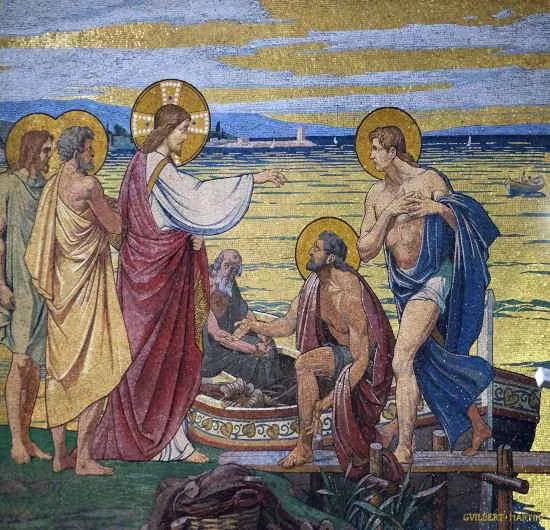
Simon Peter said to them, “I am going fishing.” They said to him, “We also will come with you.” So they went out and got into the boat, but that night they caught nothing. When it was already dawn, Jesus was standing on the shore; but the disciples did not realize that it was Jesus. Jesus said to them, “Children, have you caught anything to eat?” They answered him, “No.” So he said to them, “Cast the net over the right side of the boat and you will find something.” So they cast it, and were not able to pull it in because of the number of fish.

Reflection:

In three of His resurrection appearances, Jesus did not immediately reveal His true presence to His disciples. He wanted to teach them—and us—important lessons on how we are to encounter Him. In each of these appearances, the same thing happened: Those to whom Jesus appeared did not recognize Him at first. Only after some interaction with Him were their eyes opened to discern that it was the Lord.

The first of these encounters is recorded in John 20:11–18, when Mary Magdalene sat outside Jesus’ empty tomb, weeping at the thought that His body had been stolen. She remained there with profound devotion and love, revealing a model for our prayer. Only when Jesus called Mary by name did she recognize Him. This personal call opens her eyes, reminding us of the importance of a personal relationship with Christ. In imitation of Mary’s deep love and steadfast devotion, we are invited to remain vigilant in prayer, ready to hear Him call us by name.

The second instance is in Luke 24:13-35, when two disciples journeying to Emmaus are joined by Jesus, though “their eyes were kept from recognizing Him.” As they walked, Jesus explained everything in the Scriptures that pointed to His messianic mission. This teaches us that we, too, encounter the Lord in the Word of God. By reading, pondering, and praying over Scripture, we open ourselves to meeting Jesus. Once the disciples understood the Scriptures, Jesus broke bread with them, and they recognized Him, but He vanished from their sight. Jesus’ disappearance at that moment reveals a profound truth: He remains truly present in the Eucharist, even though we do not physically see Him.

Finally, in today’s Gospel passage from John 21:1–14, the disciples recognize Jesus only after the miraculous catch of fish. Having fished all night without success, they obey when Jesus tells them from the shore to “Cast the net over the right side of the boat,” resulting in an overwhelming catch. This reminds us of the moment when Jesus first called Simon Peter and Andrew, saying, “Come after me, and I will make you fishers of men” (Matthew 4:19). Here, Jesus reveals to the Apostles—and to us—that we will encounter Him in our apostolic works when done at His command. When we align our actions with His will, He blesses them, yielding an abundance of spiritual fruit. Thus, our apostolic efforts are another way in which the Risen Lord is present with us, working through us to draw souls to Himself.

Reflect today on the longing of Jesus’ disciples to encounter His resurrected presence. Ponder the lessons He imparted by initially concealing His presence, then revealing Himself. Resolve to seek the living and resurrected Lord in your life. Through love and devotion, meet Him in prayer, where He calls you by name. In the Word of God and the Eucharist, recognize Him in your midst. And in fidelity to His guiding hand in your apostolic work, see His superabundant fruitfulness as a sign of His presence, drawing many souls to Himself through you. Jesus is not dead; He is alive and desires to continue appearing to us in hidden and mysterious ways. Anticipate His ongoing resurrection appearances in your life, knowing that He is always with you when you remain faithful, in imitation of these holy disciples.

Source: https://catholic-daily-reflections.com/2026/04/09/discerning-jesus-presence/

John 21:3-6 Read More »

Saint Vincent Ferrer, Priest

c.1350–1419; Patron Saint of builders, plumbers, fishermen, and prisoners; Canonized by Pope Calixtus III in 1455

It can be said that today’s saint lived two sequential lives. The first forty-nine years of his life were, in many ways, a preparation for the final twenty years of his life. All sixty-nine years, however, were years of fervent study, prayer, zeal, and extraordinarily impactful preaching.

Vincent was the fourth child of noble parents born in Valencia, Spain. According to popular legend, Vincent’s father had a dream that his son would become famous throughout the whole world. This was miraculously confirmed when his mother was said not to have experienced any pains during his birth. Vincent was named after the Third Century Valencian saint, Vincent the Deacon, Protomartyr of Spain. At a young age, Vincent completed studies in philosophy and joined the Dominican friars when he was about eighteen. As a young Dominican, he spent the next several years teaching, writing, preaching, praying, fasting, and doing penance, and was very devoted to the poor. His study of the Sacred Scripture was so intense that it is said that for about three years he read nothing but Scripture, memorizing the entire Bible.

The first of the miracles that would later become commonplace in his ministry took place during a severe famine. Brother Vincent’s heart was so moved with compassion for the hungry people that he prophesied that two boats would arrive that evening at port, loaded with food. To the surprise of everyone, it happened as he said. Brother Vincent continued his studies, obtaining a Doctorate in Theology, and was ordained a Catholic priest around the age of twenty-eight.

Father Vincent was ordained during a period in the Church that is commonly referred to as the Western Schism, in which the Church found itself with two men claiming to be pope in 1378. Urban VI resided in Rome, and Clement VII resided in Avignon, France. At the time of the division, good and holy people disagreed on who the real pope should be. The future Saint Catherine of Sienna supported Urban VI in Rome, and the future Saint Vincent Ferrer supported Clement VII. This division raged on until 1417 when the matter was finally resolved by a Church council in Constance. Though Father Vincent’s choice was named the antipope by that council, Father Vincent humbly embraced this resolution and convinced many people to do the same, helping to end the schism.

During the schism, in the year 1398, Father Vincent had an experience that would open the door for the second and most remarkable period of his priestly ministry. Father Vincent had become quite ill. On what seemed to be his deathbed, he had a vision of Christ, accompanied by Saints Dominic and Francis who exhorted him to go forth to preach penance, heal the sick, and prepare the faithful for the coming Judgment. Shortly after, Father Vincent recovered and then sought and received a special commission for this new mission from the Avignon pope. He set out on an extraordinary journey that lasted about twenty years, traveling on foot from town to town all across Europe, including England, Scotland, Ireland, Spain, France, Switzerland, and Italy.

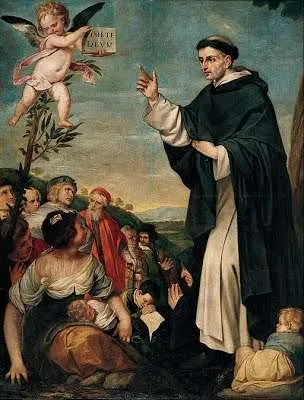
The twenty years of itinerant traveling and preaching that Father Vincent engaged in is a miracle in and of itself. Countless stories abound. During his preaching, many claim that Father Vincent had the charismatic gift of tongues. Although he spoke in his native language, everyone heard him in their own language. While he was an intellectual of the highest caliber, his style of preaching was new, more pastoral in nature, proclaiming the deep truths of the faith with a simple eloquence in which the people easily understood him. Prayer was always his immediate preparation for his sermons, while his study was the remote preparation that provided the content of his compelling messages. Among his most preached upon topics was the Final Judgment of Christ. This earned him the nickname “Angel of the Apocalypse.” Through that message, he instilled a holy fear of God and a desire for repentance among his listeners.

As Father Vincent traveled, it is said that hordes of people traveled with him, doing penance along the way. Some days he had as many as 300 followers, other days as many as 10,000. His “pulpit” was often a large field or public square, so that everyone who wanted to listen could do so.

Miracles also abounded. He raised the dead, healed the lame, cured illnesses, and did so with such regularity that people were mesmerized. As a result of his powerful sermons, backed up by miraculous signs, an estimated 25,000 Jews, 1000s of Muslims, and many pagans converted, while Catholics deepened and renewed their faith. 

Father Vincent’s reputation so preceded him that kings and nobles sought him out to come to their lands. He generously responded, over and over again. His love for the poor was also evident, and he inspired many powerful and wealthy people to practice generosity. Saint Vincent is considered the patron saint of builders due to his effectiveness in building up the Church.

Source: https://mycatholic.life/saints/saints-of-the-liturgical-year/april-5-saint-vincent-ferrer-priest/

Saint Vincent Ferrer, Priest Read More »

Luke 24:44-45

Shalom and Truth

“These are my words that I spoke to you while I was still with you, that everything written about me in the law of Moses and in the prophets and psalms must be fulfilled.” Then he opened their minds to understand the Scriptures.

Reflection:

Have you allowed God to open your mind? When you read through the Scriptures, are you able to comprehend the hidden yet glorious mysteries contained within them? The Scriptures are not only a historical book we interpret through the use of our intelligence alone. There is a layer of meaning within them that no human mind can penetrate without the assistance of grace.

Today’s resurrection appearance in Luke’s Gospel took place later in the day on Easter Sunday. That morning, our resurrected Lord appeared in physical form to some of the holy women and then to Simon Peter. In the afternoon, Jesus appeared to two of the disciples as they journeyed to the town of Emmaus, several miles from Jerusalem. Those disciples did not recognize Jesus until He opened their minds and revealed Himself in the “breaking of the bread,” foreshadowing the Eucharist. After that appearance, those two disciples returned to Jerusalem to tell the eleven and the other disciples about their encounter. It was during that conversation, behind closed doors, that Jesus appeared to all of them Easter evening, except for Thomas who was absent.

Jesus first said to them, “Peace be with you.” This was no ordinary greeting. In Hebrew, Jesus said, “Shalom.” The shalom Jesus spoke of was an imparting of His grace that brought about the tranquility that those who are united to God experience. The peace Jesus spoke of and imparted flowed from the power of His victory over sin and death, by His Passion and Resurrection. That same shalom is given to us when we worthily and fruitfully participate in the sacraments. Through these gifts, especially the Eucharist and Reconciliation, we receive the transforming power of the Paschal Mystery: His life, death, and Resurrection, bestowed through the Holy Spirit.

Once the grace of peace was bestowed, Jesus instructed them to receive it without fear. As this peace rested upon them, Jesus was able to give them another gift: “Then he opened their minds to understand the Scriptures.”

Throughout Jesus’ public ministry, He spoke about the necessity of His Passion, Death, and Resurrection. He pointed to the prophecies and promises about Him that were contained within the Law of Moses, the Prophets, and the Psalms. Until that moment, Jesus’ teaching had not fully penetrated their minds. They heard His perfect sermons, but the full meaning of what He said eluded them. During this resurrection appearance, however, they understood, as Jesus granted them the supernatural gift of Understanding—a gift of the Holy Spirit, who illuminates divine truths and helps us to perceive God’s mysteries in a way we could never achieve on our own.

Our Lord wants to open your mind, just as He did for His disciples that Easter day. Too often, we go through life in a state of confusion. We easily misinterpret our joys and struggles, leaving us on our own to make sense of our lives. Jesus wants to remedy that. He wants us to understand everything as He sees it. He invites us to receive His peace, His shalom, that brings order and tranquility to our lives and unites us in communion with God and others. From there, the Holy Spirit opens our minds to see everything through the lens of divine truth.

Reflect today on how God might be calling you to live in this peace and understanding, particularly by fostering a deeper relationship with Him in the sacraments, in prayer, and in daily reflection on the Scriptures. By receiving the grace of shalom and an understanding of divine truths, we are strengthened for our mission to witness to the Resurrection and to share Christ’s love with a world in need of His peace.

Source: https://catholic-daily-reflections.com/2026/04/08/shalom-and-truth/

Luke 24:44-45 Read More »

Saint Isidore, Bishop and Doctor of the Church

c.560–636; Patron Saint of computer technicians, the Internet, and students; Pre-Congregation canonization; Proclaimed a Doctor of the Church in 1722 by Pope Innocent XIII

Saint Isidore of Seville was among the most learned and prolific writers in the history of the Catholic Church. His influence was felt directly for more than a millennia, as his books were among the most copied and read books throughout the Middle Ages. Today, the world is unquestionably different because of this holy and brilliant man.

Isidore was born in Cartagena, modern-day Spain, to Severianus and Theodora, a well-respected, influential, and upper-class couple. Isidore had an older brother, Leander, who became a monk and then the Bishop of Seville. His younger brother, Fulgentius, became the Bishop of Astigi, and his sister, Florentina, became a nun of prominence. All three of Saint Isidore’s siblings are saints.

Isidore’s parents died when he was young, so his older brother, Leander, cared for him and his other two siblings. As a monk devoted to studies himself, Leander was especially attentive to the education of his siblings. Leander was quite strict in his disciplines, which resulted in Isidore obtaining a thorough education in grammar, logic, rhetoric, arithmetic, astronomy, music, geometry, Latin, Greek, Hebrew, and the Catholic faith. His interests were so vast that it has been said that Isidore knew everything. Isidore also benefited greatly from the contemplative influence of the monks he so admired and was drawn to their life of deep prayer.

At the time that Isidore was completing his education, the Visigoths were the ruling party in the Iberian Peninsula. The Visigoths were Christians who embraced the Arian heresy, which caused much division between them and the Nicene Catholics they ruled. Isidore’s brother, Leander, became the Bishop of Seville in 580 and served as bishop for about twenty years. In the first years of his episcopate, Leander, with the help of Isidore, worked tirelessly to convert the Visigoths to the Nicene Creed and to reject Arianism. When Liuvigild, the Arian Visigoth King died in 586, his younger son, Reccared, became king. A year later, through the efforts of Bishop Leander and Isidore, King Reccared renounced Arianism and embraced the true faith. In the decades to follow, most of the Visigoths also converted, bringing about Christian unity within the Iberian Peninsula.

When Bishop Leander died around the year 600, Isidore was named his successor in Seville and continued to strengthen the unified faith of Nicene Catholicism. Bishop Isidore was amazingly successful in his pastoral work. People flocked to him, listened to his preaching, were in awe of his vast knowledge, and were inspired by his holiness. As a shepherd, he was both an intellectual and a contemplative and enjoyed great confidence and trust from his people and other Church leaders.

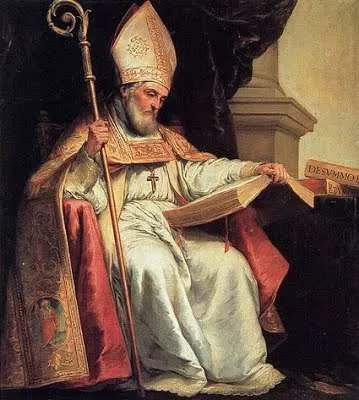
One of Bishop Isidore’s greatest contributions to the Church and to the entire Western world was the writing of the Etymologiae, a comprehensive encyclopedia of all knowledge. This encyclopedia consisted of twenty volumes and summarized many of the great writers who had come before him, both pagan and Christian. Topics included grammar, rhetoric, logic, mathematics, geometry, music, astronomy, law, military science, languages, philosophers, architecture, clothing, food, cosmology, agriculture, mineralogy, physiology, zoology, and, of course, the Catholic faith. This encyclopedia became one of the most copied sets of books throughout the Middle Ages, directly influencing the Western world for more than 1,000 years.

In addition to his writings, Bishop Isidore presided over a number of Church councils. These councils were essential for the strengthening of the Church by further purifying it of heretical teaching, setting up administrative church structures and disciplines, and helping unify the people and bishops into one united voice and vision for the future. Bishop Isidore’s role in these councils was so crucial that in 653, just seventeen years after Bishop Isidore’s death, a subsequent Council in Toledo honored his memory and influence in these words: “The extraordinary doctor, the latest ornament of the Catholic Church, the most learned man of the latter ages, always to be named with reverence, Isidore.”

During his lifetime, Saint Isidore had an enormous influence upon the Church and Western world. He influenced popes, bishops, clergy, laity, kings, and heretics. He won over the minds and hearts of countless people for Christ, uniting them with confidence in the true faith. His intellectual gifts, coupled with his deep holiness, inspired many to turn to him for guidance. It’s hard to underestimate the influence this one man had upon the entire Western world by being a holy bishop in the Diocese of Seville. Though very few people are called to accomplish what he accomplished, we must all do our part. Ponder the legacy that you will leave behind, and pray that God will use you to not only influence those around you today, but that your influence will also be felt for generations to come.

Source: https://mycatholic.life/saints/saints-of-the-liturgical-year/april-4-saint-isidore-bishop-and-doctor-of-the-church/

Saint Isidore, Bishop and Doctor of the Church Read More »

Luke 24:13-16

Our Hidden Lord Revealed

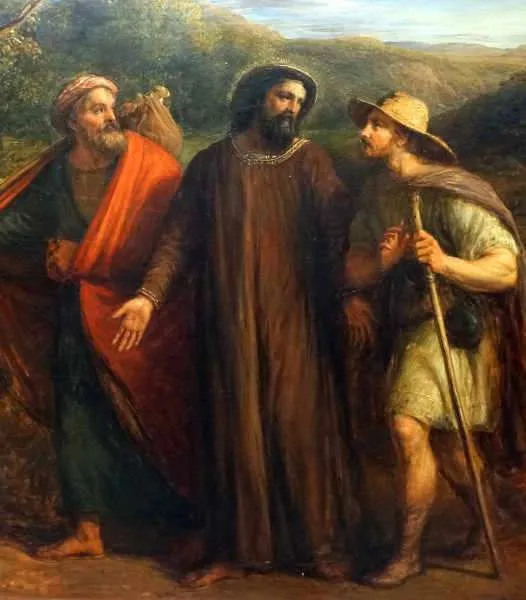
That very day, the first day of the week, two of Jesus’ disciples were going to a village seven miles from Jerusalem called Emmaus, and they were conversing about all the things that had occurred. And it happened that while they were conversing and debating, Jesus himself drew near and walked with them, but their eyes were prevented from recognizing him.

Reflection:

Why were these two disciples prevented from recognizing Jesus when He appeared to them on Easter Sunday? Earlier that morning, as Luke recounts (Luke 24:1–12), Mary Magdalene, Joanna, Mary—the mother of James—and other unnamed disciples found the tomb empty. While they were there, “two men in dazzling garments appeared to them” proclaiming that Jesus had risen. When the women told the rest of the disciples, their story “seemed like nonsense, and they did not believe them.” Surprisingly, for some of the disciples, Jesus’ Resurrection was not immediately a cause for rejoicing—it was a cause for uncertainty and, sadly, disbelief.

Today’s Gospel recounts what happened later that day when two disciples who had heard the women’s testimony took a seven-mile walk from Jerusalem to Emmaus. In John’s Gospel, when Jesus appeared to Mary Magdalene, she didn’t recognize Him until He said her name, “Mary!” (John 20:16). By speaking her name, Jesus not only showed He knew her but also revealed His resurrected presence to her.

When Jesus appeared to the two disciples walking to Emmaus, He revealed Himself in a different way. He walked with them, allowed them to express their confusion and even doubt, and then interpreted the Scriptures to them, beginning with Moses, so they understood how the Scriptures pointed to Him as the Messiah.

So back to our original question: Why were the eyes of these two disciples prevented from recognizing Jesus when He appeared to them? Because faith in the Resurrection doesn’t come from physical sight alone; it comes by hearing and understanding the Word of God, which opens our hearts to believe. Jesus preached the Gospel to these two disciples, and through that preaching, they came to believe.

The story of Emmaus not only recounts an encounter with the risen Christ but also offers a model for our own encounter with Him in the Mass. First, the Word of God is read and preached. Then, the bread and wine are consecrated into the True Presence of Jesus, which we consume. In the story of Emmaus, Jesus’ preaching inspired faith in these disciples. Once they understood and believed, Jesus “took bread, said the blessing, broke it, and gave it to them. With that, their eyes were opened and they recognized him, but he vanished from their sight” (Luke 24:30–31). In this breaking of the bread, they recognized Him. Jesus had given them faith through the Word of God and nourished that faith with the Eucharist.

Why did Jesus vanish at that moment? Because He now dwelled within their souls—a presence sustained each time we receive Him in the Eucharist, His True Presence entering our own hearts and lives. His bodily presence was no longer necessary for them; they now carried Him within. The Word of God instills faith, preparing our hearts, and the Eucharist brings us into intimate union with our Lord, who dwells within us.

Reflect today on how you encounter Jesus in the Mass. At Mass, Jesus appears to us in the exact way we need Him, through Word and Sacrament. When we listen to the Word of God, internalize it, and let it spark deeper faith in our hearts, we have truly met our Lord. When we kneel before the Eucharist and consume Him in Holy Communion, Jesus is even more intimately present to us than if He were physically before us. Each Communion infinitely blesses our souls, for through this gift, Jesus enters and makes our souls His sanctuary.

Source: https://catholic-daily-reflections.com/2026/04/07/our-hidden-lord-revealed/

Luke 24:13-16 Read More »

Saint John Baptist de La Salle, Priest

1651–1719; Patron Saint of educators; Canonized by Pope Leo XIII on May 24, 1900

Saint John Baptist de La Salle died on Good Friday, perhaps as a divine sign of the sacrificial life he had lived for the salvation of souls. This wasn’t his first death. His first death was of the life he had lived and the renunciation of the world for the sake of the unexpected mission God gave him.

The Reims Cathedral in France was founded in the fifth century. The first Frankish king to be baptized was baptized there by Saint Remigius, leading to the baptism of many others and the Christianization of the kingdom. After that time, the cathedral became the place where most French kings were crowned throughout the centuries. In its thirteenth-century reconstruction, the Reims Cathedral became one of the most ornate and beautiful Gothic cathedrals in France.

Today’s saint was born into an upper-class family in Reims, and from his youth enjoyed a life of honor and social prestige, as well as an excellent and expensive education. His parents were very devout. When John was eleven, he received tonsure, and he and his parents made a promise of his lifelong service to the Church. At the age of sixteen, he became a canon of the Reims Cathedral. Canons acted as caretakers of the cathedral and advisors to the archbishop. John was then sent to complete his education at some of the finest schools in France. Shortly after beginning his studies of theology at age twenty-one, his parents both died, and he had to return home to care for his six younger siblings and to oversee the family estate. Over the next five years, he completed his theological studies and was ordained a priest at the age of twenty-six. After ordination, he completed his doctorate of theology and immersed himself in the life of a young and well-respected priest.

Father de La Salle’s spiritual director, Father Nicolas Roland, was a saintly man who had a heart for the poor and the education of children. He helped found a new religious order called the Sisters of the Child Jesus whose mission was to care for the sick and educate poor girls. Father de La Salle became their chaplain and confessor and assisted them with their work. When Father Roland was dying, he exhorted Father de La Salle to continue the work of educating the poor youth. Father de La Salle reluctantly agreed, not realizing what he was getting himself into. Soon after, Father de La Salle came in contact with a layman, Adrian Nyel, whom he assisted to found a school for poor boys in Reims, followed by a second one.

Father de La Salle found himself in a dilemma. Naturally speaking, he did not feel drawn to the work of establishing schools for the poor, but he found it difficult to resist the sisters and Adrian who were so passionate about this work, and divine inspiration tugged on his heart. He tried to withdraw but later continued to assist them. Little did he know that he had just begun what would become his life’s work—and a transforming legacy within the Church.

As time went on, Father de La Salle saw a need to better educate the teachers. He himself had received such an excellent education that he was well aware of the teachers’ lack of skills and their poor personal formation. The children that these men were teaching were often very poorly brought up and were “far from salvation,” he would later recount. In response, Father de La Salle began inviting the teachers into his own home, sharing meals with them, and teaching them how to be better teachers and men of God. Eventually, he invited them to live with him in his family home so that he could devote even more time to them. This didn’t sit well with some of his proud relatives who disdained the idea of him so closely associating himself with the lower social class.

Father de La Salle began to experience resistance and criticism. His social peers accused him of trying to make a name for himself as a founder. Some said he was ambitious. They wondered why he was not interested in maintaining the family’s good name, by associating with the peasants. What about his canonry? Would he abandon that prestigious position in favor of educating poor boys and working with simple and poorly educated teachers? Even the bishop raised similar concerns. These criticisms weighed heavily on Father de La Salle, but he prayerfully continued to follow divine inspiration. He resigned as a canon of the cathedral and devoted himself to the full-time work of the education of the poor.

When his parents had died, Father de La Salle had inherited a small fortune. Though he considered using that money to found new schools, he decided instead to give it to the poor who were suffering from a famine in another city, and to rely completely on divine providence for the establishment of more schools. Soon after, he founded the Institute of the Brothers of the Christian Schools. The brothers lived in common but did not pursue ordination to the priesthood. Instead, they devoted themselves exclusively to the education of poor young boys.

To better assist the brothers, Father de La Salle began to write and organize so as to form the brothers in the art of education. He developed a clear system and classroom structure which was new, ordered, and effective. Teaching poor boys from poorly formed families was challenging. The teachers had to become true masters of teaching, not only of academics but also of forming the boys in virtue and ordered living. Father de La Salle believed that every poor child should be educated for free. He also believed that the youth should learn to read and study in French rather than in Latin. This was a new approach to education. Though he faced much resistance within and outside of the Church, he pressed on. He opened schools for teachers, and his methods and institute grew rapidly.

Father de La Salle remarked later in life that if he had known what God would ask of him from the beginning, he would have never said “Yes.” But God, in His perfect wisdom, led him one step at a time, and Father de La Salle only had to respond to one gentle prompting of grace at a time. Ponder the way God wants to work with you in the same way. He will most likely not reveal His entire plan for your life all at once. Instead, He will lead you and guide you today, giving you the grace you need to respond to His unfolding plan each moment. Say “Yes” today, tomorrow, and every day thereafter, and at the end of your life you will be amazed at how far God has brought you.

Source: https://mycatholic.life/saints/saints-of-the-liturgical-year/april-7-saint-john-baptist-de-la-salle-priest/

Saint John Baptist de La Salle, Priest Read More »

John 20:11-12

The Clarity of Holy Love

Mary Magdalene stayed outside the tomb weeping. And as she wept, she bent over into the tomb and saw two angels in white sitting there, one at the head and one at the feet where the Body of Jesus had been. And they said to her, “Woman, why are you weeping?”

Reflection:

Mary Magdalene was one of the women who accompanied Jesus and the Twelve Apostles as they traveled from town to town during His public ministry. Luke 8:2 introduces her as “Mary, called Magdalene, from whom seven demons had gone out.” Being possessed by seven demons signifies complete possession, illustrating the depth of her suffering. Though demons cannot touch a person’s soul, they can afflict the body, which was the case with Mary. While Scripture does not tell us how she became afflicted, we can imagine the profound gratitude she must have felt after her deliverance. This gratitude, joined with her newfound faith, made Mary one of Jesus’ most faithful and devoted followers.

Today’s Gospel offers a glimpse into Mary’s unshakable love for Jesus. The Synoptic Gospels mention that she was not alone when she went to the tomb to honor His body. However, John’s Gospel focuses solely on Mary, likely to highlight her unique experience and encourage us to learn from the depth of her devotion.

Mary’s early morning visit to the tomb reveals her passionate love—she could not wait to honor Him, even if only by tending to His lifeless body. Finding the tomb empty, she immediately ran to inform the disciples. Peter and John hurried to see for themselves, with Mary following behind. After the two disciples saw the empty tomb and left, Mary remained, setting the stage for today’s passage.

Saint John seems to invite us to contemplate Mary’s actions. Imagine Peter and John leaving, while Mary remains, seated at the entrance of the tomb, weeping. Though she did not yet understand that Jesus had risen, her love for Him held her there, anchored in the place where He had been laid. In times of distress, confusion, or uncertainty, we are called to imitate Mary’s steadfast devotion. Our love for Jesus should draw us spiritually to His empty tomb, keeping us close even when understanding eludes us.

As Mary wept outside the tomb, she did not know what would come next. She only knew she needed to be there. Her mind was clouded with grief, but her heart led her to stay. She remained not out of reason, but because her heart, filled with love, kept her there.

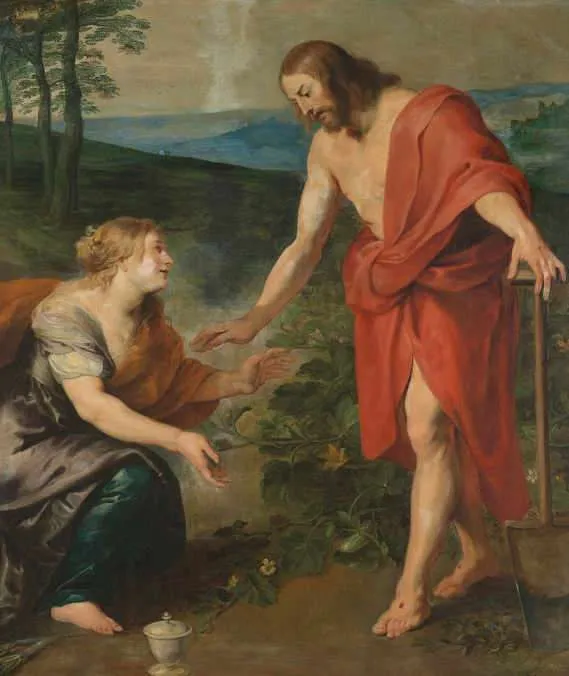
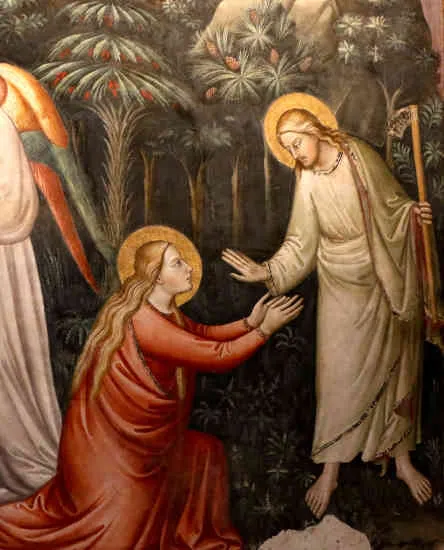
In following her heart—consumed with love for Jesus—Mary was led to a life-changing encounter. When Jesus appeared, she initially mistook Him for the gardener and, in her passionate longing, begged Him, “Sir, if you have carried him away, tell me where you laid him, and I will take him.” Again, she spoke from her heart rather than from understanding. But then Jesus called her by name: “Mary!” In that moment, her heart and mind were united, and she recognized Him. With this recognition, she saw and believed.

Reflect today on Mary Magdalene weeping outside Jesus’ empty tomb and then hearing Him say, “Mary!” That she is the first person in Scripture to see the risen Lord is deeply significant. Clearly, God desires that we learn from her and imitate her love. Though we might not have been delivered from seven demons, we have been delivered from sin. This should stir in us a gratitude so deep that we willingly abandon all to follow Him. And when life is confusing or uncertain, we, like Mary, must follow the holy desires God places in our hearts, so that our love for Christ will lead us through uncertainty into clarity, when, like Mary, we hear our Lord call us by name.

Source: https://catholic-daily-reflections.com/2026/04/06/the-clarity-of-holy-love/

John 20:11-12 Read More »

Saint Francis of Paola, Hermit

1416–1507; Patron Saint of boatmen, mariners, and naval officers; Canonized by Pope Leo X on May 1, 1519

James Martotille and his bride wedded and lived in the town of Paola, in the southernmost region of Italy. During the first years of their marriage, they were unable to conceive a child. Being devout Catholics, they turned to prayer and beseeched the intercession of Saint Francis of Assisi. Their prayers were answered when they were blessed with the birth of a son. As an expression of gratitude to Saint Francis of Assisi, the couple named their son Francis. 

While still an infant, Francis suffered from a swelling of the eyes, which endangered his sight. The Martotilles once again turned to the intercession of Saint Francis of Assisi for healing. In keeping with a pious medieval custom, they vowed that if their son were healed, they would entrust him to a friary for a year as a youth so he could be educated and formed in the practice of the faith. Their infant was indeed cured, and his parents later fulfilled their vow.

As a youth, Francis showed many signs of piety. He regularly abstained from meat as penance, sought solitude, and found great joy in prayer. When he was entrusted to the care of the Franciscan friars at age thirteen (in the nearby Friary of Saint Mark), his love of God and devotion to prayer and penance grew stronger. Though he was not a professed brother, he lived out the Franciscan vows in ways that surpassed even the friars themselves. After faithfully fulfilling the yearlong stay, in accord with the vow made by his parents, Francis and his parents took a pilgrimage north to Assisi. After stopping in Rome and other places along the way, they completed their pilgrimage and returned home to Paola.

Back in Paola, Francis’ desire for prayer, penance, and solitude grew strong. In response, Francis sought permission from his father to live as a hermit. His father granted Francis’ request, permitting him to live on a nearby portion of his property. Francis quickly discovered that life as a hermit suited him well and was his calling. The only problem was that his solitude was too often interrupted by friendly visits. To remedy this, he moved to an even more remote spot, taking up residence in a cave by the sea. In that “hermitage,” Francis relied solely upon divine providence. He ate what he could gather from the land and what people would bring to him from time to time. His bed was the ground, and his pillow a rock or log. He lived this life for six years, alone in peace and fulfillment.

When Francis was about twenty years old, his holy example inspired two other young men to join him in the wilderness. With the help of some local townsmen, who were inspired by Francis’ vocation, they built small hermitages and a chapel in which a nearby priest would come to offer Mass for them. The three of them engaged in a common life of prayer, penance, and solitude. In the years that followed, more were drawn to join them to live as hermits. Over the next few decades, the local archbishop gave Francis and his companions permission to build a larger church and monastery, and Pope Sixtus IV asked Francis to formally write down a rule of life and submit it for approval. The pope also gave these men of God the name “Hermits of Saint Francis.” Some years later, Pope Alexander VI changed their name to the “Hermits of the Order of the Minims,” and then just to “Order of Minims,” or Minims friars. This simplified name meant they were to be seen as the least of all the friars. In everything they did, they sought lowliness and humility as their central aim.

Many quickly came to know and admire the newly established hermits who attempted to inspire a revival of the practice of Lenten penance among the faithful by practicing a perpetual Lent themselves. Their perpetual penance consisted of limiting their diet to only plants, refraining not only from meat and eggs but from everything derived from animals. This fast became a fourth vow of the order, in addition to poverty, chastity, and obedience.

When Jesus walked the earth, He continually performed miracles, which confirmed His sacred identity in the eyes of His first followers. By the grace of God, Francis of Paola also performed many miracles, read minds, and spoke prophetically. One day Francis was on a journey to Sicily and was hungry. He encountered some poor men looking for work along the way and asked the men for food, but they had none. Francis told them to look in their bags, and there they found freshly baked bread that seemed to multiply as they ate it. On another occasion, a boatman refused to take Francis to Sicily one day because Francis was poor and could not pay him, so Francis simply walked or sailed across the ocean on his cloak. On other occasions, Francis is said to have raised the dead; healed the sick and crippled; averted plagues; expelled demons; spoken prophetically to bishops, popes, and kings; and performed many other miracles.

As a result of Francis’ holy life, coupled with miraculous signs, many people sought him out, despite his vocation of solitude. Popes called on him, and kings sought his counsel. Through it all, Francis continually proclaimed that all he did was done “out of love.” Love, the pure and holy love of charity, was the sole purpose of his life.

At the age of ninety-one, Francis sensed death was coming for him, so he returned to complete solitude for his final three months. On Holy Thursday he went to confession, received Holy Communion, and prayed in preparation for death. Holy death came for him on Good Friday, April 2, 1519. He had lived a perpetual Lent throughout his life; thus, it was fitting that his Lent come to an end on Good Friday. Twelve short years later, Pope Leo X canonized Francis a saint. Fifty-three years after his death, a group of French Calvinists broke into the church where he was buried, dug up his grave and found his body incorrupt. They quickly desecrated his body and burned it so that the faithful would no longer pray before his tomb. This final act of humility that God permitted Saint Francis of Paola to embrace flowed from the glories of Heaven.

From an early age, Francis sensed God calling him to a radical vocation. Francis responded in such a way that his actions quickly became extraordinary. Each one of us is called to an extraordinary life of holiness. We are called to become radical, totally given to God, doing all out of love of God and others. Ponder how radical you are every day, and deepen your commitment to radical holiness so that “radical” eventually becomes normal for you, just as it was for Saint Francis.

Source: https://mycatholic.life/saints/saints-of-the-liturgical-year/april-2-saint-francis-of-paola-hermit/

Saint Francis of Paola, Hermit Read More »