2024

Mark 9:42

Mercy for the Weak

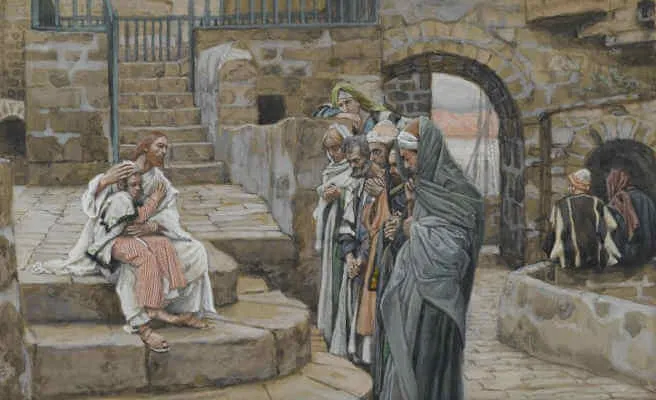
“Whoever causes one of these little ones who believe in me to sin, it would be better for him if a great millstone were put around his neck and he were thrown into the sea.”

Reflection:

St. Bede, an early Church Father, states that “he who is great, whatever he may suffer, departs not from the faith; but he who is little and weak in mind looks out for occasions of stumbling.” In other words, the “little ones” here could be understood to be those who are weak in faith and are constantly looking for reasons to depart from the faith.

Consider who might struggle with this tendency in your own life. Perhaps there is a family member who continually questions the practice of the faith, perhaps someone you know considers himself or herself a “fallen away Catholic.” According to St. Bede, these are the “little ones” of whom Jesus is speaking.

When dealing with someone who appears to lack faith, expresses doubts and disagreements, is caught in a life of manifest sin, or has begun to walk away from the practice of the faith, there can be a temptation to criticize, argue or condemn. If this is a temptation you struggle with, then listen closely to Jesus’ words: “Whoever causes one of these little ones who believe in me to sin…” We cause those who are weak in faith to sin when we fail to show an abundance of virtue toward them during their struggles. Deep down, most people who are struggling with a life of sin or a weakness of faith do, in fact, have some faith. They do believe in God. But their faith is often easily shaken, and they can be easily pushed further away from God if we fail to exercise the necessary virtues of patience, compassion and mercy they need.

With that said, we also have to avoid offering a “compassion” that is not grounded in the truth. On this point, St. Gregory states: “If a stumbling block is laid before men in what concerns the truth, it is better to allow the offense to arise, than that the truth should be abandoned.” In other words, it is not compassionate or merciful to show support for another in their error so as to make them feel good. The truth of the Gospel must never be abandoned; instead, that truth must always be offered with the greatest of charity, especially toward those “little ones” who are weak in faith.

Reflect, today, upon the important balance that is necessary in the apostolic life. “Balance” does not mean compromise. Rather, it means that we seek to continually bring forth the full truth of the Gospel while also seeking to exercise the fullness of every virtue in the process. Do not become a stumbling block to others in the faith. Seek, instead, to lavish God’s grace and mercy upon those in your life who need it the most. If you do, then many of those little ones will one day become truly strong in the grace and truth of our loving God.

Source: https://catholic-daily-reflections.com/2024/05/22/mercy-for-the-weak/

Mark 9:42 Read More »

Saint Rita of Cascia

1386–1457; Patron Saint of abuse victims, impossible causes, sickness, wounds, parenthood, and widows; Invoked against marital problems, fighting and discord, and infertility; Canonized by Pope Leo XIII on May 24, 1900

Margherita Lotti (Rita) was born in a small town near Cascia, Italy, to parents who were advanced in age. After years of childlessness, Rita’s parents saw the birth of their only child as an answer to prayer. At a young age, Rita’s faith was so strong that her parents set up a small oratory in their home in which she could pray. As a young girl, Rita begged her parents to permit her to enter a convent. Instead, according to the common practice of that time, her parents gave her away in marriage at the tender age of twelve.

Saint Rita is known as the patron saint of impossible causes, in part, because of the difficult marriage she endured with such love. Her husband was said to have been an angry and cruel man, who was mentally, emotionally, and even physically violent toward her. During their eighteen years of marriage, it is said that her prayers, coupled with the witness of her many virtues, softened his heart and he turned to Christ, at least enough to attain the hope of Heaven. Rita gave birth to two sons, perhaps twins, and raised them within the Catholic faith as a devout mother.

At that time, it was not uncommon for one family in a town to have an ongoing feud with another family. Such was the case with Rita’s husband, who was of the Mancini family. The Mancinis did not get along with the neighboring Chiqui family. The end to this feud was among Rita’s daily prayers. Her prayers were answered, at least on the side of her husband, Paolo. By the eighteenth year of their marriage, Paolo had begun to turn from his anger and to find more peace in God. He resolved to end the feud with the Chiqui family and attempted to restore peace. Rather than accept his overture, a member of the Chiqui family tricked Paolo and stabbed him to death.

At Paolo’s funeral, Rita publicly forgave her husband’s murderer and offered peace. However, Rita’s brother-in-law, Bernardo, was of a different mind. He began to stir up hatred in the hearts of Rita’s two sons to convince them to avenge their father’s death. The boys agreed, and Rita, filled with holy sorrow, tried to convince them to change their plans. When they wouldn’t, Rita turned to prayer. She prayed that God would preserve her sons from the mortal sin of murder, even if it meant taking their lives before they could carry out their plan. Rita’s prayers were answered. Both of her sons died of dysentery within a year, before they could act out their revenge.

Widowed and childless, Rita turned to her childhood desire of entering the convent. She was refused admission because she was previously married and due to the scandal of her husband’s violent death. In response, Rita sought to bring about a reconciliation between her family and the Chiqui family once and for all. She prayed through the intercession of her patrons, Saints John the Baptist, Augustine, and Nicholas of Tolentino. She also sought the prayers of Saint Mary Magdalene, the patroness of the convent she wanted to enter. Rita’s prayers were answered, reconciliation took place, and God opened the door for her to enter the convent of Saint Mary Magdalene in Cascia to live the Augustinian rule of life. One pious legend states that while she prayed and levitated, her three patron saints brought her inside the locked doors of the convent. When the sisters saw this, they concluded that it must be God’s will that she enter.

Not much is known about Rita’s forty years as a religious sister. She is said to have lived a profound life of prayer, often praying throughout the night. She joyfully embraced severe penances, ate only once a day, relying primarily on the food of the Most Holy Eucharist as her daily sustenance. Many who came to the convent to ask for her prayers attested to the power of her intercession. Some even attributed miracles to her prayers.

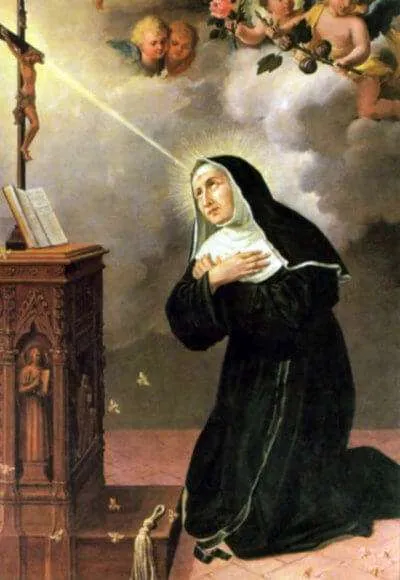
At the age of sixty, while deep in prayer before a crucifix, Sister Rita received the miraculous gift of the stigmata in the form of a wound on her head, inflicted by one of the thorns that pierced Jesus’ brow. This is believed to have taken place shortly after Rita heard a sermon on the Crown of Thorns by Saint James della Marca, a Franciscan friar who was known for his powerful preaching and devotion to the Holy Name of Jesus. Sister Rita’s wound was so painful and unsightly that she is said to have remained in seclusion in her convent, even from her fellow sisters, for the last decade of her life. The one exception was a pilgrimage to Rome taken by all the sisters. Just prior to that trip, her wound healed, but it reappeared upon her return to the convent.

Since Rita’s death from tuberculosis at the age of seventy, many miracles have been attributed to her intercession. When her body was exhumed, it was found to be incorrupt and is on display in a glass reliquary at the Basilica of Saint Rita in Cascia. It is said that at times her body levitates and that sweet odors permeate the air.

Saint Rita of Cascia suffered greatly throughout her life. Her desire of becoming a nun was initially thwarted when she was given in marriage at the age of twelve to a violent and cruel man. She endured her marriage with love and suffered the brutal murder of her husband and the death of both her sons. She joyfully inflicted severe penances upon herself as a religious sister, and God joyfully inflicted upon her the suffering of His Crown of Thorns. Through it all, Saint Rita united herself more fully to the sufferings of Christ and won many graces for her soul and the souls of many others. Ponder your own sufferings, especially if you can relate to the ones that Saint Rita endured. As you do, strive to imitate this saint by uniting those sufferings to the sufferings of Christ for the salvation of your soul and the souls of those most in need.

Source: https://mycatholic.life/saints/saints-of-the-liturgical-year/may-22—saint-rita-of-cascia/

Saint Rita of Cascia Read More »

Mark 9:38-39

Mutual Support

John said to Jesus, “Teacher, we saw someone driving out demons in your name, and we tried to prevent him because he does not follow us.” Jesus replied, “Do not prevent him…”

Reflection:

Why would John and the other disciples try to stop someone from driving out demons? To understand this, imagine the scene. John and the other disciples had come to believe that Jesus was the Christ, the Messiah of God. They witnessed Him perform many miracles and change many lives. As a result, they no doubt wanted everyone to discover Who Jesus was and come to faith in Him. But then they encountered someone they did not know, who was driving out demons in Jesus’ name, and they tried to stop him.

Just prior to this passage, we read the story of a man who had brought his possessed son to Jesus’ disciples and asked them to cure the boy, but they were unable to do so. Perhaps the disciples were a bit humbled by their inability to cast out the demon, and then they witnessed another person, not of their company, who was able to cast out demons in Jesus’ name. This might have added to their feelings of weakness and humiliation, and perhaps that is part of their motivation for trying to stop the man from exercising authority in Jesus’ name.

One common temptation that the evil one issues upon the members of the Church is that of internal division. As followers of Christ, we are all entrusted with the same mission, in different ways. We are called to become instruments of God’s grace for the salvation of souls and the glory of God. But sometimes we fail to act in unison and, instead, see our co-workers as our opponents.

Within our Church today, there are plenty of internal divisions that must cease. Perhaps the best way to accomplish this is to make it a priority to focus upon mutual support. Instead of allowing pride to create jealousy toward those who perform “mighty deeds” by the grace of God, we must work to rejoice in every good that we see. This seems like an obvious statement, but pride and feelings of inadequacy are real temptations that lead us to look down upon those who accomplish the will of God in powerful ways. When we see someone doing something good, we often immediately think about ourselves, wishing we were the ones doing the good work. And when God uses another in a powerful way, we can easily be tempted to see our own inadequacies and failings, rather than glorifying God for the good deeds done by another.

Reflect, today, upon the simple truth that every Christian is on the same spiritual team. We are all called to work toward the goals of the glory of God and the salvation of souls. Try to humbly think about those in your life who do this well and consider your attitude toward them. If you see any form of jealousy, envy or criticism, commit to dispel those attitudes. Instead, seek to have gratitude as you rejoice in the many ways that God uses others for His purpose.

Source: https://catholic-daily-reflections.com/2024/05/21/mutual-support/

Mark 9:38-39 Read More »

Saint Christopher Magallanes, Priest and Martyr, and Companions, Martyrs

1869–1927; Venerated especially in Mexico; Invoked against government persecution; Canonized by Pope John Paul II on May 21, 2000

“¡Viva Cristo Rey! ¡Viva la Virgen de Guadalupe!” Long live Christ the King! Long live the Virgin of Guadalupe! This was the cry of the Christeros, mostly peasant Catholics who opposed the fierce political and anti-Catholic oppression inflicted by the Mexican government on its citizens in the early twentieth century.

The Catholic faith arrived in modern-day Mexico in the early 1500’s with Spanish Franciscians. In 1531, the apparition of Our Lady in Guadalupe greatly aided efforts to share the Gospel. Devotion to the Mother of God and conversions to the Catholic faith grew far and wide. By the turn of the nineteenth century, the Catholic Church was a powerful force in the Spanish colony of Mexico. As a result, some ruling parties resented the Church and sought to eradicate Her influence. Anti-Catholic sentiment especially grew once Mexico declared its independence from Spain in 1810. In 1857, the new Mexican constitution sought to limit the role of the Catholic Church in Mexico. That law resulted in the confiscation of Church property and the beginning of the separation of the Catholic Church from the state. After an initial persecution, there was relative peace until around 1910. In 1917, another constitution was enacted, and in 1926, President Plutarco Elías Calles began to enforce anti-Catholic laws with vigor, especially against Catholic priests. He eliminated the Catholic education of youth, expelled all foreign priests, banned celibacy and religious vows, and confiscated all remaining Church property. The devastation was immense. At the beginning of the century, there were an estimated 4,500 priests serving in Mexico, most of them foreign-born. By 1934, only 334 state-licensed native priests remained for approximately fifteen million Catholics.

In November 1926, Pope Pius XI intervened and issued an encyclical, Iniquis Afflictisque, in which he addressed this new Mexican law: “The most recent law which has been promulgated as merely an interpretation of the Constitution is as a matter of fact much worse than the original law…” In 1934, he followed up with another encyclical, Acerba Animi, in which he said of the Mexican government: “The clearest manifestation of the will to destroy the Catholic Church itself is, however, the explicit declaration, published in some States, that the civil Authority, in granting the license for priestly ministry, recognizes no Hierarchy; on the contrary, it positively excludes from the possibility of exercising the sacred ministry all of hierarchic rank—namely, all Bishops and even those who have held the office of Apostolic Delegates.”

The twenty-five saints we honor today all died at the hands of the government during this period of anti-Catholic turmoil. One died in 1915, and the remaining twenty-four died between 1926–1928. Three of them were laymen; the rest were diocesan priests. Two were hanged in the public square, and the rest were shot to death, most by a firing squad without a trial. Though many of them were falsely accused of supporting armed conflict against the government, the only crime of each priest was secretly ministering to the needs of the people. The three laymen were members of a Catholic action group that worked to oppose the government’s oppression of the Church and encouraged fellow Catholics to remain strong in their faith.

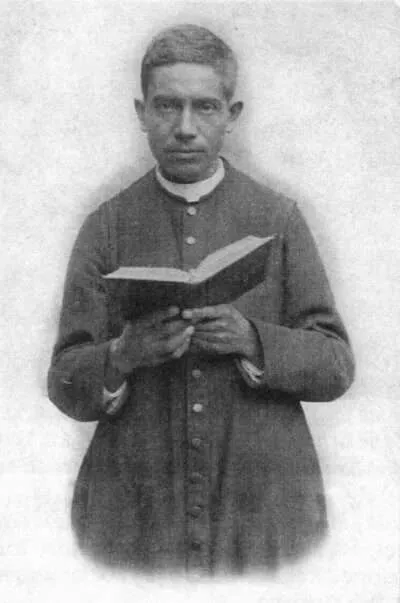
Among these twenty-five martyrs, today’s memorial specifically mentions one by name: Saint Christopher Magallanes. Cristobal Magallanes Jara was born in Totatiche, Jalisco, Mexico to faith-filled parents who were farmers. As a child, Christopher helped work the land and tend the sheep. In 1888, at the age of nineteen, Christopher entered seminary and was ordained a priest eleven years later. He began his priestly ministry as a teacher in Guadalajara but shortly afterwards was appointed parish priest in his hometown where he served for more than twenty years.

As a priest, Father Magallanes not only served the spiritual needs of his parishioners, he also assisted with their intellectual and material needs by founding schools and opening a carpentry shop to employ the locals and build infrastructure for the town. He also evangelized the indigenous people who had not yet heard the Gospel. In 1915, after the government closed the seminary in Guadalajara, Father Christopher opened a secret seminary in his own home, with the support of the bishop. Shortly afterwards he had seventeen seminarians.

Though Father Magallanes did not support armed rebellion, he was accused of assisting the Christeros and was arrested on May 21, 1927 on his way to celebrate Mass at a farm for his clandestine parishioners. Four days later, without receiving a trial, he was shot to death. His last words are recorded as, “I am innocent and die innocent. I absolve with all my heart those who seek my death and ask God that my blood bring peace to a divided Mexico.”

One of the priests assigned to assist Father Magallanes in his secret seminary was Father Agustín Caloca Cortés. Father Cortés was arrested on the same day as Father Magallanes and was imprisoned with him. By God’s grace, the two were able to absolve each other of their sins in preparation for their deaths. Since Father Cortés was only twenty-nine years old, the officers offered to set him free. He refused unless they also set Father Magallanes free, which the guards refused to do. Father Cortés’ last words before being shot were, “For God we lived and for Him we die.”

As we honor these twenty-five heroic martyrs, we are reminded that the Gospel is more important than life itself. It is better to die than to compromise the faith. Though few today face the threat of physical martyrdom, the secular world attacks the faith in many other ways, requiring us to stand as faithful witnesses to Christ. Ponder any ways that you give in to fear in the face of persecution, and pray that the martyrs we honor today will win for you the courage you need to remain faithful until the end.

Source: https://mycatholic.life/saints/saints-of-the-liturgical-year/21-may-saint-christopher-magallanes-and-companions-martyrs–optional-memorial/ 

Saint Christopher Magallanes, Priest and Martyr, and Companions, Martyrs Read More »

Mark 9:30-31

Alone with Jesus

“Jesus and his disciples left from there and began a journey through Galilee, but he did not wish anyone to know about it. He was teaching his disciples and telling them, “The Son of Man is to be handed over to men and they will kill him, and three days after his death the Son of Man will rise.”

Reflection:

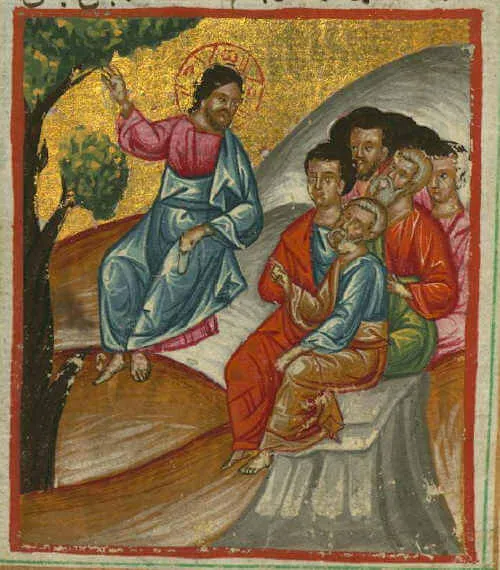
Why would Jesus wish that no one know that He and His disciples were traveling through Galilee at that time? It appears the reason was that Jesus was intently focused upon teaching His disciples about His coming passion, death and resurrection. Today’s Gospel presents us with three moments in which Jesus taught His disciples privately, directly and clearly: first, while they were journeying; second, when they arrived in Capernaum and entered a house; and third, when Jesus called a child over. Though the content of what Jesus taught His disciples is significant, it is also helpful to first reflect upon the simple fact that Jesus spent time alone with the disciples teaching them.

In many ways, our Lord does the same with us. Jesus is constantly calling us to various forms of solitude with Him so that we can listen to all that He wants to teach us. This is difficult for many today. So many people are constantly bombarded with the various noises of the world, are constantly distracted by momentary and passing experiences, and find it difficult to go off with our Lord alone so that He can teach them the most important lessons of life.

As you consider your weekly activities, how much time do you devote to being alone with our Lord? How much time do you spend in prayer, in the reading of Scripture and in silent meditation away from other distractions? For many, this is a challenge.

It is also useful to consider the content of what Jesus taught His disciples in private. He spoke to them about His coming passion, death and resurrection. This was the central purpose of His life and was clearly something that Jesus wanted to communicate to His disciples. Notice also that Jesus spoke very directly and without any figure of speech as He explained this. Contrast that with the many parables He told to the crowds. It appears that when Jesus was able to be alone with those who had dedicated their lives to following Him in faith, Jesus was able to speak His saving message more clearly and directly.

Reflect, today, upon the fact that our Lord wants to draw you into silence and solitude from time to time. He wants to spend time with you alone. This is especially the case for those who have chosen to fully devote their lives to Him and His mission. If that is you, then seek out these moments of solitude in which our Lord can speak more clearly and directly to you so that your faith will deepen and your understanding and knowledge will grow by leaps and bounds.

Source: https://catholic-daily-reflections.com/2024/05/20/alone-with-jesus-4/

Mark 9:30-31 Read More »

Blessed Virgin Mary, Mother of the Church

Little is said about the most glorious Mother of God in the Scriptures. In many ways, she lived a quiet and hidden life. Since her Assumption into Heaven, the Church has prayerfully pondered her life and role in the mystery of salvation. Little by little, saint after saint and pope after pope have shed greater light upon her singularly unique and glorious role in the Father’s eternal plan. As the Church’s understanding of the Blessed Mother has deepened, new titles and new dogmas have been proclaimed about Mary. In 2018, a new liturgical memorial honored her with the title “Blessed Virgin Mary, Mother of the Church.”

To understand the Blessed Virgin Mary’s role as Mother of the Church, we need to begin with Scripture. As Jesus hung on the Cross, John’s Gospel records that the mother of Jesus and two other women stood before Him, alongside John, the disciple whom Jesus loved. From the Cross, Jesus entrusted His mother to John’s care. “When Jesus saw his mother and the disciple there whom he loved, he said to his mother, ‘Woman, behold, your son.’ Then he said to the disciple, ‘Behold, your mother.’ And from that hour the disciple took her into his home” (John 19:26–27).

In 1895, in his encyclical on the rosary, Pope Leo XIII wrote about that Gospel passage:

Now in John, as the Church has constantly taught, Christ designated the whole human race, and in the first rank are they who are joined with Him by faith…She was, in very truth, the Mother of the Church, the Teacher and Queen of the Apostles, to whom, besides, she confided no small part of the divine mysteries which she kept in her heart” (Adiutricem #6).

In 1964, Pope Saint Paul VI promulgated the Vatican II document Lumen Gentium (Dogmatic Constitution on the Church). After presenting a complete picture of the mystery of the Church, the final chapter of that constitution presents “The Blessed Virgin Mary, Mother of God in the Mystery of Christ and the Church.” That chapter highlights her singularly unique and maternal role within the Church. Lumen Gentium did not go so far as to ascribe the title “Mother of the Church” to the Blessed Mother, but it did go into great detail about her maternal role within the Church. Four years later, in a motu proprio letter, Pope Paul VI referenced Lumen Gentium and took it a step further by bestowing upon the Mother of God the title “Mother of the Church.”

…we believe that the Blessed Mother of God, the New Eve, Mother of the Church, continues in heaven her maternal role with regard to Christ’s members, cooperating with the birth and growth of divine life in the souls of the redeemed (Solemni Hac Liturgia #15).

Since that time, Pope John Paul II, Pope Benedict XVI, and Pope Francis have continually referred to the Mother of God as the Mother of the Church. What does the title “Mother of the Church” mean? On September 17, 1997, Pope John Paul II defined it this way in a Wednesday catechesis:

The title “Mother of the Church” thus reflects the deep conviction of the Christian faithful, who see in Mary not only the mother of the person of Christ, but also of the faithful. She who is recognized as mother of salvation, life and grace, mother of the saved and mother of the living, is rightly proclaimed Mother of the Church. (#5).

On March 3, 2018, Pope Francis announced that a new memorial would be added to the General Roman Calendar and celebrated on the Monday after Pentecost Sunday, entitled “The Blessed Virgin Mary, Mother of the Church.”

In the decree instituting this memorial, Cardinal Robert Sarah, Prefect of the Congregation for Divine Worship, said:

This celebration will help us to remember that growth in the Christian life must be anchored to the Mystery of the Cross, to the oblation of Christ in the Eucharistic Banquet and to the Mother of the Redeemer and Mother of the Redeemed, the Virgin who makes her offering to God.

It is significant that the Blessed Virgin Mary, Mother of God, was entrusted to the Church in the person of Saint John the Apostle at the foot of the Cross. From the Cross, the Church was conceived by the outpouring of grace that flowed from Jesus’ Sacred Heart. At Pentecost, our Blessed Mother was present as the Church was born.

Today, the Mother of the Church reigns in Heaven next to her Son; from there, she continues to nurture the Church as a loving mother. She not only intercedes for us but also mediates her Son’s saving grace, making her the ongoing instrument of grace and mother of all.

Because our understanding of the role of the Blessed Virgin Mary has continually unfolded over the centuries, it is fair to say that we do not yet fully understand her glorious role in the Father’s plan of salvation. Some have proposed that she be given the dogmatic titles “Mediatrix of All Grace” and “Co-Redemptrix.” Regardless of what comes next in our ever deepening understanding of the role of the Blessed Mother, we can be certain that those who one day gaze upon the essence of God Himself as he reveals all truth will immediately become aware of the most profound mysteries of Mary’s hidden life.

As we honor the Blessed Virgin Mary, Mother of the Church, know that she is your spiritual mother insofar as you are a member of Christ’s Body, the Church. By giving birth to the Head, she gives birth to the members. As members of that Body, it is essential that we seek spiritual nourishment from the Blessed Virgin Mary. She is our mother and queen. From her, we are born into God’s grace. She is the chosen instrument and mediatrix of grace. Rely upon her motherly intercession and mediation, and entrust yourself more fully to her care.

Source: https://mycatholic.life/saints/saints-of-the-liturgical-year/mary-mother-of-the-church-memorial/

Blessed Virgin Mary, Mother of the Church Read More »

Saint Bernardine of Siena, Priest

1380–1444; Patron Saint of public relations, public speaking, and advertisers; Invoked against gambling addictions and chest problems; Canonized by Pope Nicholas V on May 24, 1450

Bernardine was born into a noble family in the town of Massa Marittima, in the Province of Siena, Italy, where his father was governor. Both of Bernardine’s parents died before he reached the age of seven, leaving him to the care of his aunt. His aunt’s devout Catholic faith greatly influenced Bernardine. He especially grew in love for the poor and often preferred to give his food away rather than to refuse a beggar.

When Bernardine was eleven, his uncles sent him to school in Siena to study civil and canon law. During those years of study, he continued in his devotion, fasted every Saturday in honor of the Blessed Virgin Mary, and was careful to engage only in dignified and reverent conversations. After completing his schooling at the age of seventeen, Bernardine remained in Siena and joined the Confraternity of Our Lady, whose members assisted at a local hospital that cared for the sick, orphans, the poor, and pilgrims. In the year 1400, when Bernardine was twenty, a plague hit Siena and countless people died, including many of the hospital workers. Courageously, Bernardine gathered twelve young men, just as Jesus gathered twelve apostles. Together, they took over the administration of the hospital and tirelessly devoted themselves to the care of the sick. After four months of hard work, Bernardine fell ill, but not from the plague. He remained bedridden for four months and used that time to deepen his prayer. When he recovered, he spent fourteen months caring for an aunt, who was blind and bedridden, until her death.

Around the age of twenty-two, Bernardine decided to enter into a time of solitude and prayer to discern God’s will for his life. His discernment led him to join the Franciscan Friars of the Strict Observance. Though their life of prayer and penance appeared strict to the outside world, to Bernardine it was the bare minimum. He regularly exceeded the normal disciplines of the order, joyfully imposing upon himself more severe penances and prayer than was expected of him. After completing his novitiate and his first profession of vows, the twenty-four-year-old Bernardine was ordained a priest on his birthday, the Feast of the Nativity of the Blessed Virgin Mary.

Father Bernardine loved our Blessed Mother, was deeply devoted to Christ Crucified, daily grew in humility and virtue, prayed often, engaged in severe penance, and entirely devoted himself to the glory of God. One day while he was praying in front of a crucifix, he sensed Jesus saying to him, “My son, behold me hanging upon a cross. If you love me, or desire to imitate me, be also fastened naked to your cross and follow me. Thus you will assuredly find me.”

Father Bernardine had an insatiable desire for the salvation of souls. He longed to preach the Gospel but struggled with a speech impediment. Through prayer, Father Bernardine understood that preaching was not to be based upon the eloquence or strength of his voice, but upon the interior presence of God. His faith and charity ignited a powerful fire within him by which he started to become a beloved preacher. At that time, Father Bernardine attended a mission preached by the itinerant preacher Saint Vincent Ferrer. During that mission, Saint Vincent prophesied to the congregation that someone present would take up his preaching mantle in Italy. That “someone” was Father Bernardine.

Interiorly confirmed in his mission to preach, Father Bernardine began to be exceptionally effective. He preached not only the words of Christ, he preached Christ Himself, because it was Christ Who lived in Him. Only a few words from his mouth seemed to produce more good fruit than hours of sermons given by other friars. People took note. He once taught, “In all your actions seek in the first place the kingdom of God and his glory; direct all you do purely to his honor; persevere in brotherly charity, and practice first all that you desire to teach others. By this means the Holy Spirit will be your Master, and will give you such wisdom and such a tongue that no adversary will be able to stand against you.”

Over the next thirty-plus years, Father Bernardine preached all over Italy, traveling on foot from town to town. He began in churches, but soon the churches were not big enough, so he preached in the public squares and anywhere that people would listen to him. Civil authorities even invited him to their towns. He would stay for no more than a few weeks in one town and then move on to another.

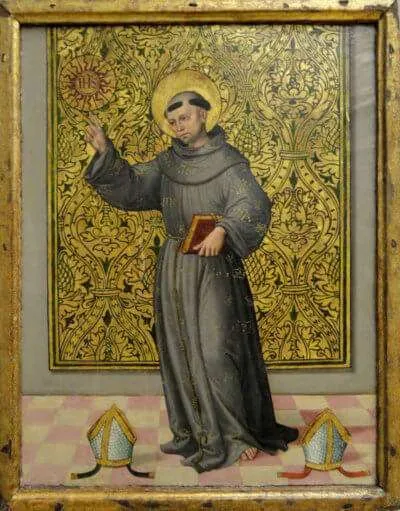
In Bernardine’s sermons, he directly confronted the sins of that time. He preached against materialism, sexual immorality, indecent conversations, gambling, and every sort of sinful excess. At times he would gather many items of immorality, such as cards, immodest clothing, dice, perfumes, and more, and burn them in the public square in a “bonfire of vanities.” He also fervently promoted devotion to the Holy Name of Jesus through the symbol “IHS,” the first three letters of Jesus’ name in Greek. Lastly, he constantly sought reconciliation and unity in Christ. Without a strong national government at the time, conflicts between neighboring cities were a serious problem. Through his preaching, people reconciled individually, and entire cities put an end to wars and conflicts with other cities. At times, his preaching was accompanied by miraculous prophecies and healings. He is even said to have raised four people from the dead.

As often happens with saintly preachers, someone accused Bernardine of heretical teaching, and he had to travel to Rome to stand trial. Upon the completion of his trial, the pope declared him innocent of all charges, and Father Bernardine resumed his mission with the blessing of the Holy Father. The Holy Father later said that Bernardine was a second Saint Paul. The Holy Father even offered to make him a bishop three times, but each time Bernadine turned the pope down. Later in life he was appointed Vicar General of his order for a period of five years, during which time he worked hard at reforms. The last two years of his life were spent traveling, preaching, and saving many souls. Six years after his death, Father Bernardine was canonized a saint.

Perhaps the greatest lesson we can take from Saint Bernardine is that the power of our words does not come from earthly learning, the sound of our voices, or the eloquence of our arguments. The true power of our words comes from the depth of our hearts. When our hearts are on fire with the love of God, it is God Himself Who speaks through us and many souls will be touched. Ponder the power, or lack thereof, of your own words. If you find yourself to be ineffective in the proclamation of the Gospel, turn more fervently to a life of prayer and penance. Seek first to glorify God within your own soul, and trust that if you do so, God will effortlessly reach many others through you.

Source: https://mycatholic.life/saints/saints-of-the-liturgical-year/may-20—saint-bernardine-of-siena-priest/ 

Saint Bernardine of Siena, Priest Read More »

John 19:25-27

Your Heavenly Mother

“Standing by the cross of Jesus were his mother and his mother’s sister, Mary the wife of Clopas, and Mary of Magdala. When Jesus saw his mother and the disciple there whom he loved, he said to his mother, ‘Woman, behold, your son.’  Then he said to the disciple, ‘Behold, your mother.’  And from that hour the disciple took her into his home.”

Reflection:

The memorial we celebrate today, which was added to the Roman Liturgical Calendar in 2018 by Pope Francis, highlights the truth that the Blessed Virgin Mary is not only the Mother of the Person of Christ, and, therefore, the Mother of God, she is also the Mother of the Church, that is, the Mother of all the faithful. The Blessed Virgin Mary is your mother. And as your mother, she is truly tender, compassionate, caring and merciful, bestowing upon you everything that a perfect mother desires to bestow. She is the fiercest of mothers who will stop at nothing to protect her children. She is a mother wholly devoted to you, her dear child.

The Gospel passage chosen for this memorial depicts our Blessed Mother standing at the foot of the Cross. She would have been no other place than directly beneath her Son as He endured His last agony. She did not flee in fear. She was not overwhelmed by grief. She did not sulk in self-pity. No, she stood by her Son with the perfect love and strength of a devoted, caring, compassionate and faithful mother.

As she stood by her Son in His hour of suffering and death, Jesus turned to her and entrusted the Apostle John to her maternal care. From the early Church Fathers until the most recent teachings of the Church today, this act of entrusting John to Mary and Mary to John by Jesus has been understood as an entrustment of all the faithful to the maternal care of Mother Mary. Mother Mary is, therefore, not only the Mother of the Redeemer, Christ Himself, she also becomes the Mother of all the redeemed, the mother of us all, the Mother of the Church.

Consider the spiritual mother you have in Heaven. A mother is one who gives life. Your mother in Heaven is entrusted with the task of bestowing upon you the new life of grace won by the Cross. And as your mother, she will not withhold anything from you that is to your benefit. A mother is also one who is tender with her children. The Immaculate Heart of our mother in Heaven is one that is filled with the greatest tenderness toward you. Though her caresses are not physical, they are much deeper. She caresses with the tenderness of grace which she imparts to you as you pray and turn to her in your need. She gives you the grace of her Son, poured out upon the Cross as the blood and water sprung forth as a font of mercy. Mother Mary pours that mercy upon you as a tender and devoted mother would. She holds nothing back.

If you are unaware of the love in the heart of our Blessed Mother for you, use this memorial as an opportunity to deepen your understanding of her role in your life. Many children take their mothers for granted, not fully understanding the depth of their love. So it is with our Mother in Heaven. We will never fully comprehend her love and her constant motherly workings in our life until we join her in Heaven face to face.

Reflect, today, upon Mother Mary standing by you in every moment of your life. See her there in your joys and in your sorrows, during your moments of temptation and struggles, in your moments of confusion and clarity. See her there by your side, bestowing every good spiritual gift upon you when you need it the most. She is a true mother, and she is worthy of your love and gratitude.

Source: https://catholic-daily-reflections.com/2024/05/19/your-heavenly-mother-3/

John 19:25-27 Read More »

Pentecost Sunday

First Reading Acts 2:1-11

When the time for Pentecost was fulfilled,
they were all in one place together.
And suddenly there came from the sky
a noise like a strong driving wind,
and it filled the entire house in which they were.
Then there appeared to them tongues as of fire,
which parted and came to rest on each one of them.
And they were all filled with the Holy Spirit
and began to speak in different tongues,
as the Spirit enabled them to proclaim.

Now there were devout Jews from every nation under heaven staying in Jerusalem.
At this sound, they gathered in a large crowd,
but they were confused
because each one heard them speaking in his own language.
They were astounded, and in amazement they asked,
“Are not all these people who are speaking Galileans?
Then how does each of us hear them in his native language?
We are Parthians, Medes, and Elamites,
inhabitants of Mesopotamia, Judea and Cappadocia,
Pontus and Asia, Phrygia and Pamphylia,
Egypt and the districts of Libya near Cyrene,
as well as travelers from Rome,
both Jews and converts to Judaism, Cretans and Arabs,
yet we hear them speaking in our own tongues
of the mighty acts of God.”

Responsorial Psalm Psalms 104:1, 24, 29-30, 31, 34

R. (cf. 30) Lord, send out your Spirit, and renew the face of the earth.

Bless the LORD, O my soul!
O LORD, my God, you are great indeed!
How manifold are your works, O LORD!
the earth is full of your creatures;

R. Lord, send out your Spirit, and renew the face of the earth.

May the glory of the LORD endure forever;
may the LORD be glad in his works!
Pleasing to him be my theme;
I will be glad in the LORD.
R. Lord, send out your Spirit, and renew the face of the earth.

If you take away their breath, they perish
and return to their dust.
When you send forth your spirit, they are created,
and you renew the face of the earth.

R. Lord, send out your Spirit, and renew the face of the earth.

Second Reading 1 Corinthians 12:3b-7, 12-13

Brothers and sisters:
No one can say, “Jesus is Lord,” except by the Holy Spirit.

There are different kinds of spiritual gifts but the same Spirit;
there are different forms of service but the same Lord;
there are different workings but the same God
who produces all of them in everyone.
To each individual the manifestation of the Spirit
is given for some benefit.

As a body is one though it has many parts,
and all the parts of the body, though many, are one body,
so also Christ.
For in one Spirit we were all baptized into one body,
whether Jews or Greeks, slaves or free persons,
and we were all given to drink of one Spirit.

Sequence

Veni, Sancte Spiritus

Come, Holy Spirit, come!
And from your celestial home
Shed a ray of light divine!
Come, Father of the poor!
Come, source of all our store!
Come, within our bosoms shine.
You, of comforters the best;
You, the soul’s most welcome guest;
Sweet refreshment here below;
In our labor, rest most sweet;
Grateful coolness in the heat;
Solace in the midst of woe.
O most blessed Light divine,
Shine within these hearts of yours,
And our inmost being fill!
Where you are not, we have naught,
Nothing good in deed or thought,
Nothing free from taint of ill.
Heal our wounds, our strength renew;
On our dryness pour your dew;
Wash the stains of guilt away:
Bend the stubborn heart and will;
Melt the frozen, warm the chill;
Guide the steps that go astray.
On the faithful, who adore
And confess you, evermore
In your sevenfold gift descend;
Give them virtue’s sure reward;
Give them your salvation, Lord;
Give them joys that never end. Amen.
Alleluia.

Alleluia

R. Alleluia, alleluia.

Come, Holy Spirit, fill the hearts of your faithful
and kindle in them the fire of your love.

R. Alleluia, alleluia.

Gospel John 20:19-23

On the evening of that first day of the week,
when the doors were locked, where the disciples were,
for fear of the Jews,
Jesus came and stood in their midst
and said to them, “Peace be with you.”
When he had said this, he showed them his hands and his side.
The disciples rejoiced when they saw the Lord.
Jesus said to them again, “Peace be with you.
As the Father has sent me, so I send you.”
And when he had said this, he breathed on them and said to them,
“Receive the Holy Spirit.
Whose sins you forgive are forgiven them,
and whose sins you retain are retained.”

Source: https://bible.usccb.org/bible/readings/pentecost-sunday-mass-during-day

Pentecost Sunday Read More »

Pentecost

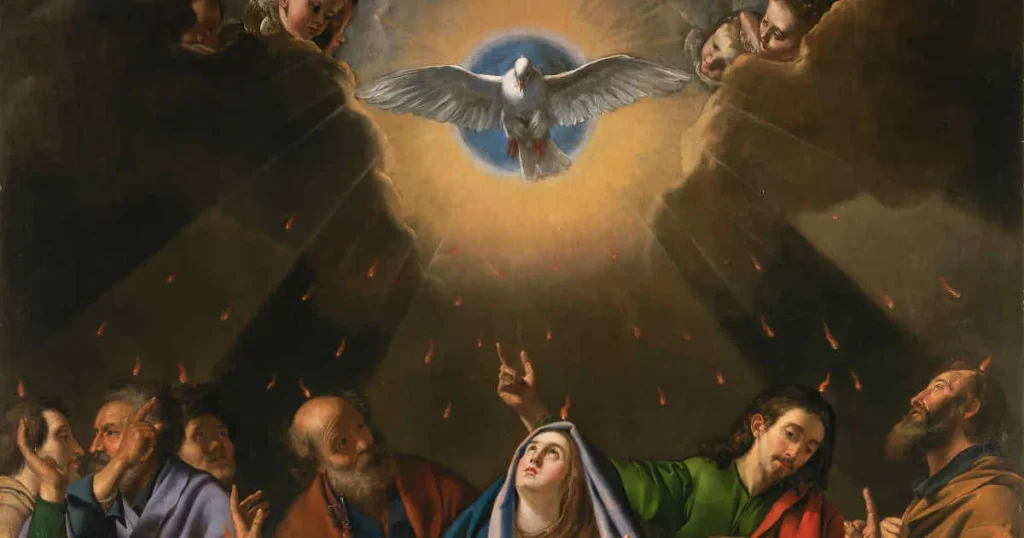
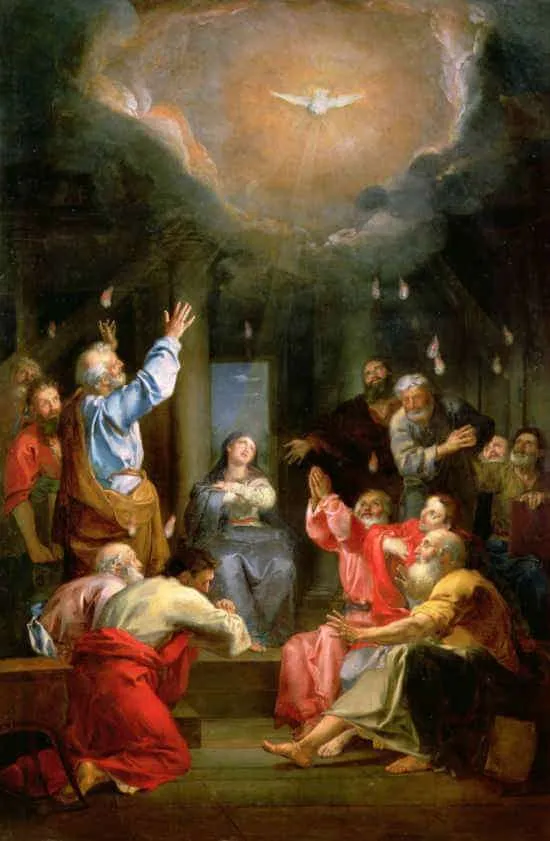
Today, we celebrate the most glorious Solemnity of Pentecost, the promised Gift of the Father and the Son to Jesus’ disciples. After rising from the dead, Jesus appeared to His disciples for forty days. During those appearances, He offered them proof of His resurrection, continued to teach them, and reminded them of all He had revealed to them about His death and Resurrection, preparing them for the next step of their mission. “While meeting with them, he enjoined them not to depart from Jerusalem, but to wait for ‘the promise of the Father about which you have heard me speak; for John baptized with water, but in a few days you will be baptized with the holy Spirit’” (Acts 1:4–5).

During the ten days after Jesus’ Ascension, the eleven Apostles gathered together in the upper room with the mother of Jesus and many other disciples, totaling 120 in all. The gathering place was most likely the same place that the Apostles ate the Passover meal, the first Eucharist, with Jesus. As they met, the first order of business was to choose a successor to Judas. They cast lots, and Matthias was chosen to be one of the Twelve.

On the fiftieth day after Jesus’ Resurrection, ten days after His Ascension, the 120 disciples were once again gathered in the upper room when they experienced something beyond their imagination. From the sky came a noise like a strong driving wind. It filled the room they were in. Tongues, as of fire, fell upon all gathered, and they were given the gift of tongues, which enabled them to speak in different languages—by the power of the Holy Spirit—to the diverse groups of people in Jerusalem. This is what Jesus had promised them, and suddenly they understood as they received the Gift of God.

After receiving the Holy Spirit, the disciples went out into the community of Jerusalem and began to boldly proclaim the Gospel to all. The inhabitants of Jerusalem were shocked and confused. Some accused the disciples of being drunk and scoffed at them. Some, however, quickly believed. Peter then stood up and gave a stirring and powerful sermon that presented the whole mystery of salvation. He spoke of Jesus as the Savior and the need to repent and be baptized. “Those who accepted his message were baptized, and about three thousand persons were added that day” (Acts 2:41). The new followers then devoted themselves to the teaching of the Apostles and to the celebration of the Eucharist. A strong Christian community was formed in Jerusalem.

As the community continued to grow, learn the teachings of the Apostles, and receive the outpouring of the Holy Spirit, miracles took place. Peter and John cured a blind man. Soon, there were 5,000 converts to Christ who were filled with the Holy Spirit. More miracles took place at the hands of all of the Apostles, people from the surrounding villages came and were converted, and the new believers lived as one, sharing their food and resources with others.

Soon the members of the Sanhedrin became concerned. They thought they had stopped Jesus, but they saw that the Apostles were converting thousands. The Apostles were arrested and jailed, but an angel let them out in the night, and they appeared in the Temple the next day, continuing to preach and heal. The bewildered Sanhedrin members did not know what to do. They hoped that the new excitement would soon subside and everything would go back to normal—but it didn’t.

Recognizing the need to better care for the poor with the money and provisions the thousands of disciples held in common, the Apostles appointed seven men to be deacons for the task, so that the Apostles could continue to preach, heal, and offer the sacraments. Shortly afterward, blood was shed. Stephen, one of the newly ordained deacons, was martyred. “On that day, there broke out a severe persecution of the church in Jerusalem, and all were scattered throughout the countryside of Judea and Samaria, except the apostles” (Acts 8:1).

The above illustrates the role of the Holy Spirit. Pentecost was the birthday of the Church. The Holy Spirit’s mission was to form the Church and empower each baptized member of Christ’s body to fulfill his or her specific duty. Some were to preach, some cared for the poor, some shed their blood for their faith, and others were to be sent to other towns and villages. The scattering of the community of the believers in Jerusalem was clearly permitted by the Holy Spirit as a way of expanding the Church beyond Jerusalem. The newly converted and empowered disciples traveled far and wide to expand the newborn Church that grew at a rapid pace as the new Body of Christ matured and fulfilled its mission.

In the years and centuries ahead, the Holy Spirit continued to form the Church. The Apostles were inspired to write what is today the New Testament so that future believers would have firsthand accounts of the Gospel. From there, the successors to the Apostles, in union with the successor of Saint Peter, helped to form the Sacred Tradition, which is the ongoing deepening revelation of the Word of God to address new questions that arose. Jesus’ promise to Peter and his successors that He would give to him the keys to the Kingdom of Heaven, so that he and his successors could bind and loose on earth as it is in Heaven, evolved and helped the Church to mature. The Holy Spirit enabled the growing communities to continue to take nourishment through the Sacraments. The believers were empowered to pray and to enter into a personal relationship with Him Who rose and is now seated at the right hand of the Father. Other believers were filled with charisms needed to build up the Church. The Gospel continued to be preached to the ends of the earth, and the people of God were drawn into lives of profound holiness and union with God. This is all effected by the Gift of the Holy Spirit first given at Pentecost and continually given today.

In addition to building up the Church and enabling it to fulfill its divine mission, the Holy Spirit also sanctifies every individual believer, especially through the bestowal of the Seven Gifts of the Holy Spirit. According to the Catechism of the Catholic Church, “The seven gifts of the Holy Spirit are wisdom, understanding, counsel, fortitude, knowledge, piety, and fear of the Lord…They complete and perfect the virtues of those who receive them. They make the faithful docile in readily obeying divine inspirations” (#1831). Additionally, the Holy Spirit instills twelve fruits: “The fruits of the Spirit are perfections that the Holy Spirit forms in us as the first fruits of eternal glory. The tradition of the Church lists twelve of them: ‘charity, joy, peace, patience, kindness, goodness, generosity, gentleness, faithfulness, modesty, self-control, chastity’” (#1832). These graces are first given in Baptism and perfected in Confirmation. Each baptized and confirmed member of Christ has the potential to fully realize these graces so as to grow in holiness and fulfill their divine mission.

As we celebrate the great Solemnity of Pentecost, call on the Holy Spirit in your life. Too often we receive Baptism and Confirmation with a closed mind and heart. We fail to allow the Holy Spirit to become fully active in our lives. Pray to the Holy Spirit today, and open yourself more fully to all that God wishes to bestow upon you so that you will become holy and a more active member of His Body, the Church.

Source: https://mycatholic.life/saints/saints-of-the-liturgical-year/pentecost/ 
Pentecost Read More »