2024

Mark 10:17-19

The Path to Perfection

“As Jesus was setting out on a journey, a man ran up, knelt down before him, and asked him, ‘Good teacher, what must I do to inherit eternal life?’ Jesus answered him, ‘Why do you call me good? No one is good but God alone. You know the commandments…’”

Reflection:

Jesus addresses different people in different ways. He chastised the proud and arrogant who came to trap Him. He was exceptionally gentle and kind to the repentant sinner who came in tears. He spoke in parables and figures of speech to those who were curious but had little faith. And to those who came with openness, sincerely seeking the truth, He spoke clearly, lovingly and directly.

Today’s Gospel presents us with the familiar story of the Rich Young Man. Notice how this young man came to Jesus. First, he “ran up” to Jesus. This suggests he was very desirous to speak with our Lord. He also knelt down before Jesus, which points to his humility and reverence. Then he asked Jesus a  direct and important question. He didn’t ask Jesus to heal someone. He wasn’t looking for a miracle or a personal favor. Instead, this young man asked the question we should all ask Jesus every day. “Good teacher, what must I do to inherit eternal life?” Is this a question that you ponder and ask our Lord?

As the story unfolds, Jesus gives two answers. First, He gives the young man the fundamental answer to his question. Eternal life is obtained by keeping away from serious sin, out of love and obedience to the will of God. But after the young man inquires further, Jesus gives him a much deeper answer. This second answer was one based on a deep love for this young man because it presented the key to perfection. “You are lacking in one thing. Go, sell what you have, and give to the poor and you will have treasure in heaven; then come, follow me.”

Many people go through life fulfilling the most fundamental precepts of holiness. They avoid serious sin so as to remain in a state of grace. And this is good. But Jesus wants so much more: He wants perfection. When we sincerely seek out perfection, Jesus will answer us as He answered the Rich Young Man. Perfection requires the deepest purification from all unhealthy attachments. Most people have many attachments that hinder perfection. Those attachments might not be mortal sins, but they are venial sins, or spiritual imperfections. Therefore, it’s important to know that if you want perfection, and if you humble yourself before our Lord and sincerely ask how to obtain it, He will lovingly invite you to detach from everything but God and His holy will for your life. What that means practically for you must be prayerfully discerned.

Reflect, today, upon whether or not you could join this rich young man in his humble questions posed to Jesus. Do you want to know how to be perfect? If so, are you ready to respond to Jesus’ answer? Are you willing to abandon everything that is a hindrance to the will of God so that you can follow Him and fulfill His perfect will? Ponder this question and commit yourself to the full embrace of Jesus’ answer and you will become richer in what matters than you could ever imagine.

Source: https://catholic-daily-reflections.com/2024/05/26/the-path-to-perfection/

Mark 10:17-19 Read More »

The Solemnity of the Most Holy Trinity

First Reading Deuteronomy 4:32-34, 39-40

Moses said to the people:
“Ask now of the days of old, before your time,
ever since God created man upon the earth;
ask from one end of the sky to the other:
Did anything so great ever happen before?
Was it ever heard of?
Did a people ever hear the voice of God
speaking from the midst of fire, as you did, and live?
Or did any god venture to go and take a nation for himself
from the midst of another nation,
by testings, by signs and wonders, by war,
with strong hand and outstretched arm, and by great terrors,
all of which the LORD, your God,
did for you in Egypt before your very eyes?
This is why you must now know,
and fix in your heart, that the LORD is God
in the heavens above and on earth below,
and that there is no other.
You must keep his statutes and commandments that I enjoin on you today,
that you and your children after you may prosper,
and that you may have long life on the land
which the LORD, your God, is giving you forever.”

Responsorial Psalm Psalms 33:4-5, 6, 9, 18-19, 20, 22

R. (12b) Blessed the people the Lord has chosen to be his own.

Upright is the word of the LORD,
and all his works are trustworthy.
He loves justice and right;
of the kindness of the Lord the earth is full.

R. Blessed the people the Lord has chosen to be his own.

By the word of the LORD the heavens were made;
by the breath of his mouth all their host.
For he spoke, and it was made;
he commanded, and it stood forth.

R. Blessed the people the Lord has chosen to be his own.

See, the eyes of the LORD are upon those who fear him,
upon those who hope for his kindness,
To deliver them from death
and preserve them in spite of famine.

R. Blessed the people the Lord has chosen to be his own.

Our soul waits for the LORD,
who is our help and our shield.
May your kindness, O LORD, be upon us
who have put our hope in you.

R. Blessed the people the Lord has chosen to be his own.

Reading 2 Romans 8:14-17

Brothers and sisters:
For those who are led by the Spirit of God are sons of God.
For you did not receive a spirit of slavery to fall back into fear,
but you received a Spirit of adoption,
through whom we cry, “Abba, Father!”
The Spirit himself bears witness with our spirit
that we are children of God,
and if children, then heirs,
heirs of God and joint heirs with Christ,
if only we suffer with him
so that we may also be glorified with him.

Alleluia Revelation 1:8

R. Alleluia, alleluia.

Glory to the Father, the Son, and the Holy Spirit;
to God who is, who was, and who is to come.

R. Alleluia, alleluia.

Gospel Matthew 28:16-20

The eleven disciples went to Galilee,
to the mountain to which Jesus had ordered them.
When they all saw him, they worshiped, but they doubted.
Then Jesus approached and said to them,
“All power in heaven and on earth has been given to me.
Go, therefore, and make disciples of all nations,
baptizing them in the name of the Father,
and of the Son, and of the Holy Spirit,
teaching them to observe all that I have commanded you.
And behold, I am with you always, until the end of the age.”
 
Source: https://bible.usccb.org/bible/readings/052624.cfm

The Solemnity of the Most Holy Trinity Read More »

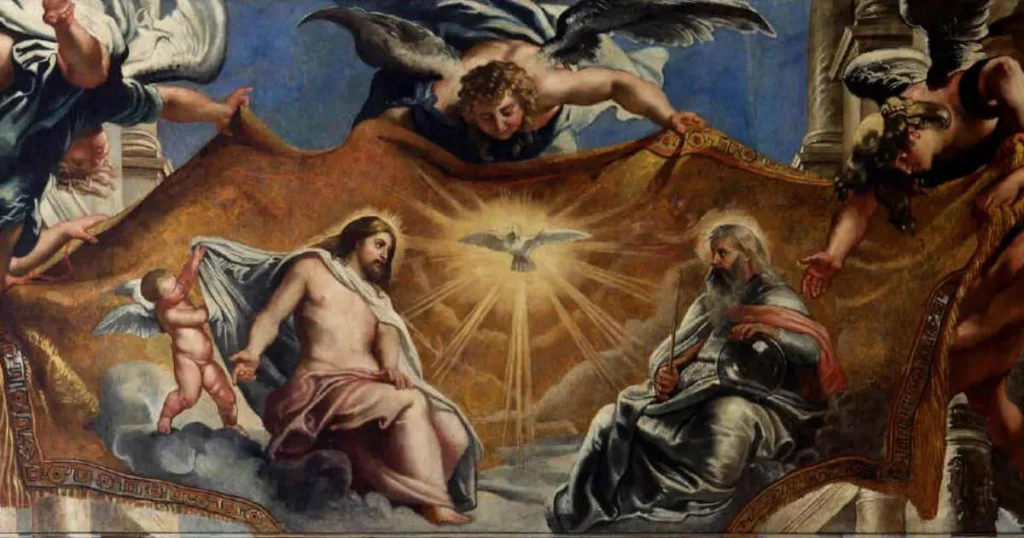
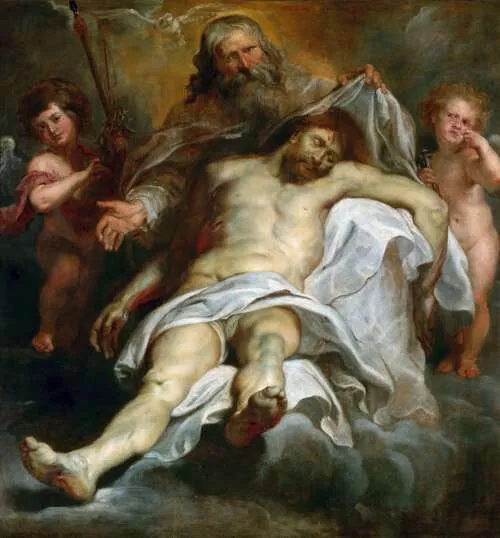
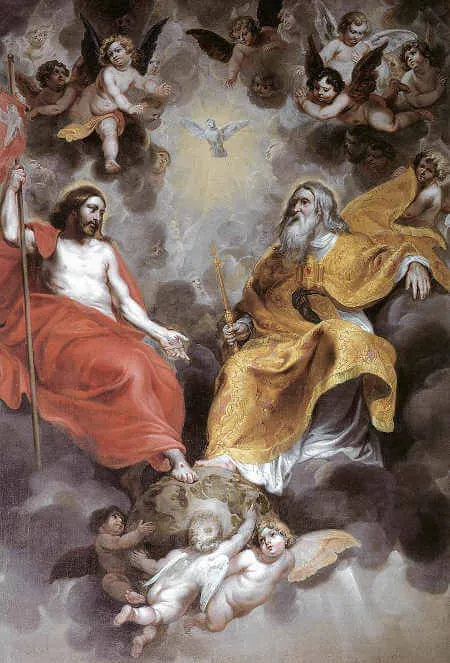
The Most Holy Trinity

One of the most fiercely debated dogmas of our faith in the early centuries of the Church was on the nature of the Most Holy Trinity. Today’s solemnity did not enter the General Roman Calendar until the fourteenth century, partly because we are called to honor and worship the Most Holy Trinity every day and in every liturgy. But designating one Sunday on which we ponder the inner life of the Most Holy Trinity is an opportunity to renew and deepen our honor and worship.

The Trinity is first and foremost a mystery. As The Divine Mystery above all mysteries, we must begin by humbly acknowledging that we will never, not even in Heaven, have a complete understanding of God’s essence, His inner reality. Only God knows Himself fully. Not even the Blessed Virgin Mary or the highest choirs of angels see Him and know Him as He sees and knows Himself. Nonetheless, every creature, whether angel or human, is called to probe the mysteries of God to the fullest extent possible. In that probing, contemplating, and understanding, we discover the purpose of our lives and experience the fullness of beatitude to which we are called. God and God alone satisfies the hungry, weary, and seeking soul.

This might come as a surprise, but God is perfectly simple. Saint Thomas Aquinas, one of the Church’s greatest teachers, explains that angels, the physical world, and humans are made up of different material and immaterial parts that can change over time, making us a complex reality capable of internal and external disunity. God, however, is incapable of change, since He is Perfection. He is exactly Who He is, always has been, and will always be. This results in a divine simplicity and harmonious unity that is infinitely beyond His creation. God doesn’t need anything to exist because it is His very nature to exist as the unchanging, transcendent God.

Within this divine simplicity and perfect unity we can distinguish various attributes of God, noting that each attribute is perfectly united with the others in the most simple and complete way. God alone is all-powerful and has supreme authority over all creation. He alone perceives all potentiality within creation and within Himself. He is perfectly wise, just, and merciful. He is both completely beyond creation (transcendent) and intimately involved with every aspect of creation (immanent). God is the perfection of holiness and morality. He is the only standard of goodness and truth. He is present everywhere at all times—unchanging and eternal. God is Love.

This philosophically rich language attempts to describe God in His oneness—He is One God, not three Gods. The Father, Son, and Holy Spirit each share perfectly in the one divine nature, and all share the same divine attributes. To understand the profound mystery of the Trinity, we must start with the above oneness of God and then move into His threefold Personhood.

How can something be one and three at the same time? We know that God is one-in-three solely because this is the way the Scriptures reveal God to us. The Old Testament alluded to the threefold personhood of God, and Jesus explicitly identified the three persons as the Father, Son, and Holy Spirit. Without this revelation from our Lord, human reason alone could never arrive at the realization that God is One in Three.

In Sacred Scripture and Church teaching, God’s attributes and existence can be summed up as Love. “God is love” (1 John 4:8). Love cannot exist without a giver, a receiver, and the love that unites them. Hence, it is the very nature of God to love perfectly, to receive love perfectly, and to be love itself.

In the Trinity, the Father loves the Son, the Son loves the Father, and this mutual love is personified in the Holy Spirit. This “love” in God is defined by the Church as an “eternal begetting” and as an “eternal procession,” which are fundamentally different from an act of creation. The words “begetting” and “proceeding” are used to point to the relational origin of love. The Father eternally begets the Son, reflecting an eternal exchange of love. The Holy Spirit, then, proceeds from both the Father and the Son, emanating from their mutual love. These profound mysteries are articulated in the Nicene Creed:

I believe in one Lord Jesus Christ, the Only Begotten Son of God, born of the Father before all ages. God from God, Light from Light, true God from true God, begotten, not made, consubstantial with the Father; through him all things were made…I believe in the Holy Spirit, the Lord, the giver of life, who proceeds from the Father and the Son, who with the Father and the Son is adored and glorified, who has spoken through the prophets.

The formulation of the Trinitarian relationship in the Creed reveals the profound depth of God’s nature: God is of one essence, yet three distinct Persons. Each Person is involved in an eternal, loving relationship with the others. The mystery within this formulation requires contemplation, as it reveals a God Who is deeply relational and Whose very nature is to exist in a state of perfect, self-giving love.

If these definitions of God seem beyond your grasp, you are correct. They are. By God’s grace, these basic definitions of the Most Holy Trinity took shape, beginning with Church councils in the fourth and fifth centuries. Later, theologians such as Saint Augustine and Saint Thomas Aquinas deepened our understanding. However, even if you were to spend years studying the best theology on the Trinity, you would still only be able to comprehend a slight image of Who God is.

The best way to grow in a deeper understanding of God and all of reality is through the deepest forms of contemplative prayer. Contemplative prayer is not something you can simply turn on. It is an infused prayer that only God can bestow as He invites you to enter into His divine presence. Contemplative prayer begins with a profound purification process by which all sin is purged from one’s life, as well as all attachment to sin, and then all conceptual knowledge of God is eliminated so that the mind can gaze upon God through infused knowledge. This mystical prayer is well taught by the greatest saints of the Church, especially Saint John of the Cross and Saint Teresa of Ávila. Being drawn into the mystery of God’s inner life sometimes includes periods of mystical ecstasy, raptures, intellectual visions, and other mystical phenomena. Though few reach that height of prayer in this life, it’s helpful to know it is possible and to know that directly infused knowledge of God through mystical prayer is the only way to achieve some comprehension of the Most Holy Trinity.

As you strive to deepen your own prayer life, offer your praise to God the best you can. Profess your unwavering belief in the Creed, despite not fully understanding it. Most importantly, open your heart to God, Who is Love, and love Him in return with every power of your soul. By doing so, you will be on the slow and steady road to a mystical union of love with the Father, Son, and Holy Spirit.

Source: https://mycatholic.life/saints/saints-of-the-liturgical-year/first-sunday-after-pentecost-holy-trinity–solemnity/
The Most Holy Trinity Read More »

Saint Philip Neri, Priest

1515–1595; Patron Saint of Rome, joy, comedians, and artists; Canonized by Pope Gregory XV on March 12, 1622

Philip Romulus Neri, the third of five children, was born into a middle class family in Florence, modern-day Italy. As a child, his friends and family often called him, “Pippo Buono” (good little Philip), because of his cheerfulness and moral character. Philip’s mother died when he was only about five years old, so he and his two sisters were cared for by their grandmother. He was well educated by the Dominican friars in Florence and later in life acknowledged the good influence they had upon him. By the age of eleven, Philip was known for his piety and prayerfulness, and for making frequent visits to the churches in Florence. When he turned eighteen, Philip was sent to live with his father’s wealthy cousin, Romolo, whom he referred to as his uncle, near the Benedictine monastery of Montecassino. Romolo had no children, so Philip was sent to him to become his heir.

Shortly after moving in with his uncle, Philip had a profound conversion. This conversion might have taken place in a seaside chapel called the Sanctuary of the Holy Trinity. Legend holds that the huge cliff overshadowing the chapel was split in two when Jesus died, opening a sanctuary overlooking the sea. Philip’s conversion had already been in full motion when he left Florence to live with his uncle, but once he arrived at his uncle’s and faced the real possibility of inheriting enough to live a stable life in the world, Philip had to make a choice. Did he want a comfortable life as a businessman, or did he want to follow the Holy Spirit Who was tugging on his heart? He chose the latter.

In 1533, Philip thanked his uncle and informed him that the Holy Spirit wanted him to go to Rome. He arrived penniless but found housing in the attic of a customs official. He paid for his simple accommodations by being a tutor for the man’s two sons. In Rome, Philip frequented the holy sites, prayed at the tombs of the Apostles Peter and Paul and the other Roman martyrs, and waited for God to direct him. His food was simple, usually only bread and water once a day. He enrolled in university where he studied philosophy, theology, and human sciences. While studying theology at the University of Saint Augustine, Philip was interiorly moved as he gazed at a large crucifix. As a result, he quit his studies, sold his books, and dedicated himself to full-time prayer. For the next ten years, until the age of thirty-three, Philip lived an eremitical life, often praying in the catacombs of the martyrs, frequently making all-night vigils. He refrained from idle pastimes, dividing his time between prayer and charity. He visited hospitals, conversed about holy subjects with the poor, converted sinners, and injected humor and laughter wherever he went. This one-on-one ministry as a layman, coupled with his life of prayer, set the foundation for what was to come next.

Around the year 1544, just before the Solemnity of Pentecost, Philip was praying in a catacomb and had a profound mystical experience. A ring of fire descended and entered his mouth, settling in his heart. The flame filled him with such an intense love for God that he fell to the ground and cried out, “Enough, Lord, I can bear it no more!” When he recovered, he noticed a visible swelling on his chest over his heart. For the rest of Philip’s life, especially when engaged in prayer and holy conversation, his heart would noticeably palpitate. Though some thought this to be a physical ailment, others saw it as the result of divine love filling his heart and flowing over. It is said that when people saw Philip, they were drawn to him, and especially drawn to his heart. A post-mortem exam revealed that he had an enlarged heart, so much so that two of his ribs were dislocated.

After this mystical experience, Philip began to engage in a more active apostolate as a street preacher in Rome. His approach to “preaching” was much different than that of others. Rather than railing against the immoralities of the day, he gathered young men around him as his companions, and with his joyful and affectionate personality, began to inspire others with the joy of following Christ. He and his companions spent much time serving the sick in the hospitals and doing many menial acts of service, such as cleaning, making beds, conversing, and helping in any way they could. He often started his conversations by saying, “Well, my brothers, when shall we begin to do good?” Doing good, with joy and enthusiasm, drew many to listen to him and follow his example. Philip converted one soul at a time to the life of virtue.

In 1548, a priest who served as Philip’s confessor assisted him in forming the Confraternity of the Holy Trinity. Members would regularly meet for prayer, especially Eucharistic adoration, and engage in holy conversations and comradery. In 1551, again with the encouragement and assistance of his confessor, Philip agreed to become a priest at the age of thirty-five, joining a community of priests at the Church of San Girolamo della Carita. As a priest, Father Phillip quickly entered into a new ministry that would occupy him for the rest of his life. He became a confessor to countless sinners, poor and rich alike. At first, he spent a few hours every day in the confessional, but eventually he would spend most of the day. As a confessor, Father Philip had profound spiritual gifts. He could read souls, identify sins that needed to be confessed, give supernatural counsel, perform miracles, and speak words of divine love that flowed directly from the Heart of Christ.

Within a year of his ordination, Father Philip began to gather young men in his room for prayer and holy conversation. They would talk, read about the saints, share meals, sing songs, go on walks, and pray together. Eventually, the number of his followers grew large, and he built an oratory for their meetings. Over the next fifteen years, this loose association continued to grow and in 1575, with the approval of the pope, Father Philip founded the Congregation of the Oratory whose ministry included prayer, preaching, and the sacraments.

Saint Philip Neri was a true missionary who re-evangelized the Christians of Rome, one soul at a time. His miracles, ecstasies during prayer, and ability to read souls were enough to convince everyone of his holiness. But setting those supernatural phenomena aside, it was the joy that radiated from his heart, a heart united to the Divine Heart of Christ, that was the surest sign of his sanctity. As we honor this saint of joy, ponder the importance of the gift of joy in your own life. Joy is a spiritual gift, not just a natural emotion. Joy comes from God alone. Open your heart to that gift, and ask Saint Philip Neri to pray that you receive it in abundance.

Source: https://mycatholic.life/saints/saints-of-the-liturgical-year/may-26—saint-philip-neri-priest/

Saint Philip Neri, Priest Read More »

Matthew 28:19-20

The Essence of the Most Holy Trinity

“All power in heaven and on earth has been given to me. Go, therefore, and make disciples of all nations, baptizing them in the name of the Father, and of the Son, and of the Holy Spirit, teaching them to observe all that I have commanded you. And behold, I am with you always, until the end of the age.”

Reflection:

Of all the great feasts we celebrate within the Church throughout the year, today’s Solemnity presents us with a Mystery that is so deep and transcendent that our eternity will be spent in perpetual contemplation. The Trinity, the life of the Father, Son and Holy Spirit, will never get old, never be fully understood, and will be the cause of our everlasting adoration and joy. Though the Church has used philosophical concepts to explain the Trinity, no human concept or description will ever fully explain Who God is. Though we can point to some general truths about God, we will never be able to fully depict the inner essence, depth, beauty and omnipotence of the Trinity.

As we consider that fact, it’s important to understand that the Trinity is not first a theological mystery we try to define. Rather, the Trinity is first a communion of Persons we are invited to know. We do not primarily come to know God through intellectual deduction. We come to know God through prayerful union with Him. Though theology is exceptionally useful and important, the essence of God is beyond any and every philosophical concept we can define.

The Father, Son and Holy Spirit are Persons. And as Persons, they want to be known. And they want to be known primarily through a life of deep and intimate prayer. Praying to One Person, of course, is praying to all, since they are One God. But we are, nonetheless, called to a relationship of love with the Father, the Son and the Holy Spirit. And though our feeble minds may not be able to fully comprehend the essence of God, He will draw us deeper and deeper into a knowledge of Him if we let Him.

Prayer often begins by saying prayers, by meditating upon Scripture, and by listening. But true prayer is something much deeper. True prayer is contemplative prayer that ultimately leads to divine union. Only God can initiate this form of prayer in our lives, and only God, through this deep form of prayer, can communicate Himself to us as He is. Some of the greatest mystics of our Church, such as Saint John of the Cross and Saint Teresa of Ávila, explain in their mystical theology that the deepest knowledge of God does not come through concepts or images. In fact, if we wish to obtain a knowledge of God in His essence, we must allow Him to purge every concept of Who He is so that the pure light of His essence can be poured forth upon our minds. This knowledge, they say, is beyond knowing “about” God. It’s the beginning of a knowledge “of” God.

Reflect, today, upon the Most Holy Trinity. As you do, say a prayer to God asking for a deeper and more intimate knowledge of Him. Ask Him to communicate to you His divine love and to open your mind and heart to a deeper understanding of Who He is. Try to humble yourself before the great Mystery of the inner life of God. Humility before the Mystery of God means that we know how little we know about Him and how little we know of Him. But that humble truth will help you move closer to the deeper relationship of love to which you are called.

Source: https://catholic-daily-reflections.com/2024/05/25/the-essence-of-the-most-holy-trinity-3/

Matthew 28:19-20 Read More »

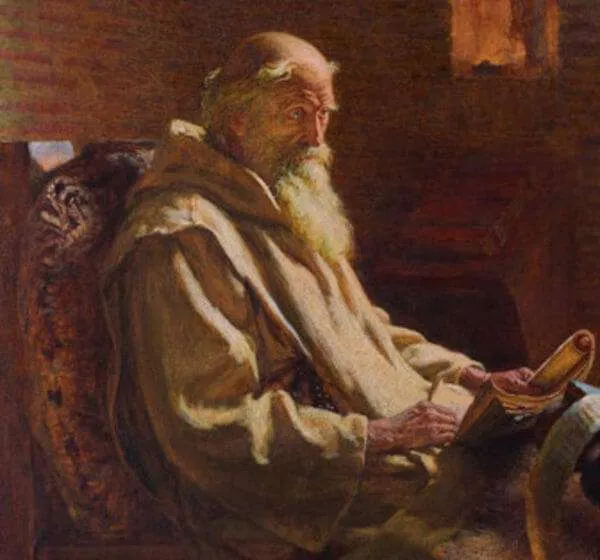
Saint Bede the Venerable, Priest and Doctor

c. 673–735; Patron Saint of lectors, scholars, English writers, and historians; Pre-Congregation canonization; Canonization confirmed and proclaimed a Doctor of the Church by Pope Leo XIII in 1899

In the fourth-century, many in Roman-controlled Britain were Catholic. However, after the fall of the Western Roman Empire in the fifth century and the removal of Roman troops from Britain to defend the homeland, Britain began to encounter threats from the Scottish and Irish. Angles and the Saxons from central Europe arrived to assist Britain but then conquered Britain themselves. By the sixth century, Britain had become known as Anglo-Saxon England and was divided into nine smaller kingdoms. The Anglo-Saxon people brought their pagan language and culture with them. Gradually, they eliminated Christianity from their new land, except from the southeast where many Britons had fled. To address this paganization, Pope Saint Gregory the Great sent Saint Augustine of Canterbury to evangelize the Anglo-Saxon kingdoms. Over the next century, all of the Anglo-Saxon kings converted and their subjects followed. It is into this historical context that today’s saint, Saint Bede, a holy monk, profound Scripture scholar, and brilliant historian, was born and ministered.

Bede was born near a Benedictine Monastery in Wearmouth and Jarrow, modern-day Tyne and Wear, in the northeastern part of the United Kingdom. As was common at that time, Bede was given to the care of the monks of Wearmouth at the age of seven with the expectation that he would remain with them and become a monk himself. A few years later, young Bede was sent across the river to the monks’ newly founded sister monastery at Jarrow. In 686, when Bede was about thirteen years old, a severe plague ravaged the monastery, leaving only Bede and Abbot Ceolfrid alive. One of the central duties of the monks was the chanting of the Divine Office, which the oblate Bede and the abbot continued faithfully.

Of his time in the monastery, Bede himself says, “I wholly applied myself to the study of Scripture; and amidst the observance of monastic rule, and the daily charge of singing in the church, I always took delight in learning, or teaching, or writing.” After more than a decade of study and prayer under Abbot Ceolfrid, Bede was ordained to the diaconate at the age of nineteen. Eleven years later, he was ordained to the priesthood at the age of thirty. Bede describes the thirty-two years of his priestly ministry as a monk this way: “From the time when I received priest’s orders, till the fifty-ninth year of my age, I have made it my business, for my own needs and those of my brethren, to compile out of the works of the venerable Fathers, the following brief notes on the Holy Scriptures, and also to make some additions after the manner of the meaning and interpretation given by them…”

Bede was a good Benedictine monk. According to the Benedictine Rule, Bede took a vow of stability, meaning he might never have left his monastery, except possibly for occasional short visits to nearby monasteries to assist with teaching. Within his monastic cell, Bede wrote more than forty books, twenty-five of them being commentaries on the Sacred Scriptures. He also wrote books on history, rhetoric, grammar, the calculation of time, biographies, theology, and poetry.

Bede’s most famous book was written when he was fifty-nine, The Ecclesiastical History of the English People. This book begins with a description of Britain and Ireland and their ancient inhabitants. From there, he traces the role of the Roman Empire in Britain, starting with Julius Caesar until Saint Alban, the first British martyr, and on through the early Christianization of the isle. After Britain was conquered by the Anglo-Saxons in the early fifth century, Bede describes the new evangelization initiated by Pope Saint Gregory the Great at the end of the sixth century and carried out by Saint Augustine of Canterbury. The bulk of his Ecclesiastical History then focuses upon the growth of the Church in England in the sixth and seventh centuries. Most importantly, this work ties the Anglo-Saxon people back to the Church in Rome. Though the Roman Empire no longer ruled Britain, the Catholic Church centered in Rome was the country’s true spiritual ruler. Bede especially saw Pope Saint Gregory the Great as the instrument of salvation for the Anglo-Saxons to whom he belonged.

Another of Bede’s great contributions to the Universal Church was his treatise “On the Reckoning of Time,” in which he taught the correct calculation of months and years. This work was significant because it enabled the Church in England to accept the correct day on which to celebrate Easter each year. This work also helped the world establish the current calendar that begins at the birth of Christ, solidifying the use of the term Anno Domini (A.D.), “in the year of our Lord.”

Bede’s commentaries on Scripture are deeply rooted in the writings of the Church Fathers but also broke new ground. Bede follows an allegorical and a moral approach by which he interprets the various passages of Scripture in the light of the death and Resurrection of Christ, emphasizing the Scripture’s deeper symbolic meaning, rather than just giving a literal interpretation.

After his death, Bede’s works became the foundation for much learning throughout Europe. He was described by his contemporaries as “the school-master of his age” and “the candle of the Church, lit by the Holy Spirit.” His works were copied over and over again, formed monks throughout Europe, and had an undeniable influence upon the whole history of the Church. By the ninth century, Bede was referred to as the “Venerable Bede’” in two Church councils. Saint Bede’s enduring influence has been felt so strongly that more than a millennia after his death, he was declared a Doctor of the Church by Pope Leo XIII in 1899, the only Englishman to receive such an honor.

During his lifetime, Bede had a profound influence upon the monks he taught. He lived, prayed, studied, taught, and wrote from the confines of his monastery. From that place of solitude and prayer, God used him to influence all of Europe and the entire world. God can do great things when we live our vocation well. Ponder the vocation God has given you. As you do, know that your vocation is your path to holiness. Live it well, and God will bring forth His transforming presence in you and through you in ways that you could never have imagined.

Source: https://mycatholic.life/saints/saints-of-the-liturgical-year/may-25-saint-bede-the-venerable-priest-and-doctor/

Saint Bede the Venerable, Priest and Doctor Read More »

Mark 10:13-14

Dependence Upon God

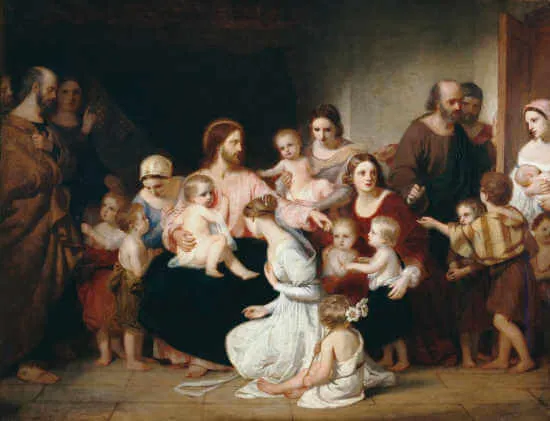
“People were bringing children to Jesus that he might touch them, but the disciples rebuked them. When Jesus saw this he became indignant and said to them, ‘Let the children come to me; do not prevent them, for the Kingdom of God belongs to such as these.’”

Reflection: 

Simplicity, trust, purity of intent, transparency, and resiliency are all qualities that children often have by nature. They are not yet capable of evil intent. They are quick to forgive and reconcile when conflicts arise. And they have an unwavering confidence in the care of their parents. These are among the qualities that we need to imitate in our relationship with God.

It seems that as we age and as our human reason develops, we can lose some of the important qualities we had as children. But when it comes to our relationships with our loving God, we must never lose the important childlike qualities that lead us to be completely trusting and dependent upon God’s providence and care.

Children are also weak in the sense that they are not able to care for themselves. They rely completely upon the care of others, especially parents. For that reason, a child is an ideal image of how we must approach God. We must see our weakness and dependence. We must know, with deep conviction, that we are incapable of caring for ourselves. And though we may achieve a certain independence as we age, being able to provide for ourselves materially, we will never be able to provide for the interior spiritual needs we have. For our spiritual needs, we remain completely dependent upon the mercy of God. We must never forget that, at our core, we are spiritual beings who long for true spiritual satisfaction. Material or fleshly satisfactions that we can obtain by ourselves will never suffice to fulfill us at the deepest level of who we are. God and God alone is capable of this form of fulfillment.

Think about your own approach to life. Do you seek to find fulfillment and satisfaction in life through your own efforts? Have you attempted to take complete control of your present and future happiness? Though it is essential that we act responsibly in life, it must be understood that the most responsible way we can act is by willfully turning over complete control of our lives to God’s providence and care. As a child depends upon a parent, so we must depend upon the grace of God.

Reflect, today, upon a child. Ponder, especially, how a child is dependent upon others. As you do, see yourself similarly as one who must become completely dependent upon God for all that is important in life and for all that ultimately fulfills who you are. Trust in God’s providence and mercy, and allow that childlike trust to place you firmly in the arms of your Father in Heaven.

Source: https://catholic-daily-reflections.com/2024/05/24/dependence-upon-god/

Mark 10:13-14 Read More »

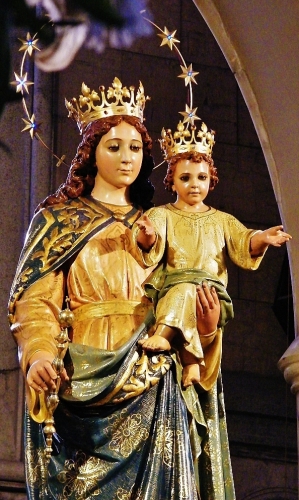
Our Lady, Help of Christians

Profile

The feast of Our Lady, Help of Christians, was instituted by Pope Pius VII. By order of Napoleon, the Pope was arrested on 5 July 1808, and imprisoned at Savona, Italy and Fontainebleau, France. In January 1814, after the Battle of Leipzig, he was brought back to Savona and set free on 17 March, the eve of the feast of Our Lady of Mercy, the patroness of Savona. The journey to Rome was a veritable triumphal march with the pontiff, attributing the victory of the Church after so much agony and distress, to the Blessed Virgin. He visited many of her sanctuaries on the way, crowning her images, and entered Rome on 24 May 1814 to enthusiastic crowds. To commemorate his own sufferings and those of the Church during his exile, he extended the feast of the Seven Dolours of Mary to the universal Church on 18 September 1814.

When Napoleon left Elba and returned to Paris, Murat was about to march through the Papal States from Naples. Pius VII fled to Savona on 22 March 1815, where he crowned the image of Our Lady of Mercy on 10 May 1815. Following the Congress of Vienna and Battle of Waterloo, he returned to Rome on 7 July 1815. To give thanks to God and Our Lady, he instituted the feast of Our Lady, Help of Christians for the Papal States on 15 September 1815; it was celebrated on 24 May, the anniversary of his first return. The dioceses in the Tuscany region adopted it on 12 February 1816, and it spread over nearly the entire Latin Church.

The hymns of the Office were composed by Brandimarte. It is the patronal feast of Australasia, a double of the first class with an octave, and is celebrated with great splendor in the churches of the Fathers of the Foreign Missions of Paris. It has attained special celebrity since Saint John Bosco dedicated the mother church of his congregation at Turin to Our Lady, Help of Christians. The Salesian Fathers have carried the devotion to their numerous establishments, and prayers for her intervention are credited with the miraculous cure of Blessed Artemide Zatti.

Patronage

  • elderly people of Italy
  • Australia (proclaimed on 17 July 1916 by Pope Benedict XV)
  • China
  • New Zealand
  • Andorran security forces
  • Austrialian military chaplains
  • New York
  • Diocese of Shrewsbury, England
  • Diocese of Townsville, Australia
  • Military Ordinariate of Australia
  • Cabras, Italy
  • Caselle di Selvazzano, Italy

Source: https://catholicsaints.info/our-lady-help-of-christians/

Our Lady, Help of Christians Read More »

Mark 10:1-2

Resolving Conflict

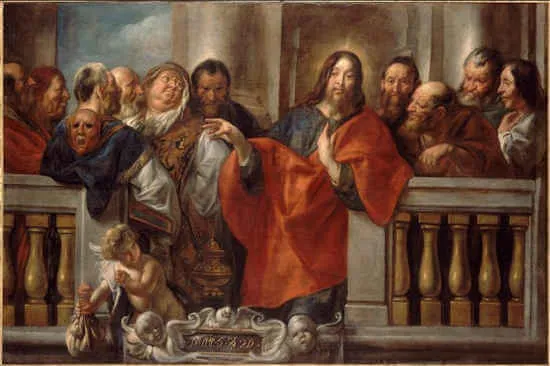
“Jesus came into the district of Judea and across the Jordan. Again crowds gathered around him and, as was his custom, he again taught them. The Pharisees approached him and asked, ‘Is it lawful for a husband to divorce his wife?’ They were testing him.”

Reflection:

Notice the contrast above. The crowds gathered around Jesus to listen to Him. Clearly, they were coming to faith. But the Pharisees came to Jesus to test Him. They did not come in faith; they came with jealousy and envy and were already seeking to trap Him. The question they proposed was a trick question, not an honest attempt at communication with our Lord. They presumed that however Jesus answered the question, some people would be offended. The Pharisees were ready to stir things up, since so many were flocking to Jesus. Also, the Pharisees wanted to find fault with Jesus’ answer so as to show that He opposed the Law of Moses. But Jesus’ answer was perfect.

Much could be said about the content of Jesus’ answer. He clearly supports the indissolubility of marriage. He states that “what God has joined together, no human being must separate.” He adds: “Whoever divorces his wife and marries another commits adultery against her; and if she divorces her husband and marries another, she commits adultery.” For those who have suffered through a divorce, it is important to prayerfully ponder this teaching from our Lord. It is also important to work with the Church Tribunal to examine the marriage in the light of truth so that a determination can be made about the validity or invalidity of the marriage bond. With that said, the approach that both the crowds and the Pharisees took toward Jesus also teaches us an important lesson about communication, not only with God but also with one another. This is a lesson that is especially important for married couples to learn.

Think about your own approach to communication. When you struggle with conflict with another, how do you resolve it? How do you bring your questions and concerns to your spouse? The crowds came to Jesus to listen and understand. The reward was the gift of faith in that they received a deeper knowledge of Who Jesus was. The Pharisees, however, came to Jesus with the intent of finding fault with Him. And though it is obviously foolish to take this approach with our Lord, it is also foolish to do so with another, especially a spouse.

Use the above approaches of the crowds and the Pharisees to think about how you come to others with your questions and concerns. When there is some conflict or misunderstanding, do you come with an open mind and heart, seeking to understand and resolve the question? Or do you come with a loaded question so as to trap and find fault with the other? So many conflicts in life with others, especially among spouses, could be resolved if the goal of any conversation was simply to understand the other person, not trap them or find fault with them. This is hard for many people to do and requires much humility and openness.

Reflect, today, upon any relationship with which you are currently struggling. Reflect, especially, upon whether your approach to communication with that person is more like the crowds or more like the Pharisees. Commit yourself to the approach of seeking open and honest communication and you will find that this commitment brings true resolution, peace and unity.

Source: https://catholic-daily-reflections.com/2024/05/23/resolving-conflict-2/

Mark 10:1-2 Read More »

Saint William of Rochester

Profile

William led a wild and misspent youth, but as an adult he had a complete conversion, devoting himself to God, caring especially for poor and neglected children. He worked as a baker, and gave every tenth loaf to the poor. He attended Mass daily, and one morning on his way to church he found an infant abandoned on the threshold. He named the baby David, and adopted him, and taught him his trade.

Years later, he and David set out on a pilgrimage to the Holy Lands. During a stop-over in Rochester, England, the boy David turned on William, clubbed him, cut his throat, robbed the body, and fled. Because he was on a holy journey, and because of the miraculous cures later reported at his tomb, he is considered a martyr.

A local insane woman found William’s body, and plaited a garland of honeysuckle flowers for it; she placed the garland on William, and then on herself whereupon her madness was cured. Local monks, seeing this as a sign from God, interred William in the local cathedral and began work on his shrine. His tomb and a chapel at his murder scene, called Palmersdene, soon became sites of pilgrimage and donation, even by the crown. Remains of the chapel can be seen near the present Saint William’s Hospital.

Born

  • 12th century at Perth, Scotland

Died

  • throat cut in 1201 at Rochester, England
  • interred in the cathedral at Rochester

Canonized

  • 1256 by Pope Innocent IV

Patronage

  • adopted children

Source: https://catholicsaints.info/saint-william-of-rochester/

Saint William of Rochester Read More »