2024

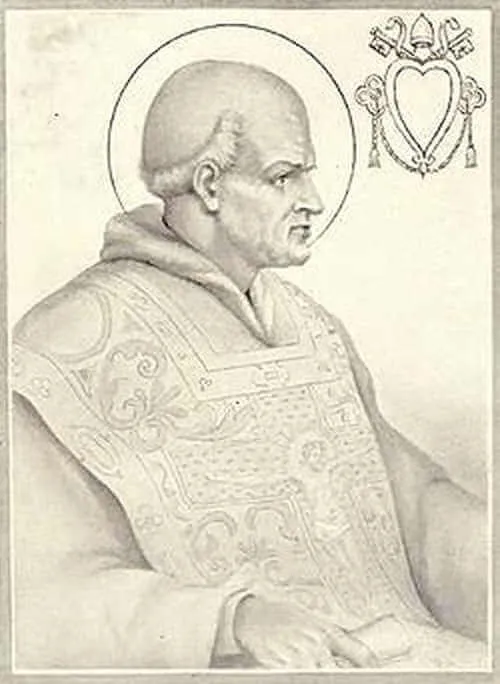
Pope Saint Celestine V

Profile

Peter was eleventh of twelve children. His father died when he was quite young. When his mother would ask, “Which one of you is going to become a saint?” Peter would answer, “Me, Mama! I’ll become a saint!”

At 20, Peter became a hermit, prayed, worked, and read the Bible. He followed the Benedictine Rule, and so many other hermits came to him for guidance, that he founded the Holy Spirit Community of Majella (Celestines).

Following a two year conclave during which the cardinals could not decide on a pope, Peter came to them with the message that God was not pleased with the long delay; the cardinals chose Peter as the 192nd Pope.

The primary objective of Celestine’s pontificate was to reform clergy, many of whom were using spiritual power to obtain wordly power. Celestine sought a way to bring the faithful to the original Gospel spirit, and he settled on “Pardon” – he called for a year of forgiveness of sins, and return to evangelical austerity and fidelity.

He reigned a mere five months, and the members of the Vatican Curia took advantage of him. This led to much mismanagement, and great uproar in the Vatican. Knowing he was responsible, Celestine asked forgiveness for his mistakes, and abdicated on 13 December 1294, the only pope to do so. His successor, Boniface VIII, kept Celestine hidden for the last ten months of his life in a small room in a Roman palace. Celestine may have appreciated it – he never lost his love of the hermit‘s life, and spent his last days in prayer.

Born

  • 1210 at Isneria, Abruzzi, Italy as Pietro del Morrone

Papal Ascension

  • 5 July 1294

Papal Abdication

  • 13 December 1294

Died

  • 19 May 1296 in Rome, Italy of natural causes
  • buried in the church of Saint Agatha, Ferentino, Italy
  • re-interred in the Church of Saint Maria di Collemaggio, Aquila, Italy

Canonized

  • 1313 by Pope Clement V

Patronage

  • bookbinders
  • in Italy
    – Aquila
    – Isernia

Source: https://catholicsaints.info/pope-saint-celestine-v/

Pope Saint Celestine V Read More »

John 20:21-23

Reconciled and Filled with the Holy Spirit

Jesus said to them again, “Peace be with you. As the Father has sent me, so I send you.” And when he had said this, he breathed on them and said to them, “Receive the Holy Spirit. Whose sins you forgive are forgiven them, and whose sins you retain are retained.”

Reflection:

Happy Pentecost! Today, throughout the world, our Church celebrates the full outpouring of the Holy Spirit upon Jesus’ first followers and upon all of us. Why do we need the Holy Spirit in our lives? This is an important question to ponder. Today, as always, the Father, Son and Holy Spirit work as One God. It is the Father Who wills that we be reconciled to Him; it was the Son Who made this reconciliation possible; and it is the Holy Spirit Who now accomplishes the completion of this act in our lives. At the heart of that gift of salvation is the remission of our sins. The passage above clearly reveals to us that Jesus bestowed a unique gift of the Holy Spirit upon the Apostles, His first bishops, entrusting them with the ability to forgive sins in His name and by His power.

As we celebrate Pentecost, it is a good opportunity to prayerfully consider the action of the Holy Spirit in your life. One of the greatest ways that the Holy Spirit is potentially active in your life is through the Sacrament of Reconciliation. Through that Sacrament, the Holy Spirit draws you to the Father and enables you to see and understand His perfect will, living more fully in union with the Son as a member of His Body.

The Seven Gifts of the Holy Spirit are some of the other ways that the Holy Spirit helps us in our Christian walk. However, these gifts would be ineffective in our lives if we did not first receive the gift of forgiveness given through the Sacrament of Reconciliation. That is the first and most foundational action of the Holy Spirit and opens the door to every other gift. Perhaps that is why Jesus’ first bestowal of the Holy Spirit focused upon the power given to His Apostles to forgive sins in His name.

Once we are reconciled to the Father and begin to live in a state of grace, the Holy Spirit will continue to deepen His relationship with us and bestow His help upon us for our Christian journey. This especially happens through the Seven Gifts of the Holy Spirit. The gifts most affecting our intellect are the Gifts of Wisdom, Understanding and Knowledge. Wisdom helps us to understand the inner life of the Trinity more clearly. Understanding helps us to make sense of our lives and mission in the light of the Gospel. Knowledge helps us make practical decisions in accord with God’s will.

The gifts of Fear of the Lord and Piety assist us in our love of God. Fear of the Lord helps us to see how our actions help or hinder our relationship with God, helping to motivate us to avoid all that harms this relationship and choose all that strengthens it. Piety helps us to see the great dignity and beauty of God and enables us to have a deep reverence for Him and for all of His people.

Counsel and Fortitude are also given by the Holy Spirit and help us to firmly move forward in faith and love. Counsel especially helps us with love of neighbor, and Fortitude adds the strength we need to do all that we are called to do in love with unwavering commitment.

As we celebrate the great Solemnity of Pentecost, reflect, today, upon the transforming power of the Holy Spirit. If you want to be open to the full outpouring of the Holy Spirit in your life and receive the many gifts you need for your journey of faith, then begin with the most fundamental gift. Begin with the Sacrament of Reconciliation. Ponder the words Jesus spoke in our Gospel today and know that by entrusting the grace to forgive sins in His name to His first priests, Jesus was also calling you to embrace that gift. The Holy Spirit wants you to be cleansed of all sin. Allow Him to do so and you will be amazed at all the grace that follows.

Source: https://catholic-daily-reflections.com/2024/05/18/reconciled-filled-by-the-holy-spirit/

John 20:21-23 Read More »

Saint John 1, Pope and Martyr

c. Late Fifth Century–526; Invoked against temptations toward false unity and acceptance of heresy; Pre-Congregation canonization

In 451, the Council of Chalcedon taught that Jesus had both a human and divine nature, and those two natures were united in the one Person of Jesus Christ. This doctrine was established in response to the Arian heresy plaguing the Eastern Roman Empire, which taught that Jesus was created by the Father and, therefore, neither co-equal with Him nor divine. After Chalcedon countered this heresy, the Arian clergy and even the Byzantine emperor tried to move closer to acceptance, but many of them didn’t go all the way. Instead, many former Arians fell into other middle-of-the-road heresies that failed to fully accept the two natures of the Son of God. In 482, Byzantine Emperor Zeno issued a document called the Henotikon. This document attempted to find a middle ground between the official Church teaching on the nature of Christ as defined in the Council of Chalcedon, and the Arian view. Emperor Zeno’s successor, Basiliscus, continued in this error of faith.

In 518, Justin I succeeded Emperor Basiliscus as the Eastern Roman Emperor. Shortly afterward, he accepted the position of the pope and the Council of Chalcedon. In 523, Emperor Justin issued an edict mandating the acceptance of the Council of Chalcedon throughout the Eastern Empire, and demanding that all Arians turn their churches over to Catholics. At that time in the West, Rome was under the control of Theodoric the Great, the king of the Ostrogoths. Theodoric was an Arian, which gave rise to ongoing tensions between him and the pope, as well as all orthodox Catholics. Though Theodoric was mostly accommodating of Chalcedon Christians (including the pope), when the Eastern Roman Emperor Justin I issued his edict in 523 against the Arians, Theodoric was outraged. He threatened that if the edict were not rescinded, he would treat all Chalcedon Catholics in the West in the same way that Arians were being treated in the East, even promising bloodshed.

In that same year, a deacon in Rome, Archdeacon John, was elevated to the papacy, becoming Pope John. Shortly after that, the outraged King Theodoric forced Pope John to travel to Constantinople in an effort to convince Emperor Justin to rescind his edict. Pope John reluctantly went, accompanied by a number of bishops and Roman senators. When Pope John arrived in Constantinople, Emperor Justin warmly welcomed him and the two were clearly of the same mind. It is said that the emperor traveled twelve miles outside of the city gate to meet the pope and when they met, the emperor bowed to the ground in homage. On their way into the city, the pope is said to have cured a blind man. Regarding the matter at hand, Pope John might have encouraged the emperor to treat the Arians gently, but in no way did he carry out King Theodoric’s demand to convince the emperor to rescind his edict. Pope John was unwaveringly Catholic and fully accepted the teachings of the Council of Chalcedon.

When word reached King Theodoric that Pope John did not carry out his order, the king was outraged. First, he imprisoned and later executed one of Pope John’s closest friends, the philosopher Boëtius. Then, when Pope John returned to Italy, King Theodoric immediately had him, the other bishops, and senators arrested and jailed in Ravenna, not permitting Pope John to return to Rome. Since Pope John was already quite frail and in ill-health, he did not survive long in the dungeon. Though he was not directly executed by the king, the Church has nonetheless named Pope Saint John I as a martyr for the faith.

If Pope John would have compromised on the faith of the Church, the king would have been grateful and treated him well. But the pope had a duty to proclaim the one true faith, without regard for his own physical well-being. This is what Pope John did, and that is why he is now a saint in the courts of Heaven.

As we honor this holy martyr, consider any ways that you are tempted to compromise your own faith for the sake of “peace at all costs.” The secular world often tempts us to downplay our faith, especially our moral convictions, for the sake of a false unity. There are many objective evils today that are being promoted by the secular world as good: abortion, confusion about sexual identity, materialism, and atheistic socialism to name a few. Allow Pope Saint John I to inspire you so that you will have courage in the face of such temptations. Commit yourself to the truth so that you will be a purer instrument of the saving truths that will lead those most in need to eternal salvation.

Source: https://mycatholic.life/saints/saints-of-the-liturgical-year/may-18—saint-john-i-pope-and-martyr/

Saint John 1, Pope and Martyr Read More »

John 21:24-25

A Holy Awe

It is this disciple who testifies to these things and has written them, and we know that his testimony is true. There are also many other things that Jesus did, but if these were to be described individually, I do not think the whole world would contain the books that would be written.

Reflection:

As we conclude our Easter season, we are given the conclusion of the Gospel of Saint John to ponder. Recall that John’s Gospel has been a central focus throughout the Easter Season. Therefore, if you have been prayerfully reading the Gospel for Mass each day for the past several weeks, then you have truly immersed yourself in this holy Gospel.

The Gospel of Saint John is much different from the other three Synoptic Gospels. John’s language is mystical and symbolic. John presents the seven miracles as the seven “signs” that reveal Jesus’ divinity. Jesus is identified as I AM, the Son of the Father, the Vine, the Bread of Life, the Light of the World, the Eternal Word, and more. John points to the Crucifixion as Jesus’ hour of glory in which He takes up His throne of the Cross for the salvation of the world. And John’s teaching on the Eucharist is truly profound.

John states that the reason he wrote his Gospel was so “that you may come to believe that Jesus is the Messiah, the Son of God, and that through this belief you may have life in his name” (John 20:31). John clearly loved our Lord and understood Him, not only by personal experiences while Jesus was alive on earth but also through a profound level of prayer in his later years. And this depth of understanding and mystical knowledge is communicated in such a way that the reader is easily drawn into John’s prayerful understanding.

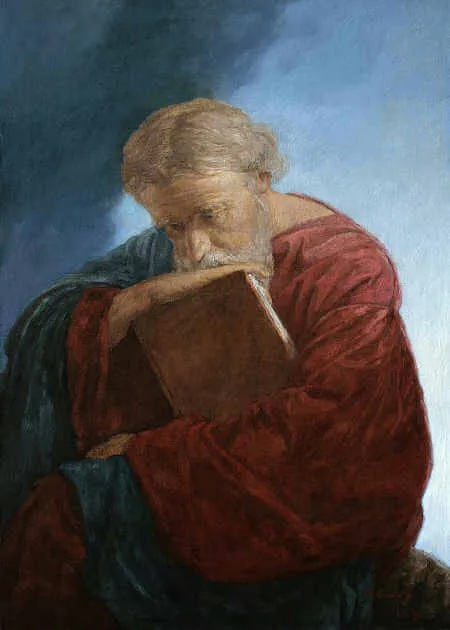
As John concludes His testimony about Jesus, he states something worth pondering. He states that Jesus did so many things that were not recorded by him or others, that if they were all written down, the whole world would not contain the books that would be written. First of all, everything that was written down could be the source of prayerful study for a lifetime. John’s Gospel alone could never be exhausted of its meaning. But then consider this final line of John’s Gospel and try to take it as a literal statement for a moment. If that statement were literally true, that the whole world could not contain the books that would record all that Jesus did, then this fact should leave us with a holy awe. In fact, the reason this must be true is because what Jesus did within each and every mind and heart He touched is truly indescribable. Volumes upon volumes could not thoroughly describe it. His divine action of saving souls, rescuing people from sin and death, and pointing them to eternal life is more than our feeble minds can fully comprehend. 

Reflect, today, upon the holy Gospel of Saint John. As we do conclude this Easter Season and our reading of John’s Gospel, allow yourself to sit in awe of the infinite activity of our divine Lord in the lives of those who have turned to Him. Consider every movement of grace in their lives that has been accomplished with such care and love by our Lord. Reflect upon the fact that for eternity you will be contemplating the Eternal Word made Flesh, the Messiah, the Great I AM, the Son of the Father and every other name given to Him Who is our God and King. Saint John loved our Lord and understood Him deeply because he spent his life prayerfully pondering all that Jesus did. Continue to commit yourself to this holy pondering so that you will be drawn more deeply into this contemplation with holy awe.

Source: https://catholic-daily-reflections.com/2024/05/17/a-holy-awe-3/

John 21:24-25 Read More »

Saint Pascal Baylon

Profile

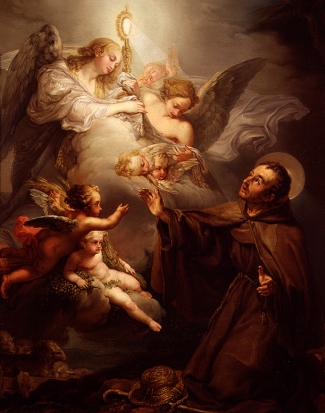
Pascal was the son of the pious peasants Martin Baylon and Elizabeth Jubera. From youth, he displayed great devotion to the Eucharist. He worked as a shepherd from ages 7 to 24, and was a good influence on his shepherd friends, an often rowdy group. He was a Franciscan lay brother with friars of the Alcantarine Reform, often serving as cook or doorkeeper. His charity to the poor and afflicted, his unfailing courtesy and humility, were remarkable even by Franciscan standards. While travelling in France, he defended the Real Presence against the blasphemies of a Calvinist preacher, and narrowly escaped death at the hands of a Huguenot mob. Poorly educated, he was still a counselor sought by rich and poor alike. His cultus is especially strong in Spain and southern Italy, in Central and South America.

Born

  • 24 May 1540 (feast of Pentecost) at Torre Hermosa, Aragon, (modern Spain)

Died

  • 15 May 1592 (feast of Pentecost) at Villa Reale, Spain of natural causes

Beatified

  • 29 October 1618 by Pope Paul V

Canonized

  • 16 October 1690 by Pope Alexander VIII

Patronage

  • cooks
  • Eucharistic congresses, confraternities and organizations (proclaimed by Pope Leo XIII on 28 November 1897)
  • shepherds
  • Bisenti, Italy
  • Castelnuovo, Assisi, Italy
  • Montebello, Orciano di Pesaro, Italy
  • Obado, Bulacan, Philippines
  • Segorbe-Castellón de la Plana, Spain, diocese of

Representation

  • man in adoration before a vision of the Host

Source: https://catholicsaints.info/saint-pascal-baylon/

Saint Pascal Baylon Read More »

John 21:18-19

True Love

“Amen, amen, I say to you, when you were younger, you used to dress yourself and go where you wanted; but when you grow old, you will stretch out your hands, and someone else will dress you and lead you where you do not want to go.” He said this signifying by what kind of death he would glorify God. And when he had said this, he said to him, “Follow me.”

Reflection:

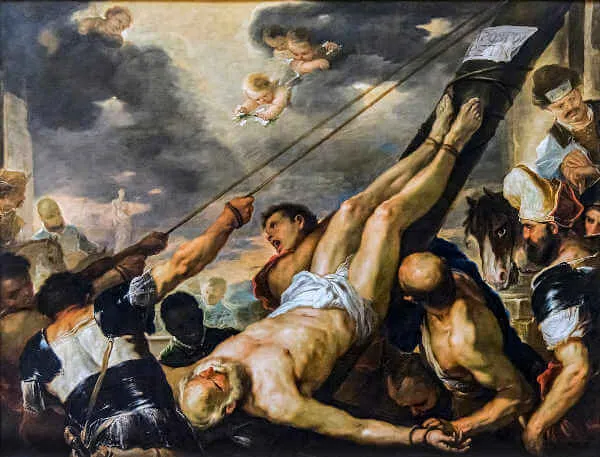
On this, the third time that Jesus appeared to His disciples, Jesus enters into a threefold discourse with Peter. Each time that Jesus asks Peter if he loves Him, Peter responds that he does. And Jesus responds back each time, “Feed my lambs,” “Tend my sheep,” and “Feed my sheep.” The passage quoted above concludes Jesus’ discourse with Peter using very powerful language. Jesus tells Peter that when he grows old, “someone else will dress you and lead you where you do not want to go.” This was Jesus’ way of saying to Peter that he would ultimately express his love of Jesus by dying for Him. As we know, tradition states that Peter was ultimately crucified. And at Peter’s request, he was crucified upside down because he felt unworthy of dying in the exact same way Jesus died.

As we consider this conversation between Jesus and Peter, it is clear that Jesus’ understanding of love is very different from the way many others understand it today. Jesus was not only telling Peter that he would die for Jesus, but Jesus was clearly offering His approval of this act of love Peter would one day offer. Most often when we love someone, we would do all we can to keep them from any such fate. In fact, when a loved one suffers, we often will do all we can to look for a way to relieve them of that suffering. So which approach is most loving?

Clearly, Jesus sees suffering differently than most of us. For Jesus, suffering is not opposed to love when the suffering is freely embraced for a higher purpose. Suffering in and of itself is of no value. But when suffering is embraced sacrificially out of love for another, it is able to take on tremendous power. And when Jesus offered His clear support to Peter who would one day die out of love for Jesus, Jesus was focusing upon the eternal merit that would be won by Peter’s cross. The fact that Jesus did not shy away from Peter’s future sacrificial suffering is one of the clearest signs of Jesus’ more perfect love for Peter.

Reflect, today, upon your attitude toward the sufferings that your loved ones endure. Do you find that your primary goal is to rid them of their sufferings? Or do you understand that even their sufferings have the potential to become a source of their own holiness and the source of grace for others? Strive to see suffering as Jesus sees it. Look at the sacrificial love that is made possible when your loved ones unite their sufferings to the Cross of Christ and try to commit yourself to the mission of helping them embrace that sacred gift of love.

Source: https://catholic-daily-reflections.com/2024/05/16/true-love-3/

John 21:18-19 Read More »

Saint Simon Stock

Profile

Little is known of his early life. Legend says that at age twelve, Simon began to live as a hermit in a hollow oak tree; the name Stock is believed derived from the old English for tree trunk. He was an itinerant preacher. He was a pilgrim to the Holy Lands, but left when invading Muslims chased out Christians. He joined the Carmelite Order soon after its arrival in England.

Simon lived and studied for several years in Rome, Italy and Mount Carmel. He was elected sixth general of the Carmelites in 1247 around age 82. He helped the Order spread through England, southern and western Europe. He founded houses in Cambridge, England in 1248, Oxford in 1253, Paris, France in 1260, and Bologna, Italy in 1260. He revised the Rule of the Order to make them mendicant friars instead of hermits.

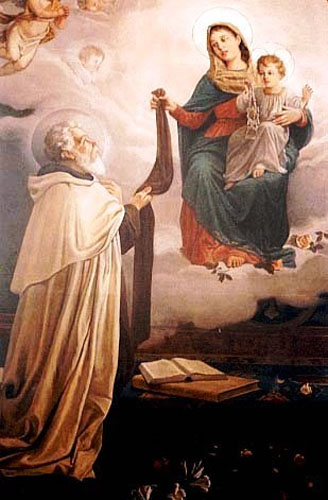
Regardless of these successes, the Order was oppressed on all sides, including by the clergy and other orders. The friars took their woes to their patroness, the Virgin Mary. Tradition says that in answer, she appeared to Simon bringing him the brown Scapular of Mount Carmel. “This shall be the privilege for you and for all the Carmelites,” she told him, “that anyone dying in this habit shall be saved.” On 13 January 1252, the Order received a letter of protection from Pope Innocent IV, protecting them from harassment.

Born

  • c.1165 in Aylesford, County Kent, England

Died

  • 16 May 1265 in the Carmelite monastery at Bordeaux, France of natural causes while on a visit
  • skull transferred to the Carmelite friary in Aylesford, England in 1951

Canonized

  • never formally canonized
  • venerated by the Carmelites since at least 1564
  • the Vatican has approved Carmelite celebration of his feast

Patronage

  • Aylesfort, England
  • Bordeaux, France

Representation

  • Carmelite friar holding a scapular
  • Carmelite friar receiving the scapular from the Blessed Virgin
  • Carmelite friar surrounded by and praying for souls in purgatory
  • elderly man in a Carmelite habit in prayer

Source: https://catholicsaints.info/saint-simon-stock/

Saint Simon Stock Read More »

John 17:20-21

Gestures of Love

“Lifting up his eyes to heaven, Jesus prayed saying: ‘I pray not only for these, but also for those who will believe in me through their word, so that they may all be one, as you, Father, are in me and I in you, that they also may be in us, that the world may believe that you sent me.’”

Reflection:

Over the past couple of weeks, we have been continually reading from Chapter 14–17 of John’s Gospel. These chapters contain Jesus’ Last Supper Discourses and provide us with Jesus’ last sermon, so to speak. Chapter 17, which we have been reading this past week, presents us with Jesus’ final prayer for His disciples and for all of us “who will believe” in Him through the preaching of the disciples. Each time we read from Chapter 17, the Lectionary begins the reading with the phrase “Lifting up his eyes to heaven, Jesus prayed saying…” That line is an adaptation of Chapter 17:1 but is used to introduce the various parts of the prayer of Jesus each time it is read at Mass.

It’s interesting that Jesus would look up to Heaven when He prayed. Of course, Heaven is not physically in the sky, because Heaven is a spiritual reality. The Father is not located in some place in the sky but is omnipresent, meaning, present all places and all times. And yet, Jesus raises His eyes upward when He prays to the Father. There is a great lesson in this.

Our physical disposition is important, at times. For example, when someone we owe respect to enters a room, we usually rise and greet them. It would be disrespectful to remain lounging on a bed or sofa in that case. And at Mass, we do not sit back with legs crossed during the Consecration; rather, we kneel in adoration. And when we greet someone for the first time, we do not look at the floor; rather, we look them in the eyes.

Jesus’ act of “Lifting his eyes to heaven” was not done because He thought He might see the Father in the sky; rather, it was done out of respect and love and as a way of acknowledging the dignity of the Father. This should teach us about our own bodily disposition and the message we communicate to others, especially to God in prayer.

When you pray, what do you do? Though you can pray at any time and while in any disposition, it is an excellent practice to speak to God not only by your words but also by the disposition you take. Kneeling, raising hands in prayer, falling prostrate before your Lord, sitting upright with attentiveness, etc., are all ways in which you communicate to God your love.

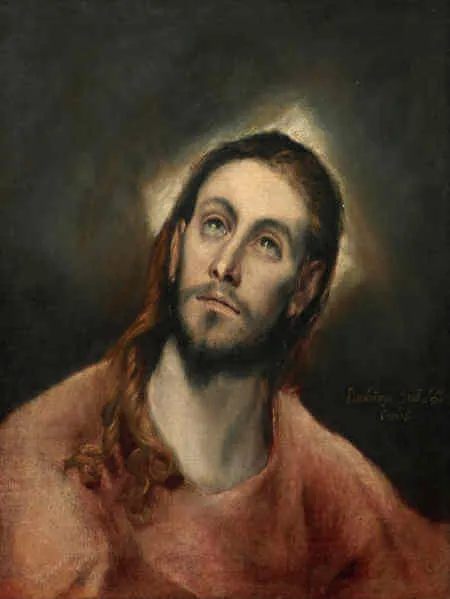
Reflect, today, upon this image of Jesus praying. Gaze at how attentive He would have been as He lifted His sacred eyes upward as a physical gesture honoring the glorious, all-powerful Father in Heaven. Try to imagine Jesus’ devotion, intensity, respect and burning love. Imitate this holy gesture of prayer and attentiveness to the Father and remind yourself of the importance of expressing your love in bodily form.

Source: https://catholic-daily-reflections.com/2024/05/15/gestures-of-love-3/

John 17:20-21 Read More »

Saint Isidore the Farmer

c. 1070–c. 1130; Patron Saint of Madrid, farms, farmers, bricklayers, and rural communities; Invoked against the death of a child; Canonized by Pope Gregory XV, March 12, 1622

Saint Isidore, whom we honor today, is often called Isidore the Laborer, or Isidore the Farmer. He was an ordinary man, husband, and father who lived a humble and simple life working the fields for a landowner. His extraordinary faith, by which he always sought first the Kingdom of God, sets for us an excellent example of achieving extraordinary sanctity in the ordinary grind of daily work.

Isidore was born into material poverty in Madrid. His parents, however, were rich in virtue and fostered in him a deep faith. At his baptism, he was given the name Isidore, after Saint Isidore of Seville, the great Spanish scholar and bishop of Seville who lived about 500 years earlier. Because of the family’s poverty, Isidore the Laborer did not receive an education. Instead, from a young age, Isidore worked as a hired hand for a wealthy landowner. The landowner grew very fond of Isidore and treated him as a son, even entrusting him with the management of his estate. It is believed that Isidore lived for sixty years as a laborer, but other speculation is that he may have died around the age of forty.

What is it that elevated this humble and simple man to the ranks of the saints of the Church? To begin, Isidore is said to have been exceptionally generous to the poor. Though poor himself, he and his wife regularly distributed the little they had to those who were in even greater need. He is also said to have been a man of deep prayer. He would regularly attend daily Mass before work, putting God first every day. And as a result of his intercession, miracles abounded, not only during his life but also after his death.

Isidore and his wife had one son. One legend states that their infant child fell into a large pit. Isidore and his wife prayed fervently, and suddenly, the water in the pit began to rise. Very soon, the water had carried the boy to the surface, and Isidore and his wife were then able to pull him out.

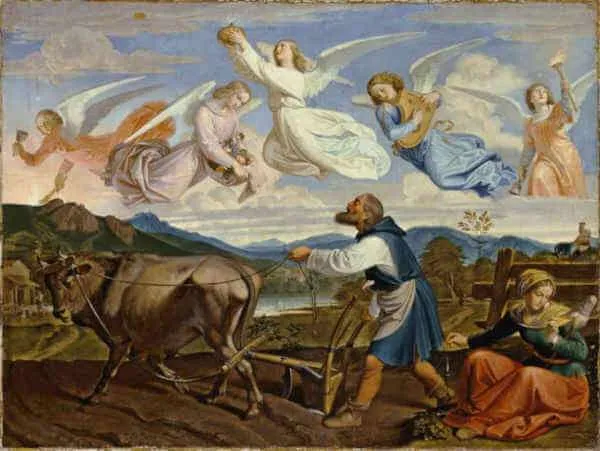
Another legend states that because Isidore attended Mass each morning, he showed up later to work than the other hired hands. When the landowner received complaints that Isidore was late for work, he decided to investigate. Sure enough, the landowner discovered that Isidore was regularly later than the others. When the landowner went to confront Isidore about this, he was met with a great surprise. As he walked toward Isidore plowing in the field, he saw that there were others plowing alongside him who looked like angels, using angelic-looking oxen. Thus, God rewarded Isidore with the help of angels to accomplish even more work than the others because Isidore put God first every day.

Isidore also cared for all of God’s creatures with great concern. According to one legend, on a winter day, when Isidore was carrying a sack of grain to be milled, he saw some hungry birds and shared some grain with them, prompting criticism from a coworker. But after Isidore’s diminished sack of grain was milled and returned to him, he had twice as much flour as the others.

Other legends describe Isidore as bringing his landowner’s daughter back to life, raising a spring of water in a dry place to give drink to the thirsty, and producing a full pot of food to feed poor, hungry visitors. 

Isidore’s wife, Maria, was also believed to be quite saintly. When their only son died at a very young age, the couple made a promise of celibacy and jointly dedicated themselves solely to God. In Spain, Maria is referred to as Santa María de la Cabeza (Saint Mary of the Head). Miracles have been attributed to her, and to this day, the relic of her head is carried in procession. It is believed that, through her intercession on multiple occasions, rain has fallen in the countryside during droughts.

After Isidore’s death, the miracles continued. Alfonso VIII, King of Castile, during a battle with the Muslims, reportedly had a vision of Saint Isidore who directed him and his army down a path of victory in 1212. That same year, after a flood, Saint Isidore’s body was miraculously exhumed from his grave and found to be incorrupt. Centuries later, when Phillip III, King of Spain, touched Saint Isidore’s body, he was miraculously cured of a serious illness. In all, there have been more than 400 miracles attributed to Isidore’s intercession throughout the centuries.

Another great honor given to this simple, poor, and humble farmer came at his canonization by Pope Gregory XV in 1622. He was canonized at the same time, in the same ceremony, with some of the most recognized and beloved saints in the history of the Church: Saints Ignatius of Loyola, Francis Xavier, Teresa of Ávila, and Philip Neri.

Saint Isidore is the patron saint of Madrid, and his feast is widely celebrated in that town and throughout Spain. He is also honored in many rural communities in Chile, Nicaragua, Peru, Philippines, and the United States. Saint Isidore is a saint for the working man. While at work, he prayed continuously, offering his work as an act of love to God. Saint Isidore’s life magnifies the dignity of work, and shows the common laborer the path to sanctity. Daily work and toil have the potential of being a way of honoring God. Saint Isidore put God first in his life. From his faith and love of God, his work, charity, and dignity shone forth.

Source: https://mycatholic.life/saints/saints-of-the-liturgical-year/may-15—saint-isidore—usa-optional-memorial/
Saint Isidore the Farmer Read More »

John 17:14-15

Rejecting the evil one

“I gave them your word, and the world hated them, because they do not belong to the world any more than I belong to the world. I do not ask that you take them out of the world but that you keep them from the Evil One.”

Reflection:

Unfortunately, the evil one is real. He is the highest of the fallen angels who retain their natural spiritual power given them at their creation. God created all angelic creatures with the purpose of serving His holy will. The Scripture reveals that there are nine levels or “choirs” to which these angelic creatures belong. Among the fallen angels, the highest of them directs the others, and he is traditionally given the name Lucifer or “the devil.”

One of the natural spiritual powers that these fallen angelic creatures retain is the power of influence and suggestive thought. They were created to be messengers of God’s truth to us; but, in their fallen state, they seek to communicate confusion and lies instead. Therefore, it is very helpful to understand the way the evil one and the other fallen angels communicate to us so that we can reject their lies and listen only to the voice of God.

In his rules for the discernment of spirits, Saint Ignatius of Loyola explains that when a person is going “from mortal sin to mortal sin,” the evil one and the other demons continually propose to their imagination the “apparent pleasures” and “sensual delights” that they obtain from their sin as a way of keeping them firmly controlled by that sin. However, when a person is “intensely cleansing their sins and rising from good to better,” the evil one and the other demons act in a contrary way. They will “bite, sadden and put obstacles, disquieting with false reasons, that one may not go on” in their pursuit of holiness. God and the good angels will act in the opposite way. For those immersed in sin, God and the good angels will use “the opposite method, pricking them and biting their consciences through the process of reason” so as to draw them away from sin. And when a person is, in fact, growing in holiness, God and the good angels will “give courage and strength, consolations, tears, inspirations and quiet, easing, and putting away all obstacles, that one may go on in well doing” (See mycatholic.life/ignatius).

These spiritual lessons on the discernment of spirits are of great value and will assist you on your daily struggle with sin and your daily pursuit of holiness. Understanding the deceptions of the evil one and discerning the promptings of grace given by God bring clarity to our daily lives and direction to all of our actions. The good news that is revealed by the Scripture passage above is that our Lord is fully aware of the working of the evil one, has prayed for you and will assist you as you seek to combat these lies and deceptions in your life.

Reflect, today, upon the importance of learning how to discern both the voice of God and the lies of the evil one. Work to discern the voice of God so that you may follow Him more faithfully. And seek to discern the lies of the evil one so that you will not be influenced by him and can directly reject him. Commit yourself to a more rigorous discernment of these spiritual experiences in your life and allow this prayer of Jesus to direct you into His holy will.

Source: https://catholic-daily-reflections.com/2024/05/14/rejecting-the-evil-one-3/

John 17:14-15 Read More »