2024

Matthew 6:16-18

Transformed by Silent Sacrifices

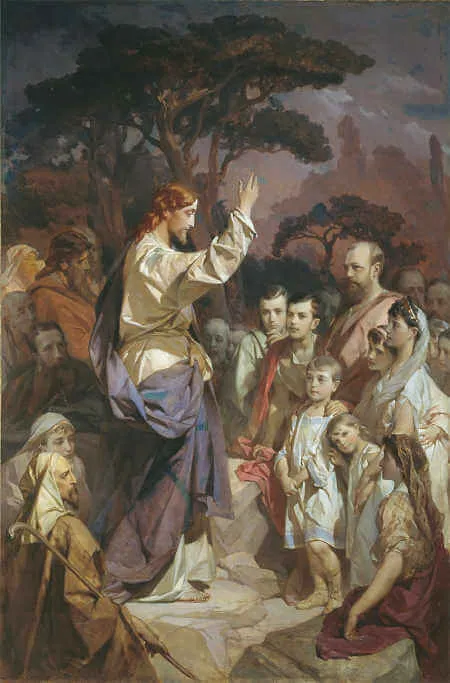
“When you fast, do not look gloomy like the hypocrites. They neglect their appearance, so that they may appear to others to be fasting. Amen, I say to you, they have received their reward. But when you fast, anoint your head and wash your face, so that you may not appear to others to be fasting, except to your Father who is hidden. And your Father who sees what is hidden will repay you.”

Reflection:

Many today have abandoned the holy practice of fasting. Fasting is a powerful penitential practice that bestows great benefits upon the soul. The act of self-denial from certain food and drink, choosing instead simple nourishment from time to time, such as bread and water, or a reduced amount of food, greatly strengthens the soul and disposes a person to many spiritual blessings. Too often, we live for fleshly satisfactions and fall into the trap of trying to indulge our appetites on a regular basis. But doing so has the negative effect of tempting us to neglect the more important spiritual desires for holiness. By depriving ourselves of sensory delights from time to time, we become more disposed to seek the true and lasting delights that come only from God’s grace. Therefore, this passage above presumes that we do regularly fast and engage in other forms of self-denial. 

Do you fast? Do you engage in other forms of self-denial on a regular basis? Daily prayer, reading the Scriptures, learning about the lives of the saints, and regular participation in the Sacraments all lead us closer to God and make us holy. But fasting and self-denial are also very important, so it is essential that we strive to embrace them as a part of our spiritual growth.

In this passage, Jesus specifically calls us to seek the interior rewards that come from fasting and self-denial. He points out that if we use fasting as a way of gaining praise from others, then we lose the spiritual benefits of our fasting. Prayer, fasting, and almsgiving must all be done in a way that they are as hidden as possible so that our acts are truly sincere and not done so as to receive the earthly rewards of the admiration of others.

Additionally, the lesson taught in this Gospel can also be applied to other areas of our lives. For example, if you are suffering from some illness or some form of bodily pain or discomfort, then of course you should seek the necessary medical attention. But these physical ailments also offer us another opportunity for spiritual growth when they are embraced in a silent and interior way. Even our pain or discomfort can be transformed into grace if we choose to embrace it with joy, offer it to God as a sacrifice, and keep it to ourselves as a silent gift given to God.

Reflect, today, upon your practice of fasting, as well as every other opportunity you have each day to make silent and interior sacrifices to God. If you do suffer from some daily cross that is beyond your control, then try to turn it into a spiritual offering to our Lord. And if you are able to freely embrace fasting on a regular basis, then try to prayerfully commit to this practice. Try to do it every week, especially on Friday in honor of the Good Friday sacrifice made by our Lord. Don’t underestimate the value of these hidden sacrifices. Make them a regular part of your spiritual life and God will bestow upon you many spiritual riches from Heaven.

Source: https://catholic-daily-reflections.com/2024/06/18/transformed-by-silent-sacrifices-3/
Matthew 6:16-18 Read More »

Saint Gregory Barbarigo

Profile

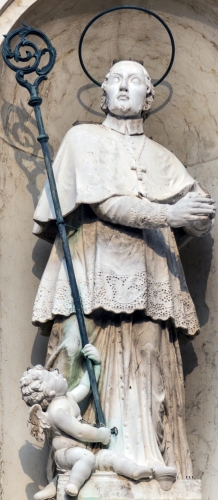
Gregory was the son of a Venetian senator. He was educated at the University of Padua. He was a civil and canon lawyer. He worked on the negotiations for the Peace of Westphalia that ended the Thirty Years’ War on 24 October 1648; one of his co-workers was archbishop Fabio Chigi, the future Pope Alexander VII. He was ordained on 21 December 1655. He was a domestic prelate to Pope Alexander VII. He was a referendary of the Tribunals of the Apostolic Signature of Justice and of Grace. He became the Bishop of Bergamo, Italy on 9 July 1657. He was elevated as Cardinal on 5 April 1660 and the Bishop of Padua, Italy on 24 March 1664. He was part of the conclave of 1667 that chose Pope Clement IX and part of the conclave of 1676 that chose Blessed Pope Innocent XI. He supervised Catholic teaching in Rome, Italy for three years. He was part of the conclave of 1689 that chose Pope Alexander VIII and the conclave of 1691 that chose Pope Innocent XII. He was noted as a distinguished churchman and leading citizen whose charities were on a princely scale. He worked for unity of the Latin and Orthodox Churches.

Born

  • 16 September 1625 at Venice, Italy as Gregorio Giovanni Gasparo Barbarigo

Died

  • 18 June 1697 at Padua, Italy of natural causes
  • buried in the cathedral of Padua

Beatified

  • 6 July 1761 by Pope Clement XIII

Canonized

  • 26 May 1960 by Blessed Pope John XXIII

Patronage

  • Bergamo, Italy, diocese of

Source: https://catholicsaints.info/saint-gregory-barbarigo/

Saint Gregory Barbarigo Read More »

Matthew 5:43-45

The "Gift" of Being Persecuted

Jesus said to his disciples: “You have heard that it was said, You shall love your neighbor and hate your enemy. But I say to you, love your enemies and pray for those who persecute you, that you may be children of your heavenly Father, for he makes his sun rise on the bad and the good, and causes rain to fall on the just and the unjust.”

Reflection:

Jesus continues to deepen and clarify His call to His new command to love of others. The love to which He calls us is radical, total, and can be very challenging at first. He calls us to move far beyond the Old Testament understanding of justice by commanding that we love everyone, including those who persecute us. This call to love is not an option but a command. It’s a requirement for every Christian.

In implementing this command, Jesus gives us not only the command itself but also offers some very practical advice on how we can achieve this depth of love. He says that we should not only love our enemies but that we should pray for them when they persecute us. First of all, an “enemy” is one who tries to inflict some form of harm on us and, generally speaking, sins against us. The common response to these experiences is to defend ourselves and fight back. So the first step is to reject any such temptation. As Jesus said in the Gospel passage prior to this one, “offer no resistance to one who is evil.”

Today’s Gospel passage takes us even further. The practical advice our Lord gives is to “pray for those who persecute you.” This command not only requires that you reject the temptation to “get back” at a person or even to simply “resist” what they do to us. You must now pray for them. Praying for someone who sins against you is an act of the greatest charity and generosity. And it’s a very practical way to imitate the abundant mercy of God. For that reason, praying for your persecutors radically transforms you interiorly and makes you holy. In a sense, the evil another does to you has the potential to be transformed into a gift given to you, because it gives you an opportunity to return prayer for an injury inflicted. And that is a very real and practical gift we must embrace by this new command of our Lord.

Reflect, today, upon those for whom this new commandment calls you to pray. Whose sin has inflicted some hurt or injury upon you or your family? Who do you hold a grudge toward? Whoever comes to mind, commit yourself to deep and sustained prayer for that person. Pray often for them and continue that prayer for as long as the persecution continues. Doing so will transform any and every attempted malice issued toward you into grace for them and holiness for you.

Source: https://catholic-daily-reflections.com/2024/06/17/the-gift-of-being-persecuted-3/

Matthew 5:43-45 Read More »

Saint Herve

Profile

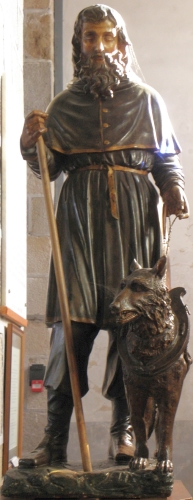
Son of the bard Hyvarnion, Herve was born blind. His father died when he was an infant. His mother, Rivanone, became an anchoress, and the boy was entrusted to the care of his uncles and a renowned holy man with whom he stayed until his teenage years. He lived for a while as a hermit and bard, then joined a monastic school at Plouvien, France which had been founded by his uncle. He was an abbot at Plouvien. He migrated with part of his community to found a new house in Lanhouarneau. He was a singer, minstrel, teacher, and a miracle worker. One of the most popular saints in Brittany, he figures in the area’s folklore. He was reported to have a special ministry of healing animals, and to have a domesticated wolf as a companion. Legend says that the wolf killed and ate the ox that Herve used to plow his fields; Herve then preached such a moving sermon the wolf repented his ways, moved to Herve’s hermitage, and ploughed Herve’s fields in place of the ox.

Born

  • Guimiliau, Brittany, France or unknown location in Wales (sources vary)

Died

  • c.556 to c.575 (sources vary) of natural causes
    interred at Lanhouarneau, Brittany, France

Canonized

  • Pre-Congregation

Patronage

  • against eye disease
  • against eye problems
  • blind people
  • in France
    – Brest
    – Plouvien

Representation

  • blind man being led by a wolf

Source: https://catholicsaints.info/saint-herve/

Saint Herve Read More »

Matthew 5:41-42

A New Depth of Mercy

Should anyone press you into service for one mile, go with him for two miles. Give to the one who asks of you, and do not turn your back on one who wants to borrow.”

Reflection:

As the faith of Israel developed over the centuries, prior to the coming of Christ, there were various stages of advancement in morality. Prior to the establishment of moral laws in the Old Testament, it was common for families to inflict severe vengeance upon other families when harm was done to them. This caused ongoing violence and feuds. But advancements were made when the law of retaliation was established which said, “When a man causes a disfigurement in his neighbor, as he has done it shall be done to him, fracture for fracture, eye for eye, tooth for tooth; as he has disfigured a man, he shall be disfigured” (Leviticus 24:19–20). This was a new form of justice that forbade the vengeance from being more severe than the crime that was retaliated against. At the time, this helped end ongoing family feuds that continually escalated.

It is this law of retaliation that Jesus addresses in our Gospel today. The new and much higher form of morality that Jesus taught called His disciples to “offer no resistance to one who is evil” and to turn the other cheek when evil was done to them. Though strict justice requires satisfaction for sin, Jesus’ new teaching was that mercy pays every debt. First, His mercy bestowed upon us, for the forgiveness of our sins, pays the debt of our sins when we truly repent and change. But if we desire our debts to God for our sins to be forgiven and repaid, then we must do the same to others, holding nothing against them.

But Jesus goes even further. In the passage quoted above, Jesus exhorts His disciples to a new and radical form of charity and generosity. This new moral code was how the children of the Kingdom of God were now called to act. It was not enough to only forgive and to forget the debt one owes you because of their sin. Mercy now requires us to “Give to the one who asks” and to walk “two miles” with one who only asks you to walk one mile with them. In other words, Christian charity far exceeds every concept of strict justice and even goes beyond basic forgiveness. This was certainly a new and radical teaching from our Lord.

Think about this new moral law in your own life. What level of “justice” do you most commonly live by? When someone wrongs you, do you live like those prior to the Old Testament laws by seeking to get back at them to an even greater degree than the harm done to you? Do you live by the law that seeks the equal justice of an eye for an eye? Do you seek to forgive and offer mercy as a payment for the debt another has incurred by the sin they have committed against you? Or, ideally, do you strive to go even beyond the act of forgiveness and bestow mercy in a new and generous, superabundant way? This last level of love is difficult to obtain and live, but it is the way our Lord treats us and it is the way that He calls us to treat others.

Reflect, today, upon any hurt you may currently be struggling with. And consider the way in which you have been dealing with that hurt. As you seek to understand this new law of love and mercy given by our Lord, pray to Him that He will give you the grace you need to give to others the same level of mercy that God gives to you.

Source: https://catholic-daily-reflections.com/2024/06/16/a-new-depth-of-mercy-3/ 

Matthew 5:41-42 Read More »

Eleventh Sunday in Ordinary Time

First Reading Ezekiel 17:22-24

Thus says the Lord GOD:
I, too, will take from the crest of the cedar,
from its topmost branches tear off a tender shoot,
and plant it on a high and lofty mountain;
on the mountain heights of Israel I will plant it.
It shall put forth branches and bear fruit,
and become a majestic cedar.
Birds of every kind shall dwell beneath it,
every winged thing in the shade of its boughs.
And all the trees of the field shall know
that I, the LORD,
bring low the high tree,
lift high the lowly tree,
wither up the green tree,
and make the withered tree bloom.
As I, the LORD, have spoken, so will I do.

Responsorial Psalm Psalms 92:2-3, 13-14, 15-16

R. (cf. 2a) Lord, it is good to give thanks to you.

It is good to give thanks to the LORD,
to sing praise to your name, Most High,
To proclaim your kindness at dawn
and your faithfulness throughout the night.

R. Lord, it is good to give thanks to you.
The just one shall flourish like the palm tree,
like a cedar of Lebanon shall he grow.
They that are planted in the house of the LORD
shall flourish in the courts of our God.

R. Lord, it is good to give thanks to you.

They shall bear fruit even in old age;
vigorous and sturdy shall they be,
Declaring how just is the LORD,
my rock, in whom there is no wrong.

R. Lord, it is good to give thanks to you.

Second Reading 2 Corinthians 5:6-10

Brothers and sisters:
We are always courageous,
although we know that while we are at home in the body
we are away from the Lord,
for we walk by faith, not by sight.
Yet we are courageous,
and we would rather leave the body and go home to the Lord.
Therefore, we aspire to please him,
whether we are at home or away.
For we must all appear before the judgment seat of Christ,
so that each may receive recompense,
according to what he did in the body, whether good or evil.

Alleluia

R. Alleluia, alleluia.
 
The seed is the word of God, Christ is the sower.
All who come to him will live forever.
 
R. Alleluia, alleluia.

Gospel Mark 4:26-34

Jesus said to the crowds:
“This is how it is with the kingdom of God;
it is as if a man were to scatter seed on the land
and would sleep and rise night and day
and through it all the seed would sprout and grow,
he knows not how.
Of its own accord the land yields fruit,
first the blade, then the ear, then the full grain in the ear.
And when the grain is ripe, he wields the sickle at once,
for the harvest has come.”

He said,
“To what shall we compare the kingdom of God,
or what parable can we use for it?
It is like a mustard seed that, when it is sown in the ground,
is the smallest of all the seeds on the earth.
But once it is sown, it springs up and becomes the largest of plants
and puts forth large branches,
so that the birds of the sky can dwell in its shade.”
With many such parables
he spoke the word to them as they were able to understand it.
Without parables he did not speak to them,
but to his own disciples he explained everything in private.

Source: https://bible.usccb.org/bible/readings/061624.cfm

Eleventh Sunday in Ordinary Time Read More »

Saint Lutgardis

Profile

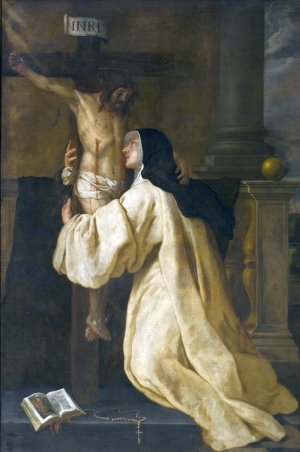
A pretty girl with a fondness for clothes and no apparent religious vocation, Lutgardis was sent to the Black Benedictine convent near Saint Trond at age 12 because her dowry had been lost in a failed business venture, and there was thus little chance for a life as a normal, married lay woman. In her late teens, Lutgardis received a vision of Christ showing her His wounds, and in 1194 at age 20 she became a Benedictine nun with a true vocation. She had visions of Christ while in prayer, experienced ecstasies, levitated, and dripped blood from forehead and hair when enraptured by the Passion. She was chosen as prioress of her community in 1205, but she repeatedly refused to be abbess.

The Benedictine order was not strict enough for Lutgardis, and on the advice of her friend Saint Christina the Astonishing, in 1208 she joined the Cistercians at Aywieres (near Brussels in modern Belgium) where she lived for her remaining 30 years. She displayed the gifts of healing, prophecy, spiritual wisdom, and was an inspired teacher on the Gospels. Blind for the last eleven years of her life, she treated the affliction as a gift – it reduced the distraction of the outside world. In one of her last visions, Christ told her when she was to die; she spent the time remaining in prayer for the conversion of sinners.

Born

  • 1182 at Tongres, Limburg, Belgium

Died

  • 16 June 1246 at Aywieres (modern Awirs), Belgium of natural causes, just as night office began on the Saturday night following Feast of the Holy Trinity
  • relics transferred to Ittre, Belgium on 4 December 1796 to avoid destruction in the French Revolution

Patronage

  • birth
  • blind people
  • blindness
  • childbirth
  • disabled people
  • handicapped people
  • physically challenged people
  • Belgium
  • in Belgium
    – Flanders
    – Tongeren

Representation

  • woman with Christ showing her His wounded side
  • blind Cistercian abbess
  • Cistercian nun being blinded by the Heart of Jesus
  • Cistercian to whom Christ extends his hand from the cross
  • woman in attendance when Christ shows his Heart to the Father

Source: https://catholicsaints.info/saint-lutgardis/

Saint Lutgardis Read More »

Mark 4:33-34

The Mysteries of the Kingdom

With many such parables he spoke the word to them as they were able to understand it. Without parables he did not speak to them, but to his own disciples he explained everything in private. 

Reflection:

The deepest mysteries of our faith can only be understood by someone who has deep faith. Understanding requires much more than just a keen intellect; it also requires an interior attentiveness to and familiarity with the voice of God. For that reason, as Jesus spoke to the crowds, He used parables and figures of speech rather than speaking directly about the mysteries of Heaven.

By analogy, if you were to attend a very special feast and you had well-formed taste buds, you might enjoy being served the best cut of meat cooked to perfection with a fine glass of wine. But to a small child, such a meal might not be that appealing. The same is true with music. If you were a musician who studied and played music throughout life, then you might have a greater appreciation for certain types of music. Others might simply be drawn to a certain type of music by the beat or because it has catchy lyrics.

In a similar way, a person who has only a little faith might not be immediately drawn into the deepest mystical truths of God when they are explained directly and clearly. Instead, they might find that a simplified Gospel message that uses familiar imagery or stories is better able to catch their attention and communicate the message.

This is good for us to understand because it’s good for us to turn to the means of communication with God most suited for our depth of faith and understanding. For most people, it will be very useful to see themselves as one of those people in the crowds to whom Jesus spoke His parables. We should especially see ourselves as a part of the crowds as we begin our journey of faith. However, when a person has spent much time in prayer and meditation over the years and their faith begins to deepen, they may find that parables and stories are not as inspiring as they once were. They need more. They long for God to speak to them more clearly and deeply.

Practically speaking, as your faith grows, it is good to look for the deeper ways that God speaks to you. How does He come to you and explain His will and the truths of faith more directly as Jesus did to the Apostles? Perhaps reading the lives of the saints, the Catechism of the Catholic Church, or some other spiritual book will engage you more deeply. Also, some Scripture passages may feed you more as you grow in faith, such as the passages where Jesus speaks more directly to His disciples.

Reflect, today, upon the way that you are most fully fed by God’s holy Word at this point in your life. The best way to identify this is to consider what it is that has given you the most consolation and inspiration as of late. How has God’s Word most powerfully resonated within you over this past year? Identifying the way that God has spoken to you recently is the best way to decide how to continue to receive from Him all that He wants to teach you and reveal to you at this point of your journey of faith. Continue to seek out God’s voice, and be open to letting Him draw you ever more deeply into the beautiful depths of the mysteries of His Kingdom.

Source: https://catholic-daily-reflections.com/2024/06/15/the-mysteries-of-the-kingdom/

Mark 4:33-34 Read More »

Saint Luigi Maria Palazzolo

Profile

Luigi Maria was the youngest of eight boys, born to Octavius and Theresa Antoine Palazzolo; his father died when he was about 10 years old. He was ordained a priest in the diocese of Bergamo, Italy on 23 June 1850. As a parish priest, he would occasionally encounter children who were abandoned or orphaned and living on their own; he would take them in and care for them until he could get them placed somewhere caring and safe. He founded the Little House of Divine Providence to care for neglected children, and the Work of Saint Dorothy. home to care for abandoned girls. He founded the Brothers of the Sacred Family, a congregation that died out in 1928. With Venerable Maria Teresa Gabrieli, he founded the Sisters of the Poor (Poverelle Sisters; Palazzolo Institute) on 22 May 1869 to care for and educate neglected girls; the Sisters received papal approval from Pope Pius X on 25 May 1912, and continue their good work today in Brazil, Burkina Faso, Congo, Italy, Ivory Coast, Kenya, Malawi, Peru and Switzerland. He founded an orphanage in Traona, Italy on 4 October 1872. Due to respiratory problems, Father Luigi had to sleep sitting up during the last year or so of his life.

Born

  • 10 December 1827 in Bergamo, Kingdom of Lombardy-Venetia (in modern Italy)

Died

  • in the early hours of 15 June 1886 in Bergamo, Italy of natural causes
  • he died murmuring the name “Jesus Christ” over and over
  • buried in the cemetery of San Giorgio in Bergamo
  • re-interred at the mother-house of the Poverelle Sisters, Via San Bernardino 56, Bergamo, on 4 January 1904

Venerated

  • 7 July 1962 by Pope John XXIII (decree of heroic virtues)

Beatified

  • 19 March 1963 by Pope John XXIII
  • beatification recognition celebrated in the Basilica of Saint Peter in Rome, Italy
  • one of the beatification miracles involved the healing of a young Sardinian woman with peritonitis and tuberculosis on the afternoon of 21 July 1956 when she had a vision of Father Luigi asking her to get out of bed and go to church to thank God for her cure
  • another beatification miracle involved the 1959 healing of a 65 year old woman from a severe head injury that left her comatose; the cure followed the family praying for the intercession of Father Luigi

Canonized

  • 15 May 2022 by Pope Francis
  • the canonization miracle involved the healing of Sister Gianmarisa Perani, who had joined the Poverelle Sisters in 1950; in November 2015 was rushed into emergency surgery, experienced complications, lapsed into a coma, and two months later was declared to be terminal; the Sisters prayed for her, she soon after recovered, and is alive and well today
  • Decree on a Miracle by Blessed Aloysius Maria Palazzolo, Priest Founder of the Institute of Sisters of the Poor v.d. “Suore delle Poverelle – Istituto Palazzolo” (1827-1866)

Patronage

  • Sisters of the Poor

Source: https://catholicsaints.info/saint-luigi-maria-palazzolo/

Saint Luigi Maria Palazzolo Read More »

Matthew 5:33-34

Daily Sincerity and Honesty

Jesus said to his disciples: “You have heard that it was said to your ancestors, Do not take a false oath, but make good to the Lord all that you vow. But I say to you, do not swear at all…”

Reflection:

The purpose of an oath was to guarantee the truthfulness of the statement made. Sometimes this can be very good. For example, many of the Sacraments involve making a public vow before God and the Church. In these cases, the vow is a form of oath that is solemnized so as to invite the grace of God to enter and strengthen it. It becomes a way of making a public witness to one’s faith and an expression of one’s need for God’s grace to be faithful to the promise that is made.

Jesus is not speaking about these forms of public vows, oaths and promises in the Gospel today. Instead, He is addressing a practice that some engaged in, whereby they regularly swore on God’s name about the truthfulness of what they were saying. The problem with this is that it takes something solemn and sacred and carelessly turns it into something ordinary. There is no need to “swear to God” about everything one says.

First of all, if one feels a need to call on God’s name regularly so as to convince another of the truthfulness of their statements, then it is most likely the case that they do so because they are struggling with dishonesty. Oath-taking on a regular basis seems to presuppose a human tendency to lie. For that reason, it is not ideal to go about one’s daily interactions with this presupposition. Instead, as Christians we must strive for a fundamental disposition of truthfulness. Jesus concludes this Gospel teaching by saying, “Let your ‘Yes’ mean ‘Yes,’ and your ‘No’ mean ‘No.’ Anything more is from the Evil One.” In other words, work to become a person of true honesty and integrity. Be sincere in all of your dealings, and do not begin with a presupposition of dishonesty. Begin with the intention of complete honesty and sincerity, and that will suffice.

Furthermore, if one were to go about their day making one oath after another, swearing on God’s name to the truthfulness every time, this would have the effect of lessening the solemnity of those few times when this is a good and holy practice. Making public vows, such as marriage vows, or public promises, such as priests make, are unique and solemn. Publicly renewing our faith within the Church, taking an oath as one begins the responsibility of some public office, or any other more solemn opportunity for oath-taking should be seen as a special occasion. Therefore, our daily commitments must simply be the fruit of our honesty and integrity as persons.

Reflect, today, upon your own daily approach to honesty and sincerity. Do you go about your day with the goal of living in the truth, speaking the truth and seeking the truth? Are you honest with others, seeking good and clear communication with them? Ponder these questions and know that interior integrity requires these virtues of honesty and sincerity. Seek that integrity and others will benefit as they grow to trust you each and every day.

Source: https://catholic-daily-reflections.com/2024/06/14/daily-sincerity-and-honesty/

Matthew 5:33-34 Read More »