2024

Twelfth Sunday in Ordinary Time

First Reading Job 38:1, 8-11

The Lord addressed Job out of the storm and said:
    Who shut within doors the sea,
        when it burst forth from the womb;
    when I made the clouds its garment
        and thick darkness its swaddling bands?
    When I set limits for it
        and fastened the bar of its door,
    and said: Thus far shall you come but no farther,
        and here shall your proud waves be stilled!

Responsorial Psalm 107:23-24, 25-26, 28-29, 30-31

R. (1b) Give thanks to the Lord, his love is everlasting.

They who sailed the sea in ships,
    trading on the deep waters,
These saw the works of the LORD
    and his wonders in the abyss.

R. Give thanks to the Lord, his love is everlasting.

His command raised up a storm wind
    which tossed its waves on high.
They mounted up to heaven; they sank to the depths;
    their hearts melted away in their plight.

R. Give thanks to the Lord, his love is everlasting.

They cried to the LORD in their distress;
    from their straits he rescued them,
He hushed the storm to a gentle breeze,
    and the billows of the sea were stilled.

R. Give thanks to the Lord, his love is everlasting.

They rejoiced that they were calmed,
    and he brought them to their desired haven.
Let them give thanks to the LORD for his kindness
    and his wondrous deeds to the children of men.

R. Give thanks to the Lord, his love is everlasting.

Second Reading 2 Corinthians 5:14-17

Brothers and sisters:
The love of Christ impels us,
once we have come to the conviction that one died for all;
therefore, all have died.
He indeed died for all,
so that those who live might no longer live for themselves
but for him who for their sake died and was raised.

Consequently, from now on we regard no one according to the flesh;
even if we once knew Christ according to the flesh,
yet now we know him so no longer.
So whoever is in Christ is a new creation:
the old things have passed away;
behold, new things have come.

Alleluia Luke 7:16

R.    Alleluia, alleluia.

A great prophet has risen in our midst 
God has visited his people.

R.    Alleluia, alleluia.

Gospel Mark 4:35-41

On that day, as evening drew on, Jesus said to his disciples:
“Let us cross to the other side.”
Leaving the crowd, they took Jesus with them in the boat just as he was.
And other boats were with him.
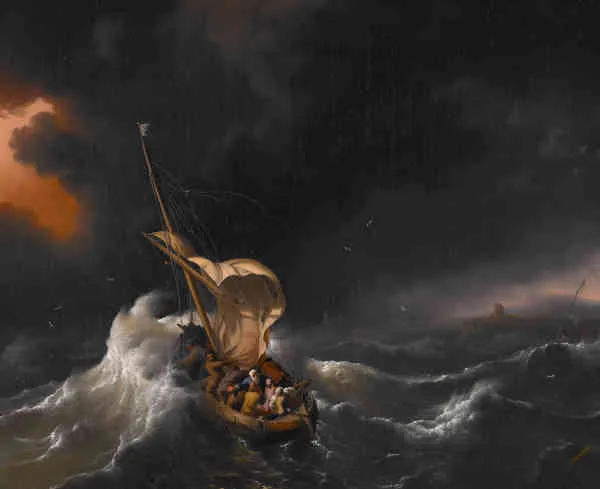
A violent squall came up and waves were breaking over the boat,
so that it was already filling up.
Jesus was in the stern, asleep on a cushion.
They woke him and said to him,
“Teacher, do you not care that we are perishing?”
He woke up,
rebuked the wind, and said to the sea, “Quiet!  Be still!”
The wind ceased and there was great calm.
Then he asked them, “Why are you terrified?
Do you not yet have faith?”
They were filled with great awe and said to one another,
“Who then is this whom even wind and sea obey?”

Source: https://bible.usccb.org/bible/readings/062324.cfm

Twelfth Sunday in Ordinary Time Read More »

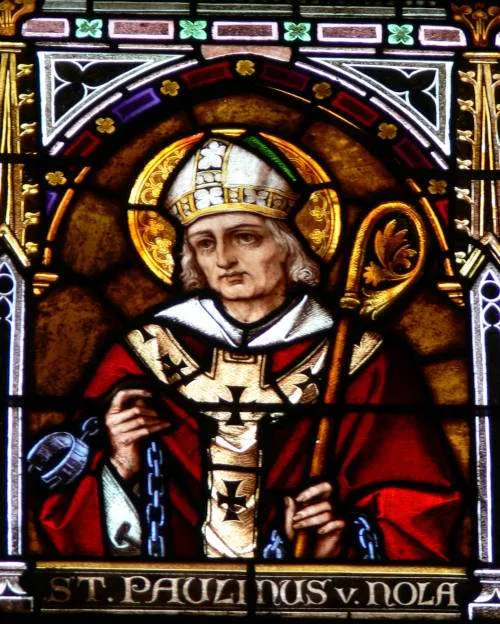
Saint Paulinus of Nola, Bishop

c. 354–431; Patron Saint of bellmakers; Invoked by the people of Nola, Italy; Pre-Congregation canonization

Pontius Meropius Anicius Paulinus, more simply known as Paulinus, was born in Bordeaux, modern-day France, into a noble senatorial family. Bordeaux, then part of the Roman Empire, was a major center for learning, culture, and trade. As a member of the nobility, Paulinus would have received an excellent education in preparation for a career in civil service. Among his teachers was the famous poet Ausonius, under whom he studied literature and rhetoric. Around the age of twenty-three, his career entered full swing when the Roman Emperor, Gratian, appointed him as a suffect consul at Rome, a position held in high esteem among the ruling class. A few years later, the emperor appointed him as governor of Campania, a region that included Naples and many surrounding cities, including Nola.

Though less important than many other cities when he was governor, Nola caught Paulinus’ attention because the townspeople had a great reverence for the third-century martyr Saint Felix who was buried there. Saint Felix was a priest likely martyred during the persecution of either Decius or Valerian between 251–260. Inspired by the locals’ devotion to Saint Felix, Paulinus built a road to make it easier for pilgrims to travel to his tomb, as well as a hospice where they could stay. Although Paulinus held an important position of power as governor, the faith and devotion that the people had for Saint Felix stirred in him a desire for something greater, leading him to inquire into the Catholic faith.

After the assassination of Roman Emperor Gratian in 383, Paulinus moved to Milan to study the Catholic faith, most likely under Saint Ambrose. He then returned home to Bordeaux where he continued his studies, was baptized by the bishop, and married Therasia, a noblewoman from Barcelona. Therasia’s strong faith greatly influenced Paulinus, helping him to grow closer to Christ and embrace a more radical life of prayer and asceticism. Not long after their marriage, Therasia gave birth to a son, but the child died within a week. This profound event, instead of leading them to anger or despair, prompted Paulinus and Therasia to deepen their devotion and trust in God. They felt God calling them to a more intense life of prayer and asceticism. Consequently, they sold most of their possessions, donated the money to the poor, and mutually agreed to live in abstinence as husband and wife.

While in Barcelona, Paulinus’ faith and good works became so well known that he was asked to become a priest. His ordination either took place in Barcelona or back in Campania, where Paulinus had been governor and where he first discovered the Catholic faith. In Campania, Paulinus and Therasia settled in Nola, Saint Felix’s burial site, since Paulinus attributed his conversion to Saint Felix.

In Nola, Paulinus and his wife began to spread the faith by embracing a new form of monastic life that they shared and invited others to join. They spread devotion to Saint Felix by constructing a monastic center for pilgrims, places of worship, and infrastructure to help with basic needs. They were very generous to the poor, even though they themselves chose to live in poverty. After Therasia died, Paulinus was chosen as bishop of Nola around 409, when he was about fifty-six years old. He would carry out this responsibility until his death, twenty-two years later.

As bishop of Nola, Paulinus continued to spread the Gospel and serve the poor with great generosity. He also used his education in poetry to write many faith-based poems and hymns. Though he was praised by many, some questioned the wisdom of his Christian vocation. His former teacher, the great poet Ausonius, saw his poverty and generosity toward the poor as irrational, and his abandonment of pagan poetry as an abandonment of poetry itself. However, Bishop Paulinus’ love for the poor was a much deeper realization of the value of material possessions and their purpose. As for his training in poetry, Bishop Paulinus used those natural talents for a much higher calling, putting them at the service of the Gospel.

Bishop Paulinus wrote many letters, some of which still exist. Most notably, he was in written communication with the great Saint Augustine of Hippo, who even mentioned Paulinus in his Christian classic, The City of God. Additionally, Paulinus corresponded with Saint Martin of Tours, Saint Jerome, and many others. Regarding Paulinus’s writings, Pope Benedict XVI said, “Saint Paulinus did not write theological treatises, but his poems and ample correspondence are rich in a lived theology, woven from God’s Word, constantly examined as a light for life. The sense of the Church as a mystery of unity emerges in particular from them. Paulinus lived communion above all through a pronounced practice of spiritual friendship. He was truly a master in this, making his life a crossroads of elect spirits…”

Saint Paulinus began his life with wealth, noble status, and civil power. When he saw the devotion that the faithful had toward Saint Felix, he realized there was more to life than the pursuits that had occupied him. When his wife and he tragically experienced the loss of their child, they didn’t turn to self-pity or anger. The couple used their loss as an opportunity to more fully abandon themselves to the will of God. When Paulinus’ wife died, he devoted himself even more fully to the service of God and His Church through his episcopal ministry and generosity to the poor and the pilgrims. He used his natural talents for the glory of God through his hymns, poetry, and extensive correspondence with others, and inspired others to join him in a life of prayer and asceticism.

As we honor Saint Paulinus today, ponder your own journey of faith. Looking back at life, especially at any challenges you have faced, have you allowed God’s grace to strengthen you through those challenges, or have you turned away as a result? Allow Saint Paulinus to inspire you on your journey, using every challenge and every natural gift for the sole purpose of glorifying God and fulfilling His perfect will.

Source: https://mycatholic.life/saints/saints-of-the-liturgical-year/june-22—saint-paulinus-of-nola-bishop/

Saint Paulinus of Nola, Bishop Read More »

Mark 4:38-39

God is Speaking

Jesus was in the stern, asleep on a cushion. They woke him and said to him, “Teacher, do you not care that we are perishing?” He woke up, rebuked the wind, and said to the sea, “Quiet!  Be still!” The wind ceased and there was great calm.

Reflection:

Do you desire to hear God speak to you? The most common way this happens is through prayerful meditation on the Gospels. Over the centuries, the saints have prayerfully pondered the Gospels and have offered various insights on the stories and our Lord’s actions. Their insights are not primarily an intellectual exercise. Rather, they are first an exercise of prayer and meditation, revealing that the Scriptures have various layers of depth and meaning. 

One Church Father, Saint Bede, explains from his prayerful pondering of today’s Gospel passage that the boat in which Jesus crossed the sea represents the Cross by which safe passage is obtained to arrive at the shores of Heaven. The other boats that followed represent those who have faith in the Cross of Christ and follow. Though they suffer the waves of temptation and hardship, they press on, relying upon the saving power of the Cross. Jesus being asleep represents His sleep of death, and His wakening represents His resurrection. The pleas of the disciples represent our need to turn to Jesus during the storms and temptations of life. The rebuke of the waves and the ensuing calm reveal the grace won by His death and resurrection, which is able to silence the demons and disordered passions. The fear that the disciples encountered points to our own fear that results from a lack of faith and trust in God.

God is able to speak these and many other truths to us through His actions and words contained in the Scriptures. There is no limit to the depth and meaning we can receive through His holy Word. Therefore, though it is useful to reflect upon the saints’ various interpretations of the Gospels, it is also very important to reflect upon these passages ourselves, so as to allow our Lord to speak to us the message we need to hear.

Reflect, today, upon this Gospel scene. Try to find time to slowly read today’s Gospel from beginning to end. Read a sentence and then close your eyes and try to imagine it. See Jesus entering the boat. Ponder the boat being an image of the Cross. See the sea as the many evils within this world. Consider the fear the disciples encountered during the storm. See yourself in that boat, waking our Lord. Listen to Him silence the waves and restore peace. Hear Him say to you about your own struggles in life: “Why are you terrified? Do you not yet have faith?” As you prayerfully meditate upon this and other Gospel passages, know that God will speak to you and reveal to you the meaning that He wishes to communicate to you today.

Source: https://catholic-daily-reflections.com/2024/06/22/god-is-speaking/

Mark 4:38-39 Read More »

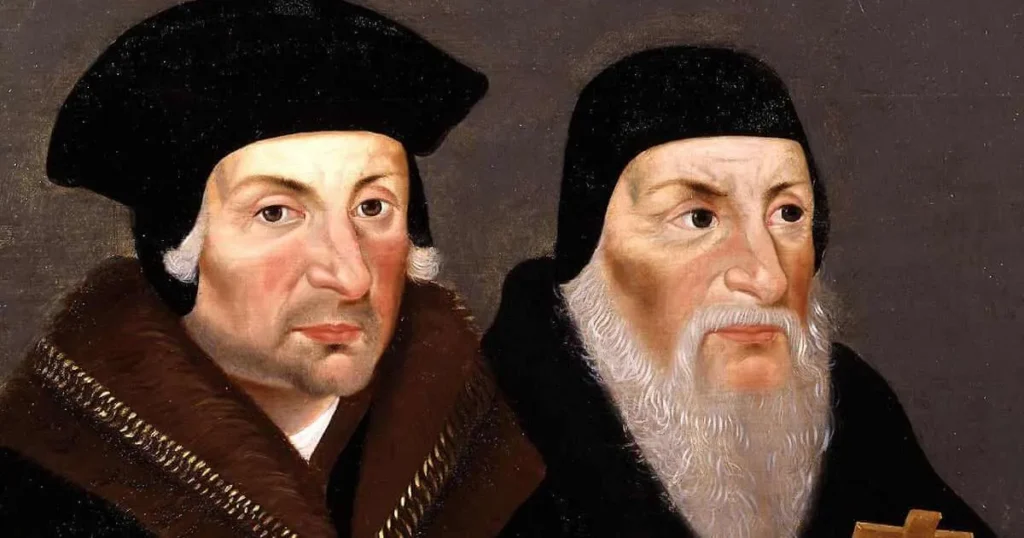
Saint John Fisher, Bishop and Marty; Saint Thomas More, Martyr

Saint John Fisher: 1469–1535; Invoked for courage and by those who are persecuted

Saint Thomas More: 1478–1535; Patron Saint of statesmen, politicians, lawyers, civil servants, court clerks, adopted children, large families, stepparents, and difficult marriages; Canonized by Pope Pius XI on May 19, 1935

Throughout the 1400s, the Catholic Church played a central role in the religious, cultural, and political fabric of England. Magnificent churches were built, monasteries thrived, clergy wielded influence, religious holidays were nationalized, and the Catholic Church collaborated with the state, in union with Rome. However, the tide began to shift during the rule of King Henry VIII (1509–1547) when King Henry severed ties between the Church of England and Rome to secure his divorce and remarriage. One year later, in 1535, the king martyred two of England’s greatest Catholic saints who opposed him, both of whom we honor today.

John Fisher was born in Beverley, Yorkshire, England, in 1469. At the age of fifteen, Fisher enrolled in the University of Cambridge, where he pursued studies in theology. He was ordained a priest around the age of twenty-two. His academic excellence led to an invitation to remain at Cambridge, where he fulfilled roles as a chaplain, professor, and eventually Vice-Chancellor and Chancellor.

In 1504, when he was approximately thirty-five years old, Father Fisher was ordained a bishop and appointed to the Diocese of Rochester. Despite serving in one of the smallest and poorest dioceses in England, Bishop Fisher became renowned for his preaching, pastoral care, and adherence to orthodox faith.

Thomas More was born in London, England, in 1478. His father, a well-respected lawyer and judge, ensured that Thomas received an education at one of London’s finest schools. At the age of twelve, Thomas served in the household of Archbishop John Morton of Canterbury, who was also the Lord Chancellor of England. Thomas’ intelligence quickly became evident, leading to his enrollment at the University of Oxford to prepare for future legal studies. During this time, he developed a strong faith, influenced by the witness of the Carthusians monks, and he contemplated a monastic vocation himself. Although he eventually chose a career in law, his life of prayer and penitential practices blossomed.

In 1505, Thomas married Jane Colt, with whom he had four children. He began working in Parliament and gained a favorable reputation. In 1510, he was appointed as an undersheriff of London, one of the city’s highest law enforcement positions. Unfortunately, Jane passed away in 1511, leaving Thomas with four young children. He soon married Alice Middleton, who lovingly cared for his children as a mother.

Over the next twenty-one years, Thomas’ faith, family, and career thrived. He became a member of the King’s Council, was knighted by King Henry VIII, and was elected as Speaker of the House of Commons. In 1529, he became the first layman to hold the post of Lord Chancellor, the highest-ranking legal position in England. After serving for approximately three years, he resigned, citing reasons of health. His primary motivation, however, was his opposition to Henry VIII’s actions regarding the Catholic Church.

The seeds of trouble were sewn in 1501 when Arthur, Prince of Wales, the firstborn son of King Henry VII, married Catherine of Aragon. The couple expected to ascend to the throne as king and queen after Arthur’s father’s death. However, Prince Arthur died five months later, passing the right of succession to the throne to his younger brother, Henry. An arrangement was made for Henry to marry Catherine, his late brother’s wife, once Henry came of age. Although such a marriage was typically prohibited, the pope granted a dispensation, based on Catherine’s testimony that she and Arthur had never consummated their marriage.

In 1509, King Henry VII passed away, and his son, Henry VIII, assumed the throne and married Catherine. Over the next twenty years, they had six children, all of whom died as infants except for one daughter, Mary, who would later become queen. In 1527, King Henry VIII sought an annulment of his marriage to Catherine, contending that it was invalid because she had, indeed, consummated her marriage to Arthur, which she denied. Henry further asserted that his lack of a male heir was a consequence of this unlawful union, signaling divine displeasure. The pope rejected Henry’s request for an annulment, provoking Henry’s anger and intensifying conflicts between him and the pope, along with those who opposed Henry among the clergy and civil servants.

In 1532, King Henry appointed Thomas Cranmer as the Archbishop of Canterbury. Sympathetic to those who sought reform of the English Church and separation from Rome, Cranmer supported Henry’s desire for a divorce from Catherine. He declared Henry’s first marriage null and void and validated his subsequent marriage to Anne Boleyn in 1533. In 1534, with the backing of Parliament, King Henry VIII proclaimed himself the head of the Church in England, effectively severing ties with the pope and the Roman Catholic Church.

Today’s saints, Saints Thomas More and John Fisher, were among the few who refused to accept the king’s decisions. Bishop John Fisher firmly defended the bond of marriage, stating that he was willing to die, just as Saint John the Baptist did, for the defense of marriage. This outraged the king. Eventually, the king had Bishop Fisher arrested before he could publicly oppose the new queen’s coronation. Though he was initially released, he was arrested again on April 26, 1534, and remained in prison under extremely harsh conditions, deprived even of a priest to minister to him, until his death about fourteen months later. Before Fisher’s death, the pope declared him a cardinal as a way of adding pressure on the king to release him, but this only angered the king more. Cardinal Fisher’s defense was to remain silent and say nothing from prison. Eventually, he was tricked into speaking, confessing his opposition to the king, which led to his beheading. Every other bishop, except for two, gave their support to the king, bringing a painful end to the Catholic Church in England.

Like Cardinal Fisher, Thomas More refused to support the king’s claim that he was the head of the Church of England, and he refused to publicly support the coronation of the new queen. After More refused to attend the coronation, he was arrested and put on trial for treason. His defense was also to remain silent, but he was found guilty and executed about two weeks after Cardinal Fisher. Cardinal Fisher’s head had been mounted on London Bridge for two weeks after his death, but it was taken down and replaced by More’s upon More’s execution.

The fall of the Catholic Church in England is perhaps one of the saddest moments of Church history. However, because of the courage of these two martyrs, it is also one of the brightest. Though they were abandoned by most, they are now honored as saints and martyrs and will forever wear those glorious crowns in Heaven.

As we honor these two great martyrs, ponder their eternal perspective and willingness to endure suffering and death rather than compromise their faith. As you do, pray that you, too, will always live for the glory of God and the salvation of souls, even if it means hardship, suffering, or even death, preferring the glorious crown of righteousness in Heaven.

Source: https://mycatholic.life/saints/saints-of-the-liturgical-year/june-22—saints-john-fisher-bishop-and-martyr-and-thomas-more-martyr/

Saint John Fisher, Bishop and Marty; Saint Thomas More, Martyr Read More »

Matthew 6:24

Singularly Devoted

Jesus said to his disciples: “No one can serve two masters. He will either hate one and love the other, or be devoted to one and despise the other. You cannot serve God and mammon.”

Reflection:

Mammon is another word for money. Jesus is clear that you must choose to serve either God or money, but not both. A divided heart does not suffice. Saint John of the Cross, in His spiritual classic “Ascent to Mount Carmel,” explains something similar. He says that our desires must become completely purified to the point that all we desire is God and His holy will. Every other desire in life must be purged away so that we are singularly devoted to God. Does this mean that God and God alone should be the object of all of our love? Yes, indeed. But that truth must be properly understood.

When we consider the calling we have been given from God to love, it is true that we must love not only God but also many other things in life. We must love family, friends, neighbors, and even our enemies. Hopefully we also love other aspects of our lives, such as our vocation, our job, our home, a certain pastime, etc. So how do we love God with singular devotion when we also have many other things we must love?

The answer is quite simple. The love of God is such that when we make God the singular object of our love and devotion, the love we have for God will supernaturally overflow. This is the nature of the love of God. As we love God, we will find that God calls us to love Him by loving other people and even various aspects of our lives. As we love what God wills us to love and as we express our love for all that is contained in the will of God, we are still loving God with all our heart, mind, soul and strength.

But back to our Scripture above. Why is it that we cannot love God and money? “Mammon” in this passage must be understood as a love that becomes an unhealthy attachment and desire. Money is such that we can “love” it by allowing our desires for it to become disordered and, thus, exclude the will of God from that “love.” Money is not evil when it is used solely in accord with the will of God. In that case, the money we use will give God great glory. But when money, or any other object of our desire, begins to take on a life of its own, so to speak, then that desire will be at odds with our love of God. To love God and God alone means we love God and all that He wills us to love in life.

Reflect, today, upon the necessity of being singularly devoted to God. As you commit yourself to this exclusive love, consider also whom and what God calls you to love in and through Him. Where does His perfect will lead you, and how are you called to show your love of God through the love of others? Consider, also, any ways in which you have allowed an unhealthy attachment to money or anything else in life to distract you from the one and ultimate purpose of your life. Allow God to purge those unhealthy desires and false “loves” from your heart so that you will be free to love as you were made to love.

Source: https://catholic-daily-reflections.com/2024/06/21/singularly-devoted-2/

Matthew 6:24 Read More »

Saint Aloysius Gonzaga, Religious

1568–1591; Patron Saint of students, Christian youth, Jesuit novices, AIDS patients and caregivers; Invoked against eye troubles and epidemics; Canonized by Pope Benedict XIII on December 31, 1726

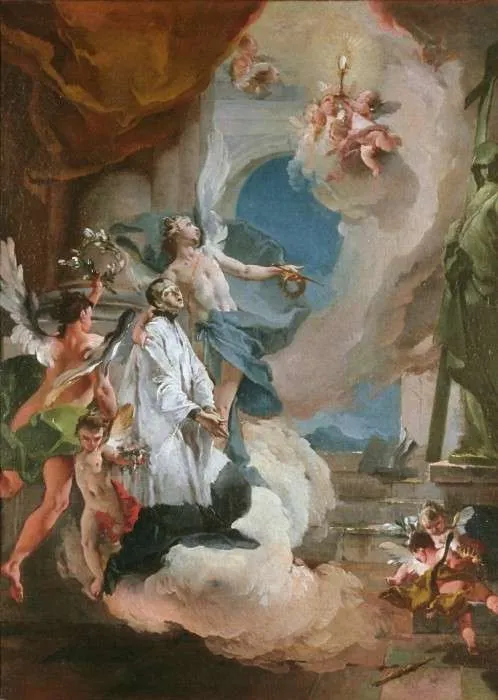
Luigi Gonzaga was the firstborn son of eight children, and the scion to a wealthy and noble inheritance. He was born into the Duchy of Mantua, modern-day northern Italy, which was ruled by his family, the princely House of Gonzaga. Luigi was the Italian version of his name; Aloysius was the Latin version. His father, Ferrante Gonzaga, was Governor of Milan, Viceroy of Sicily, and a general in the army of the Holy Roman Emperors Charles V and Philip II. As the oldest son, Luigi was expected to follow in his father’s footsteps through a military career. Ferrante began training Luigi as a soldier when Luigi was just four years old. Luigi’s mother, a devout Catholic, had different hopes for her son.

At the age of five, Luigi was sent to a military camp housing 3,000 soldiers to learn warfare and weaponry. He earned respect from the soldiers and often led them in marching, but he also picked up their rough language. When Luigi brought this language home, his mother promptly corrected him. Although the incident was somewhat innocent since he didn’t know what the words he repeated meant, his mother’s rebuke had a lasting influence on him and marked a turning point in his life. From that young age, he started to cultivate piety and a greater consciousness of moral living.

Luigi’s piety continued to flourish at the age of seven. He began to pray daily, reciting the Office of Our Lady, the penitential psalms, and many other devotions, often on his knees on a cold, hard floor. Around this time, he also endured an illness lasting about eighteen months, marked by fever and necessitating prolonged bed rest. Nevertheless, he never missed his daily prayers. Many who knew him in his childhood believed he never committed a mortal sin, given the depth of his devotion.

At the age of eight, Luigi and his younger brother were sent to Florence under the guardianship of the Grand Duke of Tuscany, Francesco I de’ Medici, a member of the influential Medici family. Florence was a thriving city, rich in culture and knowledge, exposing the boys to music, art, and science. Luigi and his brother served as pages in Francesco’s court, a role that involved household service, etiquette instruction, and establishment of important relationships for future benefits. Luigi studied Latin, literature, philosophy, and history, and was exposed to physical disciplines, such as fencing and horseback riding.

By the age of nine, however, Luigi—now using his Latin name, Aloysius—was demonstrating more interest in piety and the lives of the saints than in the worldly pursuits that made up his life at court. Most of his free time was spent learning about the faith and praying.

Ferrante brought his sons back home when Aloysius was eleven years old. After joining the court of Duke William Gonzaga of Mantua, Aloysius read a book of letters from Jesuit missionaries and was deeply moved by a letter from a Jesuit missionary from the Indies. Around this time, he made a private vow to live a celibate life devoted to God and resolved to renounce his firstborn rights. He began to embrace every virtue, especially purity, and he became so engrossed in catechetical studies and the lives of the saints that he began teaching catechism to other children.

At the age of twelve, Aloysius met then-cardinal and future saint, Charles Borromeo. After expressing his desire to be a Jesuit missionary and undergoing examination by the cardinal, Aloysius so impressed Cardinal Borromeo that he personally prepared the boy for and administered his First Holy Communion, encouraging him to receive the Eucharist frequently.

When Aloysius was thirteen, his father was required to accompany the empress of Austria to Spain and brought his children with him. The children became pages in the infant prince’s court. Aloysius continued his studies and prayer life in Spain and started to seriously consider becoming a Jesuit. His mother was thrilled when he shared this desire, but his father was enraged, even threatening physical violence. The issue was that Aloysius would need to renounce his inheritance and noble status to become a Jesuit. When some family members suggested he become a secular priest, noting that they could arrange for him to be a bishop, Aloysius refused. He felt called to the Jesuits and had no interest in the nobility’s courtly advancement, wealth, or worldly honors. When the Spanish infant prince died a year later, the family moved back to Italy.

Over the next few years, Aloysius’s piety grew, and his devotion to become a Jesuit solidified. His father and many others tried to dissuade him, even confining him for nine months. Eventually, through divine grace, hearts were softened, minds opened, and Aloysius’ father gave his reluctant consent. As a high-ranking noble, Aloysius could only renounce his inheritance and position with the emperor’s approval. Once granted, Aloysius passed his rank and inheritance to his brother and joined the Jesuit novitiate in Rome on November 25, 1585, at the age of eighteen.

Despite his noble background, Aloysius lived humbly in Rome. He advanced in prayer, often entering deep contemplation. He prayed before the Blessed Sacrament, grew in devotion to Our Lady, and always meditated on Christ’s Passion. He was obedient, manifested a pure and holy chastity, lived in poverty, and was charitable, especially towards the poor. He was also blessed to have the future Saint Robert Bellarmine as his spiritual director and teacher.

After briefly returning home to resolve a family dispute over land, Aloysius returned to Rome in 1591 when the bubonic plague was ravaging the city. Despite the widespread fear, Aloysius dedicated himself to caring for the sick, dismissing concerns for his own health. He undertook all necessary tasks to meet both the spiritual and physical needs of the sick, fulfilling his duties with profound joy. Eventually, he contracted the disease himself and endured much suffering. He embraced his suffering with much rejoicing and even prophesied the day of his death, which was revealed to him in a vision and occurred on the Octave day of the Solemnity of Corpus Christi when he was just twenty-three years old.

Saint Aloysius Gonzaga was wealthy in the things of this world and was promised everything this life could offer. However, he discovered something far more valuable—God—through a life of profound prayer and devotion. The wealth he obtained through his obedience to God’s will vastly exceeded anything he could inherit in this life. As we reflect on this youthful and holy Jesuit, consider your own dreams and desires. Like Saint Aloysius, are you prepared to relinquish everything to serve God’s will? Do you pursue genuine riches? Or are you preoccupied with the fleeting wealth of this world? Imitate this young saint’s example, and you will discover the same treasures he obtained through his fidelity to God’s will.

Source: https://mycatholic.life/saints/saints-of-the-liturgical-year/june-21–st-aloysius-gonzaga/

Saint Aloysius Gonzaga, Religious Read More »

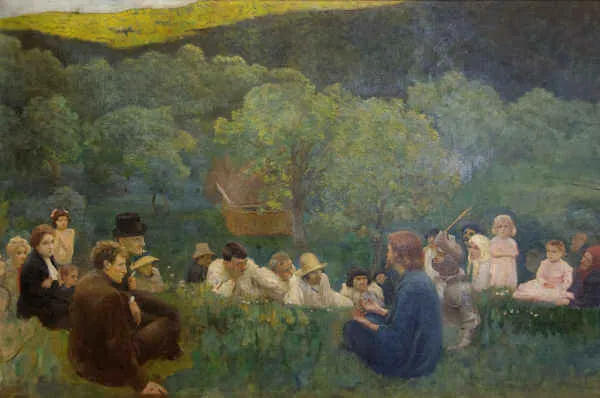
Matthew 6:22-23

Your Intentions in Life

“The lamp of the body is the eye. If your eye is sound, your whole body will be filled with light; but if your eye is bad, your whole body will be in darkness. And if the light in you is darkness, how great will the darkness be.”

Reflection:

Every Scripture passage, in a spiritual sense, can teach us many lessons. Saint Thomas Aquinas, in his commentary on Matthew’s Gospel, offers one interpretation to the passage quoted above by saying that the “eye” in this passage refers to your intention and “your whole body” refers to all of your actions that follow from your intention. Therefore, when your intentions are in line with God’s will, the actions that follow will be also. This is a very practical and useful lesson for your journey toward holiness.

With this insight from Saint Thomas, we must look at our intentions in an honest and complete way. What are your intentions in life? It’s easy for us to form various intentions that may seem good as well as some that are contrary to the will of God without even realizing it. We may intend to get a good night’s sleep on one occasion. Or intend to have fun with family and friends on a certain day. Or we may intend to cook a good meal, clean the house, do well at work, etc. There are many momentary intentions that are good and are a normal part of daily living. However, the most important intention to consider is that which is the deepest of them all. What is the most central, foundational, and fundamental intention by which your life is directed?

The primary intention that you should work to acquire is to give God the greatest glory possible in all that you do. Giving glory to God is accomplished when you choose Him and His holy will above everything else in life. When this is the deepest and most fundamental intention of your life, everything else will flow from it. All secondary intentions and actions will align with this central focus and work toward its accomplishment. But when there are other “first intentions” that you have on the most fundamental level, then all the rest of your intentions and actions will be misguided and directed in a disordered way.

Reflect, today, upon the most fundamental intention you have in life. Doing so will require a considerable amount of interior reflection and honesty. It will require that you sort through the many things that motivate you and the decisions you make each and every day. Reflect upon the primary purpose of your life, which must be to give God the greatest glory possible by choosing and living His perfect will. Do all of your daily actions align with this ultimate goal? Commit yourself to the holy work of examining all of your actions in this light so that you will more fully achieve the purpose for which you were created.

Source: https://catholic-daily-reflections.com/2024/06/20/your-intentions-in-life-3/

Matthew 6:22-23 Read More »

Saint John of Pulsano

Profile

John was a Benedictine monk. He lived with such austerity that it brought on the enmity of his brothers who felt he was setting a standard that they could not meet, making them look bad, and drawing attention to himself. He was became a monk at Montevergine Abbey under the spiritual direction of his friend Saint William of Vercelli, its founder. He was a poopular preacher in Bari, Italy. He also founded the Saint Mary of Pulsano Abbey at Pulsano, Italy where he served as abbot, and from which grew a new congregation.

Born

  • c.1070 at Matera, Basilicata region, Italy

Died

  • 1139 at Pulsano, Italy of natural causes
  • buried in a niche in a cave in the church at Saint Mary of Pulsano Abbey
  • relics translated to Matera Cathedral in 1830
  • relics enshrined in a new sarcophagus in 1939

    Canonized
  • 1177 by Pope Alexander III

Representation

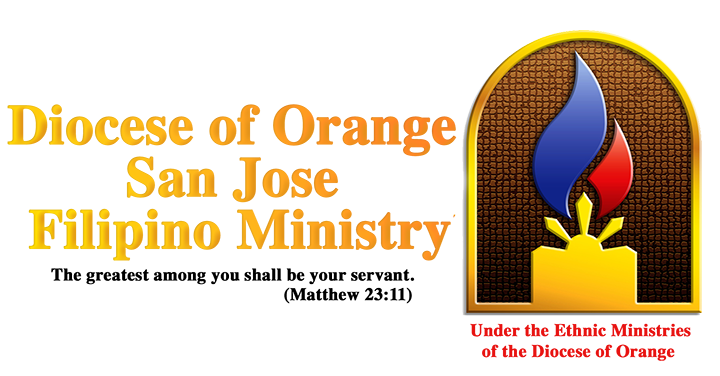
  • abbot driving away the devil with a rod

Source: https://catholicsaints.info/saint-john-of-pulsano/

Saint John of Pulsano Read More »

Matthew 6:14-15

Forgiving Others

“If you forgive others their transgressions, your heavenly Father will forgive you. But if you do not forgive others, neither will your Father forgive your transgressions.”

Reflection:

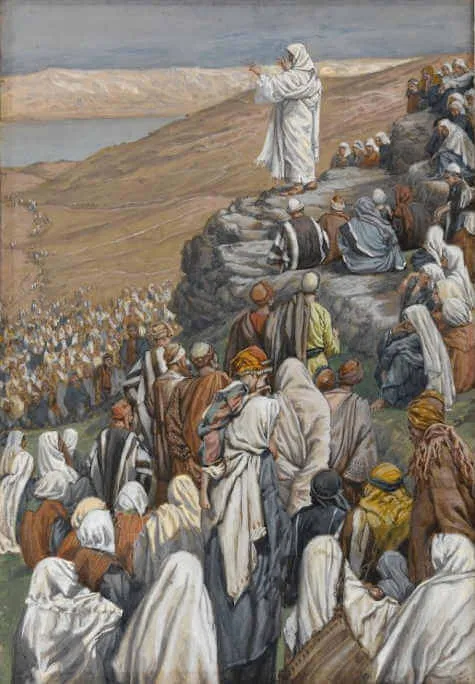
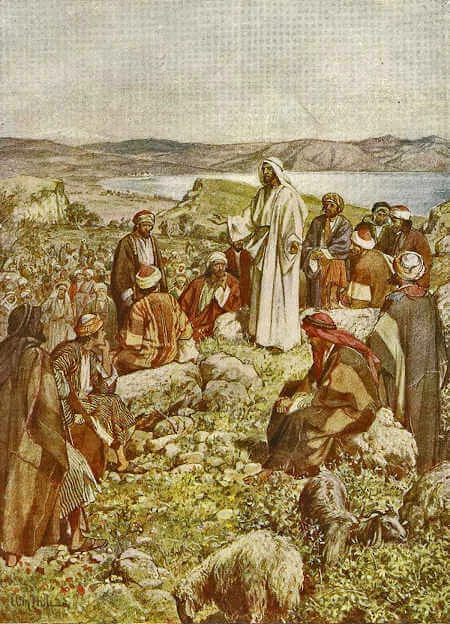
It’s truly amazing how often our Lord exhorts us to forgive. Much of Jesus’ Sermon on the Mount, from which we have been reading all week, continually calls us to offer mercy and forgiveness to others. And in the passage above from the end of today’s Gospel, Jesus offers us the consequences of not heeding His exhortations.

This passage is a sort of addendum to the “Our Father” prayer which immediately precedes it. The Our Father prayer gives us seven petitions, one of them being “forgive us our trespasses, as we forgive those who trespass against us.” It’s interesting to note that as soon as Jesus taught us this prayer with its seven petitions, He then re-emphasised one of those petitions by stating it again as is seen in the passage quoted above. This added emphasis should assure us of the seriousness of this petition.

At first, Jesus simply tells us to pray for forgiveness “as we forgive.” But He then makes it clear that if we fail to do so, we will not be forgiven ourselves. This should highly motivate us to make every effort possible to completely forgive others from the deepest depths of our hearts.

Who do you need to forgive? Forgiveness can be a confusing endeavor at times. The act of forgiveness gets confusing when our feelings do not reflect the choice we make in our will. It is a common experience that when we make the interior choice to forgive another, we still feel anger toward them. But these disordered feelings should not deter us nor should we allow them to cause doubt in what we need to do. Forgiveness is first an act of the will. It’s a prayerful choice to say to another that you do not hold their sin against them. Forgiveness does not pretend that no sin was committed. On the contrary, if there were no sin committed, then there would be no need for forgiveness. So the very act of forgiving is also an acknowledgment of the sin that needs to be forgiven.

When you make the choice to forgive another, and if your feelings do not immediately follow after, keep forgiving them in your heart. Pray for them. Try to change the way you think about them. Do not dwell upon the hurt that they have inflicted. Think, instead, about their dignity as a person, the love God has for them and the love you must continue to foster for them. Forgive, forgive and forgive again. Never stop and never tire of this act of mercy. If you do this, you may even discover that your feelings and passions eventually align with the choice you have made.

Reflect, today, upon any lingering feelings of anger you experience. Address those feelings by the free and total choice to forgive the person with whom you are angry. Do so now, later today, tomorrow and on and on. Go on the offensive against anger and bitterness by overwhelming it with your personal act of forgiveness and you will find that God will begin to free you of the heavy burden that a lack of forgiveness imposes.

Source: https://catholic-daily-reflections.com/2024/06/19/forgiving-others-3/

Matthew 6:14-15 Read More »

Saint Romuald, Abbot

c. 951–1027; Invoked for reformation of the Church and monastic life; Canonized by Pope Gregory XIII in 1582

Saint Romuald was born into a noble family in Ravenna, located in modern-day northern Italy. As a youth, he was reportedly quite mischievous, and by some accounts, even vicious. It’s likely he adopted such behavior in imitation of his father. During that time, the nobility were often engaged in conflicts over control of land, political power, or in response to perceived violations of their family’s honor. When Romuald was twenty, his father, Sergius degli Onesti, found himself embroiled in such a conflict with a relative over land ownership. They resolved their dispute through a duel, which Sergius won by killing his relative. Even though Romuald was no stranger to such conflicts, he was horrified by his father’s actions. Romuald fled to the Benedictine monastery of San Apollinare-in-Classe, just south of Ravenna. Initially, he went to the monastery for a forty-day retreat of prayer and penance to atone for his father’s sin. After forty days, however, he decided to stay and become a monk.

In Romuald’s day, many European monasteries were undergoing reform. Many had become political in nature and had relaxed their emphasis on prayer. When Romuald entered the Monastery of San Apollinare-in-Classe, reforms had just started, but true reform takes a long time. Given Romuald’s newfound zeal for prayer and penance, coupled with his temper and lack of patience, he often lashed out at his fellow monks for their lax lifestyle. As a result, Romuald was not very popular among the more worldly monks. He requested and quickly received permission from the abbot to move to Venice and live as a hermit under the spiritual direction of another hermit named Marinus. For the next several years, Romuald lived a strict life of solitude, silence, prayer, and penance. Under Marinus, he developed his own monastic lifestyle, learning not only from Marinus but also directly from the Holy Spirit through his life of prayer.

Around the year 978, while in his late twenties, Romuald and Marinus moved to the border of France and Spain and built a hermitage near the Monastery of Saint-Michel-de-Cuxa. For the next several years, Romuald continued to live a life of prayer, solitude, and silence, along with a period of intense study, taking advantage of the library at the nearby monastery. His studies, guided by the Holy Spirit, led him to further develop a new way of being a hermit and to a deeper understanding of the ideals of monasticism in general.

Around the age of thirty-seven, after living the hermit’s life for fifteen to twenty years and developing a new theological and practical understanding of the ideals of monasticism, Romuald began traveling across Europe. He founded new hermitages and monasteries and provided spiritual direction to existing ones in need of reform. One of his first stops was to visit his father, who had since repented of his former lifestyle and became a monk himself. Before his father died, Romuald helped him more fully embrace his new monastic vocation. Sometime after 996, Otto III ascended to the role of Holy Roman Emperor. Otto was devoted to reforms within the Church and across the empire. One story relates that when Otto heard about Romuald’s fervor and commitment to reforming monastic life, Otto asked him to become the abbot of Otto’s first monastery, San Apollinare-in-Classe. However, the monks resisted Romuald’s reform efforts so vehemently that he left in frustration within a year.

In 1012, according to legend, a man named Maldolus had a vision of monks dressed in white ascending a ladder to Heaven. Prompted by this vision, Maldolus donated a piece of land he owned in Camaldoli, near Arezzo in Tuscany, to Romuald. On this land, Romauld built five hermitages, marking the beginnings of the Camaldolese Hermits of Mount Corona. This new form of monasticism harmonized, for the first time, the lives of hermits and monks. Monks lived in community, sharing meals, work, and communal prayer. Hermits, in contrast, pursued their vocations mostly in solitude. Romuald’s innovative form of monasticism aimed to marry these two vocations. The monks each lived in their own hermitages in silence and solitude but would gather each day in a shared chapel for prayer. They also shared meals, though not as frequently as traditional monks, and shared a common mission and rule of life. Over the next fifteen years, Romuald founded several more monastery-hermitages, firmly establishing his new form of monastic life within the broader life of the Church.

The “Brief Rule” that Saint Romuald left his brothers is just that, brief. It is quoted above in its entirety. In its simplicity, it spells out all that Saint Romuald believed monk-hermits needed to know in order to live the life to which they are called. The Rule offers seven exercises to help grow in contemplation. The hermit-monk must love his cell, be detached, be self-observant, attentive to praying the Psalms, reverent before God, intense in asceticism, and become childlike in one’s receptivity to grace.

Saint Romuald passed away in the solitude of his cell, a place he referred to as “paradise.” Numerous miracles were reported in the years following his death by those who prayed at his tomb. According to legend, approximately 400 years later, his body was exhumed and found to be incorrupt, but being sacrilegiously unearthed, the body turned to dust. Other accounts state that his body remains incorrupt and was relocated to Fabriano, Italy, where his order had constructed another monastery. Today, this church is known as Saint Romuald’s.

The eremitical life of a hermit, while not suited for everyone, plays an essential role in the life of the Church. God calls a select number of men and women to serve as intercessors for the entire Church, as well as beacons guiding our pilgrimage toward Heaven. Their vocation underscores the importance of prayer, solitude, silence, and asceticism. As we honor the great founder of the Camaldolese Order, let us reflect on our own need for deeper interior silence, attainable only through solitude, prayer, and penance. While you might not be called to live as a hermit, you are nonetheless summoned to periods of contemplation where you can experience a glimpse of their lifestyle. Daily prayer, retreats, adoration, and the like are essential in this fast-paced and noisy world. Commit to emulating Saint Romuald and allow his witness to guide you towards a deeper union with God.

Source: https://mycatholic.life/saints/saints-of-the-liturgical-year/june-19—saint-romuald-abbot/

Saint Romuald, Abbot Read More »