2023

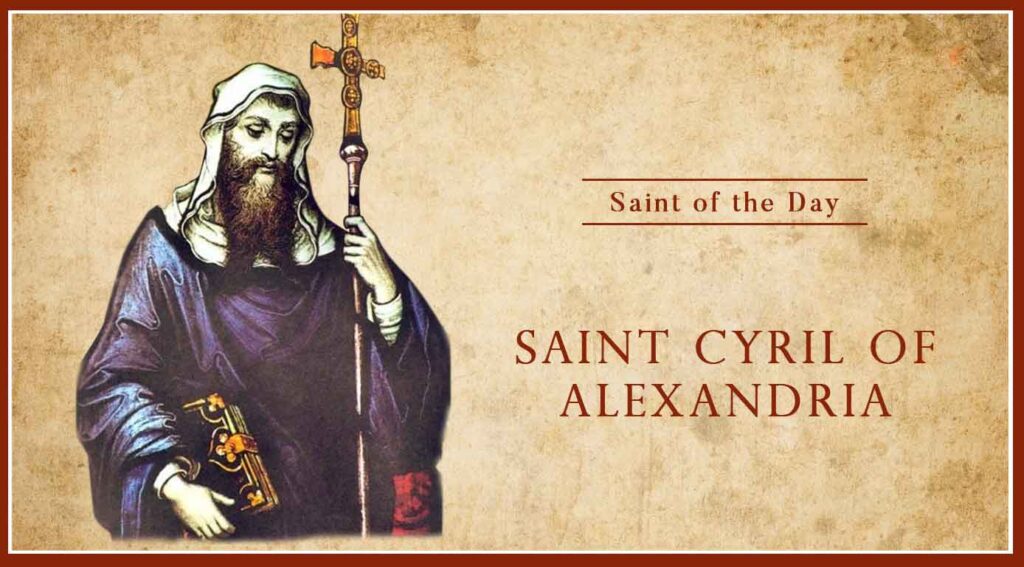
Saint Cyril of Alexandria

Saint Cyril of Alexandria was born circa 376, in the town of Didouseya, Egypt, modern-day El-Mahalla El-Kubra. Little is known for certain about his early life. He received the formal Christian education standard for his day: he studied grammar from age twelve to fourteen (390–392), rhetoric and humanities from fifteen to twenty (393–397) and finally theology and biblical studies (398–402).

Saint Cyril is well known for his dispute with Nestorius and his supporter, Patriarch John of Antioch, whom Cyril excluded from the Council of Ephesus for arriving late. He is also known for his expulsion of Novatians and Jews from Alexandria and for inflaming tensions that led to the murder of the Hellenistic philosopher Hypatia by a Christian mob. Historians disagree over the extent of his responsibility in this.

He tried to oblige the pious Christian emperor Theodosius II (AD 408–450) to himself by dedicating his Paschal table to him. Cyril’s Paschal table was provided with a Metonic basic structure in the form of a 19-year lunar cycle adopted by him around AD 425, which was very different from the first Metonic 19-year lunar cycle invented around AD 260 by Anatolius, but exactly equal to the lunar cycle which had been introduced around AD 412 by Annianus; the Julian equivalent of this Alexandrian cycle adopted by Cyril and nowadays referred to as the ‘classical (Alexandrian) 19-year lunar cycle’ would emerge a century later in Rome as the basic structure of Dionysius Exiguus’ Paschal table (AD 525).

Saint Cyril wrote extensively and was a major player in the Christological controversies of the late-4th and 5th centuries. He is counted among the Church Fathers and also as a Doctor of the Church, and his reputation within the Christian world has resulted in his titles Pillar of Faith and Seal of all the Fathers.

Saint Cyril of Alexandria Read More »
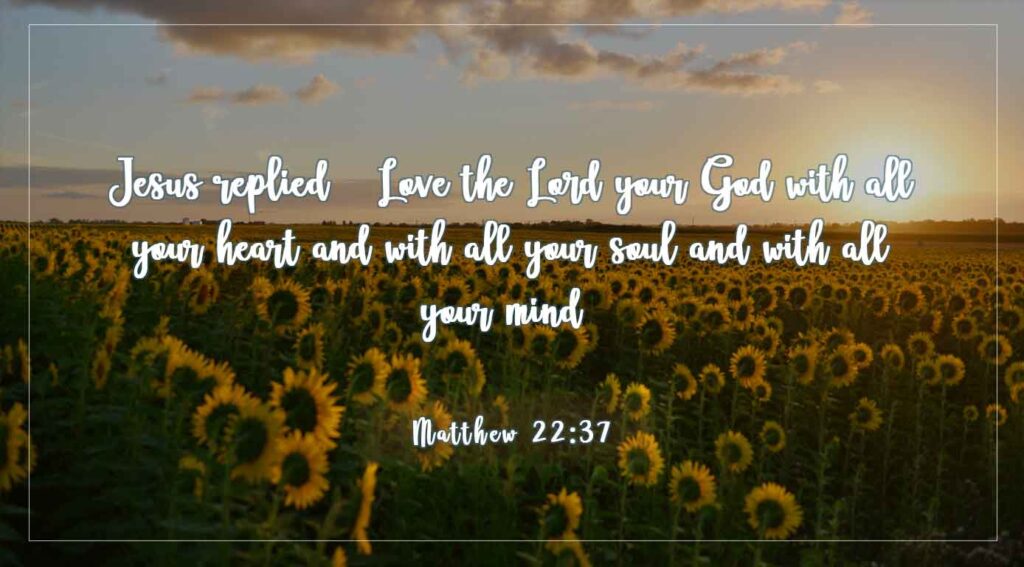
Matthew 9:13

Verse:

“But go and learn what this means: ‘I desire mercy, not sacrifice.’ For I have not come to call the righteous, but sinners.” - Matthew 9:13

Prayer Declaring The Glory Of God

The heavens declare the glory of God and the earth unites with them in a magnificent chorus of worthy praise, to Your holy name. But there should be no greater proclamation of Your grace and glory, no more worthy declaration of Your wonder and praise, than the worship that falls from the lips of sinners, saved by grace, for You have redeemed us by Your blood and clothed us in You own garments of righteousness. You deserve our ceaseless praise and glory throughout time and into the eternal ages to come.

We praise and thank You for Your great and precious promises. That seedtime and harvest, day and night, summer and winter will never fail, for Your mercy endures forever. You make Your sun to rise on the wicked as well as those that are saved, and You send showers of refreshing rain on the unjust as well as the upright. But Lord, there is no greater testimony of Your loving-kindness and patient-endurance than the opportunity to be redeemed by the blood of Your only begotten Son. A gift of grace that You are extending to the world of fallen man. Blessing and glory and wisdom and thanksgiving and honour and power and might, be unto our God for ever and ever,

Amen.

Matthew 9:13 Read More »

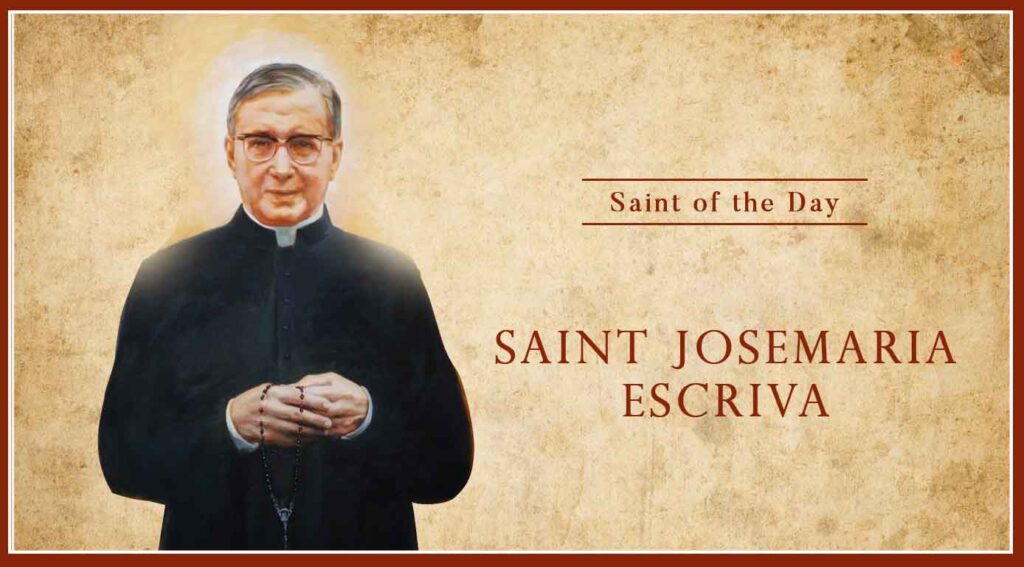
Saint Josemaria Escriva

Saint Josemaria Escriva was born on 9 January 1902, in the small town of Barbastro, in Huesca, Spain. When he was young, he saw footprints left in the snow by a monk walking barefoot and he felt that “he had been chosen for something”.

With his father’s blessing, Escrivá prepared to become a priest of the Catholic Church. He studied first in Logroño and then in Zaragoza, where he was ordained as deacon on Saturday, 20 December 1924. He was ordained a priest, also in Zaragoza, on Saturday, 28 March 1925. After a brief appointment to a rural parish in Perdiguera, he went to Madrid, the Spanish capital, in 1927 to study law at the Central University. In Madrid, Escrivá was employed as a private tutor and as a chaplain to the Foundation of Santa Isabel, which comprised the royal Convent of Santa Isabel and a school managed by the Little Sisters of the Assumption.

A prayerful retreat helped him to discern more definitely what he considered to be God’s will for him. In 1928, he founded “Opus Dei” which is a way by which Catholics might learn to sanctify themselves by their secular work. According to the decree of the Congregation for the Causes of Saints, which contains a condensed biography of Escrivá, “[t]o this mission he gave himself totally. From the beginning his was a very wide-ranging apostolate in social environments of all kinds. He worked especially among the poor and the sick languishing in the slums and hospitals of Madrid.”

In 1948 Escrivá founded the Collegium Romanum Sanctae Crucis (Roman College of the Holy Cross), Opus Dei’s educational center for men, in Rome. In 1950, Escrivá was appointed an Honorary Domestic Prelate by Pope Pius XII, which allowed him to use the title of Monsignor. In 1955, he received a doctorate of theology from the Pontifical Lateran University in Rome. In 1953 he founded the Collegium Romanum Sanctae Mariae (Roman College of Saint Mary) to serve the women’s section (these institutions are now joined into the Pontifical University of the Holy Cross.) Escrivá also established the University of Navarre, in Pamplona, and the University of Piura (in Peru), as secular institutions affiliated with Opus Dei.

Saint Josemaria Escriva died of cardiac arrest on 26 June 1975, aged 73.

Saint Josemaria Escriva Read More »

12th Sunday in Ordinary Time

First Reading: Jer 20:10-13

Jeremiah said:
"I hear the whisperings of many:
'Terror on every side!
Denounce! let us denounce him!'
All those who were my friends
are on the watch for any misstep of mine.
'Perhaps he will be trapped; then we can prevail,
and take our vengeance on him.'
But the LORD is with me, like a mighty champion:
my persecutors will stumble, they will not triumph.
In their failure they will be put to utter shame,
to lasting, unforgettable confusion.
O LORD of hosts, you who test the just,
who probe mind and heart,
let me witness the vengeance you take on them,
for to you I have entrusted my cause.
Sing to the LORD,
praise the LORD,
for he has rescued the life of the poor
from the power of the wicked!"

Responsorial Psalm: Ps 69:8-10, 14, 17, 33-35

Response– Lord, in your great love, answer me

For your sake I bear insult,
and shame covers my face.
I have become an outcast to my brothers,
a stranger to my mother's children,
Because zeal for your house consumes me,
and the insults of those who blaspheme you fall upon me.
R– Lord, in your great love, answer me

I pray to you, O LORD,
for the time of your favor, O God!
In your great kindness answer me
with your constant help.
Answer me, O LORD, for bounteous is your kindness;
in your great mercy turn toward me.
R– Lord, in your great love, answer me

"See, you lowly ones, and be glad;
you who seek God, may your hearts revive!
For the LORD hears the poor,
and his own who are in bonds he spurns not.
Let the heavens and the earth praise him,
the seas and whatever moves in them!''
R– Lord, in your great love, answer me

Second Reading: Romans 5:12-15

Brothers and sisters:
Through one man sin entered the world,
and through sin, death,
and thus death came to all men, inasmuch as all sinned—
for up to the time of the law, sin was in the world,
though sin is not accounted when there is no law.
But death reigned from Adam to Moses,
even over those who did not sin
after the pattern of the trespass of Adam,
who is the type of the one who was to come.

But the gift is not like the transgression.
For if by the transgression of the one the many died,
how much more did the grace of God
and the gracious gift of the one man Jesus Christ
overflow for the many.

Alleluia:

Alleluia, alleluia. The Spirit of truth will testify to me, says the Lord;
and you also will testify. Alleluia, alleluia.

Gospel: Matthew 10:26-33

A reading from the holy Gospel according to Matthew

Jesus said to the Twelve:
"Fear no one.
Nothing is concealed that will not be revealed,
nor secret that will not be known.
What I say to you in the darkness, speak in the light;
what you hear whispered, proclaim on the housetops.
And do not be afraid of those who kill the body but cannot kill the soul;
rather, be afraid of the one who can destroy
both soul and body in Gehenna.
Are not two sparrows sold for a small coin?
Yet not one of them falls to the ground without your Father's knowledge.
Even all the hairs of your head are counted.
So do not be afraid; you are worth more than many sparrows.
Everyone who acknowledges me before others
I will acknowledge before my heavenly Father.
But whoever denies me before others,
I will deny before my heavenly Father."

The Readings and Gospel were sourced from:

12th Sunday in Ordinary Time Read More »

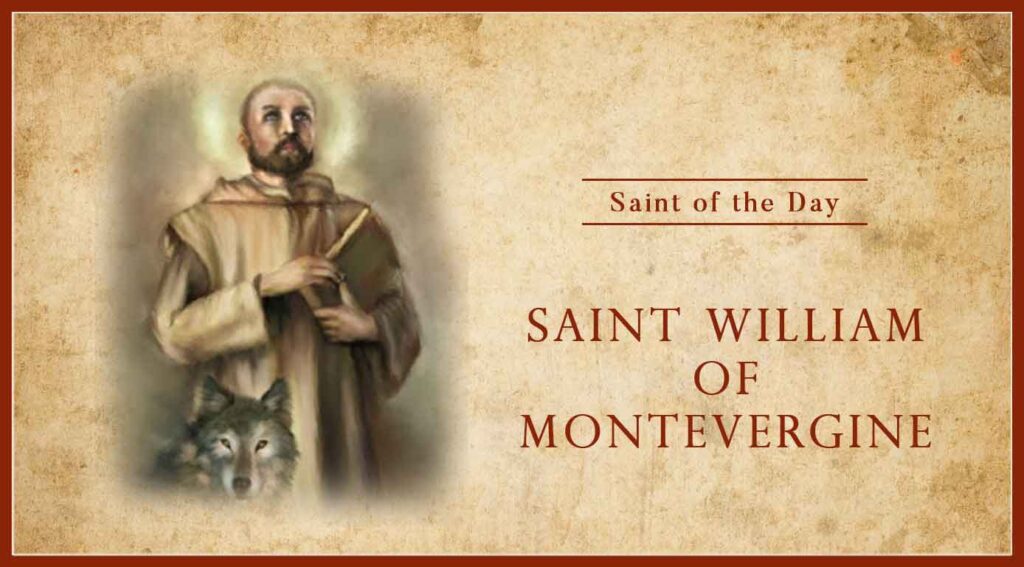
Saint William of Montevergine

Saint William of Montevergine was born in 1085 into a noble family of Vercelli in northwest Italy. When his parents passed away, he was brought up by a relation. He was also known as William of Vercelli and William the Abbot.

Saint William of Montevergine undertook a pilgrimage to Santiago de Compostela. On his pilgrimage to Compostela, Saint William of Montevergine asked a blacksmith to make an iron implement that would encircle his body and increase his suffering, and he wore it throughout the pilgrimage. After he returned to Italy, he intended to go to Jerusalem and for this purpose he reached South Italy, but he was beaten up and robbed by thieves. Saint William of Montevergine considered this misfortune a sign of God’s will to stay in South Italy and spread the message of Christ.

Saint William of Montevergine decided not to travel to Jerusalem anymore and to settle in South Italy, here he lived as a hermit. Here he attracted a number of followers and founded the Monastery of Montevergine. While at Montevergine, Saint William is stated as having performed miracles.

He left Montevergine in 1128 and settled on the plains in Goleto since his hermit life was compromised due to the inflow of the faithful. He began a new monastic experience, a double monastery built mostly by women. Subsequently, he founded several other monasteries of the same rule, but mostly remained in Goleto except for some trips to Apulia. Eventually he died in Goleto on June 25, 1142.

Saint William of Montevergine Read More »

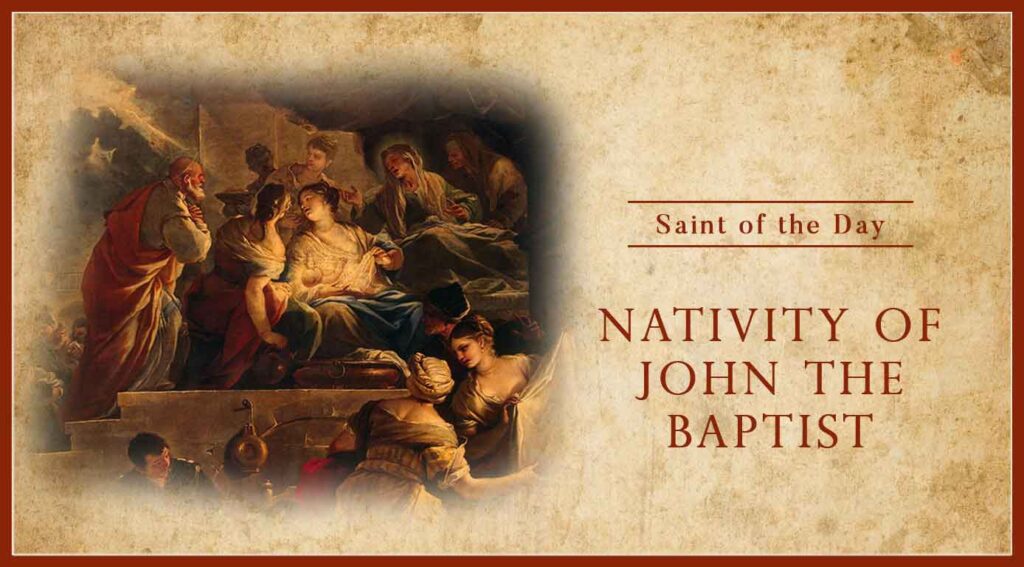
Nativity of John the Baptist

The Nativity of John the Baptist celebrates the birth of John the Baptist. It is one of the oldest festivals of the Christian church, being listed by the Council of Agde in 506 as one of that region’s principal festivals, where it was a day of rest and, like Christmas, was celebrated with three Masses: a vigil, at dawn, and at midday.

The life of John the Baptist has long been interpreted as a preparation for the coming of Jesus Christ, and the circumstances of his birth, as recorded in the New Testament, are miraculous. The sole biblical account of the birth of John the Baptist comes from the Gospel of Luke. In the Gospel, Luke gives emphasis to the announcement of his birth and the event itself, both set in parallel to the same occurrences in the life of Jesus.

Saint John the Baptist attracted countless people to the banks of the Jordan, and it occurred to some people that he might be the Messiah. But he constantly deferred to Jesus, even to sending away some of his followers to become the first disciples of Jesus.

Perhaps John’s idea of the coming of the Kingdom of God was not being perfectly fulfilled in the public ministry of Jesus. For whatever reason, when he was in prison he sent his disciples to ask Jesus if he was the Messiah. Jesus’ answer showed that the Messiah was to be a figure like that of the Suffering Servant in Isaiah. John himself would share in the pattern of messianic suffering, losing his life to the revenge of Herodias.

Nativity of John the Baptist Read More »

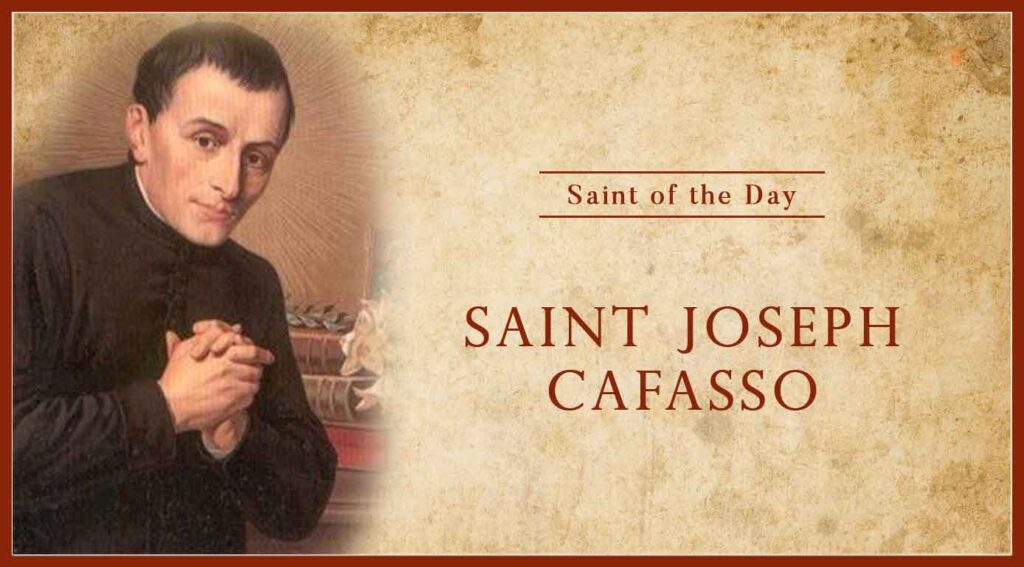
Saint Joseph Cafasso

Saint Joseph Cafasso had been born with a deformed spine which contributed to his short stature and frail constitution. As a child, Saint Joseph Cafasso was seen as a model individual. It was often said that no one could recall him having sinned.

At an early age, Saint Joseph Cafasso felt called to become a priest and so commenced his ecclesial studies in Turin and Chieri in order to achieve his dream. He received his ordination to the priesthood in the archdiocesan cathedral on 21 September 1833. He underwent some further theological studies at the Turin college four months after his ordination. He came to know Luigi Guala, the co-founder of the Institute of Saint Francis of Assisi. This college was dedicated to the higher education of the diocesan priests who were still recovering from the destruction of the church’s institutions under the Napoleonic invasion a generation earlier. He would be connected to this institution for the rest of his life advancing from student to lecturer to chaplain and then at last being named Guala’s successor as the college’s rector in 1848.

In his role as a teacher he never neglected his duties as a priest and often aided those students in poor circumstances when he would provide them with books and other things needed for them to complete their studies. He likewise fought against state intrusion in the affairs of the church.

The priest was known for his practice of mortifications in the aim of becoming as frugal as possible. He never smoked nor did he drink things other than water alone. He never indulged in coffee nor things between his meals. He never complained about toothaches or headaches but bore his pain with remarkable resilience as a sign of his own personal cross.

He was also a noted confessor and spiritual director who guided people who would go on to found new religious institutions or congregations which would help the church to meet the needs of the whole world.

He died on 23 June 1860 and his friend Bosco (who wrote a biographical account of his old friend) preached though was not the celebrant for the Mass. He died from pneumonia coupled with a stomach hemorrhage and complications from congenital medical issues.

Saint Joseph Cafasso Read More »

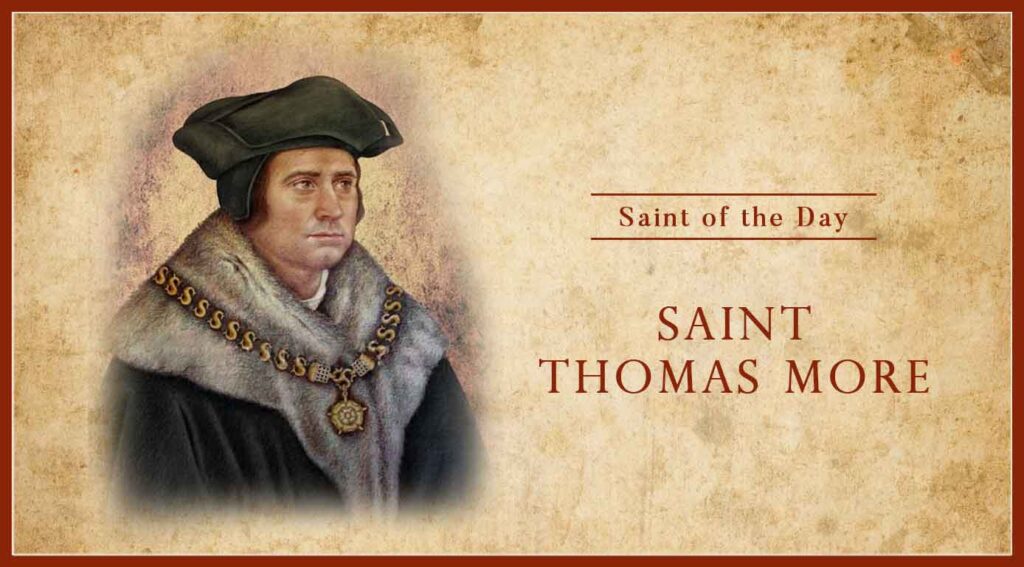
Saint Thomas More

Saint Thomas More was an English lawyer, judge, social philosopher, author, statesman, and noted Renaissance humanist. He was born on February 1478, he was the second of six children.

Saint Thomas More was educated at St. Anthony’s School. From 1490 to 1492, More served John Morton, the Archbishop of Canterbury and Lord Chancellor of England, as a household page. In 1492, he began his studies on classical education at Oxford. In 1496, Saint Thomas More became a student at Lincoln’s Inn, one of the Inns of Court, where he remained until 1502, when he was called to the Bar. He continued the ascetic practices for the rest of his life, such as wearing a hair shirt next to his skin and occasionally engaging in self-flagellation.

Between 1503 and 1504, Saint Thomas More lived near the Carthusian monastery outside the walls of London and joined in the monks’ spiritual exercises. Although he deeply admired their piety, More ultimately decided to remain a layman, standing for election to Parliament in 1504 and marrying the following year.

In 1504, Saint Thomas More was elected to Parliament to represent Great Yarmouth, and in 1510 began representing London. From 1510, he served as one of the two undersheriffs of the City of London, a position of considerable responsibility in which he earned a reputation as an honest and effective public servant. More became Master of Requests in 1514, the same year in which he was appointed as a Privy Counsellor. Saint Thomas More was eventually knighted and made under-treasure of the Exchequer in 1521. As secretary and personal adviser to King Henry VIII, More became increasingly influential.

Saint Thomas More opposed the Protestant Reformation, directing polemics against the theology of Martin Luther, Huldrych Zwingli, John Calvin and William Tyndale. Saint Thomas More also opposed Henry VIII’s separation from the Catholic Church, refusing to acknowledge Henry as supreme head of the Church of England and the annulment of his marriage to Catherine of Aragon. After refusing to take the Oath of Supremacy, he was convicted of treason and executed. On his execution, he was reported to have said: “I die the King’s good servant, and God’s first”.

Saint Thomas More Read More »

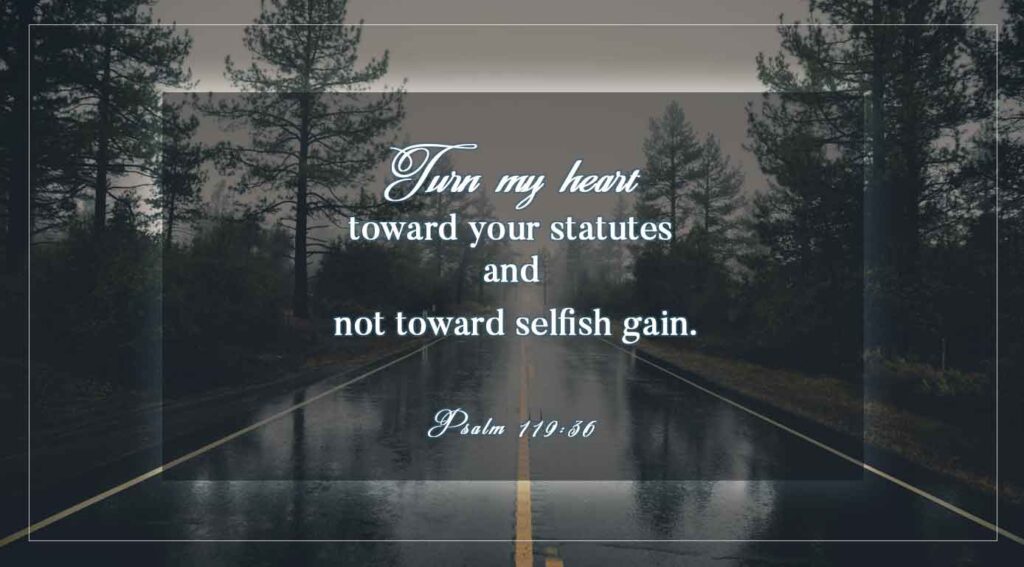
Psalm 119:36

Verse:

“Turn my heart toward your statutes and not toward selfish gain.” - Psalm 119:36

Prayer To Do God’s Will

Heavenly Father, it is my desire to do Your will in my life and I have been praying how I may find out how to know what Your will is, so that I can do Your will in my life. Thank You, Lord, for sending me to 1 Thessalonians chapter five, where I see that You have clearly laid out exactly what Your will for each one of us is.
 
Help me to walk in spirit and truth and encourage my brothers and sisters in the faith. Help me to esteem others as better than myself and support them in love.
 
Help me I pray, to encourage the fainthearted, help the weak, be patient with everyone, always return good for evil and seek after that which is good and lovely and pleasing in Your sight.
 
Most of all I pray that I develop a heart of ready rejoicing and an attitude of continuous prayer and praise. And give me the ability to be thankful in all things, even those times that prove to be the most difficult and frustrating. Help me to grow in grace and in a knowledge of our Lord Jesus Christ and mature in the faith, knowing that this is Your will for my life. Praise Your holy name.
 
Amen.

Psalm 119:36 Read More »