2023

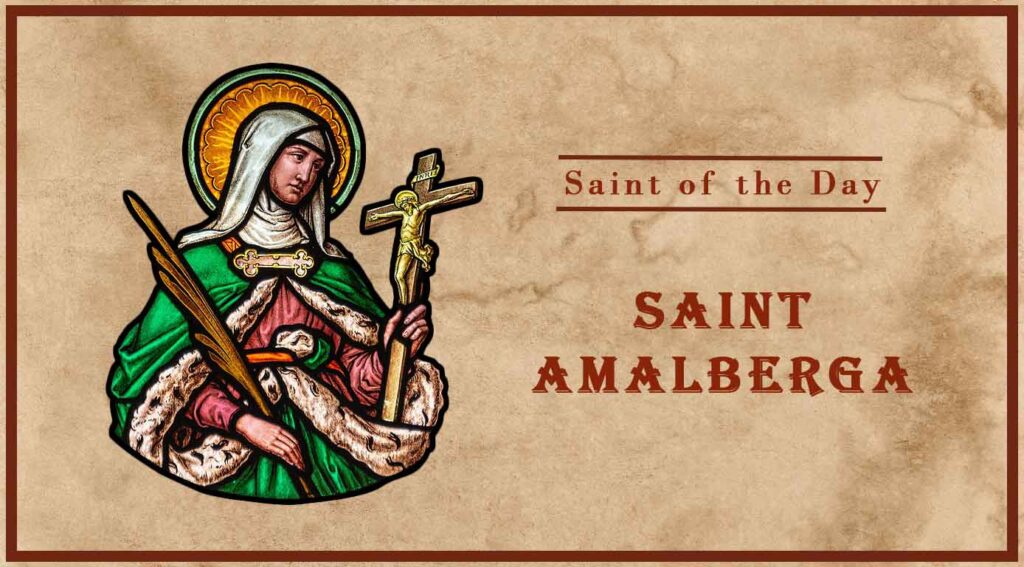
Saint Amalberga

Saint Amalberga, also referred to as Amalberga of Maubeuge, was a Merovingian nun in the 7th century.

The biography of Amalberga of Maubeuge is probably written by Abbott Hugo of Lobbes (1033–1063) between 1033 and 1048. Apart from a few Merovingian details, her genealogy was copied from another 11th-century hagiography, namely the Martyr story of Catherine of Alexandria.

Saint Amalberga was born in Brabant. Her father was Saint Geremarus and is said to be the niece of Pippin of Landen. She married the Duke Witger of Lotharingia and bore 5 children. It is said that all her children became saints: Emebert, Reineldis, Pharaildis, Ermelindis and Gudula.

After the birth of Gudula, their youngest child, Witger decided to become a Benedictine in Lobbes. Saint Amalberga, on the other hand, joined the Benedictine nuns of Maubeuge.

Saint Amalberga’s feast day is celebrated on July 10 and should not be confused with another saint, virgin Amalberga of Temse who died in 772.
Saint Amalberga Read More »

13th Sunday in Ordinary Time

First Reading: 2 Kgs 4:8-11, 14-16a

One day Elisha came to Shunem,
where there was a woman of influence, who urged him to dine with her.
Afterward, whenever he passed by, he used to stop there to dine.
So she said to her husband, "I know that Elisha is a holy man of God.
Since he visits us often, let us arrange a little room on the roof
and furnish it for him with a bed, table, chair, and lamp,
so that when he comes to us he can stay there."
Sometime later Elisha arrived and stayed in the room overnight.

Later Elisha asked, "Can something be done for her?"
His servant Gehazi answered, "Yes!
She has no son, and her husband is getting on in years."
Elisha said, "Call her."
When the woman had been called and stood at the door,
Elisha promised, "This time next year
you will be fondling a baby son."

Responsorial Psalm: Ps 89:2-3, 16-17,18-19

Response– For ever I will sing the goodness of the Lord

The promises of the LORD I will sing forever,
through all generations my mouth shall proclaim your faithfulness.
For you have said, "My kindness is established forever;"
in heaven you have confirmed your faithfulness.
R– For ever I will sing the goodness of the Lord

Blessed the people who know the joyful shout;
in the light of your countenance, O LORD, they walk.
At your name they rejoice all the day,
and through your justice they are exalted.
R– For ever I will sing the goodness of the Lord

You are the splendor of their strength,
and by your favor our horn is exalted.
For to the LORD belongs our shield,
and to the Holy One of Israel, our king.
R– For ever I will sing the goodness of the Lord

Second Reading: Romans 6:3-4, 8-11

Brothers and sisters:
Are you unaware that we who were baptized into Christ Jesus
were baptized into his death?
We were indeed buried with him through baptism into death,
so that, just as Christ was raised from the dead
by the glory of the Father,
we too might live in newness of life.

If, then, we have died with Christ,
we believe that we shall also live with him.
We know that Christ, raised from the dead, dies no more;
death no longer has power over him.
As to his death, he died to sin once and for all;
as to his life, he lives for God.
Consequently, you too must think of yourselves as dead to sin
and living for God in Christ Jesus.

Alleluia:

Alleluia, alleluia. You are a chosen race, a royal priesthood, a holy nation;
announce the praises of him who called you out of darkness into his wonderful light. Alleluia, alleluia.

Gospel: Matthew 10:37-42

A reading from the holy Gospel according to Matthew

Jesus said to his apostles:
"Whoever loves father or mother more than me is not worthy of me,
and whoever loves son or daughter more than me is not worthy of me;
and whoever does not take up his cross
and follow after me is not worthy of me.
Whoever finds his life will lose it,
and whoever loses his life for my sake will find it.

"Whoever receives you receives me,
and whoever receives me receives the one who sent me.
Whoever receives a prophet because he is a prophet
will receive a prophet's reward,
and whoever receives a righteous man
because he is a righteous man
will receive a righteous man's reward.
And whoever gives only a cup of cold water
to one of these little ones to drink
because the little one is a disciple—
amen, I say to you, he will surely not lose his reward."

The Readings and Gospel were sourced from:

13th Sunday in Ordinary Time Read More »

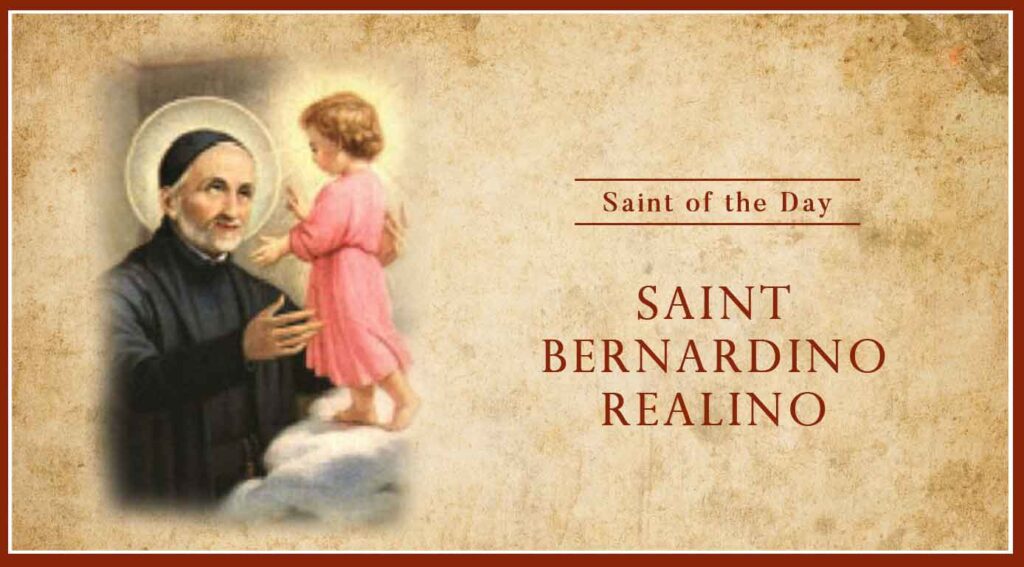
Saint Bernardino Realino

Saints Bernardino Realino was an Italian Roman Catholic priest and a professed member of the Jesuits. He was born in Carpi on 1 December 1530 to nobles.

He first attended school at Modena. Realino began his studies in philosophy and medicine in Bologna but altered this midcourse to law. In 1556, he graduated with a doctorate in law. Through his family’s influence, he was appointed as the podestà of both the Cassine and Felizzano cities – he served as a judge in Felizzano. He was viewed as honest and became the praetor of Castelleone. He also became noted in these places for his legal brilliance and learning. He entered the service of Francesco Ferdinando d’Avalos and moved to Naples to act as the superintendent of the fiefs of the Marquis.

In 1564, he joined the Jesuits and began his period of the novitiate. In 1567, he was ordained to the priesthood. He was later sent to found a Jesuit house and college in Lecce in 1574. In 1583, he began a movement for diocesan priests to foster their virtues and to improve their moral-theological education to make them better confessors and preachers. Saints Bernardino Realino spent most of his life going from place to place preaching parish missions. He taught catechism and visited slaves on the galleys in the harbour at Naples.

In 1610, he suffered a fall and sustained two wounds that never healed. Not long before his death blood was taken from one leg wound and placed in glass vials; his health took a sharp decline in June 1616.

He is often dubbed as the “Apostle of Lecce” for his commitment to the poor and for his preaching abilities.

Saint Bernardino Realino Read More »

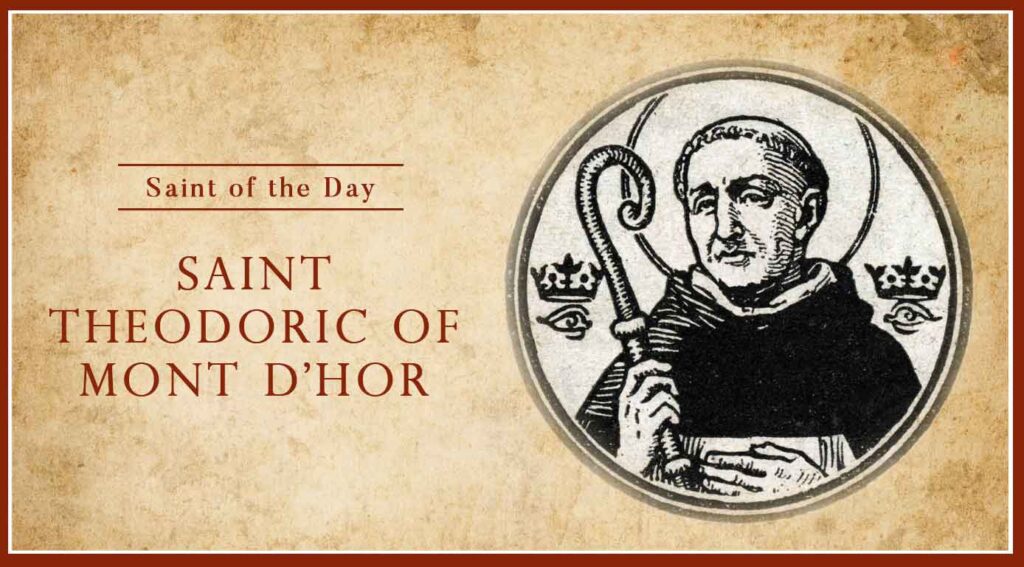
Saint Theodoric of Mont d’Hor

Saint Theodoric of Mont d’Hor was born in the district of Rheims. He was a disciple of Saint Remigius who became abbot of Saint-Thierry Abbey.

He became a monk and was made superior of an abbey founded by St. Remigius. After he received holy orders, he became famous for the many extraordinary conversions he did and for converting the sinners to repent. He succeeded as well in converting an infamous house into a nunnery of pious virgins.

King Thierry, son of Clovis, is said to have been cured of ophthalmia by the saint touching his eyes with oil. It is said that King Thierri assisted at his funeral, and esteemed himself honoured in being one of his bearers to the grave. His relics, lest they should be exposed to the impiety of the Normans, were hidden underground, but discovered in 976, and are still preserved in a silver shrine.

Saint Theodoric of Mont d’Hor Read More »

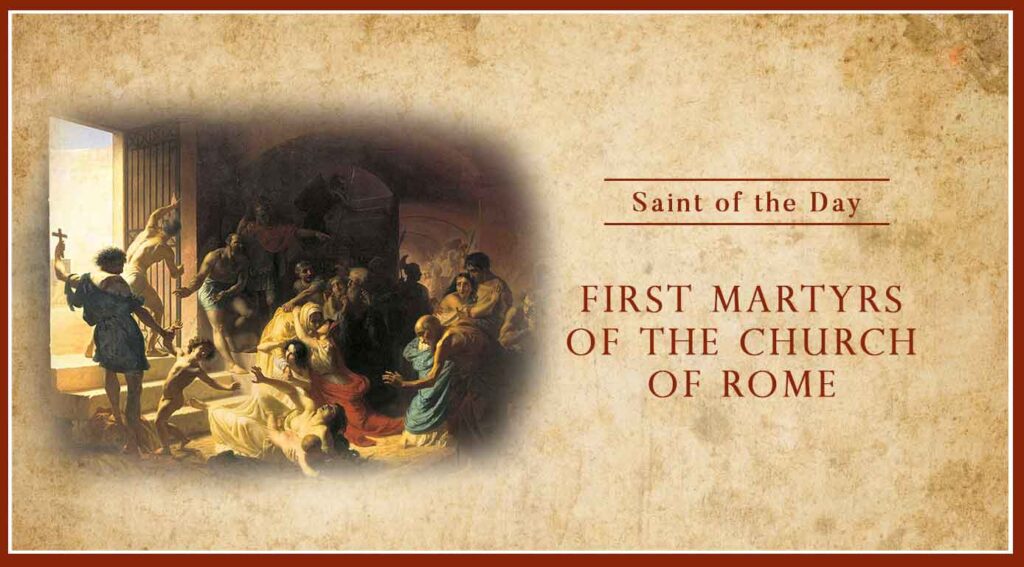
First Martyrs of the Church of Rome

The First Martyrs of the Church of Rome were Christians martyred in the city of Rome during Nero’s persecution in 64 AD. This feast first came into the General Roman Calendar in the 1969 calendar reforms. The intention of the feast is to give a general celebration of early Roman martyrs.

In July of 64 AD, Rome was devastated by fire. Largely made up of wooden tenements, fire was a frequent occurrence in the city. Rumor blamed the tragedy on the unpopular emperor Nero, who wanted to enlarge his palace. He accused the Christians. According to the historian Tacitus, many Christians were put to death “not so much of the crime of firing the city, as of hatred against mankind.”

This feast is a replacement for the many Roman martyr feasts, whose absence allowed for a less cluttered and more “dies natale” based sanctoral calendar of more major saints. It also permitted the greater celebration of ferias, partially enacting the Second Vatican Council’s call for the Proper of Time to take a greater precedence.

First Martyrs of the Church of Rome Read More »

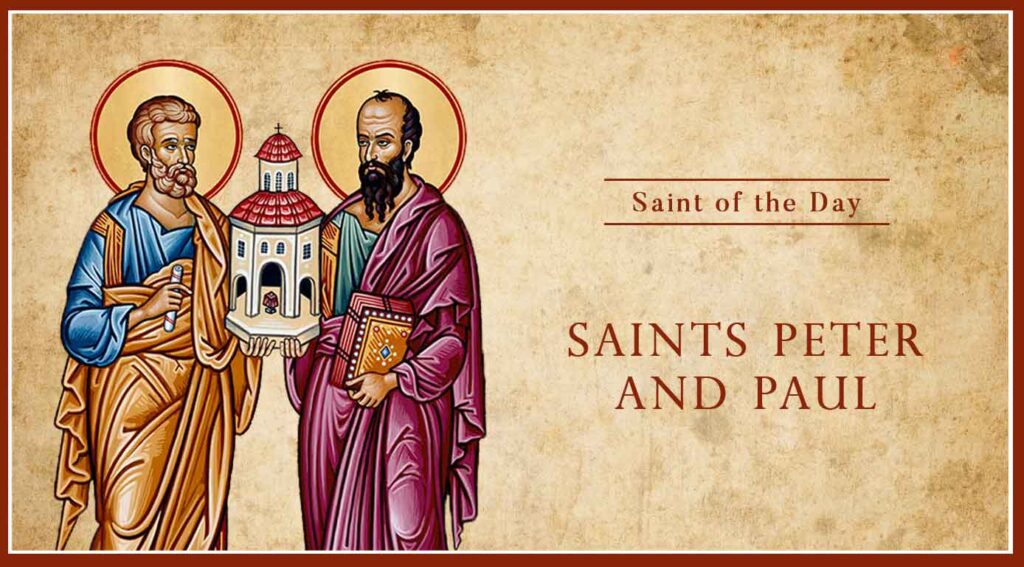
Saints Peter and Paul

The feast day of Saints Peter and Paul is a liturgical feast in honor of their martyrdom in Rome. It is one of five additional feasts ranked as a great feast in the Eastern Orthodox tradition and is often celebrated with an all-night vigil starting the evening before.

The New Testament clearly shows Peter as the leader of the apostles, chosen by Jesus to have a special relationship with him. With James and John he was privileged to witness the Transfiguration, the raising of a dead child to life, and the agony in Gethsemane. His mother-in-law was cured by Jesus. He was sent with John to prepare for the last Passover before Jesus’ death. His name is first on every list of apostles.

And to Peter only did Jesus say, “Blessed are you, Simon son of Jonah. For flesh and blood has not revealed this to you, but my heavenly Father. And so I say to you, you are Peter, and upon this rock I will build my church, and the gates of the netherworld shall not prevail against it. I will give you the keys to the kingdom of heaven. Whatever you bind on earth shall be bound in heaven; and whatever you loose on earth shall be loosed in heaven” (Matthew 16:17b-19).

But the Gospels prove their own trustworthiness by the unflattering details they include about Peter. He clearly had no public relations person. It is a great comfort for ordinary mortals to know that Peter also has his human weakness, even in the presence of Jesus.

Peter is willing to accept Jesus’ doctrine of forgiveness, but suggests a limit of seven times. He walks on the water in faith, but sinks in doubt. He refuses to let Jesus wash his feet, then wants his whole body cleansed. He swears at the Last Supper that he will never deny Jesus, and then swears to a servant maid that he has never known the man. He loyally resists the first attempt to arrest Jesus by cutting off Malchus’ ear, but in the end he runs away with the others. In the depth of his sorrow, Jesus looks on him and forgives him, and he goes out and sheds bitter tears. The Risen Jesus told Peter to feed his lambs and his sheep (John 21:15-17).

Paul’s central conviction was simple and absolute: Only God can save humanity. No human effort—even the most scrupulous observance of law—can create a human good which we can bring to God as reparation for sin and payment for grace. To be saved from itself, from sin, from the devil, and from death, humanity must open itself completely to the saving power of Jesus.

Paul never lost his love for his Jewish family, though he carried on a lifelong debate with them about the uselessness of the Law without Christ. He reminded the Gentiles that they were grafted on the parent stock of the Jews, who were still God’s chosen people, the children of the promise.

Saints Peter and Paul Read More »

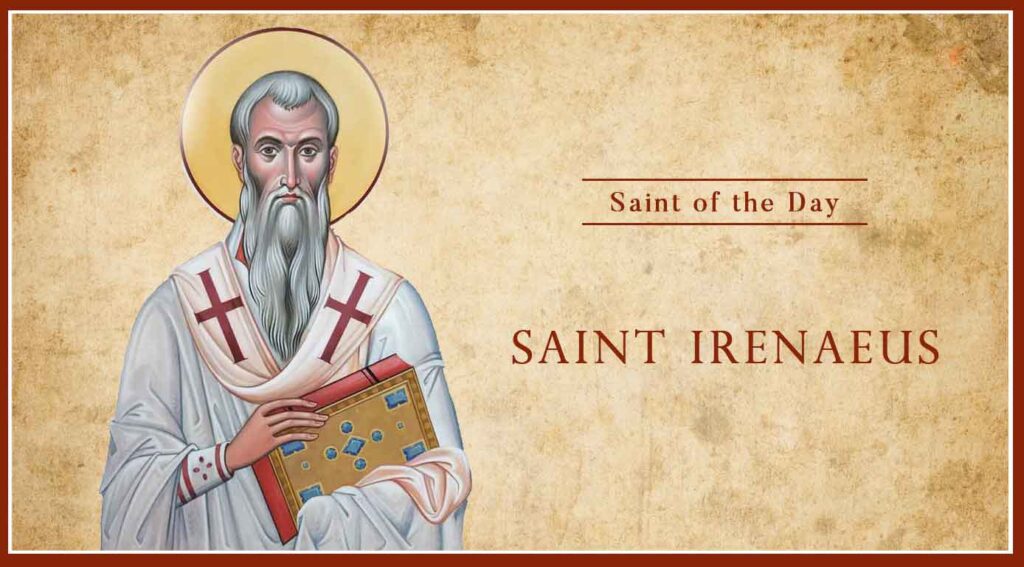
Saint Irenaeus

Saint Irenaeus was a Greek from Polycarp’s hometown of Smyrna in Asia Minor, now İzmir, Turkey, born during the first half of the 2nd century. Unlike many of his contemporaries, he was brought up in a Christian family rather than converting as an adult.

He was a Greek bishop noted for his role in guiding and expanding Christian communities in the southern regions of present-day France and, more widely, for the development of Christian theology by combating heterodox or Gnostic interpretations of Scripture as heresy and defining proto-orthodoxy.

During the persecution of Christians by Marcus Aurelius, the Roman emperor from 161 to 180, Irenaeus was a priest of the Church of Lyon. The clergy of that city, many of whom were suffering imprisonment for the faith, sent him in 177 to Rome with a letter to Pope Eleutherius concerning the heresy of Montanism, and that occasion bore emphatic testimony to his merits. While Irenaeus was in Rome, a persecution took place in Lyon. Returning to Gaul, Irenaeus succeeded the martyr Saint Pothinus and became the second bishop of Lyon.

During the religious peace which followed the persecution by Marcus Aurelius, the new bishop divided his activities between the duties of a pastor and of a missionary (as to which we have but brief data, late and not very certain). Almost all his writings were directed against Gnosticism. His best-known work is Against Heresies, often cited as Adversus Haereses, a refutation of gnosticism, in particular that of Valentinus. To counter the doctrines of the gnostic sects claiming secret wisdom, he offered three pillars of orthodoxy: the scriptures, the tradition handed down from the apostles, and the teaching of the apostles’ successors

Nothing is known of the date of his death, which must have occurred at the end of the second or the beginning of the third century. He is regarded as a martyr by the Catholic Church and by some within the Orthodox Church. He was buried under the Church of Saint John in Lyon, which was later renamed St Irenaeus in

Saint Irenaeus Read More »

Psalm 147:3

Verse:

“He heals the brokenhearted and binds up their wounds.” - Psalm 147:3

Prayer For Healing And Wholeness

Dear Lord, I know that You are a God Who heals all manner of sickness and illness through the power of Your Holy Spirit. I ask that by His power, You would send healing and wholeness to all who are afflicted at this time with illnesses and diseases.

Send comfort and strength at this time of difficulty. In Jesus' precious name,

Amen.

Psalm 147:3 Read More »