March 2023

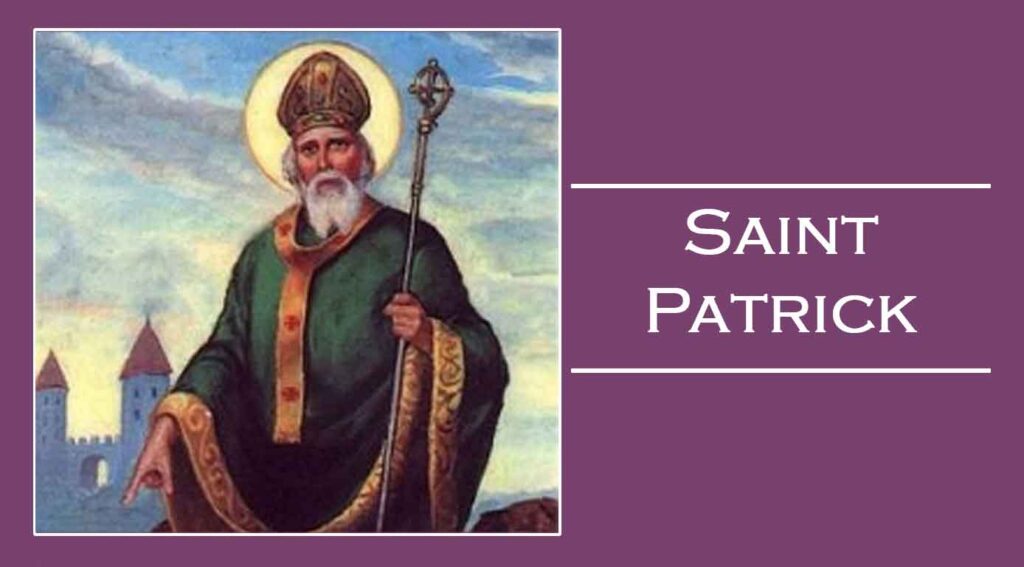
Saint Patrick

Saint Patrick was a 5th-century Romano-British Christian missionary and Bishop in Ireland. Much of what is known about Saint Patrick comes from the Declaration, which was allegedly written by Patrick himself. It is believed that he was born in Roman Britain in the fourth century, into a wealthy Romano-British family.

According to tradition, Patrick returned to Ireland to convert the pagan Irish to Christianity. The Declaration says that he spent many years evangelising in the northern half of Ireland and converted thousands. Patrick’s efforts were eventually turned into an allegory in which he drove “snakes” out of Ireland, despite the fact that snakes were not known to inhabit the region.
Saint Patrick’s Day, or the Feast of Saint Patrick, is a cultural and religious celebration held on the traditional death date of Saint Patrick (c. 385 – c. 461), the foremost patron saint of Ireland. The day commemorates Saint Patrick and the arrival of Christianity in Ireland, and celebrates the heritage and culture of the Irish in general.

Sources:

https://en.wikipedia.org/wiki/Saint_Patrick%27s_Day

Saint Patrick Read More »

Luke 6:30

Verse:

“Give to everyone who asks you, and if anyone takes what belongs to you, do not demand it back.” - Luke 6:30

Prayer for Kindness to Others

“Dear God, Grant us so much Love and compassion so that we could treat each other with Love and compassion. Bless us with so much wisdom, Love, and brotherhood so that we could think and act kindly. Amen.”

Sources:

https://bigbraincoach.com/prayer-for-kindness-and-compassion/

Luke 6:30 Read More »

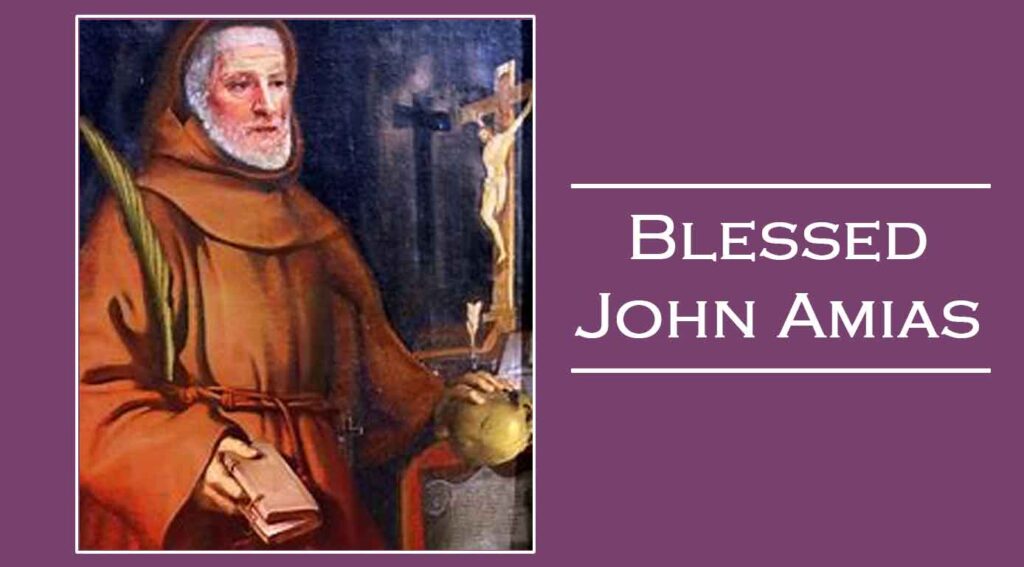
Blessed John Amias

Blessed John Amias was a Roman Catholic priest who was martyred in England. There is some doubt about his early life and his real name.

In an account of his life, a widower calling himself “John Amias” entered the English College at Rheims to study for the priesthood on June 22, 1580. He was ordained a priest in Rheims Cathedral on 25 March 1581.

Of his missionary life we know little. Towards the end of 1588 he was seized at the house of a Mr. Murton at Melling in Lancashire and imprisoned in York Castle. Given the 1585 Act making it a capital offence to be a Catholic priest in England the sentence of hanging, drawing and quartering was inevitable. It was carried out outside the city of York on 16 March 1589. Amias was beginning to address the assembled people, and explain that it was for religion, and not treason, that he suffered, but was not allowed to proceed.

Sources:

https://en.wikipedia.org/wiki/John_Amias
Ryan, Patrick W.F. "Ven. John Amias." The Catholic Encyclopedia. Vol. 1. New York: Robert Appleton Company, 1907. 2 Feb. 2013
Stanton, Richard, A Menology of England and Wales, p.119, Burns 7 Oates, Ltd., London, 1892

Blessed John Amias Read More »

James 4:2

Verse:

“You desire but do not have, so you kill. You covet but you cannot get what you want, so you quarrel and fight. You do not have because you do not ask God.” - James 4:2

Advent Prayer

Come, long-expected Jesus. Excite in me a wonder at the wisdom and power of Your Father and ours. Receive my prayer as part of my service of the Lord who enlists me in God's own work for justice.

Come, long-expected Jesus. Excite in me a hunger for peace: peace in the world, peace in my home, peace in myself.

Come, long-expected Jesus. Excite in me a joy responsive to the Father's joy. I seek His will so I can serve with gladness, singing and love.

Come, long-expected Jesus. Excite in me the joy and love and peace it is right to bring to the manger of my Lord. Raise in me, too, sober reverence for the God who acted there, hearty gratitude for the life begun there, and spirited resolution to serve the Father and Son.

I pray in the name of Jesus Christ, whose advent I hail. Amen.

James 4:2 Read More »

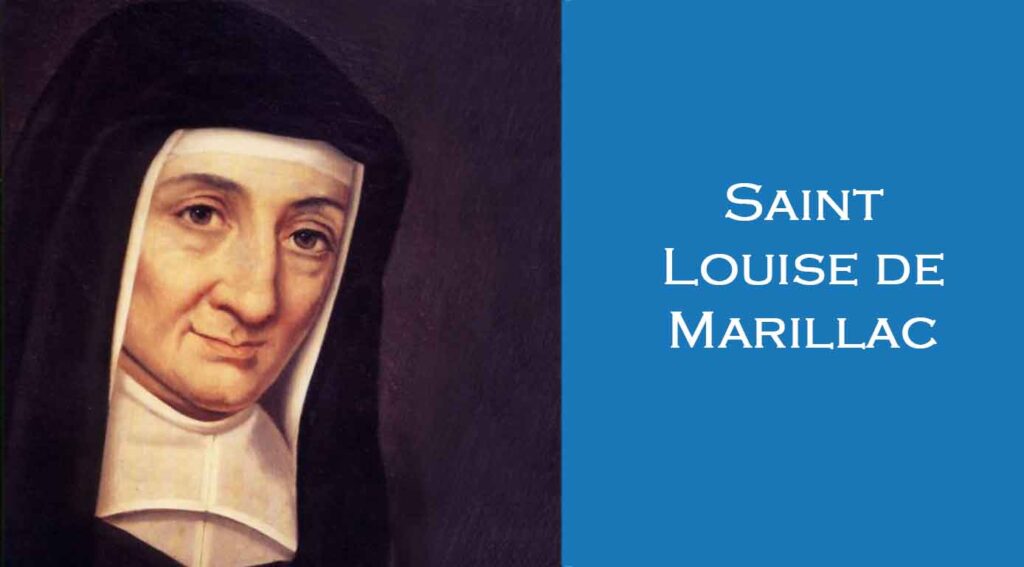
Saint Louise de Marillac

Saint Louise de Marillac was born out of wedlock in 1591. Lord of Ferrires (1556-1604), claimed her as his natural daughter yet not his legal heir. Louise grew up amid the affluent society of Paris, but without a stable home life. Nevertheless, she was cared for and received an excellent education at the royal monastery of Poissy.

Around the age of fifteen, Louise felt drawn to the cloistered life but was refused admission. Her spiritual director assured her that God had “other plans” for her. When she was 22, her family convinced her that marriage was the best alternative. Her uncle arranged for her to marry Antoine Le Gras. Louise grew to love Antoine and was an attentive mother to their son. Along with being devoted to her family, Louise was also active in ministry in her parish. She had a leading role in the Ladies of Charity, an organization of wealthy women dedicated to assisting those suffering from poverty and disease.

She vowed not to remarry if her husband died before her. Three years after this experience, Antoine died. In 17th-century France, the charitable care of the poor was completely unorganized. Louise found the help she needed in young, humble country women, who had the energy and the proper attitude to deal with people weighed down by destitution and suffering. She began working with a group of them and saw a need for common life and formation. She co-founded Daughters of Charity with Vincent de Paul.
Louise led the Company of Daughters until her death. Nearing her death, she wrote to her nuns: “Take good care of the service of the poor. Above all, live together in great union and cordiality, loving one another in imitation of the union and life of our Lord. Pray earnestly to the Blessed Virgin, that she might be your only Mother.”

Sources:

https://en.wikipedia.org/wiki/Louise_de_Marillac

Saint Louise de Marillac Read More »

Psalm 33:18

Verse:

“But the eyes of the Lord are on those who fear him, on those whose hope is in his unfailing love.” - Psalm 33:18

Prayer to Love God above all Things

God, my Father,
may I love You in all things and above all things.
May I reach the joy which You have prepared for me in
Heaven.
Nothing is good that is against Your Will,
and all that is good comes from Your Hand.
Place in my heart a desire to please You
and fill my mind with thoughts of Your Love,
so that I may grow in Your Wisdom and enjoy Your Peace.

Psalm 33:18 Read More »

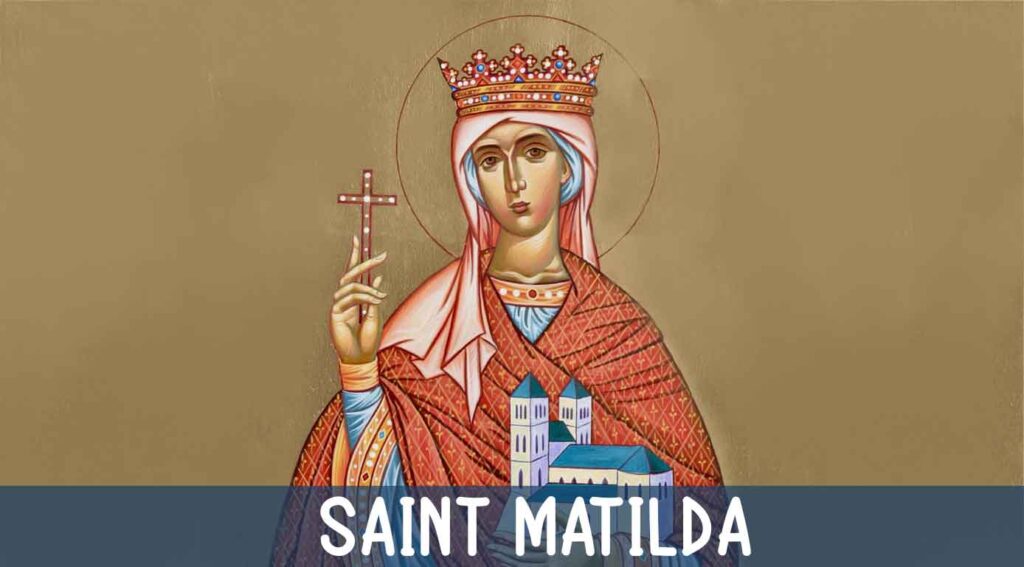
Saint Matilda

Saint Matilda, also referred to as Matilda of Ringelheim, founded several spiritual institutions and women’s convents. She was considered to be extremely pious, righteous and charitable.

Saint Matilda was born in around 892, and was raised by her grandmother. In 909, she married the Duke of Saxony who later became East Franconian King. As queen, she took an interest in women’s monasteries and is said to have had an influence on her husband’s reign by having a strong sense of justice.

After Henry’s death 936 in Memleben, he was buried in Quedlinburg, where Queen Matilda founded a convent the same year. Quedlinburg Abbey became the most important center of prayer and commemoration of the dead in the East Franconian empire.

After a long illness, Queen Matilda died on 14 March 968. Throughout her life, Matilda was dedicated to charity and her spiritual foundations – as expressed several times in her two hagiographies.

Saint Matilda Read More »

2 Corinthians 5:1

Verse:

 “For we know that if the earthly tent we live in is destroyed, we have a building from God, an eternal house in heaven, not built by human hands.” - 2 Corinthians 5:1

To Perceive Animals as God's Gifts

God Our Heavenly Father, You created the world to serve humanity's needs and to lead them to You. By our own fault we have lost the beautiful relationship which we once had with all Your creation. Help us to see that by restoring our relationship with You we will also restore it with all Your creation. Give us the grace to see all animals as gifts from You and to treat them with respect for they are Your creation. We pray for all animals who are suffering as a result of our neglect. May the order You originally established be once again restored to the whole world through the intercession of the Glorious Virgin Mary, the prayers of St. Francis and the merits of Your Son, Our Lord Jesus Christ Who lives and reigns with You now and forever.
Amen.

Sources:


2 Corinthians 5:1 Read More »

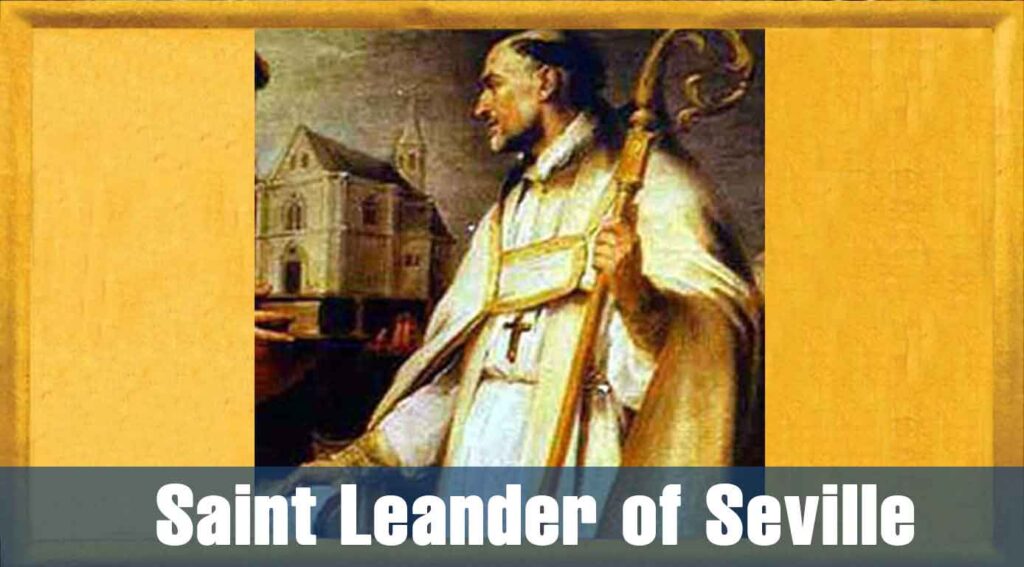
Saint Leander of Seville

The next time you recite the Nicene Creed at Mass, think of today’s saint. For it was Leander of Seville who, as bishop, introduced the practice in the sixth century. He saw it as a way to help reinforce the faith of his people and as an antidote against the heresy of Arianism, which denied the divinity of Christ. By the end of his life, Leander had helped Christianity flourish in Spain at a time of political and religious upheaval.

Leander’s own family were staunch Christians: his brothers Isidore and Fulgentius were named bishops, and their sister Florentina became an abbess. Leander entered a monastery as a young man and spent three years in prayer and study. At the end of that tranquil period he was made a bishop. For the rest of his life he worked strenuously to fight against heresy. The death of the anti-Christian king in 586 helped Leander’s cause. He and the new king worked hand in hand to restore orthodoxy and a renewed sense of morality. Leander succeeded in persuading many Arian bishops to change their loyalties.
Leander died around 600. In Spain, he is honored as a Doctor of the Church.

Sources:

https://www.franciscanmedia.org/saint-of-the-day/saint-leander-of-seville/

Saint Leander of Seville Read More »

Third Sunday of Lent

Liturgy of the Word

First Reading: Ex 17:3-7

In those days, in their thirst for water,
the people grumbled against Moses,
saying, “Why did you ever make us leave Egypt?
Was it just to have us die here of thirst
with our children and our livestock?”
So Moses cried out to the LORD,
“What shall I do with this people?
a little more and they will stone me!”
The LORD answered Moses,
“Go over there in front of the people,
along with some of the elders of Israel,
holding in your hand, as you go,
the staff with which you struck the river.
I will be standing there in front of you on the rock in Horeb.
Strike the rock, and the water will flow from it
for the people to drink.”
This Moses did, in the presence of the elders of Israel.
The place was called Massah and Meribah,
because the Israelites quarreled there
and tested the LORD, saying,
“Is the LORD in our midst or not?”

Responsorial Psalm: Psalm 95:1-2, 6-7, 8-9

Response– If today you hear his voice, harden not your hearts

Come, let us sing joyfully to the LORD;
let us acclaim the Rock of our salvation.
Let us come into his presence with thanksgiving;
let us joyfully sing psalms to him.
R– If today you hear his voice, harden not your hearts

Come, let us bow down in worship;
let us kneel before the LORD who made us.
For he is our God,
and we are the people he shepherds, the flock he guides.
R– If today you hear his voice, harden not your hearts

Oh, that today you would hear his voice:
“Harden not your hearts as at Meribah,
as in the day of Massah in the desert,
Where your fathers tempted me;
they tested me though they had seen my works.”
R– If today you hear his voice, harden not your hearts

Second Reading: Rom 5:1-2, 5-8

Brothers and sisters:
Since we have been justified by faith,
we have peace with God through our Lord Jesus Christ,
through whom we have gained access by faith
to this grace in which we stand,
and we boast in hope of the glory of God.

And hope does not disappoint,
because the love of God has been poured out into our hearts
through the Holy Spirit who has been given to us.
For Christ, while we were still helpless,
died at the appointed time for the ungodly.
Indeed, only with difficulty does one die for a just person,
though perhaps for a good person one might even find courage to die.
But God proves his love for us
in that while we were still sinners Christ died for us.

Verse Before the Gospel: Jn 4:42, 15

Lord, you are truly the Savior of the world; give me living water, that I may never thirst again.

Gospel: Jn 4: 5-42

A reading from the holy Gospel according to John

Jesus came to a town of Samaria called Sychar,
near the plot of land that Jacob had given to his son Joseph.
Jacob’s well was there.
Jesus, tired from his journey, sat down there at the well.
It was about noon.

A woman of Samaria came to draw water.
Jesus said to her,
“Give me a drink.”
His disciples had gone into the town to buy food.
The Samaritan woman said to him,
“How can you, a Jew, ask me, a Samaritan woman, for a drink?”
—For Jews use nothing in common with Samaritans.—
Jesus answered and said to her,
“If you knew the gift of God
and who is saying to you, ‘Give me a drink, ‘
you would have asked him
and he would have given you living water.”
The woman said to him,
“Sir, you do not even have a bucket and the cistern is deep;
where then can you get this living water?
Are you greater than our father Jacob,
who gave us this cistern and drank from it himself
with his children and his flocks?”
Jesus answered and said to her,
“Everyone who drinks this water will be thirsty again;
but whoever drinks the water I shall give will never thirst;
the water I shall give will become in him
a spring of water welling up to eternal life.”
The woman said to him,
“Sir, give me this water, so that I may not be thirsty
or have to keep coming here to draw water.”

Jesus said to her,
“Go call your husband and come back.”
The woman answered and said to him,
“I do not have a husband.”
Jesus answered her,
“You are right in saying, ‘I do not have a husband.’
For you have had five husbands,
and the one you have now is not your husband.
What you have said is true.”
The woman said to him,
“Sir, I can see that you are a prophet.
Our ancestors worshiped on this mountain;
but you people say that the place to worship is in Jerusalem.”
Jesus said to her,
“Believe me, woman, the hour is coming
when you will worship the Father
neither on this mountain nor in Jerusalem.
You people worship what you do not understand;
we worship what we understand,
because salvation is from the Jews.
But the hour is coming, and is now here,
when true worshipers will worship the Father in Spirit and truth;
and indeed the Father seeks such people to worship him.
God is Spirit, and those who worship him
must worship in Spirit and truth.”
The woman said to him,
“I know that the Messiah is coming, the one called the Christ;
when he comes, he will tell us everything.”
Jesus said to her,
“I am he, the one speaking with you.”

At that moment his disciples returned,
and were amazed that he was talking with a woman,
but still no one said, “What are you looking for?”
or “Why are you talking with her?”
The woman left her water jar
and went into the town and said to the people,
“Come see a man who told me everything I have done.
Could he possibly be the Christ?”
They went out of the town and came to him.
Meanwhile, the disciples urged him, “Rabbi, eat.”
But he said to them,
“I have food to eat of which you do not know.”
So the disciples said to one another,
“Could someone have brought him something to eat?”
Jesus said to them,
“My food is to do the will of the one who sent me
and to finish his work.
Do you not say, ‘In four months the harvest will be here’?
I tell you, look up and see the fields ripe for the harvest.
The reaper is already receiving payment
and gathering crops for eternal life,
so that the sower and reaper can rejoice together.
For here the saying is verified that ‘One sows and another reaps.’
I sent you to reap what you have not worked for;
others have done the work,
and you are sharing the fruits of their work.”

Many of the Samaritans of that town began to believe in him
because of the word of the woman who testified,
“He told me everything I have done.”
When the Samaritans came to him,

they invited him to stay with them;
and he stayed there two days.
Many more began to believe in him because of his word,
and they said to the woman,
“We no longer believe because of your word;
for we have heard for ourselves,
and we know that this is truly the savior of the world.”
The Readings and Gospel were sourced from:

Third Sunday of Lent Read More »