Daily Saints

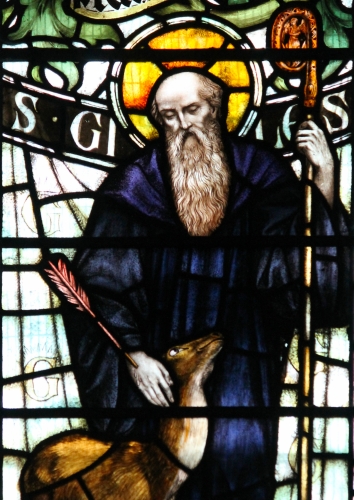
Saint Romuald, Abbot

c. 951–1027; Invoked for reformation of the Church and monastic life; Canonized by Pope Gregory XIII in 1582

Saint Romuald was born into a noble family in Ravenna, located in modern-day northern Italy. As a youth, he was reportedly quite mischievous, and by some accounts, even vicious. It’s likely he adopted such behavior in imitation of his father. During that time, the nobility were often engaged in conflicts over control of land, political power, or in response to perceived violations of their family’s honor. When Romuald was twenty, his father, Sergius degli Onesti, found himself embroiled in such a conflict with a relative over land ownership. They resolved their dispute through a duel, which Sergius won by killing his relative. Even though Romuald was no stranger to such conflicts, he was horrified by his father’s actions. Romuald fled to the Benedictine monastery of San Apollinare-in-Classe, just south of Ravenna. Initially, he went to the monastery for a forty-day retreat of prayer and penance to atone for his father’s sin. After forty days, however, he decided to stay and become a monk.

In Romuald’s day, many European monasteries were undergoing reform. Many had become political in nature and had relaxed their emphasis on prayer. When Romuald entered the Monastery of San Apollinare-in-Classe, reforms had just started, but true reform takes a long time. Given Romuald’s newfound zeal for prayer and penance, coupled with his temper and lack of patience, he often lashed out at his fellow monks for their lax lifestyle. As a result, Romuald was not very popular among the more worldly monks. He requested and quickly received permission from the abbot to move to Venice and live as a hermit under the spiritual direction of another hermit named Marinus. For the next several years, Romuald lived a strict life of solitude, silence, prayer, and penance. Under Marinus, he developed his own monastic lifestyle, learning not only from Marinus but also directly from the Holy Spirit through his life of prayer.

Around the year 978, while in his late twenties, Romuald and Marinus moved to the border of France and Spain and built a hermitage near the Monastery of Saint-Michel-de-Cuxa. For the next several years, Romuald continued to live a life of prayer, solitude, and silence, along with a period of intense study, taking advantage of the library at the nearby monastery. His studies, guided by the Holy Spirit, led him to further develop a new way of being a hermit and to a deeper understanding of the ideals of monasticism in general.

Around the age of thirty-seven, after living the hermit’s life for fifteen to twenty years and developing a new theological and practical understanding of the ideals of monasticism, Romuald began traveling across Europe. He founded new hermitages and monasteries and provided spiritual direction to existing ones in need of reform. One of his first stops was to visit his father, who had since repented of his former lifestyle and became a monk himself. Before his father died, Romuald helped him more fully embrace his new monastic vocation. Sometime after 996, Otto III ascended to the role of Holy Roman Emperor. Otto was devoted to reforms within the Church and across the empire. One story relates that when Otto heard about Romuald’s fervor and commitment to reforming monastic life, Otto asked him to become the abbot of Otto’s first monastery, San Apollinare-in-Classe. However, the monks resisted Romuald’s reform efforts so vehemently that he left in frustration within a year.

In 1012, according to legend, a man named Maldolus had a vision of monks dressed in white ascending a ladder to Heaven. Prompted by this vision, Maldolus donated a piece of land he owned in Camaldoli, near Arezzo in Tuscany, to Romuald. On this land, Romauld built five hermitages, marking the beginnings of the Camaldolese Hermits of Mount Corona. This new form of monasticism harmonized, for the first time, the lives of hermits and monks. Monks lived in community, sharing meals, work, and communal prayer. Hermits, in contrast, pursued their vocations mostly in solitude. Romuald’s innovative form of monasticism aimed to marry these two vocations. The monks each lived in their own hermitages in silence and solitude but would gather each day in a shared chapel for prayer. They also shared meals, though not as frequently as traditional monks, and shared a common mission and rule of life. Over the next fifteen years, Romuald founded several more monastery-hermitages, firmly establishing his new form of monastic life within the broader life of the Church.

The “Brief Rule” that Saint Romuald left his brothers is just that, brief. It is quoted above in its entirety. In its simplicity, it spells out all that Saint Romuald believed monk-hermits needed to know in order to live the life to which they are called. The Rule offers seven exercises to help grow in contemplation. The hermit-monk must love his cell, be detached, be self-observant, attentive to praying the Psalms, reverent before God, intense in asceticism, and become childlike in one’s receptivity to grace.

Saint Romuald passed away in the solitude of his cell, a place he referred to as “paradise.” Numerous miracles were reported in the years following his death by those who prayed at his tomb. According to legend, approximately 400 years later, his body was exhumed and found to be incorrupt, but being sacrilegiously unearthed, the body turned to dust. Other accounts state that his body remains incorrupt and was relocated to Fabriano, Italy, where his order had constructed another monastery. Today, this church is known as Saint Romuald’s.

The eremitical life of a hermit, while not suited for everyone, plays an essential role in the life of the Church. God calls a select number of men and women to serve as intercessors for the entire Church, as well as beacons guiding our pilgrimage toward Heaven. Their vocation underscores the importance of prayer, solitude, silence, and asceticism. As we honor the great founder of the Camaldolese Order, let us reflect on our own need for deeper interior silence, attainable only through solitude, prayer, and penance. While you might not be called to live as a hermit, you are nonetheless summoned to periods of contemplation where you can experience a glimpse of their lifestyle. Daily prayer, retreats, adoration, and the like are essential in this fast-paced and noisy world. Commit to emulating Saint Romuald and allow his witness to guide you towards a deeper union with God.

Source: https://mycatholic.life/saints/saints-of-the-liturgical-year/june-19—saint-romuald-abbot/

Saint Romuald, Abbot Read More »

Saint Elizabeth of Schönau

Profile

Elizabeth was born to the German nobility. She was raised and educated in Schönau Benedictine abbey near Bingen, Germany from age 12. Elizabeth came to see the abbey as home, and took vows as a Benedictine nun in 1147. She was a friend of Saint Hildegard von Bingen. She became an abbess at Schonau from 1157 until her death.

In 1152, Elizabeth began receiving ecstasies and visions of Jesus and Mary, received the gift of prophecy, and suffered the assaults of demonic forces. With the help of her brother Egbert, a monk and abbot, she wrote three volumes describing her visions. The periods in ecstasies weakened her already fragile health.

Born

  • 1126 in Bingen, Germany

Died

  • 18 June 1164 at Bingen, Germany of natural causes
  • buried in the church of Saint Florin at the Schönau abbey
  • most relics were destroyed by Swedish forces in 1632
  • remaining relics enshrined in the parish church in Schönau

Canonized

  • never formally canonized, but popular devotion went on for centuries
  • added to the Roman Martyrology in 1584 by Pope Gregory XIII

Representation

  • Benedictine nun with a book

Patronage

  • against temptations

Source: https://catholicsaints.info/saint-elizabeth-of-schonau/

Saint Elizabeth of Schönau Read More »

Saint Hervé

Profile

Son of the bard Hyvarnion, Herve was born blind. His father died when he was an infant. His mother, Rivanone, became an anchoress, and the boy was entrusted to the care of his uncles and a renowned holy man with whom he stayed until his teenage years. He lived for a while as a hermit and bard, then joined a monastic school at Plouvien, France which had been founded by his uncle. He became an abbot at Plouvien. He migrated with part of his community to found a new house in Lanhouarneau. He was a singer, minstrel, teacher, and miracle worker. One of the most popular saints in Brittany, he figures in the area’s folklore. He was reported to have a special ministry of healing animals, and to have a domesticated wolf as a companion. Legend says that the wolf killed and ate the ox that Herve used to plow his fields; Herve then preached such a moving sermon the wolf repented his ways, moved to Herve’s hermitage, and ploughed Herve’s fields in place of the ox.

Born

  • Guimiliau, Brittany, France or unknown location in Wales (sources vary)

Died

  • c.556 to c.575 (sources vary) of natural causes
  • interred at Lanhouarneau, Brittany, France

Canonized

  • Pre-Congregation

Patronage

  • against eye disease
  • against eye problems
  • blind people
  • in France
    – Brest
    – Plouvien

Representation

  • blind man being led by a wolf

Source: https://catholicsaints.info/saint-herve/

Saint Hervé Read More »

Saint Lutgardis

Profile

A pretty girl with a fondness for clothes and no apparent religious vocation, Lutgardis was sent to the Black Benedictine convent near Saint Trond at age 12 because her dowry had been lost in a failed business venture, and there was thus little chance for a life as a normal, married lay woman. In her late teens, Lutgardis received a vision of Christ showing her His wounds, and in 1194 at age 20 she became a Benedictine nun with a true vocation. She had visions of Christ while in prayer, experienced ecstasies, levitated, and dripped blood from forehead and hair when enraptured by the Passion. Chosen as prioress of her community in 1205, she repeatedly refused to be abbess.

The Benedictine order was not strict enough for Lutgardis, and on the advice of her friend Saint Christina the Astonishing, in 1208 she joined the Cistercians at Aywieres (near Brussels in modern Belgium) where she lived for her remaining 30 years. She displayed the gifts of healing, prophecy, spiritual wisdom, and was an inspired teacher on the Gospels. Blind for the last eleven years of her life, she treated the affliction as a gift – it reduced the distraction of the outside world. In one of her last visions, Christ told her when she was to die; she spent the time remaining in prayer for the conversion of sinners.

Born

  • 1182 at Tongres, Limburg, Belgium

Died

  • 16 June 1246 at Aywieres (modern Awirs), Belgium of natural causes, just as night office began on the Saturday night following Feast of the Holy Trinity
  • relics transferred to Ittre, Belgium on 4 December 1796 to avoid destruction in the French Revolution

Patronage

  • birth
  • blind people
  • blindness
  • childbirth
  • disabled people
  • handicapped people
  • physically challenged people
  • Belgium
  • in Belgium
    – Flanders
    – Tongeren

Representation

  • woman with Christ showing her His wounded side
  • blind Cistercian abbess
  • Cistercian nun being blinded by the Heart of Jesus
  • Cistercian to whom Christ extends his hand from the cross
  • woman in attendance when Christ shows his Heart to the Father

Source: https://catholicsaints.info/saint-lutgardis/

Saint Lutgardis Read More »

The Most Holy Trinity

One of the most fiercely debated dogmas of our faith in the early centuries of the Church was on the nature of the Most Holy Trinity. Today’s solemnity did not enter the General Roman Calendar until the fourteenth century, partly because we are called to honor and worship the Most Holy Trinity every day and in every liturgy. But designating one Sunday on which we ponder the inner life of the Most Holy Trinity is an opportunity to renew and deepen our honor and worship.

The Trinity is first and foremost a mystery. As The Divine Mystery above all mysteries, we must begin by humbly acknowledging that we will never, not even in Heaven, have a complete understanding of God’s essence, His inner reality. Only God knows Himself fully. Not even the Blessed Virgin Mary or the highest choirs of angels see Him and know Him as He sees and knows Himself. Nonetheless, every creature, whether angel or human, is called to probe the mysteries of God to the fullest extent possible. In that probing, contemplating, and understanding, we discover the purpose of our lives and experience the fullness of beatitude to which we are called. God and God alone satisfies the hungry, weary, and seeking soul.

This might come as a surprise, but God is perfectly simple. Saint Thomas Aquinas, one of the Church’s greatest teachers, explains that angels, the physical world, and humans are made up of different material and immaterial parts that can change over time, making us a complex reality capable of internal and external disunity. God, however, is incapable of change, since He is Perfection. He is exactly Who He is, always has been, and will always be. This results in a divine simplicity and harmonious unity that is infinitely beyond His creation. God doesn’t need anything to exist because it is His very nature to exist as the unchanging, transcendent God.

Within this divine simplicity and perfect unity we can distinguish various attributes of God, noting that each attribute is perfectly united with the others in the most simple and complete way. God alone is all-powerful and has supreme authority over all creation. He alone perceives all potentiality within creation and within Himself. He is perfectly wise, just, and merciful. He is both completely beyond creation (transcendent) and intimately involved with every aspect of creation (immanent). God is the perfection of holiness and morality. He is the only standard of goodness and truth. He is present everywhere at all times—unchanging and eternal. God is Love.

This philosophically rich language attempts to describe God in His oneness—He is One God, not three Gods. The Father, Son, and Holy Spirit each share perfectly in the one divine nature, and all share the same divine attributes. To understand the profound mystery of the Trinity, we must start with the above oneness of God and then move into His threefold Personhood.

How can something be one and three at the same time? We know that God is one-in-three solely because this is the way the Scriptures reveal God to us. The Old Testament alluded to the threefold personhood of God, and Jesus explicitly identified the three persons as the Father, Son, and Holy Spirit. Without this revelation from our Lord, human reason alone could never arrive at the realization that God is One in Three.

In Sacred Scripture and Church teaching, God’s attributes and existence can be summed up as Love. “God is love” (1 John 4:8). Love cannot exist without a giver, a receiver, and the love that unites them. Hence, it is the very nature of God to love perfectly, to receive love perfectly, and to be love itself.

In the Trinity, the Father loves the Son, the Son loves the Father, and this mutual love is personified in the Holy Spirit. This “love” in God is defined by the Church as an “eternal begetting” and as an “eternal procession,” which are fundamentally different from an act of creation. The words “begetting” and “proceeding” are used to point to the relational origin of love. The Father eternally begets the Son, reflecting an eternal exchange of love. The Holy Spirit, then, proceeds from both the Father and the Son, emanating from their mutual love. These profound mysteries are articulated in the Nicene Creed:

I believe in one Lord Jesus Christ, the Only Begotten Son of God, born of the Father before all ages. God from God, Light from Light, true God from true God, begotten, not made, consubstantial with the Father; through him all things were made…I believe in the Holy Spirit, the Lord, the giver of life, who proceeds from the Father and the Son, who with the Father and the Son is adored and glorified, who has spoken through the prophets.

The formulation of the Trinitarian relationship in the Creed reveals the profound depth of God’s nature: God is of one essence, yet three distinct Persons. Each Person is involved in an eternal, loving relationship with the others. The mystery within this formulation requires contemplation, as it reveals a God Who is deeply relational and Whose very nature is to exist in a state of perfect, self-giving love.

If these definitions of God seem beyond your grasp, you are correct. They are. By God’s grace, these basic definitions of the Most Holy Trinity took shape, beginning with Church councils in the fourth and fifth centuries. Later, theologians such as Saint Augustine and Saint Thomas Aquinas deepened our understanding. However, even if you were to spend years studying the best theology on the Trinity, you would still only be able to comprehend a slight image of Who God is.

The best way to grow in a deeper understanding of God and all of reality is through the deepest forms of contemplative prayer. Contemplative prayer is not something you can simply turn on. It is an infused prayer that only God can bestow as He invites you to enter into His divine presence. Contemplative prayer begins with a profound purification process by which all sin is purged from one’s life, as well as all attachment to sin, and then all conceptual knowledge of God is eliminated so that the mind can gaze upon God through infused knowledge. This mystical prayer is well taught by the greatest saints of the Church, especially Saint John of the Cross and Saint Teresa of Ávila. Being drawn into the mystery of God’s inner life sometimes includes periods of mystical ecstasy, raptures, intellectual visions, and other mystical phenomena. Though few reach that height of prayer in this life, it’s helpful to know it is possible and to know that directly infused knowledge of God through mystical prayer is the only way to achieve some comprehension of the Most Holy Trinity.

As you strive to deepen your own prayer life, offer your praise to God the best you can. Profess your unwavering belief in the Creed, despite not fully understanding it. Most importantly, open your heart to God, Who is Love, and love Him in return with every power of your soul. By doing so, you will be on the slow and steady road to a mystical union of love with the Father, Son, and Holy Spirit.

Source: https://mycatholic.life/saints/saints-of-the-liturgical-year/first-sunday-after-pentecost-holy-trinity–solemnity/

The Most Holy Trinity Read More »

Saint Methodius of Constantinople

Profile

Methodius was educated in Syracuse, Sicily. While in Constantinople to seek a position at court, he felt the call to enter the religious life. He built a monastery and started a monastic community on the island of Chinos. Soon after finishing construction, Methodius was summoned by the Patriarch of Constantinople to help govern the diocese.

The Eastern Church was debating the use of icons in worship and as tools to bring the faithful closer to God. Methodius and the Patriarch of Constantinople worked against the iconoclasts, and together suffered nearly as much abuse as the images. They worked to unify and reconcile the sides. Methodius traveled to Rome, Italy to seek the Pope‘s help; during his absence, he was exiled. After seven years, he returned as Patriarch of Constantinople in 842, and continued to work for unity.

Born

  • 8th century at Syracuse, Sicily

Died

  • 847 of natural causes

Canonized

  • Pre-Congregation

Patronage

  • Chios, Greece

Source: https://catholicsaints.info/saint-methodius-of-constantinople/

Saint Methodius of Constantinople Read More »

Saint Anthony of Padua, Priest and Doctor

1195–1231; Patron Saint of amputees, animals, mail, horses, expectant mothers, fishermen, harvests, lost articles, boatmen, and travelers, as well as the elderly, oppressed, poor, and starving; Canonized by Pope Gregory IX on 30 May 1232; Declared the Evangelizing Doctor of the Church by Pope Pius XII in 1946

Saint Anthony of Padua is one of the most revered saints within the Catholic Church. He was born in Lisbon, Portugal and was given the name Fernando Martins de Bulhões. His parents were wealthy nobility who provided a good education for him as a youth, most likely at the Cathedral school in Lisbon. At the age of fifteen, Fernando decided to enter religious life and joined the Canons Regular of St. Augustine, not far from his home. During his two years with the canons, he excelled in his studies and prayer. However, being so close to his home led to frequent visits from family and friends, prompting Fernando to desire greater solitude to more deeply embrace his vocation. He moved to Coimbra, just over 100 miles north of Lisbon, to join the Santa Cruz Monastery. At Santa Cruz, Fernando enjoyed nine years of excellent formation, studying, praying, and growing in virtue. After completing his formation in 1220, Fernando was ordained a priest.

During his nine years of formation in Coimbra, a small group from the newly-founded Franciscan Order took up residence nearby in a hut dedicated to Saint Anthony of Egypt. Fernando came to know these friars and was impressed by their simplicity, poverty, humility, and radical dedication to Christ. The Franciscans, founded by Saint Francis of Assisi only eleven years prior to their arrival in Coimbra, were a new and rapidly growing order within the Church. They were traveling preachers, relying upon divine providence rather than the income produced by large estates. They owned nothing except for the single piece of clothing they wore.

One day, news reached Coimbra that five Franciscan missionaries had been martyred in Morocco by Muslims. The King of Portugal ransomed their bodies, which were then brought back in a solemn procession to Coimbra for burial. The courage of these martyrs, coupled with the witness of their fellow friars, so impressed Fernando that he requested and received permission to leave the Canons Regular and join the Franciscans. He took the name Anthony after Saint Anthony of Egypt, the patron of the friars’ house in Coimbra.

Desiring to emulate these five martyrs, Father Anthony sailed to Morocco to preach to the Muslims. However, he soon fell seriously ill and required medical attention, prompting his return journey to Portugal. A storm blew his ship off course, resulting in a landing in Sicily instead. Shortly after Father Anthony recovered from his illness, Saint Francis called the famous “Chapter of Mats” in Assisi. Most of the Franciscan Friars attended, including one of their newest members, Father Anthony.

In 1209, Saint Francis founded his order with twelve members. By 1221, the number of Franciscan friars had grown to about 5,000. Such rapid growth brought not only zeal and enthusiasm, but also growing pains, divisions, and the need for clarity. At the General Chapter of Mats, Saint Francis resigned as the head of the order, turning leadership over to those he felt were more qualified. He preferred a life of greater humility, poverty, simplicity, and prayer. It was at that Chapter that Father Anthony and Brother Francis likely met for the first time. Shortly afterwards, Father Anthony was assigned to the hermitage of Monte Paola in Forli.

Anthony’s initial time in Forli was spent in solitude, study, and prayer. One day, due to confusion between the Dominicans and Franciscans, no one was assigned to preach at a first Mass in the local church. At the last minute, Father Anthony reluctantly agreed to preach. His sermon left the congregation in awe of his exceptional gift for preaching, his profound knowledge of the Sacred Scriptures, and his depth of holiness. From then on, Father Anthony became a well-known and sought-after preacher, changing many lives with his humble, down-to-earth, yet theologically profound preaching. He drew on the storehouse of wisdom from ancient saints but never presented himself in a proud or arrogant manner. His allegorical method of preaching sought to bring out the symbolic and hidden meanings of the text in a way that connected with people. His preaching and humble wisdom even caught the attention of Saint Francis, who was concerned about higher education for the friars, fearing that advanced studies could lead to pride and undermine the order’s mission. In Father Anthony, however, Francis found someone he could trust and put him in charge of the theological training of the friars preparing for ordination.

Father Anthony continued to preach far and wide for the next several years until his death at the age of thirty-five. One day, he was even invited to preach to the pope and the cardinals. During that sermon, Father Anthony was given the gift of tongues, enabling everyone present to understand him in his native language. Pope Gregory IX was so impressed with Anthony’s insight into Scripture that he referred to him as the “Ark of the Testament.” The pope asked Father Anthony to compose sermons for Sundays and feast days of the liturgical year, which he did in the form of outlines and commentaries on the Scriptures. It is those sermons that later led to him being named a Doctor of the Church with the unique title of “Evangelizing Doctor.”

Many other legends surround Father Anthony’s preaching and miracles. He is said to have preached to fish one day when the heretical townspeople had rejected him. When they saw the fish sticking their heads out of the water to listen attentively, the people converted. For this reason, he is often called the “Hammer of Heretics.” He is known as the patron saint of lost items because one day a friar stole a Gospel book from Father Anthony and when Father Anthony prayed for its return, the friar was so convicted in his heart that he returned it and repented.

Saint Anthony is often depicted holding the Child Jesus, a portrayal inspired by an account of a friar who reportedly saw Anthony in deep prayer, conversing with the Christ Child. Sacred Scripture is also frequently featured in art as a symbol of his profound knowledge of Scripture. Lilies, signifying his poverty and chastity, are present in many depictions.

Although Saint Anthony lived just thirty-five years, God used him in powerful ways. His life bears testament to the idea that the quality of life supersedes its length. “Quality” of life can only be attained through grace, and Saint Anthony received an abundance of grace in his life. It’s worth reflecting on the importance of seeking as much holiness as possible in life. Too often, we pursue longevity rather than holiness. However, many of the great saints, including Saint Anthony, lived on this earth for only a brief period. As we honor this great saint, remember that God wants you to spend whatever time you have left on earth dedicated to growing in holiness and serving His holy will. Doing so will imbue your life with a quality that far surpasses mere longevity.

Source: https://mycatholic.life/saints/saints-of-the-liturgical-year/june-13–st-antony-of-padua/

Saint Anthony of Padua, Priest and Doctor Read More »

Pope Saint Leo III

Profile

Pope Leo III was the son of Atyuppius and Elizabeth. He was a priest, Cardinal, and a Papal treasurer. He was elected pope the day after his predecessor’s burial, probably so there would not be any outside interference with the decision of the cardinals.

Upon his election, he sent Charlemagne the keys of Saint Peter and the standard of the city of Rome, Italy indicating his choice of Charlemagne as protector of the city and the see. Charlemagne, with his letters of congratulations, sent a fortune which Leo used to build churches and found charitable institutions.

On 25 April 799, members of Pope Adrian I‘s family hired thugs to attack Leo in a procession. They scarred his face and tried to tear out his tongue and eyes to render him unfit for the papacy. He survived the attack, scarred but his tongue and eyes miraculously healed. He fled to Charlemagne‘s protection at Paderborn, Germany where his enemies tried to turn the king against him. When Leo recovered, Charlemagne escorted him back to Rome. In 800, he conducted a trial of Leo and of his accusers. There was no evidence of Leo’s guilt, but there was of his accusers, and they were imprisoned. On Christmas day in 800, Leo crowned Charlemagne emperor, marking the beginning of the Holy Roman Empire.

Born

  • at Rome, Italy

Papal Ascension

  • 26 December 795

Died

  • 12 June 816 relics at Saint Peter’s, Rome, Italy

Canonized

  • 1673 by Pope Clement X

Source: https://catholicsaints.info/pope-saint-leo-iii/

Pope Saint Leo III Read More »

Saint Barnabas the Apostle

Early First Century–c. 61; Patron Saint of Cyprus, Antioch, and peacekeeping missions; Invoked against hailstorms; Pre-Congregation canonization

Saint Barnabas, originally named Joseph, was born on the isle of Cyprus and was a Jew of the tribe of Levi (see Acts 4:36). Nothing else is known about his early life. During Jesus’ public ministry, Joseph became His fervent follower and might have been one of the seventy-two disciples whom Jesus sent out on a mission (see Luke 10:1–24). After Pentecost, as the Church in Jerusalem began to grow, the Apostles changed Joseph’s name to Barnabas, which means “son of encouragement.” His name change might have occurred because Barnabas supported the Church when he “sold a piece of property that he owned, then brought the money and put it at the feet of the apostles” (Acts 4:37). This is the first mention of Barnabas in the New Testament.

Three years later, after Saint Paul had undergone his conversion to the Christian faith and spent three years fasting and praying in Arabia, he traveled to Jerusalem to consult with the Apostles. The Apostles and the Christian community were at first hesitant to receive him, for they were aware of the persecutions he had issued against the Church. Barnabas, however, “brought him to the apostles, and he reported to them how on the way he had seen the Lord and that he had spoken to him, and how in Damascus he had spoken out boldly in the name of Jesus” (Acts 9:27). After spending a short period of time in Jerusalem, Saint Paul returned to his hometown of Tarsus to avoid persecution. He remained in Tarsus for the next several years.

During that time, some of the Christians who left Jerusalem after the martyrdom of Saint Stephen traveled north to Antioch in Syria, where many Greek Gentiles lived. In Antioch, the Greek-speaking Christians began to preach the Word of God to the Gentiles. As a result, many of the Gentiles converted and accepted the faith. When the Apostles in Jerusalem heard about this, they sent Barnabas to minister to these new converts. Barnabas was so impressed that he went to find Saint Paul in Tarsus and brought him back to Antioch to help share the Good News. It was there, in Antioch, that the word “Christian” was first used, perhaps because the new converts were Gentiles who converted not to the Jewish faith, but directly to Christ.

After a year in Antioch, Paul and Barnabas returned to Jerusalem on a relief mission to assist those suffering from a famine. They brought with them money that was raised among the Christians in Antioch. After returning to Antioch, the Holy Spirit revealed to the Christian community that Paul and Barnabas were to be “set apart” for a special mission. The two were then ordained as bishops and sent forth on a mission, bringing with them Barnabas’ relative, John Mark, the Gospel writer. Over the next year, they traveled to Seleucia, Cyprus, Salamis, Paphos, Perga of Pamphylia, Antioch of Pisidia, Lystra, Derbe, Iconium, and back to Antioch, Syria. During this journey, they won many converts; some Greeks even tried to worship the two as gods. They also encountered opposition, including an unsuccessful attempt to kill Paul by stoning. The two later returned to Jerusalem to help settle disputes about Gentile converts before being sent off on another mission. Before the second journey, Barnabas and Paul disagreed about John Mark’s involvement in the mission, since John Mark had previously abandoned them for an unknown reason while in Pamphylia. The disagreement was so severe that Paul and Barnabas parted ways. Barnabas took John Mark with him to Cyprus, and Paul took Silas with him to Syria and Cilicia.

Nothing else is known for certain about Barnabas’ missionary activity with John Mark in Cyprus. Based on Paul’s first letter to the Corinthians and his letter to the Colossians, the disagreement the two had over John Mark did not have any lasting effect on their friendship. Even John Mark is later affectionately mentioned by Paul.

The only source we have that details Barnabas’ martyrdom comes from the fifth century, which makes its historicity uncertain. According to that tradition, Barnabas was preaching the Gospel around the year 61 and was arrested, dragged out of the city, and either burned to death or stoned. One tradition states that John Mark found his remains and buried them.

Another legend holds that in the year 478, Saint Barnabas appeared to the Archbishop of Cyprus and revealed the location of his burial to him. Archbishop Anthemios then found Saint Barnabas’ body incorrupt, holding the Gospel of Matthew. The Roman emperor then erected a church at the site and buried Saint Barnabas there. Though the church was later lost to history, excavations of the site have found a tomb believed to be that of Saint Barnabas. Saint Barnabas is the patron saint of Cyprus because he was the first missionary bishop on that island.

As we honor this great apostolic bishop, ponder the impact his ministry has had over time. Although the number of converts during his lifetime might have only been in the hundreds or thousands, the effect those converts had on subsequent generations multiplied over and over again. Saint Barnabas traveled, preached, baptized, celebrated the sacraments, and founded many Christian communities. He endured rejection, hardship, violence, and martyrdom, but he pressed on. His fervor stemmed from knowing his Lord, not only through his firsthand witness of Jesus’ ministry but also through his life of prayer and his reception of the Holy Spirit. Try to see his mission as one similar to yours. You, too, are called to zealously preach the Gospel to others. Do not hesitate to do so, no matter the cost. Pray that God uses you as He wills, and offer yourself to His service in imitation of this holy Apostle.

Source: https://mycatholic.life/saints/saints-of-the-liturgical-year/june-11—saint-barnabas-the-apostle/

Saint Barnabas the Apostle Read More »

Saint Ephrem, Deacon and Doctor

c. 306–373; Patron Saint of spiritual directors and spiritual leaders; Pre-Congregation canonization; Declared a Doctor of the Church by Pope Benedict XV in 1920

Ephrem was born in the town of Nisibis, near Syria’s border with present-day Turkey. At the time of Ephrem’s birth, Nisibis was part of the Roman Empire. Nisibis was a diverse city of Syrians, Arameans, Arabs, Greeks, Jews, Parthians, Romans, and Iranians. Among the religious beliefs were Judaism, Christianity, and polytheism. Aramaic was commonly spoken, and to a lesser extent, Greek and Latin.

When Ephrem was just a boy, Emperor Constantine the Great issued the Edict of Milan, legalizing Christianity throughout the empire. Ephrem likely learned the faith from his mother at an early age. Stories from his youth, however, suggest that even though he was raised in the Christian faith, he failed to practice it. One story relates that one day when Ephrem was walking through a field and saw a cow, he decided to have fun by throwing rocks at it, forcing the beast to run. Ephrem pursued the cow, pelting it all the more until the poor animal died. When Ephrem later encountered the cow’s owner, he denied ever seeing the animal. He would come to regret his double sin.

Some months later, Ephrem was spending time with a friend who was a shepherd. After the shepherd had too much to drink, he lost the sheep to thieves or wolves. As a result, the shepherd and Ephrem were arrested and imprisoned on the charge that they stole the sheep. Within that prison, something life-changing took place. An angel was sent to chastise Ephrem, explaining that even though he was innocent of the crime against the sheep, he was not innocent of other crimes, such as the death of the cow. The angel’s holy rebukes did wonders in Ephrem’s soul, and he was filled with remorse and repentance as he came face-to-face with Divine Justice. By God’s grace, when the sorrowful Ephrem was released from prison after two months, he vowed to turn his life around.

Some time after his release, Ephrem consulted with the local bishop-monk, Saint James of Nisibis, seeking spiritual direction. Bishop James took Ephrem under his wing and began to teach him in his school, mentoring him in the ways of monastic life. At that time, Syrian monasticism was different from the monastic life that was developing in Egypt. In Egypt, monks would escape into the wilderness, seeking silence and solitude from the Roman Empire and society, so that they could focus exclusively on God. Saint Anthony of the Desert is among the most renowned of these desert fathers. In northern Syria, where Ephrem lived, those who sought out the monastic life did so within the community of believers. They lived as ascetics, doing penance and praying devoutly, but they also remained servants of the local church, serving the community and addressing their needs. This is the life that Ephrem undertook after vowing to live in poverty and celibacy.  As a hermit, he spent time in the solitude of caves and in the wilderness. Within the community, he performed good works.

Over the next forty to fifty years, Ephrem studied under Bishop James and lived an ascetic life of prayer, penance, and service. He used his many gifts for the glory of God. Ephrem’s enduring legacy is his writings. He was a prolific writer of hymns, poems, biblical commentaries, and homilies. It is believed that during his lifetime, he composed as many as 400 hymns and 3,000 poems that were tools for catechetics and worship. They were rich in imagery, theologically precise, insightful, melodic, and covered important topics such as the Incarnation, the Blessed Virgin Mary, the sacraments, and the purpose of the Christian life. His hymns and poems were also apologetical, meaning, a defense of the faith. At that time, numerous heresies abounded, and some heretics sought to push their beliefs on others by composing hymns, since a hymn was easily remembered. Ephrem took the same approach, only with orthodox poems and hymns that sought to dispel the heresies’ errors. Ephrem’s gifts of artistically presenting the deep truths of the faith led many over the centuries to refer to him as the “Harp of the Holy Spirit.” 

Around the year 350, Ephrem’s mentor, Bishop James, formally opened the School of Nisibis, which became an important center for education within the Syriac church. Ephrem assisted the bishop, becoming a respected and influential teacher.

In 363, Roman Emperor Jovian lost a battle to the Persians and had to surrender the Roman town of Nisibis. All Christians were expelled from Nisibis. Ephrem settled in the town of Edessa, about 125 miles to the west, a flourishing Christian city. In Edessa, Ephrem continued to teach, write, and serve the community in any way he could. He founded a school there, which became another important Christian center for learning. In Edessa, Ephrem became known as the saint of daily living because he often came out of his solitude to teach people how to live the faith in a practical way. At some point, he was ordained a deacon, and as a deacon, he became a true servant of others. When famine hit Edessa, he helped distribute food to the poor. When a plague struck, he cared for the sick. During a plague in 373, Ephrem contracted the disease and became a martyr of charity.

Though Saint Ephrem died in the fourth century, he was declared a Doctor of the Church in 1920 by Pope Benedict XV. Saint Ephrem is the only Syrian Doctor of the Church and is not only highly revered in the Eastern Catholic Church but in the Orthodox Church as well. It might be that the 1920 declaration was done in part as a way of further bridging the gap between the Catholic Church and the Orthodox Church.

As we honor this great saint, ponder especially the powerful effect that music has upon the human person. What types of songs do you listen to? Consider following the example of Saint Ephrem by filling your mind with hymns that give praise and glory to God and do so in a clear and theologically rich way. Such a habit will certainly help you grow in holiness.

Source: https://mycatholic.life/saints/saints-of-the-liturgical-year/june-9—saint-ephrem-deacon-and-doctor/

Saint Ephrem, Deacon and Doctor Read More »