Daily Saints

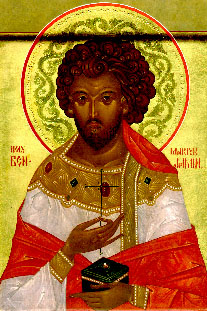
Saint John Calabytes

Profile

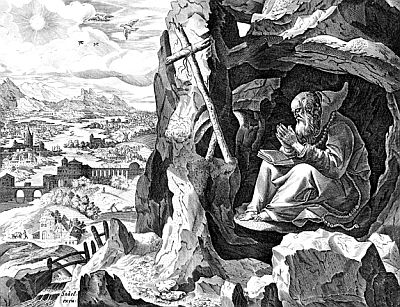
John was born wealthy. He ran away from home as a child, and became a monk at Gomon on the Bosphorus at age 12. When he finally returned home as a beggar at age 18, his family did not recognize him. However, they did recognize that he was a holy man, and the family allowed him to live as a hermit in a small hut (a calybe in Greek) near their front door. Only on his death were they were informed of his real identity. His story has led to his being a symbol of homelessness, and how we may not recognize the humanity in the poor and homeless in our midst.

Born

  • at Constantinople (modern Istanbul, Turkey)

Died

  • c.450 of natural causes

Representation

  • beggar with a Gospel in his hand
  • beggar revealing his identity to his parents on his death bed

Source: https://catholicsaints.info/saint-john-calabytes/

Saint John Calabytes Read More »

Saint Nino of Georgia

Profile

Nino was a Slave. She was not originally from Georgia and may have been brought there by her master when he emigrated. She may have been the spoils of war, or she may have fled her own war-racked homeland and become enslaved after her move to more peaceful Georgia.

Nino cured a dying child by placing her hair shirt on him, and praying over him. News of this miracle reached the Queen of Georgia, who was suffering an unspecified but untreatable malady. She sent for Nino who replied, “I am a slave. My place is not in a palace.” The Queen went to Nino, who cured her by prayer.

The royal family offered her any reward; she asked that they convert. The recently healed queen was willing, but King Mirian was not. However, soon after, while on a hunt, he found himself surrounded by wild animals. He made one of those well-known deals with God, offering to convert if he survived. The animals left, and in 325 the king asked Constantine for priests and bishops to spread the faith throughout Georgia.

This good work begun. Nino retired to live as a prayerful recluse on a mountainside at Bodbe Monastery,  Kakheti, Georgia.

Born

  • various sources place this as Cappadocia (most sources), Rome, Jerusalem, or Gaul (modern France)

Died

  • c.320 at Bodbe Monastery, Kakheti, Georgia of natural causes
  • buried in the Cathedral of Mtskheta, Georgia

Canonized

  • Pre-Congregation

Patronage

  • Congregation of the Sisters of Saint Christiana
  • Georgia
  • Azov region of Russia
  • Caspian region of Russia
  • Caucasus region of Russia

Representation

  • Georgian cross
  • grapevine cross

Source: https://catholicsaints.info/saint-nino-of-georgia/

Saint Nino of Georgia Read More »

Saint Hilary of Poitiers, Bishop and Doctor

c. 315–367; Patron Saint of children academically behind, children learning to walk, mothers, and the sick; Invoked against rheumatism and snakebites; Pre-Congregation canonization; Proclaimed a Doctor of the Church in 1851 by Pope Pius IX

Born into a wealthy pagan family in Poitiers, France, Hilary was well educated in the classics. As he looked into his own soul, however, he knew that he did not exist for the sole purpose of seeking pleasure, enjoying leisure, obtaining wealth, or merely satisfying his fleshly desires. Hilary reasoned that the human soul did not exist simply to die. Instead, it must exist for something more, something eternal, something glorious. When his pagan culture did not suffice and philosophy fell short, Hilary finally found what he was searching for when he stumbled upon the Scriptures.

Hilary was first struck by the mysterious name of God in the Old Testament: “I AM WHO I AM.” God had revealed Himself as eternal, without beginning or end—Existence itself. Then Hilary discovered the Son of God in the Gospel of John 1:1–14. Of this discovery, Hilary said, “My soul measured the mighty workings of God, wrought on the scale of His eternal omnipotence . . .by a boundless faith . . .that God was in the beginning with God, and that the Word became flesh and dwelt among us . . .” (De Trinitate 1.12).

Hilary had the will to believe, and in the years that followed he was given the power and gift to understand the beauty, mystery, omnipotence, and nature of the Most Holy Trinity. Shortly after these discoveries of faith, Hilary was baptized a Christian and went on to defend the doctrine of the Trinity against the “insanity and ignorance of men.” He so impressed the faithful that they chose him to be their bishop, a dignity to which he reluctantly agreed.

Among those who shared in the “insanity and ignorance” of that time were a group of bishops and laity who followed the heresy of Arianism, which denied the divinity of Christ, instead holding that the Son was inferior to the Father. This heresy was especially strong in the Eastern Church but was starting to spread throughout France. After Hilary was a bishop for only about five years, the emperor, an Arian himself, ordered every bishop to pledge their support for this heresy. Hilary refused. Instead, he vigorously defended the truth, and for his brave stance was exiled to Phrygia, in modern-day Turkey. In His love and providence, God used Hilary’s time of exile in powerful ways.

While in Phrygia, Bishop Hilary spent much time studying and writing. He had already composed a marvelous commentary on the Gospel of Matthew while in Poitiers, and now he set his mind to his greatest work, De Trinitate (On the Trinity). Drawing from his classical education, his knowledge of Greek, his love of the Scriptures, and from the “insanity” and “ignorance” of Arianism itself, Bishop Hilary composed a comprehensive defense of the doctrine of the Trinity as it was taught in the Nicene Creed. Bishop Hilary caused so much trouble for the Arians in Phrygia that the Arian bishops pleaded with the emperor to send him back home, a request the emperor honored.

On his return to Poitiers, Bishop Hilary took the long way home through Greece and Italy, preaching all the way, weeding out the beginnings of Arianism in the Western Church. His effectiveness came not only from his clear teaching, but also from his conciliatory approach and resolute determination. Back in Poitiers, he continued to preach, write, attend councils, and even to compose hymns. The hymns were his way of introducing the doctrines of the faith to the people of God in song. He was a true pastor who burned with a desire that everyone come to a deeper knowledge of the One God—Father, Son, and Holy Spirit.

Source: https://mycatholic.life/saints/saints-of-the-liturgical-year/january-13-saint-hilary-of-poitiers-bishop-and-doctor/

Saint Hilary of Poitiers, Bishop and Doctor Read More »

Saint Benedict Biscop

Profile

Benedict was an Anglo-Saxon nobility. He grew up around the court of King Oswy of Northumbria, and held court offices. Following a pilgrimage to Rome, he renounced his wealth and position, and dedicated himself to prayer and scripture study. He was a monk at the monastery of Saint-Honorat near Cannes, France in 666, taking the name Benedict.

In 668, Pope Saint Vitalian sent him and the monk Adrian to advise Theodore, Archbishop of Canterbury until 671. Traditionally, he introduced the construction of stone churches and glass church windows to England, and brought in many foreign craftsman to do the work and teach the English. He tried to introduce more Roman rituals to English worship. He founded the monasteries of Wearmouth and Jarrow. He built a large library and scriptorium at Wearmouth.

In late life, Benedict suffered a painful paralysis, and was confined to his bed for his last three years. He continued to work from his bed, buying books, establishing the Benedictine Rule.

Born

  • c.628 in Northumbria, England as Benet Biscop

Died

  • 12 January 690 of natural causes at Wearmouth, England
  • relics at Thorney abbey and Glastonbury, England

Canonized

  • Pre-Congregation

Patronage

  • musicians
  • painters
  • in England
    – English Benedictines
    – Jarrow
    – Monkwearmouth
    – Sunderland

Representation

  • Benedictine abbot dressed as a bishop standing by the Tyne with two monasteries nearby
  • with the Venerable Bede

Source: https://catholicsaints.info/saint-benedict-biscop/

Saint Benedict Biscop Read More »

Baptism of the Lord

Sunday after Epiphany Or, if Epiphany is celebrated on January 7 or 8, the following Monday

The Feast of the Baptism of the Lord is a liturgical bridge that connects the Christmas season to Ordinary Time. During the Christmas season we pondered the Incarnation, Nativity, Presentation in the Temple, and Epiphany. Today, we see Jesus manifesting Himself to the world as He began His three years of public ministry.

Jesus begins His ministry through an act of deep solidarity with the fallen human race. John the Baptist had been preaching in the desert and offering a baptism of repentance. John’s baptism was not the same as our baptism today. Instead, it was only a sign of one’s willingness to turn away from sin and turn toward God. Jesus, of course, had nothing to repent of. He was sinless in every way. But that didn’t stop Him from freely choosing to receive the baptism of repentance. Why would He do that?

Simply put, Jesus chose to unite Himself with fallen humanity, taking upon Himself our own sins and suffering their consequences. He humbly allowed Himself to be identified as a sinner in need of repentance. This was done out of love for us and out of His longing to become one with us so that we could become one with Him.

By bowing His sacred head to receive the baptism of repentance, Jesus united Himself and His divinity to everyone who had already chosen to repent. And He gave power to every forthcoming act of repentance others would make, even until today. When we repent today, we meet Jesus in that same water of repentance.

It was not only the Eternal Son Who was present at that baptism of repentance, but the Father and the Holy Spirit as well. The Spirit descended upon Jesus in the form of a dove, and the Father’s Voice spoke to acknowledge His oneness with His Son. Therefore, every time we make a humble act of repentance, such as when we combine the crucifixion, the Trinity, and holy water upon entering a church and blessing ourselves, we not only meet our Lord but also receive the outpouring of the Holy Spirit and share more fully in our adoption as sons and daughters of the Father in Heaven.

As we commemorate Jesus’ baptism liturgically, we celebrate the fact that our Christian baptism was the beginning of this new unity with the Holy Trinity. But we also celebrate our oneness with God, which is renewed every time we make an interior act of repentance for our sins. If we fully understood what happens every time we acknowledge our sins and repent of them, we would never grow tired of repenting. Every time we acknowledge and repent of our sin, we meet Christ anew, receive a greater outpouring of the Holy Spirit, and affirm and deepen our adoption by the Father in Heaven.

Source: https://mycatholic.life/saints/saints-of-the-liturgical-year/baptism-of-the-lord-feast/

Baptism of the Lord Read More »

Saint Francisca Salesia

Profile

Francisca was the daughter of Theodore Aviat, a shopkeeper, and Emilie Caillot. She was baptized on 17 September 1844 and confirmed on 2 July 1856. She was educated at the Visitation School in Troyes, France from age eleven to sixteen. With Father Louis Brisson and Mother Marie Therese de Sales Chappuis, she founded the Sister Oblates of Saint Francis de Sales in Troyes, dedicated to helping young women who poured into the cities during the Industrial Revolution. She took the Salesian Rule for the congregation. She entered religious life on 11 April 1866, took the veil on 30 October 1868, taking the name Sister Frances de Sales, and made her final vows on 11 October 1871. She was superior of the Institute in 1872. She opened homes and schools for working class girls. She was exiled from France on 11 April 1904 due to religious persecution and anti-religious legislation. She rebuilt her congregation from Perugia, Italy, and the Order was approved by Pope Saint Pius X in 1911.

Born

  • 16 September 1844 at Sezanne, France as Leonia Aviat

Died

  • 10 January 1914 at Perugia, Italy of natural causes

Venerated

  • 1 December 1978 by Pope John Paul II

Beatified

  • 27 September 1992 by Pope John Paul II

Canonized

  • 25 November 2001 by Pope John Paul II
    her canonization miracle involved the healing of the paralyzing spinal disease of a 14 year old girl from Philadelphia, Pennsylvania

Source: https://mycatholic.life/saints/saints-of-the-liturgical-year/#TOC-January

Saint Francisca Salesia Read More »

Black Nazarene

Profile

The Black Nazarene is a blackened, life-sized wooden icon of Jesus Christ carrying a cross. It was constructed in Mexico in the early 17th century by an Aztec carpenter. Spanish Augustinian Recollect friar missionaries to Manila, Philippines originally brought the icon to Manila in 1606. The transport ship caught fire, burning the icon, but the locals kept the charred statue. Miracles, especially healings, have been reported in its presence. The church in which it stood burned down around it in 1791 and 1929, was destroyed by earthquakes in 1645 and 1863, and was damaged during bombing in 1945. It used to be carried through the streets every January, and Christians would rub cloths on it to make healing relics, but centuries of this treatment have left the statue in bad shape, and since 1998 a replica is paraded at the feast day celebrations. In 1650, Pope Innocent X issued a papal bull which canonically established the Cofradia de Jesús Nazareno to encourage devotion; in the 19th century Pope Pius VII granted indulgences to those who piously pray before the image.

Patronage

  • Quiapo, Philippines

Source: https://catholicsaints.info/black-nazarene/

Black Nazarene Read More »

Saint Elizabeth Ann Seton, Religious

1774–1821; Patron Saint of Catholic schools, widows, loss of parents and children, and people ridiculed for their piety; Invoked against in-law problems and those who oppose the Church; Canonized by Pope Paul VI on September 14, 1975

Saint Elizabeth Ann Seton was the first citizen of the United States to be canonized a saint. She was born in New York into a prestigious and loving Anglican family of strong faith just two years before the Declaration of Independence was written. Her father was a well-respected physician. Unfortunately, her mother died when Elizabeth was only three. One of her sisters would die a year later. Her father remarried shortly after, and he and his new wife had seven children. Elizabeth was very fond of her stepmother and often accompanied her on charitable rounds caring for the poor. Sadly, when her stepmother and her father eventually separated, Elizabeth’s stepmother abandoned her, leaving young Elizabeth without a mother once again.

After a materially comfortable but difficult childhood, Elizabeth entered into a beautiful marriage at the age of nineteen with a wealthy shipping magnate named William Seton, with whom she had five children. While Elizabeth was pregnant with their third child, her father-in-law died, so the couple took William’s six younger siblings into their home to care for them. Soon after, a shocking event occurred. William’s business went bankrupt and the entire family had to abandon their home and move in with Elizabeth’s father who died shortly afterward in 1801.

By 1803, William was suffering from tuberculosis. At the recommendation of a physician, Elizabeth, her husband, and their eldest daughter spent their last bit of money to travel to the warmer climate of Italy to see if William could regain his health. Shortly after their arrival, William died. Elizabeth, only twenty-nine years old, was now fatherless, twice motherless, widowed, in a foreign land, and far from four of her children, for whom she had no way to provide.

When one has faith, heavy crosses can elicit much grace, which is what happened to Elizabeth. A month before her beloved William died, Elizabeth wrote in a journal, “Oh well may I love God—well may my whole soul strive to please him, for what but the strain of an Angel can ever express what he has done and is constantly doing for me—While I live—while I have my being in Time and thro’ Eternity let me sing praises to my God.” She was not bitter or resentful; instead, she praised God for all the good He had done for her.

While in Italy, before returning to New York to be reunited with the rest of her children, Elizabeth stayed with a devout Catholic family whose father had been a business partner of her husband. Through their inspiration and example, Elizabeth began to discover the Catholic faith. She visited many churches, discovered the Memorare prayer to the Virgin Mary, experienced the Sacred Liturgy, inquired about Christ’s Real Presence in the Eucharist, and began to understand the Church’s unbroken Apostolic succession.

When she arrived back in New York the following summer, her sister-in-law and closest friend, Rebecca, also died. Though heartbroken, Elizabeth strengthened her faith, deepened her devotion to our Blessed Mother, and continued seeking the will of God. When family and friends learned of her interest in Catholicism, she was shunned. Despite personally experiencing the anti-Catholicism so rampant in that era, Elizabeth persevered and entered the Church the following Ash Wednesday.

The journey that God had in mind for Elizabeth from that point forward would turn out to be monumental. She became a teacher in New York, but when word of her conversion to Catholicism spread, the Episcopalian parents whose children she taught withdrew them. Eventually, in 1809 at the invitation of the Sulpician Order, she moved to Maryland where she founded a congregation of sisters and started the first Catholic grade school in America. The school offered a free education to poor girls. Elizabeth was elected superior of the congregation and was henceforth called “Mother Seton.” Her daughters were able to live with her and continue their education at the school, and her sons lived and were educated at the nearby boys’ school. She remained superior until her death at the age of forty-six. She continued her childhood love of caring for the poor and inspiring many others to do the same.

Mother Seton faced many challenges in life, but she faced them with faith, with the tenderness of her personality, and with affection, determination, and concern for the poor and outcasts. She was a woman of great personal faith who discovered the true objective faith in the Catholic Church. For these and many other reasons, this poor woman became rich in eternity, while also enriching the lives of many others along the way.

Source: https://mycatholic.life/saints/saints-of-the-liturgical-year/january-4-saint-elizabeth-ann-seton-religious-usa-memorial/

Saint Elizabeth Ann Seton, Religious Read More »

Saint Raymond of Peñafort, Priest

1175–1275; Patron Saint of attorneys, canonists, and medical record librarians; Canonized by Pope Clement VIII on April 29, 1601

He was a century old when he died, and his legacy and influence have lived on for many more centuries. Saint Raymond was an evangelist at heart, but he was an educator, lawyer, canonist, organizer, preacher, and penitent by trade. He served the Church in numerous ways throughout his 100 years.

Raymond was born into a noble family in a small town near Barcelona, Spain. He was well educated and began teaching philosophy at the age of twenty. In his thirties, he obtained a doctorate degree in both civil and canon law, becoming an admired teacher for several years. Raymond’s gifts were soon noticed by many people, saints and sinners alike. Among the sinners was the King of Aragon; among the saints were the Bishop of Barcelona and even the pope himself.

While Raymond was still a layman, the Bishop of Barcelona became aware of Raymond’s brilliance and excellent reputation as a professor in Bologna, Italy. The bishop called Raymond back home to Spain to be an archdeacon, grand vicar, and official in his home diocese. Soon after, in his forties, Raymond joined the Dominican Order and began his life as a friar. As a Dominican friar, he gained a reputation for being humble, obedient, and fervent in his devotion and service to others, especially the poor. When he asked his superiors to impose upon him some penance so that he could more fully imitate his Lord, Who was humbly obedient even unto death, the superiors gave him the penance of writing a manual for priests to help them be better confessors. Father Raymond thus composed a magnificent manual of moral theology for confessors, one of the first of its kind. In addition to writing about Confession, Fr. Raymond also became known as a great confessor himself.

Among his penitents was the King of Aragon. Legend has it that on one occasion, the King of Aragon took Fr. Raymond with him on a journey to the Island of Majorca. Though the king was a good man, he suffered from a weakness of sinning with women. Father Raymond confronted the king after he refused to abandon this sin. Father Raymond then asked permission to return to Barcelona. The king refused. At that, the saint was said to have placed his cloak on the sea, stepped onto his “ship,” and speedily sailed across the water to mainland Spain with lightning speed.

In his fifties, Fr. Raymond was summoned to Rome by Pope Gregory IX and was given the monumental task of organizing the many legal decrees of the Church into a single collection, something which had not been done for eighty years. Three years and five volumes later, the Decretals were completed and published by the pope. They became the basis of the Church’s canon law for centuries to come.

The pope was so pleased with Fr. Raymond that he appointed him the Archbishop of Tarragon in Spain. Father Raymond, whose only desire was to be a humble friar, pleaded with the pope to excuse him from the appointment. By divine providence, Fr. Raymond became quite sick before he was ordained a bishop, which helped convince the pope to permit him to remain a humble friar and to return home.

Three years later, while in his early sixties, Fr. Raymond was chosen to be the third Superior General of the Dominican Order. He held the position for only two years before retiring and returning to the life of a humble friar.

Father Raymond could finally do what he loved. He preached, evangelized, catechized, and heard confessions. He felt especially called to preach to Jews and Muslims and helped establish schools where his fellow friars could learn Hebrew and Arabic to help them better evangelize these non-Christians. To help this endeavor, he encouraged another soon-to-be saint, Saint Thomas Aquinas, to write one of his greatest works, Against the Gentiles, to provide a theological basis for this evangelization. When Fr. Raymond was in his early eighties, he wrote a letter to his Superior General stating that 10,000 Muslims had been converted and baptized through his evangelical efforts.

On his deathbed he was visited by princes, princesses, two kings, and one queen. He prayed and fasted continuously, and miracles were even attributed to his intercession. He now rests in Heaven while his earthly body lies in the Cathedral of Barcelona, Spain.

Source: https://mycatholic.life/saints/saints-of-the-liturgical-year/january-7-saint-raymond-of-penyafort/

Saint Raymond of Peñafort, Priest Read More »

Saint André Bessette, Religious

1845–1937; Patron saint of family caregivers in Canada; Canonized by Pope Benedict XVI on October 17, 2010

During His Sermon on the Mount, Jesus said, “Knock and the door will be opened to you” (Matthew 7:7). In many ways, these words summarize the life of Saint André Bessette. The only caveat is that Brother André was the one opening the door for countless thousands of others during his life, not having the door opened for him. For forty years, Brother André was the doorkeeper at the Collège Notre-Dame in Côte-des-Neiges, Quebec, while serving as a professed Religious of the Congregation of the Holy Cross.

He was born Alfred Bessette in Saint-Grégoire d’Iberville, Quebec, Canada, and was the eighth of twelve children. His father was crushed by a falling tree and died when Alfred was only three. His mother died three years later of tuberculosis, leaving him and his siblings orphans. From birth, Alfred was a sickly child and remained so throughout his life. Most people thought he would die at a young age, but he lived until he was ninety-one!

Alfred had a distinct smile. It was serious, warm, welcoming, pleasant, and calming. He was a hard worker, but his poor health made it difficult for him to maintain a steady job. At the age of twenty-five, Alfred sought spiritual direction from his pastor, who encouraged him to present himself to the Congregation of the Holy Cross in Montreal for acceptance into religious life. The pastor sent along a letter to the superior, which said in part, “I am sending you a saint.” The problem was that Alfred could hardly read, and the order was a teaching order of well-educated men. After some initial hesitation, the superior welcomed him into the novitiate at the encouragement of the bishop.

Upon making his vows, Alfred chose the name Brother André, and his first assignment was one he would keep for the rest of his life—doorkeeper. In addition to minding the door, he spent his time washing floors and windows, cleaning lamps, carrying firewood, and delivering messages. He was a humble servant content to carry out the most menial of tasks.

How does an illiterate doorkeeper become a saint? Brother André’s path of holiness consisted of living the most attractive virtue of humility, of listening attentively to troubled hearts, of showing a compassion that lifted countless burdens, and of showing a gentleness that put even the worst sinner at ease. Above all, Brother André showed a love of God and trust in the intercession of Saint Joseph that was calm, steadfast, and more certain to him than life itself. In his role of doorkeeper, Brother André had the joy of interacting with countless people for forty years. Over and over, Brother André inspired faith in both the saint and the sinner, the proud and the humble, the well-to-do and the poorest of the poor. Through his lowliness, soul after soul was drawn to God. Every time a life was changed, Brother André gave the credit to Saint Joseph. “Go to Saint Joseph, he will help you,” he would say throughout his life.

Not only was the soul of Brother André filled with the most beautiful virtues, his prayers also worked countless miracles. When people spoke to Brother André and asked for his prayers, a surprising pattern began to emerge—his prayers were answered! The sick were healed, the lame could walk, problems did disappear, and hearts were converted. By the time of his death, the brothers of his order attributed as many as 10,000 miracles to his intercession. But, according to Brother André, it wasn’t he who worked the miracles but Saint Joseph.

At first, word of Brother André’s powerful prayers slowly trickled from person to person, but eventually his renown flowed like a river, roaring from one end of Canada to the other. Lines of people came streaming to him. He prayed for the sick, spent time with those who visited, went out of his way to speak to souls in need, and dispensed mercy and compassion to all. Towards the end of his life, this holy man who struggled with reading received as many as 80,000 letters each year from people asking for his prayers. He entrusted them all to Saint Joseph.

“It is with the smallest brushes that the artist paints the best paintings,” Brother André was fond of saying. The artist was God, and Brother André was the smallest and most humble brush. The living work of art God painted with Brother André was on full display at his wake and funeral. It is estimated that a million people paid their respects during the week that his body lay in state outside of St. Joseph’s Oratory! Brother André’s beautiful legacy was memorialized in a humble chapel he built to Saint Joseph. Over time, that chapel has been transformed and enlarged into the massive St. Joseph Oratory on Mount Royal near the Collège Notre-Dame. The Oratory sits on a hill and towers over its surroundings. It is crowned by one of the largest domes in the world and remains a place of pilgrimage and prayer. On the walls of its crypt hangs a moving testament to Brother André’s healing powers—hundreds of pairs of discarded crutches. The humble are not always exalted in this world, but Brother André truly was.

Source: https://mycatholic.life/saints/saints-of-the-liturgical-year/january-6-blessed-andr-bessette-religious-usa-optional-memorial/

Saint André Bessette, Religious Read More »