Daily Saints

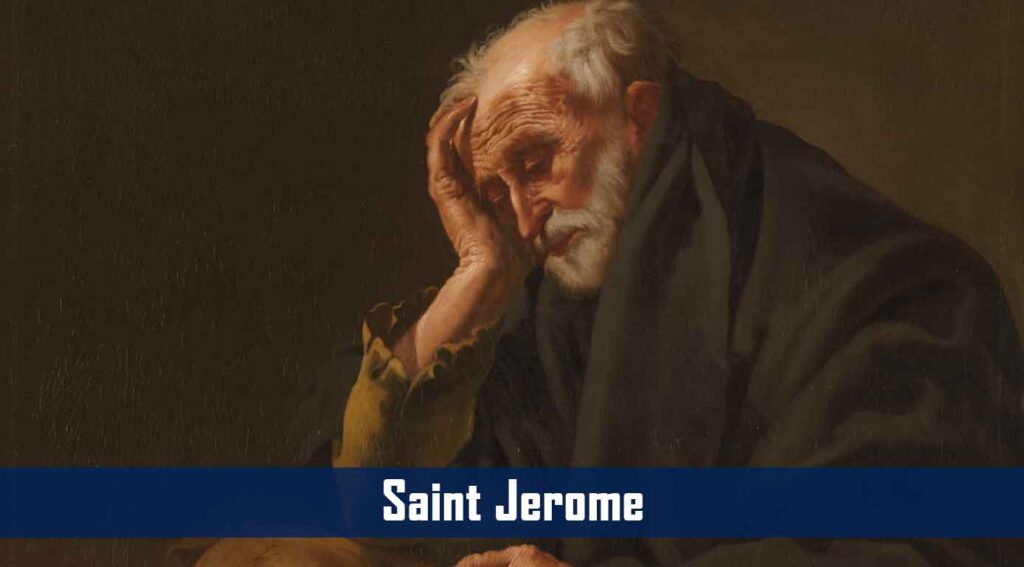
Saint Jerome

Saint Jerome is particularly important for having made a translation of the Bible which came to be called the Vulgate. It is not the most critical edition of the Bible, but its acceptance by the Church was fortunate. As a modern scholar says, “No man before Jerome or among his contemporaries and very few men for many centuries afterwards were so well qualified to do the work.” The Council of Trent called for a new and corrected edition of the Vulgate, and declared it the authentic text to be used in the Church. After these preparatory studies, he traveled extensively in Palestine, marking each spot of Christ’s life with an outpouring of devotion. Mystic that he was, he spent five years in the desert of Chalcis so that he might give himself up to prayer, penance, and study. Finally, he settled in Bethlehem, where he lived in the cave believed to have been the birthplace of Christ. Jerome died in Bethlehem, and the remains of his body now lie buried in the Basilica of St. Mary Major in Rome.
Saint Jerome Read More »

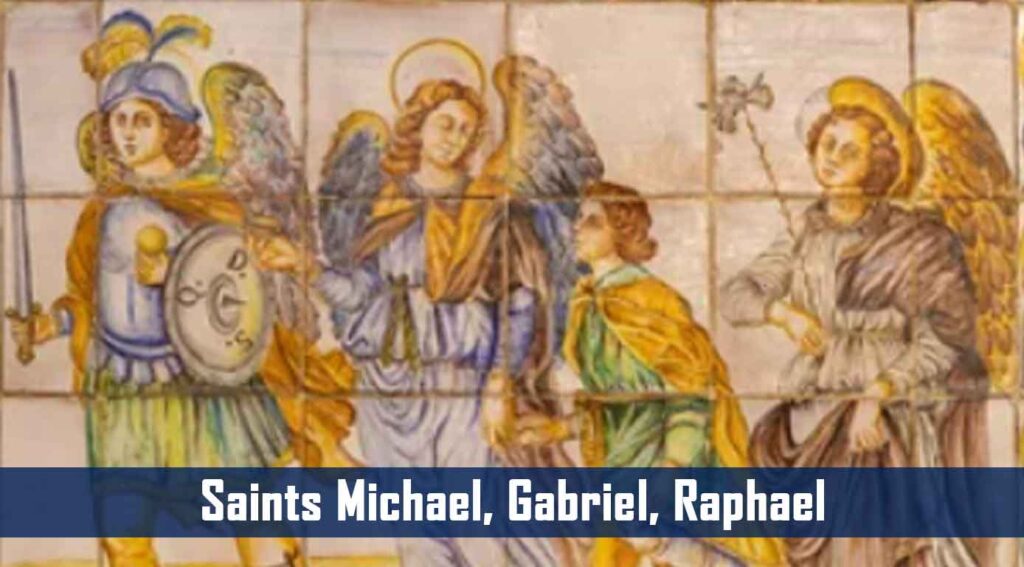
Saints Michael, Gabriel, Raphael

Angels—messengers from God—appear frequently in Scripture, but only Michael, Gabriel and Raphael are named.

Michael appears in Daniel’s vision as “the great prince” who defends Israel against its enemies; in the Book of Revelation, he leads God’s armies to final victory over the forces of evil. Devotion to Michael is the oldest angelic devotion, rising in the East in the fourth century. The Church in the West began to observe a feast honoring Michael and the angels in the fifth century.

Gabriel also makes an appearance in Daniel’s visions, announcing Michael’s role in God’s plan. His best-known appearance is an encounter with a young Jewish girl named Mary, who consents to bear the Messiah.

Raphael’s activity is confined to the Old Testament story of Tobit. There he appears to guide Tobit’s son Tobiah through a series of fantastic adventures which lead to a threefold happy ending: Tobiah’s marriage to Sarah, the healing of Tobit’s blindness, and the restoration of the family fortune.
The memorials of Gabriel and Raphael were added to the Roman calendar in 1921. The 1970 revision of the calendar joined their individual feasts to Michael’s.

Saints Michael, Gabriel, Raphael Read More »

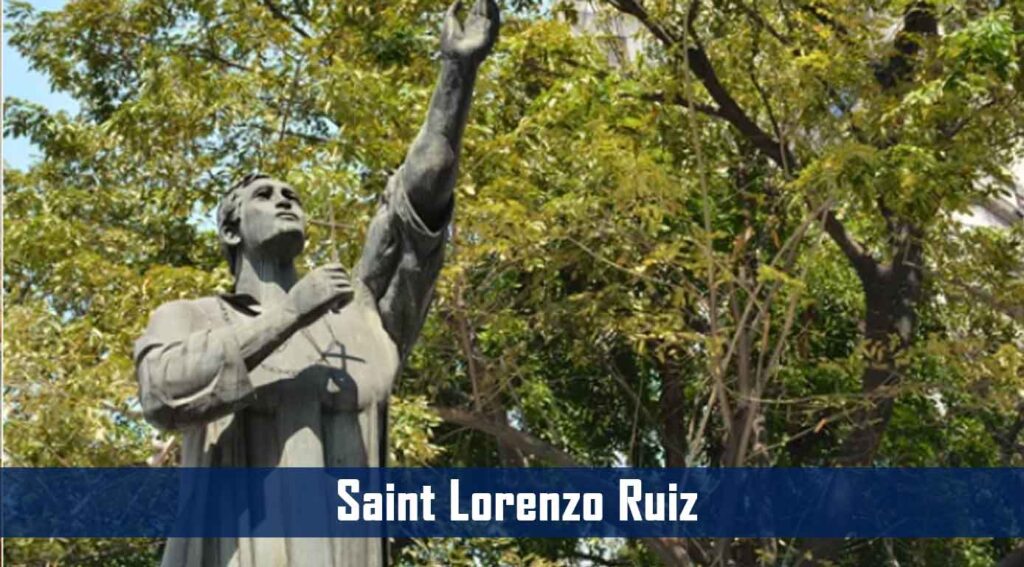
Saint Lorenzo Ruiz

Lorenzo was born in Manila of a Chinese father and a Filipino mother, both Christians. Thus he learned Chinese and Tagalog from them, and Spanish from the Dominicans whom he served as altar boy and sacristan. He became a professional calligrapher, transcribing documents in beautiful penmanship. He was a full member of the Confraternity of the Holy Rosary under Dominican auspices. He married and had two sons and a daughter. He joined a Dominican missionary expedition in Japan in order to escape arrest for a crime of which he was accused. He was arrested by the Japanese authorities in Nagasaki, tortures and executed in September 1637. It was said that during his last moments, he uttered these lines to their executioners,

“I am a Catholic and wholeheartedly do accept death for God.Had I a thousand lives, all these to Him, shall I offer.”

In 1987, Pope John Paul II canonized these six and 10 others: Asians and Europeans, men and women, who spread the faith in the Philippines, Formosa, and Japan. Lorenzo Ruiz is the first canonized Filipino martyr.

Saint Lorenzo Ruiz Read More »

Saint Vincent de Paul

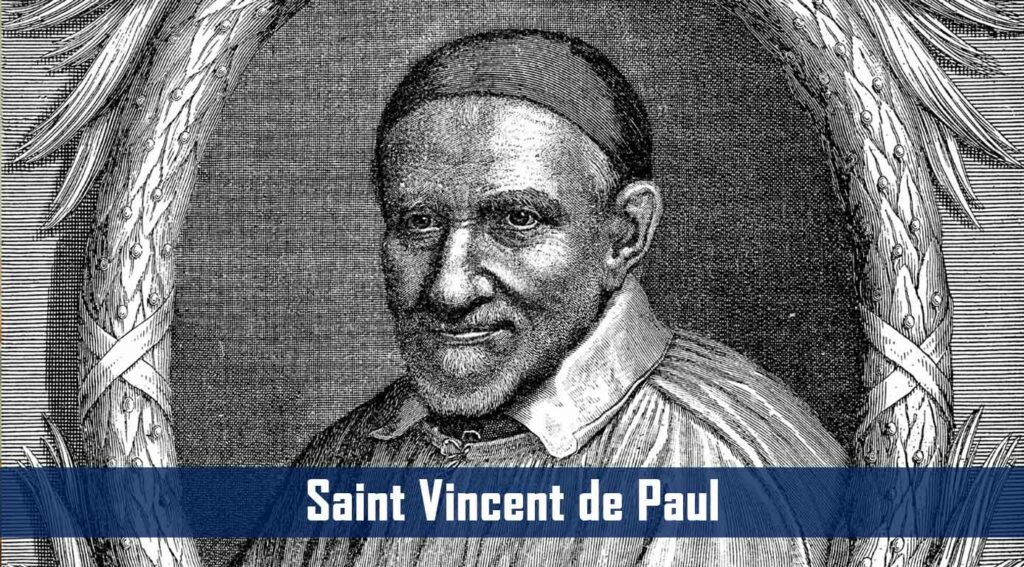
The deathbed confession of a dying servant opened Vincent de Paul’s eyes to the crying spiritual needs of the peasantry of France. This seems to have been a crucial moment in the life of the man from a small farm in Gascony, France, who had become a priest with little more ambition than to have a comfortable life. Vincent established confraternities of charity for the spiritual and physical relief of the poor and sick of each parish. From these, with the help of Saint Louise de Marillac, came the Daughters of Charity, “whose convent is the sickroom, whose chapel is the parish church, whose cloister is the streets of the city.” He organized the rich women of Paris to collect funds for his missionary projects, founded several hospitals, collected relief funds for the victims of war, and ransomed over 1,200 galley slaves from North Africa. Pope Leo XIII made him the patron of all charitable societies. Outstanding among these, of course, is the Society of St. Vincent de Paul, founded in 1833 by his admirer Blessed Frédéric Ozanam.

Saint Vincent de Paul Read More »

Saints Cosmas & Damian

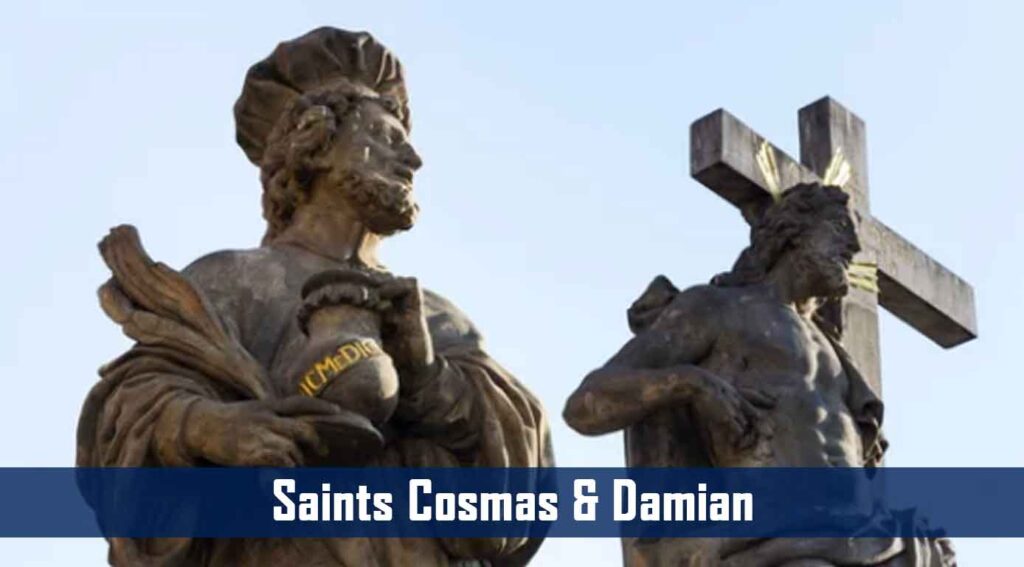
Sts. Cosmas and Damian were brothers, born in Arabia, who had become eminent for their skill in the science of medicine. Being Christians, they were filled with the spirit of charity and never took money for their services. At Egaea in Cilicia, where they lived, they enjoyed the highest esteem of the people.

When the persecution under Diocletian broke out, their very prominence rendered them marked objects of persecution. Being apprehended by order of Lysias, governor of Cilicia, they underwent various torments about the year 283. Their feast day is September 26th. They are patron saints of pharmacists.

Saints Cosmas & Damian Read More »

Saint Albert of Jerusalem

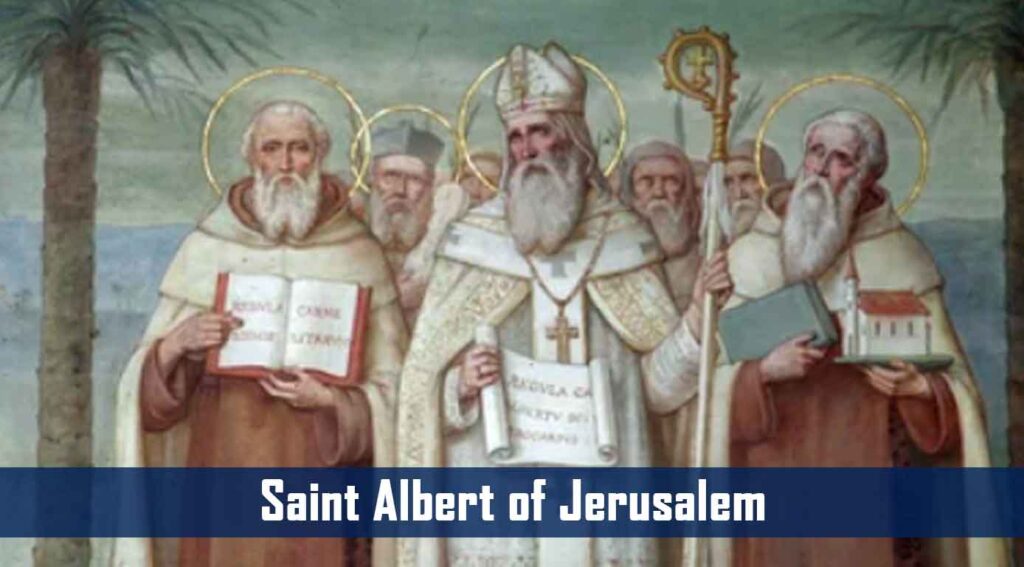
Patriarch of Jerusalem and patron of the Carmelite Order. He was an outstanding ecclesiastical figure in the era in which the Holy See faced opposition from Emperor Frederick I Barbarossa. Serving as a mediator in the dispute between the emperor and Pope Clement III, Albert was made an imperial prince, a sign of favor from Barbarossa. Albert was born in Parma, Italy, about 1149, probably to a noble family. He became a canon at the Holy Cross Abbey in Mortoba. In 1184 he was appointed as the bishop of Bobbio, Italy, and soon after he was named to the see of Vercelli. It was during this period of service as the bishop of Vereelli that he served as mediator between the pope and emperor. He was called to the general council of the Lateran in 1215 but was assassinated before leaving Palestine. A madman that he had discharged from a local hospital stabbed him during the procession on the feast of the Exaltation of the Holy Cross.

Saint Albert of Jerusalem Read More »

Feast of Our Lady of Ransom

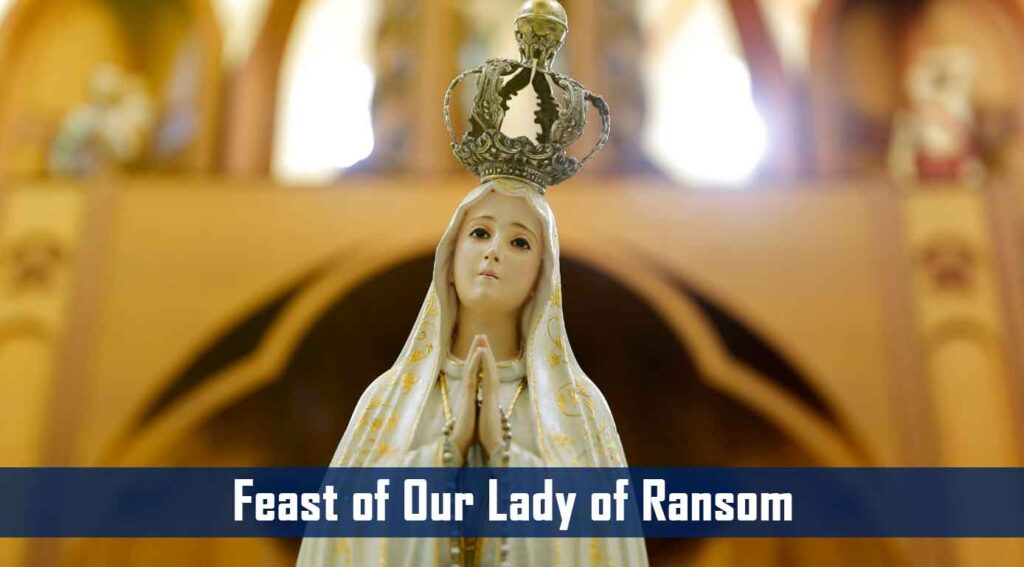
The Mercedarians in Barcelona once commemorated this apparition on the first Sunday after September 24. Our Lady of Ransom is the principal Patroness of Barcelona. In 1696, the feast of Our Lady of Ransom was placed on the calendar for the entire Latin Church at September 24. The name for the Marian commemoration on September 24 was changed to ‘Our Lady of Mercy’ after Vatican II.

Feast of Our Lady of Ransom Read More »

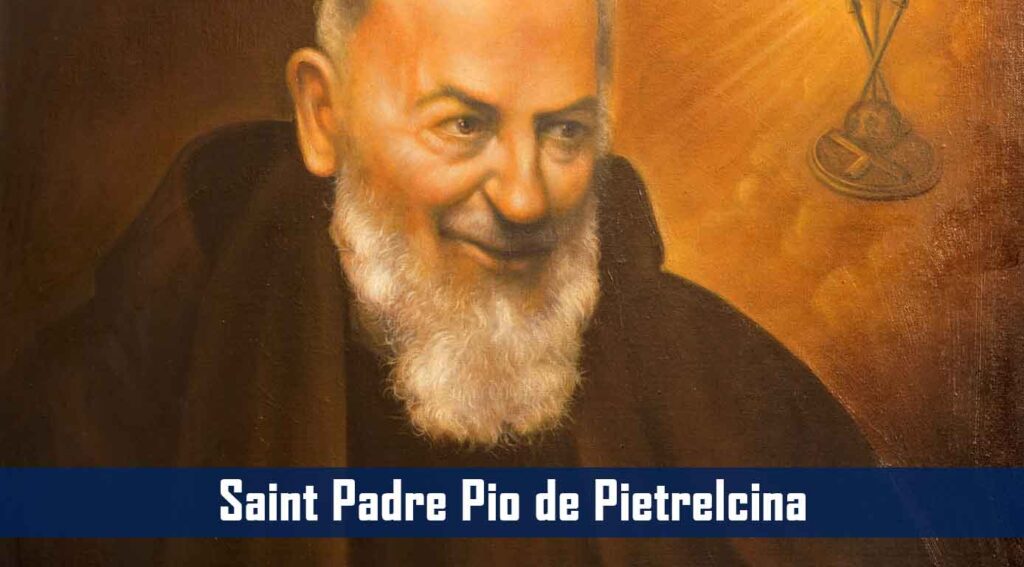
Saint Padre Pio de Pietrelcina

In one of the largest such ceremonies in history, Pope John Paul II canonized Padre Pio of Pietrelcina on June 16, 2002. It was the 45th canonization ceremony in Pope John Paul’s pontificate. More than 300,000 people braved blistering heat as they filled St. Peter’s Square and nearby streets. They heard the Holy Father praise the new saint for his prayer and charity. “This is the most concrete synthesis of Padre Pio’s teaching,” said the pope. He also stressed Padre Pio’s witness to the power of suffering. If accepted with love, the Holy Father stressed, such suffering can lead to “a privileged path of sanctity.” Born Francesco Forgione, Padre Pio grew up in a family of farmers in southern Italy. One of Padre Pio’s sufferings was that unscrupulous people several times circulated prophecies that they claimed originated from him. He never made prophecies about world events and never gave an opinion on matters that he felt belonged to Church authorities to decide. He died on September 23, 1968 after the 50th anniversary of receiving the stigmata.

Saint Padre Pio de Pietrelcina Read More »

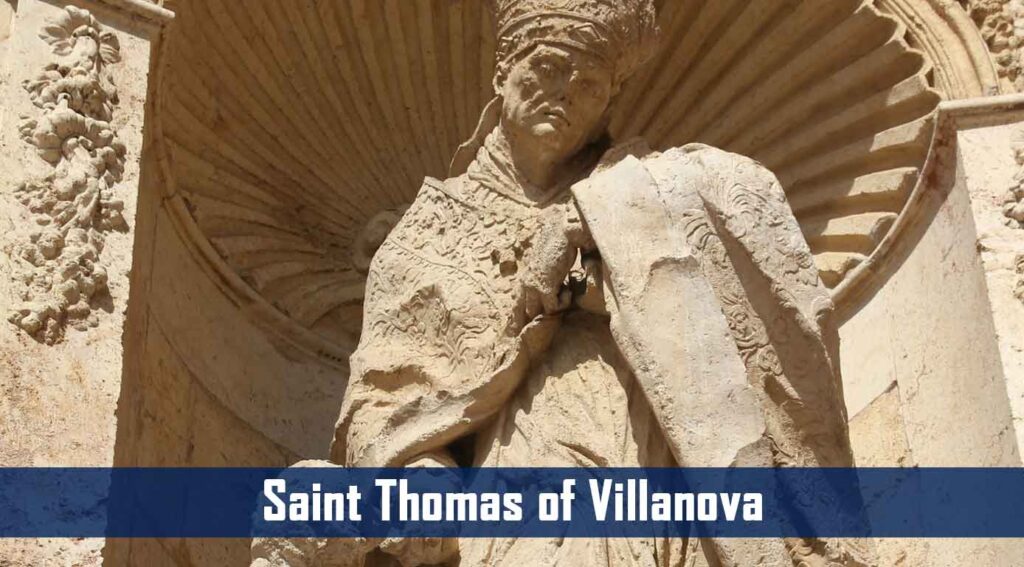
Saint Thomas of Villanova

Saint Thomas was from Castile in Spain and received his surname from the town where he was raised. He received a superior education at the University of Alcala and became a popular professor of philosophy there. After joining the Augustinian friars at Salamanca, Thomas was ordained and resumed his teaching despite a continuing absentmindedness and poor memory. He became prior and then provincial of the friars, sending the first Augustinians to the New World. He was nominated by the emperor to the archbishopric of Granada, but refused. When the see again became vacant he was pressured to accept. The money his cathedral chapter gave him to furnish his house was given to a hospital instead. His explanation to them was that “our Lord will be better served by your money being spent on the poor in the hospital. What does a poor friar like myself want with furniture?” In his lifetime Thomas of Villanova was already called “the almsgiver” and “the father of the poor.” He was canonized in 1658.

Saint Thomas of Villanova Read More »

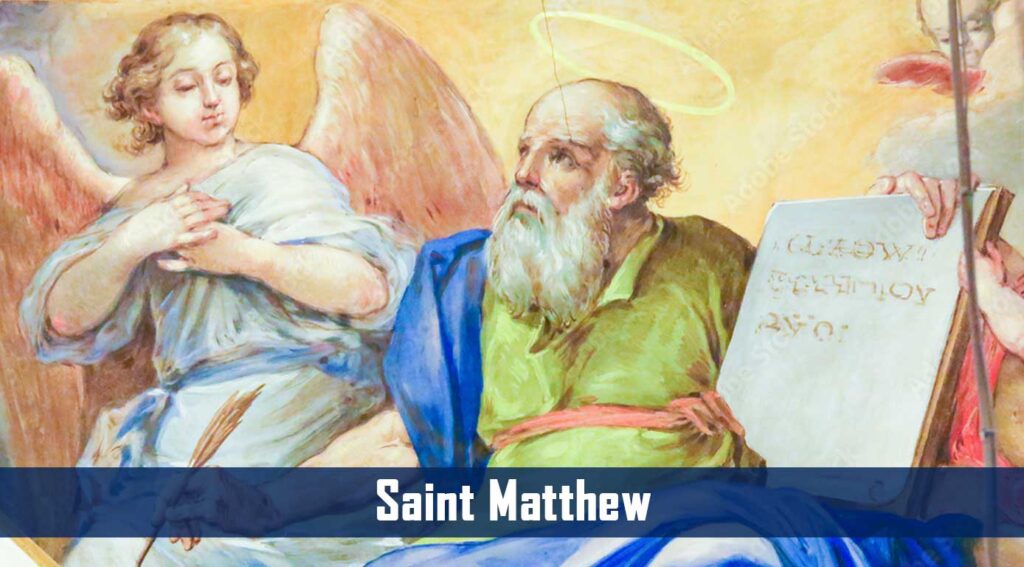
Saint Matthew

Matthew was born in Capernaum, and was working as a tax-collector when Jesus called him. He is thought by some scholars to have written and early version of his Gospel in Aramaic, a precursor to the Greek version we now have. He is also said to have preached in the East. Tradition differs as to the sense of his missions and as to whether he died a natural death or a martyr’s. His relics were reputedly discovered in Salerno (Italy) in 1080. His symbol is an angel, and he is a patron saint of tax collectors and accountants.

Saint Matthew Read More »