Daily Saints

Saint Patrick, Bishop

c. 387–c. 460 or 493 (Actual dates are uncertain); Patron Saint of Ireland; Invoked against snake bites; Pre-Congregation canonization

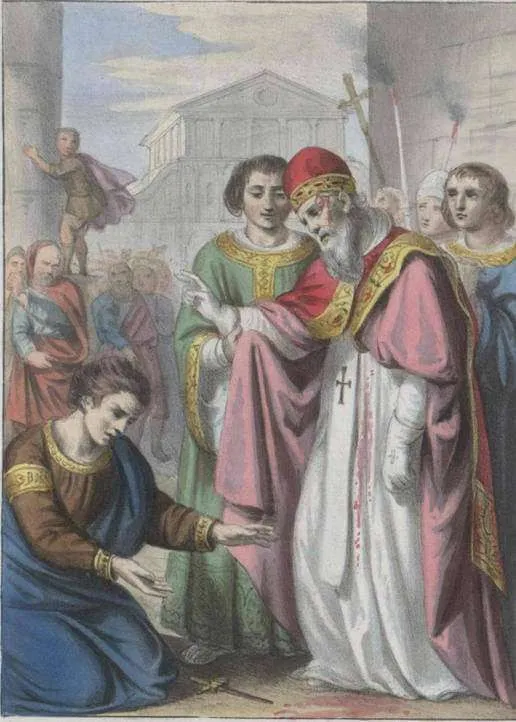
Patrick was born in Roman-ruled Britain to loving parents, perhaps as an only child. His father was a senator and a deacon, and his grandfather was a married priest. Despite his Christian upbringing and the clerical influences of his father and grandfather, Patrick struggled with his faith, stating later that when he was young he “did not know the true God.” This testimony, and the quotes to follow, come from his own hand, preserved in his Confessio, Saint Patrick’s short autobiographical confession about the workings of God’s grace in his life and ministry.

At the age of sixteen, Patrick’s life took a dramatic turn for the worse; at least, that’s how it first appeared. Gaelic slave traders from Ireland arrived by ship and raided Patrick’s village. Though young women and children were often their preferred targets, a young, healthy boy could also profit them. Patrick was captured and “was taken into captivity in Ireland with many thousands of people.”

At the time of Patrick’s captivity, Ireland was a pagan country made up of more than a hundred small, family-based clans governed by local chiefs. Most clans united with other clans to form several larger kingdoms. Their religious beliefs were a mixture of polytheism, in which gods were honored and called upon, and animism, in which the natural world was believed to contain spirits who could be communicated with. Their druids (priests) engaged in demonic spells, incantations, curses, and dark magic.

It was Patrick’s conviction that, because he and his fellow slaves had drawn away from God and did not keep God’s precepts, the Lord brought down upon them the “fury of his being,” permitting them to be scattered throughout Ireland as slaves. But God’s just punishments are always inflicted upon his children for the purpose of converting their hearts, which is exactly what happened to Patrick. “And there the Lord opened my mind to an awareness of my unbelief, in order that, even so late, I might remember my transgressions and turn with all my heart to the Lord my God, Who had regard for my insignificance and pitied my youth and ignorance.”

While in captivity, Patrick was made a swineherd for one of the clans and spent much of his time in the forests, enduring the snow, ice, and rain. But his time alone, experiencing the suffering and loneliness of captivity, greatly benefited his soul. At first, Patrick didn’t know God. Then, he began to think about God. Then he began to speak to God. Within six years, he was praying a hundred prayers every day and a hundred prayers every night. As a result, Patrick testified that “the Spirit was burning in me at that time.” After receiving chastisements from God for his lack of faith, Patrick’s heart was changed and filled with gratitude for all that God had done in his soul. He realized that his only “way to repay Him is to exalt Him and confess His wonders before every nation under heaven.”

Once Patrick had converted, God’s plan for his life changed. While asleep one night, Patrick heard a voice say to him, “Soon you will depart for your home country,” and shortly afterward, “Behold, your ship is ready.” By an intuition of grace, Patrick knew what he had to do. He escaped and ran 200 miles (about 184 modern miles). God directed him on the way and led him to a ship where Patrick convinced the captain to let him board. Three days later, they were back in Britain on a remote shore. Patrick and some pagans disembarked from the ship and began a twenty-eight-day journey through the wilderness to find civilization. On the journey, the pagans mocked Patrick’s faith, but when they ran out of food, Patrick prayed and God miraculously provided them with a herd of pigs. The pagans were impressed and Patrick won their respect. This was the first of many times that God used Patrick to change hardened hearts. Then, Patrick was reunited with his parents at last.

Back in Britain, Patrick continued to pray, study Scripture, and learn the Catholic faith. His prayer led him into deep union with God. He had dreams and visions, including a vision in which he heard the voice of the Irish say to him, “We beg you, holy youth, that you shall come and shall walk again among us.” Patrick knew that he had to return, not as a slave, but as a missionary. Despite opposition from his family, Patrick was determined to answer God’s call.

Since Patrick had learned much about Irish culture and language, he was an ideal candidate for missionary work. After years of study, probably in France, he was ordained a bishop and sent by the Church back to Ireland to convert the pagans, his captors, to Christ. And that he did. It was by the courageous witness of his character, aided perhaps by miraculous signs and unwavering faith, that one of the kings converted. After being successful in one kingdom, Bishop Patrick moved to another. When he arrived in a new territory, he always sought to convert the local king and chiefs first. Once they were open to the Gospel, the people followed.

During the fewer than thirty years that Patrick evangelized the people of Ireland, he endured many hardships, including another short captivity, the constant danger of being killed, and staunch opposition from the druid spiritual leaders. But he also converted countless pagans, baptized and confirmed “so many thousands,” built churches, established religious life, ordained native clergy, and changed pagan Ireland as a whole into one of the greatest Catholic nations on earth.

Saint Patrick’s influence on Ireland was so profound that many later biographers have attributed numerous legends to him. Though most of these legends cannot be verified, the stories highlight the remarkable spiritual transformation of a hostile pagan nation by the faith and courage of one man. God humbled Patrick, changed his heart, set him on fire, and then used that fire to purify many thousands of people. In the centuries that followed, those converts went forth to the ends of the earth, bringing the same Gospel to others that Patrick first preached to them.

As we honor Saint Patrick, seek to imitate him by joining him in his initial humiliation. See your sins and pray that God purifies you by any means necessary. Convert your heart. Increase your daily prayer. Allow your heart to become inflamed by God’s Spirit. Say “Yes” to Him when He calls, and go where He sends you. Like Saint Patrick, God wants to send you on a mission, but He cannot do so until you fully convert your heart to His.

Source: https://mycatholic.life/saints/saints-of-the-liturgical-year/march-17-saint-patrick-bishop/

Saint Patrick, Bishop Read More »

Saint Julian of Anazarbus

Profile

Julian was a prominent citizen of senatorial rank. He was arrested for his faith during the persecutions of Diocletian, he was tortured then put on display for abuse for a year in cities all over Cilicia, being led around behind a camel. He was a martyr. He was also praised by Saint John Chrysostom in a homily during the enshrinement of his relics.

Born

Anazarbus, Cilicia (in modern Turkey)

Died

sewn into a sack full of vipers and scorpions, and thrown into the sea to drown c.302
relics enshrined in Antioch

Canonized

Pre-Congregation

Patronage

Rimini, Italy

Representation

man being thrown into the sea in a sack
man in a coffin which is floating into shore and on which sits four angels
man bound on a camel being led through the streets

Source: https://catholicsaints.info/saint-julian-of-anazarbus/

Saint Julian of Anazarbus Read More »

Saint Louise de Marillac

Profile

Though she considered a religious vocation from an early age, Louise ill health kept any house from taking her. She married Antony LeGras, an official to the queen, in 1611, but became widowed in 1625. She was a spiritual student of Saint Vincent de Paul. With Saint Vincent, she founded the Daughters of Charity in 1642, receiving Vatican approval in 1655. She founded the Sisters of Charity, took her vows in the order, and served as its superior until her death. She was a spiritual guide for groups of lay women.

Born

  • 12 August 1591 at Meux, France

Died

  • 15 March 1660 at Paris, France of natural causes
  • body incorrupt

Beatified

  • 9 May 1920 by Pope Benedict XV

Canonized

  • 11 March 1934 by Pope Pius XI

Patronage

  • disappointing children
  • loss of parents
  • people rejected by religious orders
  • sick people
  • social workers (proclaimed on 12 February 1960 by Pope John XXIII)
  • Vincentian Service Corps
  • widows

Source: https://catholicsaints.info/saint-louise-de-marillac/

Saint Louise de Marillac Read More »

Saint Lazarus of Milan

Profile

Lazarus was an Archbishop of Milan, Italy c.439, a time when invading Ostrogoths controlled the area. He may have developed and certainly popularized the Rogationtide litanies; originally devised to ask for protection from the Ostrogoths, over time the devotion spread throughout Europe. His February feast day is due to the Milanese custom of not celebrating saint days during Lent.

Died

  • 14 March 450

Canonized

  • Pre-Congregation

Source: https://catholicsaints.info/saint-lazarus-of-milan/

Saint Lazarus of Milan Read More »

Saint Heldrad of Novalese

Profile

Heldrad was born wealthy. He spent his fortune on charity, then made a pilgrimage to Rome, Italy as a mendicant. He was a Benedictine monk at the Abbey Saints Peter and Andrew at Novalese in the Alps in 726, a community with many former pilgrims. He became an abbot of the house for 30 years during which he greatly expanded the library and built a hospice for the safety of travelers on Mount Cenis.

Born

  • in Provence, France

Died

  • 842 at the Novalesa Abbey of natural causes
  • relics transferred to the parish church in Novalesa, Italy in 1794

Beatified

  • 9 December 1904 by Pope Saint Pius X (cultus confirmed)

Saint Heldrad of Novalese Read More »

Saint Maximilian of Thebeste

Profile

Maximilian was a son of a Roman army veteran. He was a conscientious objector—when drafted into the Roman army, he refused to serve on the grounds that his faith prohibited it. He was martyred for this stand.

Born

  • 274

Died

  • beheaded c.295 at Thebeste, Numidia, North Africa
  • buried at Carthage

Canonized

  • Pre-Congregation

Source: https://catholicsaints.info/saint-maximilian-of-thebeste/

Saint Maximilian of Thebeste Read More »

Saint Constantine II

Profile

Born a Scottish prince, the son of King Kenneth II of Strathclyde, Constantine led a life of vice until his conversion, possibly after hearing the evangelizing preaching of Saint Columba and Saint Kentigern.

Constantine was married, and became the father of at least one son. He briefly became the king of Strathclyde. Widowed, he abdicated his position, founded a monastery at Govan on the river Clyde, became a monk there, and evangelized the region. He became a priest and abbot of a monastery in Govan, Scotland. He became a martyr.

Older martyrologies have entries for Constantines of Strathclyde, of Cornwall, and of Rahan, Ireland; they run the details of their lives together, and they could have been one, two or three people.

Died

  • bled to death in 874 in a cave near Crail after his right arm was cut off by Danish pirates
  • considered a martyr in Scotland for defending his Christian land against pagan invaders

Canonized

  • Pre-Congregation

Source: https://catholicsaints.info/saint-constantine-ii/

Saint Constantine II Read More »

Saint Macarius of Jerusalem

Profile

Macarius was the Bishop of Jerusalem in 314. He fought Arianism. He participated in and signed the documents of the Council of Nicaea, and helped formulate the Nicene Creed. When Saint Helena discovered a collection of crosses, one of which was the True Cross, Macarius suggested identifying the real one by touching them to a seriously ill woman, and seeing which one cured her. He supervised the construction of the church of the Holy Sepulcher.

Died

  • 335 of natural causes

Canonized

  • Pre-Congregation

Source: https://catholicsaints.info/saint-macarius-of-jerusalem/

Saint Macarius of Jerusalem Read More »

Saint Frances of Rome, Religious

1384–1440; Patron Saint of motorists and widows; Invoked against the death of children; Canonized by Pope Paul V on May 29, 1608

Frances was born into an aristocratic family in the Eternal City of Rome near the famed Piazza Navona. From an early age, she was drawn to God and responded with much generosity. At the age of eleven, she told her father that she wanted to become a nun, but her father had other plans for her life. He informed her that he was giving her hand in marriage to Lorenzo Ponziani, a wealthy aristocrat who was a commander in the papal army. Frances struggled with her father’s decision and brought her concern to a local priest. After listening to her, the priest said to her, “Are you crying because you want to do God’s will or because you want God to do your will?” She quickly responded that she wanted God’s will, and the matter was settled. At the age of twelve, Frances was married.

Soon after her marriage, Frances was expected to assist her mother-in-law with the family’s social calendar. She was to help plan and host parties, engage in frivolities, and attend numerous public meetings. Since all she longed for was a life of solitude and prayer, the social expectations placed on her wore her out and she became gravely ill. The illness lasted for months and left her on her deathbed at a tender age. As she lay dying, she had a vision of Saint Alexis, a holy monk who fled an arranged marriage to pursue his vocation, who told her that she could choose one of two options, to recover or not. She deferred to the will of God and was immediately healed.

For the next forty years, Frances embraced her marriage with her whole heart. She loved her husband and he loved her. Her humble affection and devotion to him were so great that it has been said that during those forty years they never once had an argument. Though drawn to a life of prayer, Frances often said, “A married woman must, when called upon, leave her devotions to God at the altar to find Him in her household affairs.” One story relates that, while praying the psalms, Frances was called away four times to tend to family affairs before even being able to finish the prayer. Upon returning to begin a fifth time, she found the words of the psalm written in gold as a sign that her fidelity to the duties of her vocation was pleasing to God.

Though Frances was wealthy and of the noble class, she embraced a personal life of simplicity, bodily penance, fasting, and prayer. She abstained from meat except for rare occasions. She would often exchange the delectable food of the nobility for the food of poor beggars, usually receiving from them dry and moldy bread. She dressed in coarse garments, never fine linen, and often wore a hairshirt that irritated her flesh.

Frances and her husband had three children, two boys, and one girl. When a plague afflicted the city of Rome, one of her sons and her only daughter died at an early age. This personal suffering led her to join her sister-in-law to begin an informal outreach to the sick and poor. The women regularly visited hospitals, nursed the sick back to health, distributed food to the hungry, and were ministers of the compassion of Christ. Frances exhausted all of her own money and possessions to care for those who were suffering. When her money ran out, she began to beg other wealthy families for more. Eventually, some holy noblewomen in Rome were inspired to join Frances and her sister-in-law in their work.

In the year 1413, when Frances was twenty-nine years old, her husband was exiled from Rome by invaders, his property was seized, their home destroyed, and their only living son was detained as a hostage. Through it all, Frances called to mind the sufferings of Job and prayed with him, “The LORD gave and the LORD has taken away; blessed be the name of the LORD!” (Job 1:21). Within a few years, the situation was resolved, and her husband was able to move back to Rome and regain his possessions. But the chaos led Frances to turn the ruined family home into a hospital to care for the sick. One of those whom she cared for was her husband, who had suffered greatly during his exile. He was broken more in mind than in body, but her loving devotion helped him heal. During this time, it is said that she began having visions of her guardian angel, who frequently spoke to her and gave her advice. These visions continued for the rest of her life.

By 1425, Frances and other holy women in Rome were working hard to care for the poor and infirm. To help this work flourish, Frances organized a lay association of Benedictine Oblates for single and widowed women. The women who joined did not take formal religious vows nor enter a cloister, but lived together, embraced the Benedictine spirituality under the direction of a local monastery, and gave loving service to the poor and ill. Though still married and unable to join the oblates, Frances did receive the consent of her loving husband to live the rest of their marriage in abstinence from intimacy. They lived this way until Lorenzo’s death in 1436.

The next year, now widowed at the age of fifty-two, Francis walked barefoot through the city to the monastery of oblates she had founded and prostrated herself on the ground before the oblates, begging for admission. She was admitted and soon after was named the superior. The desire for religious life that she felt at the young age of eleven was now realized. For the next three years, she devoted herself to the holy work of her community. When her guardian angel informed her that her mission was complete on earth, she joyfully surrendered herself to death. In 1925, Pope Pius XI declared her to be the patron saint of automobile drivers because it was said that her angel always went before her, lighting the way, as headlights illuminate the way for a car.

Saint Frances loved and served God as a wife, mother, and religious. She learned to embrace God’s will over her own. Her selfless living enabled her to discover God’s will in each evolution of her vocation and to serve Him in the way in which she was called. As we honor this holy woman, ponder your own vocation and commit yourself to serving the will of God in the way that gives Him the greatest glory here and now.

Source: https://mycatholic.life/saints/saints-of-the-liturgical-year/march-9-saint-frances-of-rome-religious/

Saint Frances of Rome, Religious Read More »

Saint John of God, Religious

1495–1550; Patron Saint of hospitals, nurses, firefighters, booksellers, alcoholics, and the sick; Canonized October 16, 1690 by Pope Alexander VIII

Saint John of God was born in the village of Montemor-o-Novo, Portugal to middle-class, faith-filled parents. According to his early biographer, John was abducted from his home when he was only eight years old and taken to the town of Oropesa, Spain, more than 200 miles away. In Oropesa, John found himself homeless and alone. He met a good man named El Mayoral who gave him a job as a shepherd and a place to live. John worked hard until he was twenty-two years old, never returning to his parents’ home. El Mayoral wanted John to marry his daughter, but John wanted to see the world. He joined the army of the Holy Roman Emperor and battled the French. During his service, he was assigned to guard some captured clothing that went missing. John was accused of theft and condemned to death, but others intervened and he was released. Frustrated with military life, John returned to El Mayoral’s farm where he worked for another four years before entering the army once again to fight the Turks for the next eighteen years.

Upon the completion of his military service, John decided to return to his home country in Montemor-o-Novo to learn what became of his parents. After much searching, he found one of his elderly uncles who informed him that his mother died of heartbreak after his abduction and that his father joined the Franciscans and advanced in holiness. John said to his uncle, “I no longer wish to stay in this country; but rather to go in search of a way to serve Our Lord beyond my native place, just as my father did. He gave me a good example by doing that. I have been so wicked and sinful and since the Lord has given me life, it is fitting that I should use it to serve him and do penance.”

John began an interior search for the best way he could serve God and decided to journey to Africa, to ransom himself to the Muslims in exchange for their prisoners. On the journey, he met a knight and his family who were destitute and unable to care for themselves. The knight begged for John’s help that John gladly gave by working and giving them his earnings. When one of John’s fellow workers fled to Muslim territory and converted to Islam, John began to despair, thinking he should have done more for his friend. After seeking counsel from a Franciscan monastery, he decided to return to the mainland of Spain for the good of his soul.

Upon his arrival, John threw himself into a life of prayer, made a general confession, and tearfully went from church to church begging God for the forgiveness of his sins. To support himself, he began to buy and sell religious pictures and books as a traveling salesman. He found this to be spiritually rewarding and fruitful for the salvation of souls. Eventually, at the age of forty-six, he set up a small shop of religious items at Granada’s city gate.

Soon after, the great preacher Saint John of Ávila came to town to preach a mission. John was in attendance and was so moved by John of Ávila’s sermons, and so keenly aware of his own sins, that he started running through the streets like a madman, shouting for mercy. He returned to his shop and destroyed every book that was not religious, gave every other religious book and picture away to those passing by, gave away the rest of his possessions, and continued crying out in the streets that he was a sinner. “Mercy! Mercy, Lord God, on this tremendous sinner who has so offended you!” Many thought John was a lunatic. Some good men brought him to Saint John of Ávila who heard his confession, counseled him, consoled him, and offered his continued guidance. But John was so deeply touched by the priest’s holy help that he wanted everyone in the town to know how sinful he was, so he ran through the streets crying out again and rolled in mud as a sign of his sinfulness. Eventually, two compassionate men took John to the local insane asylum for treatment.

The theory of the day was that those who were insane were best cured by locking them in a dungeon and torturing them continuously until they chose to abandon their insanity, and this is what happened to John. Saint John of Ávila heard of this and began communicating with John, encouraging him, and guiding him. He received every beating in the asylum with joy as penance and offered each sacrificially to God. Throughout, John exhorted the warden and other officers to treat the patients better. When John began to exude a peaceful disposition, the warden was pleased and permitted him to be freed of his shackles. John showed mercy and compassion to others, performing menial charitable tasks and spreading God’s love. He thought to himself, “May Jesus Christ eventually give me the grace to run a hospice where the abandoned poor and those suffering from mental disorders might have refuge and that I may be able to serve them as I wish.”

After receiving permission to leave the asylum, John made a pilgrimage and had a vision of the Blessed Mother who encouraged him to work for the poor and infirm. Upon his return to Granada, he moved forward with his desire to open a hospital. Through begging, he was able to rent a building, furnish it, and begin seeking out the sick. He worked tirelessly to care for them, begged for food, brought priests to hear their confessions, and nursed them back to health. In the years following, John extended his mission of mercy to the poor, the abandoned, widows, orphans, the unemployed, prostitutes, and all who suffered. Soon, others were so inspired by the work John was doing that they joined him. His companions in the work made up what would eventually become the Order of Hospitallers. In John’s life, the group would be only an organized group of companions, but twenty-two years after John’s death, the pope would approve this group of men as a new religious order. Among the many miracles that have been reported, the most notable was when John ran in and out of a burning hospital to rescue patients without being burned himself. 

Saint John of God is a shining example of God’s power. He was a sinner and was thought to be mentally ill, but God did incredible things through him. If you ever feel as though you have nothing to offer God, think of Saint John and know that the weaker you may feel, the more God can use you.

Source: https://mycatholic.life/saints/saints-of-the-liturgical-year/march-8-saint-john-of-god-religious/

Saint John of God, Religious Read More »