Daily Saints

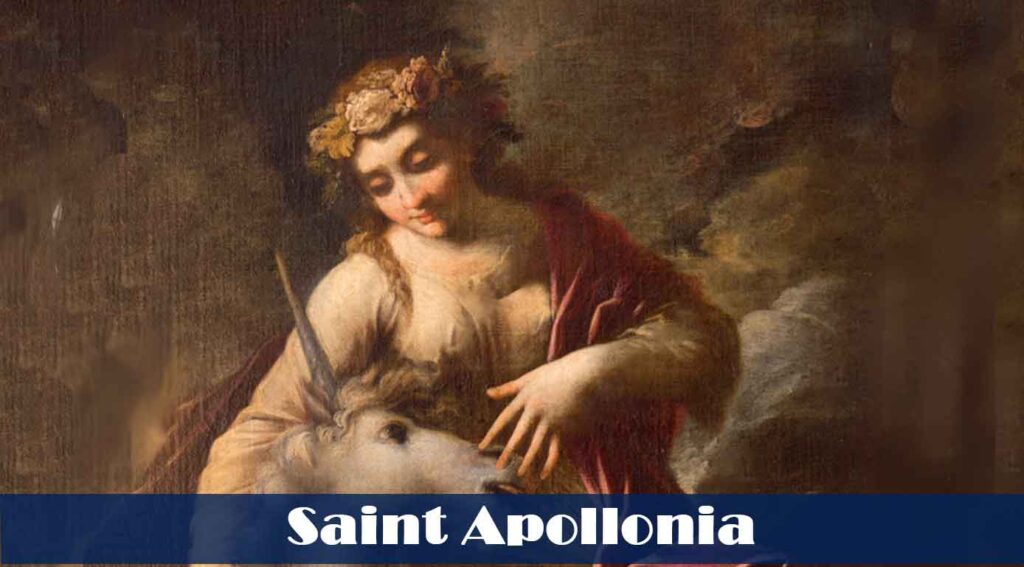
Saint Apollonia

The persecution of Christians began in Alexandria during the reign of the Emperor Philip. The first victim of the pagan mob was an old man named Metrius, who was tortured and then stoned to death. The second person who refused to worship their false idols was a Christian woman named Quinta. Her words infuriated the mob and she was scourged and stoned.
While most of the Christians were fleeing the city, abandoning all their worldly possessions, an old deaconess, Apollonia, was seized. The crowds beat her, knocking out all of her teeth. Then they lit a large fire and threatened to throw her in it if she did not curse her God. She begged them to wait a moment, acting as if she was considering their requests. Instead, she jumped willingly into the flames and so suffered martyrdom.
There were many churches and altars dedicated to her. Apollonia is the patroness of dentists, and people suffering from toothache and other dental diseases often ask her intercession. She is pictured with a pair of pincers holding a tooth or with a golden tooth suspended from her necklace. Saint Augustine explained her voluntary martyrdom as a special inspiration of the Holy Spirit, since no one is allowed to cause his or her own death.

Sources:

https://www.franciscanmedia.org/saint-of-the-day/saint-apollonia/
Saint Apollonia Read More »

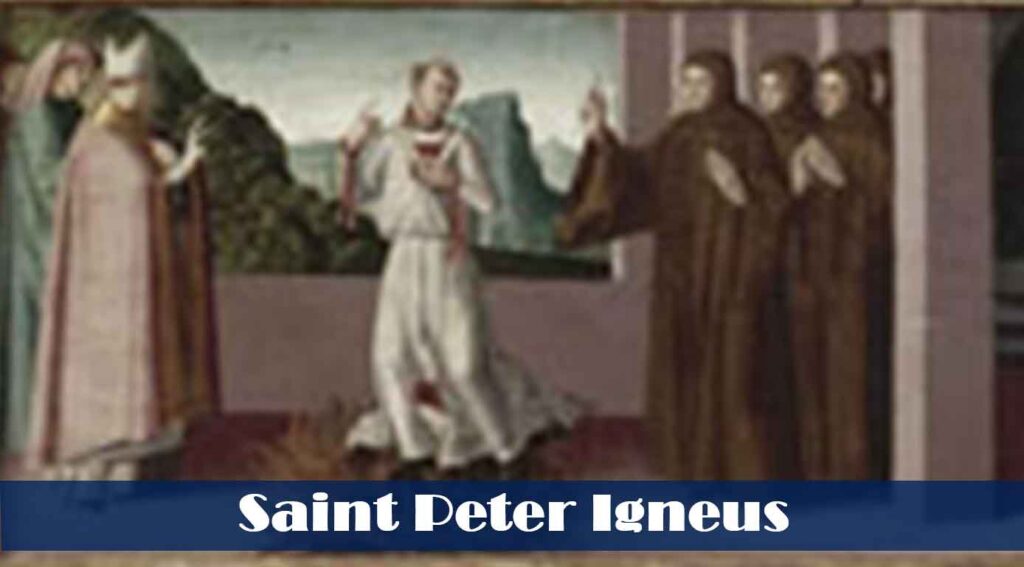
Saint Peter Igneus

Saint Peter Igneus, also known as Pietro Igneo, was born to a noble family in Florence. He entered the Order of Saint Benedict in 1018 as a monk.

Igneo soon became the abbot for San Salvatore in Fucecchio and he held that position until 1081. In 1072 he was designated as a cardinal and Pope Alexander II named him Cardinal-Bishop of Albano.

He cooperated with Pope Gregory VII to repress simony and reform church discipline. Gregory VII entrusted him with several important missions: in 1079 he served as a papal legate in the German kingdom with the Bishop of Padua to mediate between the Emperor Henry IV and Rudolf of Swabia. Igneo served as a co-consecrator for the episcopal consecration of the new Pope Victor III in 1087. He participated in the conclaves held in 1086 and in 1088.

He is often referred to as a member of the Aldobrandini house but this familiar denomination is not attested in sources as a fact. He died on 11 November 1089.

Sources:

https://en.wikipedia.org/wiki/Peter_Igneus
"Blessed Peter Igneus". Santi e Beati. Retrieved 25 September 2017.
Miranda, Salvador. "ALDOBRANDINI, O.S.B.Vall., Pietro Igneo (?-1089)". The Cardinals of the Holy Roman Church. Florida International University. OCLC 53276621.
"Blessed Peter Igneus". Saints SQPN. 10 December 2012
Weber, Nicholas. "Blessed Peter Igneus." The Catholic Encyclopedia Vol. 11. New York: Robert Appleton Company, 1911

Saint Peter Igneus Read More »

Pope Pius IX

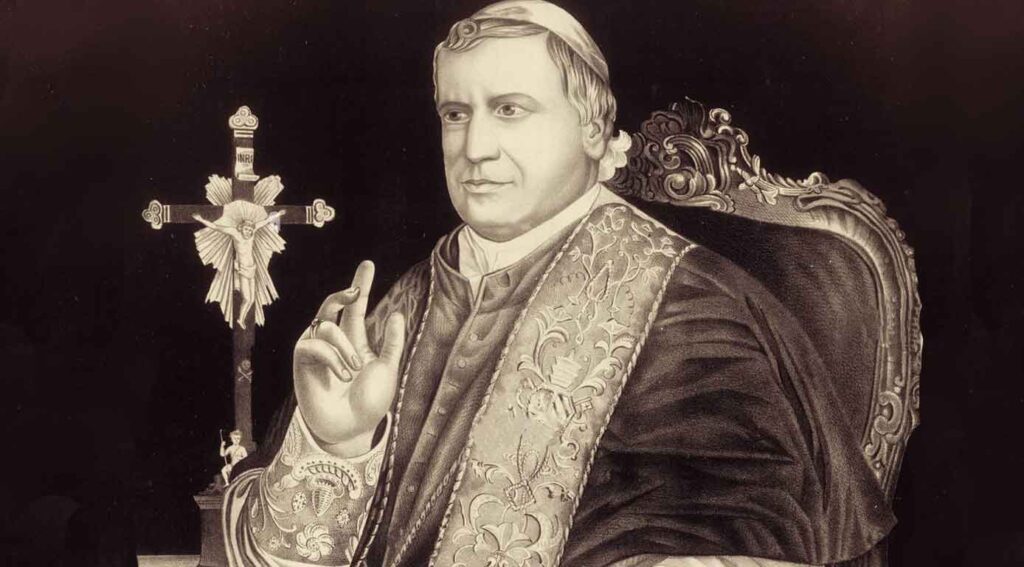
Born as Giovanni Maria Mastai Ferretti, Pope Pius IX was the ninth child born into the noble family of Girolamo dai Conti Ferretti (1750–1833) and Caterina Antonia Maddalena Solazzei di Fano (1764–1842).

Pope Pius IX had been the first future pope ever to have been in America. Upon his return to Rome, the successor of Pius VII, Pope Leo XII, appointed him head of the hospital of San Michele in Rome (1825–1827) and canon of Santa Maria in Via Lata. Pope Leo XII appointed the 35-year-old Mastai Ferretti Archbishop of Spoleto in 1827.

He was head of the Catholic Church from 1846 to 1878, the longest verified papal reign. He was notable for convoking the First Vatican Council in 1868 and for permanently losing control of the Papal States in 1870 to the Kingdom of Italy. Thereafter, he refused to leave Vatican City, declaring himself a “prisoner of the Vatican”

He centralized power in the church in the Holy See and Roman Curia, while also clearly defining the Pope’s doctrinal authority. His chief legacy is the dogma of papal infallibility. Pope John Paul II beatified him in 2000.

Sources:

https://www.franciscanmedia.org/saint-of-the-day/saint-adrian-of-canterbury/

Pope Pius IX Read More »

Saint Paul Miki

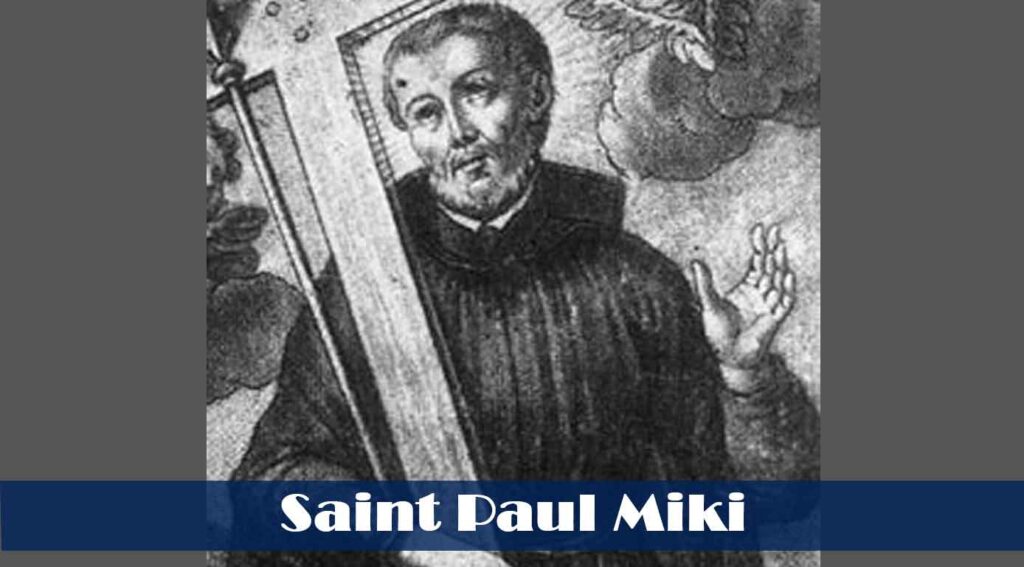
Nagasaki, Japan, is familiar to Americans as the city on which the second atomic bomb was dropped, immediately killing over 37,000 people. Three and a half centuries before, 26 martyrs of Japan were crucified on a hill, now known as the Holy Mountain, overlooking Nagasaki. Among them were priests, brothers, and laymen, Franciscans, Jesuits, and members of the Secular Franciscan Order; there were catechists, doctors, simple artisans, and servants, old men and innocent children—all united in a common faith and love for Jesus and his Church.

Brother Paul Miki, a Jesuit and a native of Japan, has become the best known among the martyrs of Japan. While hanging upon a cross, Paul Miki preached to the people gathered for the execution: “The sentence of judgment says these men came to Japan from the Philippines, but I did not come from any other country. I am a true Japanese. The only reason for my being killed is that I have taught the doctrine of Christ. I certainly did teach the doctrine of Christ. I thank God it is for this reason I die. I believe that I am telling only the truth before I die. I know you believe me and I want to say to you all once again: Ask Christ to help you to become happy. I obey Christ. After Christ’s example I forgive my persecutors. I do not hate them. I ask God to have pity on all, and I hope my blood will fall on my fellow men as a fruitful rain.”

When missionaries returned to Japan in the 1860s, at first they found no trace of Christianity. But after establishing themselves they found that thousands of Christians lived around Nagasaki and that they had secretly preserved the faith. Beatified in 1627, the martyrs of Japan were finally canonized in 1862.

Source:

https://www.franciscanmedia.org/saint-of-the-day/saint-paul-miki-and-companions/

Saint Paul Miki Read More »

Saint Agatha of Sicily

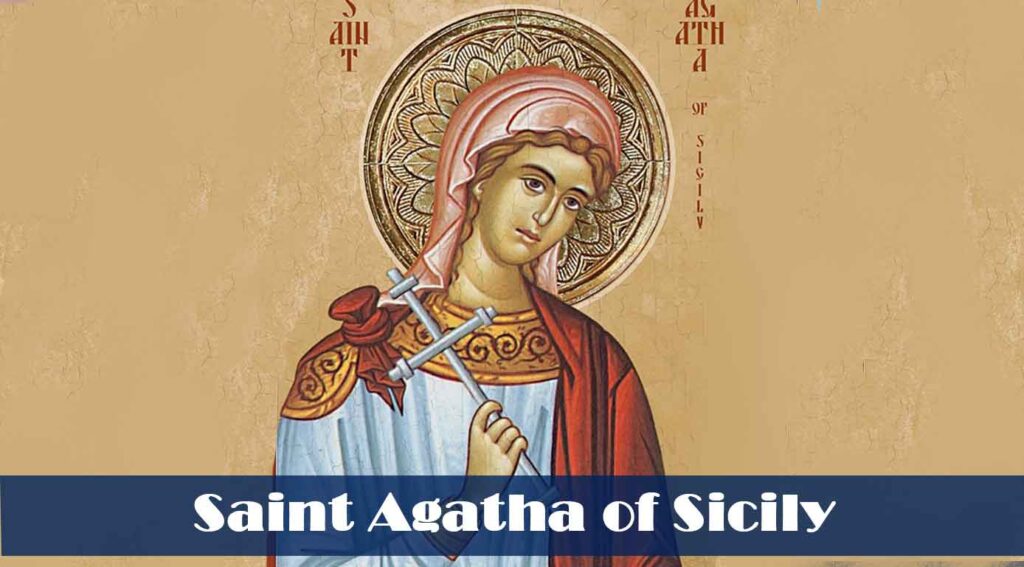
Saint Agatha of Sicily is one of several virgin martyrs who are commemorated by name in the Canon of the Mass. She is one of the most highly venerated virgin martyrs of Christian antiquity.

According to the 13th-century Golden Legend (III.15) by Jacobus de Voragine, 15-year-old Agatha, from a rich and noble family, made a vow of virginity and rejected the amorous advances of the Roman prefect Quintianus, who thought he could force her to turn away from her vow and marry him. His persistent proposals were consistently spurned by Agatha. This was during the persecutions of Decius, so Quintianus, knowing she was a Christian, reported her to the authorities. Quintianus himself was governor of the district.

Agatha died in prison, probably in the year 251 according to the Legenda Aurea. Agatha is the patron saint of Catania, Molise, Malta, San Marino, Gallipoli in Apulia, and Zamarramala, a municipality of the Province of Segovia in Spain. She is also the patron saint of breast cancer patients, martyrs, wet nurses, bell-founders, and bakers, and is invoked against fire, earthquakes, and eruptions of Mount Etna.

Sources:

https://en.wikipedia.org/wiki/Agatha_of_Sicily
D'Arrigo, Santo. Il Martirio di Santa Agata (Catania) 1985
Delaney, John P. (1980). Dictionary of Saints (Second ed.). Garden City, NY: Doubleday. ISBN 0-385-13594-7.

Saint Agatha of Sicily Read More »

Saint John de Britto

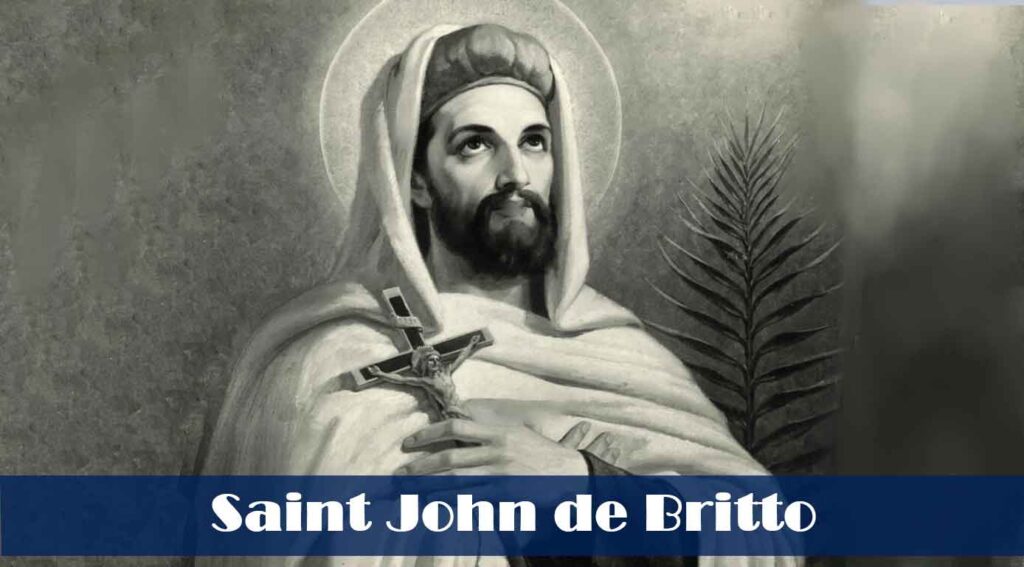
Saint John de Britto, also known as Arul Anandar, was the scion of a powerful aristocratic Portuguese family.

He joined the Jesuits in 1662, studying at the famous University of Coimbra. He travelled to the missions of Madurai, in Southern India, present-day Tamil Nadu, in 1673 and preached the Christian religion in the region of the Maravar country

John de Britto’s preaching led to the conversion of Thadiyathevan, a Maravar prince who had several wives. When Thadiyathevan was required to dismiss all his wives but one, a serious problem arose. One of the wives was a niece of the neighbouring king, the Raghunatha Kilavan Sethupathi, the King of Ramnad, who took up her quarrel and began a general persecution of Christians.[4] Britto and the catechists were taken and carried to the capital, Ramnad. Thence he was led to Orur, some 30 miles northward along the coast, where he was executed on 4 February 1693.
Saint John de Britto was a Portuguese Jesuit missionary and martyr, often called “the Portuguese St Francis Xavier” by Indian Catholics. He is also called the John the Baptist of India.

Sources:

https://en.wikipedia.org/wiki/John_de_Britto
2011 Census of India. Retrieved 2020-12-02.
de Britto, Fernando Pereira (brother of John de Britto) (1852) [History of the birth, life and martyrdom of Blessed John de Britto of the Society of Jesus, Martyr of Asia, and Protomartyr of the Madura Mission]
Roberts, Holly Harlayne (2004-09-01). Vegetarian Christian Saints: Mystics, Ascetics & Monks. New York: Anjeli Press. p. 198

Saint John de Britto Read More »

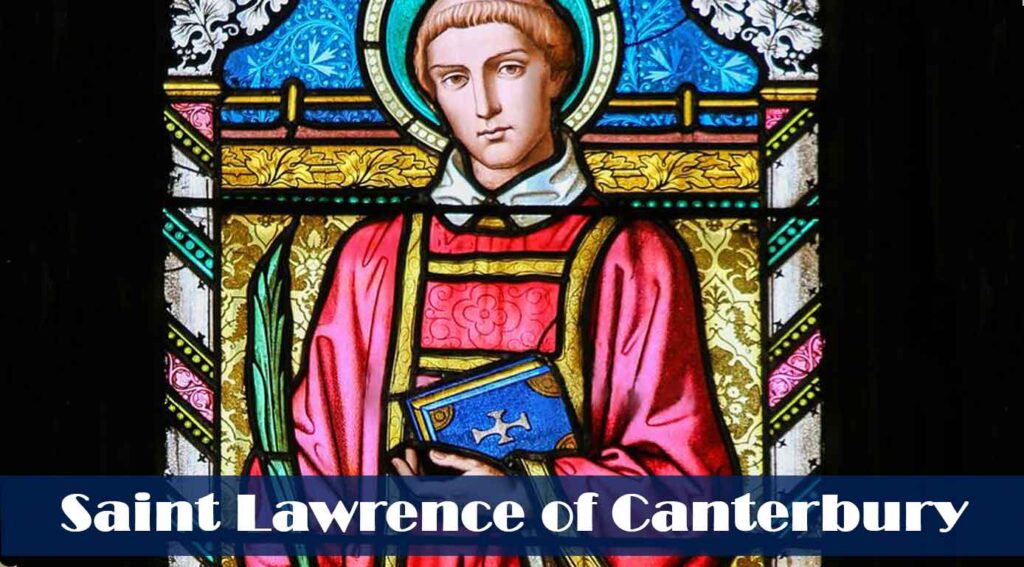
Saint Lawrence of Canterbury

Saint Lawrence of Canterbury was part of the Gregorian mission originally dispatched from Rome in 595 to convert the Anglo-Saxons from their native paganism to Christianity; he landed at Thanet, Kent, with Augustine in 597.

Saint Lawrence of Canterbury was the second Archbishop of Canterbury, serving from about 604 to 619. He was consecrated archbishop by his predecessor, Augustine of Canterbury, during Augustine’s lifetime, to ensure continuity in the office. While archbishop, he attempted unsuccessfully to resolve differences with the native British bishops by corresponding with them about points of dispute. Laurence faced a crisis following the death of King Æthelberht of Kent, when the king’s successor abandoned Christianity; he eventually reconverted.

Saint Lawrence died on 2 February 619, and was buried in the abbey of St Peter and Paul in Canterbury.

Sources:

https://en.wikipedia.org/wiki/Laurence_of_Canterbury
Blair World of Bede p. 85
Lapidge "Laurentius" Blackwell Encyclopaedia of Anglo-Saxon Englan
Brooks "Laurence" Oxford Dictionary of National Biography
Stenton Anglo-Saxon England p. 106
Hindley Brief History of the Anglo-Saxons p. 36

Saint Lawrence of Canterbury Read More »

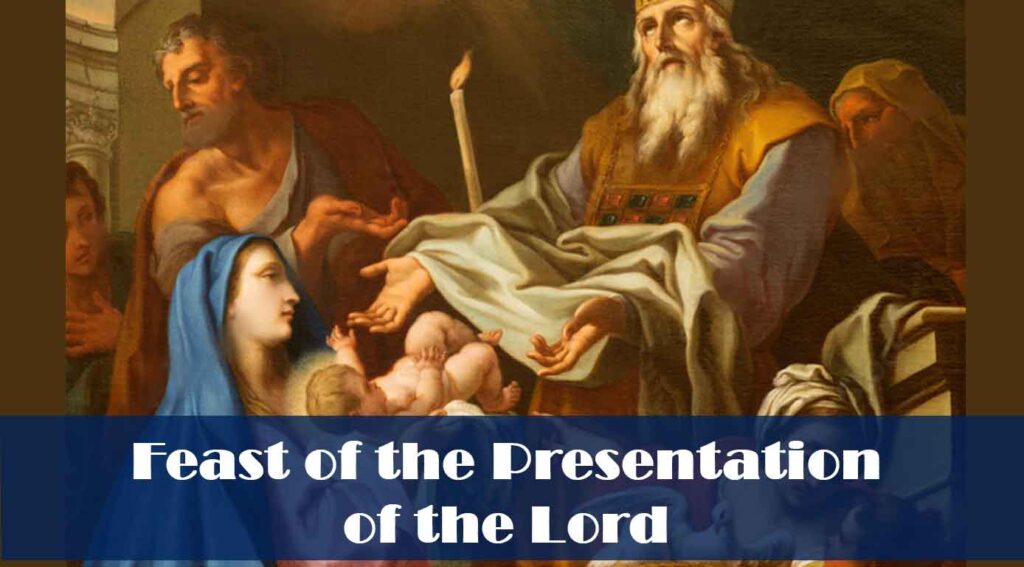
Feast of the Presentation of the Lord

Also known as, Candlemas or Presentation of Christ in the Temple, the Feast of the Presentation of the Lord is a Christian celebration. It commemorates the occasion when the Blessed Virgin Mary went to the Temple to be purified 40 days after the birth of Jesus, and to present him to God.

At the end of the fourth century, a woman named Etheria made a pilgrimage to Jerusalem. Her journal, discovered in 1887, gives an unprecedented glimpse of liturgical life there. Among the celebrations she describes is the Epiphany, the observance of Christ’s birth, and the gala procession in honor of his Presentation in the Temple 40 days later. Under the Mosaic Law, a woman was ritually “unclean” for 40 days after childbirth, when she was to present herself to the priests and offer sacrifice—her “purification.” Contact with anyone who had brushed against mystery—birth or death—excluded a person from Jewish worship. This feast emphasizes Jesus’ first appearance in the Temple more than Mary’s purification.

The observance spread throughout the Western Church in the fifth and sixth centuries. Because the Church in the West celebrated Jesus’ birth on December 25, the Presentation was moved to February 2, 40 days after Christmas.

At the beginning of the eighth century, Pope Sergius inaugurated a candlelight procession; at the end of the same century the blessing and distribution of candles which continues to this day became part of the celebration, giving the feast its popular name: Candlemas.

Feast of the Presentation of the Lord Read More »

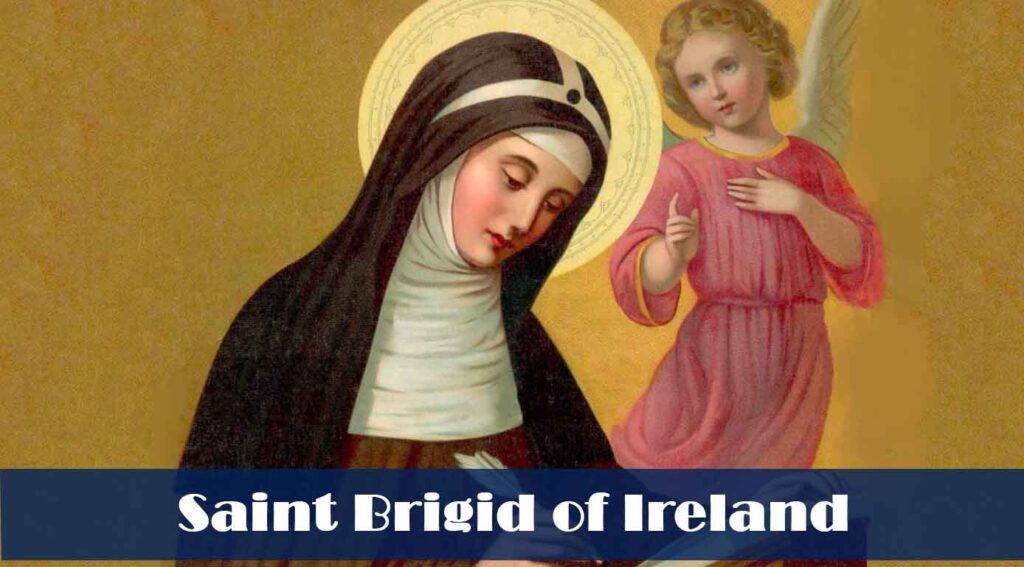
Saint Brigid of Ireland

Saint Brigid is also known as Saint Brigid of Kildare. She is patroness saint of Ireland, and one of its three national saints along with Patrick and Columba. She is patroness of many things, including poetry, learning, healing, protection, blacksmithing, livestock and dairy production. The saint shares her name with a Celtic goddess.

There are few historical facts about her, and early hagiographies are mainly anecdotes and miracle tales, some of which are rooted in pagan folklore. She was an abbess who founded several convents of nuns, most notably that of Kildare, which was one of the most important in Ireland.

Brigid was said to have worked miracles, including healing and feeding the poor. According to one tale, as a child, she once gave away her mother’s entire store of butter. The butter was then replenished in answer to Brigid’s prayers. Around the age of ten, she was returned as a household servant to her father, where her charity led her to donate his belongings to anyone who asked.

Brigid, with an initial group of seven companions, is credited with organising communal consecrated religious life for women in Ireland.She founded two monasteries; one for men, the other for women.

Sources:

https://en.wikipedia.org/wiki/Brigid_of_Kildare
St. Brigid's GNS, Glasnevin.
Farmer, David. The Oxford Dictionary of Saints (Fifth Edition, Revised). Oxford University Press, 2011. pp.66–67, 467–470
Jestice, Phyllis G. (2004). Holy People of the World: A Cross-Cultural Encyclopedia. ABC-CLIO. pp. 140–. ISBN 9781576073551.

Saint Brigid of Ireland Read More »

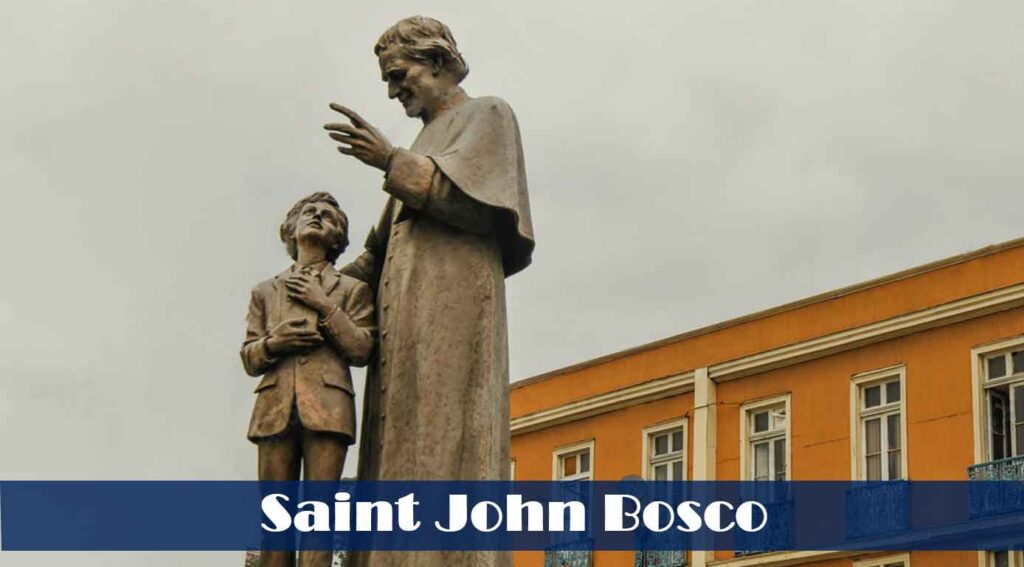
Saint John Bosco

Saint John Bosco’s theory of education could well be used in today’s schools. It was a preventive system, rejecting corporal punishment and placing students in surroundings removed from the likelihood of committing sin. He advocated frequent reception of the sacraments of Penance and Holy Communion. He combined catechetical training and fatherly guidance, seeking to unite the spiritual life with one’s work, study and play.

Encouraged during his youth in Turin to become a priest so he could work with young boys, John was ordained in 1841. His service to young people started when he met a poor orphan in Turin, and instructed him in preparation for receiving Holy Communion. He then gathered young apprentices and taught them catechism.

After serving as chaplain in a hospice for working girls, Don Bosco opened the Oratory of St. Francis de Sales for boys. Several wealthy and powerful patrons contributed money, enabling him to provide two workshops for the boys, shoemaking and tailoring.

By 1856, the institution had grown to 150 boys and had added a printing press for publication of religious and catechetical pamphlets. John’s interest in vocational education and publishing justify him as patron of young apprentices and Catholic publishers.

John’s preaching fame spread and by 1850 he had trained his own helpers because of difficulties in retaining young priests. In 1854, he and his followers informally banded together, inspired by Saint Francis de Sales.

With Pope Pius IX’s encouragement, John gathered 17 men and founded the Salesians in 1859. Their activity concentrated on education and mission work. Later, he organized a group of Salesian Sisters to assist girls.

Saint John Bosco Read More »