Daily Saints

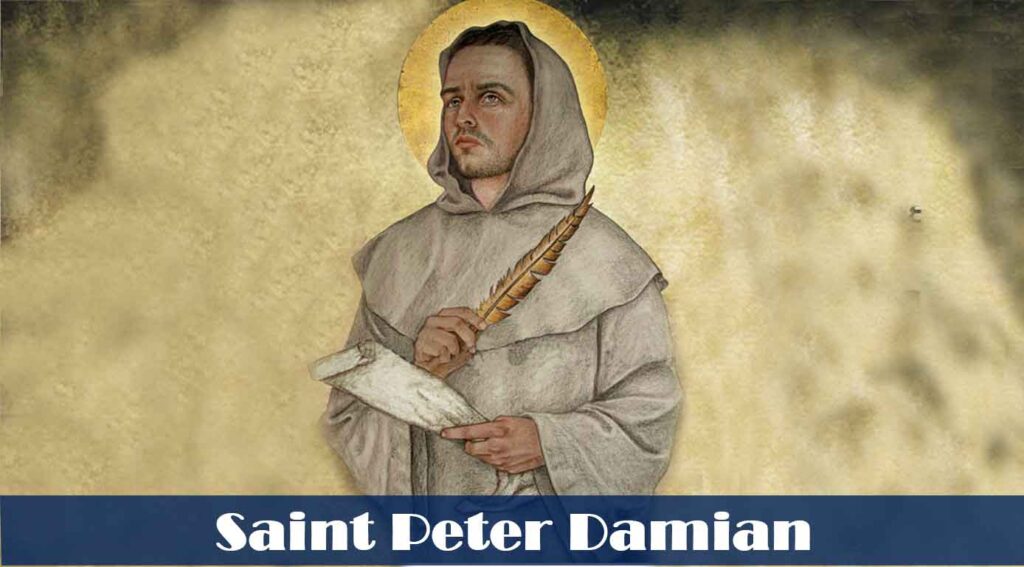
Saint Peter Damian

Maybe because he was orphaned and had been treated shabbily by one of his brothers, Peter Damian was very good to the poor. It was the ordinary thing for him to have a poor person or two with him at table and he liked to minister personally to their needs.
Peter escaped poverty and the neglect of his own brother when his other brother, who was archpriest of Ravenna, took him under his wing. His brother sent him to good schools and Peter became a professor.

Already in those days, Peter was very strict with himself. He wore a hair shirt under his clothes, fasted rigorously and spent many hours in prayer. Soon, he decided to leave his teaching and give himself completely to prayer with the Benedictines of the reform of Saint Romuald at Fonte Avellana. They lived two monks to a hermitage. Peter was so eager to pray and slept so little that he soon suffered from severe insomnia. He found he had to use some prudence in taking care of himself. When he was not praying, he studied the Bible.

The abbot commanded that when he died Peter should succeed him. Abbot Peter founded five other hermitages. He encouraged his brothers in a life of prayer and solitude and wanted nothing more for himself. The Holy See periodically called on him, however, to be a peacemaker or troubleshooter, between two abbeys in dispute or a cleric or government official in some disagreement with Rome.
Finally, Pope Stephen IX made Peter the cardinal-bishop of Ostia. He worked hard to wipe out simony—the buying of church offices–and encouraged his priests to observe celibacy and urged even the diocesan clergy to live together and maintain scheduled prayer and religious observance. He wished to restore primitive discipline among religious and priests, warning against needless travel, violations of poverty, and too comfortable living. He even wrote to the bishop of Besancon complaining that the canons there sat down when they were singing the psalms in the Divine Office.
He wrote many letters. Some 170 are extant. We also have 53 of his sermons and seven lives, or biographies, that he wrote. He preferred examples and stories rather than theory in his writings. The liturgical offices he wrote are evidence of his talent as a stylist in Latin.

He asked often to be allowed to retire as cardinal-bishop of Ostia, and finally Pope Alexander II consented. Peter was happy to become once again just a monk, but he was still called to serve as a papal legate. When returning from such an assignment in Ravenna, he was overcome by a fever. With the monks gathered around him saying the Divine Office, he died on February 22, 1072. In 1828, he was declared a Doctor of the Church.

Sources:

https://www.franciscanmedia.org/saint-of-the-day/saint-peter-damian/

Saint Peter Damian Read More »
Saints Jacinta and Francisco Marto

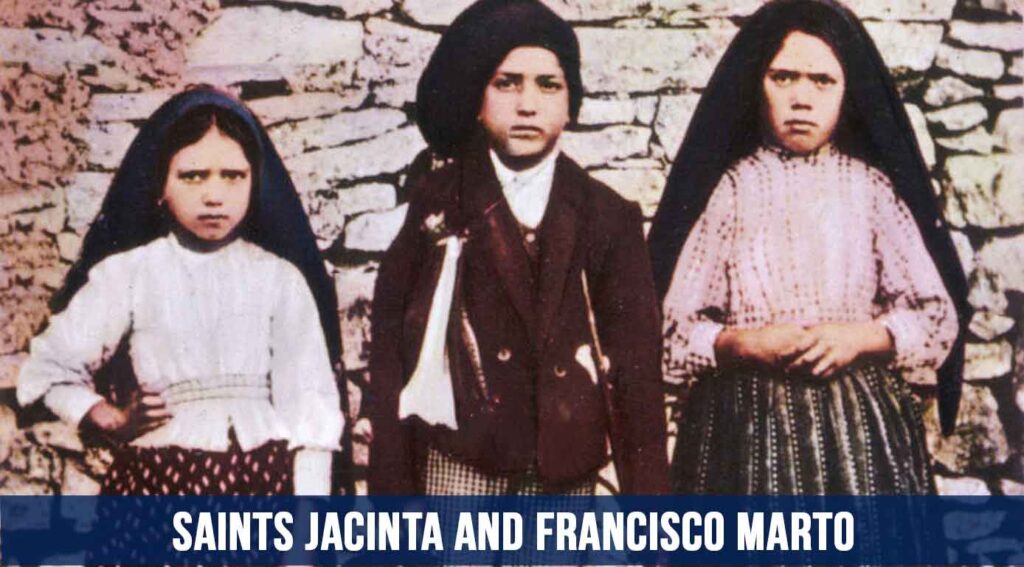
Between May 13 and October 13, 1917, three Portuguese shepherd children from Aljustrel, received apparitions of Our Lady at Cova da Iria, near Fátima, a city 110 miles north of Lisbon. At that time, Europe was involved in an extremely bloody war. Portugal itself was in political turmoil, having overthrown its monarchy in 1910; the government disbanded religious organizations soon after.

At the first appearance, Mary asked the children to return to that spot on the thirteenth of each month for the next six months. She also asked them to learn to read and write and to pray the rosary “to obtain peace for the world and the end of the war.” They were to pray for sinners and for the conversion of Russia, which had recently overthrown Czar Nicholas II and was soon to fall under communism. Up to 90,000 people gathered for Mary’s final apparition on October 13, 1917.
Less than two years later, Francisco died of influenza in his family home. He was buried in the parish cemetery and then re-buried in the Fátima basilica in 1952. Jacinta died of influenza in Lisbon in 1920, offering her suffering for the conversion of sinners, peace in the world, and the Holy Father. She was re-buried in the Fátima basilica in 1951. Their cousin Lúcia dos Santos, became a Carmelite nun and was still living when Jacinta and Francisco were beatified in 2000; she died five years later. Pope Francis canonized the younger children on his visit to Fátima to commemorate the 100th anniversary of the first apparition–May 13, 2017. The shrine of Our Lady of Fátima is visited by up to 20 million people a year.

Sources:

https://www.franciscanmedia.org/saint-of-the-day/saints-jacinta-and-francisco-marto/

Saints Jacinta and Francisco Marto Read More »

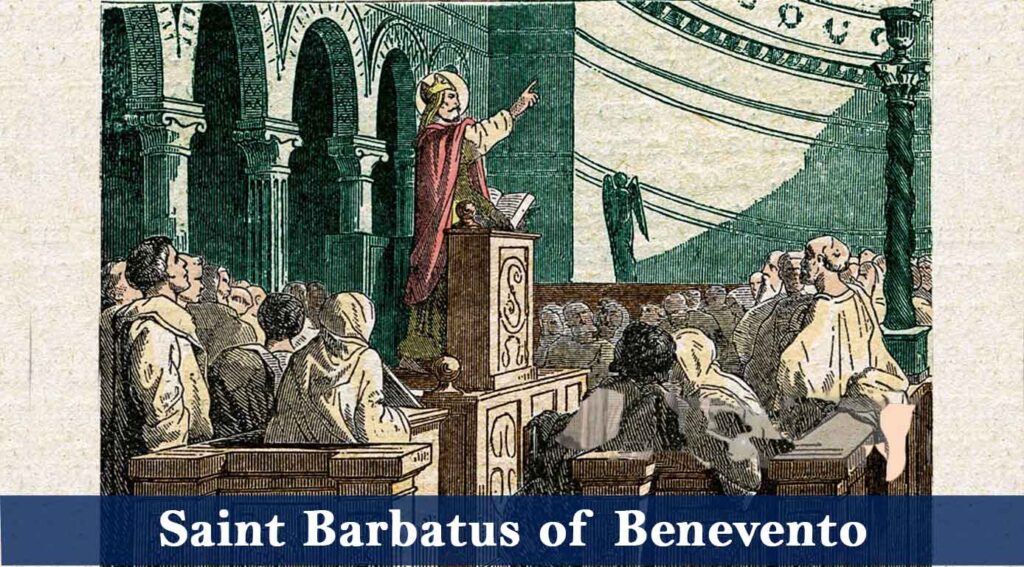
Saint Barbatus of Benevento

Saint Barbatus of Benevento was born in the village of Vandano, near Cerreto Sannita, then part of the Duchy of Benevento, toward the end of the papacy of Gregory the Great.

According to the ninth century vitae, he received a Christian education, and spent a good deal of time studying the Christian scriptures. He took holy orders as soon as allowed to do so, and was immediately employed by the local bishop as a preacher. Shortly thereafter, he was made the curate of St. Basil’s Church in nearby Morcone

He warned the people of the city of the great trials they would soon suffer at the hands of the East Roman Emperor Constans II and his army, who shortly thereafter landed in the area and laid siege to Benevento. The people, in their fear, renounced the practices Barbatus had criticized. He then cut down the tree the locals had worshipped, and melted the viper into a chalice for use in the church.
In 680, he assisted in a council held by Pope Agatho, and took part in the sixth general council held in Constantinople in 681 regarding the Monothelites. He died shortly after the end of the council, on 19 February 682, at about seventy years of age.

Sources:

https://en.wikipedia.org/wiki/Barbatus_of_Benevento#:~:text=Barbatus%20of%20Benevento%20
"Barbatus”. New Catholic Dictionary. CatholicSaints.Info. 18 August 2012
Staley, Tony. "Making a chalice from a gold snake", The Compass, Diocese of Green Bay, Wisconsin, 17 February 2012

Saint Barbatus of Benevento Read More »

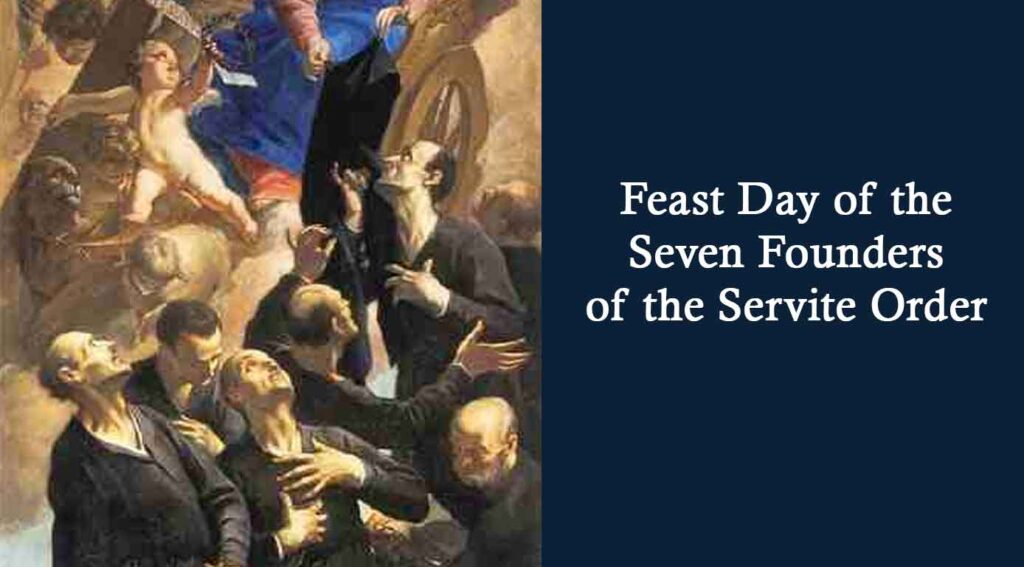
Feast Day of the Seven Founders
of the Servite Order

Can you imagine seven prominent men of Boston or Denver banding together, leaving their homes and professions, and going into solitude for a life directly given to God? That is what happened in the cultured and prosperous city of Florence in the middle of the 13th century. The city was torn with political strife as well as the heresy of the Cathari, who believed that physical reality was inherently evil. Morals were low and religion seemed meaningless.

In 1240, seven noblemen of Florence mutually decided to withdraw from the city to a solitary place for prayer and direct service of God. Their initial difficulty was providing for their dependents, since two were still married and two were widowers.
Their aim was to lead a life of penance and prayer, but they soon found themselves disturbed by constant visitors from Florence. They next withdrew to the deserted slopes of Monte Senario.

In 1244, under the direction of Saint Peter of Verona, O.P., this small group adopted a religious habit similar to the Dominican habit, choosing to live under the Rule of St. Augustine and adopting the name of the Servants of Mary. The new Order took a form more like that of the mendicant friars than that of the older monastic Orders.

Members of the community came to the United States from Austria in 1852 and settled in New York and later in Philadelphia. The two American provinces developed from the foundation made by Father Austin Morini in 1870 in Wisconsin.

Community members combined monastic life and active ministry. In the monastery, they led a life of prayer, work and silence while in the active apostolate they engaged in parochial work, teaching, preaching, and other ministerial activities.

Feast Day of the Seven Founders
of the Servite Order
Read More »

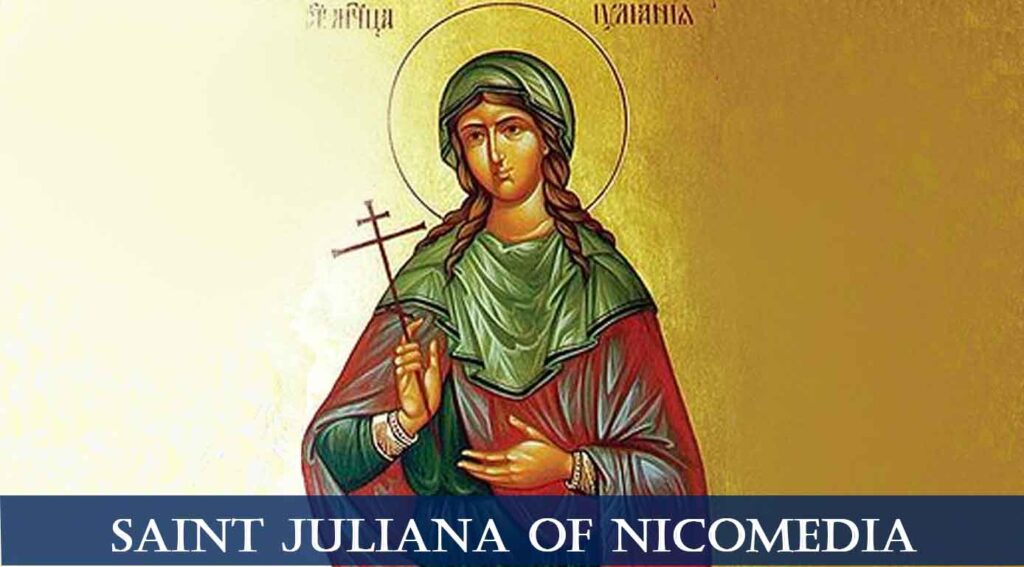
Saint Juliana of Nicomedia

Saint Juliana of Nicomedia biography are unclear. According to an account, Saint Juliana was the daughter of an illustrious pagan named Africanus. As a child was betrothed to the Senator Eleusius, one of the emperor’s advisors. Her father was hostile to the Christians. Juliana secretly accepted holy baptism. When the time of her wedding approached, Juliana refused to be married. Her father urged her not to break her engagement, but when she refused to obey him, he handed her over to the Governor, her former fiancé. Elusius again asked Juliana to marry him, but she again refused. was a 3rd-century Roman saint. He was a clergyman in the Roman Empire who ministered to persecuted Christians.

Juliana was beheaded after suffering torture in 304, during the persecution of Maximian.It is said that part of her torture was being partially burned in flames, plunged into a boiling pot of oil, and finally beheaded.

Sources:

https://en.wikipedia.org/wiki/Juliana_of_Nicomedia
"St. Juliana". In Catholic Encyclopedia. 8. New York: Robert Appleton Company
"Gregorii Magni epist.", lib. IX, ep. ####", in J. P. Migne's Patrologia Latina, LXXXVII, 1015
"St. Juliana of Nicomedia | Antiochian Orthodox Christian Archdiocese". ww1.antiochian.org.

Saint Juliana of Nicomedia Read More »

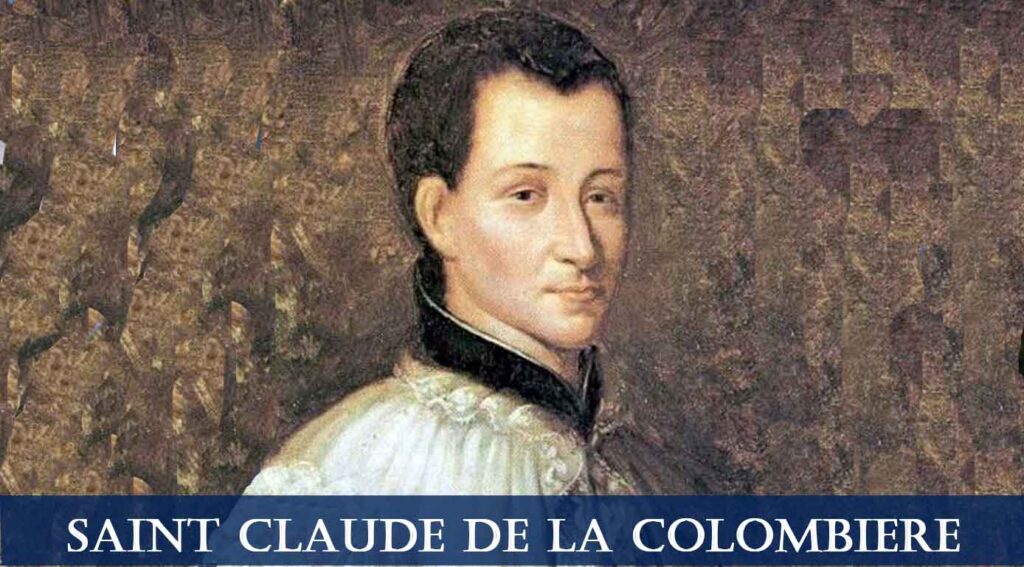
Saint Claude de la Colombiere

This is a special day for the Jesuits, who claim today’s saint as one of their own. It’s also a special day for people who have a special devotion to the Sacred Heart of Jesus—a devotion Claude de la Colombière promoted along with his friend and spiritual companion, Saint Margaret Mary Alacoque. The emphasis on God’s love for all was an antidote to the rigorous moralism of the Jansenists, who were popular at the time.

Saint Claude de la Colombière was a Jesuit priest. He was born in 1641 in the city of Saint-Symphorien-d’Ozon. In 1658, at the age of seventeen, Colombière entered the novitiate of the Society of Jesus at Avignon. When he completed the two-year novitiate, he started his higher studies in the same city. He was professed there and completed his studies. After this he spent the next five years of his regency teaching grammar and literature at the same school.

In 1676 Colombière was sent to England as preacher to Mary of Modena, then the Duchess of York, wife of the future King James II of England. He took up residence at the Court of St. James, where he still observed all his religious duties as a member of the Society. He was also as active a preacher and confessor in England as he had been in France. In November 1678, while awaiting a recall to France, he was suddenly arrested and thrown into prison, denounced as being a part of the Popish Plot alleged by Titus Oates against the English throne.

Thanks to his position at the Royal Court and to the protection of the King of France, Louis XIV, whose subject he was, he escaped death but was expelled from England in 1679. He returned to France with his health ruined by his imprisonment.

Sources:

https://en.wikipedia.org/wiki/Claude_La_Colombi%C3%A8re
www.catholicnewsagency.com.
"St. Claude La Colombiere, SJ (1641-1682)". Ignatian Spirituality
Vatican News Service
https://www.franciscanmedia.org/saint-of-the-day/saint-claude-de-la-colombiere/

Saint Claude de la Colombiere Read More »

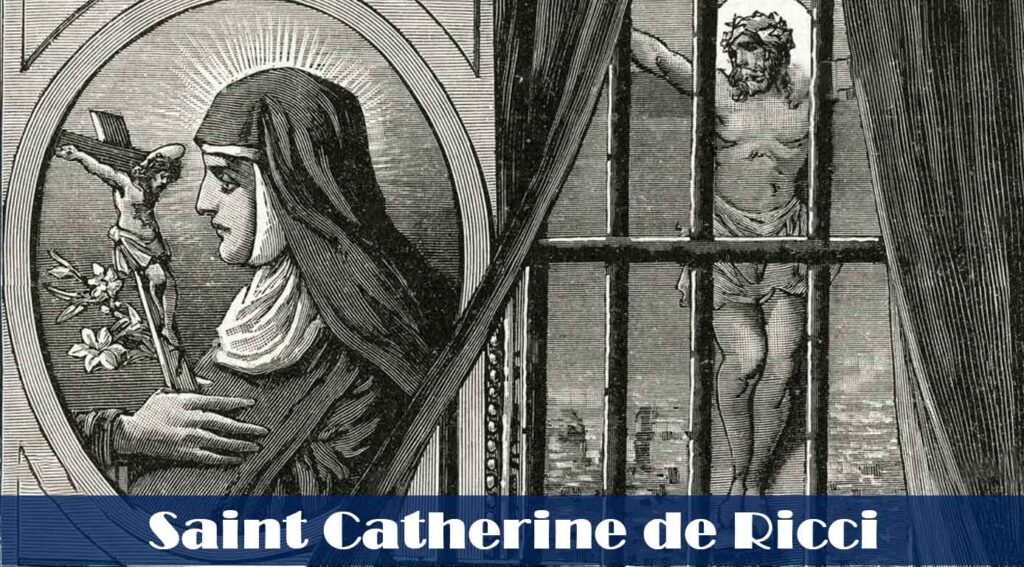
Saint Catherine de Ricci

Born as Alessandra Lucrezia Romola de’ Ricci in Florence, Saint Catherine de Ricci was an Italian Dominican Tertiary sister. She is believed to have had miraculous visions and corporeal encounters with Jesus, both with the infant Jesus and with the adult Jesus. She is said to have spontaneously bled with the wounds of the crucified Christ. She is venerated for her mystic visions and is honored as a saint by the Catholic Church.

She was a very prayerful person from a very young age. There she developed a lifelong devotion to the Passion of Christ. Saint Catherine de Ricci’s period of novitiate was a time of trial. She would experience ecstasies during her routine, which caused her to seem asleep during community prayer services, dropping plates and food, so much so that the community began to question her competence, if not her sanity. Eventually the other Sisters became aware of the spiritual basis for her behavior. By the age of 30 she had risen to the post of prioress.

It is claimed that de’ Ricci’s meditation on the Passion of Christ was so deep that she spontaneously bled, as if scourged. She also bore the Stigmata. During times of deep prayer, like Catherine of Siena, her patron saint, a coral ring representing her marriage to Christ appeared on her finger.

Saint Catherine de Ricci lived in the convent until her death in 1590 after a prolonged illness.

Saint Catherine de Ricci Read More »

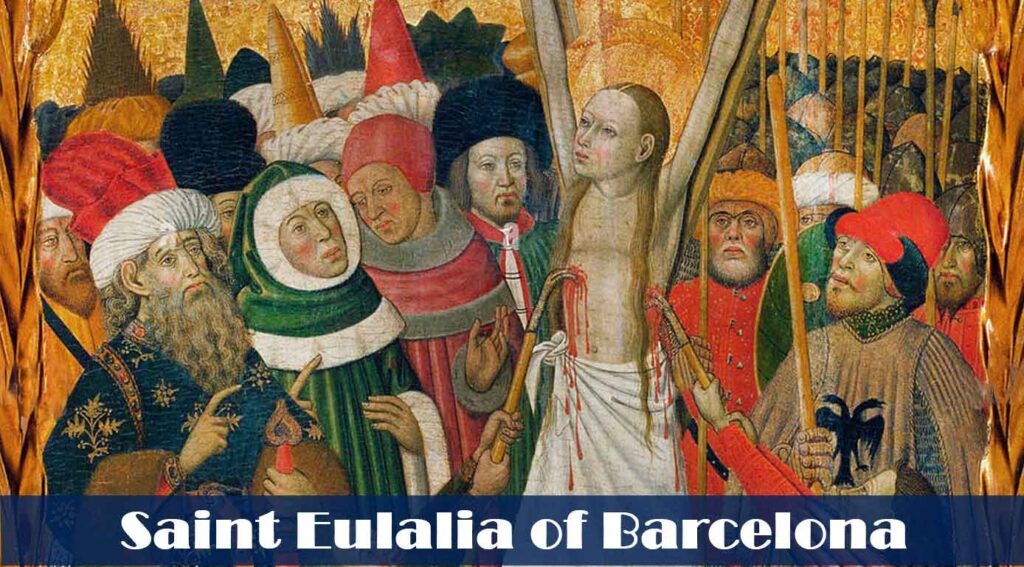
Saint Eulalia of Barcelona

Saint Eulalia was the daughter of a noble family that lived near the city of Barcelona. She was a 13-year-old Roman Christian virgin who was martyred in Barcelona during the persecution of Christians in the reign of emperor Diocletian.

She lived during the persecutions under Diocletian. Eulalia left her home, entered the city and confronted the governor for his merciless persecution of Christians. Unable to dismiss the eloquent arguments of a young girl, Dacian soon had Eulalia stripped nearly naked and flagellated, which was followed by bloodier tortures that were not to cease unless she admitted the error of her ways. Resisting to the end, she prayed that God would take her to Heaven, and died of her wounds.

She is the co-patron saint of Barcelona.

Sources:

https://en.wikipedia.org/wiki/Eulalia_of_Barcelona
https://en.wikipedia.org/wiki/Catholic_Encyclopedia
Saint of the Day, February 12: Eulalia of Barcelona Archived 2017-09-25 at the Wayback Machine at SaintPatrickDC.org

Saint Eulalia of Barcelona Read More »

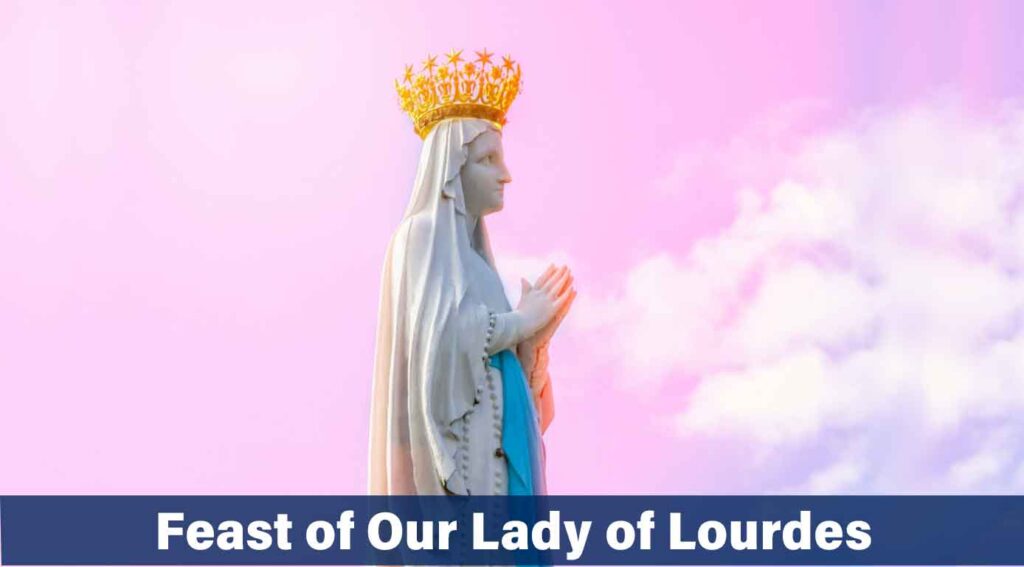
Feast of Our Lady of Lourdes

On December 8, 1854, Pope Pius IX proclaimed the dogma of the Immaculate Conception in the apostolic constitution Ineffabilis Deus. A little more than three years later, on February 11, 1858, a young lady appeared to Bernadette Soubirous. This began a series of visions. During the apparition on March 25, the lady identified herself with the words: “I am the Immaculate Conception.”

Bernadette was a sickly child of poor parents. Their practice of the Catholic faith was scarcely more than lukewarm. Bernadette could pray the Our Father, the Hail Mary and the Creed. She also knew the prayer of the Miraculous Medal: “O Mary conceived without sin.”
During interrogations Bernadette gave an account of what she saw. It was “something white in the shape of a girl.” She used the word aquero, a dialect term meaning “this thing.” It was “a pretty young girl with a rosary over her arm.” Her white robe was encircled by a blue girdle. She wore a white veil. There was a yellow rose on each foot. A rosary was in her hand. Bernadette was also impressed by the fact that the lady did not use the informal form of address (tu), but the polite form (vous). The humble virgin appeared to a humble girl and treated her with dignity.
Through that humble girl, Mary revitalized and continues to revitalize the faith of millions of people. People began to flock to Lourdes from other parts of France and from all over the world. In 1862 Church authorities confirmed the authenticity of the apparitions and authorized the cult of Our Lady of Lourdes for the diocese. The Feast of Our Lady of Lourdes became worldwide in 1907.

Sources:

https://www.franciscanmedia.org/saint-of-the-day/our-lady-of-lourdes/

Feast of Our Lady of Lourdes Read More »

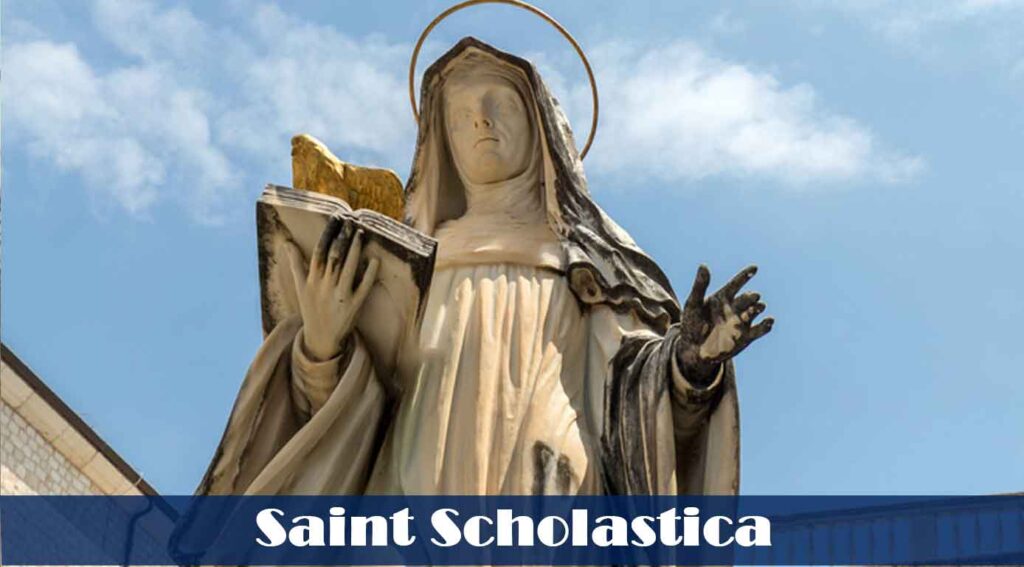
Saint Scholastica

Twins often share the same interests and ideas with an equal intensity. Therefore, it is no surprise that Scholastica and her twin brother, Benedict, established religious communities within a few miles from each other.

Born in 480 of wealthy parents, Scholastica and Benedict were brought up together until he left central Italy for Rome to continue his studies.

Little is known of Scholastica’s early life. She founded a religious community for women near Monte Cassino at Plombariola, five miles from where her brother governed a monastery.

The twins visited each other once a year in a farmhouse because Scholastica was not permitted inside the monastery. They spent these times discussing spiritual matters.

According to the Dialogues of St. Gregory the Great, the brother and sister spent their last day together in prayer and conversation. Scholastica sensed her death was close at hand and she begged Benedict to stay with her until the next day.

He refused her request because he did not want to spend a night outside the monastery, thus breaking his own Rule. Scholastica asked God to let her brother remain and a severe thunderstorm broke out, preventing Benedict and his monks from returning to the abbey.

Benedict cried out, “God forgive you, Sister. What have you done?” Scholastica replied, “I asked a favor of you and you refused. I asked it of God and he granted it.”

Brother and sister parted the next morning after their long discussion. Three days later, Benedict was praying in his monastery and saw the soul of his sister rising heavenward in the form of a white dove. Benedict then announced the death of his sister to the monks and later buried her in the tomb he had prepared for himself.

Sources:

https://www.franciscanmedia.org/saint-of-the-day/saint-scholastica/

Saint Scholastica Read More »