In 1545, when Juan was only three years old, his father died, leaving Catalina to raise and provide for their boys, a difficult responsibility for a widow at that time. She sought assistance from Gonzalo’s family but was rejected. Therefore, she and her boys lived in destitution. Two years after Gonzalo’s death, Luis died of malnutrition. Eventually, Catalina took Francisco and Juan and moved to Medina del Campo, a larger city, and resumed her work as a weaver.
In Medina, Juan was able to attend a boarding school for poor children. He received a basic education, housing, and food. Juan proved to be an excellent student and, in 1559, was invited to study at the nearby newly founded Jesuit school at the age of seventeen. With the Jesuits, Juan studied the humanities, grammar, rhetoric, Latin, and Greek. Four years later, in 1563, he entered the Carmelite Order, taking the name John of Saint Matthias.
John made his profession as a Carmelite in 1564 and subsequently received special permission from his superiors to follow the ancient Carmelite rule to the letter, rather than embrace the various changes to the rule that occurred over the years. After his professions, he was sent to study theology and philosophy at the prestigious university in Salamanca. There he excelled in his studies and was known for his intelligence and insights.
At the end of his studies, John had second thoughts about his vocation as a Carmelite, preferring instead to live a more contemplative life. As a result, he decided that he would enter the Carthusians once he was ordained. John was ordained a priest in 1567.
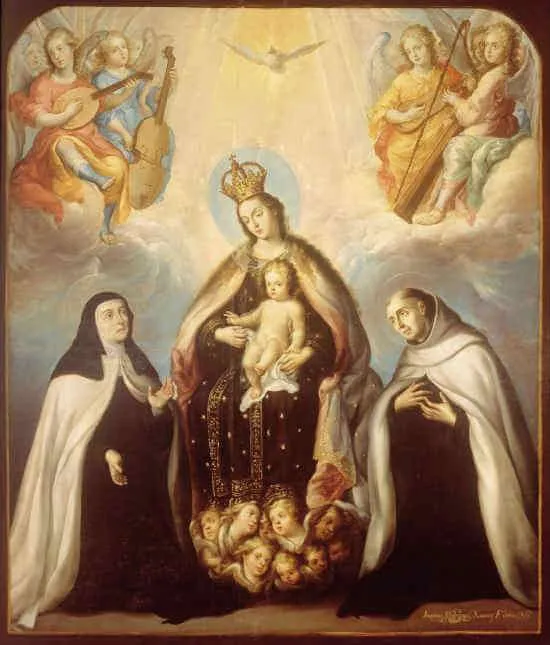
Father John returned to Medina to offer his first Mass. However, his intention to join the Carthusians all changed after meeting the Carmelite nun Teresa of Ávila. Mother Teresa was a reformer of the Carmelite Order and was in Medina to found a new convent. While there, she heard of the newly ordained priest, Father John, and attended his first Mass. Later, she spoke to him about her ideas on reforming the Carmelites in hopes that he would become her first friar in the reform. Father John was intrigued and accepted her invitation to remain a Carmelite and assist her with the new reforms, reviving the ancient rule.
After returning with Mother Teresa to Valladolid, he participated in a period of formation under her guidance and founded the first house for friars, along with two other Carmelite brothers. This first house began formally on November 28, 1568. Father John gave up his old name and took on the new name of Father John of the Cross. As more friars joined them, Father John, now the subprior and novice master, moved to a larger house in nearby Alcalá where he also became the rector of the university.
In May of 1572, Mother Teresa asked him to move to Ávila to become the spiritual director for the sisters at the Monastery of the Incarnation. He remained there for five years, working closely with the sisters and growing deep in his own spiritual life. He was especially blessed to act as spiritual director to Mother Teresa who, in many ways, acted as a spiritual guide to him.
Shortly after his arrival in 1572, Mother Teresa entered into the spiritual transformation of the Divine Union while Father John acted as her spiritual director. At times, their conversations led both of them into ecstasy as the Holy Spirit worked powerfully in their lives and through their spiritual friendship.
Sadly, politics had its place in the Church at that time, and there were some who did not like the idea of reforming the Carmelite order. In January of 1576, Father John was arrested for the first time by the more contemporary and well-established Carmelites of the Observance. They wanted to end the reforms of Father John and Mother Teresa and their Discalced Carmelites (meaning those who wore sandals rather than shoes).
His arrest was quickly ended by the intervention of the papal nuncio, Nicolás Ormaneto, who was favorable toward the reforms of the Discalced Carmelites. However, the following year, in June of 1577, the nuncio died. A new nuncio was appointed who was not in favor of the reforms. In December of that year, Father John was once again arrested by the Carmelites of the Observance and put in prison in their monastery in Toledo, where he remained for nine months.
After Father John’s arrest, the Provincial ordered him to “repent” of his reforms and to return to the monastery in Medina. Father John refused to do so, arguing that he was not bound by the Provincial’s demands, since he had received permission for his work on the reform from the nuncio Ormaneo while he was alive. As a result, Father John was judged as being rebellious and willfully disobedient to their authority and was imprisoned in a six-by-ten-foot dungeon cell.
During the nine months of his imprisonment, Father John was regularly abused by the friars in attempts to get him to “repent.” He was given no change of clothing, very little food, endured a severe case of lice, and had only his breviary to read. He endured the severe cold of the winter and the heat of the summer in the small dark cell that had only one small window high up on the wall.
However, it was during this time of abuse that some of the greatest spiritual treasures to fill our Church were born. Father John, in the darkness of this prison, composed numerous poems, including Dark Night of the Soul and portions of the Spiritual Canticle. God did not allow this abuse to go fruitless. Father John grew deep in the spiritual life and entered into interior freedom through his prayer and surrender to God.
In August of 1578, it is said that God miraculously enabled Father John to escape at night “in the darkness,” as his poem relates, and find refuge with Mother Teresa’s sisters in Toledo. Eventually, he escaped to Santa Cruz, where he was cared for secretly and nursed back to full health.
Over the coming years, his prison experience, the poems he composed, and his life of deep prayer and study prepared him to write four of the greatest works on mystical theology the Church has ever known: Ascent to Mount Carmel, Dark Night of the Soul, Living Flame of Love, and Spiritual Canticles. Each book was a commentary on the mystical poems he had composed. The poems themselves are considered to be among the most beautiful poems written in the Spanish language.
During the year after Father John escaped imprisonment, the Discalced Carmelites did all they could to regularize their situation within the larger Carmelite order and within the Church. Though the new nuncio tried to stop them, the king intervened. In April of 1579, a new provincial was appointed to oversee the Discalced Carmelites and to assist them with their reforms.
In 1580, the Holy See allowed the Discalced Carmelites to enjoy independence from the Carmelites of the Observance, and Father John was appointed as prior of one of the new monasteries. Mother Teresa died in 1582. In 1585, the Discalced Carmelites were given even greater independence from the Carmelites of the Observance when they were established as an independent province. Father John was elected Vicar Provincial.
The charisms of this reform in which Father John and Mother Teresa were so instrumental included the following: 1) a strong Marian devotion, 2) a daily plan carefully set forth to maintain a life of continual prayer, and 3) a strict rule of enclosure focused on the asceticism of solitude, manual labor, perpetual abstinence, fasting, and fraternal charity. Many were attracted to this new strict Carmelite life. Therefore, monasteries of both nuns and friars continued to be founded.
Father John continued to found monasteries and oversee the reform until September of 1591, when he developed gangrene on his leg. He went to a monastery in Ubeda to receive care for his illness. Instead, the superior treated him coldly, arguing that Father John was a burden to the monastery.
On December 13, just hours before his death, Father John called the prior to his cell and humbly begged his forgiveness for being a burden. This act of humility completely transformed the prior who was overwhelmed by Father John’s sanctity. At midnight, the saintly friar went home to Heaven to his Beloved to sing Matins with the angels, thus completing his mystical journey to divine union.
Saint John of the Cross endured many trials throughout his life, but God used those trials as a foundation for the spiritual formation he would provide to the Church through his masterful mystical theology. It could be argued that no one has captured the depths of the spiritual life, leading us to Divine Union and Mystical Marriage, better than Saint John of the Cross. He did not shy away from describing, in great detail, the interior purifications a soul must endure on that journey to complete freedom.
As we honor that great saint and mystical doctor of the Church, ponder the profound spiritual truth—that complete union with God is an ongoing process that requires total surrender, interior purgations of the senses and spirit, mortification, and mystical annihilation. Though these concepts are deep and utterly otherworldly, they are beautiful truths that the Church continues to uphold. Allow Saint John to inspire you to go deeper in your faith journey so that your divine union will evolve and blossom into the glorious life God desires for you.
Source: https://mycatholic.life/saints/saints-of-the-liturgical-year/14-december-saint-john-of-the-cross-priest-and-doctor–memorial/