Little is known about John’s background other than what is mentioned in the Gospels. He was most likely from either Capernaum or Bethsaida, just north of the Sea of Galilee. He was a fisherman, along with his father, Zebedee, and his brother, James. He was a friend and fishing companion with Simon and Andrew. John’s mother was Salome, who might have been a sister to the Blessed Virgin Mary, making John and James cousins of Jesus.
John was likely a disciple of Jesus’ other cousin, John the Baptist, and it was the Baptist who pointed John and Andrew to Jesus: “The next day John was there again with two of his disciples, and as he watched Jesus walk by, he said, ‘Behold, the Lamb of God.’ The two disciples heard what he said and followed Jesus” (John 1:35–37). A few verses later we read, “Andrew, the brother of Simon Peter, was one of the two who heard John and followed Jesus.” The other disciple is not named, but most scholars believe that it was John, Andrew’s friend.
The Gospels of Matthew and Mark share a similar version of John’s calling. In both versions, Jesus encounters Simon and Andrew casting their net into the sea. He calls them and they immediately follow. Jesus then walks a little farther, sees James and John mending their nets with their father Zebedee, calls them, and they leave their father and follow Jesus immediately. Luke’s version adds more detail and differs slightly.
Jesus gets into Simon’s boat and tells him to lower his net for a catch. He does so, despite not catching anything all night, and catches so many fish that Simon and the men in the boat have to call their friends—James, John, and Zebedee—to help them. After that, Andrew, Simon, James, and John become Jesus’ followers.
Once Jesus had called all of His Apostles, he named James and John as “Boanerges, that is, sons of thunder” (Mark 3:17). This designation might have been because they were excessively zealous. For example, they asked Jesus whether they should call down fire from heaven to consume a Samaritan town that would not welcome them (Luke 9:54), and they, along with their mother, asked to sit at Jesus’ right and left in His Kingdom (Matthew 20:20–23).
Though the Twelve Apostles accompany Jesus throughout His public ministry, Peter, James, and John emerge as His closest companions. Notably, Jesus brings only these three disciples with Him during important moments in His life and ministry: when He raises Jarius’ daughter from the dead, is transfigured in glory, and during the Agony in the Garden. Mark 13:3 also relates that Peter, Andrew, James, and John had a private conversation with Jesus about the signs of the end times.
After John and Andrew become Jesus’ followers, John is not mentioned again in his Gospel until the Last Supper when he leans on Jesus’ breast (John 13:23–25), an act that symbolizes John’s profound love of Christ. John then enters the Garden of Gethsemane with Peter and James while Jesus prays in agony. After witnessing Jesus’ arrest and trial, John is the only Apostle who stands before the Crucifix with Jesus’ mother. The others fled in fear. It was there that Jesus entrusted His mother to John’s care, “Woman, behold, your son” and “Behold, your mother” (John 19:26–27).
After the Resurrection, John ran to the tomb ahead of Peter when Mary of Magdala informed the two of them that she had seen the risen Lord. John waited for Peter and permitted him to enter the tomb first (John 20:2–8). Finally, John is present at the miraculous catch of fish after the Resurrection (21:7, 20–24). It was at that resurrection appearance that Peter specifically asked Jesus about what would happen to John. Jesus replies, “What if I want him to remain until I come? What concern is it of yours? You follow me.” This reply led the disciples to believe that John would not die.
After Jesus’ Ascension, John is among those gathered in the upper room who receive the Holy Spirit at Pentecost (Acts 1:13; 2:1–4). In Acts 3:1–11, John and Peter perform a miraculous healing of a lame man at the temple, leading to Peter’s powerful sermon to the crowd. In Acts 4, the priests, the captain of the temple guard, and the Sadducees detain John and Peter for a night in prison.
The next day, the two boldly testify about Jesus before the high priests, asserting their duty to obey God over human orders. The authorities then released them for fear of the crowds. In Acts 8:14, just after the martyrdom of Stephen, Peter and John are sent to Samaria to pray for new believers to receive the Holy Spirit. This is the last mention of John in the Acts of the Apostles.
Though there is no reliable documentation about where John traveled and ministered after Samaria, most scholars believe that he and the Blessed Virgin Mary moved to Ephesus, in modern-day Turkey, and John spent the rest of his life caring for her and ministering throughout Asia Minor, which made up what is today western Turkey. This belief is especially based on the letters mentioned in the Book of Revelation that were written to seven churches he most likely helped establish: Ephesus (Revelation 2:1–7), Smyrna (Revelation 2:8–11), Pergamum (Revelation 2:12–17), Thyatira (Revelation 2:18–29), Sardis (Revelation 3:1–6), Philadelphia (Revelation 3:7–13), and Laodicea (Revelation 3:14–22). Walking to each of these cities, one after another, was about a 400-mile journey encircling western Asia Minor.
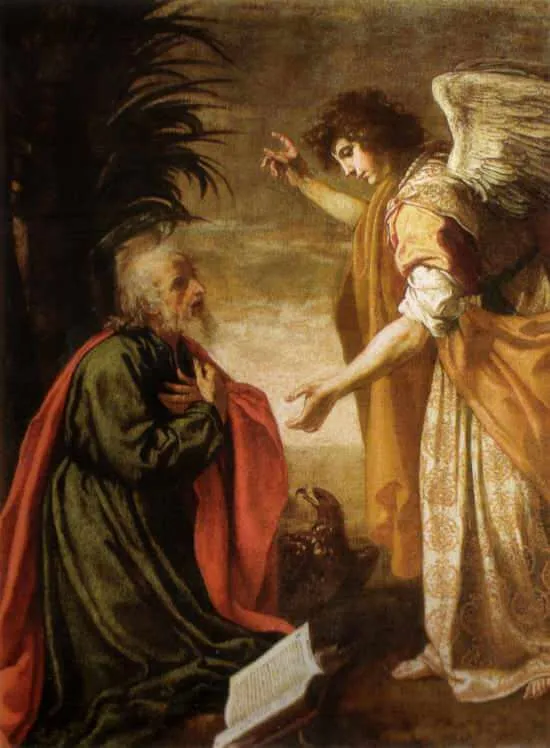
One tradition states that during the reign of Emperor Domitian (81–96), John was arrested and dropped in a boiling cauldron of oil. After he was miraculously unharmed, many witnesses converted to the faith. The emperor then exiled him to the Island of Patmos for a year, which is believed to be where he had mystical visions and wrote those visions down in the Book of Revelation, “I, John, your brother, who share with you the distress, the kingdom, and the endurance we have in Jesus, found myself on the island called Patmos because I proclaimed God’s word and gave testimony to Jesus” (Revelation 1:9).
The Book of Revelation is an apocalyptic text filled with complex and vivid symbolic visions depicting the ultimate battle between good and evil and the triumph of God. It offers messages to seven churches in Asia Minor, presenting prophecies about the end times, the Second Coming of Christ, and the establishment of the New Heavens and New Earth, providing a hopeful and triumphant conclusion to the Christian biblical message.
The three letters attributed to John—1 John, 2 John, and 3 John—focus upon love, truth, and Christian fellowship. John describes God as Love and exhorts the reader to good Christian living. He warns against following false teachers, stresses the importance of following Christ’s teachings, and encourages the work of itinerant preachers and the responsibility of the communities to welcome them.
Today, near Ephesus, there is a pilgrim site called “Meryem Ana Evi” (House of Mary), which is believed to be the house in which John and the Blessed Virgin Mary lived and from which the Mother of God was assumed into Heaven. Another tradition states she was assumed into Heaven near Jerusalem. John lived to an old age, died of natural causes, and was buried near Ephesus in what are today the ruins of Saint John’s Basilica, Selçuk.
John was truly the beloved disciple of Christ, remained so throughout his long earthly life, and will be so forever in Heaven. An ancient story from shortly after Saint John’s death states that at the end of his life, Saint John continuously repeated to his flock, “My little children, love one another.” John’s life can be summed up with love. God is love. We must love God, and we must love one another. Love is everything. Ponder this love that Saint John had for his Lord and pray to him, asking him to intercede for you so that your love of God and others will greatly increase.
Source: https://mycatholic.life/saints/saints-of-the-liturgical-year/27-december-saint-john-the-apostle-and-evangelist–feast