Daily Reflections

Matthew 13:54

Seeing the Greatness of Christ

Jesus came to his native place and taught the people in their synagogue. They were astonished and said, “Where did this man get such wisdom and mighty deeds?”

Reflection:

Today’s Gospel goes on to say that the people in Jesus’ hometown of Nazareth took offense at Him, which led Jesus to say, “A prophet is not without honor except in his native place and in his own house.” It is somewhat surprising that they took offense at Jesus after witnessing His wisdom and mighty deeds. Jesus was very familiar to the townspeople, and it seems that that familiarity led them to doubt that Jesus was someone special.

It should be noted that, in many ways, the people who knew Jesus for many years should have been the first people to see His greatness. And most likely there were some from His hometown who did. They would have known Jesus’ mother, the Blessed Virgin Mary, and she would have given daily witness to incredible virtues. They would have known Joseph as a truly righteous and just man. And Jesus would have exuded every human virtue to perfection as He grew. And again, that should have been easily noticeable. But many failed to see the holiness of Jesus and the Holy Family.

This experience of our Lord should remind us that it is easy to miss the presence of God all around us. If those who were closest to Jesus did not recognize Him as a man of exceptional virtue and holiness, then how much more might we fail to see the presence of God in the lives of those we encounter every day? For some reason, perhaps because of our struggles with pride and anger, it is easier to look at the faults of another than at their virtues. It’s easy to be critical of them and to dwell upon their perceived weaknesses and sins. But this Gospel story should encourage us to do all we can to look beyond the surface and to see God present in every life we encounter.

On the most fundamental level, God dwells within each and every person He has created. Even those who remain in a state of persistent mortal sin are still made in the image of God and reflect God by their very nature. And we must see this. And those who are in a state of grace carry the presence of God, not only within themselves by nature but also through God’s action in their lives. Every virtue that every person has is there because God is at work in them. And we must work to see this divine activity in their lives.

Begin by thinking about the people with whom you are closest. When you think about them, what comes to mind? Over the years, we can build habits of dwelling upon others’ faults. And those habits are hard to break. But they can only be broken by intentionally seeking out the presence of God in their lives. As noted, if Jesus’ own townspeople had a difficult time doing this with Him Who was perfect, then this should tell us that it will be even harder for us to do with those who lack perfection. But it must be done and is a very holy endeavor.

Reflect, today, upon the important mission you have been given to see the presence of God in the lives of those all around you. What if Jesus had grown up in your town? As your neighbor? And though the Incarnate Son of God does not live next door as He did in Nazareth, He does live in each and every person you encounter every day. Honestly reflect upon how well you see Him and commit yourself to the holy mission of seeing Him more clearly so that you can rejoice in His greatness which is truly manifest all around you.

Source: https://catholic-daily-reflections.com/2025/07/31/seeing-the-greatness-of-christ-4/

Matthew 13:54 Read More »

Matthew 13:51-52

Understanding the Voice of God

Do you understand all these things?” They answered, “Yes.” And he replied, “Then every scribe who has been instructed in the Kingdom of heaven is like the head of a household who brings from his storeroom both the new and the old.

Reflection:

At times, Jesus’ words are difficult to understand. How well do you understand what He teaches you? He often teaches in figures of speech, as well as with parables. The passage quoted above concludes a section in which He speaks three subsequent parables. The third of these parables, the parable about the fishnet, is contained in the beginning of today’s Gospel passage. But just prior to that parable are the parables about the pearl of great price and the treasure buried in a field. Upon the conclusion of these three parables, Jesus asked His disciples, “Do you understand all these things?” After they affirmed that they did understand, Jesus gave an overview of the mission to which they had been entrusted. These soon-to-be bishops would become the new scribes who were instructed in the Kingdom of Heaven. Their mission would be to bring forth both the “new and the old.”

Many Church Fathers identify the “new and the old” as a reference to the Old Testament and the New Testament. Thus, the Twelve are being entrusted with the mission of being the scribes of the full revelation contained in what will become the full Bible as we have it today. Other commentators suggest that the “old” refers to the old life of sin and the “new” refers to the new life of grace. It will be the mission of the Twelve to instruct people in the full Gospel message, so as to draw them from their old life of sin to the new life of grace.

Though Jesus’ words can be difficult to understand from the perspective of a biblical scholar, the first of His words quoted above are very straightforward. “Do you understand all these things?” As we ponder that question in particular, try to hear our Lord asking that question of you. Though many scholars and saints of old have offered much clarity on what Jesus’ teachings actually mean, the question that Jesus posed to the Twelve must be answered in a more personal way for each of us. As you hear Jesus ask you if you understand these things, the answer you give is not primarily based upon whether or not you have sufficiently studied the text of His teaching and can rationally explain it as a scholar. Instead, the answer He is seeking is whether or not you can respond from faith. He wants you to say, “Yes, I hear You speaking to me, Lord. Yes, my heart is convicted by the words You have spoken. Yes, I understand what I must do. Yes, Lord, I believe.” The Word of God is alive and can only be “understood” properly when we allow our Living Lord to speak to us, personally, as we listen to His holy Word.

Reflect, today, upon this question that Jesus posed to the Twelve. As you do, hear Him asking you this question. How fully do you understand what God is saying to you, right now at this moment in your life? As you read the Scriptures, do you sense God revealing Himself to you? Do you understand what He wants of you? If hearing the voice of God is a challenge at times, then spend more time prayerfully pondering His holy Word so that His Living Voice will more clearly resonate within your soul.

Source: https://catholic-daily-reflections.com/2025/07/30/understanding-the-voice-of-god-3/

Matthew 13:51-52 Read More »

Matthew 13:44

Discovering the Riches of Heaven

Jesus said to his disciples: “The Kingdom of heaven is like a treasure buried in a field, which a person finds and hides again, and out of joy goes and sells all that he has and buys that field.”

Reflection:

Today’s Gospel presents us with two very short and similar parables. In the first, quoted above, the Kingdom of Heaven is likened to a “treasure.” In the second parable, the Kingdom of Heaven is likened to a “pearl of great price.” Though these parables are very similar to each other, there are also subtle differences worth pondering. It appears that the treasure mentioned in the first parable is discovered almost by accident. The person simply “finds” it. This is in contrast to the second parable, in that the merchant who finds the pearl of great price did so after “searching” for it. 

We often encounter the Treasure of the Gospel without even looking for it. We do so any time God intervenes in our lives without us seeking His intervention. For example, if someone were to offer an act of charity to you without you seeking it out, this is God giving you a treasure of His Kingdom. Or if someone shares with you their faith, or an inspiration they received, this is indeed a treasure given to you by God. The problem is that many times when we are given these treasures of the Gospel, we do not always see them as treasures. Imagine, for example, if the person in this parable were to stumble upon the treasure in the field and fail to open it out of indifference. They see it from a distance, have a bit of curiosity about what is in the box, but they are not energetic enough to actually open the box and look inside. In that case, the person would have no reason to go and sell all that they have so as to buy the field in which the treasure is found.

One clear message that this first parable reveals is that we must be attentive to the countless treasures of God’s graces given to us each and every day. God is so prolific in offering us grace, that we truly do stumble upon His grace all the time. Thus, having eyes to perceive His actions and ears to Hear His Voice is essential.

A second message clearly given in both of these parables is that once we discover the graces God gives us every day, we must foster within ourselves a desire for those graces that is so strong that we are willing to do anything necessary to obtain them. The discovery is made through the gift of faith, but the discovery by faith must then be followed with a zeal that drives our will to conform to that discovery.

Reflect, today, upon two things. First, have you discovered the treasures God has given to you? If you hesitate in answering this, then it’s most likely the case that there is much you have yet to discover. Secondly, as you do discover the riches that come with the gift of faith, then have you allowed that which God has spoken to you to consume you to such a point that you are willing to sell all you have, meaning, do whatever it takes to further accept all God wants to bestow? Resolutely determine to go forth on this holy search and you will find that the riches of grace that you obtain are of infinite value.

Source: https://catholic-daily-reflections.com/2025/07/29/discovering-the-riches-of-heaven-4/

Matthew 13:44 Read More »

John 11:19-22

A Holy and Imperfect Family

Many of the Jews had come to Martha and Mary to comfort them about their brother [Lazarus, who had died]. When Martha heard that Jesus was coming, she went to meet him; but Mary sat at home. Martha said to Jesus, “Lord, if you had been here, my brother would not have died. But even now I know that whatever you ask of God, God will give you.”

Reflection:

Today’s memorial is relatively new within our Church. In the year 2021, Pope Francis replaced the Memorial of Saint Martha with this memorial in honor of all three siblings: Martha, Mary and Lazarus. In commenting on the reason for this new memorial, the Congregation for Divine Worship stated: “Martha generously offered him hospitality, Mary listened attentively to his words, and Lazarus promptly emerged from the tomb at the command of the One who humiliated death.” Furthermore, these three siblings gave an evangelical witness to us all. They model for us how to be Christians within our imperfections. They did this by welcoming Jesus into their home, by listening to Him attentively, and by believing that He is the Resurrection and the Life.

These three siblings each had their own unique personality and loved Jesus in their own way. Though not much is said about Lazarus’ personal interactions with Jesus, we do have some helpful insights into both Martha and Mary. In one Gospel story, Martha complained to Jesus that her sister left her to do all the cooking. Jesus gently corrected her. Mary, on the other hand, gave a witness of deep prayer and love of Jesus by sitting at His feet listening to Him. However, in the story of the raising of Lazarus from the dead, there is a reversal of roles. Martha is the one who runs out to meet Jesus and expresses her deep faith in Him. Mary, on the other hand, heard that Jesus was coming and appeared to stay at home because she was upset.

Perhaps the most helpful way to ponder these siblings is to acknowledge two things. First, they are now saints in Heaven enjoying eternal beatitude and glory. Second, on earth they were people of faith and love, but they were also very clearly imperfect. Therefore, the witness they give to us should be twofold. We hope to share in the glory in which they now share, and we trust this will happen if we also befriend our Lord and welcome Him into our homes, imperfect though we may be.

Reflect, today, upon this holy but imperfect family. The imperfections and manifest weaknesses of these three siblings should encourage us to press on in our practice of the faith when things are not perfect in our lives either. There are many reasons why we might get discouraged or feel like doubting or giving up at times. Perhaps things are not perfect within the Church—or at the particular church you attend. Perhaps you are struggling with loving someone in your family. Perhaps you are struggling with an emotional issue. Perhaps there is some sin you seem to be incapable of overcoming. Perhaps you struggle with a physical ailment and wonder why God permitted it to happen. If you are able to relate to any of these, or any other forms of imperfection, then take inspiration from this family of Martha, Mary and Lazarus. Invite Jesus into the home of your heart, your family home and everywhere you go. He will come, gently correct you when needed, and give you the gift of new life, raising you up from your sins and weaknesses.

Source: https://catholic-daily-reflections.com/2025/07/28/a-holy-and-imperfect-family-3/

John 11:19-22 Read More »

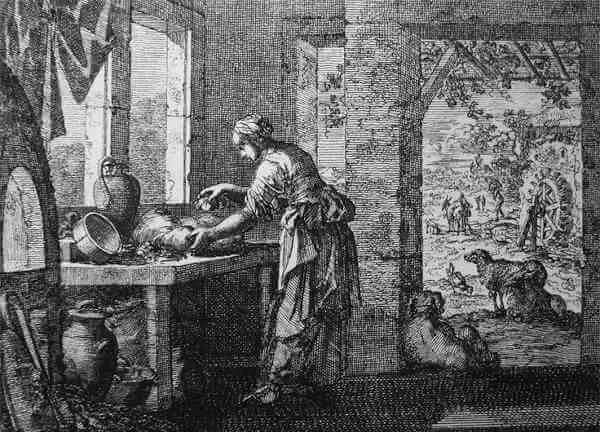
Matthew 13:33

Transformed by Grace

He spoke to them another parable. “The Kingdom of heaven is like yeast that a woman took and mixed with three measures of wheat flour until the whole batch was leavened.”

Reflection:

Yeast is powerful. Though it often accounts for only about 1% of a loaf of bread, it causes that loaf to more than double in size. Of course, it also has the amazing effect of turning the dough soft and flexible as it rises. Without yeast, the dough would remain stiff and much smaller in size. The dough would not become the bread it was meant to be.

The Church Fathers offer many interpretations of this short, one-sentence parable. Some say that the three measures of flour represent the spirit, soul and body into which the Gospel is inserted. Others say the three measures of flour represent either three different kinds of persons or three levels of fruitfulness in our lives. The yeast is understood by some as the message of the Gospel in the Scriptures and by others as charity that must permeate our lives and the world as a whole. Of course, the parables of Jesus, as well as every teaching contained within the Scriptures, offer us many levels of understanding and meaning that are all correct and consistent with each other. One of the most important questions to ponder is this: What does God want to say to you through this parable?

If you consider yourself to be the three measures of flour, and the yeast to be God, His holy Word and His gentle but clear Voice speaking to you, in what concrete ways do you see your life rising as a direct result? How do you see yourself becoming that which you are intended to be as a result of God entering your life? And do you see the effect as one that is truly transforming and even exponential?

Sometimes the Word of God has little to no effect on our lives. That, of course, is not the fault of the Word of God; rather, it’s because we do not allow God to do His transforming work. For yeast to work, the dough has to sit still for a while. So in our lives, for God to do His work, we must allow Him to gently and powerfully work. This process requires that we internalize all that God speaks to us. Then His actions must prayerfully be permitted to work within us, and we must allow the change to be slow and certain in accord with His divine plan.

Sometimes we can also become impatient with the workings of God. Again, the yeast takes time to work. If we are impatient with God’s grace, then it may be like taking the dough and kneading it over and over before it even has a chance to work. But if we are prayerfully patient, allowing God to do His work in our lives according to His will and in His time, then little by little we will experience the transformation that He initiates.

Reflect, today, upon this short but powerful parable. See yourself as that dough and see God and His action in your life as the yeast. As you sit with that image in a prayerful way, let God reveal how He wants to work within you and how He wants to transform you. Pray for patience. Trust that if you receive His transforming Word into your soul, then He will do what He wants to do. And trust that if this happens, you will indeed become the person God wants you to become.

Source: https://catholic-daily-reflections.com/2025/07/27/transformed-by-grace-3/

Matthew 13:33 Read More »

Luke 11:1

Learning to Pray

Jesus was praying in a certain place, and when he had finished, one of his disciples said to him, “Lord, teach us to pray just as John taught his disciples.”

Reflection:

In today’s Gospel we are given three teachings on prayer. First, Jesus teaches His disciples what has come to be called “The Lord’s Prayer.” Second, He teaches about the importance of persistence in prayer. Third, He teaches about the fruit that comes from correct and persistent prayer.

The Church Father Tertullian said that The Lord’s Prayer “is truly the summary of the whole Gospel.” Saint Augustine said, “Run through all the words of the holy prayers [in Scripture], and I do not think that you will find anything in them that is not contained and included in the Lord’s Prayer.” Saint Thomas Aquinas said, “The Lord’s Prayer is the most perfect of prayers…. In it we ask, not only for all the things we can rightly desire, but also in the sequence that they should be desired” (See the Catechism of the Catholic Church #2761–2763).

It’s amazing to consider what these great teachers of the faith have said about this short prayer. Perhaps because of our familiarity with this prayer we can easily gloss over the depth of its meaning. We can fail to use it as a foundation and model for all of our prayer. One way to correct this tendency is to use The Lord’s Prayer for an extended period of time by prayerfully pondering every word slowly and meditatively. Doing so will help open us up to these perfect “instructions” on how we should pray.

Immediately after Jesus taught this short prayer, He taught a lesson about persistence in prayer. He taught that we must not simply say a few prayers and leave it at that, giving up if they do not appear to be answered. Instead, we must continuously beg God for His grace until it is bestowed in its fullness.

What will we receive from persistent prayer? This is an important point. We ought not go to God with our own wants and desires. We ought not beg Him for things that do not fall within His perfect will. Instead, when our prayer is modeled on the Lord’s Prayer, and when it is persistent and grounded in faith, then our prayer will be for what the Father bestows upon us, that is His will alone. We must pray that His Kingdom will come. We must trust that He will provide for our needs. We must seek His forgiveness for our sins, and we must pray that He will protect us from the evil one.

Reflect, today, upon that perfect prayer, The Lord’s Prayer. Spend time studying it, thinking about each petition, the order in which Jesus laid it out, its simplicity and its clarity. Acknowledge that because we pray The Lord’s Prayer so often, we can sometimes miss its true meaning and beauty. Our Lord gave us this prayer for a reason. Make sure that you do all you can to discover its meaning and practice its teaching.

Source: https://catholic-daily-reflections.com/2025/07/26/learning-to-pray/

Luke 11:1 Read More »

Matthew 13:24-25

Vigilance with the Gospel

Jesus proposed a parable to the crowds. “The Kingdom of heaven may be likened to a man who sowed good seed in his field. While everyone was asleep his enemy came and sowed weeds all through the wheat, and then went off.”

Reflection:

This parable begins in a very good way. It states that good seed was sown. In other words, the pure Gospel was preached into good soil. This should be understood as any situation where the preacher is truly effective and where the Gospel reaches many ears and is planted in many hearts. This is worth rejoicing over. But this parable quickly points out that those responsible for guarding the good soil in which the Word of God was planted, failed in their duty to protect it. As a result, the “enemy came and sowed weeds all through the wheat.” In other words, the evil one also had sown his lies into the hearts of those who heard the Word of God, and those lies took root and began to grow.

This is a clear description of the world we live in today. First, it’s a description of the hearts of many Christians who have heard the Word of God and have responded, only to also struggle with doubts, confusions and lies sown by the evil one. But it is also a clear description of the world as a whole and even of the Church on earth. There are many divisions within societies and even within the Church. There are many competing voices. And among those whose hearts are good soil, it can be hard to distinguish between that which is from God and that which is a subtle deception from the evil one.

The weed referred to in this parable is called cockle. Cockle was a weed that, as it grew, looked much like wheat. It was very difficult to distinguish from wheat until the grain began to appear. But when the grain did begin to appear, it was clearly distinguishable. And if the cockle were to accidentally be ground in with the wheat, it would cause nausea when eaten.

The parable is quite clear. The lies that the evil one sows in the hearts of the faithful, those with fertile hearts, are very subtle, especially at first. It is easy for those subtle lies to confuse us. The evil one rarely succeeds in misleading the faithful through grave and obvious errors. Therefore, he deceives with small errors. As a result, the error is often not understood until much later as the fruit is born. The result is division, confusion, conflict and the like—conflict within our own souls, within our world and even within our Church.

What is the solution? Vigilance. We, as followers of Christ, must be exceptionally vigilant in regard to that which we allow our hearts to receive. Just because something sounds good at first doesn’t make it good. This is why we have the Scripture, the Magisterium of the Church and the teachings of the saints. We must constantly examine all that we allow into our hearts, our families, our world and our churches in the light of the pure and consistent teachings of our faith. And when we see divisions, this is a clear sign of some subtle error that has crept in. In the end, at the harvest time, when we all face Christ our Lord at our judgments, He will separate the good from the bad. But for our part, vigilance is essential so that only the pure seed of God’s Word is received by us and sown by us.

Reflect, today, on your own soul as fertile ground. What “seed” is sown there? What do you allow to penetrate your heart and take root? Are you vigilant, remaining attentive to the ways that the evil one tries to mislead you through subtle lies and errors? Ponder these questions honestly, and if you find conflict and confusion in your life, look more deeply at the source of these troubles. If there are lies that you have allowed into your own life, then turn them over to our Lord so that He can remove them at the proper time.

Source: https://catholic-daily-reflections.com/2025/07/25/vigilance-with-the-gospel-2/

Matthew 13:24-25 Read More »

Matthew 20:22-23

The Path to the Kingdom

“You do not know what you are asking. Can you drink the chalice that I am going to drink?” They said to him, “We can.” He replied, “My chalice you will indeed drink, but to sit at my right and at my left, this is not mine to give but is for those for whom it has been prepared by my Father.”

Reflection:

Saint James was the brother of the beloved disciple John and the son of Zebedee and Salome. Jesus called both James and John while they were working with their father, mending their fishing nets in their boat. Their response to Jesus’ call was immediate: “…they left their father Zebedee in the boat along with the hired men and followed him” (Mark 1:20). James was present at the raising of Jarius’ daughter, the Transfiguration, and is mentioned a few other times in the Gospels. In the Acts of the Apostles, James is identified as the first of the Apostles to give his life as a martyr, being beheaded by Herod in Jerusalem in the year 44 AD (See Acts 12:2).

Among the other references to Saint James in the Gospels is the passage quoted above in which Salome, the mother of James and John, asks Jesus for the unique favor of allowing her two sons to sit at His left and right in His Kingdom. Upon her request on behalf of her two sons, Jesus turns to them and asks if they can drink the chalice that He is going to drink, to which they respond, “We can.” And though this is a bold request on their parts and that of their mother, there is also something courageous and holy about their request.

Just prior to this passage, as Jesus journeyed to Jerusalem with the Twelve, He explained to them the fate that awaited Him. “Behold, we are going up to Jerusalem, and the Son of Man will be handed over to the chief priests and the scribes, and they will condemn him to death, and hand him over to the Gentiles to be mocked and scourged and crucified, and he will be raised on the third day” (Matthew 20:18–19). This was the third time that Jesus explained this to the Twelve and, therefore, it must have started to truly sink in. It is within this context that James and John ask to remain close to Jesus in His mission of establishing His Kingdom, even though Jesus explained that the path to that Kingdom was His suffering and death.

Each of us should learn from James and John. Though their request might have had some selfishness mixed in with it, it was also courageous. It showed they did not fear Jesus’ prediction of His passion. Instead, they wanted to be part of it and were willing to endure whatever was necessary so as to share in the glory of the Kingdom to come.

Reflect, today, upon making a similar request to our Lord. Say to Him that you desire to be close to Him in His Kingdom, and do so with the full knowledge that the path to this glory is by drinking the chalice of selfless sacrifice that Christ drank. It is obtained by courageously following Him, no matter what that requires of you. If that means suffering and persecution, so be it. If that means great sacrifice, so be it. If that means abandoning certain hopes and dreams, so be it. See yourself walking with these disciples and Jesus on the road to Jerusalem where our Lord would offer His life in sacrifice. Saint James would soon follow, dying by the sword of Herod. Say “Yes” to whatever our Lord asks of you and commit yourself to the drinking of the chalice of selfless sacrificial love. Doing so will enable you to share in the glory of the Kingdom of Heaven.

Source: https://catholic-daily-reflections.com/2025/07/24/the-path-to-the-kingdom-3/

Matthew 20:22-23 Read More »

Matthew 13:16-17

Blessed Beyond Measure

But blessed are your eyes, because they see, and your ears, because they hear. Amen, I say to you, many prophets and righteous people longed to see what you see but did not see it, and to hear what you hear but did not hear it.

Reflection:

Imagine what it would have been like if you were among those who saw Jesus walk the earth and heard Him preach with your own ears. What a gift! Jesus points out to His closest disciples that they were truly blessed, and indeed they were. They spent day after day with Him, listening to His words and witnessing His miracles. They saw lives changed, hearts converted and souls saved from sin. What they were privileged to witness was what so many “righteous people” before them longed to see and hear. Abraham, Moses, all of the prophets and so many others longed for the day of the coming of the Messiah. And these disciples were blessed to share in it.

Though it would have been glorious to be alive as Jesus walked the earth, in so many ways we are far more blessed. Today, we continue to have the divine presence of our Lord alive and present to us. First and foremost, He is present to us through grace. He is present in the Sacraments in a real and amazing way. He is present in His Living Word every time the Scriptures are proclaimed. He is present in the definitive teachings of the Church that have come to us over the centuries. He is alive in the witness of the saints both past and living. And He is present within us by His indwelling in our souls.

At first, some may conclude that the presence of the Messiah in these above-mentioned ways is not nearly as much of a blessing as it would have been to have seen Him walk the earth and have listened to Him preach. But if we were to conclude this, we would be wrong. In truth, God’s presence to us today is so much greater than even when He walked the earth. Recall, for example, that before Jesus ascended into Heaven, He told the disciples that it was good that He go. Why? Because then the Holy Spirit would come upon them. In that encounter, God would dwell not only next to them but within them. Today, we are blessed beyond measure because God is able to live within us, within our very souls.

The Indwelling of the Holy Trinity is a spiritual reality that we must not only understand, live and embrace, it is also a gift for which we must have the utmost gratitude. Certainly in Heaven, we will receive the full revelation of God, enter into perfect union with Him and see Him face-to-face. But while here on earth, there is no time greater than the time we live in, because it is the time of the greatest presence of God in our world.

Reflect, today, upon the incredible blessings bestowed upon you by our Lord. Too often we seek satisfaction in momentary and passing things. But God’s presence in His holy Word, in the Sacraments, through the teachings of the Church, through the witness of the saints and through His indwelling within our souls are blessings that must be seen, understood and embraced with the utmost joy. You are blessed beyond measure! Believe it and grow in gratitude for these blessings.

Source: https://catholic-daily-reflections.com/2025/07/23/blessed-beyond-measure-2/

Matthew 13:16-17 Read More »

Matthew 13:1-3

Speaking in Parables

On that day, Jesus went out of the house and sat down by the sea. Such large crowds gathered around him that he got into a boat and sat down, and the whole crowd stood along the shore. And he spoke to them at length in parables…

Reflection:

Why did Jesus speak in parables? In today’s Gospel, Jesus goes on to teach the familiar “Parable of the Sower.” Immediately after that parable in today’s Gospel, the disciples do ask Jesus this question. They ask, “Why do you speak to them in parables?” Jesus responds to them, “Because knowledge of the mysteries of the kingdom of heaven has been granted to you, but to them it has not been granted.” So why is that?

First of all, a story is easy to listen to. It keeps our attention and is easily remembered. In the “Parable of the Sower” that we hear today, Jesus explains that the seed sown by the sower falls either on the path, on rocky ground, among thorns, or on rich soil. This is a very visible description that will lead people to conclusions right away. Everyone knows that the ideal place for seed to be sown is rich soil. And everyone knows that the seed sown on the path, rocky ground and among thorns has little hope of producing fruit. Therefore, this parable easily draws the listener in so as to understand some basic lessons.

With that said, this story will only become a parable if the deeper lesson is learned. Clearly, Jesus wanted the crowd to understand that they will only understand the mysteries He is teaching them if they are like the rich soil. And He also wanted them to understand that much of what He was teaching them was not falling on rich soil in their hearts.

This parable, as well as all of Jesus’ parables, has the effect of causing the listener to think. Thinking leads to what we may term a holy curiosity. And this holy curiosity will begin to produce the rich soil that was needed within them so as to open the door to the deeper mysteries of the Kingdom of Heaven.

How does Jesus speak to you? Are you able to listen to Jesus speak directly to you, in prayer, so as to reveal to you the deepest mysteries of Heaven? When God speaks to you, in prayer and meditation, does the seed of His Word take root in your very soul? Does His gentle, quiet but transforming Voice communicate to you Who He is and what His will is for your life? If not, then parables are for you. And knowing that is an important discovery.

Reflect, today, upon the desire of God to speak to you. If you do struggle with hearing the clear and profound Voice of God resonate within your soul, then do not be afraid to spend time with the many parables that Jesus told. Try to place yourself within the scene. See yourself as a participant. In today’s parable, see your inner self as the field. Think about those things in your life that keep your soul from being rich soil. Allow this story of Jesus to speak to you. As you do, be attentive to God’s Voice. Listen for Him and listen to Him. And as you do hear Him, know that the seed He has scattered has begun to reach that rich soil of your heart.

Source: https://catholic-daily-reflections.com/2025/07/22/speaking-in-parables-4/

Matthew 13:1-3 Read More »