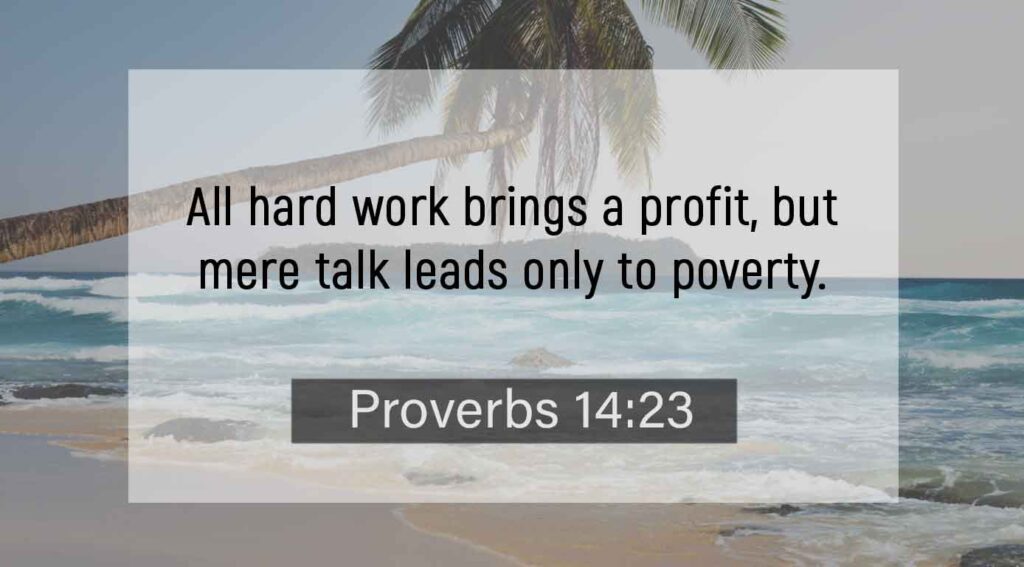

“All hard work brings a profit, but mere talk leads only to poverty.” - Proverbs 14:23
May the offering of our service and the prayer of the blessed Archangel Gabriel be acceptable in Thy sight, O Lord; that he whom we venerate on earth, may be our advocate before Thee in heaven. Through Our Lord. Amen.
Original Version of the Prayer: https://www.catholic.org/prayers/prayer.php?p=9
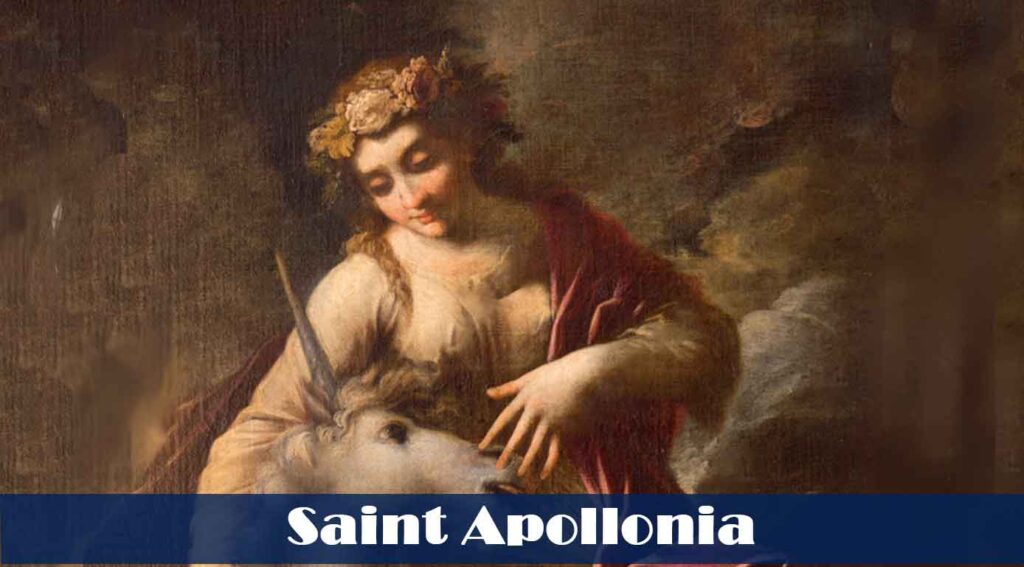
The persecution of Christians began in Alexandria during the reign of the Emperor Philip. The first victim of the pagan mob was an old man named Metrius, who was tortured and then stoned to death. The second person who refused to worship their false idols was a Christian woman named Quinta. Her words infuriated the mob and she was scourged and stoned.
While most of the Christians were fleeing the city, abandoning all their worldly possessions, an old deaconess, Apollonia, was seized. The crowds beat her, knocking out all of her teeth. Then they lit a large fire and threatened to throw her in it if she did not curse her God. She begged them to wait a moment, acting as if she was considering their requests. Instead, she jumped willingly into the flames and so suffered martyrdom.
There were many churches and altars dedicated to her. Apollonia is the patroness of dentists, and people suffering from toothache and other dental diseases often ask her intercession. She is pictured with a pair of pincers holding a tooth or with a golden tooth suspended from her necklace. Saint Augustine explained her voluntary martyrdom as a special inspiration of the Holy Spirit, since no one is allowed to cause his or her own death.
https://www.franciscanmedia.org/saint-of-the-day/saint-apollonia/
“And he has given us this command: Anyone who loves God must also love their brother and sister.” - 1 John 4:21
O God of goodness and mercy, to Thy fatherly guidance we commend our family, our household and all our belongings. We commit all to Thy love and keeping; do Thou fill this house with Thy blessings even as Thou didst fill the holy House of Nazareth with Thy presence.
Keep far from us, above all else, the blemish of sin, and do Thou alone reign in our midst by Thy law, by Thy most holy love and by the exercise of every Christian virtue. Let each one of us obey Thee, love Thee and set himself to follow in his own life Thine example, that of Mary, Thy Mother and our Mother most loving, and that of Thy blameless guardian, Saint Joseph.
Protect us and our house from all evils and misfortunes, but grant that we may be ever resigned to Thy divine will even in the sorrows which it shall please Thee to send us. Finally give unto all of us the grace to live in perfect harmony and in the fullness of love toward our neighbor. Grant that every one of us may deserve by a holy life the comfort of Thy holy Sacraments at the hour of death. O Jesus, bless us and protect us.
O Mary, Mother of grace and of mercy, defend us against the wicked spirit, reconcile us with Thy Son, commit us to His keeping, that so we may be made worthy of His promises.
Amen.
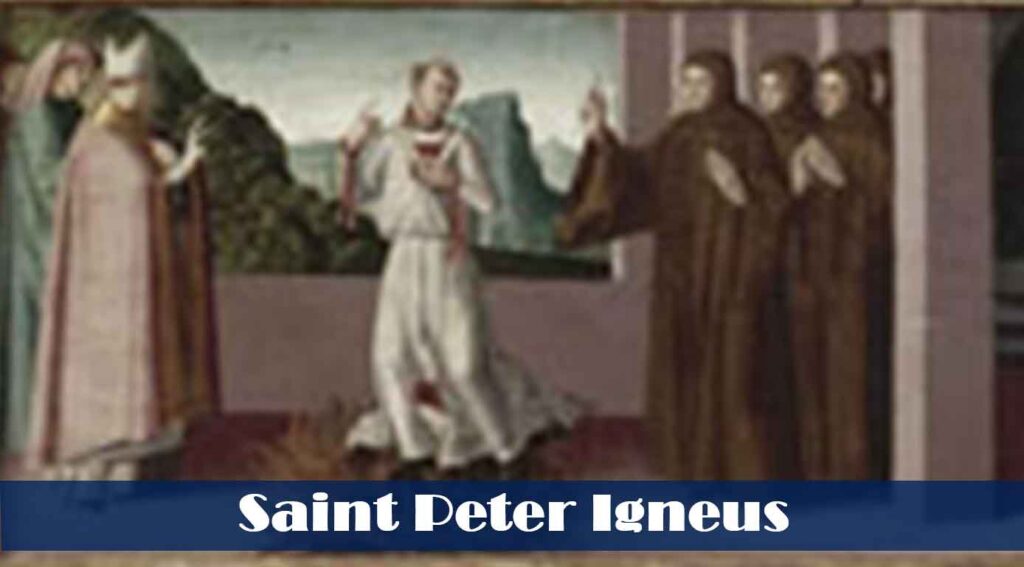
Saint Peter Igneus, also known as Pietro Igneo, was born to a noble family in Florence. He entered the Order of Saint Benedict in 1018 as a monk.
Igneo soon became the abbot for San Salvatore in Fucecchio and he held that position until 1081. In 1072 he was designated as a cardinal and Pope Alexander II named him Cardinal-Bishop of Albano.
He cooperated with Pope Gregory VII to repress simony and reform church discipline. Gregory VII entrusted him with several important missions: in 1079 he served as a papal legate in the German kingdom with the Bishop of Padua to mediate between the Emperor Henry IV and Rudolf of Swabia. Igneo served as a co-consecrator for the episcopal consecration of the new Pope Victor III in 1087. He participated in the conclaves held in 1086 and in 1088.
He is often referred to as a member of the Aldobrandini house but this familiar denomination is not attested in sources as a fact. He died on 11 November 1089.
https://en.wikipedia.org/wiki/Peter_Igneus
"Blessed Peter Igneus". Santi e Beati. Retrieved 25 September 2017.
Miranda, Salvador. "ALDOBRANDINI, O.S.B.Vall., Pietro Igneo (?-1089)". The Cardinals of the Holy Roman Church. Florida International University. OCLC 53276621.
"Blessed Peter Igneus". Saints SQPN. 10 December 2012
Weber, Nicholas. "Blessed Peter Igneus." The Catholic Encyclopedia Vol. 11. New York: Robert Appleton Company, 1911
Saint Peter Igneus Read More »
“Therefore go and make disciples of all nations, baptizing them in the name of the Father and of the Son and of the Holy Spirit, and teaching them to obey everything I have commanded you. And surely I am with you always, to the very end of the age.” - Matthew 28:19-20
O dear Jesus,
I humbly implore You to grant Your special graces to our family.
May our home be the shrine of peace, purity, love, labor and faith.
I beg You, dear Jesus,
to protect and bless all of us,
absent and present,
living and dead.
O Mary,
loving Mother of Jesus,
and our Mother,
pray to Jesus for our family,
for all the families of the world,
to guard the cradle of the newborn,
the schools of the young and their vocations.
Blessed Saint Joseph,
holy guardian of Jesus and Mary,
assist us by your prayers in all the necessities of life.
Ask of Jesus that special grace which He granted to you,
to watch over our home at the pillow of the sick and the dying,
so that with Mary and with you,
heaven may find our family unbroken in the Sacred Heart of Jesus.
Amen.
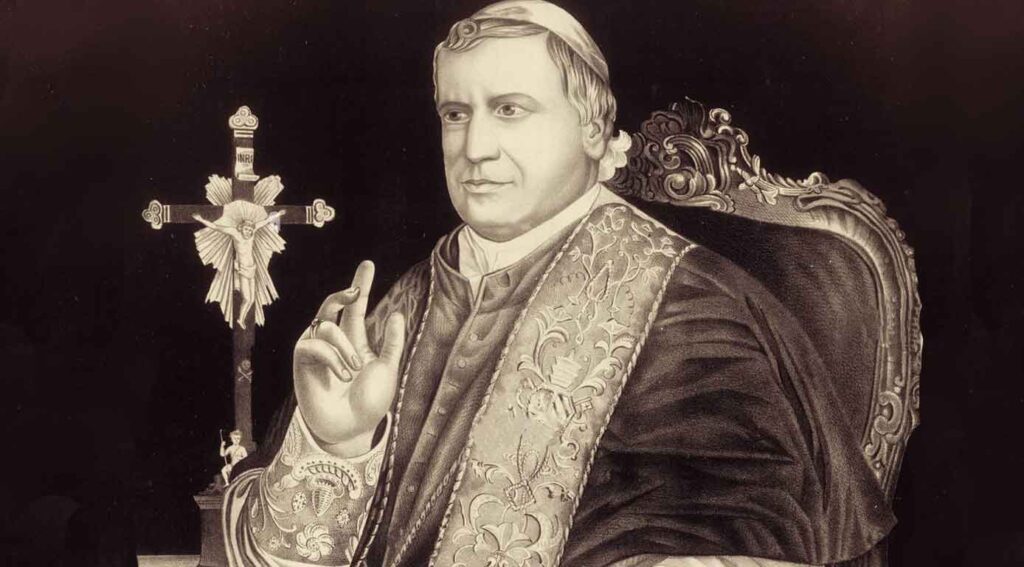
Born as Giovanni Maria Mastai Ferretti, Pope Pius IX was the ninth child born into the noble family of Girolamo dai Conti Ferretti (1750–1833) and Caterina Antonia Maddalena Solazzei di Fano (1764–1842).
Pope Pius IX had been the first future pope ever to have been in America. Upon his return to Rome, the successor of Pius VII, Pope Leo XII, appointed him head of the hospital of San Michele in Rome (1825–1827) and canon of Santa Maria in Via Lata. Pope Leo XII appointed the 35-year-old Mastai Ferretti Archbishop of Spoleto in 1827.
He was head of the Catholic Church from 1846 to 1878, the longest verified papal reign. He was notable for convoking the First Vatican Council in 1868 and for permanently losing control of the Papal States in 1870 to the Kingdom of Italy. Thereafter, he refused to leave Vatican City, declaring himself a “prisoner of the Vatican”
He centralized power in the church in the Holy See and Roman Curia, while also clearly defining the Pope’s doctrinal authority. His chief legacy is the dogma of papal infallibility. Pope John Paul II beatified him in 2000.
https://www.franciscanmedia.org/saint-of-the-day/saint-adrian-of-canterbury/

“Blessed is the one who does not walk in step with the wicked or stand in the way that sinners take or sit in the company of mockers.” - Psalm 1:1
Glorious St. Joseph,
model of all those who are devoted to labour,
obtain for me the grace to work conscientiously,
putting the call of duty above my many sins;
to work with thankfulness and joy,
considering it an honour to employ and develop,
by means of labour,
the gifts received from God;
to work with order,
peace, prudence and patience,
never surrendering to weariness or difficulties;
to work, above all,
with purity of intention,
and with detachment from self,
having always death before my eyes
and the account which I must render of time lost,
of talents wasted,
of good omitted,
of vain complacency in success
so fatal to the work of God.
All for Jesus,
all for Mary,
all after thy example,
O Patriarch Joseph.
Such shall be my motto in life and death.
Amen.
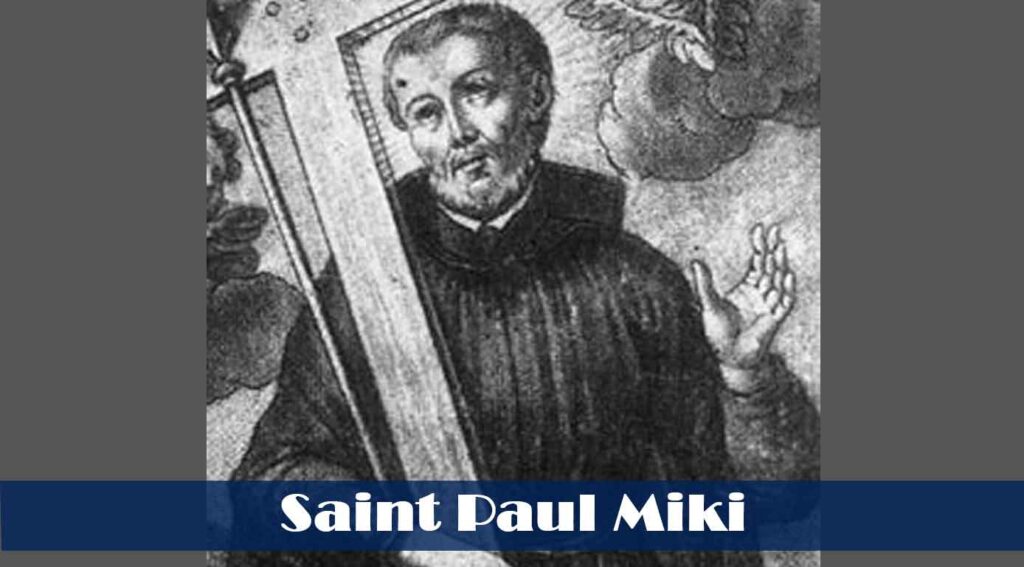
Nagasaki, Japan, is familiar to Americans as the city on which the second atomic bomb was dropped, immediately killing over 37,000 people. Three and a half centuries before, 26 martyrs of Japan were crucified on a hill, now known as the Holy Mountain, overlooking Nagasaki. Among them were priests, brothers, and laymen, Franciscans, Jesuits, and members of the Secular Franciscan Order; there were catechists, doctors, simple artisans, and servants, old men and innocent children—all united in a common faith and love for Jesus and his Church.
Brother Paul Miki, a Jesuit and a native of Japan, has become the best known among the martyrs of Japan. While hanging upon a cross, Paul Miki preached to the people gathered for the execution: “The sentence of judgment says these men came to Japan from the Philippines, but I did not come from any other country. I am a true Japanese. The only reason for my being killed is that I have taught the doctrine of Christ. I certainly did teach the doctrine of Christ. I thank God it is for this reason I die. I believe that I am telling only the truth before I die. I know you believe me and I want to say to you all once again: Ask Christ to help you to become happy. I obey Christ. After Christ’s example I forgive my persecutors. I do not hate them. I ask God to have pity on all, and I hope my blood will fall on my fellow men as a fruitful rain.”
When missionaries returned to Japan in the 1860s, at first they found no trace of Christianity. But after establishing themselves they found that thousands of Christians lived around Nagasaki and that they had secretly preserved the faith. Beatified in 1627, the martyrs of Japan were finally canonized in 1862.
https://www.franciscanmedia.org/saint-of-the-day/saint-paul-miki-and-companions/
Now the Lord is the Spirit, and where the Spirit of the Lord is, there is freedom.” - 2 Corinthians 3:17
Most Holy and Adorable Trinity, one God in three Persons, I firmly believe that You are here present; I adore You with the most profound humility; I praise You and give You thanks with all my heart for the favors You have bestowed on me. Your Goodness has brought me safely to the beginning of this day. Behold, O Lord, I offer You my whole being and in particular all my thoughts, words and actions, together with such crosses and contradictions as I may meet with in the course of this day. Give them, O Lord, Your blessing; may Your divine Love animate them and may they tend to the greater honor and glory of Your Sovereign Majesty. Amen.
2 Corinthians 3:17 Read More »
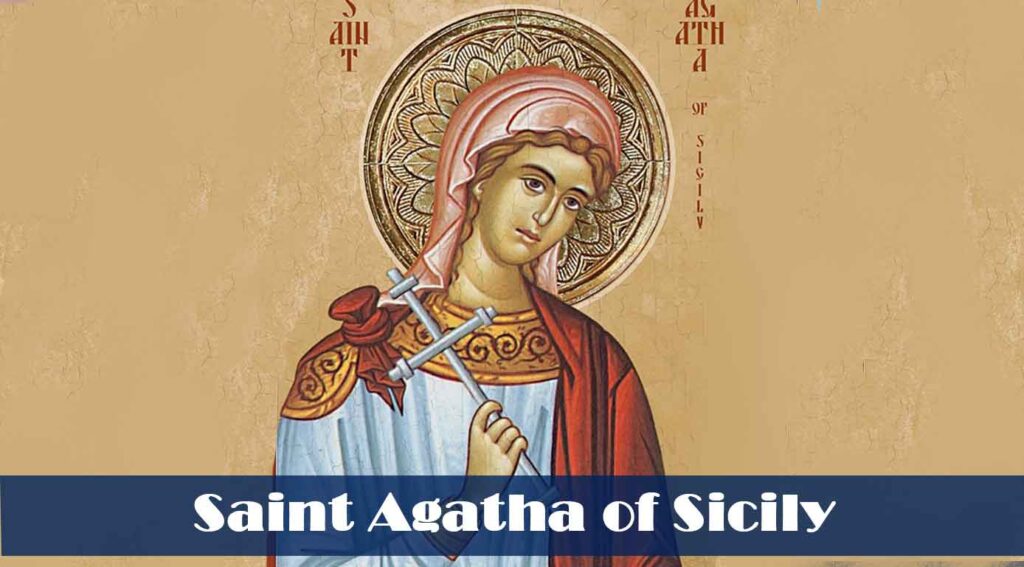
Saint Agatha of Sicily is one of several virgin martyrs who are commemorated by name in the Canon of the Mass. She is one of the most highly venerated virgin martyrs of Christian antiquity.
According to the 13th-century Golden Legend (III.15) by Jacobus de Voragine, 15-year-old Agatha, from a rich and noble family, made a vow of virginity and rejected the amorous advances of the Roman prefect Quintianus, who thought he could force her to turn away from her vow and marry him. His persistent proposals were consistently spurned by Agatha. This was during the persecutions of Decius, so Quintianus, knowing she was a Christian, reported her to the authorities. Quintianus himself was governor of the district.
Agatha died in prison, probably in the year 251 according to the Legenda Aurea. Agatha is the patron saint of Catania, Molise, Malta, San Marino, Gallipoli in Apulia, and Zamarramala, a municipality of the Province of Segovia in Spain. She is also the patron saint of breast cancer patients, martyrs, wet nurses, bell-founders, and bakers, and is invoked against fire, earthquakes, and eruptions of Mount Etna.
https://en.wikipedia.org/wiki/Agatha_of_Sicily
D'Arrigo, Santo. Il Martirio di Santa Agata (Catania) 1985
Delaney, John P. (1980). Dictionary of Saints (Second ed.). Garden City, NY: Doubleday. ISBN 0-385-13594-7.
Saint Agatha of Sicily Read More »
Add San Jose Filipino Ministry as a new recipient, Send your donation using"donate@dosjfm.org"
Payable to - San Jose Filipino Ministry
Address - Poong Jesus Nazareno Filipino Catholic Center (PJNFCC); 3700 W. Orange Ave., Anaheim CA 92804
Poong Jesus Nazareno Filipino Catholic Center (PJNFCC); 3700 W. Orange Ave., Anaheim CA 92804
Phone: (657) 214-2507
Mobile (657) 208-2038
info@dosjfm.org

Poong Jesus Nazareno Filipino Catholic Center (PJNFCC); 3700 W. Orange Ave., Anaheim CA 92804
Phone: (657) 214-2507
Mobile (657) 208-2038
info@dosjfm.org
Add San Jose Filipino Ministry as a new recipient, Send your donation using"donate@dosjfm.org"
Payable to - San Jose Filipino Ministry
Address - 1235 S Magnolia Ave
Anaheim, CA 92804-5115
San Jose Filipino Ministry. All rights reserved. 2021 © Powered by Phoenix Virtual Solutions
Sponsored by EverClear Hospice and Palliative Care