Author name: sanjose

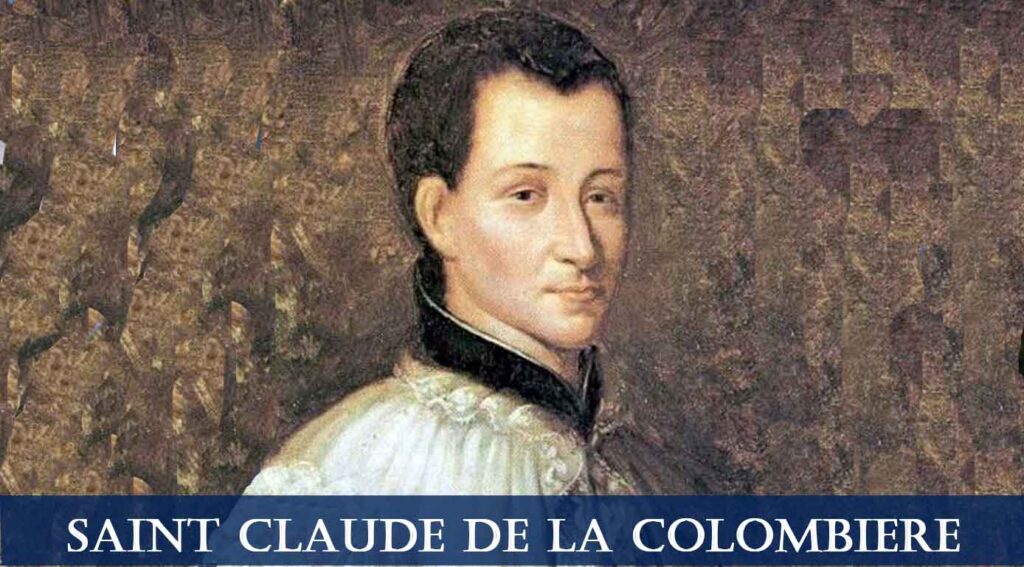
Saint Claude de la Colombiere

This is a special day for the Jesuits, who claim today’s saint as one of their own. It’s also a special day for people who have a special devotion to the Sacred Heart of Jesus—a devotion Claude de la Colombière promoted along with his friend and spiritual companion, Saint Margaret Mary Alacoque. The emphasis on God’s love for all was an antidote to the rigorous moralism of the Jansenists, who were popular at the time.

Saint Claude de la Colombière was a Jesuit priest. He was born in 1641 in the city of Saint-Symphorien-d’Ozon. In 1658, at the age of seventeen, Colombière entered the novitiate of the Society of Jesus at Avignon. When he completed the two-year novitiate, he started his higher studies in the same city. He was professed there and completed his studies. After this he spent the next five years of his regency teaching grammar and literature at the same school.

In 1676 Colombière was sent to England as preacher to Mary of Modena, then the Duchess of York, wife of the future King James II of England. He took up residence at the Court of St. James, where he still observed all his religious duties as a member of the Society. He was also as active a preacher and confessor in England as he had been in France. In November 1678, while awaiting a recall to France, he was suddenly arrested and thrown into prison, denounced as being a part of the Popish Plot alleged by Titus Oates against the English throne.

Thanks to his position at the Royal Court and to the protection of the King of France, Louis XIV, whose subject he was, he escaped death but was expelled from England in 1679. He returned to France with his health ruined by his imprisonment.

Sources:

https://en.wikipedia.org/wiki/Claude_La_Colombi%C3%A8re
www.catholicnewsagency.com.
"St. Claude La Colombiere, SJ (1641-1682)". Ignatian Spirituality
Vatican News Service
https://www.franciscanmedia.org/saint-of-the-day/saint-claude-de-la-colombiere/

Saint Claude de la Colombiere Read More »
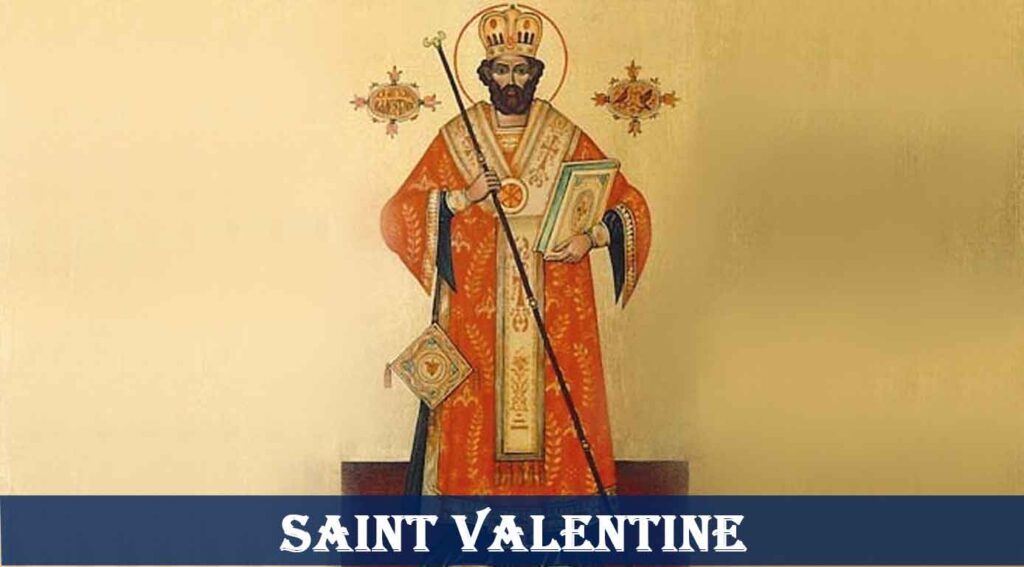
Saint Valentine

Saint Valentine was a 3rd-century Roman saint. He was a clergyman in the Roman Empire who ministered to persecuted Christians.

He was martyred and his body buried at a Christian cemetery on the Via Flaminia on February 14. Relics of him were kept in the Church and Catacombs of San Valentino in Rome, which “remained an important pilgrim site throughout the Middle Ages until the relics of St. Valentine were transferred to the church of Santa Prassede during the pontificate of Nicholas IV”.

The Roman Catholic Church continues to recognize him as a saint, listing him as such in the February 14 entry in the Roman Martyrology, and authorizing liturgical veneration of him on February 14 in any place where that day is not devoted to some other obligatory celebration, in accordance with the rule that on such a day the Mass may be that of any saint listed in the Martyrology for that day.

Saint Valentine Read More »

Deuteronomy 8:6

Verse:

“Observe the commands of the Lord your God, walking in obedience to him and revering him.” - Deuteronomy 8:6

Prayer to Saint Valentine

Dear Lord, who art high in the Heavens,
Giver of Love and Passion,
And He who strings the heart s cords,
Lead the Lovers this day, February ten plus four.
The day during the month of two,
When the date is the perfect number of God
Greater two souls and two hearts.
Some Loves are fleeting ,
But that which is built on you will never fail.
So guide the Lovers to know what is to be.
Your truths the Lovers mouths should speak,
For Your truth is that which is honest to the heart.
Only this, then, should pass over the red lips of the Lovers.
Your art, the Lovers simply a medium.
It is only with True Hearts that You can create a Masterpiece,
So let the Lovers remember that their Soul s Desire
Is the one for which You light their Fire.
And let it be You who creates the Art of the Lovers;
The art of two into one.

Amen.

Deuteronomy 8:6 Read More »

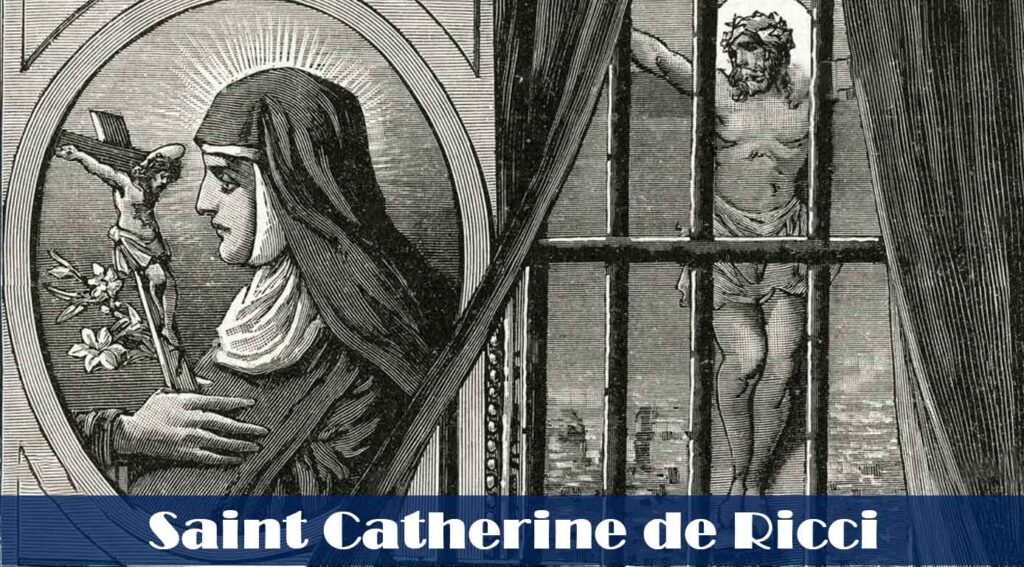
Saint Catherine de Ricci

Born as Alessandra Lucrezia Romola de’ Ricci in Florence, Saint Catherine de Ricci was an Italian Dominican Tertiary sister. She is believed to have had miraculous visions and corporeal encounters with Jesus, both with the infant Jesus and with the adult Jesus. She is said to have spontaneously bled with the wounds of the crucified Christ. She is venerated for her mystic visions and is honored as a saint by the Catholic Church.

She was a very prayerful person from a very young age. There she developed a lifelong devotion to the Passion of Christ. Saint Catherine de Ricci’s period of novitiate was a time of trial. She would experience ecstasies during her routine, which caused her to seem asleep during community prayer services, dropping plates and food, so much so that the community began to question her competence, if not her sanity. Eventually the other Sisters became aware of the spiritual basis for her behavior. By the age of 30 she had risen to the post of prioress.

It is claimed that de’ Ricci’s meditation on the Passion of Christ was so deep that she spontaneously bled, as if scourged. She also bore the Stigmata. During times of deep prayer, like Catherine of Siena, her patron saint, a coral ring representing her marriage to Christ appeared on her finger.

Saint Catherine de Ricci lived in the convent until her death in 1590 after a prolonged illness.

Saint Catherine de Ricci Read More »

Psalm 16:1

Verse:

“Keep me safe, my God, for in you I take refuge.” - Psalm 16:1

Prayer against Depression

O Christ Jesus,
when all is darkness
and we feel our weakness and helplessness,
give us the sense of Your presence,
Your love, and Your strength.
Help us to have perfect trust
in Your protecting love
and strengthening power,
so that nothing may frighten or worry us,
for, living close to You,
we shall see Your hand,
Your purpose, Your will through all things.

By Saint Ignatius of Loyola

Psalm 16:1 Read More »

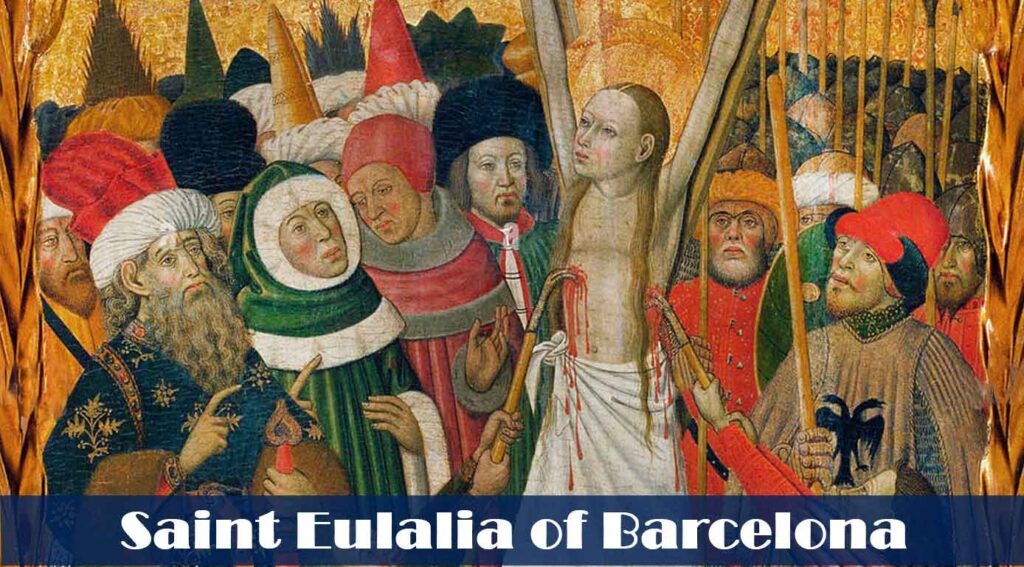
Saint Eulalia of Barcelona

Saint Eulalia was the daughter of a noble family that lived near the city of Barcelona. She was a 13-year-old Roman Christian virgin who was martyred in Barcelona during the persecution of Christians in the reign of emperor Diocletian.

She lived during the persecutions under Diocletian. Eulalia left her home, entered the city and confronted the governor for his merciless persecution of Christians. Unable to dismiss the eloquent arguments of a young girl, Dacian soon had Eulalia stripped nearly naked and flagellated, which was followed by bloodier tortures that were not to cease unless she admitted the error of her ways. Resisting to the end, she prayed that God would take her to Heaven, and died of her wounds.

She is the co-patron saint of Barcelona.

Sources:

https://en.wikipedia.org/wiki/Eulalia_of_Barcelona
https://en.wikipedia.org/wiki/Catholic_Encyclopedia
Saint of the Day, February 12: Eulalia of Barcelona Archived 2017-09-25 at the Wayback Machine at SaintPatrickDC.org

Saint Eulalia of Barcelona Read More »

Matthew 18:15

Verse:

“If your brother or sister sins, go and point out their fault, just between the two of you. If they listen to you, you have won them over.” - Matthew 18:15

Prayer For the gift of courage

that God will strengthen us as we make difficult moral decisions and empower us to put the values of the teachings of Jesus into practice
We pray to the Lord.

Matthew 18:15 Read More »

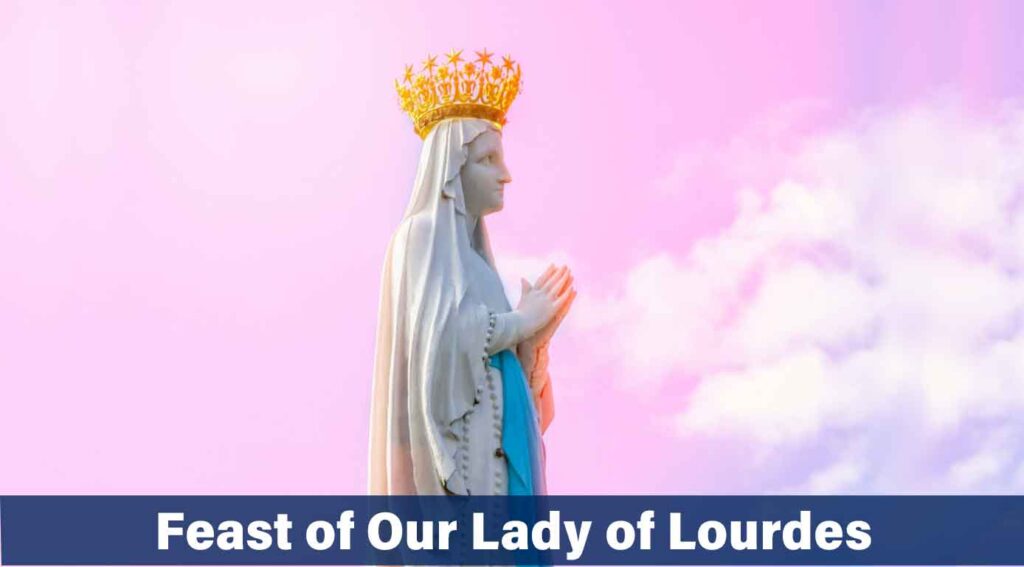
Feast of Our Lady of Lourdes

On December 8, 1854, Pope Pius IX proclaimed the dogma of the Immaculate Conception in the apostolic constitution Ineffabilis Deus. A little more than three years later, on February 11, 1858, a young lady appeared to Bernadette Soubirous. This began a series of visions. During the apparition on March 25, the lady identified herself with the words: “I am the Immaculate Conception.”

Bernadette was a sickly child of poor parents. Their practice of the Catholic faith was scarcely more than lukewarm. Bernadette could pray the Our Father, the Hail Mary and the Creed. She also knew the prayer of the Miraculous Medal: “O Mary conceived without sin.”
During interrogations Bernadette gave an account of what she saw. It was “something white in the shape of a girl.” She used the word aquero, a dialect term meaning “this thing.” It was “a pretty young girl with a rosary over her arm.” Her white robe was encircled by a blue girdle. She wore a white veil. There was a yellow rose on each foot. A rosary was in her hand. Bernadette was also impressed by the fact that the lady did not use the informal form of address (tu), but the polite form (vous). The humble virgin appeared to a humble girl and treated her with dignity.
Through that humble girl, Mary revitalized and continues to revitalize the faith of millions of people. People began to flock to Lourdes from other parts of France and from all over the world. In 1862 Church authorities confirmed the authenticity of the apparitions and authorized the cult of Our Lady of Lourdes for the diocese. The Feast of Our Lady of Lourdes became worldwide in 1907.

Sources:

https://www.franciscanmedia.org/saint-of-the-day/our-lady-of-lourdes/

Feast of Our Lady of Lourdes Read More »

Revelation 22:21

Verse:

“The grace of the Lord Jesus be with God’s people. Amen.” - Revelation 22:21

Prayer for Faith

Lord, I believe:
I wish to believe in Thee.
Lord, let my faith be full and unreserved,
and let it penetrate my thought,
my way of judging Divine things and human things.
Lord, let my faith be joyful
and give peace and gladness to my spirit,
and dispose it for prayer with God
and conversation with men,
so that the inner bliss of its fortunate possession
may shine forth in sacred and secular conversation.
Lord, let my faith be humble and not presume
to be based on the experience of my thought and of my
feeling;
but let it surrender to the testimony of the Holy Spirit,
and not have any better guarantee than in docility to
Tradition
and to the authority of the magisterium of the Holy Church.

Amen.

Sources:

Original Version of the Prayer: https://www.catholic.org/prayers/prayer.php?p=688

Revelation 22:21 Read More »

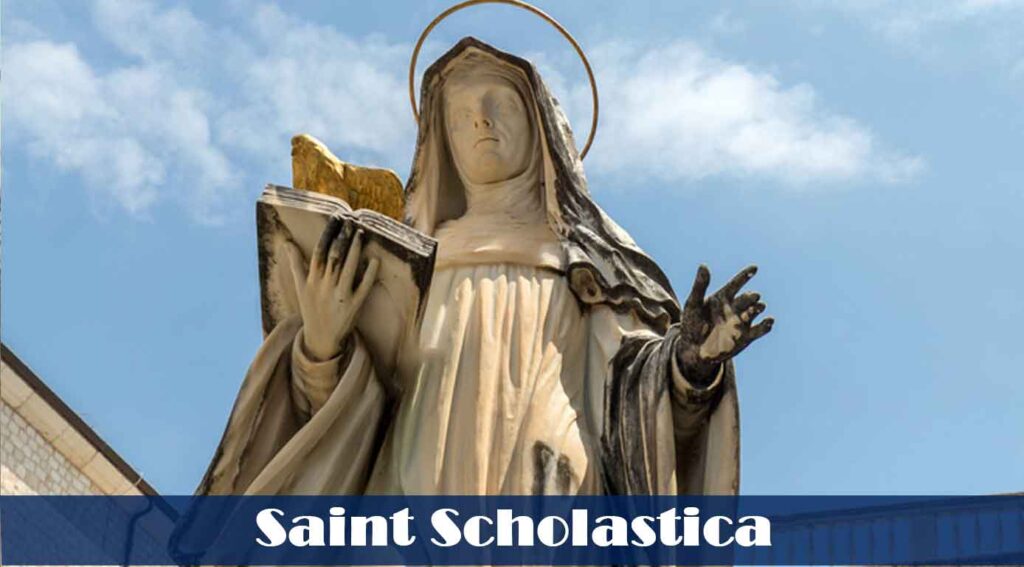
Saint Scholastica

Twins often share the same interests and ideas with an equal intensity. Therefore, it is no surprise that Scholastica and her twin brother, Benedict, established religious communities within a few miles from each other.

Born in 480 of wealthy parents, Scholastica and Benedict were brought up together until he left central Italy for Rome to continue his studies.

Little is known of Scholastica’s early life. She founded a religious community for women near Monte Cassino at Plombariola, five miles from where her brother governed a monastery.

The twins visited each other once a year in a farmhouse because Scholastica was not permitted inside the monastery. They spent these times discussing spiritual matters.

According to the Dialogues of St. Gregory the Great, the brother and sister spent their last day together in prayer and conversation. Scholastica sensed her death was close at hand and she begged Benedict to stay with her until the next day.

He refused her request because he did not want to spend a night outside the monastery, thus breaking his own Rule. Scholastica asked God to let her brother remain and a severe thunderstorm broke out, preventing Benedict and his monks from returning to the abbey.

Benedict cried out, “God forgive you, Sister. What have you done?” Scholastica replied, “I asked a favor of you and you refused. I asked it of God and he granted it.”

Brother and sister parted the next morning after their long discussion. Three days later, Benedict was praying in his monastery and saw the soul of his sister rising heavenward in the form of a white dove. Benedict then announced the death of his sister to the monks and later buried her in the tomb he had prepared for himself.

Sources:

https://www.franciscanmedia.org/saint-of-the-day/saint-scholastica/

Saint Scholastica Read More »