Author name: Sani

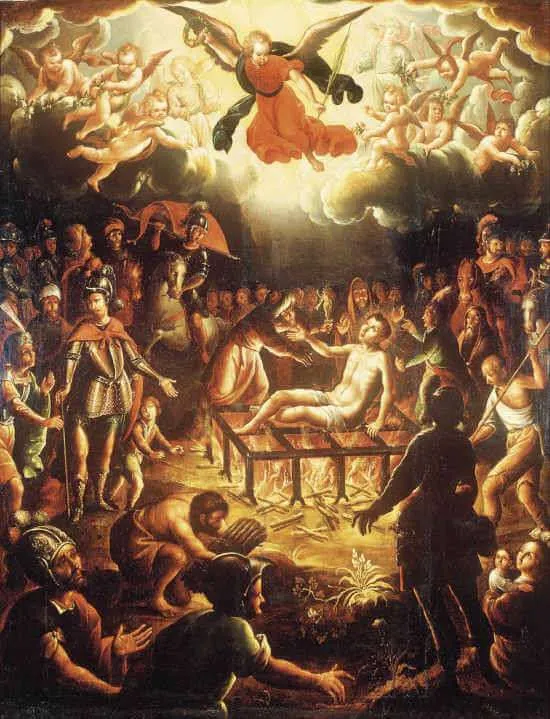
Saint Lawrence, Deacon and Martyr

c. 225–c. 258; Patron Saint of archivists, armories, book lovers, brewers, butchers, cooks, comedians, deacons, glaziers, laundry workers, librarians, firefighters, poor people, restaurateurs, schoolchildren, seminarians, tanners, vine growers, winemakers, and Rome; Invoked against fire and lumbago (lower back pain); Pre-Congregation canonization

Though not much is known for certain about Saint Lawrence, he has been highly revered as a martyr and deacon from at least the fourth century. Most of the legends come from the detailed writings of Saint Ambrose, who served as Bishop of Milan from 374 to 397, more than a century after Saint Lawrence’s death. His writings are likely more of an imagined telling of the story than a literal account. Another early source of Saint Lawrence’s life and martyrdom comes in the form of a Latin poem written by the Christian poet Prudentius, who lived c. 348–c. 405. Finally, the later Passio Sancti Laurentii gives other details about Saint Lawrence, which comes from an anonymous Spanish author who most likely did not write until the fifth or sixth century. From these three sources, as well as from the writings of others, such as Saint Augustine of Hippo and Pope Saint Gregory the Great, great reverence and devotion to Saint Lawrence have flourished throughout the centuries. He is even one of the few early martyrs named in Eucharistic Prayer I (the Roman Canon). It is for these reasons that today’s celebration holds the rank of Feast within our Church.

According to these legends, Lawrence was born in Spain, perhaps at Osca in Aragon, near the foot of the Pyrenees mountains. Both of his parents are believed to have been martyrs. As a youth, he is said to have been brilliant, studying humanities and theology in Zaragoza where he met the future Pope Saint Sixtus II. After Lawrence completed his studies, he and the future pope traveled to Rome. In Rome, Lawrence was ordained one of the city’s seven deacons—most likely as the head of the seven deacons, the Archdeacon of Rome. As archdeacon, Lawrence was put in charge of the Church’s material possessions and was responsible for distributing alms to the poor. By the time Pope Sixtus II was elected pope in 257, he and Deacon Lawrence are believed to have had a strong friendship.

In 253, Valerian became the Roman Emperor. At first, he tolerated Christians. However, in 257 he issued an edict that began a fierce persecution of the Church. Saint Cyril, then the bishop of Carthage, North Africa, who also died a martyr under Valerian, described the persecution this way: “The Emperor Valerian has consigned to the Senate a decree by which he has determined that all Bishops, Priests and Deacons will be immediately put to death. I communicate to you that Sixtus suffered martyrdom on 6 August together with four Deacons while they were in a cemetery. The Roman authorities have established a norm according to which all Christians who have been denounced must be executed and their goods confiscated by the Imperial treasury.” The Liber Pontificalis identifies two other deacons who were martyred with Pope Sixtus, for a total of six deacons on August 6, 258: Januarius, Vincentius, Magnus, Stephanus, Felicissimus, and Agapitus.

According to Saint Ambrose’s account, Deacon Lawrence was martyred four days after his close friend and spiritual father, Pope Sixtus II, and the other deacons who were put to death. Ambrose records this exchange between the two prior to the pope’s execution, “Saint Lawrence wept when he saw his Bishop, Sixtus, led out to his martyrdom. He wept not because he was being led out to die but because he would survive Sixtus. He cried out to him in a loud voice: ‘Where are you going Father, without your son? Where do you hasten to, holy Bishop, without your Deacon? You cannot offer sacrifice without a minister…’” Ambrose records Pope Sixtus as responding, “I will not leave you, I will not abandon you my son. More difficult trials are kept for you. A shorter race is set for us who are older. For you who are young a more glorious triumph over tyranny is reserved. Soon, you will see, cry no more, after three days you will follow me…”

After Pope Sixtus and the other deacons were martyred, Deacon Lawrence was arrested. Because he was in charge of the riches of the Church, the prefect of Rome demanded that Deacon Lawrence hand over to him all the treasures of the Church. Lawrence requested three days to gather them, during which time he distributed all he could to the poor. After three days, Deacon Lawrence appeared again before the prefect and pointed to the poor, the crippled, the blind, and the suffering of Rome, saying, “These are the treasures of the Church.” This infuriated the prefect who had anticipated receiving gold and silver. He ordered that Deacon Lawrence be burned on a gridiron. Saint Ambrose records Deacon Lawrence’s last act of heroic virtue and defiance of diabolical oppression this way: “However, after three days he was placed upon the gridiron by the tyrant whom he mocked, and was burnt. He said: ‘The flesh is roasted, turn it and eat.’ So by the courage of his mind he overcame the power of fire.”

What is known for certain is that Saint Lawrence of Rome gave his life for Christ. After that heroic act of selflessness, God raised Saint Lawrence back to life—not physically, but spiritually, making him an icon of Christ to inspire others. Because Saint Lawrence is believed to have been burned on a gridiron, he has become known as the patron saint of cooks and tanners. Because he cared for and hid important documents of the Church before dying, he is the patron saint of archivists and librarians. And because of the humor Lawrence displayed while dying, as recorded by Saint Ambrose, he is the patron saint of comedians. From the third century onward, Saint Lawrence has been highly venerated in Rome and is considered a patron of Rome, after Saints Peter and Paul. After Constantine the Great legalized Christianity in the fourth century, tradition holds that he built a basilica over the tomb of Saint Lawrence that became one of the seven main churches in Rome, the Basilica di San Lorenzo fuori le Mura.

As we honor this legend of heroic virtue within the Roman Church, ponder not only his courage but also the way that God has used him to inspire many throughout the centuries. Though acts of courage may be difficult at the time they are performed, the good fruit of such heroism lives on. Seek the intercession of Saint Lawrence today, asking him to pray for you so that you will have the courage to do all that God asks of you, even using humor when helpful, so that you will find joy in everything, even persecution and suffering.

Source: https://mycatholic.life/saints/saints-of-the-liturgical-year/august-10—saint-lawrence-deacon-and-martyr/

Saint Lawrence, Deacon and Martyr Read More »

Luke 12:35-37

Vigilance, Attentiveness, Action

Jesus said to his disciples: “Gird your loins and light your lamps and be like servants who await their master’s return from a wedding, ready to open immediately when he comes and knocks. Blessed are those servants whom the master finds vigilant on his arrival. Amen, I say to you, he will gird himself, have the servants recline at table, and proceed to wait on them.”

Reflection:

Vigilance, hard work, determination, attentiveness, fidelity—these are some of the qualities that Jesus is speaking about. To “gird your loins” means that you are immediately prepared for some challenging task. You are ready for the hard work ahead and are committed to it. To “light your lamps” implies that you are not in the dark but that your mind is enlightened in such a way that you are able to see that which is the will of God.

As we go through life, it is easy to become complacent in the things of faith. It is easy to become lazy, disinterested, distracted, and unfocused. This parable goes on to speak of a thief who tries to break into a house in the middle of the night. This is Jesus’ way of saying that the evil one, with his lies and attacks, is constant, vicious, forceful, and unpredictable. For that reason, we must never grow tired of being vigilant in the spiritual life and must always be attentive to the light of God’s voice.

How attentive are you to the mission of Christ on a daily basis? This is an essential question to answer honestly. Most people will find that they become distracted from the mission God has given to them. We experience countless things every day that compete for our attention. Many of those competing voices might not appear to be sinful. For example, perhaps a certain hobby has become the dominant focus of your free time. Or perhaps responsibilities at work have spilled over into your family time. Or perhaps some painful or even enjoyable experience has had your full attention for some time. Though it is obvious that sinful distractions in life are evil, it might not always be as obvious that there are many other neutral distractions that are a real problem. The problems they can produce are a lack of attentiveness to the will of God and a lack of readiness to engage the will of God the moment He calls.

Imagine, for example, that a very important person calls you to ask for a favor. Most likely you would drop all you were doing and respond immediately. But, sadly, when the King of the Universe attempts to speak to us and inspire us to some mission, we can be too distracted to even listen, let alone respond with immediacy and zeal. This is a problem. If, however, a person is continually attentive to the voice of God and responds to His interior promptings as soon as they are received, then Jesus says that this person is truly blessed and that He will “have the servants recline at table, and proceed to wait on them.” In other words, the result of being vigilant in our attentiveness to the inspirations of God is that God Himself will reward us with His service. He will invite us to the table of spiritual rest, peace, joy, and fulfillment. He will serve us His mercy, which will be more than we could ever imagine.

Reflect, today, upon the call from God to always be attentive to His voice the instant He speaks. Reflect upon how aware you are of His constant presence in your life and His ongoing communication. Know that if you can form a habit of always listening, then you will never miss out on the grace-filled mission given to you by our Lord. Always listen to Him, seek out His still and gentle voice, and be ready to respond to Him every time He calls.

Source: https://catholic-daily-reflections.com/2025/08/09/vigilance-attentiveness-action/

Luke 12:35-37 Read More »

Saint Teresa Benedicta of the Cross (Edith Stein)

1891–1942; Patron Saint of Europe; Canonized by Pope John Paul II in 1998

Edith Stein was the youngest of eleven children, eight of whom survived infancy. She was born in Breslau, Germany, the daughter of devout Jewish parents. After World War II, Breslau became part of Poland and is now named Wrocław. Edith’s father died when she was only two, so her mother raised her children as a widow but ensured that Edith received an excellent education. Although her mother was an observant Jew, Edith decided she was agnostic around the age of fourteen, breaking her mother’s heart. Edith’s decision was part of her deeper quest for truth. Edith attended the local university when she was nineteen and studied philosophy, psychology, history, and German. At the age of twenty-two, she traveled about 300 miles east to study philosophy at the University of Göttingen in Germany under the renowned professor and founder of Phenomenology, Edmund Husserl. Phenomenology is an intellectual method that seeks to offer a systematic, clear, and unbiased description of the world as it is experienced, rather than explaining it from a theoretical or abstract perspective, as is common in other philosophical approaches.

In 1914, World War I broke out, and Edith volunteered with the Red Cross, where she cared for soldiers suffering from infectious diseases. This compassionate work gave her much to reflect on during that year, and her reflections and experiences made their way into her doctoral thesis, which centered on an understanding of empathy from a phenomenological perspective. She was granted her doctorate from the University of Göttingen in 1916, at the age of twenty-five, and followed her mentor, Professor Edmund Husserl, to the University of Freiburg, where she became his teaching assistant for the next two years.

At that time in Germany, a doctoral degree was not enough to become a university professor. It was also necessary to write a habilitation, a second, post-doctorate original thesis that often includes other requirements, such as teaching courses, advising students, or giving public lectures. In 1918, Edith attempted to complete her habilitation at the University of Göttingen, but the work was rejected because women were not then permitted to go become university professors.

In 1921, during a summer vacation, Edith was visiting a friend named Hedwig Conrad-Martius in Bergzabern, Germany. Hedwig was also a phenomenologist and one of the early women pioneers in German philosophy. She had recently converted to Catholicism and had many Catholic books in her home. During her stay, Edith picked up the autobiography of Saint Teresa of Ávila and read it. After reading it, she is said to have exclaimed, “This is the truth!” Her quest for truth had led her from Judaism to agnosticism to empathetic care for the suffering soldiers, to philosophical inquiry, and finally to one of the most brilliant spiritual writers in the history of the Church. Though Saint Teresa of Ávila was not an academic like Edith, Edith knew the truth when she saw it. The truths contained in Saint Teresa’s autobiography changed Edith’s life. She left her teaching position with Professor Husserl, learned the Catholic faith, and was baptized on January 1, 1922, in the church of Saint Martin in Bergzabern, Germany. From 1923–1931, Edith taught history, philosophy, and German to girls at the Dominican convent of Saint Magdalene in Speyer, Germany. During this time, she intensified her study of Catholicism, translating portions of Saint Thomas Aquinas and other Catholic theologians and philosophers into German. In 1932, Edith became a lecturer at the Catholic Institute for Scientific Pedagogy in Münster, but this was short-lived because the Nazi government passed anti-Semitic legislation that forced her to resign. However, “We know that all things work for good for those who love God, who are called according to his purpose” (Romans 8:28), and that is exactly what happened with Edith. Out of work and oppressed by the government, in October 1933, Edith was accepted into the Discalced Carmelite Monastery of Our Lady of Peace, Lindenthal, Cologne, Germany. She took the religious name Sister Teresa Benedicta of the Cross, after Saint Teresa of Ávila and Saint John of the Cross.

As a Carmelite nun, Sister Teresa Benedicta continued her philosophical studies and writings. In Cologne, she wrote “Finite and Eternal Being,” an attempt to synthesize and harmonize the philosophies of Saint Thomas Aquinas and the phenomenology of Edmund Husserl. After Hitler came to power in 1933, life as a Jew, even a Jewish convert to Catholicism, became increasingly dangerous in Germany. In 1938, the Carmelite superiors secretly transferred Sister Teresa Benedicta and her sister Rosa (who had become an extern of the Carmelites after their mother’s death), to their monastery in Echt, Netherlands. While in Echt, Sister Teresa wrote one of her most famous books, “The Science of the Cross,” an explanation of the mystery of the Cross using the teachings of Saint John of the Cross with references to the teachings of Saint Teresa of Ávila.

In 1940, the Nazis invaded the Netherlands, and in 1942, the Dutch bishops’ conference issued a statement that was read at all Masses, condemning the Nazis and their oppression of the Jews. In retaliation, the Nazis arrested all Catholic converts from Judaism, including Sister Teresa Benedicta and her sister Rosa. On August 9, 1942, Sister Teresa and Rosa were led into the gas chambers in Auschwitz where their mortal bodies perished, but their souls triumphed over death and were welcomed into Heaven. Saint Teresa Benedicta of the Cross is considered a martyr because she died as a result of the moral clarity issued by the bishops against Nazi oppression and because she chose to remain faithful to her religious vocation, despite the evident risk.

As we honor this saint and her fascinating journey, ponder her pursuit of the truth. She walked away from her Jewish roots at an early age and studied philosophy as a way of seeking the truth. She experienced human compassion during World War I while caring for soldiers, which fueled her phenomenological reflections of human empathy. She rigorously studied philosophy as a way of making sense of life, earning her doctorate. She remained humble and open to the truth while reading the life experience of Saint Teresa of Ávila, which led to her conversion. She pursued ongoing study of the truth as a Catholic theologian and philosopher. She made the radical choice to enter Carmel and become a nun. She experienced the suffering of the Cross firsthand during the Nazi oppression of World War II. Through it all, she used her keen intellect to develop a profound theology of the Cross, using the writings of Saint John of the Cross and Saint Teresa of Ávila. Finally, she lived the ultimate suffering through her martyrdom with fellow Jewish converts to the faith in Auschwitz. Above all, her story is a witness to the pursuit of the deepest truths found in the suffering and death of Christ. Allow this witness of her intellectual and lived experience of Christ’s Cross to inspire you to turn more fully to the sacrificial life to which you are called.

Source: https://mycatholic.life/saints/saints-of-the-liturgical-year/august-9—saint-teresa-benedicta-of-the-cross-edith-stein-virgin-and-martyr/

Saint Teresa Benedicta of the Cross (Edith Stein) Read More »

Matthew 17:19-20

Doing the Unimaginable

Then the disciples approached Jesus in private and said, “Why could we not drive it out?” He said to them, “Because of your little faith. Amen, I say to you, if you have faith the size of a mustard seed, you will say to this mountain, ‘Move from here to there,’ and it will move. Nothing will be impossible for you.”

Reflection:

A man came up to Jesus, fell on his knees before Him and begged Jesus to cure his son who was possessed by a demon. The man explained that Jesus’ disciples had tried to cast the demon out, but they could not do so. Jesus’ initial response to the man was, “O faithless and perverse generation, how long will I be with you? How long will I endure you?” But then Jesus had the boy brought to Him, and He cast the demon out.

The line quoted above reveals the conversation that immediately followed between Jesus and His disciples who failed to cast out the demon. It was because of their lack of faith that they were not able to do so. It should be noted that Jesus reacts firmly with a rebuke to this lack of faith as a way of emphasizing the importance of having a more pure faith.

Is it true that if you were to have “faith the size of a mustard seed” that you would be able to move a mountain? Yes, most certainly. But this statement must be carefully understood. First of all, we can only have “faith” in that which is in the mind and will of God. Faith is a response to that which God speaks to us. We listen, understand and believe. This is faith. Faith is not just believing in something so strongly that we try to will it to happen. Thus, if God truly wanted a mountain to be uprooted and moved, and He spoke this to you asking you to do it, then if you listened to His Voice and responded with complete trust, then it would happen. But, of course, the glory of God is not fulfilled by moving a literal mountain, so it is very unlikely that this would ever be done through the gift of faith.

But Jesus speaks this to His disciples and to us to assure us that we must listen, understand and believe all that He says. In the case of the curing of the boy with the demon, it is clear that it was the will of God that the disciples cast the demon out. But they failed to believe and, therefore, were unable to bring forth God’s will through their faith.

As for moving mountains, this happens on a figurative and spiritual level all the time. Any time God works in our lives in a supernatural way, or any time God uses us to work in another’s life in a supernatural way, much more than a “mountain” is moved. From an eternal perspective, what is more glorious and what gives God greater glory? To literally move a mountain? Or to be changed by grace and to be interiorly transformed by God so as to give Him eternal glory? And what is more impressive? To be able to defy the laws of physics in a way that comes and goes in an instant, or to be used to change someone’s soul for eternity? Without question, being used by God to bring transformation to another’s soul for eternity is of infinitely greater magnitude.

Reflect, today, upon the importance of listening to the Voice of God and responding with complete obedience and love. This is faith. What “mountain” does God want to move in your life? What transformation does He want to perform? Listen to Him and believe with every fiber of your being. As you do, God will not only do unimaginable things in your life, but through you, He will do unimaginable things in the lives of others.

Source: https://catholic-daily-reflections.com/2025/08/08/doing-the-unimaginable-3/

Matthew 17:19-20 Read More »

Saint Dominic, Priest

1170–1221; Patron Saint of astronomers, scientists, and those falsely accused; Canonized by Pope Gregory IX in 1234

Dominic was born in Caleruega, in the Kingdom of Castile, present-day Spain, to noble parents. He was likely named after Saint Dominic of Silos, a local saint from the previous century. An early biographer relates that his mother, struggling to conceive a child, made a pilgrimage to the monastery where Saint Dominic of Silos had been abbot. Around that time, she dreamt of a dog emerging from her womb that ran around carrying a torch, setting the world on fire. The name “Dominic” can be translated as “The Lord’s Dog.”

Today’s saint came from a holy family. Dominic’s mother was later beatified, as was one brother who followed Dominic into the Order of Preachers. His other brother was a diocesan priest who lived in poverty and was devoted to the care of the poor and suffering. From the age of seven to fourteen, Dominic was educated under the guidance of his mother’s uncle, a priest. From fourteen to twenty-four, he attended the University of Palencia where he excelled in his studies. During his ten years at Palencia, Dominic was also deeply devoted to the poor. On one occasion, he sold all he had, including books he had copied by hand, to alleviate the suffering of those affected by a plague. Twice, he attempted to sell himself into slavery to assist those held captive by their Muslim captors.

When Dominic was twenty-four years old, the Bishop Diego de Acebo of Osma ordained him as an Augustinian canon of the cathedral, hoping that Father Dominic would help reform the other canons. For the next nine years, Father Dominic lived a life of deep prayer, was named sub-prior and then prior, and gave great witness to others through his holy life.

In 1203, the King of Castile sent Bishop Diego on a diplomatic mission. The bishop asked Father Dominic to accompany him on the journey. During their travels, they became aware of two grave needs within the Church. First, they discovered many people in northern Europe who had yet to hear the Gospel’s saving message. Second, they encountered a heretical group in southern France called the Cathars, who were leading many astray. After completing their diplomatic mission, Bishop Diego and Father Dominic detoured to Rome to consult with the pope. After their consultation, the pope sent them back to southern France to assist with the conversion of the Cathars. The Cathars followed a form of the Albigensian Heresy, which taught that there were two gods: one good, associated with the New Testament and the spiritual world, and one evil, associated with the Old Testament and the material world. They believed that the goal of life was to escape the evil of the material world and live a purely spiritual life, achieved by a rigorously ascetic lifestyle.

Previously, the pope had sent Cistercian monks to convert the Cathars. However, the Cathars lived an extremely ascetic life while the Cistercians did not, leading the Cathars to reject the Cistercian intervention. Encountering this firsthand, Father Dominic understood that the best way to combat the heresy was to form an order that lived in extreme asceticism yet remained true to the faith of the Church.

Back in southern France, Father Dominic and Bishop Diego worked tirelessly to rescue souls from the Albigensian heresy. They did so by engaging in public debates and private dialogues with the Cathars, hoping to convince them of their errors through reason and persuasion. Father Dominic and Bishop Diego lived in poverty as itinerant preachers, possessing only the Gospel. After Bishop Diego died, Father Dominic founded a convent in Prouille in 1206 dedicated to Saint Mary Magdalene. The purpose of the order was twofold. First, Father Dominic believed that it was through prayer, above all else, that souls would be saved. Second, the convent provided a safe haven for women and nuns who were converted away from the Albigensian heresy. The convent also provided for the education of girls, giving parents an alternative to the heretical convents for their daughters’ education.

Over the next several years, God performed a number of miracles through Father Dominic. Some of those miracles resulted in conversion and new followers. As time went on, Father Dominic began to write a rule of life for himself and his companions. In 1215, with the permission of the Bishop of Toulouse, Father Dominic founded a new order of men, dedicated to evangelization through prayer, study, and poverty. Like the newly formed Franciscans, they sought to institute a new form of religious life. They did not live as monks, canons, or diocesan priests. Instead, they lived a combination of the three. They lived communally; prayed together; embraced poverty, obedience, and chastity; studied the faith; and then set out on missions of preaching and evangelizing, later returning to their community house where they remained grounded and were renewed in their mission. The following year, Pope Honorius III gave formal consent to the order. Thus, the Order of Preachers, also known as the Dominicans, was established.

The Order of Preachers quickly became a huge success due to the humility, patience, and dedication of Father Dominic and his friars. Miracles also made a difference. One legend states that Father Dominic was invited to a public debate with a leading Albigensian monk. After the debate, the judges could not determine who was victorious so they suggested a test. They were both to place their book of teachings in the fire. The book that did not burn would be declared the winner. The Albigensian went first, and his writings were immediately consumed. When Father Dominic threw his book in the fire, it immediately jumped back into his hand. He did it a second time and a third with the same result. News spread quickly and hearts continued to convert.

In 1217, the pope, impressed with the order’s beginnings, gave Father Dominic the Church of Santa Sabina in Rome as the order’s second home. The pope also elevated Father Dominic to the “Master of the Sacred Palace,” a position designating Father Dominic as the pope’s chief theological adviser. Despite his success, Father Dominic remained a humble and prayerful penitent throughout his life. He slept on the floor, wore a hairshirt, and often walked barefoot when he entered a new town.

In the years following until Dominic’s death in 1221, other houses were founded in Paris, Madrid, and Bologna. After his death, the order continued to expand. By the mid-1200s, hundreds of Dominican houses had sprung up across Europe and even in other parts of the world.

As we honor Saint Dominic and the Order of Preachers, ponder his patience and dedication. In working with the Albigensian heretics, he was neither condemning nor harsh. Instead, he immersed himself in prayer and study, and then made himself available to each person he encountered, listening, discussing, reasoning, and helping to open the eyes of many. His prayerful and humble spirit, coupled with his wise words, saved many souls. Know that God calls you to a similar vocation. Each of us must long for the salvation of souls above everything else in life. Once we are filled with that longing, we must then dedicate all we are and all we have to that mission. Nothing else in life is more important because nothing gives God more glory than rescuing one soul from sin and hell as Saint Dominic did so well.

Source: https://mycatholic.life/saints/saints-of-the-liturgical-year/8-august-saint-dominic-priest/

Saint Dominic, Priest Read More »

Matthew 16:26

Purifying Worldly Desires

What profit would there be for one to gain the whole world and forfeit his life? Or what can one give in exchange for his life?

Reflection:

Would you like to “gain the whole world?” Many people daydream about becoming exceptionally rich and being able to purchase everything they ever wanted. Others dream of doing heroic acts that thrust them into the public spotlight and lead to public admiration. Still, others dream of having great power in this world and being a person of great importance. Though none of these are bad in and of themselves, the inordinate desire for them will damage your relationship with God. And when one of these desires becomes the dominant and all-consuming desire within, the result is that you forfeit your eternal soul.

When we speak of the “world,” we can understand different things. First, this is a reference to all the material things of this world—for example, the best of food and drink, self-indulgence, fleshly pleasures, material wealth, and all that is temporary and passing in this life. Second, the “world” can refer to pride and desire for attention and praise. This is when we become consumed with concern about what others think and say about us. Third, the “world” can refer to the desire for power so as to insert our own will. At a very high level, this is often the cause of wars among countries. One leader has a desire for domination and control. This desire for power and control can also affect each person within any part of that person’s life, including family, friends, work, social circles, etc.

The common thread among all three of these examples of worldly desires is the deception that obtaining more of them will satisfy you. Though they may satisfy you in a temporal and passing way, these desires will also have the effect of destroying your soul. This is because we have to choose. Either we seek to satiate the spiritual yearning of our souls, or we will seek to satiate ourselves with the passing promises of the world. We cannot have both.

It should be noted that obtaining wealth, being publicly praised, or being put in a position of power is not evil in and of itself. In fact, any one of these offers potential for good. The problem arises when a person seeks one of these worldly desires for selfish reasons and under the delusion that it will provide fulfillment. Truth be told, any one of those situations imposes a true cross on the person who is seeking to serve God alone. The responsibility that comes with wealth, prestige, or power is real. Therefore, when one or more of these are obtained, they must be handled with detachment and humility.

For example, if one becomes quite wealthy, the precept to live spiritually detached from material things still remains. Thus, in this case, material wealth poses a certain burden in the form of temptation. While this temptation certainly can be overcome and wealth can be used for good, the danger is real and must be regularly acknowledged. Or, if you are praised by many for something you did, or if you are given much responsibility and authority over others, humility and detachment must also increase so that God and God alone remains the single object of your desire.

Reflect, today, upon your desires. What do you want in life? Do you want to “gain the whole world?” Do you desire to gain even some of the worldly ambitions? If so, be careful. Reflect honestly upon your interior desires and work to purify them so that you desire God’s will alone. Once that happens, it will not matter to you if you are rich or poor, publicly praised or criticized, entrusted with earthly power or not. All that will matter is that you use all for the glory of God, in accord with His perfect and fulfilling will.

Source: https://catholic-daily-reflections.com/2025/08/07/purifying-worldly-desires-3/

Matthew 16:26 Read More »

Saint Sixtus II, Pope and Martyr, and Companions, Martyrs

Unknown–c. 258; Patron Saint of Bellegra, Italy; Pre-Congregation canonization

In the first and second centuries, Emperors Nero, Domitian, and Trajan persecuted Christians, exiling some and killing others. Famous martyrs of that time include Saints Peter, Paul, Domitilla, and Ignatius of Antioch. The Apostle John went into exile. Emperor Domitian was especially violent toward the Christians because he saw himself as a god and expected his subjects to treat him as such. In 250, Emperor Decius issued an edict requiring all citizens to offer sacrifice to the Roman gods for the well-being of the Roman Emperor. Those who did received an official certificate. Those who did not could be arrested and killed. This empire-wide persecution not only targeted the leaders within the Church but also the laity. Among the most well-known saints martyred under Decius were Pope Fabian, Bishop Alexander of Jerusalem, and two laywomen, Apollonia and Agatha.

The persecutions under Emperor Decius ended with his death in 251, and the next two emperors were more tolerant of Christians. However, the way that Decius handled Christians had a devastating impact upon the Church. Because Decius required all citizens to sacrifice to the Roman gods and obtain a certificate of compliance, many Christians did so out of fear. Once the persecutions subsided, the Church had to address the question of what to do with those who had apostatized to save their lives. Many of these “lapsi” as they were called, which is Latin for “lapsed,” wanted to be reconciled with Christ and be readmitted to the Sacraments. Some Church leaders were strict, believing that they should not and could not be readmitted after such a cowardly public act of apostasy. Others held that they could only be readmitted after severe public penance. And others believed that they should be readmitted into full communion with the Church immediately, without the requirement of public penance if their sorrow was sincere. Pope Cornelius and Bishop Cyprian of Carthage were among those who advocated for the reconciliation of the lapsi, taking a more middle-of-the-road approach, which was confirmed and universally adopted at the Council of Carthage in 251.

In 253, Valerian became emperor and was tolerant at first. However, around 257, things changed. He issued an edict that outlawed Christian worship and directed that bishops, priests, and deacons be arrested. Christian nobility lost their titles and property, and Christian senators could be put to death if they did not publicly renounce their faith. It was in that same year that today’s saint, Sixtus, was elected pope.

Little is known about Pope Saint Sixtus II’s childhood and early years, other than that he was most likely born in Greece and may have been well versed in Greek philosophy. Regarding the lapsi controversy, he was in full union with the merciful approach adopted by the Church. He was well aware of the fear so many Christians were encountering due to the threat to their lives. He was also courageous, not giving into those fears himself.

A related issue that the Church faced during the time that Pope Sixtus served was the question of whether or not those who were baptized by heretic bishops and priests needed to go through a rebaptism when they embraced the orthodox faith. Once the question of readmittance of the lapsi to the faith was resolved, those bishops and priests who refused to accept the decision of the Council of Carthage were deemed heretics. The new question was whether the baptisms of those heretical bishops and priests were valid.

Pope Sixtus came down on the side that ultimately was adopted by the Church, namely, that despite the heretical position of the bishop or priest, as long as he had the intent of the Church, used water, and spoke the words given to us by Christ for the baptism, that baptism was valid and there was no need for a rebaptism. Pope Sixtus worked hard to unite the bishops of the Church, especially the North African bishops, on this issue and succeeded in that endeavor.

Pope Sixtus’ papacy was short-lived. About a year after being chosen as pope, he was among the first of the Christians to suffer martyrdom under the edict of Emperor Valerian II. With him, six deacons were also killed: Januarius, Vincentius, Magnus, Stephanus, Felicissimus, and Agapitus. Four days later, Deacon Lawrence also suffered death. Pope Sixtus was buried in the Crypt of the Popes, within the Catacombs of Callixtus located on the Appian Way in Rome. A century later Pope Damasus I honored his tomb with an epitaph, and sometime before the end of the seventh century, his name was inserted into the Roman Canon of the Mass by which he is honored as a martyr.

Though we do not know much about Pope Saint Sixtus II, we know that he is a saint and among the early martyrs of our Church who also fought to unite the Church, treat sinners with mercy, and hold firm to the teachings handed down to us from the Apostles. As we honor this courageous saint, pray that you will be able to give witness to Christ by your fidelity to Him, to mercy, and to authentic unity in all that he calls you to do.

Source: https://mycatholic.life/saints/saints-of-the-liturgical-year/august-7—saint-sixtus-ii-pope-and-companions-martyrs/

Saint Sixtus II, Pope and Martyr, and Companions, Martyrs Read More »

Matthew 16:22-23

Facing Fear with Hope

Then Peter took Jesus aside and began to rebuke him, “God forbid, Lord!  No such thing shall ever happen to you.” He turned and said to Peter, “Get behind me, Satan!  You are an obstacle to me. You are thinking not as God does, but as human beings do.”

Reflection:

What a shocking statement this must have been that was spoken by Jesus to Peter. “Get behind me, Satan!” Jesus said. In the paragraph before this, Peter professed that Jesus was “the Christ, the Son of the living God.” Jesus in turn told Peter that he was Petros and on this petra He would build His Church. Petros is the Greek word for a movable rock and petra was an immovable solid rock foundation. Thus, Peter was told that he would be the stone, set upon a solid foundation, by which Jesus would build His Church. Jesus even went on to promise Peter that he would receive the keys to the Kingdom and that whatever he bound on earth would be bound in Heaven. And then, one paragraph later, Jesus rebukes Peter for thinking “not as God” but as a human being.

Jesus rebuked Peter because Peter could not accept Jesus’ teaching about His coming passion and death. Jesus told Peter and the other disciples that He would soon suffer greatly, be rejected by the chief priest, the scribes and the elders, be killed and then rise on the third day. So Peter went from a profound proclamation of faith, to fear and a rejection of the divine plan of salvation. And for that reason, Jesus went from entrusting much authority to Peter to rebuking him for his weakness and fear.

Fear is often a paralyzing passion. Saint Thomas Aquinas explains that the passion of fear comes from a perceived future evil. Sorrow is the normal reaction to a present suffering such as the death of a loved one. But when the perceived suffering, or apparent evil, is something that has not yet come, then we often react with fear. When that fear is caused by something exterior and out of our control, it tempts us to feel shock, a sense of being overwhelmed and anxiety. In the case of Peter, the thought of Jesus suffering greatly, and being killed, was more than he was able to accept. So Peter says, “God forbid, Lord! No such thing shall ever happen to you.”

Jesus’ rebuke of Peter was an act of true love. It was a way of shaking him free from the paralysis of fear. Jesus wanted Peter to think clearly and to face this future suffering with courage, acceptance, hope and faith. Courage provides strength. Acceptance cures anxiety. Hope produces joy. And faith is the remedy for all fear. These and other similar virtues were necessary if Peter and the other disciples were going to be able to endure the suffering and passion of Jesus. They needed to know that this perceived evil was going to be transformed by the Father in Heaven and used for the greatest good the world had ever known. They needed to know that Jesus “must go to Jerusalem and suffer greatly…” It was the Father’s will. And because it was the Father’s will, the greatest good would come from the greatest evil because of God’s almighty power.

Reflect, today, upon that which causes you the most fear and anxiety in your life. When you look to the future, what is it that paralyzes you or at least tempts you to fear and worry? The truth is that any evil or suffering that you foresee has the potential to bring forth the greatest good in your life. Your natural human mind cannot discern this. We must strive to think as God, not as humans, as Jesus says. Try to look at anything that causes you anxiety through the eyes of God alone. Trust that, in faith, all can be used by God for good. Do not doubt but believe and God will begin to bestow upon you the many virtues you need to move forward with peace, courage and confidence.

Source: https://catholic-daily-reflections.com/2025/08/06/facing-fear-with-hope-3/

Matthew 16:22-23 Read More »

Transfiguration of the Lord

c. 32

All three of the Synoptic Gospels record the event of the Lord’s Transfiguration (Matthew 17:1–8Mark 9:2–8Luke 9:28–36). Just prior to the Transfiguration, all three Gospels also record Jesus’ trip with His disciples to Caesarea Philippi, located about thirty miles north of the Sea of Galilee. Caesarea Philippi was a primarily pagan Greek town occupied by the Romans. The Greek god Pan was worshiped there in a cave thought to be bottomless and often referred to as the gate to the netherworld because of its association with the pagan god. It was there that Jesus asked His disciples who they thought He was. Peter declared, “You are the Messiah, the Son of the living God.” Jesus then blessed Peter and announced His intent to build His Church upon Peter, declaring that “the gates of the netherworld shall not prevail against it…” (Matthew 16:16–18).

After this significant exchange, Jesus began revealing to His disciples His impending fate—His journey to Jerusalem to suffer and die. Peter resisted this revelation, to which Jesus responded sternly, correcting Peter’s human thinking with divine wisdom (Matthew 16:22–23).

This is the context of the Feast of the Transfiguration we celebrate today. First, Jesus proclaimed the triumph of His Church over evil. Second, He informed them that this victory would be achieved through His own suffering and death. Although the first message is encouraging, the second one is challenging to accept. According to the Gospels, Jesus allowed His disciples about a week to grapple with these teachings, a period that must have been tough for them.

Understanding their struggle, Jesus took His three closest companions, Peter, James, and John, up a high mountain. There He was transfigured before them, radiating pure white light, conversing with Moses and Elijah, and being affirmed in His identity by the Father.

This event was likely meant to reinforce His disciples’ faith after a week of pondering Jesus’ foretold suffering and death, along with His exhortation that they must follow Him. The Transfiguration affirmed Jesus’ divinity and His relationship with the revered figures of Moses and Elijah. Furthermore, the Father in Heaven confirmed Jesus as His divine Son with whom He was well pleased.

After the Resurrection and Ascension of Jesus, these three Apostles shared their experience of the Transfiguration, fortifying others in the faith. This story is still shared today to strengthen us as we bear our own crosses.

The Feast of the Transfiguration is strategically placed forty days before the Feast of the Triumph of the Cross. Thus, the Transfiguration should be seen as a preparation for both the Cross of Christ and our participation in that triumph. According to the Gospel, we are called to take up our crosses and follow Jesus for the glory of the Father, the fulfillment of His will, and the good of the Church, which will always prevail against the gates of hell.

As you celebrate the Transfiguration today, look at this event as a foretaste of the reward awaiting you, and a source of encouragement to endure all sufferings for the final victory of Christ. The Christian life, as stated by Jesus Himself, is about suffering and dying out of love and with unwavering hope. By uniting our trials with Christ’s Cross, we share in His glorious victory for all eternity.

Source: https://mycatholic.life/saints/saints-of-the-liturgical-year/august-6—transfiguration-of-the-lord/

Transfiguration of the Lord Read More »

Mark 9:5-7

The Glory of the Transfiguration

Then Peter said to Jesus in reply, “Rabbi, it is good that we are here! Let us make three tents: one for you, one for Moses, and one for Elijah.” He hardly knew what to say, they were so terrified. Then a cloud came, casting a shadow over them; from the cloud came a voice, “This is my beloved Son. Listen to him.”

Reflection:

Just prior to the Transfiguration, Jesus began to reveal to His disciples that He would suffer greatly, be rejected by the elders, be killed and then rise on the third day. This caused much fear for the disciples as they grappled with this unsettling revelation from our Lord. And even though Jesus remained firm with them and even rebuked Peter for his fear, Jesus also gave three of His disciples a very precious gift.

After much traveling, preaching, miracle working and private conversations about His passion with the Twelve, Jesus invited Peter, James and John to go with Him up a high mountain to pray. These disciples most likely had no idea what they would soon encounter. As they made the difficult and arduous journey, their minds must have been pondering not only the mighty deeds done by Jesus in the previous months but also His words about the suffering to come. As they struggled with this, much to their amazement, Jesus “was transfigured before them, and his clothes became dazzling white.” Suddenly Moses and Elijah appeared before them, representing the Law and the prophets. These two Old Testament figures appeared as a way of saying to these disciples that everything that Jesus was telling them was to take place to fulfill all that had been foretold about Him from of old. Perhaps Jesus thought that if His disciples would not fully listen to Him, then seeing Moses and Elijah would help. But Jesus went even further. The Voice of the Father Himself thundered and said, “This is my beloved Son. Listen to him.” Thus, if these disciples would not ultimately listen to Jesus alone, or if even Moses and Elijah failed to convince them, then the last hope was the Father Himself. And Jesus delivered such a grace.

The Transfiguration was a true mercy. These disciples had never seen anything like it before. But it was most likely this act of mercy that ultimately helped them to accept the hard truth that Jesus was trying to teach them about His coming suffering and death. If the Father in Heaven Personally gave witness to Jesus, then everything that Jesus had said was trustworthy.

As we read through the Gospels and the many teachings God has given us through the Church, think about whether there are some teachings with which you struggle? Or in your own life, on a personal level, are there some things you know God wants of you but you find it difficult to accept? When confusion sets in, that means we are not listening, are not fully hearing what God is saying to us or are not understanding. And though we will not see the Transfigured Lord with our eyes and hear the Voice of the Father with our ears as these three disciples did, we must choose to believe all that God has said as if it were the Transfigured Lord, with Moses and Elijah, and the Father Himself speaking clearly and directly to us. “This is my beloved Son. Listen to him.” Those words were not only spoken for the good of the disciples, they are also spoken to us.

Reflect, today, upon this powerful experience given to these disciples by our Lord. Try to place yourself in the scene so as to witness Jesus transfigured in the most glorious way, with Moses and Elijah and with the thundering Voice of the Father. Allow the Father to speak also to you, telling you that all He has spoken through the Scriptures, the Church and within your own conscience is true. Allow this revelation to convince you on the deepest level to acknowledge not only the divinity of Jesus but also to “Listen to Him” in every way.

Source: https://catholic-daily-reflections.com/2025/08/05/the-glory-of-the-transfiguration-4/

Mark 9:5-7 Read More »