Author name: Sani

Our Lady of Sorrows

The roots of today’s memorial can be traced back to the New Testament, but the memorial wasn’t celebrated as a universal feast of the Church until 1814. Prior to that, devotion to Our Lady of Sorrows first emerged during local celebrations around the Mediterranean in the eleventh century.

In 1233, seven devout men in Florence each had a vision from the Blessed Virgin Mary, inspiring them to form a religious community that would later be known as the Servites. Around the year 1240, these same men received another vision of the Mother of God, accompanied by angels. She informed them about their mission, provided them with their habits, presented their rule of life, and personally founded their order. In that apparition, they were instructed to spread devotion to the Seven Sorrows of Mary, which became one of their central missions. Through the efforts of the Servite order in the subsequent centuries, the liturgical celebration honoring Our Lady of Sorrows gradually expanded.

In the late thirteenth century, the traditional prayer, Stabat Mater (Standing Mother), was composed and quickly became well known. This prayer emphasizes the deep sorrow in Mary’s Heart as she stood before the Cross with tremendous strength and motherly compassion for her Son.

In 1809, against the Pope’s wishes, Napoleon decided to annex the Papal States to the French empire. After Pope Pius VII excommunicated Napoleon, the emperor arrested the pope and imprisoned him from 1809–1814. After Napoleon’s defeat in 1814, Pope Pius VII was released. In gratitude for the protection granted to him and to the entire Church through the Blessed Mother’s intercession, the pope extended the feast of Our Lady of Sorrows to the entire Latin Church.

Traditionally, the Memorial of Our Lady of Sorrows commemorates the seven sorrows in the Heart of Mary as recorded in Scripture:

  1. The prophecy of Simeon (Luke 2:33–35)
  2. The flight into Egypt (Matthew 2:13–15)
  3. Loss of the Child Jesus for three days (Luke 2:41–50)
  4. Mary meets Jesus on His way to Calvary (Luke 23:27–31; John 19:17)
  5. Crucifixion and Death of Jesus (John 19:25–30)
  6. The body of Jesus being taken from the Cross (Luke 23:50–54; John 19:31–37)
  7. The burial of Jesus (Isaiah 53:8–9; Luke 23:50–56; John 19:38–42; Mark 15:40–47)

The Blessed Virgin Mary first learned about the sword that would pierce her heart while presenting the Child Jesus in the Temple with Saint Joseph on the eighth day for His naming and circumcision. “Simeon blessed them and said to Mary His mother, ‘Behold, this child is destined for the fall and rise of many in Israel, and to be a sign that will be contradicted (and you yourself a sword will pierce) so that the thoughts of many hearts may be revealed’” (Luke 2:34–35). Simeon’s prophecy was the first piercing of her heart because it is the first scriptural record of Mary knowing that her Son would suffer. The next six traditional sorrows paint the developing picture of the fulfillment of that prophecy.

As we honor the Blessed Mother’s Sorrowful Heart, it’s important to understand that a “sorrowful” heart is not the same as a “sad” heart. Theologically speaking, sadness results from a form of self-pity, or an unhealthy attachment to something that was lost. Sorrow, on the other hand, is one of the Beatitudes, and therefore one of the holiest qualities we can possess. “Blessed are they who mourn, for they will be comforted” (Matthew 5:4). To “mourn” is to have a sorrowful heart. In this context of the Beatitudes, a heart that mourns is a heart that loves. Mourning, or holy sorrow, results from a heart that witnesses sin and grieves over it. In the Blessed Mother’s case, she witnessed the brutal treatment of her Son, His rejection, suffering, and death. She did not despair as she witnessed this. She did not become angry. She did not succumb to confusion and frustration. She did not withdraw into herself in self-pity. Instead, she reacted with the empathetic love that flows from the holiest of hearts. She felt holy sorrow—not so much because she felt bad for her Son, but because she grieved over the sins that inflicted that suffering, and longed to see those sins redeemed.

As we commemorate the Sorrowful Heart of Mary today, it is an important opportunity to reflect upon your own sorrow. Is your sorrow self-centered, dwelling over the wounds you feel? Or is it selfless—meaning, does your sorrow extend to others, grieving in a holy way over the sins you witness? When our sorrow is holy, we are filled with compassion and spiritual empathy. The word “compassion” means “to suffer with.” The Blessed Mother, united with her Son’s Sacred Heart, suffered with her sinful children as she watched their sins crucify her Son. She harbored no hate as she witnessed those sins, only an indescribable longing to see the grace of her Son pour forth upon those who had rejected Him and sinned against Him.

Ponder, today, the holy and Sorrowful Heart of the Blessed Virgin Mary. As you do, try to understand her heart more fully. The only way to comprehend the depth of love in her heart is through prayer. In prayer, God will reveal her immaculate love to you and inspire you to imitate her more fully, turning from all selfishness to more fully embrace selflessness, so as to share in the perfect love shared between this immaculate mother and her divine Son.

Source: https://mycatholic.life/saints/saints-of-the-liturgical-year/september-15-our-lady-of-sorrows/

Our Lady of Sorrows Read More »

John 19:25

Mother Mary’s Sorrowful Heart

Standing by the cross of Jesus were his mother and his mother’s sister, Mary the wife of Clopas, and Mary Magdalene.

Reflection:

Our Blessed Mother, the Mother of the Son of God, loved her Son with a perfect love. She enfleshed every virtue to perfection. Her love for her Son was a love that was beyond what we could ever imagine. She conceived Him miraculously, bore Him in her womb, gave birth to Him, nursed Him, raised Him and loved Him throughout His life. It’s difficult to even imagine the depth and beauty of the love she had for Jesus. Generally speaking, a mother’s love is powerful, unwavering, deep and filled with tenderness. Try to imagine the Immaculate Heart of Mother Mary and the amazing depth of love alive in her heart.

Imagine also the scene depicted in the Gospel passage quoted above. This loving mother stood at the foot of the Cross, gazing upon her crucified Son, continuing to exude every motherly virtue. And because it’s hard to fathom the depth of her love for her Son, it’s also very hard to imagine the depth of sorrow and interior suffering she endured as she watched the cruelty toward Jesus unfold. All she could do in that moment was stand by Him and with Him in this moment of extreme agony. Her love was expressed, in that moment, by her fidelity to Him.

What’s beautiful to know is that love, sorrow, compassion and suffering were united as one within her Immaculate Heart. Within the beauty of her heart was every human emotion, fueled by God’s grace, enabling her to give to her Son the greatest gift she had: her motherhood. She was a true mother throughout her life, and, in this moment, as her Son hung on the Cross, her motherhood culminated in a perfect human expression.

We all long to be loved by another. To give and receive love is the greatest gift that we can give and receive. Love is what we were made for and is the source of our fulfillment in life. We can be certain that as Mother Mary stood at the foot of the Cross, her human heart experienced the greatest fulfillment ever known. Her heart was fulfilled because she exercised her motherly love to perfection.

Gaze upon the image of the Mother of God this day. Ponder, especially, all that she would have experienced within her human heart. Though theologians could write volumes on this meditation, the best way to understand her heart of love is through prayerful meditation. Ask our Blessed Mother to reveal her heart to you today. Find some time to sit in silent adoration of this holy image of perfect motherly love. As you do, know two things. First, know that Mother Mary has this same depth of love for you. Do not doubt it. Her heart burns with compassion as she gazes upon you, even in your sin. Second, know that our Blessed Mother’s love must also fill your heart and overflow into the lives of others. We all must allow her compassion, concern, fidelity and mercy to flow through our hearts. Who do you need to love with the heart of our Blessed Mother? Seek to receive the love in the heart of the Mother of God and seek to give that love. Receive it in and then allow it to flow forth. There is truly nothing in this world more beautiful and awe inspiring than the holy image of this love.

Source: https://catholic-daily-reflections.com/2025/09/14/mother-marys-sorrowful-heart-3/

John 19:25 Read More »

Feast of the Exaltation of the Holy Cross

First Reading Numbers 21:4b-9

With their patience worn out by the journey,
the people complained against God and Moses,
“Why have you brought us up from Egypt to die in this desert,
where there is no food or water?
We are disgusted with this wretched food!”

In punishment the LORD sent among the people saraph serpents,
which bit the people so that many of them died.
Then the people came to Moses and said,
“We have sinned in complaining against the LORD and you.
Pray the LORD to take the serpents from us.”
So Moses prayed for the people, and the LORD said to Moses,
“Make a saraph and mount it on a pole,
and if any who have been bitten look at it, they will live.”
Moses accordingly made a bronze serpent and mounted it on a pole,
and whenever anyone who had been bitten by a serpent
looked at the bronze serpent, he lived.

Responsorial Psalm Psalms 78:1bc-2, 34-35, 36-37, 38

R. (see 7b) Do not forget the works of the Lord!
Hearken, my people, to my teaching;
incline your ears to the words of my mouth.
I will open my mouth in a parable,
I will utter mysteries from of old.
R. Do not forget the works of the Lord!
While he slew them they sought him
and inquired after God again,
Remembering that God was their rock
and the Most High God, their redeemer.
R. Do not forget the works of the Lord!
But they flattered him with their mouths
and lied to him with their tongues,
Though their hearts were not steadfast toward him,
nor were they faithful to his covenant.
R. Do not forget the works of the Lord!
But he, being merciful, forgave their sin
and destroyed them not;
Often he turned back his anger
and let none of his wrath be roused.
R. Do not forget the works of the Lord!

Second Reading Philippians 2:6-11

Brothers and sisters:
Christ Jesus, though he was in the form of God,
did not regard equality with God something to be grasped.
Rather, he emptied himself,
taking the form of a slave,
coming in human likeness;
and found human in appearance,
he humbled himself,
becoming obedient to death,
even death on a cross.
Because of this, God greatly exalted him
and bestowed on him the name
that is above every name,
that at the name of Jesus
every knee should bend,
of those in heaven and on earth and under the earth,
and every tongue confess that
Jesus Christ is Lord,
to the glory of God the Father.

Alleluia

R. Alleluia, alleluia.
We adore you, O Christ, and we bless you,
because by your Cross you have redeemed the world.
R. Alleluia, alleluia.

Gospel John 3:13-17

Jesus said to Nicodemus:
“No one has gone up to heaven
except the one who has come down from heaven, the Son of Man.
And just as Moses lifted up the serpent in the desert,
so must the Son of Man be lifted up,
so that everyone who believes in him may have eternal life.”

For God so loved the world that he gave his only Son,
so that everyone who believes in him might not perish
but might have eternal life.
For God did not send his Son into the world to condemn the world,
but that the world might be saved through him.

Source: https://bible.usccb.org/bible/readings/091425.cfm

Feast of the Exaltation of the Holy Cross Read More »

Exaltation of the Holy Cross

But may I never boast except in the cross of our Lord Jesus Christ, through which the world has been crucified to me, and I to the world. ~Galatians 6:14

Reflection:

The Feast of the Exaltation of the Holy Cross, also known as the Feast of the Triumph of the Cross, commemorates three historical events: the discovery of the True Cross in 326, its initial exaltation for public veneration in 335, and the recovery of the Cross from the Persians in 628. Nowadays, this feast also celebrates the boundless impact of Christ’s Cross upon all of creation.

The Edict of Milan, issued in 313, granted religious freedom across the Roman Empire. This was a mutual agreement between Roman Emperors Constantine I in the West and Licinius in the East. Before this edict, Christians had endured various state-sponsored persecutions over the prior two and a half centuries.

After the Edict was signed, from 314 to 324, Constantine and Licinius were in continual conflict. The tension escalated when Constantine accused Licinius of plotting against him. In 324, Constantine defeated Licinius in battle and subsequently executed him on charges of conspiracy. This made Constantine the sole ruler of the Roman Empire, including Jerusalem, which had previously been under Licinius’s control.

In 326, Constantine’s mother, Saint Helena, a devout Christian, embarked on a pilgrimage to the Holy Land. Her mission was to identify significant sites from Christ’s life and establish churches at those locations. In Jerusalem, she aimed to find the True Cross and to build a church over the sites of Mount Calvary and Jesus’ tomb, known as the Holy Sepulchre. Upon identifying Mount Calvary and the empty tomb, she discovered three discarded and buried crosses. After an investigation, the local bishop confirmed they were the crosses used to crucify Jesus and the two thieves. Since Helena did not know which cross was Christ’s, she arranged for a sick woman to touch all three. The woman was immediately healed upon touching one of them, indicating that it was the True Cross.

Following the discovery of the True Cross, Mount Calvary, and Christ’s tomb, Emperor Constantine ordered the construction of a church to encompass these sites and house the True Cross. The Church of the Holy Sepulchre was erected and dedicated on September 13, 335. As the legend goes, the following day, Christ’s Cross was brought outside the newly built church for the faithful to venerate. Thus, the first showing, or Exaltation of the Holy Cross, might have occurred on September 14, 335. Over the next three centuries, because liturgical celebrations were not widely centralized, the Feast of the Exaltation of the Holy Cross was likely celebrated annually in Jerusalem and varied in other ecclesiastical jurisdictions.

In 614, the Persians invaded Jerusalem and took the True Cross as a trophy. The Persians, primarily followers of the ancient religion of Zoroastrianism, were not Christians. Allowing the Holy Cross to remain in their possession was seen as sacrilegious. Eight years later, in 622, Eastern Roman Emperor Heraclius initiated military campaigns to recapture Jerusalem and the True Cross. Finally, in 628, he triumphed, and the following year, Emperor Heraclius entered Jerusalem with the True Cross, restoring it to the Church of the Holy Sepulchre. After that, the Feast of the Holy Cross became a universal celebration within the Church, starting in Rome and subsequently spreading throughout the entire empire, and has been celebrated annually on September 14 ever since.

Although we commemorate these three historical events today, the core of our celebration is not the physical wood of the Cross or the holy sites where Jesus died and was buried. Our primary focus is the infinite love shown through the selfless and perfect Sacrifice of the Son of God and the boundless mercy that has poured forth upon the world as a result. The Cross itself is a cruel instrument of torture and death. The fact that it is now the symbol of God’s perfect love only further magnifies that love and showcases God’s infinite power to use the worst for the best: to use death to bring life and to transform the greatest act of cruelty ever known into the greatest act of mercy ever bestowed upon the world.

The Cross of Christ must permeate each one of us, transforming us and making us new. First and foremost, this happens when we open ourselves to the infinite mercy of God flowing from that selfless Sacrifice. It also occurs when we allow every one of our sufferings, the injustices we endure, the crosses, hardships, and most undesirable aspects of our lives to share in the redemptive power of Christ. We do this when we embrace Jesus’ commands to share in His sufferings, unite them with His own, and allow Him to bear an abundance of good fruit through us. “Whoever wishes to come after me must deny himself, take up his cross, and follow me. For whoever wishes to save his life will lose it, but whoever loses his life for my sake will find it” (Matthew 16:24–25).

As we commemorate the triumph of Christ’s Cross, call to mind the crosses you bear each day. More often than not, when faced with crosses, we seek a way out, succumb to self-pity, and are often tempted by anger and despair. Instead, try to allow Jesus to enter those crosses, transform them, and use them for His glory, your good, and the good of others. Crosses in life should not be avoided; they must be transformed. Although the suffering may remain, it must become redeemed suffering, thus bearing an abundance of good fruit in ways that only God can accomplish.

Source: 

The Exaltation of the Holy Cross

Exaltation of the Holy Cross Read More »

John 3:16-17

The Transforming Power of the Cross

For God so loved the world that he gave his only Son, so that everyone who believes in him might not perish but might have eternal life. For God did not send his Son into the world to condemn the world, but that the world might be saved through him. 

Reflection:

If Jesus would never have given His life on a cross for the salvation of the world, then a cross would never have been seen in “exultation.” A cross, in and of itself, is an instrument of death, a horrific and violent death. It’s also an instrument of humiliation and torture. Yet, today, the Cross is seen as a holy and blessed object. We hang crosses in our homes, wear them around our neck, keep them in our pocket on the end of the rosary, and spend time in prayer before them. The Cross is now an exalted image by which we turn to God in prayer and surrender. But that is only the case because it was on a cross that we were saved and brought to eternal life.

If you step back and consider the amazing truth that one of the worst instruments of torture and death is now seen as one of the holiest of images on earth, it should be awe inspiring. Comprehending this fact should lead us to the realization that God can do anything and everything. God can use the worst and transform it into the best. He can use death to bring forth life.

Though our celebration today, the “Feast of the Exaltation of the Holy Cross,” is first and foremost a feast by which we give glory to the Father for what He did in the Person of His divine Son, it is also a feast by which we must humbly understand that God can “exalt” every cross we endure in life and bring forth much grace through them.

What is your heaviest cross? What is the source of your greatest suffering? Most likely, as you call this to mind, it is painful to you. Most often, our crosses and sufferings are things we seek to rid ourselves of. We easily point to crosses in life and blame them for a lack of happiness. We can easily think that if only this or that were to change or be removed, then our life would be better. So what is that cross in your life?

The truth is that whatever your heaviest cross is, there is extraordinary potential for that cross to become an actual source of grace in your life and in the world. But this is only possible if you embrace that cross in faith and hope so that our Lord can unite it to His and so that your crosses can also share in the exaltation of Christ’s Cross. Though this is a profoundly deep mystery of faith, it is also a profoundly deep truth of our faith.

Reflect, today, upon your own crosses. As you do, try not to see them as a burden. Instead, realize the potential within those crosses. Prayerfully look at your crosses as invitations to share in Christ’s Cross. Say “Yes” to your crosses. Choose them freely. Unite them to Christ’s Cross. As you do, have hope that God’s glory will come forth in your life and in the world through your free embrace of them. Know that these “burdens” will be transformed and become a source of exaltation in your life by the transforming power of God.

Source: https://catholic-daily-reflections.com/2025/09/13/the-transforming-power-of-the-cross-4/

John 3:16-17 Read More »

Saint John Chrysostom, Bishop and Doctor

c. 347–407; Patron Saint of preachers, orators, lecturers, and public speakers; Invoked against epilepsy; Pre-Congregation canonization

Saint John Chrysostom was born as John of Antioch. “Chrysostom” is a title attributed to him, meaning “Golden Mouth,” an honorific Greek title emphasizing the power of his preaching and writings. He was born in Antioch, modern-day Turkey, to Christian parents. His father was a high-ranking military officer who died shortly after John’s birth. John’s twenty-year-old widowed mother opted not to remarry, choosing instead to devote herself entirely to raising her son and John’s older sister.

Antioch was an important city within the Roman Empire at that time. It was one of the first cities outside of Jerusalem where the Christian Church was established. The Acts of the Apostles tells us that shortly after Christians began preaching in Antioch, Saints Paul and Barnabas arrived and strengthened the Church. Tradition holds that Saint Peter was the first bishop of Antioch before traveling to Rome. The Bible also states that “it was in Antioch that the disciples were first called Christians” (Acts 11:26).

By the time of John’s birth, Christianity had been legalized in the Roman Empire. Although there were many Christians in Antioch, it remained a diverse city with various religious beliefs, including Greek paganism, which significantly influenced its learning and culture. There were also Roman, Syrian, and Jewish populations and influences. The city boasted beautiful temples, theaters, an aqueduct, and a marvelous central street adorned with marble and colonnades.

As a youth, John received a comprehensive Greek education in the classics under Libanius, a pagan rhetorician who was one of the most famous teachers of his time. John studied Greek literature and philosophers, such as Plato and Aristotle, among others. Libanius, firmly rooted in Greco-Roman pagan religion and culture, later said that John would have been one of the greatest pagan orators and philosophers of the time, “if the Christians had not taken him from us.”

Around the age of twenty, John met Bishop Meletius, a man of stellar character and intelligence, and a powerful preacher. Over the next three years, John abandoned his pagan studies and began devoting himself to the study of Scripture, the ascetic life, and prayer. He was baptized, became a lector, and underwent a profound conversion. Feeling drawn to a life of greater solitude and prayer, he became a hermit, living in a cave near Antioch, where he embraced extreme fasting and other ascetic practices, and studied the Bible continuously—allegedly memorizing most of it—for several years. After about eight years as a hermit, John’s health was compromised from extreme fasting and penance, and he returned to Antioch to recover.

In Antioch, around the year 381, when John was about thirty-three years old, he was ordained a deacon. His years of prayer, Scripture study, and penance prepared him well for this time of more public service in the Church. About five years later, he was ordained a priest and spent around eleven years in Antioch in a very fruitful ministry. During this period, he wrote most of his sermons and commentaries, many of which still exist. His writings—containing profound works of dogmatic, moral, and historical teachings from the early Church—reveal a deep understanding of the Sacred Scripture. They are practical, relevant, and bold, never shying away from condemning prevalent sins, while being deeply pastoral in nature. He became well known and highly influential, his fame extending beyond Antioch.

At that time, Bishop Flavian was Bishop of Antioch. Many presumed that Father John would be his successor. However, in 397, the Archbishop of Constantinople died, and soon after, the Roman Emperor—to avoid causing an uproar in Antioch—secretly sent for Father John, appointing him as the archbishop’s successor. He was ordained as Archbishop of Constantinople by the Patriarch of Alexandria in the presence of many other bishops and prominent churchmen.

Constantinople was the capital of the Eastern Roman Empire and the most important archbishopric in the East.  Archbishop John’s powerful position brought with it much wealth, prestige, and power. However, he immediately eliminated many of the extravagances that were commonplace, lived in simplicity, cared for the poor, railed against sin, rooted out abuses among the clergy, and continued his fiery preaching. As the Roman Empire had only recently become Christian, much of the pagan culture and lifestyles remained. The new archbishop sought to create a new civilization and culture based on Scripture. His sermons offered clear moral and spiritual guidance on how to live and what society as a whole should embrace. He especially preached against the materialism and extravagances of the imperial court. He quickly gained the respect of many citizens but also made enemies who felt he was too strict and took offense to him. This was especially true of those living luxurious and immoral lives, including Empress Eudoxia.

In the year 403, through the schemes of the empress, Archbishop John was falsely accused of heresy and cruelty to the empress, deposed, and exiled. However, due to a sudden natural disaster that damaged the imperial palace, along with a revolt among the people, he was recalled for fear of God’s wrath. Before long, however, he was exiled again because he refused to abandon his fearless preaching. While in exile, he remained hopeful he would return and regularly wrote to his people. The pope and the Western Roman Emperor tried to intervene, but to no avail. After three years in exile, he was ordered to be taken to the edge of the Roman Empire where he would be even more isolated. Due to harsh conditions on the journey and the cruelty of the soldiers that exacerbated his already poor health, he died en route.

Saint John Chrysostom was a convert, a holy deacon, an influential priest, an exceptionally consequential archbishop, and a prolific writer. This latter quality ultimately earned him the distinction of being a Doctor of the Church. In addition to his pastoral work, he left behind about 700 sermons, hundreds of letters, commentaries on Scripture, theological treatises—including important teachings on the Eucharist and priesthood—and other writings that remain influential today.

As we honor this “golden-mouth” preacher and teacher of the faith, ponder your own need for clear, relevant, and convincing teachers of the faith. As you do, reflect upon ways that you can better expose yourself to the wealth of catechetical insights within our Church to help you grow in your own faith. By actively seeking out good teachers, preachers, and writings, we allow God to form us and draw us closer to Himself.

Source: https://mycatholic.life/saints/saints-of-the-liturgical-year/september-13st-john-chrysostom/

Saint John Chrysostom, Bishop and Doctor Read More »

Luke 6:43-44

The Path You are On

Jesus said to his disciples: “A good tree does not bear rotten fruit, nor does a rotten tree bear good fruit. For every tree is known by its own fruit. For people do not pick figs from thornbushes, nor do they gather grapes from brambles.”

Reflection:

What a great way to examine the direction of your life! This Gospel passage gets to the heart of how we can best discern whether or not we are truly fulfilling the will of God. Oftentimes we may struggle with knowing clearly if we are doing that which God wants of us. There are many directions in life that we can be pulled toward and many goals we can come up with on our own. For that reason, it is useful from time to time to stop and do an honest inventory of our lives.

When you look at the past year of your life, what do you see? Specifically, do you see good fruit being born? Such an examination is helpful to do from time to time. It is useful to make such an examination not only for the past year but for different time periods. Perhaps start by looking at the big picture by looking at all the times in your life that were most fruitful for the glory of God. From there, try to look at your life decade by decade, year by year and then even month by month over this past year. Look for the most blessed moments in your life as well as the most challenging moments.

When we examine our lives in this way, it’s important to understand what to look for. For example, there may be moments when all went well in one way or another and then other times that were painful and very difficult. What’s important to know, from a divine perspective, is that just because something “went well” at one point, or just because something was “painful and very difficult” at another point in our lives, this doesn’t mean that the former was the most fruitful for the Kingdom of God or the latter the least fruitful. In fact, heavy crosses and difficulties in life can often be the most fruitful times for us, spiritually speaking. Just look at Jesus’ life. Of course, everything He did was fruitful for the glory of the Father in Heaven, but we can easily point to the most painful moment of His life as the most fruitful. His Crucifixion brought forth the greatest good ever known.

So it is with our lives. The fruitfulness of our lives is not best discerned by looking at those moments when all was easy, fun, memorable and the like. Though those may also be graced moments, we need to look at spiritual fruitfulness from the divine perspective. We need to look for the moments in our lives, be they easy or difficult, when God was clearly present and when we made choices that gave Him the greatest glory.

Reflect, today, upon your life being like a tree that bears spiritual fruit. What times of your life, decisions you made, or activities that you were engaged in produced the most virtue in your life? When was your prayer life the deepest? When was your charity the strongest? When was your faith and hope the most evident? Return to those moments, savor them, learn from them and use them as the best building blocks for the glorious future our Lord desires for you.

Source: https://catholic-daily-reflections.com/2025/09/12/the-path-you-are-on-3/

Luke 6:43-44 Read More »

Holy Name of the Blessed Virgin Mary

The Battle of Lepanto on October 7, 1571 was a pivotal naval conflict where the Holy League—a coalition of various Catholic maritime states—successfully defeated the Ottoman fleet. To give thanks for this victory, Pope Pius V instituted the feast of Our Lady of Victory, later known as the feast of Our Lady of the Rosary.

Just over a century later, another critical battle took place. On September 12, 1683, the Battle of Vienna was fought. The Christian forces of the Holy Roman Empire and the Polish-Lithuanian Commonwealth, under the command of Poland’s King John III Sobieski, were victorious against the significantly larger Ottoman Empire’s forces. Prior to this battle, King John III Sobieski had entrusted his troops to the Blessed Virgin Mary, visiting the Shrine of Our Lady of Czestochowa. The victory was attributed to her intercession, and in gratitude, Pope Innocent XI instituted the feast of the Holy Name of the Blessed Virgin Mary into the universal calendar of the Church the following year, 1684.

Of course, reverence for the Holy Name of the Blessed Virgin Mary did not begin in 1684. Prior to that, this feast was celebrated in various localities throughout the Church at various times. Reverence for the name of Mary, however, goes back much further. The Council of Ephesus in 431 taught that the Blessed Virgin Mary was properly called the “Mother of God,” or “God-Bearer” (Theotokos). By the sixth century, the angelic greeting in Luke 1:28 was commonly used as a prayer, “Hail, Mary, full of grace, the Lord is with you!” By the fourteenth century, the second part of the Hail Mary prayer was often used in conjunction, “Holy Mary, Mother of God, pray for us sinners, now and at the hour of our death.” In the sixteenth century, the Council of Trent, in its catechism, formally recommended this entire prayer, as we have it today, to the faithful.

It’s also providential to note that the date of September 12 falls shortly after we celebrate the Feast of the Birth of the Blessed Virgin Mary on September 8. When the Romans ruled Palestine, it was customary that newborn daughters were given their names at birth, or shortly afterwards. Thus, the Church celebrates Mary’s naming day four days after the celebration of her birth. Firstborn male children were traditionally named and circumcised in the Temple on the eighth day after their birth. Hence, we celebrate the Memorial of the Holy Name of Jesus on January 3, shortly after the completion of the Octave of Christmas on January 1. Mary and Jesus are the only two Who have liturgical celebrations honoring their names.

Names bring with them much significance and meaning. When addressing someone formally and directly, it is common to first state their name. A name uniquely identifies and dignifies the person. For this reason, in praying to our Lord it is common practice to call on His name, “Jesus!” So also with Mary. Calling on her by name is a way of seeking her prayers in a personal and intimate way. Hence, the names of Jesus and Mary should be seen and understood as being powerful, compelling us to call upon them personally, with trust in Who they are.

As we honor the Holy Name of the Blessed Virgin Mary today, reflect upon the depth of trust you have in her motherly intercession. Kings and armies called upon her for protection and victory. Sinners have sought her motherly help to overcome their weaknesses. Saints have entrusted themselves to her, knowing that she would elevate them and present them to her divine Son. Popes have sung her praises. Church councils have taught definitively about her role in salvation history. All who call upon her should have certainty that their prayers will be heard. Turn to her today, entrust yourself to her intercession, and have confidence that her prayers will win for you an abundance of grace and mercy from her Son.

Source: https://mycatholic.life/saints/saints-of-the-liturgical-year/september-12—the-holy-name-of-mary/

Holy Name of the Blessed Virgin Mary Read More »

Luke 6:41

Seeing Through the Eyes of God

“Why do you notice the splinter in your brother’s eye, but do not perceive the wooden beam in your own?”

Reflection:

Saint Teresa of Ávila, one of the greatest spiritual writers and doctors of the Church, explains in her spiritual masterpiece “Interior Castles,” that one of the first steps on the path to holiness is self-knowledge. Self-knowledge produces humility, because humility is simply having a true opinion about yourself. When a person fails to know themself from the true perspective of the mind of God, then they open themselves up to many errors of judgment. One such error is that they can easily become fixated upon their perceived sins of others.

The Gospel passage quoted above depicts a person who gravely lacks self-knowledge. Why? Because they “do not perceive the wooden beam” in their own eye, meaning, they do not see their own sin. As a result, Jesus explains that this person also becomes fixated upon the “splinter” in their brother’s eye.

When you consider your own thoughts, what do you dwell upon the most all day long? Do you honestly look inward, seeking to know yourself as God knows you? Or do you spend excessive time thinking about others, analyzing and judging their actions? This is an important question to ask yourself and to answer with honesty.

The best way to know yourself is to gaze upon Jesus. When He becomes the focus of your attention throughout the day, you will not only come to know Him, but you will also come to know yourself more honestly. Gazing at the beauty and perfection of our Lord will have the double effect of knowing Him and knowing yourself through His eyes. It will also help you to know others as He sees them.

How does Jesus look at those around you? He looks at them with perpetual mercy. True, at the end of every life, when we pass from this world to the next, we will encounter our particular judgment from our Lord. But while here on earth, God continually gazes upon us with mercy. For that reason, mercy must become our daily mission, and we must build a habit of gazing upon everyone in our life with the eyes of mercy.

Reflect, today, upon our Lord. Look at Him, gaze upon Him, seek to know Him and make Him the focus of your attention. As you do, try to dismiss from your thinking process your own perceived judgments of others. Allow your gaze upon our Lord to help you to not only see Him but to also see others through His eyes. Build this habit and you will be on the fast track to the path to holiness.

Source: https://catholic-daily-reflections.com/2025/09/11/seeing-through-the-eyes-of-god-3/

Luke 6:41 Read More »

Saint Jean-Gabriel Perboyre

Profile

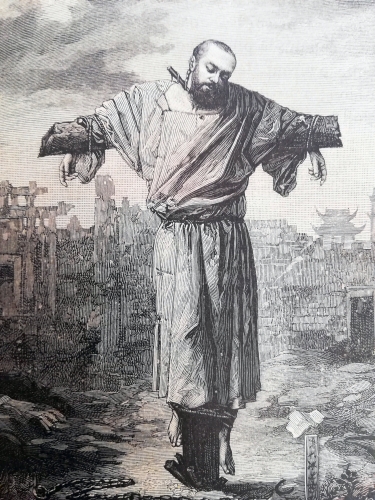
Jean-Gabriel was one of eight children born to Pierre Perboyre and Marie Rigal. At age 16, he followed his brother Louis to the seminary, and joined the Congregation of the Mission of Saint Vincent on Christmas Day 1818. He was ordained in Paris on 23 September 1825. He was a professor of theology, a seminary rector, and an assistant director of novices.

His brother died on a mission to China, and Jean-Gabriel was asked to replace him. In March 1835, he sailed for China, and began his mission in Macao in June, 1836. A widespread persecution of Christians began in 1839, the same year England had attacked China. Father John Gabriel was denounced to the authorities by one of his catachumens, arrested, tried on 16 September 1839. He was tortured by hanging his thumbs and flogging with bamboo rods, and condemned to death on 11 September 1840. He was a martyr and the first saint associated with China.

Born

6 January 1802 at Le Puech, near Mongesty, Cahors diocese, southern France

Died

lashed to a cross on a hill named the “red mountain”, then strangled with a rope on 11 September 1840 at Ou-Tchang-Fou, China

Beatified

10 November 1889 by Pope Leo XIII

Canonized

2 June 1996 by Pope John Paul II

Source: https://dosjfm.com/wp-admin/post.php?post=21333&action=elementor

Saint Jean-Gabriel Perboyre Read More »