Author name: Sani

Pentecost Sunday

First Reading Acts 2:1-11

When the time for Pentecost was fulfilled,
they were all in one place together.
And suddenly there came from the sky
a noise like a strong driving wind,
and it filled the entire house in which they were.
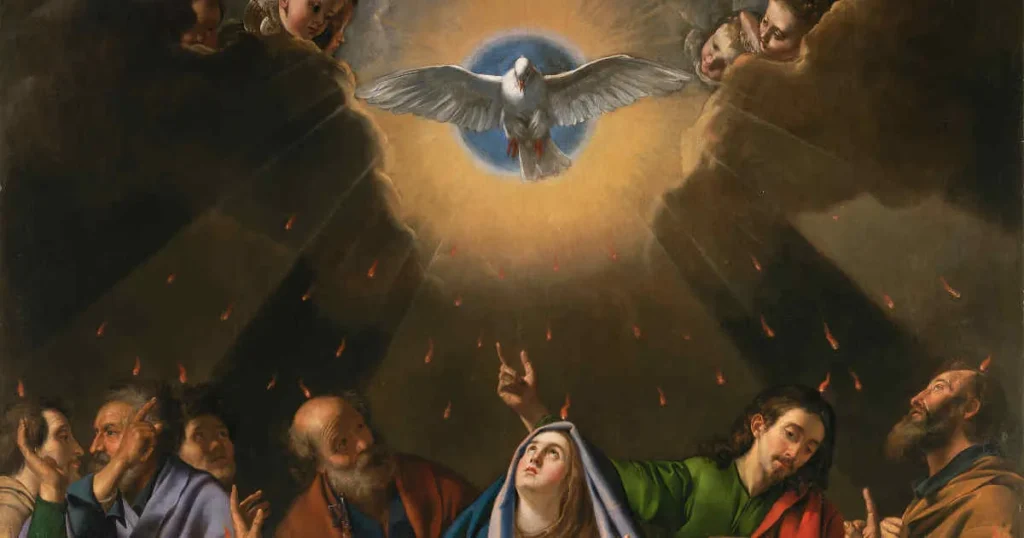
Then there appeared to them tongues as of fire,
which parted and came to rest on each one of them.
And they were all filled with the Holy Spirit
and began to speak in different tongues,
as the Spirit enabled them to proclaim.

Now there were devout Jews from every nation under heaven staying in Jerusalem.
At this sound, they gathered in a large crowd,
but they were confused
because each one heard them speaking in his own language.
They were astounded, and in amazement they asked,
“Are not all these people who are speaking Galileans?
Then how does each of us hear them in his native language?
We are Parthians, Medes, and Elamites,
inhabitants of Mesopotamia, Judea and Cappadocia,
Pontus and Asia, Phrygia and Pamphylia,
Egypt and the districts of Libya near Cyrene,
as well as travelers from Rome,
both Jews and converts to Judaism, Cretans and Arabs,
yet we hear them speaking in our own tongues
of the mighty acts of God.”

Responsorial Psalm Psalms 104:1, 24, 29-30, 31, 34

R. (cf. 30) Lord, send out your Spirit, and renew the face of the earth.

Bless the LORD, O my soul!
O LORD, my God, you are great indeed!
How manifold are your works, O LORD!
the earth is full of your creatures;

R. Lord, send out your Spirit, and renew the face of the earth.

May the glory of the LORD endure forever;
may the LORD be glad in his works!
Pleasing to him be my theme;
I will be glad in the LORD.
R. Lord, send out your Spirit, and renew the face of the earth.

If you take away their breath, they perish
and return to their dust.
When you send forth your spirit, they are created,
and you renew the face of the earth.

R. Lord, send out your Spirit, and renew the face of the earth.

Second Reading 1 Corinthians 12:3b-7, 12-13

Brothers and sisters:
No one can say, “Jesus is Lord,” except by the Holy Spirit.

There are different kinds of spiritual gifts but the same Spirit;
there are different forms of service but the same Lord;
there are different workings but the same God
who produces all of them in everyone.
To each individual the manifestation of the Spirit
is given for some benefit.

As a body is one though it has many parts,
and all the parts of the body, though many, are one body,
so also Christ.
For in one Spirit we were all baptized into one body,
whether Jews or Greeks, slaves or free persons,
and we were all given to drink of one Spirit.

Sequence

Veni, Sancte Spiritus

Come, Holy Spirit, come!
And from your celestial home
Shed a ray of light divine!
Come, Father of the poor!
Come, source of all our store!
Come, within our bosoms shine.
You, of comforters the best;
You, the soul’s most welcome guest;
Sweet refreshment here below;
In our labor, rest most sweet;
Grateful coolness in the heat;
Solace in the midst of woe.
O most blessed Light divine,
Shine within these hearts of yours,
And our inmost being fill!
Where you are not, we have naught,
Nothing good in deed or thought,
Nothing free from taint of ill.
Heal our wounds, our strength renew;
On our dryness pour your dew;
Wash the stains of guilt away:
Bend the stubborn heart and will;
Melt the frozen, warm the chill;
Guide the steps that go astray.
On the faithful, who adore
And confess you, evermore
In your sevenfold gift descend;
Give them virtue’s sure reward;
Give them your salvation, Lord;
Give them joys that never end. Amen.
Alleluia.

Alleluia

R. Alleluia, alleluia.

Come, Holy Spirit, fill the hearts of your faithful
and kindle in them the fire of your love.

R. Alleluia, alleluia.

Gospel John 20:19-23

On the evening of that first day of the week,
when the doors were locked, where the disciples were,
for fear of the Jews,
Jesus came and stood in their midst
and said to them, “Peace be with you.”
When he had said this, he showed them his hands and his side.
The disciples rejoiced when they saw the Lord.
Jesus said to them again, “Peace be with you.
As the Father has sent me, so I send you.”
And when he had said this, he breathed on them and said to them,
“Receive the Holy Spirit.
Whose sins you forgive are forgiven them,
and whose sins you retain are retained.”

Source: https://bible.usccb.org/bible/readings/pentecost-sunday-mass-during-day
Pentecost Sunday Read More »

Pentecost

Today, we celebrate the most glorious Solemnity of Pentecost, the promised Gift of the Father and the Son to Jesus’ disciples. After rising from the dead, Jesus appeared to His disciples for forty days. During those appearances, He offered them proof of His resurrection, continued to teach them, and reminded them of all He had revealed to them about His death and Resurrection, preparing them for the next step of their mission. “While meeting with them, he enjoined them not to depart from Jerusalem, but to wait for ‘the promise of the Father about which you have heard me speak; for John baptized with water, but in a few days you will be baptized with the holy Spirit’” (Acts 1:4–5).

During the ten days after Jesus’ Ascension, the eleven Apostles gathered together in the upper room with the mother of Jesus and many other disciples, totaling 120 in all. The gathering place was most likely the same place that the Apostles ate the Passover meal, the first Eucharist, with Jesus. As they met, the first order of business was to choose a successor to Judas. They cast lots, and Matthias was chosen to be one of the Twelve.

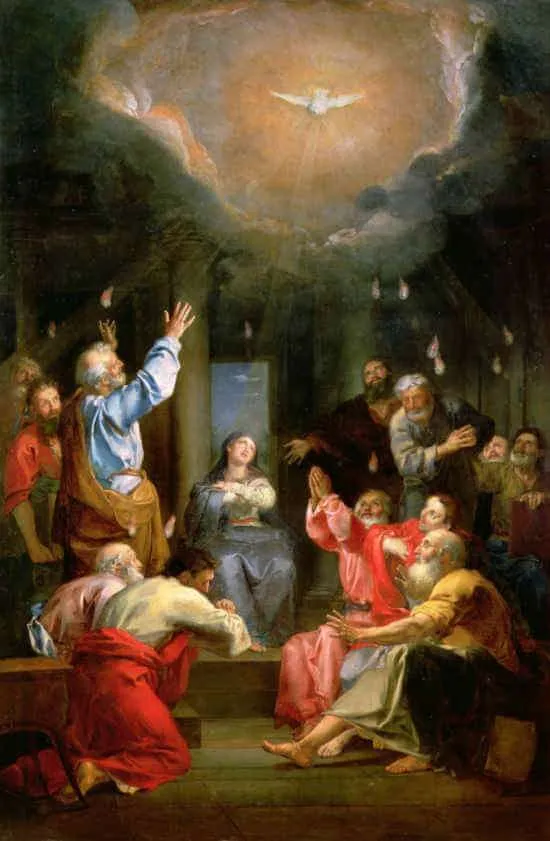
On the fiftieth day after Jesus’ Resurrection, ten days after His Ascension, the 120 disciples were once again gathered in the upper room when they experienced something beyond their imagination. From the sky came a noise like a strong driving wind. It filled the room they were in. Tongues, as of fire, fell upon all gathered, and they were given the gift of tongues, which enabled them to speak in different languages—by the power of the Holy Spirit—to the diverse groups of people in Jerusalem. This is what Jesus had promised them, and suddenly they understood as they received the Gift of God.

After receiving the Holy Spirit, the disciples went out into the community of Jerusalem and began to boldly proclaim the Gospel to all. The inhabitants of Jerusalem were shocked and confused. Some accused the disciples of being drunk and scoffed at them. Some, however, quickly believed. Peter then stood up and gave a stirring and powerful sermon that presented the whole mystery of salvation. He spoke of Jesus as the Savior and the need to repent and be baptized. “Those who accepted his message were baptized, and about three thousand persons were added that day” (Acts 2:41). The new followers then devoted themselves to the teaching of the Apostles and to the celebration of the Eucharist. A strong Christian community was formed in Jerusalem.

As the community continued to grow, learn the teachings of the Apostles, and receive the outpouring of the Holy Spirit, miracles took place. Peter and John cured a blind man. Soon, there were 5,000 converts to Christ who were filled with the Holy Spirit. More miracles took place at the hands of all of the Apostles, people from the surrounding villages came and were converted, and the new believers lived as one, sharing their food and resources with others.

Soon the members of the Sanhedrin became concerned. They thought they had stopped Jesus, but they saw that the Apostles were converting thousands. The Apostles were arrested and jailed, but an angel let them out in the night, and they appeared in the Temple the next day, continuing to preach and heal. The bewildered Sanhedrin members did not know what to do. They hoped that the new excitement would soon subside and everything would go back to normal—but it didn’t.

Recognizing the need to better care for the poor with the money and provisions the thousands of disciples held in common, the Apostles appointed seven men to be deacons for the task, so that the Apostles could continue to preach, heal, and offer the sacraments. Shortly afterward, blood was shed. Stephen, one of the newly ordained deacons, was martyred. “On that day, there broke out a severe persecution of the church in Jerusalem, and all were scattered throughout the countryside of Judea and Samaria, except the apostles” (Acts 8:1).

The above illustrates the role of the Holy Spirit. Pentecost was the birthday of the Church. The Holy Spirit’s mission was to form the Church and empower each baptized member of Christ’s body to fulfill his or her specific duty. Some were to preach, some cared for the poor, some shed their blood for their faith, and others were to be sent to other towns and villages. The scattering of the community of the believers in Jerusalem was clearly permitted by the Holy Spirit as a way of expanding the Church beyond Jerusalem. The newly converted and empowered disciples traveled far and wide to expand the newborn Church that grew at a rapid pace as the new Body of Christ matured and fulfilled its mission.

In the years and centuries ahead, the Holy Spirit continued to form the Church. The Apostles were inspired to write what is today the New Testament so that future believers would have firsthand accounts of the Gospel. From there, the successors to the Apostles, in union with the successor of Saint Peter, helped to form the Sacred Tradition, which is the ongoing deepening revelation of the Word of God to address new questions that arose. Jesus’ promise to Peter and his successors that He would give to him the keys to the Kingdom of Heaven, so that he and his successors could bind and loose on earth as it is in Heaven, evolved and helped the Church to mature. The Holy Spirit enabled the growing communities to continue to take nourishment through the Sacraments. The believers were empowered to pray and to enter into a personal relationship with Him Who rose and is now seated at the right hand of the Father. Other believers were filled with charisms needed to build up the Church. The Gospel continued to be preached to the ends of the earth, and the people of God were drawn into lives of profound holiness and union with God. This is all effected by the Gift of the Holy Spirit first given at Pentecost and continually given today.

In addition to building up the Church and enabling it to fulfill its divine mission, the Holy Spirit also sanctifies every individual believer, especially through the bestowal of the Seven Gifts of the Holy Spirit. According to the Catechism of the Catholic Church, “The seven gifts of the Holy Spirit are wisdom, understanding, counsel, fortitude, knowledge, piety, and fear of the Lord…They complete and perfect the virtues of those who receive them. They make the faithful docile in readily obeying divine inspirations” (#1831). Additionally, the Holy Spirit instills twelve fruits: “The fruits of the Spirit are perfections that the Holy Spirit forms in us as the first fruits of eternal glory. The tradition of the Church lists twelve of them: ‘charity, joy, peace, patience, kindness, goodness, generosity, gentleness, faithfulness, modesty, self-control, chastity’” (#1832). These graces are first given in Baptism and perfected in Confirmation. Each baptized and confirmed member of Christ has the potential to fully realize these graces so as to grow in holiness and fulfill their divine mission.

As we celebrate the great Solemnity of Pentecost, call on the Holy Spirit in your life. Too often we receive Baptism and Confirmation with a closed mind and heart. We fail to allow the Holy Spirit to become fully active in our lives. Pray to the Holy Spirit today, and open yourself more fully to all that God wishes to bestow upon you so that you will become holy and a more active member of His Body, the Church.

Source: https://mycatholic.life/saints/saints-of-the-liturgical-year/pentecost/ 

Pentecost Read More »

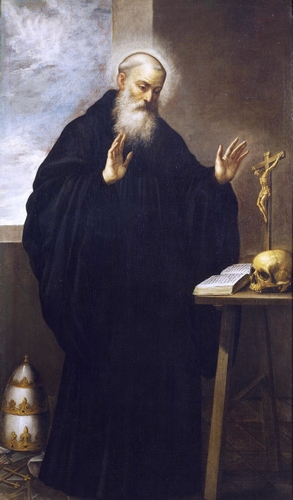
Pope Saint Celestine V

Profile

Peter was eleventh of twelve children. His father died when he was quite young. When his mother would ask, “Which one of you is going to become a saint?” Peter would answer, “Me, Mama! I’ll become a saint!”

At 20, Peter became a hermit, prayed, worked, and read the Bible. He followed the Benedictine Rule, and so many other hermits came to him for guidance, that he founded the Holy Spirit Community of Majella (Celestines).

Following a two year conclave during which the cardinals could not decide on a pope, Peter came to them with the message that God was not pleased with the long delay; the cardinals chose Peter as the 192nd Pope.

The primary objective of Celestine’s pontificate was to reform clergy, many of whom were using spiritual power to obtain wordly power. Celestine sought a way to bring the faithful to the original Gospel spirit, and he settled on “Pardon” – he called for a year of forgiveness of sins, and return to evangelical austerity and fidelity.

He reigned a mere five months, and the members of the Vatican Curia took advantage of him. This led to much mismanagement, and great uproar in the Vatican. Knowing he was responsible, Celestine asked forgiveness for his mistakes, and abdicated on 13 December 1294, the only pope to do so. His successor, Boniface VIII, kept Celestine hidden for the last ten months of his life in a small room in a Roman palace. Celestine may have appreciated it – he never lost his love of the hermit‘s life, and spent his last days in prayer.

Born

  • 1210 at Isneria, Abruzzi, Italy as Pietro del Morrone

Papal Ascension

  • 5 July 1294

Papal Abdication

  • 13 December 1294

Died

  • 19 May 1296 in Rome, Italy of natural causes
  • buried in the church of Saint Agatha, Ferentino, Italy
  • re-interred in the Church of Saint Maria di Collemaggio, Aquila, Italy

Canonized

  • 1313 by Pope Clement V

Patronage

  • bookbinders
  • in Italy
    – Aquila
    – Isernia

Source: https://catholicsaints.info/pope-saint-celestine-v/

Pope Saint Celestine V Read More »

John 20:21-23

Reconciled and Filled with the Holy Spirit

Jesus said to them again, “Peace be with you. As the Father has sent me, so I send you.” And when he had said this, he breathed on them and said to them, “Receive the Holy Spirit. Whose sins you forgive are forgiven them, and whose sins you retain are retained.”

Reflection:

Happy Pentecost! Today, throughout the world, our Church celebrates the full outpouring of the Holy Spirit upon Jesus’ first followers and upon all of us. Why do we need the Holy Spirit in our lives? This is an important question to ponder. Today, as always, the Father, Son and Holy Spirit work as One God. It is the Father Who wills that we be reconciled to Him; it was the Son Who made this reconciliation possible; and it is the Holy Spirit Who now accomplishes the completion of this act in our lives. At the heart of that gift of salvation is the remission of our sins. The passage above clearly reveals to us that Jesus bestowed a unique gift of the Holy Spirit upon the Apostles, His first bishops, entrusting them with the ability to forgive sins in His name and by His power.

As we celebrate Pentecost, it is a good opportunity to prayerfully consider the action of the Holy Spirit in your life. One of the greatest ways that the Holy Spirit is potentially active in your life is through the Sacrament of Reconciliation. Through that Sacrament, the Holy Spirit draws you to the Father and enables you to see and understand His perfect will, living more fully in union with the Son as a member of His Body.

The Seven Gifts of the Holy Spirit are some of the other ways that the Holy Spirit helps us in our Christian walk. However, these gifts would be ineffective in our lives if we did not first receive the gift of forgiveness given through the Sacrament of Reconciliation. That is the first and most foundational action of the Holy Spirit and opens the door to every other gift. Perhaps that is why Jesus’ first bestowal of the Holy Spirit focused upon the power given to His Apostles to forgive sins in His name.

Once we are reconciled to the Father and begin to live in a state of grace, the Holy Spirit will continue to deepen His relationship with us and bestow His help upon us for our Christian journey. This especially happens through the Seven Gifts of the Holy Spirit. The gifts most affecting our intellect are the Gifts of Wisdom, Understanding and Knowledge. Wisdom helps us to understand the inner life of the Trinity more clearly. Understanding helps us to make sense of our lives and mission in the light of the Gospel. Knowledge helps us make practical decisions in accord with God’s will.

The gifts of Fear of the Lord and Piety assist us in our love of God. Fear of the Lord helps us to see how our actions help or hinder our relationship with God, helping to motivate us to avoid all that harms this relationship and choose all that strengthens it. Piety helps us to see the great dignity and beauty of God and enables us to have a deep reverence for Him and for all of His people.

Counsel and Fortitude are also given by the Holy Spirit and help us to firmly move forward in faith and love. Counsel especially helps us with love of neighbor, and Fortitude adds the strength we need to do all that we are called to do in love with unwavering commitment.

As we celebrate the great Solemnity of Pentecost, reflect, today, upon the transforming power of the Holy Spirit. If you want to be open to the full outpouring of the Holy Spirit in your life and receive the many gifts you need for your journey of faith, then begin with the most fundamental gift. Begin with the Sacrament of Reconciliation. Ponder the words Jesus spoke in our Gospel today and know that by entrusting the grace to forgive sins in His name to His first priests, Jesus was also calling you to embrace that gift. The Holy Spirit wants you to be cleansed of all sin. Allow Him to do so and you will be amazed at all the grace that follows.

Source: https://catholic-daily-reflections.com/2024/05/18/reconciled-filled-by-the-holy-spirit/

John 20:21-23 Read More »

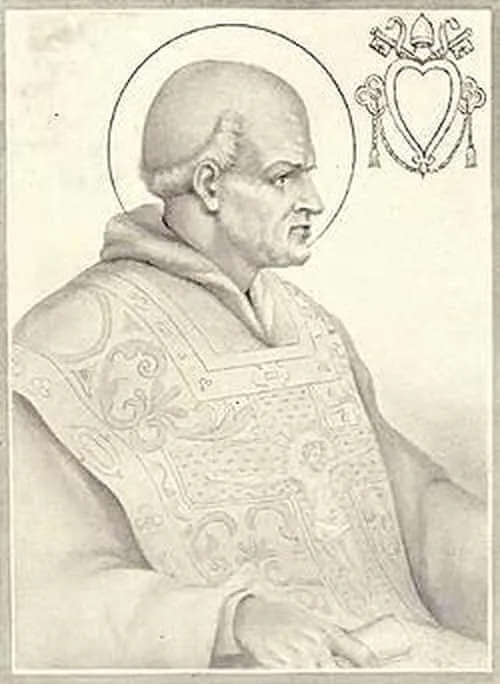
Saint John 1, Pope and Martyr

c. Late Fifth Century–526; Invoked against temptations toward false unity and acceptance of heresy; Pre-Congregation canonization

In 451, the Council of Chalcedon taught that Jesus had both a human and divine nature, and those two natures were united in the one Person of Jesus Christ. This doctrine was established in response to the Arian heresy plaguing the Eastern Roman Empire, which taught that Jesus was created by the Father and, therefore, neither co-equal with Him nor divine. After Chalcedon countered this heresy, the Arian clergy and even the Byzantine emperor tried to move closer to acceptance, but many of them didn’t go all the way. Instead, many former Arians fell into other middle-of-the-road heresies that failed to fully accept the two natures of the Son of God. In 482, Byzantine Emperor Zeno issued a document called the Henotikon. This document attempted to find a middle ground between the official Church teaching on the nature of Christ as defined in the Council of Chalcedon, and the Arian view. Emperor Zeno’s successor, Basiliscus, continued in this error of faith.

In 518, Justin I succeeded Emperor Basiliscus as the Eastern Roman Emperor. Shortly afterward, he accepted the position of the pope and the Council of Chalcedon. In 523, Emperor Justin issued an edict mandating the acceptance of the Council of Chalcedon throughout the Eastern Empire, and demanding that all Arians turn their churches over to Catholics. At that time in the West, Rome was under the control of Theodoric the Great, the king of the Ostrogoths. Theodoric was an Arian, which gave rise to ongoing tensions between him and the pope, as well as all orthodox Catholics. Though Theodoric was mostly accommodating of Chalcedon Christians (including the pope), when the Eastern Roman Emperor Justin I issued his edict in 523 against the Arians, Theodoric was outraged. He threatened that if the edict were not rescinded, he would treat all Chalcedon Catholics in the West in the same way that Arians were being treated in the East, even promising bloodshed.

In that same year, a deacon in Rome, Archdeacon John, was elevated to the papacy, becoming Pope John. Shortly after that, the outraged King Theodoric forced Pope John to travel to Constantinople in an effort to convince Emperor Justin to rescind his edict. Pope John reluctantly went, accompanied by a number of bishops and Roman senators. When Pope John arrived in Constantinople, Emperor Justin warmly welcomed him and the two were clearly of the same mind. It is said that the emperor traveled twelve miles outside of the city gate to meet the pope and when they met, the emperor bowed to the ground in homage. On their way into the city, the pope is said to have cured a blind man. Regarding the matter at hand, Pope John might have encouraged the emperor to treat the Arians gently, but in no way did he carry out King Theodoric’s demand to convince the emperor to rescind his edict. Pope John was unwaveringly Catholic and fully accepted the teachings of the Council of Chalcedon.

When word reached King Theodoric that Pope John did not carry out his order, the king was outraged. First, he imprisoned and later executed one of Pope John’s closest friends, the philosopher Boëtius. Then, when Pope John returned to Italy, King Theodoric immediately had him, the other bishops, and senators arrested and jailed in Ravenna, not permitting Pope John to return to Rome. Since Pope John was already quite frail and in ill-health, he did not survive long in the dungeon. Though he was not directly executed by the king, the Church has nonetheless named Pope Saint John I as a martyr for the faith.

If Pope John would have compromised on the faith of the Church, the king would have been grateful and treated him well. But the pope had a duty to proclaim the one true faith, without regard for his own physical well-being. This is what Pope John did, and that is why he is now a saint in the courts of Heaven.

As we honor this holy martyr, consider any ways that you are tempted to compromise your own faith for the sake of “peace at all costs.” The secular world often tempts us to downplay our faith, especially our moral convictions, for the sake of a false unity. There are many objective evils today that are being promoted by the secular world as good: abortion, confusion about sexual identity, materialism, and atheistic socialism to name a few. Allow Pope Saint John I to inspire you so that you will have courage in the face of such temptations. Commit yourself to the truth so that you will be a purer instrument of the saving truths that will lead those most in need to eternal salvation.

Source: https://mycatholic.life/saints/saints-of-the-liturgical-year/may-18—saint-john-i-pope-and-martyr/

Saint John 1, Pope and Martyr Read More »

John 21:24-25

A Holy Awe

It is this disciple who testifies to these things and has written them, and we know that his testimony is true. There are also many other things that Jesus did, but if these were to be described individually, I do not think the whole world would contain the books that would be written.

Reflection:

As we conclude our Easter season, we are given the conclusion of the Gospel of Saint John to ponder. Recall that John’s Gospel has been a central focus throughout the Easter Season. Therefore, if you have been prayerfully reading the Gospel for Mass each day for the past several weeks, then you have truly immersed yourself in this holy Gospel.

The Gospel of Saint John is much different from the other three Synoptic Gospels. John’s language is mystical and symbolic. John presents the seven miracles as the seven “signs” that reveal Jesus’ divinity. Jesus is identified as I AM, the Son of the Father, the Vine, the Bread of Life, the Light of the World, the Eternal Word, and more. John points to the Crucifixion as Jesus’ hour of glory in which He takes up His throne of the Cross for the salvation of the world. And John’s teaching on the Eucharist is truly profound.

John states that the reason he wrote his Gospel was so “that you may come to believe that Jesus is the Messiah, the Son of God, and that through this belief you may have life in his name” (John 20:31). John clearly loved our Lord and understood Him, not only by personal experiences while Jesus was alive on earth but also through a profound level of prayer in his later years. And this depth of understanding and mystical knowledge is communicated in such a way that the reader is easily drawn into John’s prayerful understanding.

As John concludes His testimony about Jesus, he states something worth pondering. He states that Jesus did so many things that were not recorded by him or others, that if they were all written down, the whole world would not contain the books that would be written. First of all, everything that was written down could be the source of prayerful study for a lifetime. John’s Gospel alone could never be exhausted of its meaning. But then consider this final line of John’s Gospel and try to take it as a literal statement for a moment. If that statement were literally true, that the whole world could not contain the books that would record all that Jesus did, then this fact should leave us with a holy awe. In fact, the reason this must be true is because what Jesus did within each and every mind and heart He touched is truly indescribable. Volumes upon volumes could not thoroughly describe it. His divine action of saving souls, rescuing people from sin and death, and pointing them to eternal life is more than our feeble minds can fully comprehend. 

Reflect, today, upon the holy Gospel of Saint John. As we do conclude this Easter Season and our reading of John’s Gospel, allow yourself to sit in awe of the infinite activity of our divine Lord in the lives of those who have turned to Him. Consider every movement of grace in their lives that has been accomplished with such care and love by our Lord. Reflect upon the fact that for eternity you will be contemplating the Eternal Word made Flesh, the Messiah, the Great I AM, the Son of the Father and every other name given to Him Who is our God and King. Saint John loved our Lord and understood Him deeply because he spent his life prayerfully pondering all that Jesus did. Continue to commit yourself to this holy pondering so that you will be drawn more deeply into this contemplation with holy awe.

Source: https://catholic-daily-reflections.com/2024/05/17/a-holy-awe-3/

John 21:24-25 Read More »

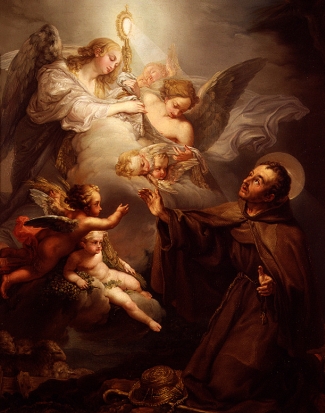
Saint Pascal Baylon

Profile

Pascal was the son of the pious peasants Martin Baylon and Elizabeth Jubera. From youth, he displayed great devotion to the Eucharist. He worked as a shepherd from ages 7 to 24, and was a good influence on his shepherd friends, an often rowdy group. He was a Franciscan lay brother with friars of the Alcantarine Reform, often serving as cook or doorkeeper. His charity to the poor and afflicted, his unfailing courtesy and humility, were remarkable even by Franciscan standards. While travelling in France, he defended the Real Presence against the blasphemies of a Calvinist preacher, and narrowly escaped death at the hands of a Huguenot mob. Poorly educated, he was still a counselor sought by rich and poor alike. His cultus is especially strong in Spain and southern Italy, in Central and South America.

Born

  • 24 May 1540 (feast of Pentecost) at Torre Hermosa, Aragon, (modern Spain)

Died

  • 15 May 1592 (feast of Pentecost) at Villa Reale, Spain of natural causes

Beatified

  • 29 October 1618 by Pope Paul V

Canonized

  • 16 October 1690 by Pope Alexander VIII

Patronage

  • cooks
  • Eucharistic congresses, confraternities and organizations (proclaimed by Pope Leo XIII on 28 November 1897)
  • shepherds
  • Bisenti, Italy
  • Castelnuovo, Assisi, Italy
  • Montebello, Orciano di Pesaro, Italy
  • Obado, Bulacan, Philippines
  • Segorbe-Castellón de la Plana, Spain, diocese of

Representation

  • man in adoration before a vision of the Host

Source: https://catholicsaints.info/saint-pascal-baylon/

Saint Pascal Baylon Read More »

John 21:18-19

True Love

“Amen, amen, I say to you, when you were younger, you used to dress yourself and go where you wanted; but when you grow old, you will stretch out your hands, and someone else will dress you and lead you where you do not want to go.” He said this signifying by what kind of death he would glorify God. And when he had said this, he said to him, “Follow me.”

Reflection:

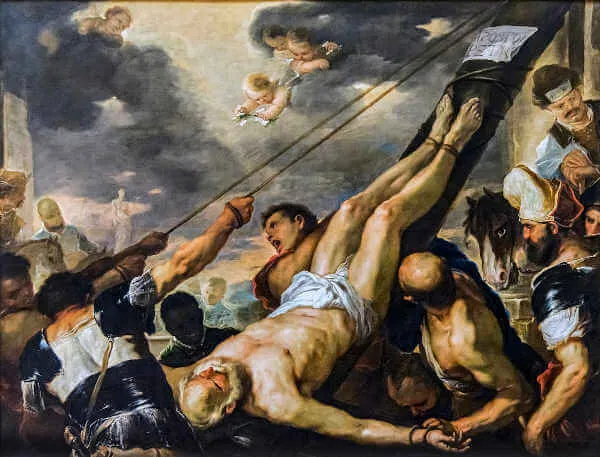
On this, the third time that Jesus appeared to His disciples, Jesus enters into a threefold discourse with Peter. Each time that Jesus asks Peter if he loves Him, Peter responds that he does. And Jesus responds back each time, “Feed my lambs,” “Tend my sheep,” and “Feed my sheep.” The passage quoted above concludes Jesus’ discourse with Peter using very powerful language. Jesus tells Peter that when he grows old, “someone else will dress you and lead you where you do not want to go.” This was Jesus’ way of saying to Peter that he would ultimately express his love of Jesus by dying for Him. As we know, tradition states that Peter was ultimately crucified. And at Peter’s request, he was crucified upside down because he felt unworthy of dying in the exact same way Jesus died.

As we consider this conversation between Jesus and Peter, it is clear that Jesus’ understanding of love is very different from the way many others understand it today. Jesus was not only telling Peter that he would die for Jesus, but Jesus was clearly offering His approval of this act of love Peter would one day offer. Most often when we love someone, we would do all we can to keep them from any such fate. In fact, when a loved one suffers, we often will do all we can to look for a way to relieve them of that suffering. So which approach is most loving?

Clearly, Jesus sees suffering differently than most of us. For Jesus, suffering is not opposed to love when the suffering is freely embraced for a higher purpose. Suffering in and of itself is of no value. But when suffering is embraced sacrificially out of love for another, it is able to take on tremendous power. And when Jesus offered His clear support to Peter who would one day die out of love for Jesus, Jesus was focusing upon the eternal merit that would be won by Peter’s cross. The fact that Jesus did not shy away from Peter’s future sacrificial suffering is one of the clearest signs of Jesus’ more perfect love for Peter.

Reflect, today, upon your attitude toward the sufferings that your loved ones endure. Do you find that your primary goal is to rid them of their sufferings? Or do you understand that even their sufferings have the potential to become a source of their own holiness and the source of grace for others? Strive to see suffering as Jesus sees it. Look at the sacrificial love that is made possible when your loved ones unite their sufferings to the Cross of Christ and try to commit yourself to the mission of helping them embrace that sacred gift of love.

Source: https://catholic-daily-reflections.com/2024/05/16/true-love-3/

John 21:18-19 Read More »

Saint Simon Stock

Profile

Little is known of his early life. Legend says that at age twelve, Simon began to live as a hermit in a hollow oak tree; the name Stock is believed derived from the old English for tree trunk. He was an itinerant preacher. He was a pilgrim to the Holy Lands, but left when invading Muslims chased out Christians. He joined the Carmelite Order soon after its arrival in England.

Simon lived and studied for several years in Rome, Italy and Mount Carmel. He was elected sixth general of the Carmelites in 1247 around age 82. He helped the Order spread through England, southern and western Europe. He founded houses in Cambridge, England in 1248, Oxford in 1253, Paris, France in 1260, and Bologna, Italy in 1260. He revised the Rule of the Order to make them mendicant friars instead of hermits.

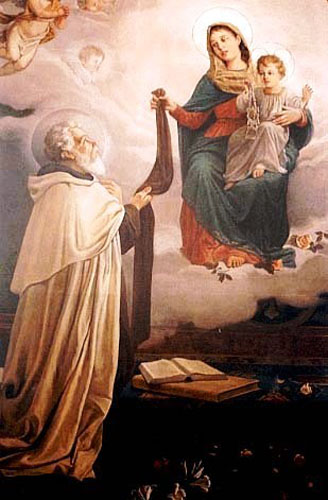
Regardless of these successes, the Order was oppressed on all sides, including by the clergy and other orders. The friars took their woes to their patroness, the Virgin Mary. Tradition says that in answer, she appeared to Simon bringing him the brown Scapular of Mount Carmel. “This shall be the privilege for you and for all the Carmelites,” she told him, “that anyone dying in this habit shall be saved.” On 13 January 1252, the Order received a letter of protection from Pope Innocent IV, protecting them from harassment.

Born

  • c.1165 in Aylesford, County Kent, England

Died

  • 16 May 1265 in the Carmelite monastery at Bordeaux, France of natural causes while on a visit
  • skull transferred to the Carmelite friary in Aylesford, England in 1951

Canonized

  • never formally canonized
  • venerated by the Carmelites since at least 1564
  • the Vatican has approved Carmelite celebration of his feast

Patronage

  • Aylesfort, England
  • Bordeaux, France

Representation

  • Carmelite friar holding a scapular
  • Carmelite friar receiving the scapular from the Blessed Virgin
  • Carmelite friar surrounded by and praying for souls in purgatory
  • elderly man in a Carmelite habit in prayer

Source: https://catholicsaints.info/saint-simon-stock/

Saint Simon Stock Read More »

John 17:20-21

Gestures of Love

“Lifting up his eyes to heaven, Jesus prayed saying: ‘I pray not only for these, but also for those who will believe in me through their word, so that they may all be one, as you, Father, are in me and I in you, that they also may be in us, that the world may believe that you sent me.’”

Reflection:

Over the past couple of weeks, we have been continually reading from Chapter 14–17 of John’s Gospel. These chapters contain Jesus’ Last Supper Discourses and provide us with Jesus’ last sermon, so to speak. Chapter 17, which we have been reading this past week, presents us with Jesus’ final prayer for His disciples and for all of us “who will believe” in Him through the preaching of the disciples. Each time we read from Chapter 17, the Lectionary begins the reading with the phrase “Lifting up his eyes to heaven, Jesus prayed saying…” That line is an adaptation of Chapter 17:1 but is used to introduce the various parts of the prayer of Jesus each time it is read at Mass.

It’s interesting that Jesus would look up to Heaven when He prayed. Of course, Heaven is not physically in the sky, because Heaven is a spiritual reality. The Father is not located in some place in the sky but is omnipresent, meaning, present all places and all times. And yet, Jesus raises His eyes upward when He prays to the Father. There is a great lesson in this.

Our physical disposition is important, at times. For example, when someone we owe respect to enters a room, we usually rise and greet them. It would be disrespectful to remain lounging on a bed or sofa in that case. And at Mass, we do not sit back with legs crossed during the Consecration; rather, we kneel in adoration. And when we greet someone for the first time, we do not look at the floor; rather, we look them in the eyes.

Jesus’ act of “Lifting his eyes to heaven” was not done because He thought He might see the Father in the sky; rather, it was done out of respect and love and as a way of acknowledging the dignity of the Father. This should teach us about our own bodily disposition and the message we communicate to others, especially to God in prayer.

When you pray, what do you do? Though you can pray at any time and while in any disposition, it is an excellent practice to speak to God not only by your words but also by the disposition you take. Kneeling, raising hands in prayer, falling prostrate before your Lord, sitting upright with attentiveness, etc., are all ways in which you communicate to God your love.

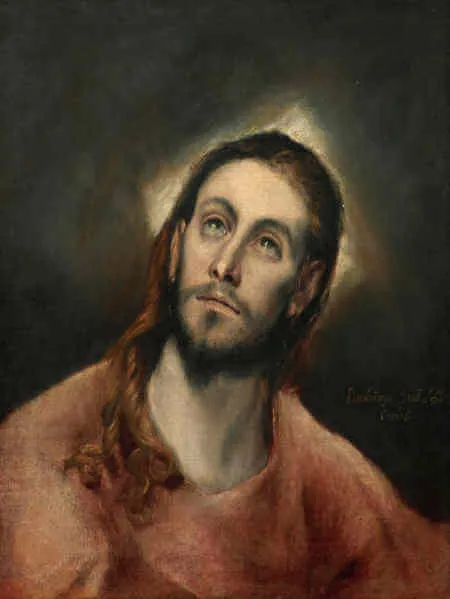
Reflect, today, upon this image of Jesus praying. Gaze at how attentive He would have been as He lifted His sacred eyes upward as a physical gesture honoring the glorious, all-powerful Father in Heaven. Try to imagine Jesus’ devotion, intensity, respect and burning love. Imitate this holy gesture of prayer and attentiveness to the Father and remind yourself of the importance of expressing your love in bodily form.

Source: https://catholic-daily-reflections.com/2024/05/15/gestures-of-love-3/

John 17:20-21 Read More »